As a member of Gen-X who first arrived in NJ in the fall of 1989 to attend college, I heard my classmates tell tales of "Traction Park". It seemed almost unbelievable to me: an amusement park so inherently dangerous that most people talked about the injuries they or someone they knew sustained at this place. How could this place have existed? Naturally, I perked up when I heard about this book as well as several recent documentaries. I didn't realize this book was authored by one of the owner's sons. While this offers a unique inside-look at the park operations, I also wonder if the narrator is unreliable.
The book did answer my primary question about how could a place like this exist. The answer: money, privilege, and a complete disregard for the law. The owner made enough money on stock trades to invest in real estate in a rural area of NJ, include a ski resort, and hit upon the idea of building a summer attraction to keep the money rolling in during the warmer months. This grew into the Action Park of legend.
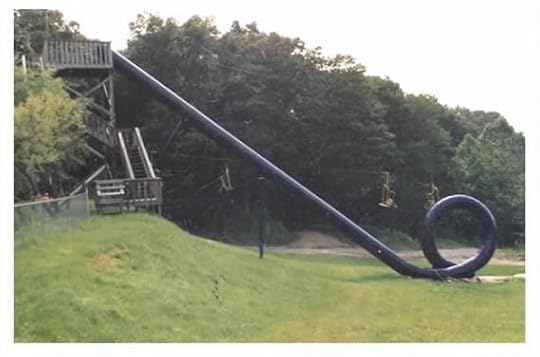
Why was it so dangerous? The owner had no concept of safe ride design. The infamous Cannonball Loop is the pinnacle of this: a ride so unsafe that it decapitated the test dummy, caused serious injuries to most of the few human test subjects, and only operated for part of a summer after minor "safety" measures were implemented, including a hatch to rescue trapped patrons. Worse, the owner thought that unsafe conditions were the point in some misguided notion that people should be in charge of their own destiny. People nearly drowning in the wave pool every day, in conditions so crowded the lifeguards could barely keep watch over everyone, in water so murky that the guards couldn't see people who went under? Don't even think about restricting access points, allowing the water to clear after rain, reducing the depth, or limiting the number of people. He even put his teenage son in charge of the lifeguards. It's remarkable that they only had 3 drownings in that death trap.
That leads to another factor in the danger: the place was run by teens. Sure, there were some adults on hand to do ride construction or maintenance work. But the staff was pretty much all kids, many drunk or barely paying attention. Even when they tried, they could do nothing to stop the patrons from taking unnecessary risks.
Speaking of drunks, the place also served alcohol. Mixing alcohol and inherently dangerous water rides seems crazy now.
How did this place come to be, and how did it continue to operate? The owner criminally broke the law. The author tries to spin this, but the fact remains that his dad scammed several state agencies and local government. In one case, he had an employee pretend to be a NJDOT employee to assure a town representative that the trolly installed to cross Rt. 94 was permitted. In another, the park failed to secure an American Gladiators license but proceeded to install an American Gladiators attraction that was a complete copy of the original, not even bothering to change the name of the attraction. In the most egregious case, his dad failed to carry insurance and went so far as to invent a sham insurance company. This came back to bite him, and his dad was almost, almost held criminally responsible. But as is too often the case: people with wealth and connections do not face the same legal system as the rest of us. He came out of that case with a slap on the wrist and somehow even got to purchase state parkland he had been leasing at a bargain price. Rich people problems.
The author seems completely oblivious to this. He and his siblings all attended elite universities, and he even had the gall to call his college friends pampered elites, as if he wasn't in that same category simply because he had to work at the park. He seems oblivious to the fact that he was put in charge of major park operations despite his youth and inexperience simply because he was the son of the owner, yet maintains that he's not like his spoiled rich buddies. Yeah, ok. I pretty much lost all sympathy for him as the story delved into his life as a drunken college frat boy who could jet off to some Greek Island (because, if you can believe it, it was cheap) to drink himself blackout drunk and fail to remember his first meeting of the woman who would eventually become his wife. At one point, he wakes up from a drunken bender and decides it's time to grow up. I believe he was already out of the college at the time. I don't ever remember needing to make a decision to become an adult.
Back to the insurance fraud. The owner thought self-insurance would save money in the long run. The park failed to accurately report injuries, and the author claimed that Disney parks have the same injury rate but also underreport injuries. He has no evidence to back this up, other that the unfailing knowledge that this is simply what rich corporations do, since that's what his rich father did. Instead of insurance, his father employed an aggressive lawyer who had some very effective methods to ensure that guests injured at the park would lose or give up on their personal injury court cases.
Ultimately, insurance is what did the original park in. After being caught and nearly jailed for his sham insurance company, the owner agreed to carry real insurance. But, no surprise, somewhere along the way he ended up woefully underinsured and lost a couple of court cases. The FBI actually raided the park several times to seize admissions sales to pay for those personal injury awards. This is also a lesson that the wealthy can hide their assets. His father was invested in many other businesses, including real estate deals worth over $10 million, yet he couldn't pay the $1 to $2 million in personal injury awards. The park declared bankruptcy yet the family still enjoys a life of wealth and privilege. They even bought the park back after a period of years.
I'm pretty sure the author wants his readers to think that his father was just a libertarian visionary, and that the much maligned state agencies were all that stood in his way. But I'm currently employed by one of the state agencies his father defrauded, so I wasn't buying his bs.
Still, it was an enjoyable read, even if my takeaway was pretty much the opposite of what the author intended.