

What do you think?
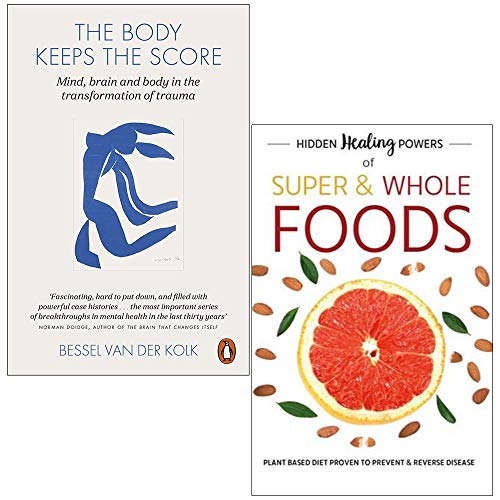
The Body Keeps the Score: Mind, Brain and Body in Transformation of Trauma / Hidden Healing Powers Of Super & Whole Foods: Plant Based Diet Proven To Prevent & Reverse Disease
Please Note That The Following Individual Books As Per Original ISBN and Cover Image In this Listing shall be Dispatched Collectively:
The Body Keeps The Score: Mind, Brain And Body In Transformation Of Trauma & Hidden Healing Powers Of Super &Whole Foods:Plant Based Diet Proven To Prevent & Reverse Disease 2 Books Collection Set:
The Body Keeps the Score:
The effects of trauma can be devastating for sufferers, their families and future generations. Here one of the world's experts on traumatic stress offers a bold new paradigm for treatment, moving away from standard talking and drug therapies and towards an alternative approach that heals mind, brain and body.
Hidden Healing Powers Of Super & Whole Foods:
To Prevent & Reverse Disease The human body, by design, is built to survive It knows to regenerate cells, to remove toxins and with its inbuilt immune system, to fight disease and illness.While the advance of medical science continues to grow, no medical practitioner or scientist will ever disagree that preventative medicine should always be the first step to a healthier life. Unfortunately we all too often overlook the natural ways in which we can feed our bodies with healing properties.
The Body Keeps The Score: Mind, Brain And Body In Transformation Of Trauma & Hidden Healing Powers Of Super &Whole Foods:Plant Based Diet Proven To Prevent & Reverse Disease 2 Books Collection Set:
The Body Keeps the Score:
The effects of trauma can be devastating for sufferers, their families and future generations. Here one of the world's experts on traumatic stress offers a bold new paradigm for treatment, moving away from standard talking and drug therapies and towards an alternative approach that heals mind, brain and body.
Hidden Healing Powers Of Super & Whole Foods:
To Prevent & Reverse Disease The human body, by design, is built to survive It knows to regenerate cells, to remove toxins and with its inbuilt immune system, to fight disease and illness.While the advance of medical science continues to grow, no medical practitioner or scientist will ever disagree that preventative medicine should always be the first step to a healthier life. Unfortunately we all too often overlook the natural ways in which we can feed our bodies with healing properties.
Paperback
About the author
Bessel van der Kolk
39 books3,198 followersBessel van der Kolk MD spends his career studying how children and adults adapt to traumatic experiences, and has translated emerging findings from neuroscience and attachment research to develop and study a range of treatments for traumatic stress in children and adults.
In 1984, he set up one of the first clinical/research centers in the US dedicated to study and treatment of traumatic stress in civilian populations, which has trained numerous researchers and clinicians specializing in the study and treatment of traumatic stress, and which has been continually funded to research the impact of traumatic stress and effective treatment interventions. He did the first studies on the effects of SSRIs on PTSD; was a member of the first neuroimaging team to investigate how trauma changes brain processes, and did the first research linking BPD and deliberate self-injury to trauma and neglect in early childhood.
In 1984, he set up one of the first clinical/research centers in the US dedicated to study and treatment of traumatic stress in civilian populations, which has trained numerous researchers and clinicians specializing in the study and treatment of traumatic stress, and which has been continually funded to research the impact of traumatic stress and effective treatment interventions. He did the first studies on the effects of SSRIs on PTSD; was a member of the first neuroimaging team to investigate how trauma changes brain processes, and did the first research linking BPD and deliberate self-injury to trauma and neglect in early childhood.
Ratings & Reviews
Friends & Following
Create a free account to discover what your friends think of this book!
Community Reviews
Displaying 1 - 3 of 3 reviews

August 24, 2026
I was given this book at a pivotal moment — right in the middle of doing deep internal work on myself, long before I ever imagined I'd become a trauma therapist. Looking back, I can say without exaggeration that this book helped pave the way for the entire path I eventually walked into professionally.
Van der Kolk's central argument — that trauma isn't just a psychological event but something the body itself carries, stores, and reenacts — was genuinely revelatory to me at the time. I had spent years trying to think my way through my own history, treating it as something to analyse and understand intellectually. This book was the first thing that helped me understand why that approach only ever got me so far. Trauma lives in the nervous system, in posture, in the way we breathe and flinch and freeze, and no amount of insight alone can override that. That reframe changed how I related to my own healing completely.
What I found so powerful was how van der Kolk moves between rigorous science and genuine compassion. He doesn't just explain the neurobiology of trauma; he explains it in a way that makes you feel less broken and more understood. Reading about how the body responds to threat, how memory and safety and attachment are all wrapped up together, gave language to things I had felt for years but never had words for.
Coming back to this book now, years into doing this work with others, I can see so clearly how much of my own practice was shaped by what I first encountered here. It didn't just help me understand my own trauma — it gave me a framework I still draw on when I sit with clients today. This is one of those rare books that manages to be both a personal turning point and a genuine clinical education, and I don't think I'd be doing the work I do now without it.
Van der Kolk's central argument — that trauma isn't just a psychological event but something the body itself carries, stores, and reenacts — was genuinely revelatory to me at the time. I had spent years trying to think my way through my own history, treating it as something to analyse and understand intellectually. This book was the first thing that helped me understand why that approach only ever got me so far. Trauma lives in the nervous system, in posture, in the way we breathe and flinch and freeze, and no amount of insight alone can override that. That reframe changed how I related to my own healing completely.
What I found so powerful was how van der Kolk moves between rigorous science and genuine compassion. He doesn't just explain the neurobiology of trauma; he explains it in a way that makes you feel less broken and more understood. Reading about how the body responds to threat, how memory and safety and attachment are all wrapped up together, gave language to things I had felt for years but never had words for.
Coming back to this book now, years into doing this work with others, I can see so clearly how much of my own practice was shaped by what I first encountered here. It didn't just help me understand my own trauma — it gave me a framework I still draw on when I sit with clients today. This is one of those rare books that manages to be both a personal turning point and a genuine clinical education, and I don't think I'd be doing the work I do now without it.
September 7, 2023
As someone who has danced stopped danced stopped having a knowledge within my muscles that allows me to begin again dance exploration is often non verbal and difficult to explain to others. My fwlt memory has a history and a memory. This corporeality, body-memory knowledge opened me to empathetically rethinking trauma and how diverse the experience and presentation of trauma. Resilience I have learned is neurobiological and building resilience isn't easy, especially in families who have experienced the unimaginable cult or ritual abuse, war, and repeated coercive control tactics to remove their integrity and deny their right to feel. The right to have rights, our vulnerability, extends to the right to heal and feel. Van der Kolk has understood the creative ways we can heal as well as the creative ways the body remembers trauma. I have heard ex dancers speak of their muscles weeping during loss and grief. It sounds poetic but for them it was felt, real and very present as part of their experience. I recommend this book to those interested in supporting trauma and seeking support, not simply counsellors and social workers and also teachers and educators who work in trauma settings like primary schools, high schools and families in need of interaction and social support after a traumatuc event. Thank you for an approachable read with real cases that evidence successes and bring hope.

Currently Reading
March 23, 2023Reading Audiobook
Quotes notebook
"Traumatic experiences do leave traces, whether on a large scale (on our histories and cultures) or close to home, on our families, with dark secrets being imperceptibly passed down through generations. They also leave traces on our minds and emotions, on our capacity for joy and intimacy, and even on our biology and immune systems."
Quotes notebook
"Traumatic experiences do leave traces, whether on a large scale (on our histories and cultures) or close to home, on our families, with dark secrets being imperceptibly passed down through generations. They also leave traces on our minds and emotions, on our capacity for joy and intimacy, and even on our biology and immune systems."
Displaying 1 - 3 of 3 reviews