Mentre lo scintillio degli anni Venti cede il posto alla Grande Depressione, Mary e Rose sono ormai due pianiste famose. Girano l’America soggiornando negli alberghi più esclusivi e vengono accolte come star alle feste d’élite, dove lo champagne scorre a fiumi e gli invitati sono ricchi, affascinanti e privilegiati. Di pari passo al lusso e al successo, si trovano però ad affrontare una società crudele e la volgarità di chi si finge amante della musica senza realmente comprenderla. Ma soprattutto le due gemelle non riescono a colmare il divario tra presente e passato e a intessere nuove relazioni; prostrate dal dolore per la scomparsa della cara madre e dell’adorato fratello, subiranno anche l’allontanamento dell’unica persona che sarebbe in grado di dare valore alle loro esistenze: l’affascinante cugina Rosamund, che ha inspiegabilmente sposato un uomo avido e volgare, la quale abbandona il suo lavoro per viaggiare all’estero con lui. In questo faticoso percorso di maturazione emotiva e artistica, le due donne si aggrapperanno sempre di più l’una all’altra e troveranno rifugio e ristoro nell’affettuosa e pacata umanità degli avventori del Dog and Duck – il pub sul Tamigi –, che ai loro occhi paiono trasformarsi quasi in figure mitologiche. Eppure, mentre il loro senso di inadeguatezza nei confronti della realtà continua a crescere, e Mary si ritira sempre di più a vita privata, c’è una sorpresa che attende Rose: la più deliziosa delle scoperte, l’amore, con tutta la potenza di una sensualità ancora da esplorare. Da una delle più raffinate maestre di stile del Novecento inglese, il terzo e ultimo capitolo della trilogia della famiglia Aubrey che ha scalato le classifiche conquistando i lettori con la grazia e la vividezza della sua prosa.
Cicely Isabel Fairfield, known by her pen name Rebecca West, or Dame Rebecca West, DBE was an English author, journalist, literary critic, and travel writer. She was brought up in Edinburgh, Scotland, where she attended George Watson's Ladies College.
A prolific, protean author who wrote in many genres, West was committed to feminist and liberal principles and was one of the foremost public intellectuals of the twentieth century. She reviewed books for The Times, the New York Herald Tribune, the Sunday Telegraph, and the New Republic, and she was a correspondent for The Bookman. Her major works include Black Lamb and Grey Falcon (1941), on the history and culture of Yugoslavia; A Train of Powder (1955), her coverage of the Nuremberg trials, published originally in The New Yorker; The Meaning of Treason, later The New Meaning of Treason, a study of World War II and Communist traitors; The Return of the Soldier, a modernist World War I novel; and the "Aubrey trilogy" of autobiographical novels, The Fountain Overflows, This Real Night, and Cousin Rosamund. Time called her "indisputably the world's number one woman writer" in 1947. She was made CBE in 1949, and DBE in 1959, in recognition of her outstanding contributions to British letters.
Cousin Rosamund’ is the final, incomplete book of a series that was to tell the story of a century through the story of the lives of the Aubrey family and their circle.
The first book, 'The Fountain Overflows' was published in 1956; the second book, 'This Real Night' was published in 1984, a year after the author’s death; and then this book was published, with notes suggesting what might have followed.
This book, reckoned to be two-thirds complete by Victoria Glendinning, who wrote the afterword, is less polished than the books came before, and it doesn't stand up well as a book on its own, but I was drawn in by a wonderfully familiar narrative voice and I was intrigued by the way that the story evolved.
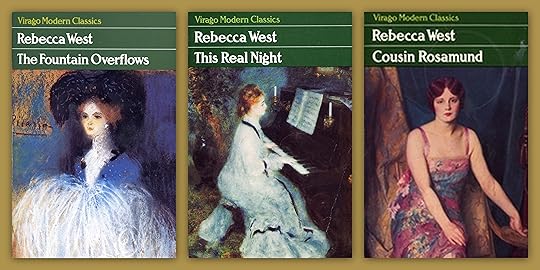
It has moved into a new milieu and a new age, and the covers of the Virago Modern Classics editions of these books reflect the way that this story of a century has developed and changed rather well.
Twin sisters Rose - who tells the story - and Mary have successful careers as concert pianists, but they are struggling to come to terms with the loss of their mother and of their much loved younger brother, Richard Quin.
They have the support of family friends.
Mr Morpugo, who had employed their father and had always been happier with their family than with his own, had helped them to let the family home and found them a lovely new home in St John's Wood. They recognised that it was the right thing to do, but they vowed to make it as much like south London as they could. Bringing Kate, their much loved family retainer with them, helped a great deal.
Their much-loved cousin Rosamund had achieved her long-held ambition to become a nurse and is sharing a flat with her mother a few miles away. Rose and Mary were sorry not to have Rosamund with them, but they understood that she had to live close to her work, and they appreciated that she wanted to support her mother, who had not had the easiest life.
The Dog and Duck, on the banks of the river Thames, run by old family friends, continued to be a refuge. It showed them a world utterly different from the artistic and domestic worlds they knew, and they had always loved it.
They weren't just coping with grief; they were coping with their careers not being what they hoped they would be. They loved the playing, they loved the luxuries that success brought them, but they hated the vulgar, social world that they had to move through and they were bitterly disappointed that so few of the people that they met had a real love and understanding of music
The love of their oldest friends sustained Rose and Mary, but they seemed unable to move forward from that, and to form new, adult relationships.
This book follows their painful journey towards emotional and artistic maturity.
They lose their cousin Rosamund, who makes an inexplicable marriage to a man they consider quite beyond the pale, and abandons her career and her mother to travel abroad with him.
They are to some degree reconciled with their elder sister Cordelia, who, after being forced to face the fact that she lacked the emotional understanding of music needed to make it a career, had found happiness as the wife of a successful man.
Many of the things that Rebecca West did so well in the books that came before this one are present again. Her prose is rich and vivid, full of sentences and expressions to treasure. She presents extended scenes and long conversations so very well. Her understanding of her characters emotions and situations is so very good, and I couldn't doubt for a moment that she was writing about a world and about people that were utterly real and alive for her.
There are weaknesses though. Rosamund's marriage was as inexplicable to me as it was to Rose and Mary. The return of Miss Beaver, Cordelia's old music teacher, seemed driven by a wish for all of the past cast to make a reappearance rather than because the story needed her. Though there seemed to be no concern for Rosamund's mother after her daughter's departure.
And - though I'm not sure if this is a weakness or just a difference - Claire - the girls' mother - and Richard Quin brought a warmth that I missed in this book. Of course this book had to be different, it explores bereavement and grief, but it is not as easy to love as the books that came before.
In the end - after a crisis - Rose choses to move forward and allows herself to love, while Mary choses to retreat from the world. That made wonderful sense after the time I have spent with them, and thinking about how they were alike and how they were different
Rose's story was so beautifully executed, and I wished I could have followed it for a little longer.
'He came towards me and I became rigid with disgust, it seemed certain that I must die when he touched me, but instead, of course, I lived.'
Mary's story was much less complete, but it was easy to see where it was going.
The book as a whole needs editing, but just for a little more clarity; the quality of the writing is still there and it is only when it ends that the story feels incomplete.
The afterword includes the author's notes about the previous volumes, and I loved the insight into the authors themes, ideas and plans that they gave me. It also contains note for a fourth volume that she would never write. Her plan was ambitious, I'm not convinced that she would have pulled them off, but I do wish that she had written that book.
There have been diminishing returns with this series of books, but the staring point was high and the downward slope has been gentle.
I have loved following the story of the Aubrey family, and I will miss them now I have reached the end.
A disappointment, but still interesting because of the information the novel provides on the evolution of the characters that populated The Fountain Overflows. The book was never really finished by its author but there is a useful afterword by Victoria Glendinning that helps to make sense of certain events and to fill the holes in the story. Perhaps the afterword should be read as an introduction. I still plan to read the missing 2nd volume, This Real Night of the Aubrey Trilogy which should contain keys for the present storylines.
Finally, the title may seem misleading since only a few pages are spent on cousin Rosamund. The afterword provides some information that confirms my suspicions that Rosamund is an eternalist.
This is not a great sequel. Since so many of the main characters from The Fountain Overflows and This Real Night are dead or MIA before this book begins, we have to rely on a mix of new faces and characters who took minor roles in the previous books. None of them can really hold a candle to Mama, Papa, or Richard Quin. Also, most of the conflict from the first two books has been resolved. Cordelia is married and out of trouble, but her transformation is not complete enough that we can trust her with anything. Rose and Mary are now successful pianists, and their interactions with high society are not nearly as compelling as their childhood struggle for survival. Nancy returns, but her destiny of outstanding ordinariness (narrator's words, not mine) doesn't quite do it for me. Most of all, the writing that made the previous books so enjoyable and makes English rival any other language in beautiful prose is here unpolished and wordy to the point that many passages are downright difficult to understand. It's a good argument against post-humous publishing.
There are some good points- I found the critical perspective of 1920s fashion novel and fun (flapper dresses are saggy, unflattering, and fit only for the beach), and although Rosamund leaves us hanging big-time, the ending for Rose and Mary is reasonably satisfying. Finally, though I can't in good faith recommend reading this book, through my disappointment and frustration I was still totally engrossed, to the point that I looked up and realized that my 2 hour layover and 4 hour flight had passed in a blink.
You know when you're on a bike at speed and that exhilarating feeling freewheeling downhill that you think will last forever ? No pedaling, just you, the wind and the road in front with the promise of effortless joy ?
Well , this trilogy has been like that . A blissful and surprising reading experience: stuff full of a tight-knit family of fully formed characters, inventive twists and turns and touching on life's mysteries during a period when the world cracked open .
Then your speed drops , the hill bottoms out and it's no use , you're going to have to think about putting in some effort. At first momentum is carrying you forward and your speed stays constant but, inevitably , the next hill rears into view and the bike , without your input , wobbles and slows . At any moment you're going to lurch into a ditch .
Not to put you off but don't be surprised that West's trilogy ends like this . After all she never published the second and third books during her lifetime and the ambition of a quartet remained unrealised .
In this novel we have Rose , Mary, Nancy and Rosamund gaining middle age.. Rosamund is " lost " to the twins whose careers as professional pianists provides them with wealth and intercontinental busyness . New Dickensian characters appear and sex too , with it's unique potency, but the loose threads at the novels end make me feel as if I've suddenly run out of road .
This is the third and final book of the Aubrey trilogy.
Even if the style of writing of Rebecca West is not considered as being as romain-fleuve, the last two volumes of this series certainly have the similar characteristics used by Romain Rolland and Marcel Proust.
Recensione a cura di Harley Quinn per Feel the Book
Per me non è semplice scrivere recensioni, trovo difficile mettere nero su bianco quelle sensazioni che regalano le pagine. La serenità, l’angoscia, la gioia che trasmettono sono un mix esplosivo e vanno domate e districate per renderle chiare e fruibili anche a chi non vive nella mia mente. Quando si tratta di questa saga familiare, però, non posso proprio tirarmi indietro. Come per gli altri volumi, viviamo la storia attraverso gli occhi di Rose. Lei e Mary sono donne adesso, delle concertiste affermate che viaggiano per l’America, portando in dono la loro musica, che frequentano feste mondane e al limite dell’assurdo, ma non sono mai completamente a loro agio. Seguiamo le loro vicende da quando Rose e i suoi fratelli erano poco più che bambini, da quando mangiavano castagne davanti al fuoco e aspettavano con gioia gli abiti che la madre confezionava per loro; sappiamo che la loro fanciullezza è stata fuori dall’ordinario e ha sicuramente avuto una grossa influenza sulle donne che sono diventate.
Penso si sentano proprio così, delle “bambine abbandonate”. Quando erano giovani le abbiamo viste affrontare – ma soprattutto interpretare – emozioni e problemi, con la maturità che nemmeno un adulto avrebbe avuto. Ora quella maturità emotiva sembra svanita, sembrano aver perso quella perspicacia ed empatia che le avvolgeva. Un po’ come quando rimproveravano Cordelia di rovinare un’esecuzione perché ci metteva solo tecnica ma nessuna emozione, allo stesso modo loro sembrano vivere le loro vite meccanicamente, stando attente a mettere un piede davanti all’altro, ma perdendosi tutto quello che scorre attorno, incapaci di coltivare vere e proprie relazioni adulte. Mary è probabilmente quella che ne risente di più, finendo per chiudersi sempre più in se stessa, mentre Rose, nella seconda metà del libro, sembra riscoprire amore e curiosità verso gli altri.
Oltre a dover affrontare la perdita della madre e di Richard Quin, in questo libro le sorelle accusano anche l’allontanamento della loro amata Rosamund. La cugina infatti, si sposa inspiegabilmente a un omuncolo scialbo e viscido che nella mia mente ha assunto le sembianze del Mundungus Fletcher di J.K Rowling. Nonostante il libro sia intitolato a lei, in realtà non ne è poi così protagonista; non si può definire “assente” ma non ha quel peso che mi sarei aspettata. Come per gli altri libri, la voce narrante suona famigliare e consapevole, incontriamo molti dei personaggi che abbiamo già imparato a conoscere, il caro Morpurgo, zia Lily, Nancy e soprattutto Cordelia, e non posso non sottolineare quanto adori le sue apparizioni e il suo personaggio fuori dal coro. Le parole si rincorrono fluide come le acque del fiume che scorre vicino al Dog and Duck, senza mai esondare però; tutto è calmo, controllato, permeato di quella magia che ha sempre accompagnato la famiglia Aubrey. Nonostante sia un libro con una struttura solida e un suo inizio e una sua fine, non lo consiglio a chi non abbia letto gli altri due volumi, al contrario vi esorto ad andare in libreria e portarvi a casa questa saga familiare, non vi deluderà.
This was a funny one. It was so incredibly mannered it was ridiculous. All the characters sounded the same, and their dialogue was all equally unnatural. I don't remember the other Rebecca West book I read being so artificial. And it was so super obsessed with this dividing line between ordinary people and SPECIAL people (the main characters being the speshulest snowflakes ever).
I really wanted to find out why Cousin Rosamund married the dude. I know they tell you in the afterword, but it isn't the same. And I still want that ending to have been written and for me to have read it even though I suspect it would have been spectacularly faily -- the description of her husband is so weirdly racialised. Also, she married him so she could be martyred in a concentration camp? I just ... Rebecca West. Dude. How could you think that was a good idea?
And yet there's something there. West has a way of expressing feminist insights that feel particularly fresh, that seem to reveal something new about society, or really reveal something you already knew but in a way that makes it even more convincing. And feminist insight aside, the book was absorbing, I couldn't put it down. Mind you, British interwar women's fiction is the genre of my er not really heart, probably loins or something embarrassing like that, so I'm not sure that says much about it. But West had something. It's weird how obscure she is now.
This entire review has been hidden because of spoilers.
A richly detailed look into the grownup Aubrey twins and their extended family, after their careers are launched. Their beloved cousin Rosamund is actually more notable for her absence in their lives after her strange marriage. I was glad to know more of their outcomes even though this one was more unevenly organized. The afterword by Victoria Glendinning provided more details of the incomplete story. The Aubrey family saga is a rich and interesting story featuring musicians and insights about the musical life of the early 20th century. Rebecca West was an exuberant writer, and I have several other books of hers on my tbr.
This is not West's best book, as it is her last (and unfinished). The writing reflects a lack of revision and gets rangy at times, yet West's sharp perceptions of human nature are still quite alive here. At times she is hilariously nasty, as when she describes a man as looking like a fish wearing a toupee. But at other moments she treats human foibles with tenderness, and her description of coming into the experience of sexuality is true and even revelatory in the way that common elements of life can also be transformative.
Final book in the triology. This one is a bit uneven but really rich in description and feels surprisingly modern for its time.
If you love music and books about the artistic journey, the series is for you. In this final offering, Rose must grow up, face change and loss and learn how to let go as well as hold onto the things she loves most.
Het derde deel over de Aubrey-familie en ook al is de titel Rosamund, ze komt zelf amper aan bod in het boek. Het past wel bij de gehele trend van deze drie boeken. Er is zoveel dat geschreven word, en toch zo weinig.
De zussen trekken doorheen de wereld als gevierde pianisten maar het gemis van hun ouders en broer - iets wat zeer regelmatig opnieuw aan bod komt - zorgt ervoor dat genieten toch iets moeilijks blijkt te zijn. Getroebleerd, zelfs wanneer ze uiteindelijk, afzonderlijk van elkaar en elk op hun eigen manier, gelukkig zijn.
De schrijfstijl is zoals de vorige boek heel verhalend en gedetailleerd, er zijn heel veel woorden om een enkel iets te vertellen en mis ik nog enkele puzzelstukjes, zoals in verband met Rosamund. Het voelde toch vertrouwd om dit boek in te duiken en voor de derde keer te ontdekken waarom dit de noemer klassieker krijgt want dat snap ik wel.
Ik moet na drie boeken dus concluderen - net zoals de vorige delen - dat ik deze familie Aubrey moeilijk kan loslaten ook al ben ik niet de grootste fan van de manier waarop de auteur haar verhaal heeft willen vertellen.
Esce oggi in libreria il degno finale di una trilogia meravigliosa che ha saputo farmi innamorare poco a poco, ma completamente.
Non sono nuova alle saghe familiari; ne ho sempre lette e negli ultimi anni la mia conoscenza si è arricchita proprio grazie alle pubblicazioni di Fazi editore.
La famiglia Aubrey è la rappresentazione poetica di una famiglia imperfetta, ma che riesce ad essere un modello d'amore purissimo.
"Tutto quello che sappiamo è che Rosamund è come la mamma e Richard Quin: è eterna, è parte di ciò che fa in modo che le stelle rimangano unite l'una accanto all'altra e ora sta facendo qualcosa che non siamo in grado di capire."
Se siete arrivati a questo terzo volume vuol dire che conoscete già i personaggi, conoscete la storia di questa famiglia in cui il legame con la musica è profondissimo e speciale.
Vorrei parlare quindi di due argomenti in particolare.
Il primo riguarda la profondità della voce narrante. Il personaggio di Rose, una della due gemelle Aubrey, concede al lettore la possibilità di addentrarsi in un mondo interiore molto vivido e di osservare la sua entrata nel mondo adulto. La psicologia del personaggio, il suo modo di vedere il mondo e di viverlo, è toccante e intenso. Per questo motivo quello che accade nella storia passa in secondo piano, perché si rimane facilmente avvinti dalla personalità di Rose e dalla sua intensità.
Il secondo punto forte del romanzo, almeno per quanto riguarda la mia sensibilità di lettrice, è la capacità narrativa di Rebecca West. Ovviamente il motivo della prosa è fortemente legato anche alla caratterizzazione del personaggio di cui parlo sopra. Ho letto parecchi libri molto introspettivi, con personaggi sensibili e profondi, ma i personaggi di Rebecca West sono davvero tra i migliori da questo punto di vista.
La particolare sensibilità di Rose come musicista si lega alla sua sensibilità come essere umano, ed è questo a commuovere.
"Quella stanza per me era vuota perché non c'era Rosamund. Per me tutte le stanze dove non c'era Rosamund erano vuote. Non potevo sapere con certezza se questo significasse che da quel momento in avanti ogni stanza per me sarebbe stata vuota."
Essere un musicista significa lavorare duramente sulla comprensione di un testo, scendere a patti con la propria capacità di interpretazione e cercare di migliorare. Da un certo punto di vista suonare a livello professionale è un po' come scrivere. Uno scrittore deve lavorare alacremente sulla propria arte, sulla manualità, su quello che significa parlare, per riuscire; e così il musicista.
La sensibilità con cui è trattato il tema della musica è altrettanto un motivo per avvicinarsi alla lettura di questi libri.
Un altro buon motivo è la possibilità, leggendo, di assaporare la bellezza di quei piccoli momenti che rendono migliore la vita. E quali potrebbero essere? Bere una tazza di tè, osservare la qualità perfetta di alcuni fiori, la luminosità del fiume in un momento particolare del giorno; e poi la compagnia delle persone amate. Osservare le persone amate, insegnano questi libri, risana davvero lo spirito.
La lettura di questo romanzo, come anche quella dei due libri precedenti, è stata un piacere. Potersi addentrare nelle riposte pieghe di pensieri e sentimenti di personaggi così insoliti, buffi e serissimi, fiabeschi e straordinariamente realistici, partecipare in qualche modo alla loro famiglia allargata, in parte biologica e in parte costruita unicamente dall’affetto e dalla volontà di sostenersi a vicenda, è stato un piacere fatto anche di tristezza, di ammirazione e disappunto, di folgoranti illuminazioni e di silenziose accettazioni di comportamenti incomprensibili.
Opening: NOTHING was ever so interesting again after Mamma and Richard Quin died. I cannot think that any two human beings have been more continuously amused and delighted than Mary and I had been after Cordelia had married and we were left alone with our mother and brother and Kate.
Good, but not as brilliant as the other installments in this trilogy - though considering its unfinished status, that's understandable. West's writing doesn't disappoint, of course, and I thoroughly enjoyed revisiting Rose and Mary (and would have liked to see more Cordelia! Talk about misunderstood characters...). I think the narrative feels a little lacking because it is unfinished, and based on Victoria Glendinning's (excellent) afterword, and what it presents from West's notes on how this series would have ended, I think it would have been much more well-rounded had it been complete. Nevertheless, another delightful read. I look forward to diving into this universe with more depth and detail as I revisit it for my thesis.
Y el primer libro de la Familia Aubrey me pareció brillante, el segundo no me pareció que estaba a la altura del primero y el tercero directamente me chocó porque acababa de una manera abrupta y no concluía nada pese a ser el cierre de la trilogía. Después de investigar, Y no fue fácil, no encontré ninguna página en español donde lo pusiera, descubrí que tanto el segundo como el tercero fueron publicados póstumamente, siendo el segundo solo un borrador y el tercero también, pero inconcluso.
This style is obviously not my piece of cake. It took a lot of effort to finish the book. Now and then there was a flow, a spark lit to read on. And suddenly that flow was totally flushed away and the book became chaotic again. And so on..
Cousin Rosamund is Dame Rebecca West’s concluding book in her Saga of the Century trilogy. It is not up to her standards and can be very aggravating. The narrator, the no long pre-pubescent Rose Aubrey is like her twin sister Mary an accomplished, world traveling concert pianist. Adult as her life may be she is still immature and opinionated. She is unaware of the larger world and of her own humanity. What had been the precocious insights of the child has devolved into the too precious blatherings of a woman moving inside a highly protected cocoon. Unlike the previous books when Dame West knew exactly when turn the plot into a driving force that sweeps away the safe artificial world of her characters; Cousin Rosamund collapses into an obvious and conventional conclusion. If like me you do not like leaving a trilogy unfinished; that is about as much of a recommendation as I care to make.
I remain a fan of Dame Rebecca West. So far I have only read her fiction and until Cousin Rosamund her other books earned my admiration. I have not yet read her non-fiction and I will not let this experience keep me from those books.
In the first two books the Aubrey children and circle of friends deal with among other things gentile poverty and an unreliable if principled father. The narrator becomes a skilled pianist while other characters seek out their destinies as a nurse or house wife. There are events dramatic, the murder of a close family friend and tragic, the loss of the Aubrey parents.
I am not sure what about these event are particular to the period roughly the Fin de siècle to this book the period between World War I and II. There are only barest of references people and events outside of the small circle of characters. There is mention of fashion, the more modern the less complementary. World War I does make a brief and dramatic appearance, but the same events could have been worked into the plot line of any of the mini wars of the Pax Britanica. How this justifies the trilogy as the Saga of the Century is not clear.
And so to book 3, Cousin Rosamund. The Aubrey circle has addressed poverty, war, death and a few other excitements. The new generation is at work and one by one finding love. Two marriages, whatever their oddities are happy. Rose and sister Mary, the two are all but merged into one personality travel about doing concerts. Nothing much impede upon their separated status as artists and therefore not really involved in the real world of lessor beings. There is one private recital that never happens. Many pages are wasted on it. In it we get to spend time with a character who will suddenly become important and waste a lot of time on a young musical protégé who will never become important.
Rosamund, of the title, a nurse and one of the most attractive of the personalities in this set is suddenly presented as married to a repellent nouveau riche and possibly crooked German. We are emphatically told he is not Jewish. In what was my favorite scene we get to see this oozing pretender next to a gently aging English aristocrat. It seemed as if Dame West was contrasting the classic, classy and gently crumbling British Empire and the looming threat of the rapacious and déclassé emerging German Nazis.
Given the title of the book and the improbability of this marriage some explanation is necessary. Many pages on an awkward but promising girl musician, but nothing on the title character’s inexplicable choice.
All that remains is one last resolution for the twins. Without spoiling it directly. The one is more of an evasion the other predictable and abrupt.
In quest'ultimo volume della trilogia intitolata " La famiglia Aubrey", l'autrice concentra la sua attenzione sulla figura di Rosamund, cugina di Rose e Mary, che nei precedenti volumi era rimasta avvolta nel mistero. La storia della famiglia Aubrey viene raccontata sempre dalla stessa voce narrante, la splendida Rose che in questo terzo volume è diventata una musicista sempre più affermata, successo che condivide con la sorella Mary. La famiglia Aubrey, a mio parere, è una saga familiare talmente diversa dalle altre, da non poterla paragonare con nessun'altra saga. La trilogia segue un andamento classico ed elegante che conferisce alla storia un ritmo lento e pacato. Non possiamo confrontarla, per esempio, con i Cazalet dove gli avvenimenti si susseguono in maniera frenetica, mantenendo in allerta il lettore. Qui, tutto procede secondo un ritmo moderato, ogni evento viene narrato nei minimi dettagli perché ogni cosa ha un determinato valore e merita un suo spazio. Questo comporta descrizioni molto dettagliate e accurate. Per esempio, il marito di Rosamund, un uomo materiala e volgare, di cui facciamo conoscenza in questo terzo volume, non fa altro che ripetere, riferendosi alla moglie, la seguente frase: " voglio coprirla di diamanti". Quindi, attraverso le stesse frasi e gli stessi concetti, l'autrice sottolinea, quasi allo sfinimento, quale sia la mentalità di questo personaggio. La stessa Rosamund prova imbarazzo per avere sposato un uomo di tale natura. Non è chiaro il motivo che spinge una donna cosi bella, da lasciare meravigliati tutti gli uomini che la guardano, a sposare un essere simile, forse per bontà d'animo o per un tornaconto personale. Il modo in cui la West descrive Rosamund e la sua storia è particolare e toccante. Infatti, in questo libro, conclusivo della trilogia, è come se l'autrice volesse tirare le somme sulla famiglia Aubrey attraverso l'unico personaggio che unisce tutti i componenti della famiglia stessa, Rosamund appunto. In questo volume, più dei primi due, viene dato spazio ai sentimenti, agli stati d'animo di tutti i personaggi. Soprattutto, si guarda con nostalgia al passato, ricordando con tristezza e malinconia gli affetti perdute e quelli che si sono allontanati per volontà propria. Quest'ultimi riempiono, più dei primi, il cuore di solitudine, un sentimento in continua ascesa in tutta la trilogia. Tutto questo viene raccontato attraverso una melodia dolce e soave che trasporta la mente del lettore altrove, la penna di Rebecca West.
Dopo aver fatto la conoscenza di Rose, Mary, Cordelia, Richard Quin, Rosamund, la mamma e il signor Morpurgo ne “La Famiglia Aubrey“, dopo aver visto gli sviluppi di questa famiglia di pari passo con l’avvicinarsi della prima guerra mondiale in “Nel cuore della notte“, è arrivato il momento del capitolo conclusivo di questa saga lenta dal sapore dolce amaro. In “Rosamund” di Rebecca West, tradotto da Francesca Frigerio, assistiamo all’ascesa definitiva nel mondo della musica di Rose e Mary e vedremo anche in che modo le loro strade si divideranno (o si uniranno). Tutti i personaggi che abbiamo imparato ad amare nel corso dei libri ricompaiono qui ancora una volta, persino la madre di Nancy, che avevamo lasciato nel primo capitolo. L’atmosfera che si respira è ormai familiare e come sempre il tempo in “Rosamund” si dilata, soffermandosi a lungo su certi episodi per poi andare avanti veloce, quasi come se si facesse un balzo per approdare a una storia diversa. Avvicinandosi al capitolo conclusivo di questa saga si ritroveranno tutti gli elementi e tutti i personaggi che l’hanno caratterizzata durante la sua lettura.
I just finished reading the Rebecca West trilogy (Fountain Overflows, The Real Night, and Cousin Rosamund). I got addicted and had to read them all. I particularly enjoyed the dashes of magic inserted into the everyday world, and the way in which she weaves a humble and fascinated view of the world into descriptions of ordinary people and ordinary scenes. What story there is feels irrelevant. I got caught up in Rose as narrator, I'm not sure why. I guess the tension throughout was between Rose's narrow and judgemental view of the people around her, her obession with music (without really enjoying it), and the delightful world she lived in. Finally, at the end of the third book, she falls in love with Oliver (having shown no interest whatsoever in men before that), and she becomes more human and more credible, but at the same time seems to lose the clarity of her vision, which had kept the tension. Seemingly, by accident, the story ends where it needed to end. I can't imagine it having continued as per plan for another volume or more, without that tension. Rose is like a visitor from outer space - carefully viewing human behavior, without herself being part of it. Once she becomes human, that unique perspective goes away.
I loved the visit to the country house. West recreates the outrage of being rudely treated, but makes it wonderfully funny as well. The scene of looking out at the beautiful tree, in the midst of all the shock and fury, is one the loving and memorable depictions that light up her books. Some of the novel was hard going though. Rosamond's choices seemed just baffling. The afterword by Victoria Glendinning made me feel like I'd read a much better novel than I thought I had, so maybe I'll try it again sometime.
I'm glad the edition I read included West's summary of the fourth book of the series (which she never had a chance to write), because, like Rose and the rest of her familiars, I was confused and saddened by Rosamund's choices throughout the book.
It's a terrible shame West never finished the series. What she had planned for the end was certainly ambitious, but it would have been a marvel.
This book took me ages to read, very dense about the meaning of music and art - in fact pretentious in places.
However, I liked the series as a whole, very well-written and I wanted to know how Rose Aubrey got on. It finishes rather abruptly as RW died before the series finished.
De familie Aubrey is een buitengewone talentvolle muzikale familie. In de eerdere delen was te lezen dat vooral moeder hier een grote rol in speelde. Moeder was een beroemde concertpianiste die haar carrière opzijgezet heeft om voor haar kinderen te kunnen zorgen. Vader maakte al langere tijd geen deel meer uit van hun opvoeding. Het bleek dat hij een dubbelleven leidde en eigenlijk een charlatan was. Door lef en goed inzicht weet moeder uiteindelijk een fortuin voor zichzelf en de kinderen op te bouwen.
Klassieker In het derde en tevens laatste deel - Rosamund - komen de kinderen, inmiddels uitgegroeid tot volwassenen, er echter alleen voor te staan. Iets wat ze heel erg zwaar valt. Deze grauwe sluier ligt als een zware deken over het verhaal. Als lezer krijg je deze emotie goed mee. Dat is in alle delen trouwens zo. De schrijfstijl van Rebecca West is uitzonderlijk goed te noemen. Met een perfect oog voor de kleinste details weet ze je mee te voeren naar het leven rondom 1900. Ze beschrijft uitgebreid het hele reilen en zeilen van het huishouden, upstairs en downstairs, en van het privéleven van de hoofdpersonages. Doordat het zo gedetailleerd is wordt het verhaal wel erg traag verteld. Hier moet je je als lezer op aanpassen. Je leest dan ook een echte klassieker. De eerste keer dat deze trilogie werd uitgegeven was namelijk al in 1956.
Een tip voor degene die het boek, of de vorige boeken inderdaad te langzaam vinden gaan: leg ze af en toe even weg en lees wat anders tussendoor. Het fijne is dat er niets veranderd is wanneer je het boek weer oppakt en verder gaat lezen. Het is namelijk, naar mijns inziens, wel echt de moeite waard om de boeken – ‘De familie Aubrey’, ‘Rose en Mary’ en ‘Rosamund’ te lezen. Ze geven een heel mooi tijdsbeeld. Je waant je in de wereld van de tv-serie Downtown Abbey. Het is vergelijkbaar met de boeken van Elizabeth Jane Howard.
De personages worden per karakter heel goed neergezet en hun emoties komen uitgebreid aan bod. Dat is ook wat dit deel, maar eigenlijk bij alle delen zo bijzonder maakt. In 'Rosamund' is het vooral de volwassenheid en de keuzes die daarbij horen wat centraal staat. De hartverscheurende keuze die nicht Rosamund maakt. En uiteindelijk ook Rose die haar grote liefde ontmoet. Het leven van iedereen verandert, zo ook hun kijk op de toekomst. Het is ook niet zo dat er in die tijd minder problemen of issues waren. Nee, integendeel. Het was alleen minder gehaast. Voor alles, dus ook voor emoties werd meer tijd genomen. Gesprekken waren nog echt gesprekken en muziek werd nog echt beleefd. Muziek heeft zo en zo een hele belangrijke functie in alle delen over de familie Aubrey.
Slow reading, tijd nemen voor details Slow reading...tijd nemen om je te verdiepen in het verhaal. Je concentreren op de details, net als de schrijfster Rebecca West doet. Geen enorme plotwendingen verwachten maar je mee laten voeren op het voortkabbelende familieverhaal. Dat verdient deze trilogie en zeker ook het laatste deel van de serie - Rosamund. Ik schreef het al eerder en blijf daarbij: het echte verhaal van deze drie boeken zit hem in de details, in datgene in het leven waar we normaal gesproken aan voorbij zouden gaan, maar waar wel de echte waarheid ligt.