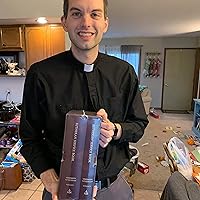
As the most significant theologian of the Evangelical Lutheran Church in the 17th century, the life and work of Johann Gerhard are known throughout the Western Church. Whether through writing weighty works such as his "Loci Theologici" or devotional books such as his "Daily Exercise of Piety," Gerhard's significance as a theologian has endured across the centuries.Johann Gerhard’s concern as a theologian was, above all, pastoral, and this concern is reflected in his numerous devotional books and sermon collections. Gerhard’s “An Explanation of the History of the Suffering and Death of our Lord Jesus Christ” leads the reader through the prototypes and prophesies of the Old Testament pointing forward to Christ’s suffering and death.The work is divided into two introductory sermons and five ‘acts’ (I. In the Garden, II. At the Home of Caiaphas, III. Before Pilate, IV. Christ’s Crucifixion, and V. Christ’s Burial) for a total of 24 sermons. However, readers will find that this books is far from “just another book of sermons”—Gerhard’s profound depth of knowledge of Holy Scripture and his ability to draw together the Old Testament prototypes with their fulfillment in Christ combine to make this work a true blessing.
Johann Gerhard was a Lutheran church leader and Scholastic theologian during the period of Orthodoxy.
At the age of fourteen, during a dangerous illness, he came under the personal influence of Johann Arndt, author of Das wahre Christenthum, and resolved to study for the church. He entered the University of Wittenberg in 1599, and studied philosophy and theology. A relative then persuaded him to change his subject, and he studied medicine for two years. In 1603, he resumed his theological reading at Jena, and in the following year received a new impulse from J.W. Winckelmann and Balthasar Mentzer at Marburg. He graduated in 1605 and began to give lectures at Jena, then in 1606 he accepted the invitation of John Casimir, Duke of Coburg, to the superintendency of Heldburg, today Bad Colberg-Heldburg, and mastership of the gymnasium; soon afterwards he became general superintendent of the duchy, in which capacity he was engaged in the practical work of ecclesiastical organization until 1616, when he became the senior theological professor at Jena, where the remainder of his life was spent.
Here, with Johann Major and Johann Himmel, he formed the "Trias Johannea." Though still comparatively young, Gerhard was already regarded as the greatest living theologian of Protestant Germany; in the "disputations" of the period he was always protagonist, and his advice was sought on all public and domestic questions touching on religion or morals. During his lifetime he received repeated calls to almost every university in Germany (e.g. Giessen, Altdorf, Helmstedt, Jena, Wittenberg), as well as to Uppsala in Sweden. He died in Jena.
His writings are numerous, alike in exegetical, polemical, dogmatic and practical theology. To the first category belong the Commentarius in harmoniam historiae evangelicae de passione Christi (1617), the Comment, super priorem D. Petri epistolam (1641), and also his commentaries on Genesis (1637) and on Deuteronomy (1658). Of a controversial character are the Confessio Catholica (1633–1637), an extensive work which seeks to prove the evangelical and catholic character of the doctrine of the Augsburg Confession from the writings of approved Roman Catholic authors; and the Loci communes theologici (1610–1622), his principal contribution, in which Lutheranism is expounded "nervose, solide et copiose," in fact with a fulness of learning, a force of logic and a minuteness of detail that had never before been approached.
The Meditationes sacrae (1606), a work expressly devoted to the uses of Christian edification, has been frequently reprinted in Latin and has been translated into most of the European languages, including Greek.
Johann Gerhard, an arch-theologian of the Lutheran Church, always provides readers with numerous biblical proofs when explaining the history of the suffering (Passion) and death of our Lord Jesus Christ. In polemics, he is a university scholar, having written so many books that all theologians are eager to read him. In the pulpit, he is a faithful pastor who shepherds his congregation and the Christians alive after him as well. In this book, Pastor Johann Gerhard illuminates the heart of Christianity. This book cannot be read just once; it should be read regularly. The truths contained in it will sanctify the family that reads it during Lent. Yes, I now prefer this book for Lenten reading instead of the Book of Concord. Every year at Easter, Christians try to make the Via Dolorosa present and alive through a drama. However, I find it useless as it neither exegetes the Scriptures nor demonstrates the Passion with precision. Thus, instead of wasting time, money, and energy on producing such a drama, every church, congregation, family, and individual should read this book as devotion. Five stars are never enough for Gerhard's writings.