

What do you think?

The Engineer's Wife
She built a monument for all time. Then she was lost in its shadow.
Emily Warren Roebling refuses to live conventionally—she knows who she is and what she wants, and she's determined to make change. But then her husband Wash asks the unthinkable: give up her dreams to make his possible.
Emily's fight for women's suffrage is put on hold, and her life transformed when Wash, the Chief Engineer of the Brooklyn Bridge, is injured on the job. Untrained for the task, but under his guidance, she assumes his role, despite stern resistance and overwhelming obstacles. Lines blur as Wash's vision becomes her own, and when he is unable to return to the job, Emily is consumed by it. But as the project takes shape under Emily's direction, she wonders whose legacy she is building—hers, or her husband's. As the monument rises, Emily's marriage, principles, and identity threaten to collapse. When the bridge finally stands finished, will she recognize the woman who built it?
Based on the true story of the Brooklyn Bridge, The Engineer's Wife delivers an emotional portrait of a woman transformed by a project of unfathomable scale, which takes her into the bowels of the East River, suffragette riots, the halls of Manhattan's elite, and the heady, freewheeling temptations of P.T. Barnum. It's the story of a husband and wife determined to build something that lasts—even at the risk of losing each other.
300 pages, Kindle Edition
First published April 7, 2020
About the author
Tracey Enerson Wood
6 books483 followersTracey Enerson Wood has always had a writing bug. While working as a Registered Nurse, starting an interior design company, raising two children, and bouncing around the world as a military wife, she indulged in her passion as a playwright, screenwriter and short story writer. She has authored magazine columns and other non-fiction, written and directed plays of all lengths, including Grits, Fleas and Carrots, Rocks and Other Hard Places, Alone, and Fog. Her screenplays include Strike Three and Roebling's Bridge. The Engineer's Wife is her first published novel.
Other passions include food and cooking, and honoring military heroes. Her co-authored anthology/cookbook Homefront Cooking, American Veterans share Recipes, Wit, and Wisdom, was released in May, 2018, and all authors' profits will be donated to organizations that support veterans.
A New Jersey native, she now lives with her family in Germany and Florida, and loves to travel, so be careful giving out casual invitations, she will show up anywhere.
(source: Amazon)
Other passions include food and cooking, and honoring military heroes. Her co-authored anthology/cookbook Homefront Cooking, American Veterans share Recipes, Wit, and Wisdom, was released in May, 2018, and all authors' profits will be donated to organizations that support veterans.
A New Jersey native, she now lives with her family in Germany and Florida, and loves to travel, so be careful giving out casual invitations, she will show up anywhere.
(source: Amazon)
Ratings & Reviews
Friends & Following
Create a free account to discover what your friends think of this book!
Community Reviews
Displaying 1 - 30 of 1,912 reviews

August 1, 2020
I finished this novel because I was curious about Emily Warren Roebling, an engineer who helped build the Brooklyn Bridge. But it was a chore because of the pedestrian writing and wooden characters. It was a helpful sleep aid.

August 15, 2024
Why I chose to listen to this audiobook:
1. I have always been fascinated by the construction of the Brooklyn Bridge ever since showing a documentary video about it several years ago to my Grade 3 students as part of a "Building" science unit;
2. some GR friends' reviews intrigued me; and,
3. August 2024 is my self-appointed "Biographical Fiction" Month.
Praises:
1. this particular audiobook gave me an in-depth look into the health issues Washington Roebling, this bridge's engineer, experienced while working in the caisson, but more importantly, how much his wife, Emily, contributed in regards to supervising the successful completion of this bridge;
2. I got a true sense of the time-period in this story, such as the Women's Suffrage Movement, typical ladies' fashions, society's opinions of women in the workplace, even to the invention of bobby pins!
3. the Author's Note is quite informative; and,
4. the endpapers in the hardcopy depict various construction diagrams of the Brooklyn Bridge.
Niggles:
1. when Emily sees Siamese twins enter P. T. Barnum's establishment, she refers to them as "Asian" when the term "Oriental" would have been used in the mid- to late-1800s;
2. sometimes the writing style seemed simplistic and the characters fell flat; and,
3. my BIGGEST niggle: why do some authors feel the need to insert romance into historical fiction? Is it in order to appeal to women readers? What's worse, a romance between two historical figures (in this case, Emily Roebling and P. T. Barnum) that is totally imagined? I would have thought a story about a strong woman who takes over the construction of one of America's most iconic bridges after her husband falls seriously ill would be a powerful story in itself, but to insert a defamatory relationship when no proof is found to support it just makes my blood boil! Emily's thoughts and actions in these senseless scenes made her an extremely unsympathetic character, unfortunately, in my eyes.
Overall Thoughts:
⭐⭐ stars = okay read, mainly because I was totally unaware that the engineer's wife played a huge part in the building of the Brooklyn Bridge, but 2 thumbs down for the imagined love affair. Ugh!
1. I have always been fascinated by the construction of the Brooklyn Bridge ever since showing a documentary video about it several years ago to my Grade 3 students as part of a "Building" science unit;
2. some GR friends' reviews intrigued me; and,
3. August 2024 is my self-appointed "Biographical Fiction" Month.
Praises:
1. this particular audiobook gave me an in-depth look into the health issues Washington Roebling, this bridge's engineer, experienced while working in the caisson, but more importantly, how much his wife, Emily, contributed in regards to supervising the successful completion of this bridge;
2. I got a true sense of the time-period in this story, such as the Women's Suffrage Movement, typical ladies' fashions, society's opinions of women in the workplace, even to the invention of bobby pins!
3. the Author's Note is quite informative; and,
4. the endpapers in the hardcopy depict various construction diagrams of the Brooklyn Bridge.
Niggles:
1. when Emily sees Siamese twins enter P. T. Barnum's establishment, she refers to them as "Asian" when the term "Oriental" would have been used in the mid- to late-1800s;
2. sometimes the writing style seemed simplistic and the characters fell flat; and,
3. my BIGGEST niggle: why do some authors feel the need to insert romance into historical fiction? Is it in order to appeal to women readers? What's worse, a romance between two historical figures (in this case, Emily Roebling and P. T. Barnum) that is totally imagined? I would have thought a story about a strong woman who takes over the construction of one of America's most iconic bridges after her husband falls seriously ill would be a powerful story in itself, but to insert a defamatory relationship when no proof is found to support it just makes my blood boil! Emily's thoughts and actions in these senseless scenes made her an extremely unsympathetic character, unfortunately, in my eyes.
Overall Thoughts:
⭐⭐ stars = okay read, mainly because I was totally unaware that the engineer's wife played a huge part in the building of the Brooklyn Bridge, but 2 thumbs down for the imagined love affair. Ugh!

December 5, 2019
Many of us have walked over the Brooklyn Bridge, but probably most of us don’t know the story behind this bridge and what an enormous achievement back then it was to build such grand bridge and to take on such massive project. And the dedication it took.
1865, Emily Warren marries Captain Washington ‘Wash’ Roebling. She marries into the family of engineers. Father and son are working on finishing “the Cincinnati-Covington Bridge, which had been long delayed by the war (…),” linking Ohio and Kentucky. And this “is just a prototype. The real challenge is the East River.”
And that’s when Emily is asked to help with “Speeches, meetings, dinner receptions, whatever necessary. We have to raise about seven million dollars.”
She is left speechless. “They were responsible for finding the project as well as building it?”
An office is established to run all the logistics pertaining to building the bridge. And the most qualified person to manage the office turns out to be Mrs. Roebling.
She meets challenges with officials as she performs man’s job. But she is not afraid to put man’s pants on, even if it means punishable offense.
An accident happens at the work site and she becomes a messenger, bearing a journal with drawings and instructions. Further events push her to get even more involved with the construction.
Richly imagined and beautifully woven story of a woman who refuses to bend to old conventions. A woman who craves changes and progress and makes a difference by taking part in it.
She is not a bystander. She is a woman of action. She wants to see more and do more, and “meet people pushing in new directions.”
But in a world when a woman meddles where she shouldn’t be, it usually results in some consequences, including being shunned by other woman and disrespected by men. Nevertheless, she is a woman of great strength. She tilts her head up and she lives her life as best as she can.
With intelligent prose, this expertly detailed account weaves a touching story of how a famous bridge comes to be and a marriage that is tested through its ups and downs like the construction of a bridge. It seems to be a parallel story (maybe not meant to be, maybe it just came through that way) that paints a powerful picture what it takes to build a bridge – a solid foundation. And what it takes to build a successful relationship – trust.
The story interestingly weaves many aspects including heart-touching story of what led Wash to become an engineer, through detailed construction and its challenges including caisson disease (decompression sickness), to undeniable determination of a woman to see completion of a bridge.
Source: ARC was provided by the publisher via Netgalley in exchange for an honest review.
1865, Emily Warren marries Captain Washington ‘Wash’ Roebling. She marries into the family of engineers. Father and son are working on finishing “the Cincinnati-Covington Bridge, which had been long delayed by the war (…),” linking Ohio and Kentucky. And this “is just a prototype. The real challenge is the East River.”
And that’s when Emily is asked to help with “Speeches, meetings, dinner receptions, whatever necessary. We have to raise about seven million dollars.”
She is left speechless. “They were responsible for finding the project as well as building it?”
An office is established to run all the logistics pertaining to building the bridge. And the most qualified person to manage the office turns out to be Mrs. Roebling.
She meets challenges with officials as she performs man’s job. But she is not afraid to put man’s pants on, even if it means punishable offense.
An accident happens at the work site and she becomes a messenger, bearing a journal with drawings and instructions. Further events push her to get even more involved with the construction.
Richly imagined and beautifully woven story of a woman who refuses to bend to old conventions. A woman who craves changes and progress and makes a difference by taking part in it.
She is not a bystander. She is a woman of action. She wants to see more and do more, and “meet people pushing in new directions.”
But in a world when a woman meddles where she shouldn’t be, it usually results in some consequences, including being shunned by other woman and disrespected by men. Nevertheless, she is a woman of great strength. She tilts her head up and she lives her life as best as she can.
With intelligent prose, this expertly detailed account weaves a touching story of how a famous bridge comes to be and a marriage that is tested through its ups and downs like the construction of a bridge. It seems to be a parallel story (maybe not meant to be, maybe it just came through that way) that paints a powerful picture what it takes to build a bridge – a solid foundation. And what it takes to build a successful relationship – trust.
The story interestingly weaves many aspects including heart-touching story of what led Wash to become an engineer, through detailed construction and its challenges including caisson disease (decompression sickness), to undeniable determination of a woman to see completion of a bridge.
Source: ARC was provided by the publisher via Netgalley in exchange for an honest review.

February 3, 2020
Thank to NetGalley, Tracey Enerson Wood and Lume Books for my copy of The Engineer's Wife.
In 1865, Emily Warren married Captain Washington Roebling, they met during the American Civil War and Wash was her older brother’s Gouverneur Kemble Warren’s aide. The couple was instantly attracted to each other, their courtship was conducted by mail and they didn’t spend a lot of time together due to the war. Wash and his father John were both engineers, they needed to finish the Covington Cincinnati Bridge construction and it had been delayed due to the Civil War and they had plans to build a much bigger bridge.
John Roebling had a dream to build a bridge called the New York and Brooklyn Bridge or as it’s called today the Brooklyn Bridge. The plan was to build a suspension bridge for Brooklyn residents to use to get to work in Manhattan and not have to catch water ferries. Once funding was sorted out, Wash was to be the chief engineer, guided by his father and they would build a suspension cable stay bridge supported by two huge towers that are built on two caissons. Caissons are watertight retaining structures used to build the foundations of bridges; they are large upside wooden boxes and had false bottoms. The false bottoms were removed so men working inside them could dig away at the mud and bedrock at the bottom of the river and compressed air was pumped into the chambers to keep the river water from running in and drowning the men. It was very dangerous work, Wash didn’t mind getting his hands dirty and he worked alongside his workers while building the bridge. He developed a bad case of Caisson sickness; we now refer to it as the bends and he became too sick to oversee the building of the bridge
Emily became her husband’s messenger, despite having no formal education in math, science or engineering. Emily was very smart, soon she was more involved in the building of the bridge and she walked around a construction site wearing a big dress and with her toddler son John pulling at her long skirts. Emily hired a nanny, wore bloomers, people talked about her and some women snubbed her completely. Emily had to deal with grumpy foremen, dodgy suppliers, criticism, questions about if the bridge was strong enough for both pedestrians and traffic to use. Emily Roebling was a remarkable woman, she was a wife, a mother and she managed the project of building the world’s longest suspension bridge at the time.
The Engineer’s Wife uses interesting facts about building the Brooklyn Bridge, to create a story about a strong, determined woman and who didn’t follow the traditional roles expected of her. I enjoyed reading The Engineer's Wife, if you like Historical Fiction, want to read something different, I highly recommend reading it and I gave the book five stars. I have shared my review on Goodreads, Australian Amazon, NetGalley, Edelweiss, Kobo, Twitter any my blog. https://karrenreadsbooks.blogspot.com/
In 1865, Emily Warren married Captain Washington Roebling, they met during the American Civil War and Wash was her older brother’s Gouverneur Kemble Warren’s aide. The couple was instantly attracted to each other, their courtship was conducted by mail and they didn’t spend a lot of time together due to the war. Wash and his father John were both engineers, they needed to finish the Covington Cincinnati Bridge construction and it had been delayed due to the Civil War and they had plans to build a much bigger bridge.
John Roebling had a dream to build a bridge called the New York and Brooklyn Bridge or as it’s called today the Brooklyn Bridge. The plan was to build a suspension bridge for Brooklyn residents to use to get to work in Manhattan and not have to catch water ferries. Once funding was sorted out, Wash was to be the chief engineer, guided by his father and they would build a suspension cable stay bridge supported by two huge towers that are built on two caissons. Caissons are watertight retaining structures used to build the foundations of bridges; they are large upside wooden boxes and had false bottoms. The false bottoms were removed so men working inside them could dig away at the mud and bedrock at the bottom of the river and compressed air was pumped into the chambers to keep the river water from running in and drowning the men. It was very dangerous work, Wash didn’t mind getting his hands dirty and he worked alongside his workers while building the bridge. He developed a bad case of Caisson sickness; we now refer to it as the bends and he became too sick to oversee the building of the bridge
Emily became her husband’s messenger, despite having no formal education in math, science or engineering. Emily was very smart, soon she was more involved in the building of the bridge and she walked around a construction site wearing a big dress and with her toddler son John pulling at her long skirts. Emily hired a nanny, wore bloomers, people talked about her and some women snubbed her completely. Emily had to deal with grumpy foremen, dodgy suppliers, criticism, questions about if the bridge was strong enough for both pedestrians and traffic to use. Emily Roebling was a remarkable woman, she was a wife, a mother and she managed the project of building the world’s longest suspension bridge at the time.
The Engineer’s Wife uses interesting facts about building the Brooklyn Bridge, to create a story about a strong, determined woman and who didn’t follow the traditional roles expected of her. I enjoyed reading The Engineer's Wife, if you like Historical Fiction, want to read something different, I highly recommend reading it and I gave the book five stars. I have shared my review on Goodreads, Australian Amazon, NetGalley, Edelweiss, Kobo, Twitter any my blog. https://karrenreadsbooks.blogspot.com/

January 2, 2022
Though written for the suffragist movement I found the Engineer’s Wife disappointing. A bit boring and anti-climatic. The last of action made the book long. I almost DNF a few times but chose to continue. Never disappointed when I persevere to the end.

June 28, 2021
The Engineer's Wife is an entertaining historical novel that is intelligently narrated and full of emotions as well as clever conversations.
The story starts off in Washington, D.C., Feb. 1864 and deals with the establishment of the monumental Brooklyn Bridge. Thereby, I began to accompany John Roebling´s journey, a German immigrant in the US and the designer of the Brooklyn Bridge, who was also the meister of the Cincinnati Bridge over the Ohio River.
Unfortunately, John Roebling died of an accident building the Brooklyn Bridge. His son Washington Roebling took over from his father to finish building the bridge, but he is affected by the Caisson Disease.
Hence, his wife, Emily Roebling, our quite ambitious and competitive protagonist, assumes the responsibility of an engineer and embraces her new role with passion!
I loved Emily for her out-of-the-box thinking, her determination, her cleverness, her diplomacy, but also her agony over men, her indecisiveness and her emotional cravings. She did so well managing her marriage as well as leading the project of the Brooklyn Bridge.
More than 600 men and women were tirelessly involved to build the bridge, whilst they also mourned about the lives that ended in accidents during the building procedure.
The Brooklyn Bridge merged New York and Brooklyn that makes the city what it is now:
The Gigantic Big Apple! 🍎
The novel raised my appreciation for the monumental bridges in the USA and around the world.
The Brooklyn Bridge is a symbol of New York, a monument of American style and inspiration that is known at a worldwide scale.
In my humble opinion, the challenge that the reader will face is to follow various historically important events Tracey Enerson Wood is writing about.
Whilst she focuses on the establishment of the Brooklyn Bridge from a technical and political perspective, she will also deep dive into the restrictions women were exposed to. She will also detail out the movements by suffragettes till all American women are eligible to vote in 1920. GOOSEBUMPS!
Women stood up for their rights and wanted to move freely beyond the norms defined by society at that time. Consequently, our way of dressing was revolutionized. Thank you Amelia Bloomer and Alva Vanderbilt for making the start.
The author will also raise awareness of Carrie Beebe who wrote "Violets" in New York, which was published in 1873.
I love that Tracey Enerson Wood is transparent about the elements she fictionalized in her book to spice up the story. Also the relationship of P.T. Barnum and Emily Washington is fantasized. I am still impressed that Barnum, an immensely wealthy and influential figure back then, has been the first person EVER to provide peanuts as snacks to human beings. Previously, peanuts used to be reserved for elephants only.
An invigorating read that consumes your brain cells ;) Be prepared to extend your vocabulary on component parts of a bridge :)
🥜 #peanuts #Brooklyn #NewYork #Roebling #German engineering meets American style
#inspiration #Land of opportunities
IG: @nilguen_reads
The story starts off in Washington, D.C., Feb. 1864 and deals with the establishment of the monumental Brooklyn Bridge. Thereby, I began to accompany John Roebling´s journey, a German immigrant in the US and the designer of the Brooklyn Bridge, who was also the meister of the Cincinnati Bridge over the Ohio River.
Unfortunately, John Roebling died of an accident building the Brooklyn Bridge. His son Washington Roebling took over from his father to finish building the bridge, but he is affected by the Caisson Disease.
Hence, his wife, Emily Roebling, our quite ambitious and competitive protagonist, assumes the responsibility of an engineer and embraces her new role with passion!
I loved Emily for her out-of-the-box thinking, her determination, her cleverness, her diplomacy, but also her agony over men, her indecisiveness and her emotional cravings. She did so well managing her marriage as well as leading the project of the Brooklyn Bridge.
More than 600 men and women were tirelessly involved to build the bridge, whilst they also mourned about the lives that ended in accidents during the building procedure.
The Brooklyn Bridge merged New York and Brooklyn that makes the city what it is now:
The Gigantic Big Apple! 🍎
The novel raised my appreciation for the monumental bridges in the USA and around the world.
The Brooklyn Bridge is a symbol of New York, a monument of American style and inspiration that is known at a worldwide scale.
In my humble opinion, the challenge that the reader will face is to follow various historically important events Tracey Enerson Wood is writing about.
Whilst she focuses on the establishment of the Brooklyn Bridge from a technical and political perspective, she will also deep dive into the restrictions women were exposed to. She will also detail out the movements by suffragettes till all American women are eligible to vote in 1920. GOOSEBUMPS!
Women stood up for their rights and wanted to move freely beyond the norms defined by society at that time. Consequently, our way of dressing was revolutionized. Thank you Amelia Bloomer and Alva Vanderbilt for making the start.
The author will also raise awareness of Carrie Beebe who wrote "Violets" in New York, which was published in 1873.
I love that Tracey Enerson Wood is transparent about the elements she fictionalized in her book to spice up the story. Also the relationship of P.T. Barnum and Emily Washington is fantasized. I am still impressed that Barnum, an immensely wealthy and influential figure back then, has been the first person EVER to provide peanuts as snacks to human beings. Previously, peanuts used to be reserved for elephants only.
An invigorating read that consumes your brain cells ;) Be prepared to extend your vocabulary on component parts of a bridge :)
🥜 #peanuts #Brooklyn #NewYork #Roebling #German engineering meets American style
#inspiration #Land of opportunities
IG: @nilguen_reads

March 11, 2020
This is a compelling novel of historical fiction about Emily Watson Roebling, a fascinating woman who was instrumental in the building of the Brooklyn Bridge. In 1864 Emily Warren meets Captain Washington “Wash” Roebling, a civil engineer. After they marry Emily leaves her own ambitions behind to help her husband and father-in-law, John Roebling, fulfill their dream of building a bridge connecting Brooklyn to Manhattan. During the project John Roebling dies of tetanus, and Wash is stricken with “caisson disease”. It is up to Emily to take charge of the project. She begins by running back and forth with messages between her husband and those at the work site, but she eventually becomes an integral part of the processes. From handling the PR, to coming up with creative ways to solve technical problems, Emily is soon the person keeping the project going.
Emily is a pioneer for working women, overcoming her own fears and insecurities, she earns the respect and admiration of many of the men around her. She must balance her role as a wife and mother, with a career in a time with few role models to guide her. The characters in this novel, and their many strengths and weaknesses, are richly drawn, especially the portrayal of P. T. Barnum. This is a well-researched, richly detailed novel evoking the sights and smells of New York City in the later part of the 19th century. There are detailed descriptions of the engineering behind bridge building, and the innovative design behind the Brooklyn Bridge. We are given a compelling portrait of Emily Warren Roebling and her contributions to engineering and history. I highly recommend this book to historical fiction fans and fans of the history of bridges, especially for those who enjoy the books of Marie Benedict and Melanie Benjamin.
Thank you to Sourcebooks Landmark and NetGalley for the e-ARC.
Emily is a pioneer for working women, overcoming her own fears and insecurities, she earns the respect and admiration of many of the men around her. She must balance her role as a wife and mother, with a career in a time with few role models to guide her. The characters in this novel, and their many strengths and weaknesses, are richly drawn, especially the portrayal of P. T. Barnum. This is a well-researched, richly detailed novel evoking the sights and smells of New York City in the later part of the 19th century. There are detailed descriptions of the engineering behind bridge building, and the innovative design behind the Brooklyn Bridge. We are given a compelling portrait of Emily Warren Roebling and her contributions to engineering and history. I highly recommend this book to historical fiction fans and fans of the history of bridges, especially for those who enjoy the books of Marie Benedict and Melanie Benjamin.
Thank you to Sourcebooks Landmark and NetGalley for the e-ARC.

March 22, 2020
This was a wonderful and wonderfully enlightening novel based on the life of Emily Warren Roebling, wife of Washington Roebling and daughter in law of John Roebling who designed both the Cincinnati-Covington Bridge and the Brooklyn Bridge.
With John’s untimely death and Washington’s unfortunate incapacity due to the bends, Emily finds herself tasked with not only supervising the construction of the Brooklyn Bridge but verifying the integrity of the supplies and components necessary. She is also the one who must meet with the politicians and various committees who provide funds, oversee the project, etc.
Due to Washington’s guidance, mentoring and her own diligence in studying his engineering texts, she does an incredible job.
One of the major historical characters injected into this story was P. T. Barnum. Our author depicted him as being in love with Emily and rescuing her time and time again when she encountered unexpected obstacles. Our author also depicted Emily as being in love with PT, although she didn’t go so far as to proclaim physical intimacy. However in the Afterward, our author says that that entire relationship was imagined and fictitious. She says she put that in the book as Barnum was a very rich and influential New Yorker at that time. She admits that there is no historical nor documented basis – whatsoever – for that relationship. I take issue with the fact that she falsified the actions of historical figures in that manner. Apparently there was no evidence that Emily had any interest, at all, in any paramour. I appreciate the fact that she owned up to her deception, but that completely negated my enjoyment of the book, and I will not read anything further by this perpetrator of “fake news.”
I appreciate the ARC from NetGalley and the publisher in exchange for an honest review. I only hope that the publisher will be more diligent in demanding facts about historical people.
With John’s untimely death and Washington’s unfortunate incapacity due to the bends, Emily finds herself tasked with not only supervising the construction of the Brooklyn Bridge but verifying the integrity of the supplies and components necessary. She is also the one who must meet with the politicians and various committees who provide funds, oversee the project, etc.
Due to Washington’s guidance, mentoring and her own diligence in studying his engineering texts, she does an incredible job.
One of the major historical characters injected into this story was P. T. Barnum. Our author depicted him as being in love with Emily and rescuing her time and time again when she encountered unexpected obstacles. Our author also depicted Emily as being in love with PT, although she didn’t go so far as to proclaim physical intimacy. However in the Afterward, our author says that that entire relationship was imagined and fictitious. She says she put that in the book as Barnum was a very rich and influential New Yorker at that time. She admits that there is no historical nor documented basis – whatsoever – for that relationship. I take issue with the fact that she falsified the actions of historical figures in that manner. Apparently there was no evidence that Emily had any interest, at all, in any paramour. I appreciate the fact that she owned up to her deception, but that completely negated my enjoyment of the book, and I will not read anything further by this perpetrator of “fake news.”
I appreciate the ARC from NetGalley and the publisher in exchange for an honest review. I only hope that the publisher will be more diligent in demanding facts about historical people.

July 8, 2020
Whenever I read fiction based on a true story I go in skeptical. Does the story feel too perfect? Is our lead character too strong or too unbelievable? And while there are people in the world that are incredible human beings; the reality is that most of us are just average and incapable of most feats in our favourite novels. In The Engineer's Wife it's 1865; and so women are arm candy, the suffragette cause is protesting forward, and white men believe themselves to be the best of the best. Our lead character is the wife of the primary engineer whose tasked to build the Brooklyn Bridge. While the story is fascinating, deadly, and awe-inspiring at times in the end I can't quite give it five stars because of the romantic entanglement story (completely fictional). I will credit Tracey Enerson Wood however with being very honest in the afterword about what is true and what is not in this historical fiction novel.
Romance
I'm not a sucker for romances to start with; so anytime you want to try and justify why people should just fall into one another's arms instantly, or be compelled to cheat on their spouses because 'OMG the other person is just so amazing' (gag), it's going to be a hard sell. Yes I have a long-time spouse. It's a man (although could be a woman as I’m bisexual) whom I've been with for 12+ years. We are not formally married (but call one another husband and wife). Neither of us is overly romantic or into the big gestures. Due to my health situation we don't have a ton of sex; nor do we take part in any overly romantic events or affairs. Why? Because that is not what the core of a relationship should be in my opinion. So when you give me a romantic story line that is seemingly 100% focused on the idea of 'good sex' and on grand moments of passion I will always remain unconvinced.
This is the problem with the developing relationship between our engineer's wife and P.T. Barnum (yes the circus man). The reality is it doesn't work because (most importantly) it probably didn't happen. This is man who made circuses famous, widely supported the thirteenth amendment to abolish slavery, and whom months after his wife of many years died married a woman 40-years younger than him. Barnum was a man of action, excitement, thrills, and didn't wait around for things to happen, he made them happen.
Thus the romantic side story and ridiculous insertion of Barnum is the entire reason this is not a 5-star book for me.
While Barnum had some connection to the bridge construction; it's as though Wood thought no one would care to read the story without a famous historical figure to tote in the back blurb. I'd have much rather Barnum had a couple cameo's here or there like history tells it than have him smooching the engineer's wife time and time again.
Caisson Disease, the Bends, Depression Sickness
No matter what you call it, depressurization's effect on our bodies is intense. Those darn air bubbles wreak havoc on our ability to breathe, thus affecting the amount of oxygen our brains are getting and from there can ruin just about every aspect of how your body functions. I had no idea prior to reading The Engineer's Wife how prevalent caisson's disease was for construction workers, or the exact physics and math behind building giant bridges that was used in the late 1800's. It's impressive to me that humans were able to fathom these structures and then ultimately build them. However, they came at a price. Many lives were lost during construction of the Brooklyn Bridge and many others were destroyed from caisson's disease; including that of our primary engineer. There is a lot more death and sickness in this story than you might expect.
Caisson's disease is how a woman *gasp* ends up working directly on the Brooklyn Bridge plans and construction. If you want to be outraged by the way women were treated back then this is a great book to show it. With many references and lines like:
"Calculus. Trigonometry. Engineering. All subjects deemed unsuitable for women."
The Science and Math
I love how Wood gives enough details on engineering the bridge to whet my appetite; without going into vast amounts of detail. I understand tensile strength of steel cords, caisson building, weight allocation, and other engineering concepts better than before I read The Engineer's Wife. Yet, I never felt like the science and math were too belaboured. It is a real feat to balance a woman's suffragette story with a task as huge as building the Brooklyn Bridge. Not only does Wood do a good job in authoring this story but our leading lady does all the hard work fighting back every step of the way.
Everyone around her is gossiping, making fun, questioning her abilities, and/or deciding what political causes she can associate with because of her involvement in the construction. It makes me feel like my stories of being over looked, sexualized, or underestimated because I'm a woman are nothing next to hers. I can't decide if she would be pleased by how far we've come; or disappointed in the ~75% wage differential, number of female CEO's, that we still divide 'women's work' up in today's world.
”I set back my shoulders. To be successful in a man’s world, I would be strong.”
Overall
I did really, really enjoy this book. It's a fascinating time in New York as huge high-rises are being raised, bridges are reaching across water, and women are fighting for their rights. Wood does a great job of keeping the pace of the novel up, even if it does mean that some events are skewed (especially near the end of the story). I could forgive all of them if not for the ridiculous Barnum romance aside. Luckily the romance is not the crux of the story and each time it came up I could look forward to the next visit to the bridge site our leading lady would make or moment when she conferred with her debilitated husband over the building plans.
If you have ever had any interest in this time period, bridge building or the history of New York City I would highly recommend you read this book. Wood did a great amount of homework to put this story together for us and I"m so glad to have learned about Emily Warren Roebling and her immense contribution to the New York City skyline; and proof that women are just as smart and capable as men. I hope that I can continue my career and life in a male dominated industry (software development at this moment) with even half the dignity and courage that she had.
"Let them talk. Gossip has always been spread and there is nothing to do but to live ones life as best one can."
Please note: I received an eARC of this book from the publisher via NetGalley. This is an honest and unbiased review.
Romance
I'm not a sucker for romances to start with; so anytime you want to try and justify why people should just fall into one another's arms instantly, or be compelled to cheat on their spouses because 'OMG the other person is just so amazing' (gag), it's going to be a hard sell. Yes I have a long-time spouse. It's a man (although could be a woman as I’m bisexual) whom I've been with for 12+ years. We are not formally married (but call one another husband and wife). Neither of us is overly romantic or into the big gestures. Due to my health situation we don't have a ton of sex; nor do we take part in any overly romantic events or affairs. Why? Because that is not what the core of a relationship should be in my opinion. So when you give me a romantic story line that is seemingly 100% focused on the idea of 'good sex' and on grand moments of passion I will always remain unconvinced.
This is the problem with the developing relationship between our engineer's wife and P.T. Barnum (yes the circus man). The reality is it doesn't work because (most importantly) it probably didn't happen. This is man who made circuses famous, widely supported the thirteenth amendment to abolish slavery, and whom months after his wife of many years died married a woman 40-years younger than him. Barnum was a man of action, excitement, thrills, and didn't wait around for things to happen, he made them happen.
Thus the romantic side story and ridiculous insertion of Barnum is the entire reason this is not a 5-star book for me.
While Barnum had some connection to the bridge construction; it's as though Wood thought no one would care to read the story without a famous historical figure to tote in the back blurb. I'd have much rather Barnum had a couple cameo's here or there like history tells it than have him smooching the engineer's wife time and time again.
Caisson Disease, the Bends, Depression Sickness
No matter what you call it, depressurization's effect on our bodies is intense. Those darn air bubbles wreak havoc on our ability to breathe, thus affecting the amount of oxygen our brains are getting and from there can ruin just about every aspect of how your body functions. I had no idea prior to reading The Engineer's Wife how prevalent caisson's disease was for construction workers, or the exact physics and math behind building giant bridges that was used in the late 1800's. It's impressive to me that humans were able to fathom these structures and then ultimately build them. However, they came at a price. Many lives were lost during construction of the Brooklyn Bridge and many others were destroyed from caisson's disease; including that of our primary engineer. There is a lot more death and sickness in this story than you might expect.
Caisson's disease is how a woman *gasp* ends up working directly on the Brooklyn Bridge plans and construction. If you want to be outraged by the way women were treated back then this is a great book to show it. With many references and lines like:
"Calculus. Trigonometry. Engineering. All subjects deemed unsuitable for women."
The Science and Math
I love how Wood gives enough details on engineering the bridge to whet my appetite; without going into vast amounts of detail. I understand tensile strength of steel cords, caisson building, weight allocation, and other engineering concepts better than before I read The Engineer's Wife. Yet, I never felt like the science and math were too belaboured. It is a real feat to balance a woman's suffragette story with a task as huge as building the Brooklyn Bridge. Not only does Wood do a good job in authoring this story but our leading lady does all the hard work fighting back every step of the way.
Everyone around her is gossiping, making fun, questioning her abilities, and/or deciding what political causes she can associate with because of her involvement in the construction. It makes me feel like my stories of being over looked, sexualized, or underestimated because I'm a woman are nothing next to hers. I can't decide if she would be pleased by how far we've come; or disappointed in the ~75% wage differential, number of female CEO's, that we still divide 'women's work' up in today's world.
”I set back my shoulders. To be successful in a man’s world, I would be strong.”
Overall
I did really, really enjoy this book. It's a fascinating time in New York as huge high-rises are being raised, bridges are reaching across water, and women are fighting for their rights. Wood does a great job of keeping the pace of the novel up, even if it does mean that some events are skewed (especially near the end of the story). I could forgive all of them if not for the ridiculous Barnum romance aside. Luckily the romance is not the crux of the story and each time it came up I could look forward to the next visit to the bridge site our leading lady would make or moment when she conferred with her debilitated husband over the building plans.
If you have ever had any interest in this time period, bridge building or the history of New York City I would highly recommend you read this book. Wood did a great amount of homework to put this story together for us and I"m so glad to have learned about Emily Warren Roebling and her immense contribution to the New York City skyline; and proof that women are just as smart and capable as men. I hope that I can continue my career and life in a male dominated industry (software development at this moment) with even half the dignity and courage that she had.
"Let them talk. Gossip has always been spread and there is nothing to do but to live ones life as best one can."
Please note: I received an eARC of this book from the publisher via NetGalley. This is an honest and unbiased review.

January 15, 2020
While the historical events that inspired this book are fascinating to me, I'm not sure how I feel about this retelling. The writing and overall structure of the story is fine. However, I found the characterization bland, which made it hard for me to really connect with Emily and Wash as real people. Emily was your basic Mary Sue "I'm not like other girls" heroine. While the book is told in first person, I never felt like I understood her. The pacing was also strange to me. Important events were rushed through, while at the same time the building of the bridge was very long and drawn out. The author also took several liberties to the actual historical story, and while I understand some of the changes for dramatization, I didn't really care for some of them. For example, the main conflict of the book is based around a fictitious affair involving another historical figure which was my least favorite part of the book. Overall I did learn from the history behind this story, I just personally had some problems with the execution.

March 31, 2020
The construction of the Brooklyn Bridge was a massive undertaking in the late 19th century. It is fascinating to discover the integral part a woman played in keeping the project going. Emily Warren Roebling was a woman ahead of her time. When her husband and father-in-law were busy building a bridge in Cincinnati, she kept herself occupied reading engineering books. Then it was time to move onto the East River bridge or the Brooklyn Bridge. Papa (her father-in-law) dies of tetanus when work is barely begun. Her husband Wash gets the bends so badly from working at the base in the caisson that he is bedridden. Emily steps up despite the scorn of men around her and her husband's physical and emotional difficulties. There are times when she will wish for a rewind button. This book shows the toll such a project will exact from a family and especially a marriage. Tracey Enerson Wood shows the sweetness of their marriage as well as the bitter times -- the sickness and the health. I appreciate the many ways that the relationship of marriage is positively portrayed and shown to be of value. One disappointment for me was the way P.T. Barnum's character was expanded in a fictional way. As The Greatest Showman, he was undoubtedly a part of the story -- hopefully not to the extent he was portrayed. Give this to readers who love Marie Benedict and Stephanie Thornton.
Thank you to Sourcebooks and Edelweiss for a DRC in exchange for an honest review.
Thank you to Sourcebooks and Edelweiss for a DRC in exchange for an honest review.

June 5, 2020
THE ENGINEER'S WIFE is a historical fiction novel that should be great, but it just fell flat. Based on the true story of Emily Warren Roebling, the wife of Washington Roebling, who designed and built the Brooklyn Bridge, I really thought I'd love this book. Emily had to take over the building and supervising of the bridge when her husband was afflicted with Caisson disease (the bends). The book spans from the Civil War to the completion of the Brooklyn Bridge in 1883.
The problems I have with this book start with the characters. Emily and Wash are never fleshed out. They were in love and happy and then all of a sudden, they weren't. There wasn't much depth to them and I didn't care about them enough to even hate them. They were just blah.
I also felt like the narrative needed something more. Wood spent a lot of time describing the processes of engineering and building the bridge, but not in an interesting way. The whole book was disjointed because from the middle to the end of the book, each chapter was a year or two in the future. I couldn't get invested in the story because things were changing so much.
Finally, I was disappointed to find out that the friendship and emotional affair that Emily had with PT Barnum in the book, was in fact entirely fictitious. While I know it is historical fiction and that you can take certain liberties, I thought this was an awfully big one to take and it didn't add much to the book - and in fact, made Emily an unsympathetic character.
Overall, this was a disappointment. Now, I'm going to watch the Ken Burns documentary on the building of the Brooklyn Bridge so I can get the real story.
The problems I have with this book start with the characters. Emily and Wash are never fleshed out. They were in love and happy and then all of a sudden, they weren't. There wasn't much depth to them and I didn't care about them enough to even hate them. They were just blah.
I also felt like the narrative needed something more. Wood spent a lot of time describing the processes of engineering and building the bridge, but not in an interesting way. The whole book was disjointed because from the middle to the end of the book, each chapter was a year or two in the future. I couldn't get invested in the story because things were changing so much.
Finally, I was disappointed to find out that the friendship and emotional affair that Emily had with PT Barnum in the book, was in fact entirely fictitious. While I know it is historical fiction and that you can take certain liberties, I thought this was an awfully big one to take and it didn't add much to the book - and in fact, made Emily an unsympathetic character.
Overall, this was a disappointment. Now, I'm going to watch the Ken Burns documentary on the building of the Brooklyn Bridge so I can get the real story.

October 27, 2020
've only seen pictures of the Brooklyn Bridge, but just seeing those it is amazing to think that after 120 years it is still standing. The sheer majesty of it, with all the limestone, cables, and steel - how they all work together. It is mind-boggling to me.
This was the story of Emily Warren Roebling, the wife of Washington Roebling, who was the engineer to the building of the Brooklyn Bridge. After suffering from caisson's disease and rending Washington Roebling physically unable to work at the bridge, it fell on Emily to be the messenger/manager of the construction of the rest of the bridge. With details from the complexity of building the stone structures, going feet down in the water to bedrock, how the wires were strung from one side to the next, and the vastness of it in the end. It was the story of a couple who wanted to fulfill the dream of one's father, all the while raising a young son, the stressors on their marriage, and the strength of Emily to do what no woman was supposed to do at that time.
I enjoyed this book, more so the details of the building of the bridge, the trials they went through to get things just right, the heartache when something went wrong, and the sheer toll it took on everyone. I enjoyed Emily's character, although there were times I felt she was a bit selfish, but maybe that was because of the ignorance of her husband. She was a determined woman with the building of the bridge, woman's rights, and realizing her dreams even though late in life. Wash to me was a bit of a self-centered man, used to getting his way, excessively smart in terms of architecture and math, but lacking sensitivity where it mattered. I didn't like the relationship of Emily and PT Barnum, I felt it forced to be part of the story, and at times the center of the story rather than the building of the bridge. But in the epilogue learned it may have happened, although to what extent shall not be known. In all I enjoyed the book and would give it 4 stars.
Thank you to Netgalley and the publisher for an advanced copy of this book.
This was the story of Emily Warren Roebling, the wife of Washington Roebling, who was the engineer to the building of the Brooklyn Bridge. After suffering from caisson's disease and rending Washington Roebling physically unable to work at the bridge, it fell on Emily to be the messenger/manager of the construction of the rest of the bridge. With details from the complexity of building the stone structures, going feet down in the water to bedrock, how the wires were strung from one side to the next, and the vastness of it in the end. It was the story of a couple who wanted to fulfill the dream of one's father, all the while raising a young son, the stressors on their marriage, and the strength of Emily to do what no woman was supposed to do at that time.
I enjoyed this book, more so the details of the building of the bridge, the trials they went through to get things just right, the heartache when something went wrong, and the sheer toll it took on everyone. I enjoyed Emily's character, although there were times I felt she was a bit selfish, but maybe that was because of the ignorance of her husband. She was a determined woman with the building of the bridge, woman's rights, and realizing her dreams even though late in life. Wash to me was a bit of a self-centered man, used to getting his way, excessively smart in terms of architecture and math, but lacking sensitivity where it mattered. I didn't like the relationship of Emily and PT Barnum, I felt it forced to be part of the story, and at times the center of the story rather than the building of the bridge. But in the epilogue learned it may have happened, although to what extent shall not be known. In all I enjoyed the book and would give it 4 stars.
Thank you to Netgalley and the publisher for an advanced copy of this book.

July 2, 2022
The Engineer’s Wife by Tracey Enerson Wood was a fascinating and powerful book about a woman history neglected to document and give credit to for her important contributions. Emily Warren Roebling came from Cold Spring, New York. She lived during the Civil War and met her husband Washington Roebling during that time. Washington (Wash) was an officer in the Union Army in her brother’s infantry. Emily’s brother had a hand in introducing his sister to Wash. Washington Roebling was a civil engineer. His life time dream was to build a bridge that connected Brooklyn to Manhattan. Wash’s father, John A. Roebling, initially designed the bridge but did not live to see it completed. Emily supported her husband wholeheartedly in this endeavor but its construction impacted her marriage in ways she never could have imagined. When Wash developed caisson disease from working under the East River to secure the footings for the bridge he became bedridden. The disease took a firm hand on him and he suffered greatly from it. His limbs were greatly affected by this disease as was his breathing. Emily had no choice but to run the project for her husband as his liaison. She became the supervisor on the job much to the dislike of those in charge. Wash remained her chief advisor but little by little Emily taught herself the principles of engineering. She poured over Wash’s engineering books and consulted her husband when she had questions. Emily Roebling oversaw the design and completion of the Brooklyn Bridge over a ten year period.
The position she took in seeing the Brooklyn Bridge to its completion was no easy feat during that time. Her marriage suffered greatly and it limited the time she was able to spend with her only son John. She was met with resistance at every decision she tried to make in her male dominated world. Women were expected to stay at home, raise children and keep house. It was unheard of for women to hold meaningful and important positions in the workplace during the nineteenth century. Emily was a big advocate of women’s rights. She was forced to take a back seat while women were fighting for the right to vote while she worked tirelessly and completely on the construction of the bridge. She still supported these courageous women and hoped to rejoin the cause after the bridge was completed. Emily learned to face not only discrimination she encountered but corruption, scandalous government officials and the knowledge of bribes. Emily persevered and did see the bridge open in 1883.
I listened to the audiobook of The Engineer’s Wife that was narrated very well by Libby McKnight. The characters were well etched and vivid. I loved all the descriptions of the fashion of that time and the opulent and impressive homes. Emily’s friendship and relationship with P.T. Barnum also added flair and excitement to the story. The Engineer’s Wife was about a dream come true, family, motherhood, friendship, struggles, sacrifice, allegiance, marriage, women’s roles and the on going fight for women’s right, especially the right to vote. This book portrayed the strength and resolve of one very determined woman, Emily Warren Roebling that lived during the nineteenth century. Emily was not credited with all she deserved. This book portrayed the story of a woman who was an anomaly of her time. The Engineer’s Wife was well written, impeccably researched and fast paced. It was an outstanding historical fiction novel. I highly recommend it.
The position she took in seeing the Brooklyn Bridge to its completion was no easy feat during that time. Her marriage suffered greatly and it limited the time she was able to spend with her only son John. She was met with resistance at every decision she tried to make in her male dominated world. Women were expected to stay at home, raise children and keep house. It was unheard of for women to hold meaningful and important positions in the workplace during the nineteenth century. Emily was a big advocate of women’s rights. She was forced to take a back seat while women were fighting for the right to vote while she worked tirelessly and completely on the construction of the bridge. She still supported these courageous women and hoped to rejoin the cause after the bridge was completed. Emily learned to face not only discrimination she encountered but corruption, scandalous government officials and the knowledge of bribes. Emily persevered and did see the bridge open in 1883.
I listened to the audiobook of The Engineer’s Wife that was narrated very well by Libby McKnight. The characters were well etched and vivid. I loved all the descriptions of the fashion of that time and the opulent and impressive homes. Emily’s friendship and relationship with P.T. Barnum also added flair and excitement to the story. The Engineer’s Wife was about a dream come true, family, motherhood, friendship, struggles, sacrifice, allegiance, marriage, women’s roles and the on going fight for women’s right, especially the right to vote. This book portrayed the strength and resolve of one very determined woman, Emily Warren Roebling that lived during the nineteenth century. Emily was not credited with all she deserved. This book portrayed the story of a woman who was an anomaly of her time. The Engineer’s Wife was well written, impeccably researched and fast paced. It was an outstanding historical fiction novel. I highly recommend it.
January 27, 2021
There is a good book ready to be written about Emily Warren Roebling, the unsung hero of the building of the Brooklyn Bridge, but this book isn’t it. The author rushed through the real life of this amazing woman so that she could focus her interest on a fictional romance between Mrs. Roebling and P.T. Barnum. All of her accomplishments are boiled down in this book to a titillating “will she or won’t she leave her husband?”. Frankly, I am offended that once again the authentic Mrs. Roebling is not allowed to shine in her own story. Another reviewer described the author’s writing as “pedestrian;” that reviewer was being kind. The only good thing about this book was that it forced me to read up on the real Warren and Roebling families. They deserved better.

April 14, 2020
Thanks to NetGalley and Sourcebooks Landmark for an egalley in exchange for an honest review.
I absolutely adore when authors choose to write their books about women that history has forgotten. The Engineer's Wife is the tale of Emily Warren Roebling, wife of the chief engineer of the Brooklyn Bridge. The story begins with Emily and Wash's first meeting during the height of the American Civil War and follows the years until the completion of the building of the bridge. Along the way there are many hardships both marital and with the business. As well, Emily has caught the attention of the seductive P.T Barnum and any whiff of scandal may just send her house of cards tumbling down.
A devotee of the suffrage movement and determined to not live the conventional life so imposed by society, I found Emily to be a very interesting person even if I didn't always agree with her decisions. I shall certainly be looking out for the author's books in the future.
Goodreads review published 16/04/20
Publication Date 07/04/20
I absolutely adore when authors choose to write their books about women that history has forgotten. The Engineer's Wife is the tale of Emily Warren Roebling, wife of the chief engineer of the Brooklyn Bridge. The story begins with Emily and Wash's first meeting during the height of the American Civil War and follows the years until the completion of the building of the bridge. Along the way there are many hardships both marital and with the business. As well, Emily has caught the attention of the seductive P.T Barnum and any whiff of scandal may just send her house of cards tumbling down.
A devotee of the suffrage movement and determined to not live the conventional life so imposed by society, I found Emily to be a very interesting person even if I didn't always agree with her decisions. I shall certainly be looking out for the author's books in the future.
Goodreads review published 16/04/20
Publication Date 07/04/20

October 31, 2025
4.5 shiny stars rating from me ✨✨✨✨💫🌉

December 29, 2020
I wanted to like this book a lot more than I did. It was a book club selection and recommended by a friend whose opinion I value very highly. Unfortunately I did not enjoy the book as much as she did.
Emily Warren Roebling was the wife of Washington Roebling, whose father John Roebling designed the Brooklyn Bridge. After John’s death, Washington was tasked with ensuring the building and completion of the bridge. After Washington was disabled by Caisson’s disease (what we would now call “the bends”), as a result of spending too much time inside the caissons that formed the underwater structural base of the bridge. Emily then became his eyes, ears and legs in terms of managing the building of the bridge and supervising it for him. Her role in the building of the bridge became very controversial, for women were supposed to just stay home and care for the children and make a good home for their families. They were not supposed to be out in the world working, especially at a man’s job.
I was looking forward to reading this book because I had read David McCullough’s book The Great Bridge: The Building of the Brooklyn Bridge, and found it fascinating. I already knew that Emily Roebling had played an integral role in the building of the Brooklyn Bridge and was interested in reading a book from her perspective. Unfortunately, this book did not live up to my expectations. It reads more like a chic-lit romance novel than a good historical fiction novel. Although many of the characters are real people and many of the incidents did occur, there is so much embellishment and fabrication in the story to damage its credibility. For example, in the author’s afterword, she says that the relationship that she portrayed between Emily Roebling and PT Barnum was totally made up. This “story” is a major part of the overall narrative, and knowing that it is all fiction really ruined the story for me. The inclusion of an extraneous relationship or romance reminded me of The Lilac Girls by Julia Kelly, and how a make-believe suitor was inserted into the story for absolutely no reason. Because surviving WWII wasn’t dramatic enough, I guess. I don’t understand why some authors feel the need to do things like this when the story that they are trying to tell is interesting and dramatic enough without an extraneous romance thrown in. Do they think that women won’t read a book without a romance thrown in it?
I also had a problem with the writing itself. It is very simplistic, almost insipid, and melodramatic. I guess the telling of the building of an engineering and architectural marvel was not dramatic enough for this author. Believe me, there was enough drama in the building of the Brooklyn Bridge in and of itself, and some of the more melodramatic scenes were just not necessary. There are also times when the writing, grammatically, just doesn’t make sense:
“As an adult, when you were giving a talk about the grand bridge to be built at the home of your mother.”
Say what? A grand bridge is going to be built at her mother’s home? Um, no. She was giving a talk at her mother’s home about a grand bridge that was going to be built. Things like this drive me crazy...short trip, I know.
Emily Warren Roebling was a fascinating women in her own right, way ahead of her times in terms of women’s rights, women’s suffrage and women’s place in the world. She deserves much better than this book offers.
Emily Warren Roebling was the wife of Washington Roebling, whose father John Roebling designed the Brooklyn Bridge. After John’s death, Washington was tasked with ensuring the building and completion of the bridge. After Washington was disabled by Caisson’s disease (what we would now call “the bends”), as a result of spending too much time inside the caissons that formed the underwater structural base of the bridge. Emily then became his eyes, ears and legs in terms of managing the building of the bridge and supervising it for him. Her role in the building of the bridge became very controversial, for women were supposed to just stay home and care for the children and make a good home for their families. They were not supposed to be out in the world working, especially at a man’s job.
I was looking forward to reading this book because I had read David McCullough’s book The Great Bridge: The Building of the Brooklyn Bridge, and found it fascinating. I already knew that Emily Roebling had played an integral role in the building of the Brooklyn Bridge and was interested in reading a book from her perspective. Unfortunately, this book did not live up to my expectations. It reads more like a chic-lit romance novel than a good historical fiction novel. Although many of the characters are real people and many of the incidents did occur, there is so much embellishment and fabrication in the story to damage its credibility. For example, in the author’s afterword, she says that the relationship that she portrayed between Emily Roebling and PT Barnum was totally made up. This “story” is a major part of the overall narrative, and knowing that it is all fiction really ruined the story for me. The inclusion of an extraneous relationship or romance reminded me of The Lilac Girls by Julia Kelly, and how a make-believe suitor was inserted into the story for absolutely no reason. Because surviving WWII wasn’t dramatic enough, I guess. I don’t understand why some authors feel the need to do things like this when the story that they are trying to tell is interesting and dramatic enough without an extraneous romance thrown in. Do they think that women won’t read a book without a romance thrown in it?
I also had a problem with the writing itself. It is very simplistic, almost insipid, and melodramatic. I guess the telling of the building of an engineering and architectural marvel was not dramatic enough for this author. Believe me, there was enough drama in the building of the Brooklyn Bridge in and of itself, and some of the more melodramatic scenes were just not necessary. There are also times when the writing, grammatically, just doesn’t make sense:
“As an adult, when you were giving a talk about the grand bridge to be built at the home of your mother.”
Say what? A grand bridge is going to be built at her mother’s home? Um, no. She was giving a talk at her mother’s home about a grand bridge that was going to be built. Things like this drive me crazy...short trip, I know.
Emily Warren Roebling was a fascinating women in her own right, way ahead of her times in terms of women’s rights, women’s suffrage and women’s place in the world. She deserves much better than this book offers.

June 12, 2020
I'm not a fan of historical fiction in which real people are given thoughts and placed in situations that may never have happened, for the purpose of building interest in an historical event or person.
This book struck out for me on several levels:
1) Don't make things up about real people that you can't document and support. Gossip and speculation at the time don't count as historical sources. To say, "hey, PT Barnum and Emily Warren Roebling were in the same area at the same time, and may have interacted, sure," and then to create a romantic history between them to add tension to the history feels shabby. It's hard enough to protect living people from living gossip, without impugning motives and emotions to the dead. Ick.
2) The author did the same thing with bridge building that some science fiction and (forgive me) JRR Tolkien does: in an attempt to be authentic, she doubled down on construction detail that truly did not interest me. I spent a lot of this book skimming the construction and design details.
3) Comparatively light on sexual description as it was, I'm still not into it. This is an automatic strike for me, any author, any book, any time. Not into it.
The moments I appreciated the most were:
1) the author's honesty about the reality of "can't have your cake and eat it, too." In life, we make choices, which limit our options. Being a stay at home mom limits career opportunities; devoting oneself to career limits home opportunities. Either path has its costs and rewards. We make our choices, we have the consequences. Hopefully, the blessings and joys outweigh the regrets.
2) Emily's realization that she commits a human error: "So entrenched in my own world, I had failed to recognize the achievements of the women marching shoulder to shoulder with me. . . 'I thought I was exceptional. That I was bright and talented and deserved a place working next to the men. . . I am guilty of underestimating my own gender, not considering how much more they were capable of. . ."
3) Eleanor's comments on marriage: "You can't expect a marriage to remain as it is in the beginning. If your souls continued to burn for each other in that way, you would be cinders. . . true love doesn't fade away. It changes, deepens. It seems to disappear at times, only to come back in a different way."
I always hate relationship issues based on lack of communication, but I concede that it is at least realistic. It's a lot easier to react to the assumptions in our minds than to set aside pride, fear and/or anger, be still and listen to someone else. It can also be scary to unload fears and insecurities, even to the people whose love and good opinion we want/need the most.
This book struck out for me on several levels:
1) Don't make things up about real people that you can't document and support. Gossip and speculation at the time don't count as historical sources. To say, "hey, PT Barnum and Emily Warren Roebling were in the same area at the same time, and may have interacted, sure," and then to create a romantic history between them to add tension to the history feels shabby. It's hard enough to protect living people from living gossip, without impugning motives and emotions to the dead. Ick.
2) The author did the same thing with bridge building that some science fiction and (forgive me) JRR Tolkien does: in an attempt to be authentic, she doubled down on construction detail that truly did not interest me. I spent a lot of this book skimming the construction and design details.
3) Comparatively light on sexual description as it was, I'm still not into it. This is an automatic strike for me, any author, any book, any time. Not into it.
The moments I appreciated the most were:
1) the author's honesty about the reality of "can't have your cake and eat it, too." In life, we make choices, which limit our options. Being a stay at home mom limits career opportunities; devoting oneself to career limits home opportunities. Either path has its costs and rewards. We make our choices, we have the consequences. Hopefully, the blessings and joys outweigh the regrets.
2) Emily's realization that she commits a human error: "So entrenched in my own world, I had failed to recognize the achievements of the women marching shoulder to shoulder with me. . . 'I thought I was exceptional. That I was bright and talented and deserved a place working next to the men. . . I am guilty of underestimating my own gender, not considering how much more they were capable of. . ."
3) Eleanor's comments on marriage: "You can't expect a marriage to remain as it is in the beginning. If your souls continued to burn for each other in that way, you would be cinders. . . true love doesn't fade away. It changes, deepens. It seems to disappear at times, only to come back in a different way."
I always hate relationship issues based on lack of communication, but I concede that it is at least realistic. It's a lot easier to react to the assumptions in our minds than to set aside pride, fear and/or anger, be still and listen to someone else. It can also be scary to unload fears and insecurities, even to the people whose love and good opinion we want/need the most.

December 24, 2019
The Engineer’s Wife
This book is a yummy mix of history (just after the Civil war, then through 1890ish), growing up, falling in love, marrying, having a career and family – all in a New York setting – Brooklyn to be exact – right at the feet of that wonderful old Brooklyn bridge!
I love a sticky read, and this stuck from the very first chapter. The reader follows Emily Warren, and soon is introduced to Washington Roebling. From there, the story grows like an oak tree spreading out in all directions. From civil war generals to PT Barnum there is something for everyone in these pages. There is a little bit of everything. I find it is a hero(ine)’s tale, and Emily truly does save the day – we have this bridge today because of her persistence, courage and intelligence – she believed in her father-in-law’s design, and proved herself willing to be taught, pupil to her husband’s guidance and scholarship. Family, friends, and Suffragettes poke their noses in. Elephants on the bridge? Maybe. Almost. Who introduced peanuts for human snacks? TGS. Sex? Yes – even nipple-twisting (although the specific mention was a first aid assist, it was implied for other functions). Tensions rise when questions of love, and the relentless press corps threaten her family and her happiness. But wait! There’s more! Bridge tragedies during the building and after – yes! The author catches up all of these and weaves them in as the bridge goes up. All in all a very satisfying read.
4 stars from this Satisfied Reader, on this mix of fact and fiction.
A sincere thanks to Tracey Enerson Wood, Sourcebooks Landmark and NetGalley for providing me an e-ARC in exchange for an honest review.
This book is a yummy mix of history (just after the Civil war, then through 1890ish), growing up, falling in love, marrying, having a career and family – all in a New York setting – Brooklyn to be exact – right at the feet of that wonderful old Brooklyn bridge!
I love a sticky read, and this stuck from the very first chapter. The reader follows Emily Warren, and soon is introduced to Washington Roebling. From there, the story grows like an oak tree spreading out in all directions. From civil war generals to PT Barnum there is something for everyone in these pages. There is a little bit of everything. I find it is a hero(ine)’s tale, and Emily truly does save the day – we have this bridge today because of her persistence, courage and intelligence – she believed in her father-in-law’s design, and proved herself willing to be taught, pupil to her husband’s guidance and scholarship. Family, friends, and Suffragettes poke their noses in. Elephants on the bridge? Maybe. Almost. Who introduced peanuts for human snacks? TGS. Sex? Yes – even nipple-twisting (although the specific mention was a first aid assist, it was implied for other functions). Tensions rise when questions of love, and the relentless press corps threaten her family and her happiness. But wait! There’s more! Bridge tragedies during the building and after – yes! The author catches up all of these and weaves them in as the bridge goes up. All in all a very satisfying read.
4 stars from this Satisfied Reader, on this mix of fact and fiction.
A sincere thanks to Tracey Enerson Wood, Sourcebooks Landmark and NetGalley for providing me an e-ARC in exchange for an honest review.

December 31, 2019
Read long ago. Excellent

March 22, 2020
I love the Historical Fiction genre because I get to learn about different people and eras while enjoying a compelling story. I'm often enticed by books featuring strong female characters and The Engineer's Wife sounded like it fit the bill on both counts.
Emily Roebling isn't a name many people will recognize but she is a woman who became increasingly vital to the building of the iconic Brooklyn Bridge back in the late 19th century. This story revolves around her personal and professional lives as the wife of the chief architect of the Brooklyn Bridge.
Unfortunately, this book fell flat for me. I tried to connect with Emily and her husband Wash but they were a hard couple to like and didn't have enough depth. But my main issue was the detailed technical information about the building of the bridge that took over the story. These facts were unnecessary and too technical for the average reader who wants a good story but not necessarily comprehensive engineering info.
I liked that Enerson Wood included historical aspects including the suffrage movement, the human toll and working conditions the workers endured during the bridge construction and the limitations faced by women. Those additions give readers a good view of the era but with the weak characterizations and unnecessary clinical text, this became a tedious read for me. Roebling was an interesting historical character and her story, and the history of the Brooklyn Bridge are stories that should be shared, but I didn't enjoy how these stories were told within this book.
Disclaimer: My sincere thanks to the publisher for providing me with a complimentary digital copy of this title in exchange for my honest review.
Emily Roebling isn't a name many people will recognize but she is a woman who became increasingly vital to the building of the iconic Brooklyn Bridge back in the late 19th century. This story revolves around her personal and professional lives as the wife of the chief architect of the Brooklyn Bridge.
Unfortunately, this book fell flat for me. I tried to connect with Emily and her husband Wash but they were a hard couple to like and didn't have enough depth. But my main issue was the detailed technical information about the building of the bridge that took over the story. These facts were unnecessary and too technical for the average reader who wants a good story but not necessarily comprehensive engineering info.
I liked that Enerson Wood included historical aspects including the suffrage movement, the human toll and working conditions the workers endured during the bridge construction and the limitations faced by women. Those additions give readers a good view of the era but with the weak characterizations and unnecessary clinical text, this became a tedious read for me. Roebling was an interesting historical character and her story, and the history of the Brooklyn Bridge are stories that should be shared, but I didn't enjoy how these stories were told within this book.
Disclaimer: My sincere thanks to the publisher for providing me with a complimentary digital copy of this title in exchange for my honest review.

April 4, 2020
The Engineer's Wife is a fascinating piece of historical fiction about Emily Warren, the wife of Wash Roebling, who was the Chief Engineer on the Brooklyn Bridge project. The Brooklyn Bridge is such an iconic and impressive landmark, but I didn't know much about its history. And I certainly didn't know that a woman contributed considerably to its building.
After Emily's husband, Wash, developed decompression sickness from working in high-pressure tanks and was unable to continue overseeing the project, she started managing it, first with his help, and later all by herself, when Wash's health deteriorated even further. Emily had no formal engineering training but with her husband's guidance and her formidable intellect, she succeeded in bringing the project to completion, despite all the hurdles and suspicions she faced as a woman.
Also, the Brooklyn Bridge was her husband's dream, not hers. She was interested in the women's suffrage movement and wanted to be a part of it but her involvement in the Brooklyn Bridge project didn't leave her any time to pursue her dream. Only after the bridge was completed, which took more than a decade, she was able to pursue it.
I love books about women who challenge the patriarchy and found Emily's story fascinating. From now on, every time I'll see the iconic bridge, I'll be thinking of her. I would highly recommend The Engineer's Wife to all historical fiction fans and especially those who enjoy books about real-life outstanding women.
*Free copy of the book provided by the publisher in exchange for an honest review.
After Emily's husband, Wash, developed decompression sickness from working in high-pressure tanks and was unable to continue overseeing the project, she started managing it, first with his help, and later all by herself, when Wash's health deteriorated even further. Emily had no formal engineering training but with her husband's guidance and her formidable intellect, she succeeded in bringing the project to completion, despite all the hurdles and suspicions she faced as a woman.
Also, the Brooklyn Bridge was her husband's dream, not hers. She was interested in the women's suffrage movement and wanted to be a part of it but her involvement in the Brooklyn Bridge project didn't leave her any time to pursue her dream. Only after the bridge was completed, which took more than a decade, she was able to pursue it.
I love books about women who challenge the patriarchy and found Emily's story fascinating. From now on, every time I'll see the iconic bridge, I'll be thinking of her. I would highly recommend The Engineer's Wife to all historical fiction fans and especially those who enjoy books about real-life outstanding women.
*Free copy of the book provided by the publisher in exchange for an honest review.

May 18, 2021
Have you ever been in a situation where you randomly pick up a book and give it a chance? Well that was me with this one and I'm so happy I did. As a historical fiction junkie this took me back to the building of the Brooklyn Bridge and the amazing woman who was instrumental in the success of the bridge. There were a few slow parts and details about bridge building that may not be for everyone.

November 7, 2019
The Engineer’s Wife by Tracey Enerson Wood is an amazing and fascinating historical fiction that focusses on Mrs. Emily Warren Roebling, as the main character, as the woman that should have been standing next to the men, Captain Washington Roebling and his father John, as the chief engineers that created and built the stunning and ingenious Brooklynn Bridge that was completed in 1883.
This story recounts the life dedicated to the creation and building of this breathtaking monument of human ingenuity and perseverance, as well as the numerous obstacles that were placed in front of an intelligent, fiesty, and unique woman that was present during this time.
I loved learning about Emily, her story of struggles, and her path to hard-won success. I loved learning more about the Brooklynn bridge and the construction that took place for it to be. I never realized how many years it took for completion.
I feel it is important to learn of all the adversities for this bridge to be built, as well as all the lives forever changed and lost in the process. Caisson disease (decompression sickness), as well as the danger of bridge building, are both very real and serious occurrences during this time.
I also feel the discussion of women’s trials and suffrage is important to discuss as well and I am so glad that the author was able to bring this struggle to light with due justice.
The author’s note at the end was fabulous and discussed what was real and what was fictional that was intertwined with history to make this book the beauty that it is. This is the first book written by this author, and I feel she has a fabulous career ahead of her. It kept my interest and attention till the end. Bravo.
5/5 stars
Thank you NetGalley and Sourcebooks Landmark for this ARC and in return I am submitting my unbiased and voluntary review and opinion.
I am posting this review to my GR account immediately and will post it to my Bookbub, Amazon, and B&N accounts upon publication.
This story recounts the life dedicated to the creation and building of this breathtaking monument of human ingenuity and perseverance, as well as the numerous obstacles that were placed in front of an intelligent, fiesty, and unique woman that was present during this time.
I loved learning about Emily, her story of struggles, and her path to hard-won success. I loved learning more about the Brooklynn bridge and the construction that took place for it to be. I never realized how many years it took for completion.
I feel it is important to learn of all the adversities for this bridge to be built, as well as all the lives forever changed and lost in the process. Caisson disease (decompression sickness), as well as the danger of bridge building, are both very real and serious occurrences during this time.
I also feel the discussion of women’s trials and suffrage is important to discuss as well and I am so glad that the author was able to bring this struggle to light with due justice.
The author’s note at the end was fabulous and discussed what was real and what was fictional that was intertwined with history to make this book the beauty that it is. This is the first book written by this author, and I feel she has a fabulous career ahead of her. It kept my interest and attention till the end. Bravo.
5/5 stars
Thank you NetGalley and Sourcebooks Landmark for this ARC and in return I am submitting my unbiased and voluntary review and opinion.
I am posting this review to my GR account immediately and will post it to my Bookbub, Amazon, and B&N accounts upon publication.

October 21, 2019
Reading this compelling novel, I was introduced to Emily Warren who marries into the Roebling family of engineers, with many famous landmarks in their portfolio. But none to rival the bridge which John Roebling envisions building to span the East River and connect Manhattan with Brooklyn. John's unexpected death forces his son [her husband] Washington [Wash] to carry on with the project.
Early drawings and fund raising begin in earnest in 1864 as the Civil War raged. The bridge was finally completed in 1883 and it is a testament to the workmanship and design that it still stands today.
Why is this novel called "The Engineer's Wife" and not "The Engineer", or "The Bridge"? Because unforeseen circumstances during the years as the bridge takes shape, Wash is confined to bed as a result of an accident on the worksite. Emily is firstly a messenger, taking notes and drawings from Wash to his Assistant, but it soon becomes necessary for her to make decisions-- often without the time to consult anyone else.
This DEBUT work is an in-depth look at a family in crisis, a city in the throes of organized crime, women's suffrage, a search for intimacy, and a woman who takes control of a situation at a time when women are seen as homemakers and child tenders. But most of all, I was captivated by the detail describing the 20-year building of this American landmark.
I read this EARC courtesy of Landmark Sourcebooks and Edelweiss. pub date 04/07/20
Early drawings and fund raising begin in earnest in 1864 as the Civil War raged. The bridge was finally completed in 1883 and it is a testament to the workmanship and design that it still stands today.
Why is this novel called "The Engineer's Wife" and not "The Engineer", or "The Bridge"? Because unforeseen circumstances during the years as the bridge takes shape, Wash is confined to bed as a result of an accident on the worksite. Emily is firstly a messenger, taking notes and drawings from Wash to his Assistant, but it soon becomes necessary for her to make decisions-- often without the time to consult anyone else.
This DEBUT work is an in-depth look at a family in crisis, a city in the throes of organized crime, women's suffrage, a search for intimacy, and a woman who takes control of a situation at a time when women are seen as homemakers and child tenders. But most of all, I was captivated by the detail describing the 20-year building of this American landmark.
I read this EARC courtesy of Landmark Sourcebooks and Edelweiss. pub date 04/07/20

November 2, 2020
It's always great to read a historical fiction on a subject that I never thought about so there's lots of new information. So, a star each for covering a new person, a new subject and a debut novel!
Things I liked--there's not too much engineering and structural information to weigh down the story but enough so you know what's going on. There's plenty of details about the mishaps of those building the bridge which can be a little squimishing to imagine.
Things I might have changed--Adding some line drawings of plans, how the wires were formed, perhaps even a map; maybe adding a fictional neighbor who adds color of the neighborhood and the local and national news of the day and more of Emily's younger days.
When you read the epilogue, you may be surprised at what was made up and what wasn't. I was a little deflated when I found out that
Whee!
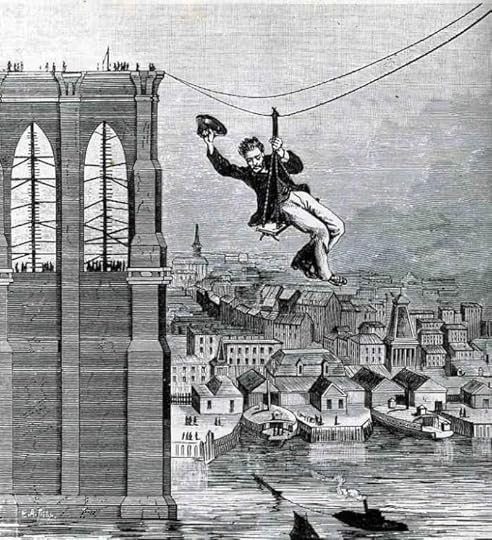
I'm looking forward to more of Wood's works.
Things I liked--there's not too much engineering and structural information to weigh down the story but enough so you know what's going on. There's plenty of details about the mishaps of those building the bridge which can be a little squimishing to imagine.
Things I might have changed--Adding some line drawings of plans, how the wires were formed, perhaps even a map; maybe adding a fictional neighbor who adds color of the neighborhood and the local and national news of the day and more of Emily's younger days.
When you read the epilogue, you may be surprised at what was made up and what wasn't. I was a little deflated when I found out that
Whee!
I'm looking forward to more of Wood's works.

October 30, 2025
4.5 stars ⭐️

April 10, 2020
I love historical fiction that includes a strong pioneering woman facing uphill challenges and doggedly striving for well-deserved respect in what is presumed to be a man’s world. This was a great entry into that genre.
I feel so satisfied when I've finished a book having learned something. The well researched details about the design and building of the Brooklyn Bridge included here make me feel a bit smarter.
I feel so satisfied when I've finished a book having learned something. The well researched details about the design and building of the Brooklyn Bridge included here make me feel a bit smarter.

June 27, 2022
An interesting story told poorly. I did learn a lot about Emily Warren Roebling, a strong woman who helped her husband build the Brooklyn Bridge. I also learned more about bridge building than I ever imagined. The book came to life when ever P.T. Barnum appeared as he was a larger than life character.
I also enjoyed reading about the suffragettes and wished more women would vote today and realize how women fought to get that right.
I have a book club discussion tomorrow and will be interested to see what others think.
I also enjoyed reading about the suffragettes and wished more women would vote today and realize how women fought to get that right.
I have a book club discussion tomorrow and will be interested to see what others think.
Displaying 1 - 30 of 1,912 reviews