Originally posted on monosounds.org.
It’s probably bad form to discuss a book in the same way you would an underground record. Typical write-ups consist of comparing a band to a more established act in order to point the reader in the right direction. I don’t think you’re supposed to review literature in that way, but goddamn it if it doesn’t apply in this case.
The elephant in the room… ‘Black Metal – Evolution of the Cult’ is far better than ‘Lords of Chaos’. Dayal Patterson makes a polite mention of this in his foreword in order to not step on toes, not to mention sales, seeing as how they’re on the same imprint. I’m going to be more explicit. This book kicks the shit out of ‘Lords’, out of ‘Until the Light Takes Us’, out of any book discussing the formation of a musical genre. Any musical genre.
Let’s start at the beginning. The most stunning piece of information from ‘Lords of Chaos’ is given in the opening chapters – “A significant degree of Black Metal’s allure and stature does not derive from the accomplished musical achievements and originality of the artists playing the music. The grisly crimes have contributed as much, and maybe even more, to its appeal.” The main author, Michael Moynihan, has a background in the neofolk/martial scene, so I’m guessing this reflects his own outlook and his own fascination with black metal. He saw it as an outsider, the wacky antics splashed on the covers of glossy magazines. I really don’t think the man had an interest in the artistic merits of the genre, rather he was drawn in by the pagan aspect and the nationalist aspect of it. This is just a guess, seeing as others have written quite a bit on his personal political affiliations and the imagery in his own music. He speaks of the Black Widow’s ‘Sacrifice’ by saying “Today it fetches large sums from collectors, clearly due more to its bizarre impression than for any other reason.” Image is much more important in his mind, and his novel, than his actual subjects. If the interviews were conducted solely for this project, and not over the course of years due to a personal love of the topic, then they would also have a bias.
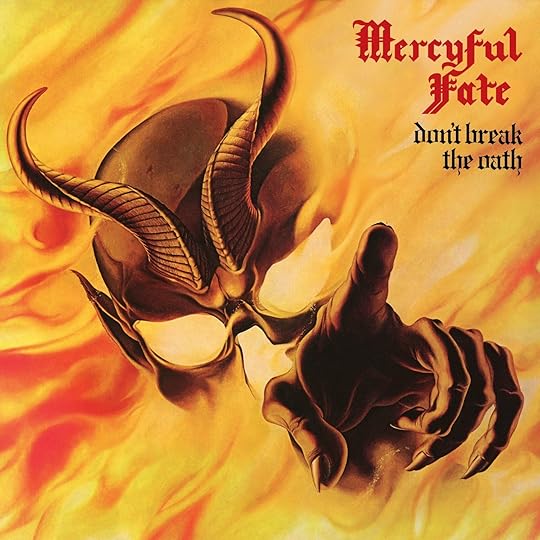
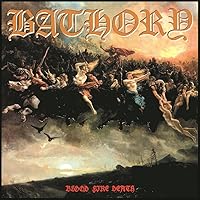
That last aspect does not come into play in Patterson’s expertly researched 600-page book. Most of the interviews came from his own zines, so he’s working with a much fuller palette. The subjects come across as relaxed in their conversations – while in the other book, they’re fully in character. It’s a very logical time line Patterson uses, it’s basically biblical. Venom begat Hellhammer. Hellhammer begat Master’s Hammer. Master’s Hammer begat Mayhem, ad infinitum. It goes well beyond Dead and Euronymous, well beyond Varg, and well beyond Quarthon. It doesn’t dwell on the history of Christian oppression in Scandinavia. It is as in-depth as in-depth gets. And it focuses on the facts of the bands included – there are no leaps trying to connect the ‘Wild Ride’ to the current state of affairs. The only ancient spirits are Sarcófago and King Diamond.
The passage of time is also a factor in making this the superior book. In the early 90s, Tom G. Warrior was persona non grata, he wasn’t even acknowledging his own past – never mind other people acknowledging his past. Some distance was required to fully appreciate how the man influenced an entire generation of musicians. Also, if there’s one fact that will be repeated from ‘Evolution’, it will be how KISS trading cards influenced every single fucking black metal musician in Scandinavia. I really never thought I’d see the day that the church-burning, murdering masses would freely admit their connection to the Gods of Thunder. Attila, Fenriz, Dead, Enslaved, Emperor, everyone sings the praises of KISS. It’s odd but really refreshing. No pretense whatsoever. Most importantly, the interviews with Necrobutcher and Manheim go into exquisite detail about the very early days of Mayhem and how they arrived at each stage of their career. Absolutely meticulous.
I recently read an article on Slate that was suggested to me, and while I agree with that author on some points, I really have to take issue with Robbins saying Patterson did not do enough to editorialize the sections on NSBM. Read ‘Lords’ and have a look at what a wreck over-editorializing creates. ‘Evolution of the Cult’ is not an entry-level book, I’d imagine. It doesn’t sensationalize, so I don’t know if there’s going to be any crossover with this piece with the True Crime genre. The folks picking this up are not going to be swayed one way or the other. Either they do not care or look the other way at some of the sketchier elements in black metal. They may do their homework and actively avoid the fascism and opt for Pantopicon. Or they actually are the sketchy elements. In any case, it doesn’t make a difference. At all.
There are a few chapters that I could have done without, and that’s just due to the fact that I could care less about the history of Cradle of Filth and Dimmu Borgir, but I totally understand why they’re in there. I don’t understand the multiple chapters on the introduction of EBM and industrial into black metal. Brevity would have worked better than individual chapters on Dødheimsgard, Thorns, Aborym, Mysticum and Blacklodge. It could be cultural, maybe industrial black metal is a far bigger phenomenon in the UK than it is in the US, but it’s just treading water after Thorns. A chapter on Immortal would serve the book better overall than multiple chapters on a sub-subgenre. Maybe a chapter on modern French bands and not so much focus on Les Legions Noire. That’s just picking nits though.
I cannot imagine the level of attention Patterson gave to this project. I mean, fuck… I’ve wanted to stop writing this review about four times since I started three hours ago. My hats are off to this dude for writing this. I’m guessing (and hoping), that music writers use this as a template – give me the history of death metal and crust punk in the same manner and I’m in. Please consider this review to be my recommendation to pick this up. Quickly.