

What do you think?
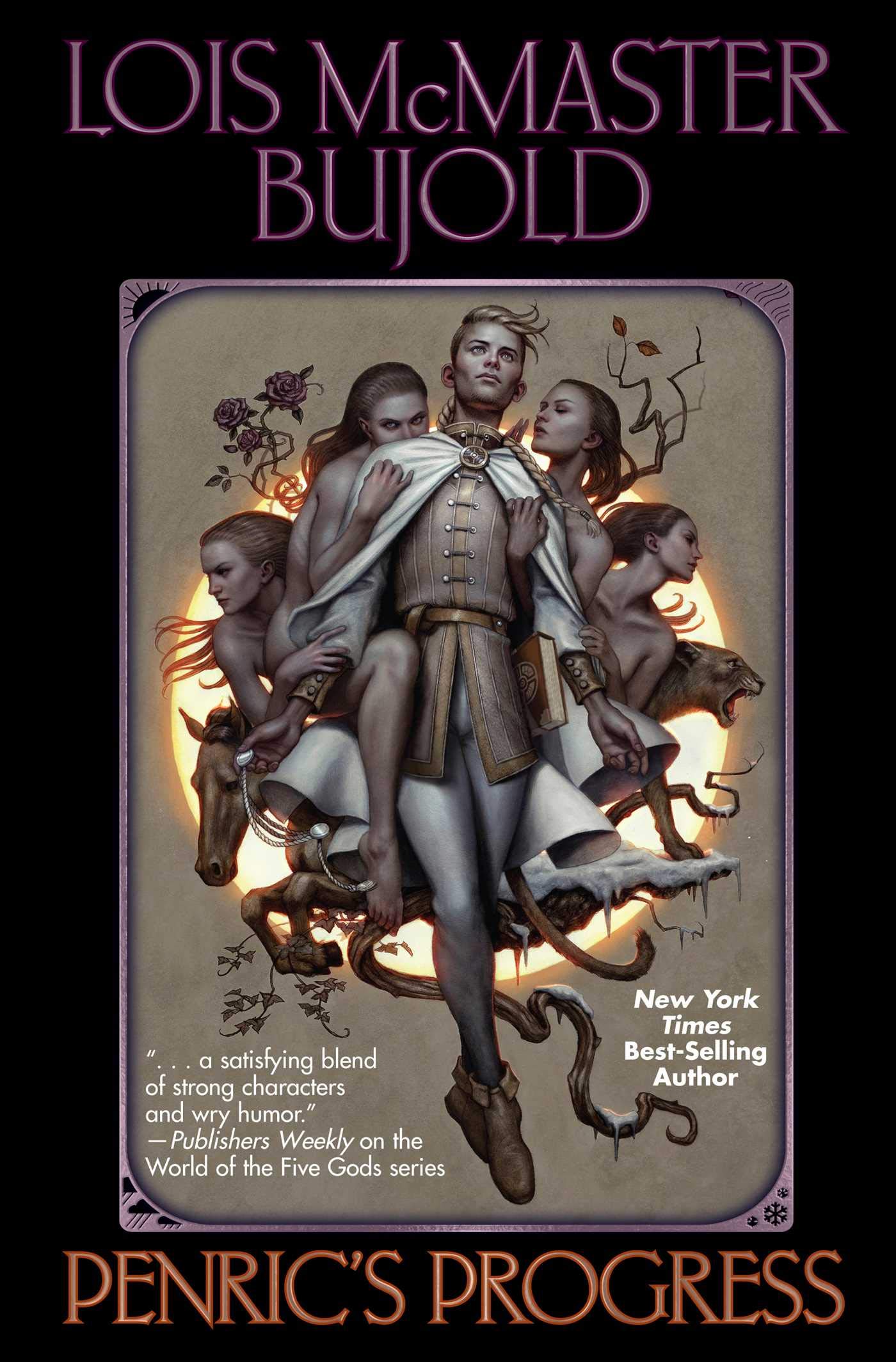
Penric and Desdemona (Chronological) #1-3
Penric's Progress
MYSTERY AND MAGIC FROM A LEGENDARY MASTER
Footloose nobleman Penric journeys from young lord to sorcerer and scholar in the Bastard’s Order—and solves mysteries along the way.
Penric’s Demon: On the way to his betrothal, young Lord Penric happens upon a riding accident and stops to help. But the victim is a Temple divine, servant to the five gods of this world. Her avowed god is The Bastard, “master of all disasters out of season.” As she lies dying, she passes her strange powers to Penric—and changes the course of his life forever.
Penric and the Shaman: Now a divine of the Bastard’s Order as well as a sorcerer and scholar, Penric must accompany a Locator of the Father’s Order assigned to capture a runaway shaman charged with the murder of his best friend.
Penric’s Fox: When Penric—sorcerer, scholar, and divine in the Bastard’s Order—travels to Easthome, the capital of the Weald, he once again finds himself embroiled in a mystery. The body of a sorceress has been found in the woods, and it is up to Penric and his friends, Shaman Inglis and Locator Oswyl, to unravel a mystery mixing magic, murder, and the strange realities of Temple demons.
About Penric's Demon:
“A novella filled with a satisfying blend of strong characters and wry humor.”—Publishers Weekly
About Lois McMaster Bujold:
"The pace is breathless, the characterization thoughtful and emotionally powerful, and the author's narrative technique and command of language compelling. Highly recommended."—Booklist
"If you love solid space opera rooted in strong character, you can't go wrong . . . The Warrior's Apprentice already displays the craft and the heart which would soon make Lois McMaster Bujold one of the most feted talents in SF."—SF Reviews
“Bujold is adept at worldbuilding and provides a witty, character-centered plot, full of exquisite grace notes . . . fans will be thoroughly gripped and likely to finish the book in a single sitting.”—Publishers Weekly on Diplomatic Immunity
Footloose nobleman Penric journeys from young lord to sorcerer and scholar in the Bastard’s Order—and solves mysteries along the way.
Penric’s Demon: On the way to his betrothal, young Lord Penric happens upon a riding accident and stops to help. But the victim is a Temple divine, servant to the five gods of this world. Her avowed god is The Bastard, “master of all disasters out of season.” As she lies dying, she passes her strange powers to Penric—and changes the course of his life forever.
Penric and the Shaman: Now a divine of the Bastard’s Order as well as a sorcerer and scholar, Penric must accompany a Locator of the Father’s Order assigned to capture a runaway shaman charged with the murder of his best friend.
Penric’s Fox: When Penric—sorcerer, scholar, and divine in the Bastard’s Order—travels to Easthome, the capital of the Weald, he once again finds himself embroiled in a mystery. The body of a sorceress has been found in the woods, and it is up to Penric and his friends, Shaman Inglis and Locator Oswyl, to unravel a mystery mixing magic, murder, and the strange realities of Temple demons.
About Penric's Demon:
“A novella filled with a satisfying blend of strong characters and wry humor.”—Publishers Weekly
About Lois McMaster Bujold:
"The pace is breathless, the characterization thoughtful and emotionally powerful, and the author's narrative technique and command of language compelling. Highly recommended."—Booklist
"If you love solid space opera rooted in strong character, you can't go wrong . . . The Warrior's Apprentice already displays the craft and the heart which would soon make Lois McMaster Bujold one of the most feted talents in SF."—SF Reviews
“Bujold is adept at worldbuilding and provides a witty, character-centered plot, full of exquisite grace notes . . . fans will be thoroughly gripped and likely to finish the book in a single sitting.”—Publishers Weekly on Diplomatic Immunity
320 pages, Hardcover
First published January 7, 2020
About the author
Lois McMaster Bujold
187 books39.7k followersLois McMaster Bujold was born in 1949, the daughter of an engineering professor at Ohio State University, from whom she picked up her early interest in science fiction. She now lives in Minneapolis, and has two grown children.
Her fantasy from HarperCollins includes the award-winning Chalion series and the Sharing Knife tetralogy; her science fiction from Baen Books features the perennially bestselling Vorkosigan Saga. Her work has been translated into over twenty languages.
Questions regarding foreign rights, film/tv subrights, and other business matters should be directed to Spectrum Literary Agency, spectrumliteraryagency.com
A listing of her awards and nominations may be seen here:
http://www.sfadb.com/Lois_McMaster_Bu...
A listing of her interviews is here:
http://vorkosigan.wikia.com/wiki/Auth...
An older fan-run site devoted to her work, The Bujold Nexus, is here:
http://www.dendarii.com/
Her fantasy from HarperCollins includes the award-winning Chalion series and the Sharing Knife tetralogy; her science fiction from Baen Books features the perennially bestselling Vorkosigan Saga. Her work has been translated into over twenty languages.
Questions regarding foreign rights, film/tv subrights, and other business matters should be directed to Spectrum Literary Agency, spectrumliteraryagency.com
A listing of her awards and nominations may be seen here:
http://www.sfadb.com/Lois_McMaster_Bu...
A listing of her interviews is here:
http://vorkosigan.wikia.com/wiki/Auth...
An older fan-run site devoted to her work, The Bujold Nexus, is here:
http://www.dendarii.com/
Ratings & Reviews
Friends & Following
Create a free account to discover what your friends think of this book!
Community Reviews
Displaying 1 - 30 of 126 reviews

March 9, 2020
ARC received from the publisher (Baen) in exchange for an honest review.
I had a fairly strong suspicion I would like the Penric novellas. The Curse of Chalion is one of my favourite books of all times, a comfort read I reread at least once a year. The new omnibus seemed like the perfect opportunity to try them out and my suspicion has proved correct - I do love them and I very much want more.
Penric, the youngest son of a minor country lord is about to be engaged. On the way to meet his betrothed, he meets an old lady in distress at the side of the road, and as she dies, her demon inexplicably passes onto him, making him a sorcerer. Of course, the marriage arrangement falls apart and he must travel to the Bastard's Order.
This omnibus is composed out of three novellas in chronological order:
- Penric's Demon, the story of how he ended up with Desdemona;
- Penric and the Shaman, where he's tasked to find a runaway shaman and solve a murder or two;
- Penric's Fox, an investigation into the murder of a sorceress and the search for her demon who ended up stuck in a fox.
And the whole thing is a delight from start to finish. Penric is, in a way, the polar opposite to Cazaril - young, with a very sunny disposition, but equally likable. I feel like cheerful male protagonists who are not really inclined to violence are a bit of a rarity, so this was nice to see. Seeing him nerd over the stuff he learns was adorable. His demon, which he names Desdemona, is older, with several lifetimes of experience, and acts more as his mentor or guide. Their dynamic was great and it was a pleasure to see them learn to work together.
The pacing is relaxed, even slow, the plot is simple, and the stakes are very low and personal. At most a murder mystery, with no kingdom- or world-saving. It's really just a story of a young man and his demon. Nothing earth-shattering, but executed well and perfect for what it is. It felt practically written for me - slow, personal stories are my favourite kind. It also works far better as an omnibus - I think if I read just one novella, it would have felt too short yet again, but three interconnected ones was just about the perfect amount.
Highly recommended, regardless of whether you read the Chalion books or not - this series takes place in a different timeline, so no prior knowledge of the world is necessary. I'll definitely be reading the next collection!
Enjoyment: 4.5/5
Execution: 4.5/5
Recommended to: anyone looking for more low-key, personal fantasy with likable characters or an uplifting read
Not recommended to: those looking for something fast-paced or full of action
More reviews on my blog, To Other Worlds.
I had a fairly strong suspicion I would like the Penric novellas. The Curse of Chalion is one of my favourite books of all times, a comfort read I reread at least once a year. The new omnibus seemed like the perfect opportunity to try them out and my suspicion has proved correct - I do love them and I very much want more.
Penric, the youngest son of a minor country lord is about to be engaged. On the way to meet his betrothed, he meets an old lady in distress at the side of the road, and as she dies, her demon inexplicably passes onto him, making him a sorcerer. Of course, the marriage arrangement falls apart and he must travel to the Bastard's Order.
This omnibus is composed out of three novellas in chronological order:
- Penric's Demon, the story of how he ended up with Desdemona;
- Penric and the Shaman, where he's tasked to find a runaway shaman and solve a murder or two;
- Penric's Fox, an investigation into the murder of a sorceress and the search for her demon who ended up stuck in a fox.
And the whole thing is a delight from start to finish. Penric is, in a way, the polar opposite to Cazaril - young, with a very sunny disposition, but equally likable. I feel like cheerful male protagonists who are not really inclined to violence are a bit of a rarity, so this was nice to see. Seeing him nerd over the stuff he learns was adorable. His demon, which he names Desdemona, is older, with several lifetimes of experience, and acts more as his mentor or guide. Their dynamic was great and it was a pleasure to see them learn to work together.
The pacing is relaxed, even slow, the plot is simple, and the stakes are very low and personal. At most a murder mystery, with no kingdom- or world-saving. It's really just a story of a young man and his demon. Nothing earth-shattering, but executed well and perfect for what it is. It felt practically written for me - slow, personal stories are my favourite kind. It also works far better as an omnibus - I think if I read just one novella, it would have felt too short yet again, but three interconnected ones was just about the perfect amount.
Highly recommended, regardless of whether you read the Chalion books or not - this series takes place in a different timeline, so no prior knowledge of the world is necessary. I'll definitely be reading the next collection!
Enjoyment: 4.5/5
Execution: 4.5/5
Recommended to: anyone looking for more low-key, personal fantasy with likable characters or an uplifting read
Not recommended to: those looking for something fast-paced or full of action
More reviews on my blog, To Other Worlds.

July 27, 2020
Omnibus of the first three Penric novellas, two of which were new to me. As always, Bujold's writing is impeccable. If you've missed any of these, your library may have a copy. And the publisher has a nice introduction from LMB (which she suggests reading after you read the stories: https://www.baen.com/Chapters/9781982... ]
No spoilers, and (assuming you are already a Bujold fan) some interesting stuff on how she writes.
There are many, many reviews of the three novellas, so I will be brief. They are connected, and in chronological order in Penric's life, but it's a collection, not a fix-up novel.
● "Penric’s Demon": the story of how he acquired his demon, named her "Desdemona" (which she liked), and starts having adventures. Not least, learning how to live with this 200 year-0ld entity in his head. A memorable scene: Penric's a young guy, he starts to play with himself one night -- but then, realizes he has a bunch of fascinated women in his head, looking forward to the show. Wilt.
4.5 stars, rounded up.
● "Penric and the Shaman." Previously read, and I had a review up here, that has mysteriously disappeared. If I find it, I'll put it back up. But, in short, I bogged down when I first read this one, and gave it 2.5 stars, rounded up. Skimming this time, I'm kicking it up to a strong 3+ stars.
● "Penric’s Fox". Another new-to-me story, and a good to great one. A murder mystery, more on the shamans, and baby foxes! First-rate story, 4.5 stars.
So I'm looking forward to catching up on the rest of these!
No spoilers, and (assuming you are already a Bujold fan) some interesting stuff on how she writes.
There are many, many reviews of the three novellas, so I will be brief. They are connected, and in chronological order in Penric's life, but it's a collection, not a fix-up novel.
● "Penric’s Demon": the story of how he acquired his demon, named her "Desdemona" (which she liked), and starts having adventures. Not least, learning how to live with this 200 year-0ld entity in his head. A memorable scene: Penric's a young guy, he starts to play with himself one night -- but then, realizes he has a bunch of fascinated women in his head, looking forward to the show. Wilt.
4.5 stars, rounded up.
● "Penric and the Shaman." Previously read, and I had a review up here, that has mysteriously disappeared. If I find it, I'll put it back up. But, in short, I bogged down when I first read this one, and gave it 2.5 stars, rounded up. Skimming this time, I'm kicking it up to a strong 3+ stars.
● "Penric’s Fox". Another new-to-me story, and a good to great one. A murder mystery, more on the shamans, and baby foxes! First-rate story, 4.5 stars.
So I'm looking forward to catching up on the rest of these!

November 22, 2019
Okay, so this one is slightly confusing. It collects three novellas that follow Penric, a side character from the novel series World of the Five Gods, so to make things easier I'm going to include the internal chronology and the numbers following will show their order of internal chronology:
- The Hallowed Hunt (World of the Five Gods, #3)
- Penric's Demon (Penric and Desdemona, #1)
- Penric and the Shaman (Penric and Desdemona, #2)
- Penric's Fox (Penric and Desdemona, #5)
- Penric’s Mission (Penric and Desdemona, #3)
- Mira's Last Dance (Penric and Desdemona, #4)
- The Prisoner of Limnos (Penric and Desdemona, #6)
- The Orphans of Raspay (Penric and Desdemona, #7)
- The Curse of Chalion (World of the Five Gods, #1)
- Paladin of Souls (World of the Five Gods, #2)
Penric's Progress collects Penric's Demon, and the Shaman, and Fox, making this an excellent entry into the world if you haven't yet got around to reading this series. Each and all are also standalone however I always recommend reading in internal chronological order; s'just how my mind works (and I'll never understand how anyone could ever want otherwise? Isn't it the easiest way to devour books to read them in the order the characters would have lived their lives?)
Back to what the story actually is. Penric is a simple young man; his full title being Lord Penric of kin Jurald, barons of a small stretch of land with not much money left in the purse. The majority of his clothes are hand-me-downs, and as we start his story he is off to be married. Nervous, but glad to be getting to live his own life away from the constant comparisons to his older siblings and the fact there wasn't enough money to send him to the university which is what he wanted to do with his life, he's now worrying if he can make his wife-to-be happy. Which is rather sweet.
Along this short journey he comes across a small party of people halted on the main road; one woman lying on the ground having taken ill, and the various people around her being temple guardsmen and from the religious Daughter's Order, for as the series title gives away, there are five Gods in this story; Mother, Father, Daughter, Son, and the fifth being the Bastard, who is in charge of all things chaotic and disordered.
The woman dies with Pen at her side, trying to give her comfort in her last moments, and it's here Penric discovers just what chaos the Bastard governs. For the woman was a Temple sorceress; a very senior one, which means she housed a demon, who need a body to ride around in generation to generation. She had been travelling to give her demon on to its planned successor but when she died early, her demon went instead to the nearest suitable person... who in this case, was Penric.
Thus his betrothal is off and he is instead thrown into the life of a sorcerer with his demon (whom he calls Desdemona) who comprises of the memories of the 12 generations who carried her before Penric did. At any time Des can speak with his voice which, at the start, is a bit awkward and hilarious.
As a demon Des's magic thrives on disorder, which at the least can be things like getting rid of all fleas and ticks in the nearby vicinity (which comes handy on their travels) and to find out what else it can aspire to, well, you'll just have to read the books for yourself.
The first three novellas cover the early years of Penric's life, from when he gets Des and manages to be allowed to keep her, to becoming the Princess-Archdivine's personal sorcerer after his training is complete (which he manages to finish years early, thanks to his demon and the past generations having gone through it multiple times already), and on to travelling with friends he's made along the way, such as the Shaman mentioned in the second novella's title.
This is a series that's hard to put down, fun, full of great characters and interesting heroics, and Penric and Des's friendship as it grows is lovely to see. She thinks she may be one of the oldest demons in existence and yet still manages to be surprised by the way in which Pen treats her. The dry wit is exactly what I love to read, and the ways in which they use the magic 'downhill' can be really clever.
Highly recommended, as are the other four novellas in this series. I'm still yet to read the three novels that make up the other part of this world which I really hope I can get to soon.
- The Hallowed Hunt (World of the Five Gods, #3)
- Penric's Demon (Penric and Desdemona, #1)
- Penric and the Shaman (Penric and Desdemona, #2)
- Penric's Fox (Penric and Desdemona, #5)
- Penric’s Mission (Penric and Desdemona, #3)
- Mira's Last Dance (Penric and Desdemona, #4)
- The Prisoner of Limnos (Penric and Desdemona, #6)
- The Orphans of Raspay (Penric and Desdemona, #7)
- The Curse of Chalion (World of the Five Gods, #1)
- Paladin of Souls (World of the Five Gods, #2)
Penric's Progress collects Penric's Demon, and the Shaman, and Fox, making this an excellent entry into the world if you haven't yet got around to reading this series. Each and all are also standalone however I always recommend reading in internal chronological order; s'just how my mind works (and I'll never understand how anyone could ever want otherwise? Isn't it the easiest way to devour books to read them in the order the characters would have lived their lives?)
Back to what the story actually is. Penric is a simple young man; his full title being Lord Penric of kin Jurald, barons of a small stretch of land with not much money left in the purse. The majority of his clothes are hand-me-downs, and as we start his story he is off to be married. Nervous, but glad to be getting to live his own life away from the constant comparisons to his older siblings and the fact there wasn't enough money to send him to the university which is what he wanted to do with his life, he's now worrying if he can make his wife-to-be happy. Which is rather sweet.
Along this short journey he comes across a small party of people halted on the main road; one woman lying on the ground having taken ill, and the various people around her being temple guardsmen and from the religious Daughter's Order, for as the series title gives away, there are five Gods in this story; Mother, Father, Daughter, Son, and the fifth being the Bastard, who is in charge of all things chaotic and disordered.
The woman dies with Pen at her side, trying to give her comfort in her last moments, and it's here Penric discovers just what chaos the Bastard governs. For the woman was a Temple sorceress; a very senior one, which means she housed a demon, who need a body to ride around in generation to generation. She had been travelling to give her demon on to its planned successor but when she died early, her demon went instead to the nearest suitable person... who in this case, was Penric.
Thus his betrothal is off and he is instead thrown into the life of a sorcerer with his demon (whom he calls Desdemona) who comprises of the memories of the 12 generations who carried her before Penric did. At any time Des can speak with his voice which, at the start, is a bit awkward and hilarious.
As a demon Des's magic thrives on disorder, which at the least can be things like getting rid of all fleas and ticks in the nearby vicinity (which comes handy on their travels) and to find out what else it can aspire to, well, you'll just have to read the books for yourself.
The first three novellas cover the early years of Penric's life, from when he gets Des and manages to be allowed to keep her, to becoming the Princess-Archdivine's personal sorcerer after his training is complete (which he manages to finish years early, thanks to his demon and the past generations having gone through it multiple times already), and on to travelling with friends he's made along the way, such as the Shaman mentioned in the second novella's title.
This is a series that's hard to put down, fun, full of great characters and interesting heroics, and Penric and Des's friendship as it grows is lovely to see. She thinks she may be one of the oldest demons in existence and yet still manages to be surprised by the way in which Pen treats her. The dry wit is exactly what I love to read, and the ways in which they use the magic 'downhill' can be really clever.
Highly recommended, as are the other four novellas in this series. I'm still yet to read the three novels that make up the other part of this world which I really hope I can get to soon.

January 7, 2020
Ahoy there me mateys! I received a copy of this fantasy omnibus eArc from the publisher in exchange for me honest musings . . .
These delightful novellas take place in the World of the Five Gods from the trilogy of that name. That said, ye do NOT have to have read the trilogy first, though I did. Book one of the trilogy, curse of the chalion, is one of the best fantasy books I have ever read. Period. I reread that book earlier this year and quickly polished off the remaining two. After finishing the trilogy I just knew I had to get me mitts on the seven novellas set in this world. And I was thrilled to find out they were all being republished in a two-book omnibus set. This review is for penric's progress which contains the novellas penric’s demon, penric and the shaman, and penric’s fox. In addition there also be an introduction from the author that states (among other things):
I took a break after each novella to (slightly) prolong the reading and record me thoughts. I also read the remainder of the introduction last (as suggested) and include me thoughts for that too. Minor spoilers from the blurbs be used so read at yer own peril . . .
penric's demon
How glorious it be to revisit the World of the Five Gods and meet Penric. I absolutely love good-hearted, kind-natured Penric. On the way to his betrothal, Penric's future is thrown into peril when he inadvertently becomes a host to a demon pledged to the Bastard, one of the Five Gods. Now a demon is supposed to be transferred to prepared and high-status people - not an untrained young man. So Penric has to cope with the complications of having a combination of twelve female personalities inside of him and the powers that subsequently ensue. While the plot is straight-forward enough, it be Penric's personality and how he interactions with his demon that truly shine. I particularly loved how they meet and begin their relationship. Penric genuinely wants to do the right thing and he be intelligent even if his naivety gets in the way. The story seems simple at first glance but is richly nuanced and a delight. I adored it! I was completely engrossed in this tale and am so glad I have the next two to read immediately after.
penric and the shaman
Well this certainly surprised me. The first surprise be the time jump of multiple years. I was slightly sad because I wanted more of how Penric and Desdemona learn to work together and their life at university. The second surprise be multiple points of view. There be three - Penric, Oswyl, and Inglis. Penric is asked to help hunt down a fugitive. Oswyl is the hunter and Inglis is the hunted (and a suspected murderer). Though the World of the Five Gods has, well, five gods, there be another type of magic as well. That of shamanism. The third book of the trilogy (publishing order), the hallowed hunt, dealt with that aspect of magic. The third surprise of the novella was how much I loved it. I quickly got used to the newer and wiser Penric. I thought it was entertaining that I had forgotten (already!) that Penric was 19 in the first novella because he felt so much younger in that one. I loved getting to see the two types of magic working side by side. But above all I continue to love the world building and the characters. Not quite enough Desdemona in this one but I loved what ye got. And the resolution was extremely satisfying and fun. Onto the next!
penric's fox
Well dang these just get better and better. This novella is back to being in only Penric's point of view but does once again feature Oswyl and Inglis as characters. Penric and Inglis are out to enjoy a quiet day of fishing only to be drawn into a murder investigation. The problem, besides the body of course, is the dead sorcerer's missing demon. Where did it go? Can they track it down and solve a murder? Well aye, but I won't spoil the fun of how it all goes down. So very fun. I did not know where this tale was going but thought the ending was perfect. I also continue to love that having demon or shaman magic does not equal an easier life. Penric is run ragged. It be a very bittersweet life. But more Desdemona in this one. Arrrr! I think this one is (barely) me favourite of the three, followed by one then two. But seriously, I love them all. The further insight into the Gods and magic be excellent.
the introduction
I loved, loved, loved the leisurely chat! So an element of the author's work be that her stories grow "organically" and thus are not published in the stories' chronological order. In this edition, the author has arranged the Penric novellas chronologically for ye. She also provides an overview at the end of the book of "all my stories and how they relate to one another" with a reading order guide. Awesome. Even more awesome is that the rest of the introduction details the author's writing process, how she names her series, how she came to write the Penric novellas, etc. Seriously ARRRR! I be very glad I listened to the author and read that information with the context I had from the novellas. Listen to her genius.
Now I read the World of Five Gods original trilogy in the publishing order as is me general preference and rule. However, I am so very glad to have the author's reading order guide because I am certainly going to branch out to her sci-fi work given how much I have adored this fantasy world. As for the Vorkosigan Saga and best reading order, the author states that she "favor[s] internal chronological, with a few adjustments." I will defer to her wisdom and will read them in her stated order with this book as me guide.
I certainly call this omnibus a smashing success and will be rereading these delightful novellas. I cannot wait for 5/5/2020 so I can read the next omnibus edition, penric's travels. So excited. But in the meantime there be plenty of backlist books to read. Arrrr!
These delightful novellas take place in the World of the Five Gods from the trilogy of that name. That said, ye do NOT have to have read the trilogy first, though I did. Book one of the trilogy, curse of the chalion, is one of the best fantasy books I have ever read. Period. I reread that book earlier this year and quickly polished off the remaining two. After finishing the trilogy I just knew I had to get me mitts on the seven novellas set in this world. And I was thrilled to find out they were all being republished in a two-book omnibus set. This review is for penric's progress which contains the novellas penric’s demon, penric and the shaman, and penric’s fox. In addition there also be an introduction from the author that states (among other things):
"So from my point of view, the ideal reader should now put down this introduction and turn to the start of the actual story, spoiler-free. Come back later; these words will wait, and the leisurely chat that follows will make more sense in context."
I took a break after each novella to (slightly) prolong the reading and record me thoughts. I also read the remainder of the introduction last (as suggested) and include me thoughts for that too. Minor spoilers from the blurbs be used so read at yer own peril . . .
penric's demon
How glorious it be to revisit the World of the Five Gods and meet Penric. I absolutely love good-hearted, kind-natured Penric. On the way to his betrothal, Penric's future is thrown into peril when he inadvertently becomes a host to a demon pledged to the Bastard, one of the Five Gods. Now a demon is supposed to be transferred to prepared and high-status people - not an untrained young man. So Penric has to cope with the complications of having a combination of twelve female personalities inside of him and the powers that subsequently ensue. While the plot is straight-forward enough, it be Penric's personality and how he interactions with his demon that truly shine. I particularly loved how they meet and begin their relationship. Penric genuinely wants to do the right thing and he be intelligent even if his naivety gets in the way. The story seems simple at first glance but is richly nuanced and a delight. I adored it! I was completely engrossed in this tale and am so glad I have the next two to read immediately after.
“It indicates a deep confusion of thinking to mistake one's own discomfort for a benefit to another.”
― Lois McMaster Bujold, Penric's Demon
penric and the shaman
Well this certainly surprised me. The first surprise be the time jump of multiple years. I was slightly sad because I wanted more of how Penric and Desdemona learn to work together and their life at university. The second surprise be multiple points of view. There be three - Penric, Oswyl, and Inglis. Penric is asked to help hunt down a fugitive. Oswyl is the hunter and Inglis is the hunted (and a suspected murderer). Though the World of the Five Gods has, well, five gods, there be another type of magic as well. That of shamanism. The third book of the trilogy (publishing order), the hallowed hunt, dealt with that aspect of magic. The third surprise of the novella was how much I loved it. I quickly got used to the newer and wiser Penric. I thought it was entertaining that I had forgotten (already!) that Penric was 19 in the first novella because he felt so much younger in that one. I loved getting to see the two types of magic working side by side. But above all I continue to love the world building and the characters. Not quite enough Desdemona in this one but I loved what ye got. And the resolution was extremely satisfying and fun. Onto the next!
"For all that we trust the gods, I think we can trust them to know the difference between humor and blasphemy."
― Lois McMaster Bujold, Penric and the Shaman
penric's fox
Well dang these just get better and better. This novella is back to being in only Penric's point of view but does once again feature Oswyl and Inglis as characters. Penric and Inglis are out to enjoy a quiet day of fishing only to be drawn into a murder investigation. The problem, besides the body of course, is the dead sorcerer's missing demon. Where did it go? Can they track it down and solve a murder? Well aye, but I won't spoil the fun of how it all goes down. So very fun. I did not know where this tale was going but thought the ending was perfect. I also continue to love that having demon or shaman magic does not equal an easier life. Penric is run ragged. It be a very bittersweet life. But more Desdemona in this one. Arrrr! I think this one is (barely) me favourite of the three, followed by one then two. But seriously, I love them all. The further insight into the Gods and magic be excellent.
“If you don’t understand something, you should just try to learn more, that’s all.”
― Lois McMaster Bujold, Penric's Fox
the introduction
I loved, loved, loved the leisurely chat! So an element of the author's work be that her stories grow "organically" and thus are not published in the stories' chronological order. In this edition, the author has arranged the Penric novellas chronologically for ye. She also provides an overview at the end of the book of "all my stories and how they relate to one another" with a reading order guide. Awesome. Even more awesome is that the rest of the introduction details the author's writing process, how she names her series, how she came to write the Penric novellas, etc. Seriously ARRRR! I be very glad I listened to the author and read that information with the context I had from the novellas. Listen to her genius.
Now I read the World of Five Gods original trilogy in the publishing order as is me general preference and rule. However, I am so very glad to have the author's reading order guide because I am certainly going to branch out to her sci-fi work given how much I have adored this fantasy world. As for the Vorkosigan Saga and best reading order, the author states that she "favor[s] internal chronological, with a few adjustments." I will defer to her wisdom and will read them in her stated order with this book as me guide.
I certainly call this omnibus a smashing success and will be rereading these delightful novellas. I cannot wait for 5/5/2020 so I can read the next omnibus edition, penric's travels. So excited. But in the meantime there be plenty of backlist books to read. Arrrr!

February 14, 2020
A fine collection of previously written connected novellas. I appreciated the intro and the reading order. At first glance I was a little irritated by the cover, but it is obviously direct from the books and grew on me over time.

June 30, 2020
What a lovely set of novellas. Penric grabs you by the heart from the first page, and so does Desdemona. The third novella was amazingly cute (and oddly, gave me a much better understanding of my cat, who is clearly a Great Cat, if not possessed by a demon). Much, much, much recommended.

February 23, 2021
Wonderful as always. Penric is fun. As these stories are novellas there isn't as much in depth characterization as say for Miles in the Vorkosigan books but you still know him. The magical dilemmas are what drive these stories and they are fun.
November 3, 2024
Penric's Demon - 4.5 Stars (A): a wonderfully strange but warm & comfy read about a young man receiving a demon that changes his life's trajectory drastically
Penric and the Shaman - 2.5 Stars (B-): an established Penric must help solve an odd supernatural mystery that requires a sorcerer's expertise and he makes some interesting friends along the way
Penric's Fox - 3.5 Stars (B+): Penric and his friends must once again solve a murder mystery requiring all their best skills and then some before tragedy strikes again. Ending with intriguing conclusion to where Penric and Desdemona may go next.
Penric and the Shaman - 2.5 Stars (B-): an established Penric must help solve an odd supernatural mystery that requires a sorcerer's expertise and he makes some interesting friends along the way
Penric's Fox - 3.5 Stars (B+): Penric and his friends must once again solve a murder mystery requiring all their best skills and then some before tragedy strikes again. Ending with intriguing conclusion to where Penric and Desdemona may go next.

January 13, 2020
Outstanding stories. I read all three of these novellas before, but I didn't have "Penric's Demon" in print, so I got this one, and I re-read the whole book. Obviously the stories are great all the way through, but I'm going to highlight the end of the first one as especially powerful. Pen is worried that he may not measure up because of his youth and Desdemona tells him in no uncertain terms ("You looked a god in the eyes. And spoke for me.") that he does. I've got individual reviews for each of the novellas so I won't repeat them here.

November 1, 2019
There used to be a time I read nothing but science fiction, with a smattering of fantasy in between. One of the fantasy-series I liked most is the books with Miles Vorkosigan - I share this with fans all over the world. I've read this series multiple times. I really admired Lois McMaster Bujold.
So many books and never enough time... and so I missed out on this delightful series when it was published originally. I'm very happy I found this on Edelweiss because I enjoyed myself immensly with this volume, the first three books in the Penric saga.
Penric lives in a rather complicated world where gods and demons are very real, and not always what they seem. In the first book Penric gets very close acquainted with some of the latter, and after some deliberation they agree on calling her (him/them) Desdemona.
The dialogs between Penric and Desdemona are often the funniest parts of Penric's tales and I had to laugh out loud sometimes.
A really great series! I hope to pick up the other books in the series soon.
For readers who would like to read a fantasy series without the obligate kings and queens who keep fighting all the time, this would be an excellent choice.
Thank you Edelweiss for this digital review copy.
So many books and never enough time... and so I missed out on this delightful series when it was published originally. I'm very happy I found this on Edelweiss because I enjoyed myself immensly with this volume, the first three books in the Penric saga.
Penric lives in a rather complicated world where gods and demons are very real, and not always what they seem. In the first book Penric gets very close acquainted with some of the latter, and after some deliberation they agree on calling her (him/them) Desdemona.
The dialogs between Penric and Desdemona are often the funniest parts of Penric's tales and I had to laugh out loud sometimes.
A really great series! I hope to pick up the other books in the series soon.
For readers who would like to read a fantasy series without the obligate kings and queens who keep fighting all the time, this would be an excellent choice.
Thank you Edelweiss for this digital review copy.

October 2, 2024
8.8/10. Light breezy start to a fantasy novella collection with masterful writing and lovable characters and plots.
----
I read Lois McMaster Bujold's first ever novel - Shards of Honour, perhaps a year or more ago, and was a little disappointed. I had heard so much about the Vorkosigan Saga, and yet the book came off as rather dated, among some other issues. I accepted that maybe a debut effort is not reflective of an author's best work and made a soft promise to return to Lois Mcmaster's work sometime in the future.
Fast forward to last week, having come out of reading two long, heavy, 500 page tomes, I was looking for something more digestible, and serendipitously chanced upon McMaster's recent novella fantasy series, and today I am so-so thankful I gave it a go because I was won over by the first 5 pages! (Now I'll have to give the Vorkosigan Saga another look!)
Penric's Progress is a collection of three novellas written after McMaster retired in 2015, and its honestly such a gift that she's writing these fantastic stories, having already established 30 years of Hugo winning material.
In the book and series' first story, "Penric's Demon", we meet a young man named Penric as he-- you guessed it, -- accidentally stumbles upon a demon in an unusual encounter. The demon promptly hops into this body, and this changes the course of Penric's life, because in the world of the Five Gods, humans harbouring demons essentially become sorcerers! Now Penric is sharing his body not only with a demon, but the 10 former female personalities (12 if you count the mare and the lioness) that the demon previously possessed! Beyond sharing some expertise with these ten women (ranging from healers to farmers to courtesan.) Penric can also do magic, which ranges from killing small insects to being able to dodge arrows, run real fast, set things of fire-- the whole works.
Honestly, beyond the 10 personalities premise ( or even with, some might argue), this might come off as pretty prosaic fantasy fare. And you're right, and so the difference is all up to the skill of the author, their craft, the focus and direction etc. And Bujold's skill as a writer is fantastic! Her prose is so lively, assured and often very witty and wry. I find myself smiling and laughing along with the writing, or sometimes pausing and revisiting lines just to appreciate the phrasing. She's also great at writing likeable characters. Penric and his demon Desdemona make such a great duo. Penric's gift isn't even the powers he has, but rather just his earnest, well-meaning nature. In fact he's the first sorcerer to NAME his demon. And for that, Desdemona-- the demon who's a collection of sardonic elderly wisened women-- is eternally grateful for having been given a title and the accompanied sense of dignity, and she takes to her new human vessel with some grandmotherly fondness.
All the other characters that Pen and Des meet also have unique personalities of their own, and its nice to see them show up in subsequent stories. It really hits the spot to find a series of character-driven fantasy novellas that are well- paced, and not too in a hurry to get anywhere or prove themselves to be the best thing you've ever read. There's a bit of a slice-of-life, light, wholesome energy to the three stories in this collection, even as there's a good enough deal of action, violence, and solemnity in this world that is careful crafted by Bujold.
Its also interesting to see where each novella goes. I did not expect the subsequent stories in the collection to go in a slightly different subgenre from the first story, and yet I quite liked it. Also, Penric grows quite a bit in age and even maturity and outlook between the novellas, which was surprisingly enjoyable and naturally.
One of my favourite authors is Robin Hobb, and I think there's a meaningful comparison to be made here between both authors as Hobb and Bujold are very much character focused writers. But it can be hard to keep up with Hobb because the trade- off engaging with her great character studies and her fantastic prose, is having to put up with the inversely terrible pacing, and all that sadness and anguish her characters are often subject to. Bujold has the same attention to character that I look for, but in the Penric novels, the reader isn't made to endure reading these characters being dragged across glass, which is a nice relief. Also as these are novellas, the stories sport a much more palatable word count, and yet doesn't scrimp on good detail, which further proves Mcmaster's skill as an economical writer. . :) To be clear, I appreciate and love both Hobb and McMaster, but a well written and paced novella that does all the things I like just makes it eminently more readable.
All in all, this is a really promising start to a whole running series of novellas, and I can't wait to continue with the rest of the series.
----
I read Lois McMaster Bujold's first ever novel - Shards of Honour, perhaps a year or more ago, and was a little disappointed. I had heard so much about the Vorkosigan Saga, and yet the book came off as rather dated, among some other issues. I accepted that maybe a debut effort is not reflective of an author's best work and made a soft promise to return to Lois Mcmaster's work sometime in the future.
Fast forward to last week, having come out of reading two long, heavy, 500 page tomes, I was looking for something more digestible, and serendipitously chanced upon McMaster's recent novella fantasy series, and today I am so-so thankful I gave it a go because I was won over by the first 5 pages! (Now I'll have to give the Vorkosigan Saga another look!)
Penric's Progress is a collection of three novellas written after McMaster retired in 2015, and its honestly such a gift that she's writing these fantastic stories, having already established 30 years of Hugo winning material.
In the book and series' first story, "Penric's Demon", we meet a young man named Penric as he-- you guessed it, -- accidentally stumbles upon a demon in an unusual encounter. The demon promptly hops into this body, and this changes the course of Penric's life, because in the world of the Five Gods, humans harbouring demons essentially become sorcerers! Now Penric is sharing his body not only with a demon, but the 10 former female personalities (12 if you count the mare and the lioness) that the demon previously possessed! Beyond sharing some expertise with these ten women (ranging from healers to farmers to courtesan.) Penric can also do magic, which ranges from killing small insects to being able to dodge arrows, run real fast, set things of fire-- the whole works.
Honestly, beyond the 10 personalities premise ( or even with, some might argue), this might come off as pretty prosaic fantasy fare. And you're right, and so the difference is all up to the skill of the author, their craft, the focus and direction etc. And Bujold's skill as a writer is fantastic! Her prose is so lively, assured and often very witty and wry. I find myself smiling and laughing along with the writing, or sometimes pausing and revisiting lines just to appreciate the phrasing. She's also great at writing likeable characters. Penric and his demon Desdemona make such a great duo. Penric's gift isn't even the powers he has, but rather just his earnest, well-meaning nature. In fact he's the first sorcerer to NAME his demon. And for that, Desdemona-- the demon who's a collection of sardonic elderly wisened women-- is eternally grateful for having been given a title and the accompanied sense of dignity, and she takes to her new human vessel with some grandmotherly fondness.
All the other characters that Pen and Des meet also have unique personalities of their own, and its nice to see them show up in subsequent stories. It really hits the spot to find a series of character-driven fantasy novellas that are well- paced, and not too in a hurry to get anywhere or prove themselves to be the best thing you've ever read. There's a bit of a slice-of-life, light, wholesome energy to the three stories in this collection, even as there's a good enough deal of action, violence, and solemnity in this world that is careful crafted by Bujold.
Its also interesting to see where each novella goes. I did not expect the subsequent stories in the collection to go in a slightly different subgenre from the first story, and yet I quite liked it. Also, Penric grows quite a bit in age and even maturity and outlook between the novellas, which was surprisingly enjoyable and naturally.
One of my favourite authors is Robin Hobb, and I think there's a meaningful comparison to be made here between both authors as Hobb and Bujold are very much character focused writers. But it can be hard to keep up with Hobb because the trade- off engaging with her great character studies and her fantastic prose, is having to put up with the inversely terrible pacing, and all that sadness and anguish her characters are often subject to. Bujold has the same attention to character that I look for, but in the Penric novels, the reader isn't made to endure reading these characters being dragged across glass, which is a nice relief. Also as these are novellas, the stories sport a much more palatable word count, and yet doesn't scrimp on good detail, which further proves Mcmaster's skill as an economical writer. . :) To be clear, I appreciate and love both Hobb and McMaster, but a well written and paced novella that does all the things I like just makes it eminently more readable.
All in all, this is a really promising start to a whole running series of novellas, and I can't wait to continue with the rest of the series.

January 6, 2020

More reviews (and no fluff) on the blog http://surrealtalvi.wordpress.com/
Penric's Progress collects the first three (in chronological order) novellas in Bujold's delightful Penric series, set in the World of Five Gods (the series starting with the Curse of Chalion). It's not necessary to have read the earlier books in the series as we are set in a different time and place, but some of the background information can give useful insight - there's very little exposition given on the world itself.In the first novella, Penric's Demon, our titular hero (a minor noble of little import) accidentally gains a powerful 'Demon', which essentially is a group or spirits, each representing a previous host. The collection is passed on to a new host when the old host dies - and this is to the nearest person, which Penric happens to be. In addition to providing the experience and skills of previous hosts, the demon also provides the host the ability to perform magic - all sorcerers in this world have a demon. Desdemona, the demon in question, is particularly old and powerful and was intended to be passed on to a trained host. Penric coming to possess (or rather, be possessed by) her causes a bit of havoc.
The second novella, Penric and the Shaman, depicts Penric's first mission. He is still getting used to his new position and skills. Penric is sent on a manhunt after a presumed murderer and in the remote mountain village not everything is what it seems.
The third novella, Penric's Fox, is a whodunnit set near Penric's base of operations. However, even if the main plot is a murder mystery, the feel of a the novel is more of a slice of life with a very nice, serene feel to it. Of the three stories, this one is my favorite.
This set of the first three novellas is very enjoyable - each story is fully self contained and it is not even necessary to read the others to be able enjoy each novel. Bujold is supremely talented author and her short stories are some of her best work in general. I especially enjoy the Penric stories as they have a very 'comfortable' feel to them - perfect for a lazy Sunday afternoon read. Reviewed from an advance reader copy provided by the publisher.

April 2, 2021
An adorable and light-hearted romp through a medieval fantasy world where trained acolytes bond with animal spirits or demons to heal the sick and injured, catch murderers, and expand the limits of their capabilities with all manner of magical activities. Penric's Progress is actually the first three novellas of the Penric & Desdemona series: Penric's Demon, Penric and the Shaman,, and Penric's Fox. Furthermore the whole series nestles right in with Bujold's other fantasy series The World of the Five Gods, and she has another series on top of that so if you decide you like her writing you're in luck, it sounds like there's a lot to read. So without further ado let me introduce you to Penric and Desdemona.
Penric's Progress is where we first meet Penric, on his way to the first day of the rest of his life of wedded bliss. His mother's best laid plans are derailed when Penric meets a dying Temple Divine on the roadway. His offer of assistance is accepted and nets him what turns out to be a collection of demons. I should clarify here that these aren't demons like we typically think of them, powerful and uncontrollable evil. While their morality can be a little fuzzy, their relationship with the human host is symbiotic and, provided the host is properly trained, the demons' knowledge and powers are a great boon. Which is good, because Penric's got a full house now and he's going to need to learn how to handle himself before the demons decide they're bored and start running amok.
Penric and the Shaman expands the cast somewhat as our now trained and promoted Penric - and Desdemona, the name he gave to the group of personalities and spirits cohabiting his corporeal form - gets sent out on loan to a Temple Inquirer chasing down a suspected murderer. Who appears to have stolen not just the knife with which the deed was done, but the soul of the victim as well. A smidge darker than Penric's Progress, but the tale as a whole is much lighter than my brief description makes it sound. Bujold expands the lore, universe, and cast in this second installment.
Penric's Fox finishes the first trio as Penric and Desdemona (and more characters from Penric and the Shaman) investigate the suspicious death of a Temple sorceress and the disappearance of her demon. Again, a little more descriptive in terms of violence and bloodshed but still very much on the mild side. Add in several new characters with fun personalities and adorable quirks and you may just want to bring book #4 home with you, so you can start it as soon as you're done Penric's Fox. Which is what I wish I had done.
Overall these books get very mild content warnings for mentions of violence, death, and murder. I also want to mention that religious imagery and church bureaucracy form a large part of the structure of the tale; however it is a religion invented solely for the books and there is no abuse of power. The whole series is like a box of kittens: cute, fun, and only a teensy bit stabby.
Penric's Progress is where we first meet Penric, on his way to the first day of the rest of his life of wedded bliss. His mother's best laid plans are derailed when Penric meets a dying Temple Divine on the roadway. His offer of assistance is accepted and nets him what turns out to be a collection of demons. I should clarify here that these aren't demons like we typically think of them, powerful and uncontrollable evil. While their morality can be a little fuzzy, their relationship with the human host is symbiotic and, provided the host is properly trained, the demons' knowledge and powers are a great boon. Which is good, because Penric's got a full house now and he's going to need to learn how to handle himself before the demons decide they're bored and start running amok.
Penric and the Shaman expands the cast somewhat as our now trained and promoted Penric - and Desdemona, the name he gave to the group of personalities and spirits cohabiting his corporeal form - gets sent out on loan to a Temple Inquirer chasing down a suspected murderer. Who appears to have stolen not just the knife with which the deed was done, but the soul of the victim as well. A smidge darker than Penric's Progress, but the tale as a whole is much lighter than my brief description makes it sound. Bujold expands the lore, universe, and cast in this second installment.
Penric's Fox finishes the first trio as Penric and Desdemona (and more characters from Penric and the Shaman) investigate the suspicious death of a Temple sorceress and the disappearance of her demon. Again, a little more descriptive in terms of violence and bloodshed but still very much on the mild side. Add in several new characters with fun personalities and adorable quirks and you may just want to bring book #4 home with you, so you can start it as soon as you're done Penric's Fox. Which is what I wish I had done.
Overall these books get very mild content warnings for mentions of violence, death, and murder. I also want to mention that religious imagery and church bureaucracy form a large part of the structure of the tale; however it is a religion invented solely for the books and there is no abuse of power. The whole series is like a box of kittens: cute, fun, and only a teensy bit stabby.

January 12, 2020
This is a collection of three of Bujold's Penric novellas, in chronological order: Penric's Demon, Penric and the Shaman, and Penric's Fox. They are #1, #2, and #5 in publication order. My ratings are 5, 4, and 4 for these three novellas, respectively.

September 26, 2021
Love, love, love! See my reviews of the separate novellas included in this volume.
Penric's Demon
Penric and the Shaman
Penric's Fox
Delightful!
Penric's Demon
Penric and the Shaman
Penric's Fox
Delightful!

December 22, 2024
The first story didn't quite click with me but the other ones? Love, love, love. Such much love for them. 🧡
Penric and Desdemona are awesome and I'm looking forward to read more of their adventures. I also hope that Oswyl and Inglis are going to show up again.
But, the cover? Shudders. Not my thing. I understand it better after reading the stories but a) why are not all of them shown and b) the artstyle is just not my thing.
Penric and Desdemona are awesome and I'm looking forward to read more of their adventures. I also hope that Oswyl and Inglis are going to show up again.
But, the cover? Shudders. Not my thing. I understand it better after reading the stories but a) why are not all of them shown and b) the artstyle is just not my thing.
This entire review has been hidden because of spoilers.

November 27, 2022
Why did these have to be short novellas?
I'm in a state of mind to read a couple thousand of pages about Penric and Desdemona and am very sad that such don't exist.
This is exactly the type of fantasy I love - a unique one with both depth and humour.
I'm in a state of mind to read a couple thousand of pages about Penric and Desdemona and am very sad that such don't exist.
This is exactly the type of fantasy I love - a unique one with both depth and humour.

June 14, 2026
If you love inventive world-building and strikingly well written dialogue, then the first three short stories about Learned Penric will delight you. He and Desdemona make for very entertaining characters with a fun dynamic.

October 15, 2025
A delightful trio of novellas about a very polite scholar and the demon he accidentally inherits. Solid classic fantasy.

March 4, 2024
Bujold is just a damned good writer. That's just it, you know. All three novellas were superb. You, too, will be happy to read them.

July 12, 2020
"Penric's Progress" collects the first three of Bujold's "Penric and Desdemona" novellas, which take place in her fantasy setting The World of the Five Gods. I'd previously read her three novels in this world, one of which, "The Curse of Chalion," I loved. As with those novels, I especially like the way that the gods are portrayed. They do not surface often, but they resonate. I also particularly liked Penric, a very likable, even sweet, young hero, and I loved his interactions with the far, far older Desdemona. While I enjoyed all three novellas, for me they liked urgency, and, in the case of the second and third novellas, it took a while before I was invested in the particulars of the plot. The first novella held my attention best, probably because it centered so firmly on Penric, who engaged my attention without need of much support at all.
Overall, I'd give this 3.5 stars out of 5, but I'd give "Penric's Demon," the first novella, 4 stars.
Update, 6/27/2022: I re-read these three novellas. I'd liked them the first time round, and liked them more on re-reading. The first novella, "Penric's Demon," is Very Good; the third, on re-reading, I liked nearly as well as the first. The second novella is merely fairly good, probably my least favorite of the nine Penric-and-Desdemona novellas I've read so far. That, however, is a high bar. I love Penric and Desdemona separately, and am especially taken by their interactions with each other.
About my reviews: I try to review every book I read, including those that I don't end up enjoying. The reviews are not scholarly, but just indicate my reaction as a reader, reading being my addiction. I am miserly with 5-star reviews; 4 stars means I liked a book very much; 3 stars means I liked it; 2 stars means I didn't like it (though often the 2-star books are very popular with other readers and/or are by authors whose other work I've loved).
Overall, I'd give this 3.5 stars out of 5, but I'd give "Penric's Demon," the first novella, 4 stars.
Update, 6/27/2022: I re-read these three novellas. I'd liked them the first time round, and liked them more on re-reading. The first novella, "Penric's Demon," is Very Good; the third, on re-reading, I liked nearly as well as the first. The second novella is merely fairly good, probably my least favorite of the nine Penric-and-Desdemona novellas I've read so far. That, however, is a high bar. I love Penric and Desdemona separately, and am especially taken by their interactions with each other.
About my reviews: I try to review every book I read, including those that I don't end up enjoying. The reviews are not scholarly, but just indicate my reaction as a reader, reading being my addiction. I am miserly with 5-star reviews; 4 stars means I liked a book very much; 3 stars means I liked it; 2 stars means I didn't like it (though often the 2-star books are very popular with other readers and/or are by authors whose other work I've loved).

January 12, 2020
Three novellas. The first is my favourite, but they're all good. Deft characterization, cool magic, depth of world. Bujold's writing is so good it rewards rereading.
I love the cover!
I love the cover!

July 21, 2020
Pretty happy with this collection of Penric & Desdemona novellas published by Baen. I’ve actually already read 2/3 of the novellas here but really wanted to get a physical copy (the Subpress editions are gorgeous but over budget for me).
Aiming to get the second collection somewhere down the line (like waaaay down the line no rush (!) as it’s not like I’ll run out of stuff to read anytime soon 😂).
Bujold is one of those authors that I’m always happy to find other people reading - I’m a big fan of her Vorkosigan Saga and the three Chalion books! Recommended!
First finished: 21jul2020
Bought new: Book Depo
-- review copy pasta'd from my insta
Aiming to get the second collection somewhere down the line (like waaaay down the line no rush (!) as it’s not like I’ll run out of stuff to read anytime soon 😂).
Bujold is one of those authors that I’m always happy to find other people reading - I’m a big fan of her Vorkosigan Saga and the three Chalion books! Recommended!
First finished: 21jul2020
Bought new: Book Depo
-- review copy pasta'd from my insta

April 20, 2021
Lots of witty, funny moments between Pen and his demon companion! Why they always seem to be tied up with murder cases, when he'd much rather be studying? Blame the white god!

June 12, 2020
I've been lagging behind on the Penric novellas, despite Lois McMaster Bujold's status as my favorite author. I read the first one when it first came out, loved it, and then promptly ignored all of the rest. This is actually a classic me move, and a big part of why I have a gajillion series that I've started and not finished. Anyway, when Baen started releasing the bind-ups of these novellas, I figured it was time to get on the bandwagon.
In the first novella, Penric's Demon, we meet Penric, a minor nobleman's son on the way to his betrothal. Along the road, he runs into an older woman who's having some health problems, and ends up, by the divine accident of her unplanned death, possessed of her demon. I think the biggest draw for this novella is Penric himself. He is adorable, and I fell in love with him almost instantly. He is a genuinely wholesome character. I loved the way that he responded to suddenly having a demon inhabiting him, and the care that he showed for her, despite his own fears.
In the second novella, Penric and the Shaman, a slightly older Penric ends up involved in tracking down a murder suspect, who also happens to be a shaman. This novella was a bit weaker for me. I was a bit confused about some of the events that were happening, which may be my own fault for reading when I was tired. I found the changing viewpoints to be less enjoyable, given my abiding love for Penric. I also thought that the shamanic magic was a bit too vague. I have read The Hallowed Hunt a couple times, which should have given me plenty of background for this story, but I have a hard time remembering it, and it's one of my less favorite Bujold works. Still, I thought this was a solid entry, and it turned out to nicely set-up the next novella.
The third novella, Penric's Fox, features the same cast as the previous novella, and even has a slightly similar plot, but I found it more satisfying. The basic premise is that a sorceress is murdered and Penric and company need to track down the murderer, as well as the sorceress's demon. This was a return to Penric as the narrator, which I appreciated. I really liked the discussion of both demonic and shamanic magic, and I found the murder investigation much more interesting this time around. I also appreciated the side characters much more in this one, and now feel like they've become old friends.
I'm really glad I got the chance to start catching up on these novellas. They're quite a treat, and I'm looking forward to continuing the collection with Penric's Progress.
In the first novella, Penric's Demon, we meet Penric, a minor nobleman's son on the way to his betrothal. Along the road, he runs into an older woman who's having some health problems, and ends up, by the divine accident of her unplanned death, possessed of her demon. I think the biggest draw for this novella is Penric himself. He is adorable, and I fell in love with him almost instantly. He is a genuinely wholesome character. I loved the way that he responded to suddenly having a demon inhabiting him, and the care that he showed for her, despite his own fears.
In the second novella, Penric and the Shaman, a slightly older Penric ends up involved in tracking down a murder suspect, who also happens to be a shaman. This novella was a bit weaker for me. I was a bit confused about some of the events that were happening, which may be my own fault for reading when I was tired. I found the changing viewpoints to be less enjoyable, given my abiding love for Penric. I also thought that the shamanic magic was a bit too vague. I have read The Hallowed Hunt a couple times, which should have given me plenty of background for this story, but I have a hard time remembering it, and it's one of my less favorite Bujold works. Still, I thought this was a solid entry, and it turned out to nicely set-up the next novella.
The third novella, Penric's Fox, features the same cast as the previous novella, and even has a slightly similar plot, but I found it more satisfying. The basic premise is that a sorceress is murdered and Penric and company need to track down the murderer, as well as the sorceress's demon. This was a return to Penric as the narrator, which I appreciated. I really liked the discussion of both demonic and shamanic magic, and I found the murder investigation much more interesting this time around. I also appreciated the side characters much more in this one, and now feel like they've become old friends.
I'm really glad I got the chance to start catching up on these novellas. They're quite a treat, and I'm looking forward to continuing the collection with Penric's Progress.

March 31, 2026
Although I’ve finished my Vorkosigan Saga project, it appears there is still more Lois McMaster Bujold for me to read! I borrowed an omnibus of fantasy novellas, titled Penric’s Progress, from a friend. It contains three extremely delightful stories about a young country lord named Penric whose general life plans go awry when he is unexpectedly possessed by a demon, an eventuality that, in this world, gives him sorcerous powers. The demon contains the memories and skills of the twelve people it had possessed previously (“people” defined loosely here; two of them were animals) as well as its own base personality, which Penric names Desdemona.
The magic systems in this set of stories are really fun, and lend a lot of interest to what is otherwise a comfortably familiar sort of pseudo-medieval-fantasy-land setting. The other thing that lends interest to such a setting is that Bujold, as always, is actually interested in social questions, so she thinks at least in passing about questions like “how do these two different religious traditions coexist when they are both observably real” and “what does having mercenary companies in a conveniently off-page borderland mean when those people come back to our established settings” and “if we used magic to invent the printing press, what would this do to the economics of going to college.” I like it when authors think about the practicalities.
But overall, these are fun magical mysteries, where Penric and his slowly growing band of allies–including the council of sarcastic female elders that lives in his head–have to solve crimes and uncover plots and not get their asses beat too badly. Utterly charming; I can’t wait to read the next batch.
Originally posted at Taking a break from all my sad literature.
The magic systems in this set of stories are really fun, and lend a lot of interest to what is otherwise a comfortably familiar sort of pseudo-medieval-fantasy-land setting. The other thing that lends interest to such a setting is that Bujold, as always, is actually interested in social questions, so she thinks at least in passing about questions like “how do these two different religious traditions coexist when they are both observably real” and “what does having mercenary companies in a conveniently off-page borderland mean when those people come back to our established settings” and “if we used magic to invent the printing press, what would this do to the economics of going to college.” I like it when authors think about the practicalities.
But overall, these are fun magical mysteries, where Penric and his slowly growing band of allies–including the council of sarcastic female elders that lives in his head–have to solve crimes and uncover plots and not get their asses beat too badly. Utterly charming; I can’t wait to read the next batch.
Originally posted at Taking a break from all my sad literature.
January 17, 2021
Started the year with something lighter.
Penric's Progress is a collection of three fantasy novellas from Bujold that, no surprise, feature strong character development and some wry humor. The stories are set in her "World of the 5 Gods." But these are much "smaller" or "personal" tales than something like Paladin of Souls. Only a few lives are impacted in each novella.
The first novella is as an Origin Story and explains how Penric, completely untrained for the task, inherits a "demon" which inhabits him either through accident or perhaps as the will of the 5th God. The Demon, which Penric names Desdemona, is hardly a fire and brimstone creature. Instead she is the culmination of memories of eight human (woman) lives, one lioness and a goat. Penric ultimately gets the ability to iill lice and vermin, set small things on fire, and the ability to speed up his body. Against that his life is turned up side down as he looses an arranged marriage and has to find a new home in a group of sorcerers who are dubious that he's actually in charge of the voices in his head...
The second novella focuses on the pursuit of a man wanted for murder, with Penric helping a companion who may or may not have a different moral compasses than Penric. How three characters try to resolve this unusual pursuit culminates in a tightly written feel good resolution. In my opinion this is the strongest of the three novellas.
The last is a murder investigation. The wrinkle is that the murdered person was a sorcerer like Penric and there is no sign of the demon. Which is potentially a very big problem. Unfortunately this one is a lot more straight forward than the first two, with less soul searching and humor. My least favorite.
While this is not Bujold's finest writing, its easily worth four stars to me. And a very enjoyable first book of 2021.
Penric's Progress is a collection of three fantasy novellas from Bujold that, no surprise, feature strong character development and some wry humor. The stories are set in her "World of the 5 Gods." But these are much "smaller" or "personal" tales than something like Paladin of Souls. Only a few lives are impacted in each novella.
The first novella is as an Origin Story and explains how Penric, completely untrained for the task, inherits a "demon" which inhabits him either through accident or perhaps as the will of the 5th God. The Demon, which Penric names Desdemona, is hardly a fire and brimstone creature. Instead she is the culmination of memories of eight human (woman) lives, one lioness and a goat. Penric ultimately gets the ability to iill lice and vermin, set small things on fire, and the ability to speed up his body. Against that his life is turned up side down as he looses an arranged marriage and has to find a new home in a group of sorcerers who are dubious that he's actually in charge of the voices in his head...
The second novella focuses on the pursuit of a man wanted for murder, with Penric helping a companion who may or may not have a different moral compasses than Penric. How three characters try to resolve this unusual pursuit culminates in a tightly written feel good resolution. In my opinion this is the strongest of the three novellas.
The last is a murder investigation. The wrinkle is that the murdered person was a sorcerer like Penric and there is no sign of the demon. Which is potentially a very big problem. Unfortunately this one is a lot more straight forward than the first two, with less soul searching and humor. My least favorite.
While this is not Bujold's finest writing, its easily worth four stars to me. And a very enjoyable first book of 2021.

January 5, 2020
What a fun read! Although this book (read from an eARC from Edelweiss) is made up of 3 previously published novellas by Bujold, reading them together gives you a continuity that is not found when you have read the individual novellas as they were published. Set in Bujold's 'World of the Gods', we meet our hero Penric in Penric's Demon where he has his life turned upside down when he stops to assist an old lady in distress by the side of the road and ends up with her demon which makes him a sorcerer. It turns out that Penric's demon has been around for a long time (over 200 years) but Penric turns out to be quite different than any of her previous hosts. He is the only one who gives her a name - Desdemona-and their bond is sealed. In the second book, Penric and the Shaman, it is several years later and Penric has gotten the education as a sorcerer that he should have gotten before he received a demon. Sent out with Locator Oswyl (basically a law enforcement official), Penric is tasked with finding a shaman who is sought for murder. In the third novella, Penric's Fox, Penric is again paired with Locator Owsyl, this time to try and solve the murder of a sorcerer. Not only was the murdered sorcerer relatively new to her demon and well loved by all, Penric's task is to find where her demon jumped when she was killed. That mystery is solved by the title but finding that fox and solving the mystery of why the sorcerer was murdered keeps us reading. Anything that Bujold writes is good but Penric and his world are especially appealing.

January 27, 2020
Electronic ARC provided by Edelweiss.
"Penric's Progress" collects the first three Penric and Desdemona novellas in one volume. I've been meaning to read the Penric novellas for quite awhile, so this book was the perfect entry point. This series takes place in Bujold's World of the Five Gods, and follows Penric, a young nobleman who unintentionally becomes a sorcerer of the Bastard's order. The first novella is sort of an origin story that introduces us to Penric and Desdemona, and gives a bit of background on the world and how things work. The following two novellas are mostly standalone adventures/mysteries, where Penric is assigned to investigate particular events.
These novellas are the perfect length to provide a fun but of adventure and character without being too much. Penric and Desdemona are likeable, and the various side characters we meet are also engaging. I especially love the way that the many voices in Penric's head are constantly popping in with their own commentary (Desdemona is a demon who inhabits Penric's body, and her personality is sort of an amalgamation of all of the previous hosts that she has had). While this series is set in the same universe as "The Curse of Chalion", you don't need to have read any of the other books to understand and enjoy these (though you should, because they are fantastic). If you enjoy Lois Bujold's fantasy works then you will like these. If you have never read Bujold, then this would be a fun and relatively light entry point. I'm looking forward to picking up the rest of the series!
"Penric's Progress" collects the first three Penric and Desdemona novellas in one volume. I've been meaning to read the Penric novellas for quite awhile, so this book was the perfect entry point. This series takes place in Bujold's World of the Five Gods, and follows Penric, a young nobleman who unintentionally becomes a sorcerer of the Bastard's order. The first novella is sort of an origin story that introduces us to Penric and Desdemona, and gives a bit of background on the world and how things work. The following two novellas are mostly standalone adventures/mysteries, where Penric is assigned to investigate particular events.
These novellas are the perfect length to provide a fun but of adventure and character without being too much. Penric and Desdemona are likeable, and the various side characters we meet are also engaging. I especially love the way that the many voices in Penric's head are constantly popping in with their own commentary (Desdemona is a demon who inhabits Penric's body, and her personality is sort of an amalgamation of all of the previous hosts that she has had). While this series is set in the same universe as "The Curse of Chalion", you don't need to have read any of the other books to understand and enjoy these (though you should, because they are fantastic). If you enjoy Lois Bujold's fantasy works then you will like these. If you have never read Bujold, then this would be a fun and relatively light entry point. I'm looking forward to picking up the rest of the series!
March 26, 2020
This collection of three novellas are a delightful introduction to this fantasy series. While I later began to wonder about the apparent holes in the structure of this fantasy world's magic system, the stories themselves were a real treat, ranging from traditional fantasy to very odd mystery stories. The first story is relatively introductory, but the other two contain the genre/crossover that makes them so intriguing, as both involve elements of mystery, but the two involve those in very different ways. Yes, technically one could call both of them “murder mysteries,” but that would be very much an over-simplification.
The character of Penric is relatively simple to read, but the interactions with a demon who is twelve “generations” old are what make the stories a treat to read. Because Penric wasn't trained to be the recipient/handler of such a creature, his lack of assumptions makes for some great passages, as he simply treats this being in a polite and mostly friendly way, rather than as a great and powerful, dangerous servant to be dealt with.
If the stories have a weakness, it's that in these first three stories, we almost learn more about the other characters than about Penric himself. Since that seems to be a stylistic choice, it didn't bother me much, but it might bother some readers.
As the stories go on, the reader can see the “demon” responding to this in fascinating ways, ranging from friendly teasing to puzzlement when Penric does something outside the being's experience over the years. I look forward to reading the next volume of these adventures.
The character of Penric is relatively simple to read, but the interactions with a demon who is twelve “generations” old are what make the stories a treat to read. Because Penric wasn't trained to be the recipient/handler of such a creature, his lack of assumptions makes for some great passages, as he simply treats this being in a polite and mostly friendly way, rather than as a great and powerful, dangerous servant to be dealt with.
If the stories have a weakness, it's that in these first three stories, we almost learn more about the other characters than about Penric himself. Since that seems to be a stylistic choice, it didn't bother me much, but it might bother some readers.
As the stories go on, the reader can see the “demon” responding to this in fascinating ways, ranging from friendly teasing to puzzlement when Penric does something outside the being's experience over the years. I look forward to reading the next volume of these adventures.
Displaying 1 - 30 of 126 reviews