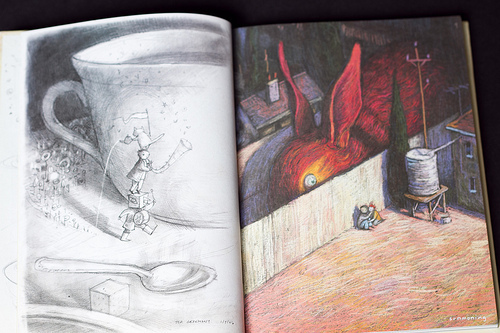
"Staring at a blank piece of paper, I can't think of anything original. I feel utterly uninspired and unreceptive. It's the familiar malaise of "artist's block" and in such circumstances there is only one thing to do: Just start drawing."
"I find good drawing requires conscientious effort: active research, careful observation of things around me, ongoing experimentation and reference-gathering, all of which exist "behind the scenes.""
"I was also interested in a spontaneity that can sometimes be missing from more finished paintings, which can suffer from excessive revision, polishing, and commercial compromise, leading to a familiar lament: "Why isn't the finished work as good as the sketch?"
I think this has something to do with the directness of small drawings, their lack of self-consciousness. Each piece in this book was generally completed in a single sitting of less than two hours, and not intended to be published at the time of execution..."
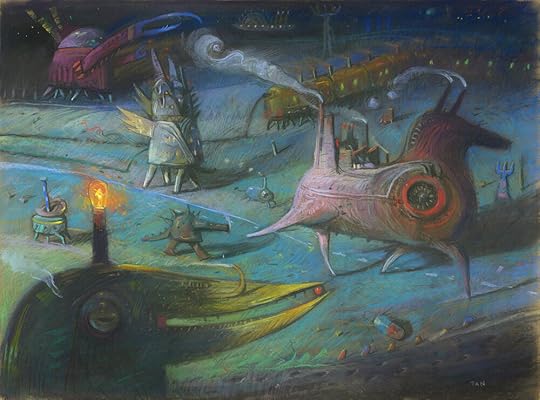
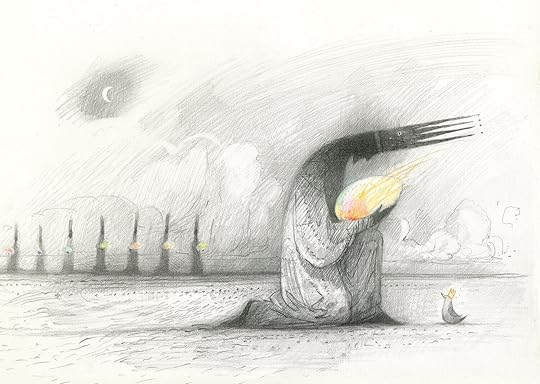
"My stories generally begin with images rather than words, modest sketches drawn in a fairly aimless way. One of the joys of drawing is that meaning can be constantly postponed, and there is no real pressure to "say" anything special when working privately in a sketchbook. Nevertheless, interesting or profound ideas can emerge of their own accord, not so much in the form of a "message," but rather as a strangely articulated question. A scene or character seems to look back from the page and ask, "What do you make of this?" A drawing feels successful to me when it is both clear and ambiguous, something I try to underscore by adding an equally ambiguous title."
"Realizing a vision can be a long and complicated affair because there's so much revision and problem-solving involved, and unfortunately the original ideas that inspire a project can easily be clouded or forgotten along the way. Quick sketches are an essential means of recording some of this source energy, like pinning ephemeral butterflies to the page, a library of fresh impressions that can be used for later reference. I usually have my preliminary studies pinned to the walls of my studio for the duration of a project, as a constant reminder of what I was "getting at" in the first place."
"Sometimes I will also cut up and rearrange drawings with scissors and tape, which can awaken further "accidental" concepts."
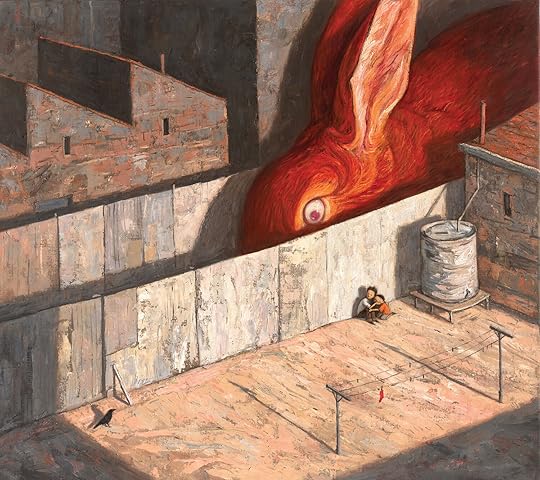
"I'm especially interested in the tensions between natural and man-made forms, and this is a a recurring theme in all of my paintings and stories. My drawings of people and animals relate to another abiding interest: the relationship between individuals and their respective environments, their sense of "belonging" to a place."
"At a more elemental level, the sketches represented here are studies in the relationship of line, form, color, and light, where I'm trying to learn a vocabulary of visual ideas and skills that will inform all my other studio work. More importantly, I'm trying to develop a certain sensibility too, finding some emotional empathy with a subject, whether it is a person, a tree, or just a shadow on water."
"It's surprising what sense can emerge from nonsense [of quick sketches], and how the juxtaposition of odd images on a page can have a serendipitous effect, catching ideas that might otherwise be hidden beneath the waves."