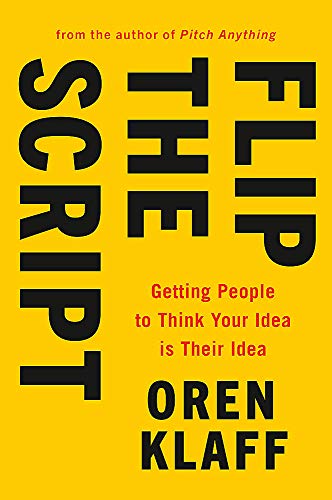
Oren Klaff, sales and negotiating expert and bestselling author of Pitch Anything, reveals new playbook on persuasion in business.
No one likes being pressured into making a purchase. Over decades of being marketed, pitched, sold (and lied) to, we've all grown resistant to sales persuasion. The moment we feel pressured to buy, we pull away. And if we're told what to think, our defenses go up. These days, it's just not enough to make a great pitch. That's why Oren Klaff says it's time to throw out the old playbook on persuasion.
Instead, in Flip the Script, he devises a new approach based on a simple insight: everyone trusts their own ideas. Instead of pushing your idea on your buyer, if you can guide them to discover it on their own, they will believe it, trust it, and get excited about it. Then they'll buy in and feel good about the chance to work with you. Klaff breaks down this insight into a series of actionable steps, for instance:
- Achieve Status Alignment: Make sure that your potential buyer or investor recognizes you as a peer on the dominance hierarchy by using a status tip-off, a strategically placed remark that identifies you as an insider who can relate to your client's concerns. - Close the Certainty Gap: Allay your buyer's fears about going into business with you by delivering a flash roll, a practiced display of technical mastery that proves your expertise in the domain. - Present Your Idea as Plain Vanilla: You can go overboard trying to present your product as a cutting-edge, first-of-its-kind solution. The more you emphasize the familiar, reliable elements of your product, showing that it's just "plan vanilla," the easier you make it for your buyer to say yes.
Packed with examples and stories of the long-shot, often hilarious deals that Klaff has pulled off over the years, from training a team of motorcycle parts salesmen in the freezing reaches of North Dakota, to selling investors on a Chinese marketplace in Hawaii, Flip the Script is the most entertaining, informative masterclass in dealmaking you'll find anywhere.
As Director of Capital Markets for investment bank Intersection Capital, www.intersectioncapital.com, Oren Klaff is responsible for managing the firm’s capital raising platform which includes both direct capital raising and deal syndication. Oren oversees business development and product development and is responsible for the firm’s flagship product, Velocity. He also sits on the investment committee at Geyser Holdings where he has been a principal since 2006. During its growth he was responsible for, marketing, product development, and business development. In the previous five years in the securities markets, Oren has supervised and assisted in the placement of over $400 million of investor capital. Previously, Oren was a venture analyst and partner at several mid-sized investment funds. He attended the University of Delaware for Mechanical Engineering, and lives in Los Angeles, CA.
Introduction ‘Drama Is Life with the Dull Bits Cut Out’, Alfred Hitchcock. Oren Klaff knows this. That’s why his everyday is like something from a James Bond movie.
Bolstered by the success of his first book Pitch Anything in 2011, Oren Klaff returns with his second book Flip The Script. It’s another series of stories from his life as a pitch hand for hire. Flying around the world Klaff makes deals for people that have problems and only Klaff can solve them.
Klaff meets hard nosed Russian oligarchs in very tall buildings. He goes to bars with women on each arm. You and I turn on a computer. Klaff fires up a computer. When he parks a car, it’s not any old car, it’s a red 1971 Alfa Romeo Sprint GT and the valet appreciates it before parking it.
Flip The Script Klaff puts pen to paper for a second time to warn us things have changed. Today ‘most things are bought, they aren’t sold’. Klaff argues information is so freely available buyers are educated to the point they can’t be sold to. (Dan Pink highlighted this in his book ‘To Sell Is Human’)
Klaff claims he has a solution to this change: get the buyer to think your idea is their idea. Most sales people know this is not a new idea. Perhaps Klaff has a new way of achieving it?
Should I read this book?
I have given Flip The Script two stars. Klaff’s tales of pitching are entertaining. He does big deals, dramatic deals and he leads a life Daniel Craig would approve of; combined with a super relaxed writing style, Flip The Script is a very easy read.
If there’s anything to be taken from Flip The Script it is Klaff’s ability to communicate through the medium of stories. Ironically, he doesn’t once explain how he builds his narratives and how to apply them to a pitch.
Below are seven reasons why I’m not buying what Klaff says in Flip The Script.
About the Author American Oren Klaff claims to be a former investment banker and now an expert in sales, raising capital and negotiation.
Classification I have classified Flip The Script ‘airport lounge appropriate‘ i.e. it can be read in a busy environment with the odd interruption and not lose your way. You can even make a last minute dash for your plane and you won’t mind leaving it behind.
7 Reasons I’m Not Buying Flip The Script NB: The term investor/buyer is used interchangeably.
1) Pitches Aren’t That Important
Klaff assumes the pitch has primacy, deals stand or fall according to them. In my experience this is too simple. The only time a pitch is all important is when you are part of a beauty parade.
A beauty parade involves an educated buyer who has bought a product/service many times before. They have time to perform due diligence and now need a way to split your deal from others, at which point they say ‘lets see who has the most compelling pitch’.
In reality many things aside from a pitch can determine the impact of a pitch, for example due diligence.
2) What About Due Diligence? This is where the buyer reviews the terms of any deal and performs checks, such as the seller’s track record, monies in place, provenance of assets etc. Due diligence can take months. In Klaff’s world due diligence takes less than an hour.
Pitching is an important driver in any deal but it’s naive to think it’s everything. In Shark Tank or Dragons Den, investors declare ‘I’m in’ but often investment isn’t made owing to ‘the numbers not stacking up’.
In Dragons Den less than half of all money pledged converts to investment.
In the real world a buyer or investor who says ‘Yes’ means nothing more than ‘Yes….. but only if the deal passes due diligence’.
3) Klaff Says Nothing New Flipping the Script proposes the buyer should believe the deal idea is their idea. A pitch's purpose is to implant the deal idea in the buyers mind so they think it's their own. Why is this valuable? Klaff says:
‘The Human Brain is thus wired by evolution to distrust any information from the outside world and to greatly favour that which originates inside us.’ I recall my grandmother suggesting a similar strategy to me when I was a child.
George Lowenstein’s approach puts this better:
‘Ask not what information do I need to convey but what questions do I want my audience to ask?’
4) What Happened To Pitch Anything? In Klaff's first book Pitch Anything, he refers to a success formula:
STRONG
> Setting the frame
> Telling the story
> Revealing the intrigue
> Offering the prize
> Nailing the hookpoint
> Getting a decision
There’s hardly any mention of STRONG or any content from Pitch Anything in Flip The Script. Should we abandon STRONG? Does Flip The Script build on Pitch Anything?
Klaff’s decision to ignore his first book undermines his credibility. Could he write a third book that overwrites everything he said in books one and two?
5) Where Does Klaff Get His Ideas From? "In the family of ideas there are no orphans.’ John Yorke Klaff suggests he has a research team with psychologists on his payroll. He’s ‘Spent years investigating … with my private research team’.
I’d like to know who are in his research team? Are his findings so hot that he refuses to share them with the world? Usually research is published so peers can review it, comment and work on improving it.
Without answers to these questions I consider Klaff a data point of one. He has interesting anecdotes but not enough to move me to change my methods. Being open and transparent builds trust, being opaque increases skepticism. As does poor attention to detail...
6) Does ‘No’ Really Mean ‘No’?
Klaff claims: “When you ask someone to give you $10 million, it’s stressful for all involved; because the stakes are high no really means no.”
However, Chris Voss in Never Split the Difference suggests you should actively seek out ‘No’ (read my book review here).
“People have a need to say “No”. So don’t just hope to hear it at some point; get them to say it early.”
Voss wants to hear ‘no’ because it can mean one of:
> I am not yet ready to agree; > You are making me feel uncomfortable > I do not understand > I don’t think I can afford it > I want something else > I need more information; or > I want to talk it over with someone else. > Who should I believe? Klaff who deals in dollars or Voss who deals in lives?
7) Flash Rolls Have Limited Value Klaff highlights a film scene from My Cousin Vinny in which an expert witness convinces a skeptical courtroom of her value by displaying her knowledge of a Chevy. She speaks quickly, very matter of fact, with lots of technical language.
Klaff says this display of domain knowledge reduces the certainty gap. However, when I read one flash roll example given by Klaff’s cyber security expert to an IT expert she was not flashed or dazzled or impressed.
Flash rolls only work when you have an uneducated buyer.
Conclusion Pitch Anything caused quite a stir when it was released. Though it had poor grammar and lifted ideas from NLP without attribution, it was easy to read, exciting and very sure of itself.
Flip The Script is not too different to Pitch Anything. Except, this time the reader is an educated reader and that’s why I’m just not buying Flip The Script.
This is not a review, but a tip: read the book and don't listen to the audiobook as Oren's delivery will make you want to reach into your app and strangle him to shut him up. I actually thought Oren was an 18 yo kid high on something until I saw his pic.
The book has some high points and some food for thought and action, but mostly it's fluff about how awesome Oren thinks Oren is. Okay, now it's a review.
I wish I could have found a summary of this book online rather than having gone through 3 hours of listening and 4 hours of skimming through the rest of the book to find the useful bits.
2 stars for the book and 0.3 additional star because of the bits mentioned above.
I thought Flip the Script: Getting People to Think Your Idea Is Their Idea would be all about manipulation. I didn’t love Klaff’s NTY best seller Pitch Anything so I fully intended to pass. But the book kept calling to me. I tried to check it out from the library. There were no copies available. I had to buy it, and I have no regrets about it.
Klaff offers six strategies for communicating with someone to arrive at a mutually beneficial arrangement. Flip the Script is not a traditional salesperson model. There is no close. There is no aggressiveness just a savvy demonstration of connection and expertise under volatile circumstances that require just the right amount of pessimism for the audience to make an informed decision. In brief, the strategies are 1) status alignment or connection with your audience 2) flash roll, a demonstration of expertise 3) pre-wired ideas about knowing that times are changing, the audience can come out two times ahead, and the person pitching has skin in the game 4) novelty chunking where are new ideas chunked together as one improvement on the norm to make the audience feel excited yet comfortable 5) pessimism—introducing what could go wrong before the audience can object and 6) be compelling also known as being yourself.
Klaff and I couldn’t be from more opposing positionalities, but as I read his approach and his narratives, I realized I had been doing them unconsciously for years. All it needed to do was replace his stories with ones from my lived experiences, and I had found the best persuasive speaking text I’ve ever encountered, which is saying a lot. I started teaching public speaking 20 years ago. His strategies can be linked together for one persuasive presentation or they can be used individually in persuasive conversation. My first class of students responded incredibly well to it. I recommend Flip the Script not only for teaching but also for personal use.
Klaff's "new" sales framework is solid. It includes the following elements: Status Tip-Off, the Flash Roll, Pre-Wired Ideas (Winter Is Coming, 2X, and Skin in the Game), Plain Vanilla (New Normal), being Compelling, and the Buyer's Formula. While he has some solid insights into the sales process, some of the elements are just repackaged ideas.
As an example, part of being Compelling involves "Sticking to Your Guns" -- which is very similar to the concept of not being needy during a sale. In his Buyer's Formula, he teaches ideas that are similar to setting the buying criteria and take-away selling. Nevertheless, he still brings some fresh insights to these old sales concepts.
I mostly enjoyed the stories Klaff uses to illustrate his formulas and techniques. At the same time I was a little bit put off by how boastful Klaff comes across. It's almost like he's subtly (or not so subtly) showboating while teaching you how he's closed one multi-million dollar deal after another.
I'm not sure how he could have done it differently. After all, he's a professional negotiator at the top of his game. So his stories are all high stakes negotations with major players and companies.
I think Klaff was aware of how his stories might come across to readers, so he inserted a couple self-deprecating stories (damaging admissions) -- yet I still came away feeling ambivalent about Klaff.
Ultimately, this is a solid sales framework for getting deals done.
As an audible book I enjoyed the stories which made the concepts come to life. I feel I need to do a reread of a text copy to pull out in bullet form the key concepts.
There is a lot of learning in this book that's for sure.
First of all, fantastic resource for tactical information on pitching your ideas/selling anything. Whether it’s a product you sell or an idea you need your boss to buy into, this book can teach you strategies to get it done.
Second, this book is SO READABLE. Instead of leading with technical jargon or explaining some aspect of psychology, he tells a story each time he introduces something new. I was bracing myself when I started reading, expecting to have to force myself to read it, but in reality… such a pleasure to read.
Definitely will be reading many more times and practicing the tools he teaches.
One small critique - it feels like his techniques could go sour if applied incorrectly. At times, you could easily be condescending or snobbish using his scripts. You also could seem threatening or aggressive. I think there’s a pretty fine balance to be had here, which the author can pull off with all his years of experience, but I’d be weary to go all-in exactly how he says to.
The advises and techniques are great, highly applicable yet anecdotal. I enjoyed reading through but almost at the end of the book, the author was describing recruiting a e-sport gamer - sniper at the last minute for Counter Strike PC game. Everyone who has played Counter Strike or watched tournaments know it's not how things work out. It was way over exaggerated and made up that undermine all the "personal encounters/experiences" that he gave as examples in the book. For that reason, I gave a 3 stars. Had it been more believable personal encounters, non-exaggerated, would have been a much better book.
Pretty good. The tips are pretty average and I have trouble believing the stories but I think the real lesson is in how he tells those stories, weaving in each of the components and how he portrays himself in them. It almost like the book is him selling himself
Really enjoyed it, Oren is not only communicating great pitching and selling advice, he is doing it through enticing stories, which makes it really hard to put down the book.
Definitely some interesting ideas for how to approach sales and the sales process. Not sure it’s entirely applicable to every sales job or customer profile, but good stuff either way.
First, you have to go into this book knowing that he's a salesmen, trying to inspire other salesmen. Second, it helps to realize he uses his own methods in the content of the book--he spends effort explaining how he is high status and a true expert so that you will take his advice seriously. So there are moments when it's over the top. But in the end, there are truly useful methods in the book--and not stuff that requires me to act like I'm a big shot.
For example, when doing a complex deal, bring multiple people at different levels/technical abilities to the conversation. Your finance leader can talk to their finance leader. Your tactical person can sync with theirs. And your big idea leader stays focused on their big idea person.
Or, when you're pitching a novel idea, find a familiar idea to connect it to (e.g. this is like a mall, it's just all outdoor shops). Being too novel gets you the meeting and also loses you the deal. Find the middle zone.
Oren is on fire as with his last book. If you haven't read Pitch Anything, start there. This builds on those same principles whether in sales or simple negotiations, he does an excellent job stripping everything down to the essence of what's effective and what is not. Also, a bonus with Flip the Script is that the anecdotes to illustrate his points are even more entertaining than the last book. Highly recommend to anyone who will ever need to close a deal.
I don't know how to feel about this book. I love the framework Oren provides but the stories he tells to convert them come across as bombastic and hard to believe, which takes away from the tactics.
I am going to have to come back to read this one again because I can't tell if my own attitude towards the book has been coloured because I think of the author as arrogant. One man's confidence and all that.
I took a glorious amount of notes - pitch anything I personally like his 1 st book more in saying that both have extreme value and will short cut your likely uneducated eyes to seeing from the educated eyes of the author. 5 stars 🌟 the man has lived lifetimes of experiences and distilled those in this book that we get to read!.
Which is awesome, literally you just apply all this and get as many reps every day in every conversation to strengthen your signal receptors ( to even form them in the first place - it’s like tagging his concepts as mental heuristics then seeing them during conversation in language patterns) then getting to a stage where that’s in the subconscious.
Well worth the read here are my notes out into orderly fashion by ChatGPT if otherwise 🤣 there would be a lot of chaos
🎯 1. Status Alignment — Start on equal footing
Getting the other person to take you seriously by demonstrating you "belong" at their level.
Tactics: Status Tip-Off Medium +12 Selling & Persuasion +12 Jake & Gino +12
– Speak insider language: Industry-specific lingo – Reveal, with brevity, what you’ve recently done in their field – Mention a real situation everyone in their world cares about Purpose: Signals you’ve done your homework and are part of their in-group. This breaks down immediate resistance.
⚡️ 2. Flash Roll — Instill certainty
A 60–90‑second technical monologue that showcases expertise and competence. Medium +2 Selling & Persuasion +2 public.summaries.com +2
Structure:
Locate the problem (e.g., “Degrading movement patterns in post-op knees…”) Take a POV (e.g., “…which always leads to hip compensation within weeks”) Deductive solution (e.g., “You must retrain the neuromuscular reflex from the core first.”) Brief economics/results (e.g., “We’ve done this for 50 clients in 6 weeks with measurable gait improvements.”) Delivery: Fast‑paced, jargon‑dense, no emotional qualifiers, no “I think” — just facts. A flashing signal of mastery.
🧠 3. Pre-wire the Brain — Use pre-existing neural receptors
Use pre-wired ideas that address what lives in their decision-brain: Threat, Reward, Fairness. Blinkist +4 summaries.com +4 Selling & Persuasion +4
Key Themes (The 3Ws): Why they should care: Trigger Threat — e.g., “Winter is coming…” shows disruption ahead What’s in it for them: Reward — promise of doubling outcomes (“2X better…”) Why you: Fairness + Skin‑in‑the‑Game — “I’ve got the most to lose if this fails.” Using these themes dissolves uncertainty quickly.
🛡 4. Inception & Containing Questions
You plant the idea, then contain their objections so their questions happen inside your frame — acting as your invisible fence. When they surface doubts, you learn from them, not get derailed.
⚖️ 5. Pessimism / Risk Containment
Bring up obvious ways things could fail and neutralize them before they do — it's called leveraging the buyer’s natural skepticism. Doesn’t kill momentum; it builds trust. SoBrief +4 summaries.com +4 Selling & Persuasion +4
🧊 6. Plain Vanilla + Novelty Chunking
Present your offer as familiar but with one compelling difference to minimize novelty overwhelm. Reddit +3 Selling & Persuasion +3 SoBrief +3
🧩 7. Autonomy & Qualification
Hand‑over autonomy: "Do what feels right." Redirect unhelpful questions: steer them back to the key frame. Qualify out disrespectful buyers: “If this feels too rigid, I might not be the right guide for you.” These create clean decision boundaries and avoid wasting time.
⏱ 8. Scream‑Speed Delivery
Deliver your flash roll and key frames faster than typical speech — jolting enough to break normal thought patterns and grip attention.
✅ Putting It All Together: 90 Seconds of Influence
Status tip-off (10s): “We’ve helped clinics adopt neuromuscular core retraining after dozens of failed surgeries; just last week we implemented it at [prestigious facility] dealing with persistent gait collapse.” Flash roll (60–90s, fast): “Here’s the deal: a knee that’s been through surgery almost always loses proprioceptive feedback within two weeks. That causes hip torque vectors to shift by +15%, which then pulls the pelvis into an anterior tilt. Step patterns degrade, glutes shut off… Our approach plugs in an early core-to-knee reflex reset, retrains the dorsiflexion chain in phase with hip drive, and we see gait efficiency improve by 34% in 4–6 weeks… so if someone’s still limping 3–6 months post-op — that’s your bottleneck.” Pre‑wires: – Threat: “Waiting longer makes these patterns unconscious — those inefficiencies harden.” – Reward: “Intervening now nearly doubles recovery speed.” – Fairness: “I can’t take your client unless we’re both fully committed — I’m scaling my team so failing this would affect us too.” Autonomy + fences: – “Of course, your team decides what to pilot.” – If they digress: “That’s actually outside our focus — we stay tightly on neuromuscular reset.” – If they push back: “If that feels too structured, maybe it’s not the right fit — no hard feelings.” Contain risk: – “Sure, we could fail: if the client doesn’t perform three precursor injections or skip sessions…” (then neutralize it). Close: – “Want to preview how we’d roll it out at your busiest clinic?” ✨ Why It Works Status alignment gets them listening. Flash roll establishes undeniable competence. Pre-wired ideas answer their internal questions. Pessimism + autonomy builds trust and framing control. Scream‑speed locks attention and avoids overthinking
This entire review has been hidden because of spoilers.
Oren Klaff is a deal maker. He’s brought in to close high-stakes deals for clients. He has some great info here on overcoming objections and getting around the status quo when it comes to interacting with high level leaders/C-suite.
Book full of funny stories, like a comedy :) The first part contained more useful tips; the second half was a bit too empty for me. Anyway, my notes => The buyer has been lied to so much that he does not believe in selling texts anymore. But they do believe their own ideas, so it’s useful to serve things as their own ideas. “The products are not sold anymore, they are bought”. * PROFOUND - we have to talk on the same level as the other person, when trying to influence! When they are higher, we have to present ourselves as higher! When pushing for deals, the author as CEO (“the deal maker”) has a whole hierarchy of employees (CFO, Marketing Officer, Senior Analyst, Legal, Client Relations, Junior accountant, Assistant) to serve the other party on the same level - so when the conversation opens up with their CEO, this is the first time that he steps in (and presents himself as scarcity). * “The status tip-off” - the big players have a way of communicating with each other by tipping off the status with a few sentences, so that they recognize the other “insider”. The key is to 1) use specific language 2) describe a recent action You have taken in the field 3) Mention a real situation the industry really cares about. * “The Flash-roll” - a quick set of highly detailed information presented in a dull/boring format like You do these things every day. Speak fast (240 words per minute), speak emotionless, no ego or charisma, but very specific. So fast and detailed that even the experts won’t dare to mention, that they did not get it 100%. * Humans are pre-wired for thinking about a deal 1) “Why should I care, what are the threats?”. Present the “Winter is coming”, how good times are about to end. They will die, if they do not change. 2) “What's in it for me?” Follow the “2x as good results with 2x lower fees” formula. 3) “Why should I deal with you? Why should I trust you?”. Show You’ve got “Skin on the game”, that You are invested even deeper than they are. That You have made real sacrifices and that You have paid the price to be here. “I have made it so far without You, let’s see how far we can go together”. * I liked the author’s opening on a meeting: “I'm glad we could get to each others calendars" - feeling of scarcity. And often he ends with: “Anyway, that’s what I would do and i’ve done these things a hundred times” - or “Hey, I solve these problems every day, let me help”. * You get faster to the listener’s imagination if You present cliche stereotypes that already pre-exist in their head. * There is a balance of novelty threshold (panic) and curiosity - while there has to be SOME novelty, it has to be limited not to scare away. So group all Your novelty together to get attention, but the rest present as “plain vanilla” to get the feeling of comfort too. * In every deal there are some downsides so don’t try to tear down every argument the other person has, but leave in some room for pessimism. If You blindly attach every argument, You lose credibility, so pick Your battles. * As a salesperson do not bend according to Your client, but stay true to Your vision. If You change Your personas like a wardrobe, then the customer loses faith in You.
What is great about the author is that he knows how to engage an audience. The book isn't boring, the author is a great story teller. He understood how to embed his concept in multiple stories and sales pitches. Each pitch is a great lesson that he has to offer. Pitching is an art and the author understood how to gather powerful insights across the pitches that he does for for various clients.
In Klaff's first book Pitch Anything, he refers to a success formula:
STRONG
> Setting the frame
> Telling the story
> Revealing the intrigue
> Offering the prize
> Nailing the hookpoint
> Getting a decision
Now he reveals another such framework to pitch the concept in a way that the investors believe that it is also their idea. This is an upgrade over the previous formula that the author has suggested, indicating that the new sales formula have to be altered according to the need of the hour or as the market saturated and becomes more educated, it is now required to up the ante.
I loved the way the author takes the reader from the russian oligarchs to a luthivanian car maker, all the while sticking to his script and dissecting each pitch and analyzing how sticking to his script helped them crack the deal. This felt like sherlock holmes analyzing a case and then ripping it open for everyone to understand how the pieces fit together and how all of them come together to cause the crime.
Klaff's "new" sales framework is solid. It includes the following elements: Status Tip-Off, the Flash Roll, Pre-Wired Ideas (Winter Is Coming, 2X, and Skin in the Game), Plain Vanilla (New Normal), being Compelling, and the Buyer's Formula. While he has some solid insights into the sales process, some of the elements are just repackaged ideas.
Reading Flip the Script felt a bit like being cornered at a party by someone who won't stop bragging - except this one wrote a whole book about it.
I made it through over half the pages, hoping the relentless self-congratulation and endless stream of irrelevant details might eventually give way to something useful. Spoiler: they didn't. But the real turning point came in a chapter where the author attempts to flex his deep understanding of gaming by introducing us to a "world-class sniper for a Counter-Strike team."
Now, I'm willing to suspend disbelief for the sake of storytelling. Maybe names were changed, fine. But then came the scene: a dramatic account of a Counter-Strike match complete with weapons and gameplay mechanics that don't actually exist in the game. Finally, this elite pro gamer apparently joined a live tournament match mid-game from his phone. I wish I were joking.
At that point, whatever credibility the author had been clinging to went up in smoke faster than his fictional sniper could spawn into his imaginary map.
To be fair, if you're genuinely interested in the rare nuggets of practical advice buried beneath all the noise, there's a neat little two-page conclusion at the end. You could read just that and save yourself a few hours of eye-rolling.
Or better yet, don't bother flipping any pages of this book. Unless you're collecting examples of how not to write nonfiction, in which case - congrats, you've found gold.
First off, this is like the Ready Player One of business/sales books. Full of references to popular culture of the 80s, fun stories, etc. It's an easy read. It's not a lecturing and boring business book.
Next, the idea is really great. It addresses a very real problem - we all hate being sold to/at. There was a time where sales people were the gatekeepers of information. That day has passed, and we can get info on our own pretty rapidly. If you don't differentiate, you're in a downward cycle of offering more for less until you have no profit margin. Flip the Script helps you see how to present yourself as the resource customers need, who they will choose, for achieving what they're after.
This book doesn't just teach you how to present your ideas, it makes me hopeful to encounter sales people who follow these ideas. I don't want someone tricking and berating me into buying. I want someone who knows what they're doing, who understands me, presenting good options to me that I get to choose.
I get nearly all of my books from the library, and don't collect books. This is one I may end up buying to have a copy readily available, and I'd definitely consider giving to the right people as gifts.
This book offers valuable insights into how to effectively persuade customers to purchase a product. The majority of the content centers on the author, Oren Klaff, and his project. Klaff provides a step-by-step guide to successfully convincing customers, highlighting key points such as establishing equal position, utilizing fast and persuasive language, and incorporating a series of ideas related to the winter season, 2x, and being in the game to answer why customers should be interested, what benefits they will receive, and why they should choose your product. While the author's writing style may come across as self-important, the modern sales techniques presented are relevant and worth exploring, and can be applied based on individual preferences. Tên tiếng việt của cuốn sách là Tâm lý học thuyết phục. Mình bị dụ mua vì có từ khóa "tâm lý học" này, phải nói là cho 3 sao vì cái tựa không liên quan nhiều đến nội dung gốc của tựa sách bằng tiếng anh.
Friendly read, he has the kind of stories you’d enjoy listening to over a beer. I’m not sure this book is marketed as accurately as it could be, it’s less of a guide for selling to investors and more of a collection of stories that demonstrate how important it is to research your potential client before the pitch.
There are a handful of really good tips, although if you’ve taken psychology it’ll sound familiar: -status alignment; proving you’re at the same level as your audience before pitching. -flash roll; proving your skills within 90 seconds. Making sure to talk faster during this ramble, and keeping to technical language. -novelty chunking; isolate the weird or unusual part of the pitch as ‘new and different’ then place it against a backdrop of ‘completely normal’.
Ultimately a large part of his success seems to be that he researches his potential clients and then aligns his pitch with their interests.
Flip the Script: Getting People to Think Your Idea is Their Idea
In "Flip the Script," Oren Klaff presents an innovative strategy for closing sales by making prospects believe that your idea is actually their own.
This book challenges traditional notions of persuasion and teaches you how to effectively guide clients to discover and get excited about your idea.
Rather than pressuring them to buy, you'll learn how to build trust and alignment, address their concerns, and present your idea in a relatable and familiar way.
With entertaining anecdotes and practical steps, Klaff shares his expertise in deal-making, helping you transform your pitching approach, secure deals, raise funding, and thrive in challenging business situations.
"Flip the Script" will revolutionize your understanding of persuasion and have you closing deals with confidence.
Love Oren and I get him back on my podcast tomorrow. This book was great. Better maybe. It felt also like a resume. I loved the stories and the diversity of the pitches.
I’ve always loved my job in marketing and think I’m quite good at it. This is a job I would take. Hopefully visiting Oren at his office next month and gonna tell his team to let me be an intern. The creativity of the deals is just as fun as the creativity with campaigns.
Was a privilege to hear these stories and the application of the stories translated well into the learnings.
Answer these three questions asap for the buyer’s Brain: 1. Why do they care 2. What’s in it for them 3. Why me
And the 3 pre-wired starting points / mental hooks: 1. Winter is coming 2. 2x 3. Skin in the game
Gotta write them and practice them till they’re in my daily vernacular.
With real deal examples of medical deal with oligrachs, renewable energy investors, voice verification software with swiss banks, genetic testing, esports, bike selling from Dakota and Volka Motors, Orin explains good ways. Foe example, To maintain status alignment, keep yourself in the lead position, scarce and things consistent with your position on the team and as the person in charge. Obedience(eg hospital nurse) to uniforms different from influence via hierarchy. Before you implant an idea('inception'), you need to show status alignment(eg fellow car enthuasiast as valet). Status tip off can be industry lingo, recent action and real industry situation, also flash roll(250 word/60-90s display of technical mastery on complex subject on problem-POV-solution and 'fast') Approaching Doom(Why should I care/Industry transform and you are the best) Big Payoff(what is in for me) Fair Deal(Is this a good transaction)
A must-read for people in sales game. Oren Klaff writes very well. I mean excellent! You can easily read the book, enjoy every single bit of it, and get a lot of value. The book is written just the way Oren talks (I've talked with the guy before). Each chapter Oren will tell a story, and injects those sales strategies and philosophies in between each section. The number one reason why I gave this book 4 stars, is this: Sometimes you can clearly see that the author is just pouring words to fill the page. Unnecessary story pieces here and there would annoy you. And the other major downside of this book, for me personally, was the low range of knowledge being shared. I think Oren could share more knowledge instead of boring details.
I think I was a little skeptical to read this book as I am when picking up a new sales book. I'm usually afraid that it won't live up to expectations or that it'll be a complete dud. The worst is when the book is mediocre at best and you're so far invested that you feel obligated to finish it. This book was nothing like that. I loved how each chapter was its own story. This way the information was easily retained, since anyone can recall the story. I also like Oren's dive into details and gave just the right amount of descriptions. I mean, I don't want to oversell this book, but it's one of the best sales books I've read to date!
the stories in this book were so gripping and entertaining, not to mention Klaff's hilariously rude comments. lots of great, golden ideas in this, and I took a lot of notes. however, the meat of these ideas are not for everyone, and not for all salesmen, but just for business-to-business deals. if you sit down with clients, or just have them walk by your business, you have to just salvage some of the ideas in the book and refine them yourself. the ideas felt sufficient, but I can't help but wish that he went into more detail on the ideas instead of just having them to integrate into the stories.
This book is for anyone looking to elevate their persuasion skills by evaluating the psychology of influence and offering practical strategies to make your ideas heard and embraced. Klaff provides a step-by-step framework for crafting messages that resonate with your audience, emphasizing the importance of audience-centric communication.
What I liked most about this book is its applicability across various settings. Whether you're in for-profit, leadership, or non-profit organizations, Klaff's techniques could be valuable. The negotiation strategies shared, drawn from real-world deal-making experiences, are insightful.