

What do you think?
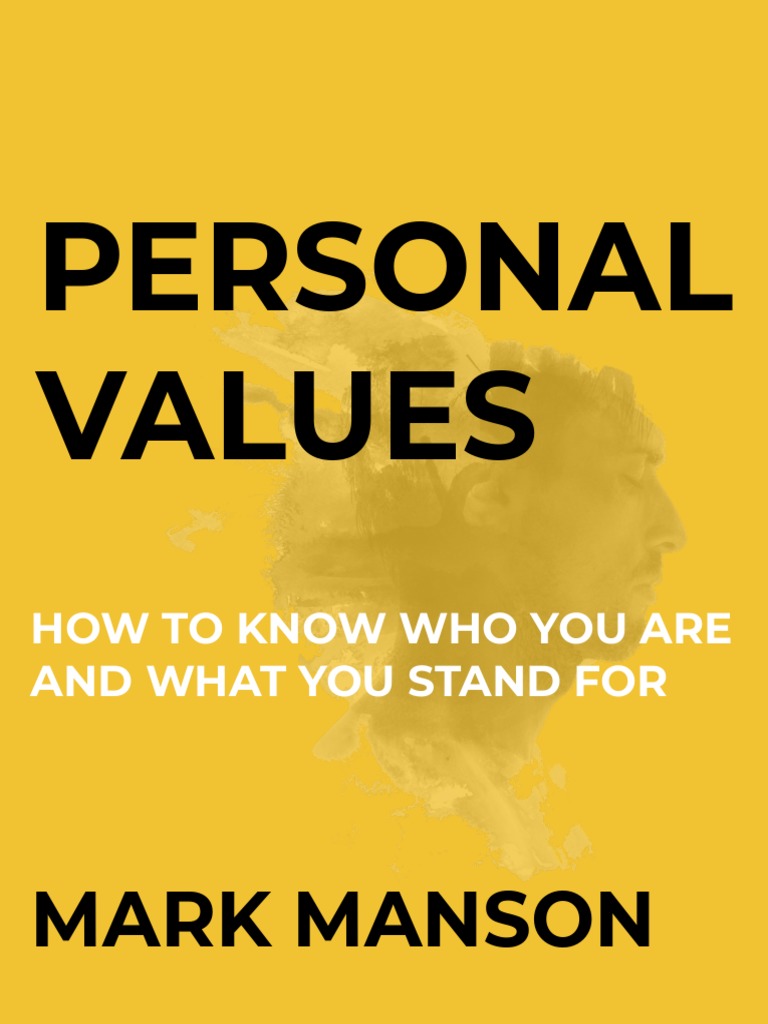
Personal Values How to know who you are and what you stand for
50 pages, Kindle Edition
Published January 1, 2019
About the author
Mark Manson
105 books19.2k followersMark Manson (born 1984) is a professional blogger, entrepreneur, and former dating coach. Since 2007, he's been helping people with their emotional and relationship problems. He has worked with thousands of people from over 30 different countries.
He regularly writes and updates his blog at: www.markmanson.net
He regularly writes and updates his blog at: www.markmanson.net
Ratings & Reviews
Friends & Following
Create a free account to discover what your friends think of this book!
Community Reviews
Displaying 1 - 11 of 11 reviews

October 9, 2022
Some excerpts:
"...you cannot talk about self-improvement without also talking about values. It’s not enough to simply “grow” and become a “better person.” You must define what a better person is. You must
decide in which direction you wish to grow...
A lot of people don’t realize this. A lot of people obsessively focus on being happy and feeling good all the time —not realizing that if their values suck, feeling good will hurt them more than help them.
...
Our values are constantly reflected in the way we choose to behave.
This is critically important—because we all have a few things that we think and say we value, but we never back them up with our actions...
Values are the fundamental component of our psychological make-up and our identity . We are defined by what we choose to find important in our lives. We are defined by our prioritizations.
...
Good values are:
1. Evidence-based
2. Constructive
3. Controllable
Bad values are:
1. Emotion-based
2. Destructive
3. Uncontrollable
...
Psychological research also shows us that our feelings are generally self-centered, willing to give up long-term benefits for short-term gains, and are often warped and/or delusional."
"...you cannot talk about self-improvement without also talking about values. It’s not enough to simply “grow” and become a “better person.” You must define what a better person is. You must
decide in which direction you wish to grow...
A lot of people don’t realize this. A lot of people obsessively focus on being happy and feeling good all the time —not realizing that if their values suck, feeling good will hurt them more than help them.
...
Our values are constantly reflected in the way we choose to behave.
This is critically important—because we all have a few things that we think and say we value, but we never back them up with our actions...
Values are the fundamental component of our psychological make-up and our identity . We are defined by what we choose to find important in our lives. We are defined by our prioritizations.
...
Good values are:
1. Evidence-based
2. Constructive
3. Controllable
Bad values are:
1. Emotion-based
2. Destructive
3. Uncontrollable
...
Psychological research also shows us that our feelings are generally self-centered, willing to give up long-term benefits for short-term gains, and are often warped and/or delusional."
December 23, 2024
What were my expectations when picking up this book?
- It will help me generate a list of personal values to live by.
Did it meet my expectation?
- No. It had some good ideas about evolution of values in the natural development of people, but it did not have help generate any list of values.
My Notes:
Parameters to select your values:
1. It must be evidence based but not emotion based (no explanation on how to arrive at evidence based values).
2. Constructive vs destructive: Growth vs pain can be hard to differentiate unless you know the why or the intention. 'The Why' matters.
3. Controllable vs uncontrollable: Are your values under your control or at the mercy or the world or others? You cannot always control pursuit of money (bad value) but you can always control the choice to be conscientious (a good value) which may make you more money.
The book title does not do justice to its content. It did not teach me to know who I am and what I stand for. There are good ideas here but no help to practically figure things out.
- It will help me generate a list of personal values to live by.
Did it meet my expectation?
- No. It had some good ideas about evolution of values in the natural development of people, but it did not have help generate any list of values.
My Notes:
Parameters to select your values:
1. It must be evidence based but not emotion based (no explanation on how to arrive at evidence based values).
2. Constructive vs destructive: Growth vs pain can be hard to differentiate unless you know the why or the intention. 'The Why' matters.
3. Controllable vs uncontrollable: Are your values under your control or at the mercy or the world or others? You cannot always control pursuit of money (bad value) but you can always control the choice to be conscientious (a good value) which may make you more money.
The book title does not do justice to its content. It did not teach me to know who I am and what I stand for. There are good ideas here but no help to practically figure things out.
June 24, 2022
It was ok.
We need to pursue good transcendental personal values like freedom instead of money.
We need to learn to do things for the sake of ourselves.
We need to stop doing things that are transactional in nature. Don't pursue values just for the sake of material or transactional things in the future.
Really drill down on your values. You will always try to justify them even if they will eat you inside.
Don't follow values that never leave you satisfied but instead leave you on a treadmill of wanting more, more, more without a goal.
Follow values with well defined goals. Dont follow something like money because there is always more to be made and it creates problems. If you chase something like freedom, you only think of how much money you need to achieve it.
Good values are:
1. Evidence-based
2. Constructive
3. Controllable
Bad values are:
1. Emotion-based
2. Destructive
3. Uncontrollable
We lie to ourselves about our values because we want to cover something up.
We need to pursue good transcendental personal values like freedom instead of money.
We need to learn to do things for the sake of ourselves.
We need to stop doing things that are transactional in nature. Don't pursue values just for the sake of material or transactional things in the future.
Really drill down on your values. You will always try to justify them even if they will eat you inside.
Don't follow values that never leave you satisfied but instead leave you on a treadmill of wanting more, more, more without a goal.
Follow values with well defined goals. Dont follow something like money because there is always more to be made and it creates problems. If you chase something like freedom, you only think of how much money you need to achieve it.
Good values are:
1. Evidence-based
2. Constructive
3. Controllable
Bad values are:
1. Emotion-based
2. Destructive
3. Uncontrollable
We lie to ourselves about our values because we want to cover something up.

July 7, 2022
Personal Values dissect the reasons behind each people’s values. What built them and what caused them to be. This book also thoroughly discusses what enables someone to value something while others don’t. This book also discusses some types of relationships that are toxic and healthy. Principles that made the foundation of the values are also discussed here. I learned there are genuine and conditional-based relationships, or as the author describes, transactional-based values. Moreover, I also learned that people’s values are divided into three: child, adolescent, and adult. While a child doesn’t have a principle, an adolescent and adult have it. Furthermore, people’s value has been built upon their lives since little and is significantly affected by their surroundings and relationships, mostly with their family and friends.

April 28, 2023
This is a follow up book from the Classic "The Subtle Art of Not Giving A F*ck", and I think it gives a good explanation about values (what is it, how to spot it, and more importantly, how to update it to better ones).
It's a book that calls for quiet times and reflection. What are my real values? What are the things that I wish to see as my values, but I still fail to do so? I highlighted a lot of things and I'm sure some of it leads to pages of self reflection. It's a book that you can read over and over again throughout years of your life.
This is my second Mark Manson's books and I'm convinced that I want to read more of his works in the future.
It's a book that calls for quiet times and reflection. What are my real values? What are the things that I wish to see as my values, but I still fail to do so? I highlighted a lot of things and I'm sure some of it leads to pages of self reflection. It's a book that you can read over and over again throughout years of your life.
This is my second Mark Manson's books and I'm convinced that I want to read more of his works in the future.

July 4, 2025
Dari buku ini aku belajar bahwa di kehidupan ini kita harus punya nilai-nilai yang kita anut di kehidupan kita yang mengatur tindakan kita sehari-hari dan nilai-nilai yang lebih tinggi yaitu dari agama contohnya agar hidup kita lebih bermakna.
nilai yang paling berbekas dari buku ini yaitu adalah kita sebagai manusia dan orang dewasa seharusnya mempunyai nilai-nilai yang kita anut berdasarkan karakteristik ini : Tindakan yang akan kita lakukan tidak terpengaruh oleh perasaan, pilih hal yang membuat kita tidak enak karena pasti outputnya lebih baik daripada dopamine murahan, pilihlah value yang dapat kita kontrol di kehidupan sehari-hari bukan yang tidak bisa kontrol.
nilai yang paling berbekas dari buku ini yaitu adalah kita sebagai manusia dan orang dewasa seharusnya mempunyai nilai-nilai yang kita anut berdasarkan karakteristik ini : Tindakan yang akan kita lakukan tidak terpengaruh oleh perasaan, pilih hal yang membuat kita tidak enak karena pasti outputnya lebih baik daripada dopamine murahan, pilihlah value yang dapat kita kontrol di kehidupan sehari-hari bukan yang tidak bisa kontrol.
March 22, 2021
It was OK.
The author advocates that we should value things that enhance ourselves and others, with the emphasise our intention that matters most.
We should obtain our values from experience and learn to have values that we can control, for example, giving your best effort or doing something you find meaningful.
One should foster the willingness to be unmoved by suffering.
The author advocates that we should value things that enhance ourselves and others, with the emphasise our intention that matters most.
We should obtain our values from experience and learn to have values that we can control, for example, giving your best effort or doing something you find meaningful.
One should foster the willingness to be unmoved by suffering.

May 30, 2020
Very engaging and thoughtful
August 13, 2020
Me pareció un buen análisis de lo que son los valores y para que nos sirven, lo que más me gusta fue el desenlace y como todo al final confluye en lo que significa madurar realmente.
October 1, 2022
Five stars because it reminds me what maturity means, and to differentiate between doing something for pleasure vs. doing something because it's right.

May 2, 2024
With a simple contrastive example of a child, adolescent and an adult, the author has explained what personal values could be.
Displaying 1 - 11 of 11 reviews