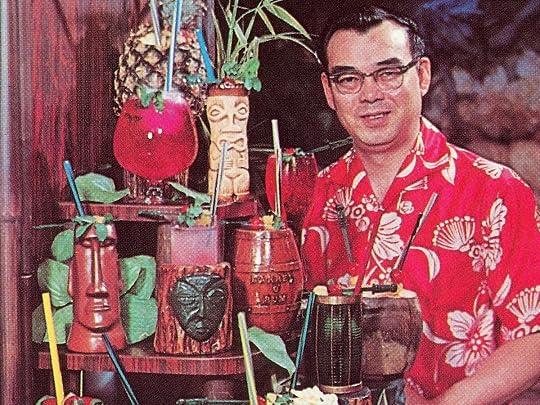
Hula girls, palm trees and Tiki gods beckoned Ohioans of the 1950s and '60s as tropical hot spots sprang up in suburban neighborhoods and concrete jungles alike. The Kon Tiki restaurants of Cleveland and Cincinnati slung rum cocktails to patrons eager for escape to a South Seas paradise. Visitors to the famed Kahiki Supper Club of Columbus, the Tropics in Dayton and Toledo's Aku-Aku could spot celebrities swaying to the exotic sounds of steel guitars and native percussion. Venturing a step beyond restaurants and bars, others decked out theaters, bowling alleys and even a McDonald's in sultry island décor. Join author and Tiki veteran Jeff Chenault on an excursion into a bygone era when the South Pacific came to Ohio.
There used to be a time---not too long ago, actually---when Polynesian kitsch was all the rage: Tiki gods, cocktails with an overabundance of rum and fruit juice and little umbrellas in them, Hawaiian shirts, grass skirts, and colorful leis.
Seriously, whole generations have grown up in a time when going out to eat at a Polynesian-themed restaurant wasn’t a thing. So sad.
To be honest, I missed that train myself, but my wife and I have been keeping the Tiki spirit alive by having an annual luau at our house in Ohio, every February. It’s usually snowing outside and/or freezing, but in our little home by the lake, it’s the Hawaiian islands. (To be fair, my wife started the annual luau years before we were married. Heck, even before we were dating. In fact, I brought a date one time to one of her famous luaus. My wife, good sport that she is, finds that story funny.)
We love our luaus and the tiny enclosed porch that is decorated with all things Tiki and Polynesian, and we usually have a pretty good turnout. Indeed, our “Tiki Lounge” as we call it, can probably safely only hold about five or six people, but we have, in the past, stuffed close to fifteen people in there. Don’t tell the Fire Marshall.
Anyway, despite the lack of Polynesian supper clubs, restaurants, and tiki bars throughout the United States anymore (seriously, at one point, nearly every major city in the U.S. had several of them), there is still a lively if not large contingent of people like my wife and I who adore all things Tiki.
Jeff Chenault is a fellow Tiki-nut. His book, “Ohio Tiki” is as colorful and fun as its subject matter is. It is an entertaining if somewhat unnecessary history of the many Tiki-themed places that have existed (and a few that are still, amazingly, hanging around) in the Buckeye state.
If you’ve never visited Ohio... congratulations! No, just kidding. Seriously, though, Ohio has a somewhat unfair reputation for being boring and conservative. Most of the time, it’s true. Ohio is like that mousy little librarian that keeps to herself but secretly likes to pick up college guys, take them back to her suburban home, dress in dominatrix outfits, and do things she would kick teenage boys out of the library for looking at on the library computer. Her safety word is “cardinal”.
Beneath its staid Bible-belt demeanor, Ohio has some stuff going on. It’s actually got a fun side.
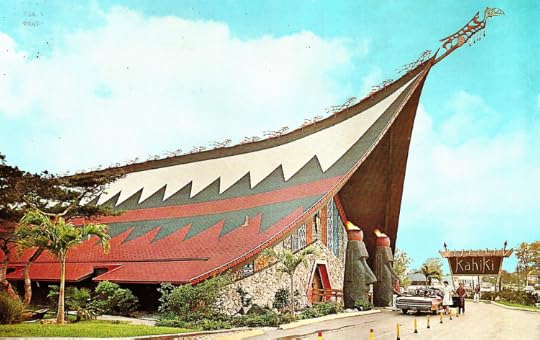
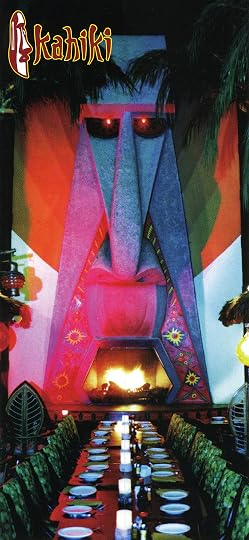
For example, did you know that Columbus, Ohio was once home to one of the largest Polynesian-themed restaurants in the country? The Kahiki Supper Club was famous for its beautifully unique architecture as well as its five-star food and drink menu. Anybody who was anybody---celebrities, sports figures, politicians, presidential candidates---stopped at the Kahiki when visiting Ohio. (For more info on this, Chenault also authored the book “Kahiki Supper Club: A Polynesian Paradise in Columbus, Ohio”)
Sadly, the Kahiki closed its doors in 2000. The building was razed and a Walgreens corner drug store now resides on its burial ground, but Chenault isn’t worried. The Kahiki will rise again!
In the meantime, though, there are a very small handful of Tiki places still in the state, keeping the dream alive.
It is unfortunate that places like Cincinnati, which once had dozens of Polynesian restaurants within its borders, today has absolutely none. Even places like Cedar Point in Sandusky and the Ohio Sea World (which is no longer extant either) had Tiki-themed areas within their parks, which drew in huge crowds. Today, the Tiki Bar at Cedar Point is where the Top Thrill Dragster is. Personally, I’d rather get sick from lots of rum drinks than a stupid ride that one has to wait in line for two hours and lasts all of ten seconds, but hey that’s just me.
If you love Tiki culture, in all its Technicolor pseudo-paradisical kitschiness, check out “Ohio Tiki”.
I've never lived in Ohio or gone to a Tiki restaurant, but I did have a peanut butter mai tai in a Tiki glass at Salvadore's in Wrocław, Poland in March.
In the very late 1990s my wife and I visited my best friend Chris and his wife in Columbus, OH, where they had recently moved after leaving the DC area where he and I had worked together. One of the highlights of that visit was seeing the giant basket-shaped building that was the world HQ of the Longaberger Basket Co. The other was dinner and drinks at a restaurant called Kahiki, a well-known tiki lounge with an Easter Island-themed fountain named George out front, a huge wall aquarium, and even an artificial volcano to capture the atmosphere of the South Seas.
For several years previous, Chris and I had been locked in a windowless SCIF for 8-10 hours a day, running classified ballistic missile defense simulations for the Navy. To keep our sanity, we started cultivating hobbies and passions that could offset the serious tedium that was our jobs. We enjoyed reading the books of the Church of the Subgenius; playing card games like Magic: The Gathering; watching quirky TV shows like Northern Exposure and Twin Peaks and The X-Files; and scouring the record store across the street for obscure music CDs. One of our favorite categories of the latter was that wide, amorphous category known as lounge music, encompassing also "exotica" and "space-age bachelor pad" music, as well as other styles including tiki-themed music.
I had always thought--when I thought about it at all--that the tiki craze of the '50s and '60s came about because of all the American military veterans who served in the Pacific during World War II coming home and celebrating the positive aspects of their experience. After all, most of them had been born in the 1920s and had spent their entire childhoods in the depths of the Great Depression. Traveling to Hawaii, Fiji, Tahiti and other exotic locales would surely have made a favorable impression on those men and women (especially if they didn't have to face the hardships and terrors of equally exotic places like Guam, Guadalcanal, Iwo Jima, and Okinawa). But this book by Jeff Chenault, Ohio Tiki, claims the tiki craze was really sparked by the success of the play, and more especially the film, South Pacific.
Whatever its genesis, the rise of tiki culture led to a wave of tiki-themed restaurants, bars, and clubs across the nation. The Western nexus would have been in California; but in the East, it appears that Ohio was the beating heart of tiki. What I didn't know during that trip to Columbus was that not only was Kahiki one of the restaurants to come out of that craze; it was arguably the biggest and best, most famous tiki restaurant of them all. But there were many others, and Chenault has done an admirable, scholarly. and thorough job of identifying tiki establishments--some dating back to the 1930s, well before the Golden Age of Tiki--right up through 2019.
He starts the book with some background history into tiki culture, and this part is a must-read even for mild aficionados like me. Then, because tiki joints were so common in Ohio, he organizes the following chapters around geographic areas of the state, starting with Columbus and Kahiki (and its cohorts). After the detailed review of all known tiki establishments--some identified only by a found matchbook or newspaper advertisement, so ephemeral could they be--he rounds out the book with some miscellaneous chapters dedicated to related subjects: capsule biographies of influential people in the recent revival of tiki culture, tiki music, and memories of Kahiki in particular by people who worked there.
This softcover book is pretty well illustrated with photos of tiki places, the people who made them great, and the artwork that graced their advertisements. Most of the photos are black and white but some are in stunning color. My only wish was that there were more interior shots, but I can understand how those could be hard to find.
The audience for a book like this is going to be pretty small, I suppose; but within those narrow confines this is going to be essential reading and an excellent reference source. I hope Ohio Tiki marks the beginning of a newer and even bigger resurgence of tiki culture, an upbeat and happy world to counter the increasing bitterness in, and fragmenting of, our modern American society.
When I'd gone through the most obvious books on tiki culture - Berry's Sippin' Safari, Cate's Smuggler's Cove - and finding it financially inadvisable to seek out Sven Kirstin's Book of Tiki (for now), I searched afield. I'd read tales of Southern California tiki culture, where it all started. Hawai'i, where it came (back, sort of) to. Florida, which was tropical. And then this book, which struck me as completely incongruous to everything I knew: Ohio? A tiki Mecca?
What this book proves first and foremost is how pervasive the tiki and Polynesian pop movement was in mid-century America. Evolving alongside mid-century modern's elegant lines and Googie stars was this whole aesthetic of escape and exoticism. And it struck me: of COURSE Ohio. You're in the middle of America, your greatest body of water is Lake Erie, why NOT have the sort of escape afforded to ocean coasters?
What surprised me is that one of the nation's biggest and best Polynesian hotspots was located in Columbus, Ohio - the Kahiki Supper Club. (I don't know why, but the term "supper club" makes me giddy.) It had a fountain called George. It had a Mystery Girl and a Mystery Drink, like the Mai-Kai in Ft. Lauderdale. And at least two generations of fans grew up with this place, which was razed to make a Walgreen's in 2000.
Author Jeff Chenault is very good at making you understand his love for the place, and for the robust history of tiki in Ohio. It's very difficult to convey emotions surrounding a place most of us have never been, but Chenault does a very good job of making us see the place - and all the tiki haunts and history in Ohio. I had worried that a listing of all the exotic restaurants and bars Ohio had to offer would be dull (a few years ago, I read a book on the history of LEGO that decided in its second half to meticulously discuss every single playset the company had ever put out. It was mind-numbing.) On the contrary, these pocket histories - hinting occasionally at not only the past exotic but also at the involvement of the criminal underworld of the 30s and 40s - were each fascinating in their own way.
Not many drink or food recipes as in most books on tiki, but that's all right - it's not what this book is for. It's sort of easy to imagine the early days of the tiki movement in warm places that have their own exoticism to them. Hollywood. Ft. Lauderdale. Waikiki. Sure, of course. But to really understand the extent of tiki's mass appeal, get yourself to Cleveland, Columbus, Euclid. There's a whole world of tiki out there.
This book offers a great retrospective of tiki culture, restaurants/bars and cocktails in Ohio going back to the 1950's. There has been somewhat of a resurgence in recent years, but it doesn't hold a candle to the heyday with spots like Kahiki, Kon-Tiki, Aku Aku and many more across the state. Kudos to the authors and to the Ohio Rum Society for keeping tiki culture alive and thriving in Ohio!