Jump to ratings and reviews
Rate this book

The Apocalypse Factory: Plutonium and the Making of the Atomic Age

Rate this book
A thrilling narrative of scientific triumph, decades of secrecy, and the unimaginable destruction wrought by the creation of the atomic bomb.

It began with plutonium, the first element ever manufactured in quantity by humans. Fearing that the Germans would be the first to weaponize the atom, the United States marshaled brilliant minds and seemingly inexhaustible bodies to find a way to create a nuclear chain reaction of inconceivable explosive power. In a matter of months, the Hanford nuclear facility was built to produce and weaponize the enigmatic and deadly new material that would fuel atomic bombs. In the desert of eastern Washington State, far from prying eyes, scientists Glenn Seaborg, Enrico Fermi, and many thousands of others—the physicists, engineers, laborers, and support staff at the facility—manufactured plutonium for the bomb dropped on Nagasaki, and for the bombs in the current American nuclear arsenal, enabling the construction of weapons with the potential to end human civilization.

With his characteristic blend of scientific clarity and storytelling, Steve Olson asks why Hanford has been largely overlooked in histories of the Manhattan Project and the Cold War. Olson, who grew up just twenty miles from Hanford’s B Reactor, recounts how a small Washington town played host to some of the most influential scientists and engineers in American history as they sought to create the substance at the core of the most destructive weapons ever created. The Apocalypse Factory offers a new generation this dramatic story of human achievement and, ultimately, of lethal hubris.

345 pages, Kindle Edition

First published July 28, 2020

199 people are currently reading
2519 people want to read

About the author

Steve Olson

177 books30 followers
Steve Olson is the author of Eruption: The Untold Story of Mount St. Helens (winner of a Washington State Book Award), Mapping Human History (a finalist for the National Book Award), and other books. He lives in Seattle, Washington.

Ratings & Reviews

What do you think?
Rate this book

Friends & Following

Create a free account to discover what your friends think of this book!

Community Reviews

5 stars
281 (35%)
4 stars
349 (44%)
3 stars
133 (17%)
2 stars
14 (1%)
1 star
5 (<1%)
Displaying 1 - 30 of 94 reviews
Profile Image for Will Byrnes.
1,372 reviews121k followers
January 20, 2022
In the Bible, the apocalypse is not the final battle between good and evil—that is Armageddon, a word derived from an ancient military stronghold on a trade route linking Egypt and the Middle East. An apocalypse is a revelation—literally an uncovering—about the future that is meant to provide hope in a time of uncertainty and fear.
The above was quoted from the book. But in Olson’s Twitter feed he offers a slightly different take.
The title is The Apocalypse Factory: Plutonium and the Making of the Atomic Age. To be clear, apocalypse refers to the threat of nuclear war, not to the site itself.
Most of us, if asked, could probably identify the Manhattan Project as the national undertaking that produced the atomic bombs used in World War II, and as the Ur prototype for every future absolutely-positively-got-to-do subsequent development drive, to be referred to forever as A Manhattan Project for [insert your national need here]. Many people, certainly those of my (boomer) generation, can easily recall seeing film clips of that first test explosion in New Mexico, and probably later tests that vaporized large portions of Pacific islands. But if we, as a group, were to be asked where the material that fueled those terrible explosions came from, I doubt that a majority would know. It was manufactured, primarily, in Hanford, Washington.

description
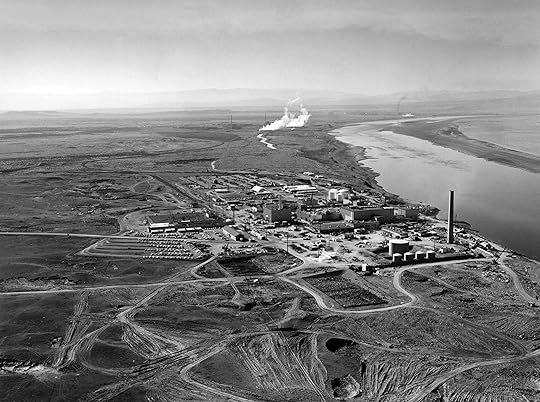
Nuclear reactors line the riverbank at the Hanford Site along the Columbia River in January 1960. The N Reactor is in the foreground, with the twin KE and KW Reactors in the immediate background. The historic B Reactor, the world's first plutonium production reactor, is visible in the distance. - Image and text from Wikipedia

Steve Olson must have a fondness for things that go BOOOOOM!!! His last book was The Untold Story of Mount St. Helen’s. At least his earlier work did not deal in things that would be stopped by the TSA. This is a history. It was the drive during World War II to develop a nuclear bomb that drove the establishment of Hanford, and many other places. There have been a lot of books written about Los Alamos, and fewer about Oak Ridge, Tennessee. But the place that made the glowing special sauce has received scant historical attention, relatively. Olson, a local, sought to correct that imbalance.

description
Steve Olson - image from his Twitter pages
I’ve been getting ready to write this book pretty much my whole life. I grew up in the 1960s in Othello, Washington, a small town in the south-central part of the state just over a ridgeline from a mysterious government facility called Hanford. We knew that Hanford was involved in the U.S. nuclear weapons program. Some people in town knew that it manufactured a substance called plutonium. But it was the Cold War. It was best not to ask too many questions. In 1984 I visited Hanford to write a story for Science 84 magazine, and by the end of the trip, I had decided to write a book about the place. Thirty-six years later, the book is done. - from the NASW interview
This is a story of war, science, politics and people. It is a story of what was known, what knowledge was needed to move forward, whether known or not, a story of personal ambition and national requirements under the direst of circumstances, a story of patriotism and risk. Yes, we know how it all turned out, but maybe did not know where the turns were that needed to be made to ensure that outcome, maybe had less of an idea about who was involved, what they worked on, where, and why. And maybe did not know what blind alleys were entered before a clear route was constructed.
description
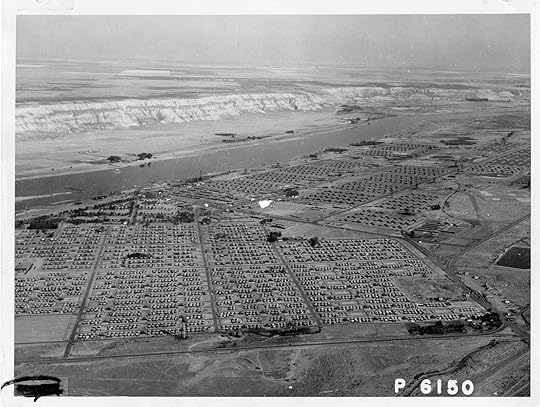
Aerial view of Hanford Construction Camp - image from the National Building Museum

And that development began with science. Olson walks us through the steps that had to be taken to advance from theory to implementation. Here is some of it:

1932 - discovery that neutrons are the glue holding electrons and protons and the nucleus of atoms together

1934 - a French scientist discovers that bombarding any material with subatomic particles creates unstable materials that decay down to stable ones. This was a huge discovery, artificially induced radioactivity.

1939 - German scientists discovered that bombarding uranium with neutrons does not cause it to change into materials adjacent on the periodic table, but to split, releasing vast amounts of energy. Uh oh. Might be a good idea to get some control over this before it was developed by someplace Hitlerian and applied to a dark purpose.

And so on…There were many steps leading from the science to the making of an operational bomb (and using nuclear power to generate electricity for that matter). I bet that for most of us many of these details will be news. Many were for me.

In 1941, the US government, alarmed by the possibility of a Nazi-bomb, gets cracking, FDR accepting the recommendation of Vannevar Bush, head of the Office of Scientific Research and Development (OSRD), established earlier that year..

description
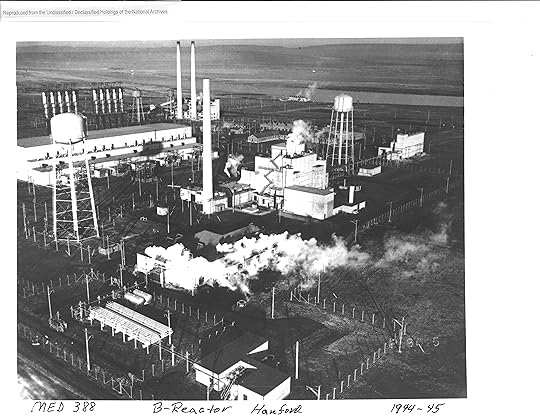
The B Reactor at Hanford was the world’s first large-scale nuclear reactor. It produced plutonium for the device tested at the Trinity site in New Mexico on July 16, 1945, and for the bomb that was dropped on Nagasaki, Japan, on August 9, 1945. The B Reactor was permanently shut down in 1968, and is now being converted into a museum. - image and text from The National Buildings Museum – Secret Cities exhibition
”I knew that the effort would be expensive, that it might seriously interfere with other war work. But the overriding consideration was this: I had great respect for German science. If a bomb were possible, if it turned out to have enormous power, the result in the hands of Hitler might enable him to enslave the world. It was essential to get there first, if an all-out American effort could accomplish the difficult task.”
Even before it was known if a bomb could be made at all, it was known that there were materials that would be needed for it, and at a large scale.
December 16, 1942 found Col. Franklin T. Matthias…and two DuPont engineers headed for the Pacific Northwest and southern California to investigate possible production sites. Of the possible sites available, none had a better combination of isolation, long construction season, and abundant water for hydroelectric power than those found along the Columbia and Colorado Rivers. After viewing six locations in Washington, Oregon and California, the group agreed that the area around Hanford, Washington, best met the criteria established by the Met Lab scientists and DuPont engineers. - from The Atomic Heritage Foundation
Olson writes of the displacement of locals that took place. Part of the project entailed housing tens of thousands of new Hanford workers. Five years before Levittown, the United States government built the first standardized suburb. Of course, it came with a surveillance state attached, and provided endless fodder for conspiracy theorists and science-fiction writers with diverse notions of an Oddville sort of place. (All hail the Glow Cloud) He tells of the construction of the first nuclear reactor, and many that followed, and the enormous buildings that were used for chemically extracting plutonium from the product of the reactors. We learn about the environmental degradation that resulted and the eventual acceptance of responsibility for cleaning up. (without, of course, adequate funding to do the job completely, now estimated to require $300 to $600 billion)
description
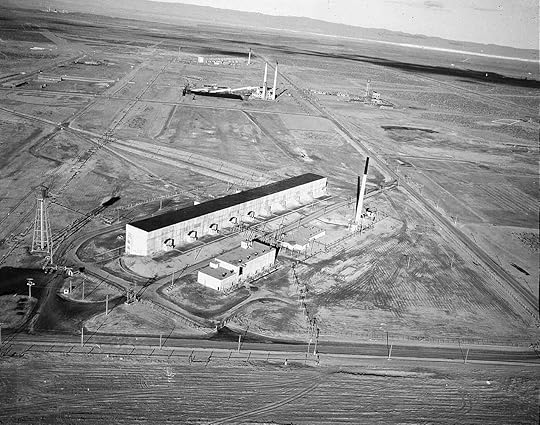
Aerial view of “Queen Mary” chemical separation plants at Hanford, Washington - image from the U.S. Department of Energy.

Olson tells of the various teams that were working on different aspects of the Manhattan Project, even where the name for the project originated, as well as the origin of the element name plutonium. He uses a familiar technique for history writing, focusing on specific individuals and letting us follow them through at least part of the story. This gives the events the more personal feel of a human element, relieving us of the perils of a straight up recitation of facts. Prime among these is Glenn Seaborg, a co-discoverer of plutonium. We follow him from his education in Physics and Chemistry at UC Berkeley, headed by Ernest Lawrence and Robert Oppenheimer, through several stages of the big project to come. We get to know Enrico Fermi, Leona Woods, the only woman on Fermi’s team, Susan Leckband, who arrives at Hanover in the 1980s with a high school degree, and winds up running the place, and others. There were plenty of personality conflicts that made forward movement sometimes difficult. Olson gives considerable space to a very moving description, by Nagasaki resident Dr. Raisuke Shirabe, of his experience of the bombing and its after-effects.

description
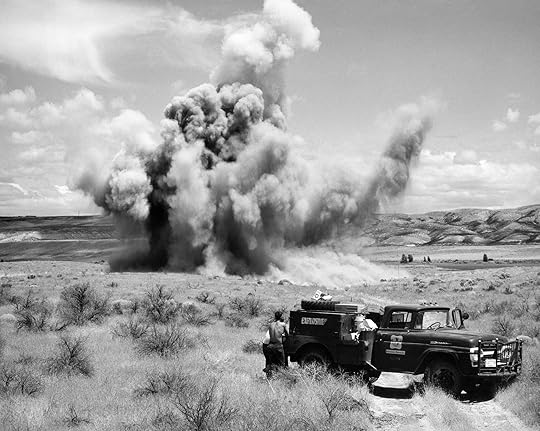
A 1963 explosives test near Hanford to determine the safest underground spot for disposing of radioactive waste – image and text from NY Times - Credit...Associated Press

And we learn details that are amusing and alarming, like a radioactive vending machine and the surprising material used for swabbing aluminum tubes for the reactors, and the considerable challenges entailed in transporting plutonium and other dodgy materials from Hanford to (well, that’s classified). Add in the challenge of maintaining a safe work environment without letting the workers know what it was that they were working on.

description
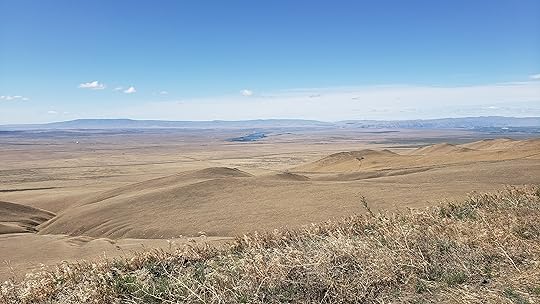
A contemporary (6/3/2020) view of Hanford from the ridgeline between Hanford and Othello, where Olson was raised - his photo, from Twitter

Olson brings us up to the present with the changes Hanford has gone through in the years since the war, the environmental toxicity that became apparent, cleanups that have been done, and remain, and how the facility is being used today. It does seem quaint that the expectation in the 1940s, when large amounts of radioactive waste were first being generated, was that science would come up with a solution to that problem before too terribly long. We are still waiting for that.

description
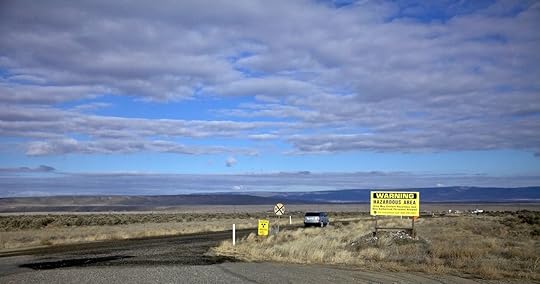
Many roads around Hanford are marked with signs warning travelers they're entering a hazardous area (The Oregonian)

Hanford, Washington, provided a critical service to its country in a time of war, and got our nation militarily prepared, for good or ill, for the Cold War to come. It did this at considerable cost to its people and its environment. It holds a unique place in the annals of our nation, and should never be forgotten. By writing a popular history that is informative as well as entertaining and very readable, Steve Olson has made it likelier that Hanford will be remembered by a wide swath of Americans, who might never, otherwise, have learned of it, and thus, has done a service to us all. The Apocalypse Factory is not a disastrous ending to anything, but a very welcome revelation.
The most recent studies indicate that a nuclear exchange of even 50 Nagasaki-type bombs would produce climate changes unprecedented in recorded human history and threaten the global food supply. A large-scale exchange of nuclear weapons would so reduce temperatures that most of the humans who survived the initial bombing would starve. Many people are concerned today that climate change poses a threat to human civilization but the most certain and immediate threat still resides in the nuclear weapons sitting in missile silos, bombers, and submarines around the world.

Review first posted – August 7, 2020

Publication dates
----------July 28, 2020 - Hardcover
----------January 4, 2022 - Trade paperback


I received an ARE of this book from Norton, but was sworn to secrecy until this review was unleashed on the world.

=============================EXTRA STUFF

Links to the author’s personal, Twitter and GR pages

Interviews
-----National Association of Science Writers (NASW) Steve Olson: Apocalypse Factory
-----NPR - Main Street on Prairie Public - audio – 53:00 – by Doug Hamilton

Items of Interest
-----Atomic Heritage Foundation - Hanford, WA
-----Wiki on Vannevar Bush - it was his recommendation to FDR that got The Manhattan Project started
-----Wiki on the Hibakusha, survivors of the nuclear bombs
-----Atomic Age - The Trinity Test
Profile Image for Peter Tillman.
4,033 reviews476 followers
December 8, 2020
The book starts out really well, with the discovery of plutonium (Pu) in early 1941, by chemist Glenn Seaborg, who later shared a Nobel Prize for this work. He (and others) realized early on that one isotope, Pu-239, was fissionable, and could be an alternative pathway to the atom bomb, since separating enough U-235 from natural uranium to make a bomb was going to be really, really hard. By 1943, the Manhattan Project was underway, with the Army Corps of Engineers in charge of the project under Gen. Leslie Groves. The area around Hanford in the eastern Washington desert was selected for the plutonium plants, as sufficiently remote in case a reactor blew up. The breeder reactors were to be fueled by natural uranium, just as was the world's first atomic reactor that Enrico Fermi built in 1942, under the old stadium in Chicago, which was intended to be the prototype for industrial-scale plutonium production.

Hanford became the largest construction project in Washington history, and the plant was built remarkably quickly. Construction of the first reactor began in 1943, and the reactor went critical in Sept. 1944 — only to discover one of many problems of “designing on the fly.” Xenon-135, one of many daughter products of the fission of uranium, turned out to be a strong neutron absorber, shutting down the reactor. It has a short half-life of 9 hours, so the poisoning effect was short-lived. Fortunately, the Dupont engineers who designed the reactor insisted on building in a substantial over-capacity “just in case” — a wise design choice — and the reactor was soon back in business. Next step: extracting the plutonium from the hellishly-radioactive fission products and purifying it — all by remote control, as no one could enter the plant once it was loaded up. The first chemical plant was pretty much Seaborg’s lab chemistry expanded to industrial scale. It worked pretty well, but was eventually replaced by a more efficient continuous-flow process. But speed was of the essence at the start.

By early 1945, the Hanford plant was shipping plutonium to Los Alamos, where the first bomb was being designed. Pu is prone to spontaneous fission (from a co-product, Pu-240), so the Los Alamos scientists and engineers decided to go with ignition by implosion. I won’t try here to describe all the details, but they needed VERY precisely-built and simultaneously-ignited shaped-charge explosives, to compress the plutonium “pit” and sidestep the spontaneous-fission issue. Note that it would have been almost impossible to separate out the Pu-240 from the fissionable Pu-239: it’s hard enough to separate fissionable U-235 from U-238 in natural uranium. But it turns out that, once implosion was proved to work, it saved a LOT of the (scarce and expensive) nuclear fuel. The uranium bomb that destroyed Hiroshima required about 140 lbs of U-235, which was all that the US had been able to make in two years, and couldn’t be replaced for a year. The plutonium bomb, by contrast, required just over 13 pounds of Pu-239, which could be made in a month or less at Hanford.

The Los Alamos engineers weren’t quite sure that the implosion device was really going to work, and Oppenheimer wasn’t going to release it without a test. By contrast, everybody was pretty sure that the gun-type uranium bomb would work — and it couldn’t be tested anyway, as there was only enough U-235 for one bomb.

At around p. 123, the book’s focus changes from plutonium to the politics of the Bomb. Then on to the plutonium bombing run to Nagasaki — which had the very bad luck to offer better weather than the primary target, a munitions arsenal, which was socked in that day. The mission came close to being aborted, and fuel was running low on the bomber — when the clouds over Nagasaki cleared, and the bombardier could see his target. The rest, as they say, was history.

The author provides far more detail of the horrors on the ground in Nagasaki than I really wanted to read. And the rest of the book is politics, the Cold War build up, the ridiculous over-production of nuclear warheads during the cold war…. The focus eventually returns to Hanford, but as anticlimax, as the plant was scaled back and eventually mothballed. The author discusses late health scares and lawsuits, but concludes that the safety precautions were good enough to keep the workers and general population healthy. And the first reactor is to be preserved as part of a Manhattan Project National Historic Park. Expensive clean-up work remains to be done at the old plant.

For me, there was too much rehashing of well-known Manhattan Project history, and too much time spent on the (dullish) local aftermath at Hanford. Still, the first half was first-rate, 5-star technical history, with a real sense of the wartime urgency and remarkable speed of construction and problem-solving. My recommendation is to read the good stuff and skim the rest. You may want to skip the Nagasaki details, which are truly grim.

A good professional review:
https://www.nytimes.com/2020/07/28/bo...
Profile Image for John.
22 reviews
May 9, 2023
Enjoyed this book immensley from beginning to the end. A brief history of the discovery of plutonium from the element uranium. The sacrifice of the individuals that were at Hanford making this product for the bomb and did not even know. Reflecting on the bombs being dropped on Japan and the suffering they endured were painstaking. We do not know how it would of transpired if we did not drop them but more than likely a lot more of United States military would of parrished from a mainland invasion. A must read for WWII and nuclear science enthusiasts.
Profile Image for Rebecca.
502 reviews
March 27, 2020
I received a free copy of this e-book from the publisher (Via NetGalley) in exchange for an honest review.

After reading the description, I thought this book would be more focused on the history made at Hanford Site, Washington. While some of the book is set there, a larger portion that I expected was focused on other things (war goings on, the test and use of the bombs, etc). I would have liked to hear more about the work done at Hanford. I felt some of the stories had been told too many times in various books on the topic. I would have loved to hear more about the dumping of wastes there. Tell me more about radioactive railcars and how they came to be contaminated!

All that aside, the writing was well done and clear, so those clueless about nuclear science have nothing to fear.

If someone came to the Reference Desk and asked for a book on nuclear history (ha!), this wouldn't be the first one I reach for. That doesn't mean it couldn't be a good choice for the right reader. Certainly pick it up if you're even passingly interested in the subject.
Profile Image for Sophie Els.
205 reviews
November 27, 2024
Is it in poor taste to say that blasting the Oppenheimer soundtrack while reading this made it a transcendant experience? I am so haunted by nuclear weapons - on the one hand, sickened and disgusted by their usage and their potential - on the other, in awe of their existence. The Hanford plant is my neighbor, a blight in my proverbial backyard, possibly the reason for an aggressive cancer that stole from me a most beloved grandmother. Will it also be my doom, if its outdated and fragile tanks filled with radioactive waste are ever breached? I mourn for a world where plutonium was never isolated. Tears filled my eyes when I learned that the man who pulled the lever to release the bomb over Nagasaki chanted "Never again, never, never again" as he did so. I am full of grief thanks to this read and I cannot recommend it highly enough.

"In the Bible, the apocalypse is not the final battle between good and evil - that's Armageddon, a word derived from an ancient military stronghold on a trade route linking Egypt and the Middle East. An apocalypse is a revelation - literally an uncovering - about the future that is meant to provide hope in a time of uncertainty and fear."
Profile Image for Edwin Howard.
420 reviews16 followers
July 7, 2020
In THE APOCALYPSE FACTORY, by Steve Olson, the age of plutonium and nuclear weaponization is looked at from it's raw and untested beginnings and brings the reader all the way to the present. The reader sees how the discovery of plutonium extraction, that can eventually become a nuclear weapon, quickly went from scientific experimentation to creating a town in a barren section in eastern Washington state for the sole purpose of developing and creating the components that become a nuclear bomb. Olson covers the dropping of those initial bombs in Japan, particularly the one in Nagasaki, and its after effects on the Japanese population not just from a health perspective, but looking at economic and diplomatic effects as well. As the book continues past World War II, the nuclear arms race becomes a political hot button and Olson considers all sides in the diplomatic negotiations that continue well into the 1980's and are still happening today.
Olson does an excellent job of describing all of the science behind everything nuclear in a way that is easy to understand and very accessible. While recounted the major decisions and events around the Atomic Age, facts are presented with little political color or judgment, but the reader can't help but share in Olson's feeling of awe that bleeds through the text that it was truly astonishing that United States was able to create nuclear weapons so fast and without "blowing themselves up".
THE APOCALYPSE FACTORY does what only the best non-fiction books do; it tells a story, full of anticipation, success, and failure. The story just happens to be true. Olson also has a cinematic way of describing things so that the reader can really picture in their head what is going on. A pleasure to read.
Thank you to W. W. Norton & Company, Steve Olson, and Netgalley for a copy of this book in exchange for an honest review!
Profile Image for Andy Miller.
975 reviews69 followers
December 19, 2020
The Apocalypse Factory's focus on the Hanford story of the Manhattan project leads to different perspectives. It is well known that the material from the Hiroshima bomb came from Oak Ridge and that the material from the Nagasaki bomb came from Hanford. The author, Steve Olson, emphasizes the lesser known corollary, that the Hiroshima approach was never used again, it was the Hanford bomb that was replicated throughout the Cold War.
Since Hiroshima was first much has been written about the devastating results of that bomb, starting with John Hershey's classic telling. Here, Olson writes so well of the devastation on Nagasaki. Much of those pages are told from the perspective of Raisuke Shirabe, a doctor at a medical school/hospital, who was shielded from much of the effects of the bomb by the hospital's walls. Shirabe immediately started treating people after the explosion as he noted the results of the bomb and looked for his family. He found one son who slowly died from radiation poisoning, he found evidence of another son who was instantly incinerated by the bomb.
Much has been written about the decision of dropping the bomb on Hiroshima, a decision still debated today. Olson describes that debate with balance. However, Olson points out the lesser known debate, the decision to bomb Nagasaki after Hiroshima. Olson notes that many of the scientists involved in the creation of the bomb as well as others at the time, agreed with the bombing of Hiroshima but questioned the need to later bomb Nagasaki. Olson explores different arguments including that General Leslie Groves may have pushed for the second bombing to justify the proliferate spending on two different technologies.
Olson describes the Hanford story of the development of the bomb. However, I found David Schwartz's "The Last Man who knew everything," a biography of Fermi to be a better and more thorough telling. Olson's narrative of Hanford life and development of Richland is much better told in "Atomic Frontier Days" by John Findlay and Bruce Hevly, especially of how DuPont instituted a Southern style segregation in the Tri Cities. Olson's "hometown" perspective of growing up in Othello, close to Hanford, is good but not as compelling as Mark Smith's "Something Extraordinary."
But that does not diminish the greatness of this book especially as it confronts the Cold War issues of the danger to the entire world from too many nuclear bombs and the long term effects of nuclear waste and radiation and the clean up process. His discussion of whether Hanford radiation caused widespread cancer deaths is the most thorough and balanced that I have read. He finds that there is no scientific evidence that the radiation caused deaths to those living near Hanford and discusses why the evidence may not show the correlation is there was one as well as that the scientific evidence is lacking is simply because the radiation exposure from Hanford did not cause increased deaths.
Olson ends by discussing "Fermi's paradox." Fermi postulated to fellow scientists that the reason advanced civilizations from elsewhere in the universe had not contacted earth because any civilization advanced enough to develop that type of technology also developed technology that ended up destroying them. But Olson also acknowledges positive steps in controlling nuclear arsenals and cleaning waste and nods to the fact that it was unavoidable for us to discover the science of nuclear fission, quoting one scientist who refused to apologize for his role in discovering it, but stating that he wishes the science that allowed for fission did not exist. It is that type of science that makes this a great book
Profile Image for Robin.
28 reviews
December 13, 2023
This book is sort of a tough one for me to rate, because I did feel many times throughout reading/listening, that it was just sort of throwing information at me much like a textbook would. But at the same time, there were quite a few parts that had me completely engrossed. It tells the story of the birth of the atomic age, through war times, public opinion, nuclear disaster, government handlings of such matters, it goes from the beginning with the discovery of plutonium, through modern day and even touches on the fermi paradox. There was so much interesting information within this book. So much that I think one reading doesn’t cover it. If it is a subject that interests you, read it. But it. Own a physical copy
Profile Image for Shawn  Aebi.
397 reviews1 follower
January 11, 2021
An excellent walk through the history of the discovery of Plutonium and subsequent march to create nuclear weapons in the United States. The author also jumps over to Nagasaki to illustrate the devastating effects on the city. Just the right amount of technical detail and explains both sides of the nuclear debate without sinking into didactic tone. A focus on the Hanford site here in Washington and how it expanded and contracted based upon government demand. Well written and a quick, easy read.
Profile Image for Daniel Kukwa.
4,735 reviews122 followers
January 22, 2024
A much different take on the story of the atomic bomb...in some ways the most important aspect, and in other ways the most forgotten. This makes for a superb (dare I say, superior) counter-point to the recent film "Oppenheimer"...and I certainly enjoyed it much more than the film.
Profile Image for Tom.
480 reviews6 followers
August 22, 2020
I'm almost embarrassed to admit this, but before reading this book I knew very little about both Nagasaki and Hanford, the town in Washington State where the material for the plutonium based bomb was made. I knew a lot about Hiroshima because of other readings and two visits to that city. I did not realize that the more important of the two bombs dropped on Japan was the one exploded over Nagasaki. Plutonium manufactured at Hanford became the basis for the United States nuclear arsenal right up to current day. I did not know that.

This book tells the story of the discovery of plutonium and the processing of it. It also delves into the damage to the environment and some of the moral dilemmas that have been created. A well written, and well to,d story.
Profile Image for Fred Diamond.
31 reviews1 follower
October 1, 2023
Really good historical description of the Manhattan Project and the scientific workings going on behind the scenes. Great read!
Profile Image for David.
1,692 reviews16 followers
August 19, 2020
An in-depth history and examination of the Hanford, WA nuclear site. Hanford was created as part of the Manhattan Project. It contained reactors that were used to create Plutonium, the heart of the atomic bomb. Olson describes how reactors work and how bombs explode. He provides bios of the key players. A chapter about Nagasaki is very poignant. The bombs used to destroy Hiroshima and Nagasaki were different, the latter using Plutonium and the template for all future atomic bombs. Olson’s examination of the decision to drop the bomb is balanced. His abhorrence of nuclear weapons and his support for nuclear energy are both crystal clear.
Profile Image for Jonathan Parsons.
9 reviews
March 3, 2022
I really enjoyed this book, good scientific history and background of the development of the atomic bomb and sobering recounting of the horror it caused. Interesting angle to focus on this specific facility which I previously knew little about. Author did a great job of giving context of American opinions regarding the bomb at that time as well.
Profile Image for Martin.
285 reviews12 followers
August 16, 2020
Exceptional history of the birth of the nuclear age. Great biographical insights of the significant participants and the less notable too. Recommend to those interested in history, and, especially the history of science and technology as they relate to society.
869 reviews51 followers
February 6, 2021
The book, though history, moves along in a page-turner fashion. Interesting history of people and scientific discoveries that made nuclear energy and nuclear weapons possible. Olson's epilogue is speaks in favor of eliminating nucreal weapons from the world. The weapons are simply too dangerous because of human error, nationalism, belligerence, limits to human knowledge, and human hubris. Humans cannot guarantee safety or that nothing can go wrong - think Chernobyl or Fukushima Daiichi. So, while describing the great effort and energy which America applied to inventing nuclear weapons which perhaps helped win a war, Olson is also saying there is a great price to be paid worldwide and by all of humanity for the development of nuclear energy and weapons. He draws attention to that part of the story as well.
Profile Image for Deuce Naftel.
304 reviews3 followers
September 26, 2020
I love atomic science books, I am realising. Midnight in Chernobyl was fantastic, and The Apocalypse Factory is as well. It is very well written and flows so well. It is so much more than just about Hanford. I thought this book would be rather dry and just discuss a rather boring part of the atomic program, but it is about everything. And I learned so much about the bomb dropped on Nagasaki, and what it did immediately after dropping there. This was my favorite part of the book as I knew nothing about the devastation, beyond the very obvious and superficial.
Profile Image for Regina Gifford.
43 reviews
February 7, 2022
'The Apocalypse Factory' tells the story of the atomic age from the perspective of Hanford and the plutonium it produced. In the extensive histories of the atomic bomb that have been previously published, Hanford is rarely mentioned. I had read Richard Rhode’s excellent ‘The Making of the Bomb’ years ago - I was fascinated by the secret towns of Los Alamos and Oak Ridge but would have been hard pressed at the time to tell you where Hanford was located or why it was so important in the nation’s history. Very few books have accorded Hanford it’s proper role from World War II through the Cold War and its legacy of waste.

Hanford is the vast nuclear reservation in the Washington state desert (yes Washington has a desert!) that was erected during World War II to produce plutonium while Oak Ridge separated uranium isotopes. The weapon produced with Oak Ridge uranium was dropped on Hiroshima while Hanford plutonium fell on Nagasaki. (What is less known is that Hanford plutonium was also used in the Trinity test, the first bomb to ever detonate.) During the Cold War arms race, Hanford continued to operate and produced over 70% of the nation’s nuclear plutonium until it was decommissioned in the late 1980s.

The book opens with a brief history of the early nuclear age: Fermi’s piles in Chicago, the government’s decision to start the Manhattan project, the selection of WWII production sites. The author provides the most emphasis of Glenn Seaborg’s discovery of plutonium in 1941 at Berkeley. (As I told my Berkeley educated husband “this history has Glenn Seaborg in the lead role while Fermi has a supporting role. Oppenheimer is far away in Los Alamos.”) There are good descriptions of the first scientists and generals (I don’t think I would have personally liked General Leslie Groves), and their interpersonal dynamics. There are also personal stories of the workers who relocated to work at Hanford, not knowing exactly what they were doing but that it was necessary for the war effort. Olson provides enough science for the lay reader to understand the early discoveries of atomic power (as well as the engineering that went into building the first reactors) without getting overly technical.

The book then takes us through the war years at Hanford and the dropping of the bombs on Japan in August 1945. There are three harrowing chapters that describe the horrific aftermath in Nagasaki, including detailed descriptions of the destruction, personal accounts of the explosion, the death, and the radiation sickness that followed. This is difficult to reconcile with the vision of patriotic Americans working to end the war at Hanford but it is probably the most necessary part of this history. (As the author explains, whether dropping the bombs - especially the second bomb on Nagasaki - was necessary will always be one of the great “what-ifs” of history. It’s aftermath, however, was absolute.)

The ups and downs of the Hanford Cold War era form the next section of the book. During this period, additional plutonium production reactors were built on the 528 square mile site. After enough weapons grade plutonium was produced to fuel 70% of the nuclear arsenal, demand went down. (By this point, the Savannah River site was also producing more advanced nuclear materials.) Plans were made to build commercial nuclear reactors on site but due to the colossal failure of WPSS, that plan was also scuttled. In 1986 (just after Chernobyl), the last reactor (the N reactor) was shut down for repairs but was never brought back on line.

After Hanford was decommissioned, one of the most daunting challenges at Hanford began: the cleanup. Since the Tri-Party Agreement of 1995, the site has been one of the nation’s largest government projects, at a cost of over two billion dollars a year. Engineers, physicists and other professionals have come back to the site to solve complex nuclear waste and environmental issues. Olson acknowledges that progress has been made over the last 25 years but big challenges remain at not only Hanford but throughout the Cold War weapons complex.

Hanford’s role in the nuclear age can be divisive and I wasn’t sure whether the author would be an apologist or a critic. Olson is neither - I found this to be a very even-handed history and treatment of the politics and moral issues that surround nuclear weapons production. Olson provides facts and different sides of the issues and avoids his own moralizing and drawing conclusions from anecdotes. At just under 300 pages, this is not an in-depth history but it’s a good start for anyone unfamiliar with the history of this site and the long-term costs of the Cold War arms race. It’s also a sobering reminder that nuclear weapons are still the most certain and immediate threat to the world.
Profile Image for Robert Spillman.
64 reviews7 followers
October 18, 2020
The inside cover of The Apocalypse Factory reads: "A thrilling narrative of scientific triumph, decades of secrecy. and the unimaginable destruction wrought by the atomic bomb."

That captures my feelings of this book exactly. It was thrilling to watch the development of nuclear technology in a time of war as large numbers of men and women joined the effort to "stop the war." Secrecy was so great that many did not know what it was they were working on. From their perspective, they saw that the project must indeed be important and so devoted, and risked, their lives to making it succeed. Even after rumors of radiation illness, they ignored the invisible peril in a dedicated effort to help stop the war.

Unlike many other accounts of what is known as the Manhattan Project, this book focuses primarily on the reactors built at Hanford. The author explains the science in sufficient detail to inform the non-scientist why the facility played a critical role in the development of nuclear technology in both nuclear weapons and for power generation.

Some favorite excerpts:
- "It began with Plutonium, the first element ever manufactured in quantity by humans."
- "I didn't think, "My God, we've changed the history of the world." - Glenn Seaborg
- "Never again," Beahan muttered as he released the bomb. "Never, never again."
- "I cannot describe my thoughts." - Shirabe writing in his physician's journal in Nagasaki after returning to the remains of his hospital.

But there are many memorable paragraphs and sentences in this book. Personal details are included, such as the individuals who wrote their wills shortly before observing the first nuclear explosion test. It is a well-written documentary that incorporates individuals' experiences during this time, including many who were most impacted. The author, Steve Olsen, provides an extensive bibliography that reveals his tremendous effort to find original sources, not simply the summary of what was written before.

This book goes on my "Favorite Science Books" list.

Bob Spillman
Profile Image for David Elton.
140 reviews1 follower
July 14, 2024
The Apocalypse Factory. by Steve Olson. The history of the Hanford, WA, nuclear plant and the development of the atomic bomb. Interesting, moves right along, seems factual. Lots of information on the participants. Fermi, Groves, Glenn Seaborg who discovered plutonium the element used in the bomb. Szilard who first recognized a chain reaction was possible. Ernest Lawrence.

I was impressed with how quickly the project occurred and was successful. How many major problems occurred, including the first real reactor poisoning itself – totally unexpected, and how quickly they found a solution. Inspiration? Who knows, but I think so.

People then felt real, continuing fear during WWII. What was the world coming to? The future was so uncertain. It’s the reason my folks waited to post-war (1947) to have children. The cold war of the 1950s was little better. More fear.

Interesting note: after an atomic war, the skies would be so dark, crop failure / famine would kill the rest of us.

Imagine the hydrogen bomb, 500 times more powerful when the WWII bombs dropped on Japan…

Some information on the dropping of the first atomic bombs (the first event went smoothly, the second had lots of snafus, but landed the bomb perfectly. The Japanese physician who led surveys of the Nagasaki survivors after the war and greatly added to knowledge base of nuclear disease. Quite the guy.


Nathan Elton is reading this book, which is why I read it. Hope he finishes it.

Profile Image for Ted Haussman.
447 reviews1 follower
February 15, 2021
Much has been written and told about the Manhattan Project that developed the first nuclear weapons and ended World War II. This book cleverly and wonderfully tells one piece of it -- the discovery and development of plutonium and the vast, but amazingly quick ramp-up of the Hanford facilities in Washington State to mass-produce plutonium. Unlike the bomb dropped on Hiroshima, which became extinct with its usage, plutonium was the source of the bomb dropped on Nagasaki and became the basic building block of the nuclear arsenals that developed over time.

The story is wonderfully told -- from the genius scientists who conceived of the military power of atomic bombs, to the race to be the first to develop the capability, to the political and military thinking behind the development of the project to the ultimate usage, to harrowing and nearly aborted bombing run, to survivors of Nagasaki who experienced the devastation, to the Cold War that ensued and questionable policies of build-up and deterrence, to the de-commissioning of Hanford, to the environmental catastrophes at the site, and finally to the legacy bequeathed to us all of being forever on the precipice of momentary annihilation. This book has it all and tells its story succinctly in 280 pages. It's well worth the read.
Profile Image for Shrike58.
1,448 reviews23 followers
December 25, 2021
When I actually got around to picking up this book, I wasn't sure that it was really something I wanted to read. What I was mostly looking for was an examination of the Manhattan Project as an industrial adventure. I was afraid that I had just another generic overview of the start of the Atomic Age. Olson actually managed to satisfy my intentions, but what he is really about is looking at the second act of the First Atomic War, as Nagasaki tends to get somewhat slighted as compared to coverage of Hiroshima. It also means that there is a focus on Glenn Seaborg, the point man in the discovery of Plutonium, the element that really made atomic weapons a relatively practical industrial product.

Besides that, there is quite a bit of an elegiac tone to this history. This is since Olson originally hails from the general vicinity of Hanford, and uses this history as an opportunity to muse over whether Humanity can get its act together enough to overcome the ever looming prospect of nuclear war, among surviving other aspects of industrial civilization; there being no "externalities" in a closed system. Finally, Olson dedicates this book to the memory of John Hersey, who was an important teacher for him.

Recommended.
Profile Image for Ben Savage.
391 reviews11 followers
January 19, 2025
2.75 to maybe 3.15.

Right off the bat, I didn't get a sense of Hanaford, the Town, and Hanaford, the Factory. I got a rehash of several over views of the atomic program.

There was a lot of divergent focus, from Glenn Seaborgs efforts with discovering plutonium and additional elements, to survivors of the often overlooked second city, Nagasaki. There was some comparison of the implosion and explosion types of bomb. Which tangentially related to Hanaford the Factory and city.
There was discussion of Groves, Szaliard, Fermi, and the others... a smattering of the people on the ground.

I'm not sure what this book wanted to be. I thought it was the history of the company town but it was really a history of plutonium and it's effects on the world. It's anti nuclear but also pro nuclear, it's not as coherent in its story as I like. He says in the epilouge that " it would be a cool story to tell". It was ...cool, but read to finish.

Final note, he defends the title as not to shame, and not as Armaggedon which most seem to take it as. Rather the apocalypse is supposed to inspire hope. I don't know about that?

Ok addition to the stories of nuclear power and the hazards it added to the world.
Profile Image for Gary Brecht.
247 reviews13 followers
September 5, 2020
What prompted me to read this book was the fact that my wife’s grandparents left Iowa to work at the Plutonium facility in Hanford Washington. Her uncle Jimmy moved there with them when he was still in grade school. From him I learned very little about what it must have been like living there; mostly because he was so young and this was almost 80 years ago. But author Steve Olson paints a very good portrait of Hanford, both before it was co-opted by the Federal government, and afterwards, when it became the focal point of developing atomic power sufficient to end WWII.

Our country was driven to develop an atomic bomb before the German scientists could arm the Nazis with such a potentially devastating weapon. Hanford was one of three key locations (including Los Alamos and Chicago) where the research and development of the bomb took place. The author showcases the main scientists and political appointees responsible for the discoveries and management of the bomb’s evolution. He then takes us beyond the war years and describes the cleanup necessary to restore the area to normalcy.
Profile Image for Amanda Reynolds-Gregg.
82 reviews56 followers
February 8, 2021
Just wrapped this up last week and overall it was a good read. The subject matter is handled very well, I especially enjoyed the way the city of Hartford was really vividly described, helping me to better appreciate the people working so hard (even if there is some question about how good of an idea nuclear weapons is overall).

My eyes did cross a bit during bits that focused on the particulars of the science (essentially any time the ins and outs of atoms were being explained) but that's more of a personal preference than an actual problem with the book. I truly felt the majority of the subject matter was handled well and I appreciated the amount of details included. The many players involved in this part of history were very well explained and fleshed out.

I think one aspect of why I didn't give this book a higher rating is that I felt the brushing over of Hiroshima was ultimately unnecessary. I understand the author wanted to focus on Nagaski as it tends to be ignored or downplayed in the story of nuclear weapons, but it still was slightly disorientating to brush over that so quickly and then spend the day Nagaski was bombed with one character going through it on the ground (a very powerful chapter, btw). Again, this may be more of a personal preference thing. I would have liked both bombings to receive attention.

Overall, very solid book tackling a very complicated and difficult bit of American history. If you're interested in the subject matter, I recommend it for sure!
Profile Image for Vanessa.
5 reviews
May 20, 2023
“Do I wish I hadn’t discovered plutonium?” he once said. “No way. Once God had made a world that made bombs possible, there was no option. Both sides were going to make them. But if you ask me, ‘Do I wish the laws of nature were such that you couldn’t make and atomic bomb?’ God, yes.” - Glenn Seaborg

I thought this book was a great summarization of the good and bad that came from Hanford. It was a perfect balance of the contradictory nature of developing nuclear weapons. It also did a great job of delving into the personal opinions of the scientists that worked towards the development of atomic bombs.
One of my favorite classes taken in my undergraduate career was my environmental nuclear engineering course. Reading the contextualization of the data analyzed in that class was interesting. I also liked the personal accounts in the book, especially from people working at the Hanford site and of those affected by the atomic bombs. I am looking forward to reading The Bells of Nagasaki soon. The only thing I would say I didn’t like about this book (and it isn’t really about the book) is that information on the author’s background is hard to find.
Profile Image for Michel Meijer.
364 reviews1 follower
April 6, 2025
A complete (?) story of the discovery, development and application of plutonium as the key element for atomic bombs. It starts with pre-WW2 physics, then moves into the Manhattan Project and its delivery of 2 atomic bomb explosions in Japan, to the cold war aftermath and call to close this chapter in human history. I think the power of this book is that it connects the lives of people to their zeitgeist and the technical understanding and developments. Olson manages to bring the people that steered and affected key events in the Manhattan Project and the aftermath into the cold war into the narrative. You can argue that the beginning of the book and the end are slightly different, the former more aimed at human ingenuity in physics and chemistry, leading to the production of the enriched uranium and plutonium, while the second is more about the afterwar politics, the story of the victims and the call to move away from atomic weapons just after the cold war. Personally, I liked the first bit more because I am a scientist myself, but I chose not to ignore the second part, because cause and effects are deeply connected in innovation. So overall 4.5 stars, rounded up.
Profile Image for Blake Brashear.
129 reviews1 follower
December 12, 2020
Having just read Countdown 1945, this was a good compliment to the Manhattan Project and included a lot of the technical details that Countdown 1945 was lacking. An interesting background about the area of Hanford and how it became the center of Plutonium production in the US. While the environmental factors were covered, they were not overly preachy except at the end. The added stories of the people of Nagasaki (from which the only Plutonium device used on people), added perspective and consequences of the use of nuclear weapons against people. Overall this book was detailed enough and followed a good chronology without being overly dry. I'd have liked to seen some of the quick changes between the Nagasaki events and Hanford events to be a little less inter-mingled only for the sake of not going back and forth so much but it wasn't so much as to be unreadable. Worth the read for anyone interested in the Manhattan Project, nuclear physics of the early 20th century, the end of WWII or anyone interested in Plutonium production.
156 reviews11 followers
February 7, 2023
A wonderful book that really is about two things, first the discovery of plutonium, its development and use in nuclear weapons andcsecond, the history of the Hanford Nuclear Reactors where the plutonium for the US nuclear weapons was made. Olson spends most of the book on the World War II development of plutonium and the scientists who discovered and worked on it in labs at Berkeley, California and in Chicago. He also details how the Hanford site came to be and tracks its construction. After this we follow the bomb being made at Los Alamos and dropped on Nagasaki. After this Olson jumps ahead and discusses the fate of the Hanford reactors and the scientists.

I really wish more attention had been paid to the work on Tinian where the bomb was stored prior to being dropped on Nagasaki as well as more on Hanford in the years immediately after World War II ended.

Overall as a lifelong resident of Washington State I found this both fascinating and enlightening about a part of local history that doesn't get the attention it deserves.
Displaying 1 - 30 of 94 reviews

Can't find what you're looking for?

Get help and learn more about the design.