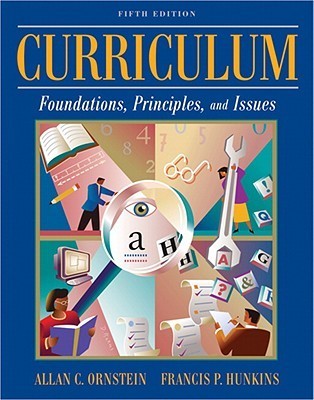
A thorough exploration of the historical, philosophical, psychological, and social context for the field of curriculum, Foundations, Principles, and Issues addresses the curriculum process and issues that influence it and encourages readers to consider how new thinking impacts curriculum deliberation, development, and implementation. A more concise Fifth Edition provides both the student and the professor of curriculum with a comprehensive treatment of the curriculum foundations as well as the principles and procedures for conceptualizing, developing, implementing, and evaluating curriculum. As in previous editions, it provides solid coverage of the philosophical, historical, psychological, and social foundations of curriculum including recent research and thinking in these areas.
Possibly the worst textbook I've ever read. The book is simultaneously way too broad and way too narrow in the topics it chooses: it's attempting to both be entirely comprehensive and pretty deep, and the result is a confusing jumble of ideas that are loosely tied together. There is a virtue in simplicity, and that's something this book lost. It attempted to thoroughly dissect the topic of curriculum. And I guess it succeeded at dissected it. But being able to see all the individual body parts of a frog on the table in front of you tells you nothing about what a living frog actually looks like. This book essentially did the same thing with curriculum. While it may technically cover everything, it didn't cover it in a way that I felt helped me in creating my own curriculum. Very tedious, very unhelpful. Would not recommend.
this book. this book is already on its 7th edition, for which i write this review. i do not recommend using it for any curriculum development class. i have had the misfortune of attending two of them where this book was discussed extensively, throughout the whole semester. i have read this a bunch of times. i even gathered help from an outsider in deciphering this book in case it was a skill issue of mine. it does not get any clearer.
it repeats the same phrases over and over and over for chapters on end. sometimes it contradicts itself on the same paragraph. sometimes it describes things in a way that’s so broad it could really mean anything, which is confusing when we’re categorizing things. now, i admit, a few lists are actually pretty helpful! and some of the history of curriculum development is really fun to read! but that’s like 12% of the book. i understand authors need to fulfill a word quota, still, it gets to a point. reading it once is fine. getting some of the useful stuff is fine. planning a whole class with this thing involved is a bad idea.
which would be no fault of the author, except the purpose of a textbook this length is to support a uni-level class. and it fails. 7 editions as a pearsons publication too. this should be unacceptable.
still, i give it two stars because it’s not the worst book in the world, i learned some stuff, and i did enjoy laughing at the absurd parts of it. never use this though i beg you.
Again, I discussed this so much for my grad classes, I'm too fatigued to write a review. Apologies.
I'm betting that if you're reading it, you're reading it for the same reasons.
Favorite part: Looking at the philosophies and how they influenced curriculum. (I was surprised the the author more or less lumped them together though. For instance, one may not hold an existential or progressive world view - but may take some of the precepts into their classroom. I.e. Existentialists reject Absolute Truth. A teacher may believe in Absolute Truth in a moral sense, but that doesn't mean that in the classroom she belittles others, or devalues the input of her students. It's apples to oranges...)
Anyway. Go me. Go all y'all. Good luck on your studies.
I read this book from cover to cover for my first class on curriculum design. While the book doesn't really get into curricula itself, it does provide a lot of background knowledge of the philosophies people bring to the planning table, histories behind the evolution of state standards, how curricular change can be implemented (and why it is often opposed), methods for evaluating curricula, and how schools are organized in other countries and their teachers prepared for teaching. For a textbook it wasn't an overwhelming read.
As most of the other reviewers stated, I read this book for a grad school class. There is some great information about the history, philosophy, and development of curriculum. You have to sort through the author's bias to pick out the information. The author's make no real assertions throughout the book and instead leave things ambiguous for the reader. It has affirmed that my uneducated gut instincts about curriculum design were appropriate for the needs I was meeting.
It had a lot of great information in it. However, I hated the formatting of the book. I wondered as I was reading it if the publisher was trying to save ink. Instead of making vocabulary and important terms, etc. in bold print, they were typed in italics. This made it very hard to find information quickly. Overall the formatting of the book was poor, that is just one example.
Helped me pass my test for my teacher's license. Fairly informative, but there's a lot of bias mucking up the pages, made it difficult to dig out the facts I was looking for. I thought that the newer, more "radical" ideas had a lot more print dedicated to them than was merited.
The authors have some clear bias. I ended my class feeling less sure of what curriculum actually is than before I started, but the book has some great information and gave me a lot to think about!