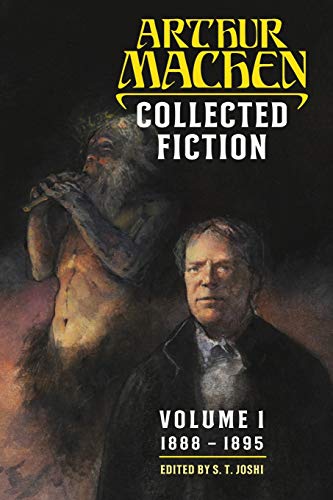
Welsh writer Arthur Machen (1863-1947) is one of the towering figures in the Golden Age of weird fiction, and his novels and tales have influenced generations of weird writers and remain immensely popular among readers. But much of his work has been difficult to obtain, remaining buried in obscure magazines and newspapers of a century ago or published in expensive limited editions.
This is the first edition of Machen's fiction to be based on a thorough examination of his manuscripts and early publications. It is also the first edition to arrange Machen's fiction chronologically by date of writing.
This first volume contains his charming picaresque novel The Chronicle of Clemendy (1888), an exquisite imitation of the medieval narratives of Chaucer and Boccaccio. At this time Machen was a young journalist who had moved from his native Wales to London, and he wrote a number of humorous and slightly risqué sketches for fashionable London magazines.
But then he published "The Great God Pan" (1894), one of the pioneering works in the entire range of weird fiction. It was condemned by contemporary reviewers as the work of a diseased mind. Machen followed it up with the episodic novel The Three Impostors (1895), containing the brilliant segments "The Novel of the Black Seal" (which features the Little People, a sub-human race lurking on the edges of civilization), "The Novel of the White Powder," and other vivid narratives.
The edition has been prepared by S. T. Joshi, a leading authority on weird fiction and the author of The Weird Tale (1990) and Unutterable Horror: A History of Supernatural Fiction (2012). Joshi has prepared textually corrected editions of the work of H. P. Lovecraft, Ambrose Bierce, and many other weird writers.
Arthur Machen was a leading Welsh author of the 1890s. He is best known for his influential supernatural, fantasy, and horror fiction. His long story The Great God Pan made him famous and controversial in his lifetime, but The Hill of Dreams is generally considered his masterpiece. He also is well known for his leading role in creating the legend of the Angels of Mons.
At the age of eleven, Machen boarded at Hereford Cathedral School, where he received an excellent classical education. Family poverty ruled out attendance at university, and Machen was sent to London, where he sat exams to attend medical school but failed to get in. Machen, however, showed literary promise, publishing in 1881 a long poem "Eleusinia" on the subject of the Eleusinian Mysteries. Returning to London, he lived in relative poverty, attempting to work as a journalist, as a publisher's clerk, and as a children's tutor while writing in the evening and going on long rambling walks across London.
In 1884 he published his second work, the pastiche The Anatomy of Tobacco, and secured work with the publisher and bookseller George Redway as a cataloguer and magazine editor. This led to further work as a translator from French, translating the Heptameron of Marguerite de Navarre, Le Moyen de Parvenir (Fantastic Tales) of Béroalde de Verville, and the Memoirs of Casanova. Machen's translations in a spirited English style became standard ones for many years.
Around 1890 Machen began to publish in literary magazines, writing stories influenced by the works of Robert Louis Stevenson, some of which used gothic or fantastic themes. This led to his first major success, The Great God Pan. It was published in 1894 by John Lane in the noted Keynotes Series, which was part of the growing aesthetic movement of the time. Machen's story was widely denounced for its sexual and horrific content and subsequently sold well, going into a second edition.
Machen next produced The Three Impostors, a novel composed of a number of interwoven tales, in 1895. The novel and the stories within it were eventually to be regarded as among Machen's best works. However, following the scandal surrounding Oscar Wilde later that year, Machen's association with works of decadent horror made it difficult for him to find a publisher for new works. Thus, though he would write some of his greatest works over the next few years, some were published much later. These included The Hill of Dreams, Hieroglyphics, A Fragment of Life, the story The White People, and the stories which make up Ornaments in Jade.
The first of Hippocapus Press’ three volume collection of Arthur Machen’s fiction spans the years 1888-1895. It includes some early works, as well as some of Machen’s most famous tales. It can roughly be divided in three parts: the book’s first one third (“A Chapter from the Book Called The Ingenious Gentleman Don Quijote de la Mancha,” “The Chronicle of Clemendy,” and “The Spagyric Quest of Beroaldus Cosmopolita”) showcase a young Machen in love with the medieval, a healthy dose for humor, and an, alas, overly long-winded prose. Focusing on reading Machen’s supernatural period, I just skimmed these stories, which require a certain patience to wade through – especially The Chronicle of Clemendy which is roughly 200 pages long. Thus I will not currently dwell on these, without yet precluding a later reading. The second and shortest part contains 7 short stories, written in 1890-1. Written for magazines, these society (or, “smart,” according to Machen) tales are what I’d call vignettes. Mostly unspectacular on their own, they do contain traces of Machen’s later style – indeed, even though only some of them are supernatural (and even then only marginally), they all have a hint of the weird, being especially obsessed with the confusion and osmosis of personalities (both within and without oneself), the implied existence of doubles/doppelgangers, and the fragility of memory and the sense of self itself. The third and most interesting part contains two of Machen’s most famous tales (“The Great God Pan” and “The Three Impostors”), as well as three other supernatural stories (“The Inmost Light,” “The Red Hand,” and “The Shining Pyramid”). I place The Great God Pan here, despite it being written before the others (1890), since it is thematically closer to them. This is the first main period of Machen’s supernatural fiction. There are several common threads and motifs, especially among the post-1893 stories: non-linear narration following a chapter articulation, extreme coincidence occasionally verging on absurdity, a slightly exotic London as setting, the occult as something dangerous and beguiling, a permeating Christian morality, a duo of protagonists, one skeptic, the other dreamer; there is a tendency of avoiding climaxes, and a general whimsicality not especially common to other contemporaries (as well as later) writers of genre. All of the stories showcase layered plots, with many of their threads left in the dark. Walls of text abound – they seem to have been a thing back then. Also, as far as the Dyson stories are concerned (all apart from Pan), the co-protagonists/rational counterparts (three in total: Salisbury, Phillipps, Vaughn) could have been compressed into one, for there isn't any substantial difference between them. Onward to the stories themselves:
-The Great God Pan (1890/94): A fragmented kaleidoscopic story, comprised of several different narrations, that starts with an occult surgical operation on a young woman, passes through some strange misfortunes and suicides, to finally culminate in a foreshadowed revelation and death. Though sturdily founded in horror, certain parts of this novelette have an early sci-fi aura. The plot is uncovered slowly (and ingeniously), gripping the reader's interest. There are some issues, the largest of which is the strongly Victorian Judeo-Christian rational morality. The rational, rigid self is presented as the fortress that must be shielded and defended at all costs from the things, forces and beings that can fracture its solidity. The story is a bit drawn out in places, but it remains a remarkable work in its entirety, especially taking into account the year in which it was written. 4/5
-A Remarkable Coincidence (1890): Two friends set out to write a novel. Upon completion, they send it to a publisher who rejects it by saying that he has another novel which very closely resembles their own. It is revealed that one of them had, unbeknownst to the other, written a slightly changed version of their novel and sent it to the publisher. 2/5 -The Autophone (1890): A priest studying for an ecclesiastical test encounters a passage concerning the transience of personality and is hypnotized by the thought of the many selves he has had throughout his life. A curious inventor visits him and exhibits his latest invention, the Autophone – a thing that enables one to listen to voices and thoughts from his past. Things end with a boom. The focus is on the threshold between the different personalities that exist throughout one’s life, the osmosis between them, the hiding and silent submission of some in favor of others. Sort of sci-fi philosophy. 2/5 -A Double Return (1890): An artist returning from an excursion to Cornwall catches a glimpse in a passing train of somebody who looks like him. Later, at his house, his wife tells him that he (or somebody like him, as she realizes with horror) had returned the night before. A doppelganger story, very short but weird and effective. 3/5 -A Wonderful Woman (1890): The protagonist meets the new wife of a friend; she seems rather cold towards him. She reminds him of someone he had an affair with, a suspicion which becomes certainty upon seeing a certain piece of jewelry he had given to his past mistress. After some time he learns that she doesn't want to see him again in her house. A short tale of confused and concealed identities. Apart from the establishment of weirdness through the doubting of one's memories, it’s nothing special. 2/5 -The Lost Club (1890): Two men take cover from rain and end up in the building of a strange club whose members are people they know, people which supposedly are abroad during this period. At the building’s main room each member of the club opens a huge book at random – if they chance upon an empty page they soon disappear from the face of the earth, which is what happens with the last person that opens it on that night. When the men return after some time, there's no club; it has been a factory for some years. Nice tone of weirdness, would benefit from some lengthening bit still a solid 3/5. -An Underground Adventure (1890): A man sees an ad in the newspaper: a widow requests a meeting (in the so and so place and time) with a man who recently helped her. The protagonist goes there out of sheer curiosity and the widow approaches him, tells him that he's the one who helped her, and ends up proposing to him to marry her very wealthy self. The protagonist flees. Again, a twist of memory and blending of identities. A bit of humor but nothing special. 2/5 -Jocelyn's Escape (1891): A lawyer's love affair has a near brush with revelation. There is again a blending of characters (wife and mistress) but this is a rather uninteresting story. 1/5
-The Inmost Light (1894): First appearance of Dyson, the occult investigator and dilettante extraordinaire. The plot revolves around the death of the secluded wife of a doctor who has been dabbling in the occult. This is a short story in 5 parts, quite powerful, with a horrifying revelation. It leaves a lot to the reader to muse upon after the story's end. Who are the people that wanted the gem? What is the secret society that is hinted upon? Also, there seems to be a slight connection with Mr Davies from the Three Impostors. 4/5
-The Three Impostors (1895): Moving non-lineary, the plot concerns two men and a woman, the impostors, who are after a fourth person, a man who has stolen an ancient coin. Through a heavy dose of coincidence and a plethora of stories which span half the globe and whose validity is dubious at best, the protagonist Dyson and his pragmatic friend Phillipps try to unravel the truth behind this case which includes the Little People of folklore and an occult secret society. Within this web are woven three of Machen’s better known stories: the Novel of the Dark Valley, the Novel of the Black Seal, and the Novel of the White Dust – they are all narrated by the impostors as things from their past. These stories can stand alone as weird/supernatural short stories (as they have in numerous collections); but seen as parts of the whole, as tales of people with layers of false personalities atop them, they assume an extra mantle of intricacy: are they true? Do they consist of real fragments? Are they distorted versions of real events or just impostor lies? Characters and identities are fluid, elusive, while we get some one-of-a-kind descriptions of London (Novel of the Iron Maid) and the Welsh countryside (Novel of the Black Seal). A true masterpiece. 5/5
-The Red Hand (1895): Dyson and Phillipps once more, investigating a murder committed with an ancient flint instrument. After a bout of coincidence and an application of Dyson’s relevant (and semi-absurd) law of improbability, they unravel the mystery which involves among others, the little people of lore. The highly ambivalent ending is of special note. This is probably the weakest story of the third part of the collection, but it still remains a solid occult mystery and adventure. 3/5
-The Shining Pyramid (1895): A countryside adventure in rural England, involving a vanished girl, some flint stones arranged in strange patterns, Roman ruins, and the Little People. A phantasmagorical pulp-ish Dyson adventure, this time with a certain Mister Vaughn (who is more or less a copy of Phillipps). 4/5
While relatively new to the work of Machen, I am well familiar with editor S.T. Joshi, of whom I am generally a fan. In fact, if he has an edition of any give bit of "weird fiction," that is the edition I am most likely to seek out. Here, however, Joshi has been far outclassed by the Oxford University Press, and their recent collection in a smaller trade paperback format.
While thsi does have a few pieces not included in the OUP volume, such as "A Chapter from the Book Called The Ingenious Gentleman Don Quijote de la Mancha Which by Some Mischance Has Not Till Now Been Printed" and four essays by Machen about his own work, the smaller volume in smaller print contains both more works than are present here (some of which may be included in the volume 2 that I have not seen) and extensive explanatory notes to archaisms, Welsh-isms, and context that I never would have picked up on otherwise.
So, if you're into Machen's weirdness, this is a good collection of his earlier work, but if you want to actually understand it and aren't already well versed with the background, language, and context, the other is probably your best choice, and easier to hold if more in need of squinting.
Obviously, I recognize the importance and necessity of collecting all the works of Arthur Machen but I'd be a liar to not state that the attempts at satire he wrote at the start of his career weren't a huge slog for me.
Once out of the way, this collection hots up quickly.
I really appreciate the effort Hippocampus Press has clearly applied to these volumes. Arthur Machen was the first author I read that fundamentally stupefied me. The true test of greatness, —in literature and perhaps other endeavors— is relevance and celebration in defiance of the inevitability of time. ‘The Great God Pan’ is well over 100 years old and remains, for me at least, perhaps the greatest short novel of the ‘Weird’ that I have ever read. Arthur Machen is a titan of the genre and belongs on the ‘Mount Rushmore’ next to Lovecraft.
I found the works in this volume to be very mixed in quality. The first stories are pastiches of medieval stories, the longest of which was 'The Chronicle of Clemendy'. This seemed to be heavily influenced by works such as The Canterbury Tales', although was much lower in quality. Those stories were based around an ancient drinking society, the members of which told each other stories, which sounds like an amusing setup. Unfortunately, the tales were extremely tedious, with long, pointless introductions that were often painful to read.
The collection became much more interesting during the horror themed stories. They were all based around Victorian gentleman discussing experiences they found disturbing, which gave them a much more indirect feel when compared to modern horror stories where events are told directly.
The best stories are those in which a sense of horror or mystery emerges naturally from the events. 'The three imposters' was my favourite story in the collection, which is a series of tales connected by a broad connection to a secret society. The story 'Novel of the dark valley' was particularly evocative, describing a poor man who is hired by a wealthy employer and taken to America, where he is captured by savages in a case of mistaken identity.
By contrast, the author has some annoying habits that become evident in a collected work. Firstly, his political opinions are often crudely stated. Machen evidently believed that 'science' improperly dominated intellectual thought, an idea that is often crassly stated in the narrative. Secondly, characters often come to wholly improbably conclusions based on bizarre leaps of logic that have nothing to do with anything mentioned in the story. In one example, a chemist is given a mysterious powder to examine and when giving their explanation at the end of story, they start with a long, tedious monologue about how scientists are prejudiced for not believing in the 'supernatural', before giving their description of what the powder is that is both nonsensical and not referenced anywhere else in the story; the other characters believe the explanation for no obvious reason to conclude the narrative.
Despite that I was often annoyed by the author's faults, the best scenes in the collection were memorable, and I intend to read the next collection to see how Machen developed in his more mature works.
By virtue of being a complete collection of Machen's early fiction, this includes some early clunkers - but once he kicks into high gear with The Great God Pan and The Three Impostors he's unbeatable. Full review: https://fakegeekboy.wordpress.com/202...