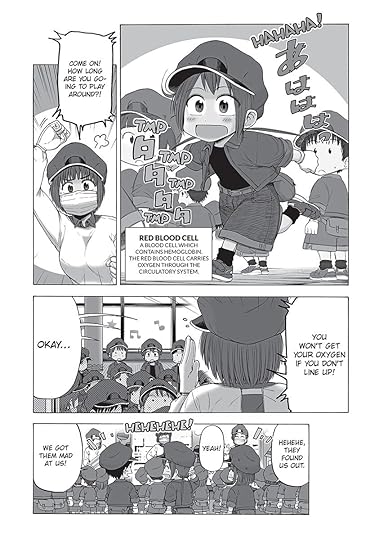
This is another spin-off of Cells at Work, but baby! All the characters are so adorable.✨
The story follows a little and friendly Red Blood Cell and her friends in their assigned task inside a young child.
It is super cute and informative. It started with birth and what happens during the first months of a child's life—a very entertaining way to learn about those events.
And yes, this is a work of fiction, but the manga is under a pediatrician's supervision. 🧑⚕️
I can totally understand how those who have taken biology, physiology, etc. have read Cells at Work and it helped them ace their classes! Wow! What an informative and fun read!
I enjoyed how the main character gave off Red Blood Cell vibes from the original work as she is one of my favorite characters (though this main character is much more vocal and less timid). I also liked that overall there is some distinct Cells at Work vibes in general even if some of the characters DO have different personalities. It felt nostalgia in that regard of bringing “homage” to the original.
All the characters were SUPER cute! I think the Parietal Cells were my favorite and absolutely loved how there was talk about mother’s milk and the positive things it does for a baby’s health! I feel that is a score for breast feeding moms!
I LOVED the interview at the end! I thought it to be really special and think that though this is no substitute for seeing a doctor or anything like that, I found it to be really informative and an easier way to understand the information of what exactly happens in newborn babies’ bodies. I deeply appreciated the why and intention of this manga’s messaged and why it was being shared.
I would recommend this manga to those who enjoyed Cells at Work but are curious about what happens in a baby’s body and to those who are pregnant and are curious as well.
*(I received an e-copy from the publisher via NetGalley. All thoughts expressed are my own.)*
As with the original Cells at Work! series, this stars anthropomorphized cells. This time we're inside the body of a baby. The volume begins shortly before its birth - its red blood cells receive oxygen and nutrients from the placenta. The main protagonist is a regular red blood cell (we'll call her RBC). A red blood cell bearing hemoglobin-f (called F from here on out) watches out for RBC - while the fetus is still in the womb, F is better at carrying oxygen, and he's presented as RBC's older, more competent brother/coworker. One of the mother's cells is represented by a nice lady wearing gloves and a mask, who only interacts with the fetus's cells via the placenta and never touches them.
After the baby's birth, we get the start of pulmonary circulation, baby's first meal (breast milk), and baby's first risk of infection.
I need to start off by saying that I don't have the knowledge to say how accurate the information presented in this series is. The original Japanese version had a medical editor, but there was no mention of whether someone with similar medical knowledge was involved in the English translation.
This was super cute. As part of introducing readers to the functions of the various cells, the baby's cells were depicted as kids trying their best but with only a vague understanding of what they were supposed to be doing. As a result, you get a manga about a bunch of kids doing factory work while the kids in Control (the brain) tap away at their computers and look through books trying to figure out how best to respond to yet another brand new potentially worrisome situation.
I was just as confused about where RBC was supposed to go after the start of pulmonary circulation as she was. I tried, but I couldn't really wrap my brain around the "before and after birth" routes of the red blood cells.
As much as I enjoyed the overall volume, I had some thoughts/concerns about a couple things. First, the portion of the volume about what happens when the fetus is still in the womb - there are details given about the strain the fetus puts on the mother's body, but they're presented in terms of the needs of the fetus and advice about supplements pregnant people should be taking (calcium, for example). Getting to see the mother's body's side of things would be fascinating, but that's not the focus of this series. (Maybe Cells at Work! Lady deals with it, but I've heard that's one of the weaker Cells at Work! series.)
Second, baby's first meal. The interview with the Dr. Hashimoto, the medical editor, at the end of the volume indicates that one of the goals of this series is to reassure parents and give them a better understanding of their baby's body. While we know there are antibodies in breast milk that help babies develop strong immune systems, it would have been nice if one of the informational boxes had made it clearer that formula feeding, while less ideal, won't leave babies defenseless. Formula feeding doesn't even come up in this baby's experience.
All in all, I enjoyed this and thought it was a good new entry in the Cells at Work! franchise.
Extras:
Four pages of full-color artwork at the start, as well as a 2-page interview with Dr. Hashimoto, the medical editor of the original Japanese edition.
I received this book from Netgalley/publisher in exchange of an honest review.
So now I have seen/read three kinds of Cells at work and I am enjoying them all, well, OK I am still not sure about Cells at Work BLACK. But I love this one and I love the normal Cells at Work! I love that there are so many variations of the series and I really want to read them all. Whereas BLACK is more gritty and more about an older body, the normal Cells at Work is more humour and at times a dash seriousness, this one is all about a baby’s body and the chibi-cells that work in it and are figuring out what the HELL is going on.
We begin with the pregnancy, the “aftershocks”, and then comes the moment for these new cells to shine and figure out how things work WITHOUT the help of older cells. Which created some hilarious situations as the cells weren’t sure what to do or what was happening. And it definitely didn’t help our ever getting lost Red Blood Cell who kept getting even more lost because parts of the body weren’t in function any more or stopped working for reasons. I loved that the brains had a small little library, fully kids/baby style with simple books. One of the guys working there had to find a book, read it, and then announce it through the system so the whole body (and thus the cells) would know. He didn’t mind reading that much, in fact for most of the book he is found there or reading with a big pile of books (I definitely could relate to him).
It was so much fun to see all my favourite cells and others and I found myself rooting for these baby cells. I can only imagine how confusing it must be for them to just be thrown into a new body like that without any help. Without any support. Without any way to get back to the older cells of the mom’s body. Red Blood Cell girl has her promise and that keeps her going and powering through things. She definitely does things that red blood cells probably wouldn’t do. Haha. But all the cells help each other out and figure out their roles.
I had a big big laugh that our White Blood Cell went from murderous in one series to being a cute coward in this one. I am sure he will get stronger and he did show some amazing skills, though he will really have to work on not being so scared.
Just like with the other books in the Cells at Work series we get information on various things that happen in the body. I often couldn’t read those very clearly as the text was tiny and the font not that clear. I will definitely be buying the series when I can, so I can read those then. I do love the extra information + we also get tips on healthy eating/living.
Oh, and I wish I had this series when I was still in high school. Because this is so much more fun than normal biology!
The art is super adorable, I do love some chibi cells!
All in all, I loved loved LOVED reading this one and I cannot wait for the next volume in the series.
A very young set of cells work to keep a baby alive through birth and then have to transition to life outside of the mother's womb and the changes birth triggers in the baby's anatomy.
This is a super educational set of stories that teach about how a baby's circulatory and pulmonary system changes after birth as well as the digestive system and how the immune system gets a boost from the Mother. I taught high school human anatomy for several years and there are details about the changes in infant anatomy in here that I never saw included in any high school or general college textbooks (probably are reserved for texts for pediatricians and pediatric nurses and OBGYN doctors). It is fascinating, and you learn things without realizing it because of the creative way the story is done. I'm so happy that someone is doing a branch off of the original Cells at Work series that is aimed more at middle grade. While the original is definitely more YA, this one doesn't have any language, and all the violence (killing bad cells, like viruses) is done off page in this. Highly recommended to anyone studying human biology, and those looking for STEM reading for middle graders on up.
Notes on content: No language issues. No sexual content. Medical processes are talked about in clinical terms and all birth scenes happen inside the baby's body from the animated cell's perspectives. All violence happens off page. (Just mentions the viruses or bacteria are killed, or limp characters shown.)
Thanks to NetGalley and the publisher for providing a copy in exchange for an honest review.
I watched the Cells at Work anime on Netflix. It combines two of my favorite topic anime/manga and science. Anatomy and physiology is presented in a clever and entertaining story. I can't wait to watch the spinoff series Cells at Work: Code Black (set in an unhealthy body that puts the cells work in deeper risk.) Here is a new version: babies.
I have 2 children and newborns go through a lot of changes during the first year of life. Cells at Work: Baby starts at 40 weeks gestation (full-term fetus.) in the placenta and transitions to labor and delivery. The adorable chibi cells are thrust into the world and have to learn how to do their jobs. The lives of baby cells proved to be more complex than I imagined.
I loved the interview with Dr. Hashimoto, the pediatrician consultant, at the end of the manga. It not only gave insight into the manga's creation but his passion for his career just leaps off the page. I can see this inspiring future pediatricians.
If you’re a Cells at Work fan or looking for an educational manga, then Cells at Work: Baby! is a cute, informative addition to the collection.
Super cute and adorable, it was a fun and fast read. I defientely saw some parallels between this volume and scenes from the parent volumes. The only thing I missed was the original Red and White Blood Cell, but I enjoyed the new red and white blood cell and I am super excited to read the next volume!
A cute look at some bits of anatomy and physiology that are different in fetuses and newborns (birth, closure of the foramen ovale and ductus arteriosus, passive immunity, and so on). A little too sugary sweet for my taste, a lot of stuff I already knew, and ugh the gender dynamics, but I'm curious to try the main series.
A thrilling start to a new series. This one starts with the birth of a new body and the cells figuring out how to do basic tasks and survive. Very cute, fun, and informative.
I decided to check this out, because I'm a huge fan of the Cells at Work anime series. This was much of the same as the original series, but no really interesting characters. Definitely learnt a lot about how babies bodies work shortly before and after birth.
Warnings: physiological challenges and medical crisis in fetus/newborn
After watching Cells at Work anime, I was very excited for this but was also curious how the 'story setting' can reflect any changes in storyline. For example, while the original Cells at Work is in a 'regular' body, Cells at Work: Code Black is in a body with deteriorating health, but a baby body would be similar to the original right, or so I thought. But Cells at Work! Baby truly brings a new perspective onto the same basic premise, and it starts with a baby that is just about to be born and the body adjusting to the change in environment from a womb to an independent life.
For those new to the series, Cells at Work universe anthropomorphizes the cells of your body, such that they are workers/employees in the big factory-like world of the body. (If you're familiar with Osmosis Jones, you already get it) So, the red blood cells become delivery workers and their job is delivering oxygen (which appear like gas canisters in the series) to the 'normal' cells living in apartment complexes, and the arteries and veins are the roads of the 'city'; the white blood cells are varied, so the neutrophils are wandering assassins, while helper T-cells and regulatory T-cells man the command center (which is Somewhere in the body?); and so on.
Anyway, back to the Baby - as usual, the red blood cells are the primary characters, with one extra-cute-adorable red blood cell as the main character, who like the other tiny red cells of the fetus aren't really that organized; she is regularly scolded by the older brother-like character, F-cell, who is worried about this little klutz. The first major event is the labor, which is a new experience for all the cells, who don't know what exactly the 'earthquakes' happening are, until the brain center looks up in the gene corner of the library to find out that it is an expected occurrence. Red blood cell and F-cell, who are both in the placenta at this time, have to escape via the umbilical cord back to the main body. Then, the challenges of this new independent body start - the cells have to go to the newly functional lungs but oh wait, it is not functioning yet due to amniotic fluids in lungs. The blood flow changes of the heart due to valve closures and diversions has the red blood cell confused. Then comes the surprise of the newly functioning stomach, and the baby's first heat rash and invasion of skin bacteria (we get a cute cowardly child neutrophil in this series!). For the cells living in the body, it is all about the firsts and the new challenges they have to keep this body alive, and it particularly highlights their desire to work hard for the sake of the body.
The book is very informative, putting in details about the cells and their functions and all in neat boxes beside the artwork. The fetal stage scenes do have some extra information, like the dietary suggestions for pregnant people. I love the series universe on the whole for its accuracy (well, aside from the life expectancy of these cells, but we are not going to discuss that lol) and this one is no exception; I was delighted to find in the afterword that they actually worked with medical professionals to create this. Only thing missing was the cute platelets that I've come to expect; they have not made an appearance in this book and considering most of the cells in this are sort of children-like in size, I wonder how they will be added. As for the artwork, I was impressed with the transformation of an organic body into a factory-like world, but the character design didn't impress me much. It was sort of chibi, but not: it would have been better to make them more cute in a truly chibi style, as the proportions and facial features are a bit off to be truly cute.
Nevertheless, I like this edutainment manga series and am looking forward to more!
Received an advance reader copy in exchange for a fair review from Kodansha Comics, via Netgalley.
Cells at work! is one of those little surprises I found last year when I was still subscribed to Kindle Unlimited. While seemingly every new manga coming out is some sort of isekai story – the plot of Cells At Work! was rather refreshing despite its simplicity. The main series told the story of the relationship between a lowly red-blood cell and her budding relationship with a heroic white blood cell while they go about their lives trying to keep their home healthy. The way biological functions were realized on an anthropomorphized scale was cool, and vaguely educational. I later found some of the spin-off works such as Code Black (which was gender swapped and dealt with a destructive person heavily drinking and such), and enjoyed them as well. This is the first time I’ve heard of this detour from the main story- and I’m pretty excited as we now have cells living inside a baby:
"BEING A BABY IS HARD WORK! Join these cute baby cells as they work hard within their tiny body! A mini-Red Blood Cell picks up oxygen from the helpful ladies at the Placenta, and meets a White Blood Cell for the first time, in this adorable spinoff of Cells at Work! But when tremors begin to shake their world, they’ll need to consult the Gene Library to find out what’s going on! Could this be…a contraction? And might their body soon have to…fend for itself?!" -- Official description
This book still tells the story of a Red Blood Cell, however rather than seeing her task of delivering oxygen throughout the body as some sort of delivery job ala the Post Office, this book starts out in a pre-school setting sort sorts with all of the Red Blood Cells first learning how to deliver it then transitions to the setting we’re all used to. The story takes us from forty weeks into the pregnancy, to the birth, and finally into some situations a baby might have in their small life such as removal of the umbilical cord, eating for the first time, and the lungs being filled with fluid etc. This all leads up to a viral attack, and the introduction of fan favorites – The White Blood Cells, this time in chibi form. We see this through the relationship between Red Blood Cell and her big brother that watches over her, and keeps her out of trouble (or at least he tries).
I will give this book props for not just being a total rehash of previous books with chibi characters, or a book with wall-to-wall jokes. I’m thinking of the Attack On Titan spinoff set in a school, and how awful it was. This stands on its own, and honestly is paced largely the same as the other books, it just has a different setting an somewhat different characters.
I enjoyed this book a lot, and it is a great volume in the ever-growing Cells at Work! saga. Honestly, I think the only thing left for them to do would be a animal version of it, or something about viruses (they did bacteria already I suppose). We’ll see where it goes I guess. If you like Cells at Work! you will enjoy this, if are not familiar with what this is all about, it stands on its own for the most part and could be read without prior knowledge of the other books. Definitely, a recommendation.
Thanks to Netgalley for providing a copy in exchange for an honest review.
Cells at Work has been growing in popularity and with good reason. It presents science about the body in a fun and entertaining story, with delightful characters who we follow through the many routes of the body. It’s so popular it spawned an anime, and a spinoff series Cells at Work: Code Black, set in an unhealthy body that puts the cells work in deeper risk. And now we have a new version: babies.
Ever wondered what a newborn has to go through in the first year of life? Now you can know. All our characters are adorable chibi designs who are thrust into the world and have to discover how to do their jobs, while learning how every other cell works in the process. Exploring labour, milk, digestion, and so much more, the lives of baby cells prove to be more interesting and complex than we thought.
Because it follows the same formula as its mangas predecessors, the style of it can get repetitive at times. You focus on a certain bodily function, something happens, it gets fixed, and so forth. I forgive it for that because the aim is to be educational, and the content is detailed and in-depth, and when it comes to the human body, things never always go smoothly. You also get treated to an interview with Dr Hashimoto, the paediatrician who consulted on the manga, which gives another insight into the mangas creation.
If you’re a Cells at Work fan, or are looking for an educational manga, then go no further. Cells at Work: Baby is cute, informative, and a great addition to the collection.
Cells at Work! Baby 1 by Yasuhiro Fukuda Four stars
Going into the this manga, I haven’t read any others, or seen the anime, so I wasn’t sure what to expect.
It’s a cute and fun way to describe and show what various cells in the body do, specifically in newborn babies. It informs readers about how the body works, but doesn’t feel like reading a boring non-fiction book on the subject.
I enjoyed the way facts about the body were intersperced between the dialogue and ‘plot’, which all related back to each other. Everything that happened is something that happens in everyone. I honestly think I learned more from this manga about the jobs of different cells, pregnancy and immunity than I did when I was in school, and it was much more entertaining and easy to remember.
I would reccomend this manga to any previous fans of the series, and new fans who are interested in starting. It’s an easy way to get into the series, and starts with the main characters, white blood cell and red blood cell, when they first began their jobs.
We follow red blood cell and her friend as they slowly adjust to life outside the womb, and the new ways to deliver oxygen around the body. Their adventures give insight into how the digestive system works, how viruses and immunity affect the body and the differences of before and after the birth of a baby. It clearly explains what is happening to the body in each chapter, and why it is happening or why it needs to happen, ad the brain cells helpfully chime in with occasional announcements.
mangavormis kirjeldus beebi sünnist ja ta elu alguses ette tulevatest terviseriskidest, jutustatud... seestpoolt - tegelasteks on lapse enda verelibled ja muud keharakud.
idee on tore, aga nagu tihti mangadega, varjutab action tihtipeale tegelikku sisu, nii et kuigi ma sain siit küll mingeid teadmisi stafülokokist ja immunoglobuliinist ja mõtlesin vist esimest korda elus selle peale, kuidas (ja kas) beebi sündmise järel hingama hakkab, siis suurema osa ajast olin ikka pigem segaduses, et miks need tegelased kogu aeg kuhugi tormama peavad ja miks üks punane verelible teist kogu aeg kamandab ja manitseb ja laisklemises süüdistab. jube palju tarbetuid emotsioone, ühesõnaga. aa, ja minu maailmas peavad valged verelibled olema vaprad rüütlid ja mulle jäi segaseks selle manga autori otsus teha valgest vereliblest hoopis argpüks, kes jätab oma töö peaaegu et tegemata.
aga siit tuli üsna koherentne lugu kokku selle nurga alt, kuidas lootest lapseks üleminek on kehale ikka päris suur muutus. lõpus on ka intervjuu raamatu lastearstist meditsiinitoimetajaga, mis lisab kindlust, et faktid olid paigas.
You know how cute the platelets are in Cells at Work!? Now imagine an entirely new series in the Cells at Work! world where all the characters are babies! Adorable, right? Yes! This series is such a fun and informative adventure that you can't help but cheer on the little cells in their struggles. The first chapter is about the body that these chibi characters inhabit being born, and then the subsequent chapters progress into the struggles that a newborn may face. It's always interesting seeing how the different cells cooperate together in harmony to solve whatever problems arise.
I also enjoyed the interview with Dr. Hashimoto at the end. I thought it was interesting to hear his reasons for agreeing to be the medical fact checker for the series--that new mothers struggling could see just how miraculous birth is and that fathers could be more grateful!
My only complaint is that sometimes the medical explanations burden the panels, but I think that's unavoidable.
Thank you to Netgalley and Kodansha for this eARC!
If I were to describe this in one word, it would be lively.
Like the original series, Cells at Work Baby tells the story of cells as little people working to keep the body functioning, specifically following a red blood cell and her friend delivering oxygen. To make it even cuter, the characters are drawn in chibi style appropriate to the context.
Inside a soon to be born baby, cells are hard at work, and there’s a lot to learn as the body begins to fend for itself, fighting off all kinds of viruses. The depiction of cells as people is so much fun- working together, facing the unknown, naturally involving plenty of banter and laughs . The design of cells invaded by Norovirus especially made me grin- they gave me serious Darth Vader vibes. It’s also educational- I didn’t pick this up for the biology, though it does make one awe at the miracle of human life.
I’m looking forward to Volume 2.
Thanks to NetGalley and Kodansha Comics for providing a free e-copy in exchange for an honest review.
I didn't know there was a Cells at Work Baby series-- I'm ready! I read this first one and will absolutely borrow the rest in the series just like I've read as many as I can in the original series (and hopefully eventually will watch the anime just to compare).
This one is literally not the cells as babies but the work of childbirth INSIDE the baby. I learned about the valves that close and reroute once the placenta is detached and the baby uses their lungs and own blood flow to and from the heart. How oxygen is used when the baby is floating in liquid, how the baby brain starts to kickstart, and what mother's milk does including for the baby's digestive system but also the antibiotics inside of it to help combat issues that creep up as the baby is born.
It is exactly like the other series- full of adorable, emotive characters as the cells and diseases inside the body have fun but also putting in the hard work and the explanatory text boxes that share what is actually happening in scientific terms.
Alright, I’ll admit it, I did not read the blurb before going into this manga. So yeah, I was surprised but this was still an interesting read. I was surprised because it is not really a story but more like a lesson about how the human body works as a foetus and then, once it is ejected into the outside world. The drawings and the characters were really cute. It made it fun and entertaining to read. Even though it is a spin-off of Cells at Work! It can be read alone. You don’t need the other series to understand this one. I learnt things while reading this manga, but not sure I will remember them in a few weeks. Guess we’ll see. I would recommend this book, especially to people interested in anatomy and new or to-be parents.
3/5
Thank you Netgalley for this eArc in exchange of my honest opinion
Thanks to NetGalley and the publisher for an early copy of this book!
I've seen the anime for Cells at Work! and really enjoyed the experience. This version of Cells at Work! takes the form of chibi art style and starts at the birth of the cell's host. It was a different take on the classic Cells at Work! and remained to be very informative, which I think is a really important aspect of this series.
Personally I don't think the art style is for me, but the story and characters are all good. I liked that you got the medical aspect as well as the "dumbed-down" version aka the side bars of medical information and the information the cells themselves learn/spread. While I'm not sure I'll pick up another volume, for anyone interested in science and the medical field would enjoy this.
Thank you so much to Netgalley and Kodansha Comics for the opportunity to read and review this manga. I really enjoyed this manga actually more than I expected to because of the original anime series was fun but a tad episodic. This manga was a lot more flowing and more continual and easy to understand especially when it comes to the birthing progress. This is also a very good manga if you are a new parent who wants to understand the infant's body with different situations but also for teens who want to explore how viruses and heat rashes manifest. My favorite part though was the new characters that was presented in this story and I'm excited to see more from this. Because of these points, I have to give this manga a 4 out of 5 stars
I came to know about 'Cells At Work' through the ongoing anime which was such a fun watch. When I read the manga, I felt the exact same. Yasuhiro Fukuda's drawings are incredible and in Cells At Work BABY, they are even more adorable. All of the character designs are really cute and the scenarios they go through are so much fun to read. This edition in the Cells at Work series gives a cute spin to the characters we already know from the main series. I enjoyed this book a lot, and it is an excellent addition to the ever-growing Cells at Work! saga.
Thank you Netgalley and Kodansha for the eARC! This was such a cute manga. I saw some of the anime and thought it was such a fascinating take on learning about the human body, so when I saw this manga I couldn't resist requesting it! I love the depiction of all the characters from the original Hataraku Saibou as children versions of themselves. This manga is such a fun way to learn more about the workings of the human body when you're first born. There are so many terms to learn and it's all in medical terminology, but the artwork helps translate those terms into something everyone can understand. This is just so cute!
The adorable is strong in this one. I had my doubts about how well the story of the cells in the body could be retold without it getting repetitive or being a straight rehash of the original, but the whole idea of it being a baby body translates adorably into little baby cells that are still learning how everything works. It remains incredibly educational and easy to follow while also being entertaining. As much as I love the ditzy but brave Red Blood Cell and F-Niichan at her side, nothing will beat scaredy-cat White Blood Cell in making me want to continue learning with the adorableness.
Many happy thanks to NetGalley and Kodansha Comics for the early read!
Cells at Work! Baby is a really cool way to learn about the human body and how it works. The story starts just before birth and shows how the baby's body starts working on its own for the first time. And there are many new things to do - from breathing on your own, to meeting with viruses and bacteria. The way that the information is explained is easy to understand and engaging, so I think this is a great way to help your kids learn about the body.
I definitely recommend if you're interested in how the body works.
*Thanks to NetGalley and Kodansha Comics for providing me with an ARC of this title in exchange for an honest review.*
Thank you to Netgalley and the publisher for this ARC in exchange for an honest review.
That was an informative and fun manga to read. I found the characters so cute and the idea so interesting and at the same time so useful. This is a different style of manga that could be so helpful at schools during science classes or for the parents in order to explain things to their kids about cells and how the human body works. It wasn't my usual kind of manga but I'm always open to new things. I just discovered that there is an anime based on the manga, so I'm sure gonna check it.
So I LOVE the original Cells at Work, and even Code Black had its charms, so I picked this up during the recent sale when I was hoping to find a new series to read, since I adore the original cast, and I figured babies that’s gonna be cute??
Eh, it was pretty boring. Hence why it took me a month to get through. I mean there’s nothing wrong with it, really, and I did learn a few things (I don’t know much about babies I’ll be frank), but ultimately, it lacked the charm of either the original or “Black.”
If it’s on sale I might pick up a second volume of this, but idk.
A breath of fresh air. I enjoyed it from start to finish. Who says manga is not educational??? 🥸
I actually got this copy back in 2021, and I’m only reading it now. There are actually three different versions of Cells at Work, and this one revolves around the development of a newborn, essentially everything that goes inside a baby’s body. It has the same characters as the original Cells at Work, but here they are depicted as toddlers! So cute! I might consider continuing this series. I learned so much. What a fun way to learn, truly.
I love the "Cells at Work" series, and this is an interesting spin-off that focuses on the cells of a baby, just before and after birth. I never realized how many changes the baby goes through to adapt to living in the outside world after birth, and the portrayal of the "cells" as children themselves emphasizes the vulnerability of the body. An interview with the consultant for the series, a pediatrician, also stresses how important it is for new parents to know the science behind the whole process.
I voluntarily read and reviewed an advance copy of this book from the publisher via NetGalley. All thoughts and opinions are my own.
This manga is so cute and is very informative in an adorable way. It also feels like I refreshed my knowledge about the topics per chapter here and it's much more fun because of the illustrations and the storyline. I also loved that this is about babies.