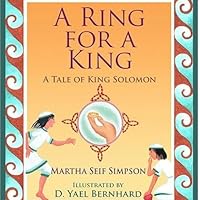
Set in Morocco, this sweet story of friendship and shared customs between a Jewish family and their Muslim neighbors provides a great introduction to the Moroccan Jewish holiday of Mimouna. It’s Mimouna ― the Moroccan Jewish holiday that marks the end of Passover, and when blessings are given for a year of prosperity and good luck. Miriam wants to help her mother make the sweet moufletot pancakes they always eat at their Mimouna party, but after following the rules of Passover, they don’t have any flour in the house! So Miriam’s mother takes her to visit their Muslim neighbors, who are happy to share. The women drink tea together, and Miriam makes friends with a young girl named Jasmine. Miriam almost drops the bag of flour when she and Jasmine go to fetch it from the storeroom ― but luckily Jasmine is there to catch it! Jasmine and her family then join Miriam’s family and friends to celebrate Mimouna. This sweet story of friendship and shared customs will introduce North American readers to the Mimouna holiday. The book concludes with an author’s note and a recipe for making moufletot, the sweet, paper-thin pancakes featured in the story, so that readers can enjoy, too. Key Text Features recipes author’s note Correlates to the Common Core State Standards in English Language CCSS.ELA-LITERACY.RL.2.2 Recount stories, including fables and folktales from diverse cultures, and determine their central message, lesson, or moral. CCSS.ELA-LITERACY.RL.2.6 Acknowledge differences in the points of view of characters, including by speaking in a different voice for each character when reading dialogue aloud.
Here I am as a Jewish woman learning even more about the diversity within our culture. Wow. Mimouna is a Moroccan Jewish holiday that begins after Passover during which the Jewish community often celebrates with Muslim neighbors. While the book could have used some editing to sharpen the focus of the story, it is a rare gem in terms of representation: A family that is Moroccan (African), Jewish, Brown, kosher for Passover, and celebrates a holiday from Sephardic/Mizrahi tradition.
I love reading about food spanning cultures. Or about food IN cultures. So this book about a time in Jewish culture (with those in North Africa) and how they make a yeasted sweet bread after Passover is really precious. Friendship spanning religion is SO important, especially these days, as well!
A sweet and lovely story. (I only wish there might have been a suggestion of the year in which the story was taking place--my grown-up mind was situating it within the history of Moroccan Jewish immigration to Israel.)
This is a gorgeously illustrated picture book with a gentle, intriguing story. I felt a lot of affection for the main character and her world, and the story carried a quiet power. I especially loved how hushed and soothing the night scenes felt, yet they were also vivid. I highly recommend for preschool and up!
This lovely story tells about an after-Passover celebration in Morocco called Mimouna. When Passover ends, Miriam goes with her mother to a Muslim neighbor to get flour to make a type of pancake called moufletot. Miriam meets a Jasmine, a girl her age. Back home, Miriam helps prepare for Mimouna. Family and friends come, including Jasmine and her mother. But the following year, Miriam's family has moved to Israel, where they continue to celebrate this Moroccan holiday. This charming story is a wonderful introduction to a joyous holiday that is unfamiliar to most Americans, as well as a beautiful tale of friendship between Jewish and Muslim cultures. The illustrations add lots of details and there is a moufletot recipe at the back of the book.
Lovely illustrations. Two girls living in Morocco - one Jewish and one Muslim - celebrate the Jewish holiday of Mimouna. Sharing food and cultures and getting over their shyness helps them become friends. A year later, one is living in Jerusalem and hoping her friend remembers her. There's kind of a lot packed in here. I would have liked to have had the author stick to the story of Mimouna.
This is such a sweet book and the drawings are beautiful! I’m so glad that the author included the recipe for the moufletot. I’m not sure if I spelled that right and i’m sorry if it is wrong.
Kids books are the best way to learn new things about other cultures. Excellent illustrations and an approachable story help bring people of other cultures into the story.
From the perspective of teaching about Mimouna, this was a bit disappointing. There’s very little information about this holiday, its history, who its named for. It mentions briefly some of the food, but essentially the story serves as a vehicle for telling the reader that Moroccan Muslims were kind to Moroccan Jews, who led an idyllic life there. While it’s true that Morocco is probably the only Muslim country where Jews can currently live with any kind of safety, the agenda driving story detracts from its integrity.
The stores close before the end of Passover, so a Moroccan Jewish mother has a tradition of buying flour from a Muslim neighbor. One year, her daughter goes along and meets the Muslim woman's daughter. The Jewish family invites the Muslim family to the celebration.
The next year, the Jewish family is in Jerusalem and the Jewish girl wonders if the Muslim family wonders where they've gone.
A nice story about two cultures meeting and sharing one of their celebrations.
A sweet story about the Jewish holiday of Mimouna, and the interactions between a Jewish girl and her Muslim neighbor. There was more text per page than usual, and the story itself was wordier than most picture books. This allowed for more detail, but it might also be hard to keep younger kids interested in a book like this.
A sweet holiday picture book that tells of Mimouna, a Jewish holiday celebrated after Passover. My favorite part of this tale is how the Jewish and Muslim families worked together to participate in this holiday.
Sits on themes of neighborliness, hospitality, and celebration.
About two girls bonding over the course of a Mimouna party. One is the daughter of the family hosting. The other is the daughter of the Muslim family that gave the hosting family flour for the party.
This feels a little incomplete, but it's a sweet holiday story.