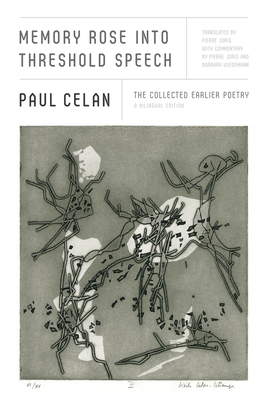
Memory Rose into Threshold Speech gathers the poet Paul Celan's first four books, written between 1952 and 1963, which established his reputation as the major post-World War II German-language poet.
Celan, a Bukovinian Jew who lived through the Holocaust, created work that displays both great lyric power and an uncanny ability to pinpoint totalitarian cultural and political tendencies. His quest, however, is not only there is in Celan's writing a profound need and desire to create a new, inhabitable world and a new language for it. In Memory Rose into Threshold Speech , Celan’s reader witnesses his poetry, which starts lush with surrealistic imagery, become gradually pared down; its syntax tightens and his trademark neologisms and word formations increase toward a polysemic language of great accuracy that tries, in the poet's own words, "to measure the area of the given and the possible."
Translated by the prize-winning poet and translator Pierre Joris, this bilingual edition follows the 2014 publication of Breathturn into Timestead , Celan's collected later poetry. All nine volumes of Celan's poetry are now available in Joris's carefully crafted translations, accompanied here by a new introduction and extensive commentary. The four volumes in this edition show the flowering of one of the major literary figures of the last century.
This volume collects Celan’s first four Mohn und Gedächtnis (Poppy and Memory) , Von Schwelle zu Schwelle (Threshold to Threshold) , Sprachgitter (Speechgrille) , and Die Niemandsrose (NoOnesRose) .
Poet, translator, essayist, and lecturer, influenced by French Surrealism and Symbolism. Celan was born in Cernăuţi, at the time Romania, now Ukraine, he lived in France, and wrote in German. His parents were killed in the Holocaust; the author himself escaped death by working in a Nazi labor camp. "Death is a Master from Germany", Celan's most quoted words, translated into English in different ways, are from the poem 'Todesfuge' (Death Fugue). Celan's body was found in the Seine river in late April 1970, he had committed suicide.
The astounding creative engagement between Paul Celan and Pierre Joris comes to a close with this magnificent volume. With spectacular commentary to boot. It's a mighty feat for Joris to bring Celan's "thousand darknesses of deathbringing speech" into English, through a comprehensive vision honed through decades of study. Having translated the entirety of Celan's late work, and having those resonances in mind when approaching the earlier volumes, gives Joris the special qualification as the most critically well-equipped major translator of Celan in English. At times, however, the heavily literal approach that Joris takes to Celan actually makes the poet more difficult to understand—an issue more so in "Breathturn into Timestead," occasionally resulting in whimsy strained to the point of clumsiness—than in this volume of earlier poetry, which is less reliant on grammatical wrings and neologisms. In "Memory Rose into Threshold Speech," Celan sounds more sagely, youthful, lyrical. And yet the graveness of Celan's poetic project constrained his lyricism, and so "beauty" in a conventional sense is not to be expected from work that so intensely seeks to recapture the lives claimed by Shoah. A poetic oeuvre which seeks to repossess moments from those lives, to make what is abstract, what presents itself as a statistic of six million, palpable and terrifying. But for gravity to come off as a haunting misspeaking? Any tonal oddities are meant to be remedied by the precision of Celan scholar Barbara Wiedemann's translated commentary, and Joris thoroughly explains any unusual word choices with great erudition. His scholarly powers shine here as they did in the collection, "Breathturn into Timestead." One does, however, question how well a translation can stand independently, if annotations are meant to travel with it like additional pieces of luggage. Additional commentary is nearly inescapable given Celan's heavily allusive and elusive techniques, But could a less literal approach be more faithful to the letter (as Celan imagined the act of translation) than literalism? Celan himself, as a translator, often strayed from being literal. His reworkings of Dickinson are a very interesting example of this—inserting or cutting away words! In Celan's translation of "Let down the bars, O Death!" he takes the last of the subsequent lines,
"The tired flocks come in Whose bleating ceases to repeat, Whose wandering is done."
and changes it to "Wer nicht mehr wandert, kommt." ("Who wanders no more, comes.") Any choices made in the spirit of poetic freedom / betrayal of the source could be more effective in American English, but much harder to defend, compared with the rigorous faithfulness to the word that Joris has powerfully and paradigmatically endorsed. But this is not to diminish from Joris's profound accomplishment. Joris's volume is spectacular for a reader no matter their level of experience with the German language. He encourages his readers to think boldly about what is retained, and what is lost in the art of translation.
Above all, this culmination of Pierre Joris's Celan project should serve as a great inspiration to readers, poets, and translators alike. Joris's devotion is moving. He asks more of our attention, in the hopes that we may ask more of ourselves, how we read—and to question more deeply what we pursue in long-term engagements with creative figures (whether or not they be Paul Celan) who beckon to us continually, and unexplainably.
Stumme Herbstgerüche. Die Sternblume, ungeknickt, ging zwischen Heimat und Abgrund durch dein Gedächtnis
Bogengebete - du sprachst sie nicht mit, es waren du denkst es, die deinen
Ungeschriebenes, zu Sprache verhärtet, legt einen Himmel frei
ortlos und schwer aus sich selbst: erblickt und umgangen Findlinge, Sterne schwarz und voll Sprache: benannt nach verschwiegenem Schwur ~~~~~~~~~~~~~~~~~~~~~~~~~~~~~~~~ Niemand knetet uns wieder aus Erde und Lehm, niemand bespricht unsern Staub. Niemand.
Gelobt seist du, Niemand. Dir zulieb wollen wir blühn. Dir entgegen.
Ein Nichts waren wir, sind wir, werden wir bleiben, blühend: die Nichts-, die Niemandsrose.
Mit dem Griffel seelenhell, dem Staubfaden himmelswüst, der Krone rot vom Purpurwort, das wir sangen über, o über dem Dorn. ~~~~~~~~~~~~~~~~~~~~~~~~~~~~~~~~
was zu dir stand an jedem der Ufer es tritt gemäht in ein anderes Bild
über aller dieser deiner Trauer: kein zweiter Himmel
von deinem Gott war die Rede, ich sprach gegen ihn, ich ließ das Herz, das ich hatte, offen: auf sein höchstes, umröcheltes, sein haderndes Wort
Ihr Finger Fern, unterwegs an den Kreuzungen, manchmal die Rast bei freigelassenen Gliedern auf dem Staubkissen Einst
Schlüsselgeräusche oben im Atem- Baum über euch: das letzte Wort, das euch ansah, soll jetzt bei sich sein und bleiben
O diese Wege, galaktisch O diese Stunde, die uns die Nächte herüberwog in die Last unserer Namen
mit allen Gedanken ging ich hinaus aus der Welt: das warst du du meine Leise, du meine Offne, und du empfingst mich
Dort: ein Gefühl vom Eiswind herübergeweht das sein tauben-, sein schnee- farbenes Fahnentuch festmacht
Schweigendes Leibes liegst du im Sand neben mir, Übersternte.
Brach sich ein Strahl herüber zu mir? Oder war es ein Stab, den man brach über uns, der so leuchtet?
Das Schwere, das du mir zuwarfst: es macht mir den Stein nicht gewogen, der aufklafft, wenn ich mit murmelenden Finger in sein von Tiefen gekämmtes Haar greif.
Dich nur neigt zu mir hin, was du geworfen.
Ein Vogel, der rundesten Träne entschlüpft, regt sich wie Laub über dir: du kannst warten, bis unter allen den Augen ein Sandkorn dir aufglimmt, ein Körnchen Sands, das mir träumen half, als ich niedertauch dich zu finden... und ich schwebt dir voraus als ein Blatt, das weiß, wo die Tore sich auftun.
Strähne, die ich nicht flocht, die ich wehn ließ, die weiß ward von kommen und gehen, die sich gelöst von der Stirn, an der ich vorbeiglitt, im Stirnenjahr
Dies ist ein Wort, das sich regt, Firnen zu lieb, ein Wort, das schneewärts geäugt, als ich, umsommert von Augen, der Braue vergaß, die du über mich spanntest, ein Wort, das mich mied, als die Lippe mir blutet, vor Sprache.
Dies ist ein Wort, das neben den Worten einherging, ein Wort nach dem Bilde des Schweigens, umbuscht von Singrün und Kummer.
Niedergehen hier die Fernen und du, ein flockiger Haarstern, schneist hier herab und rührst an den erdigen Mund.
Voller, da Schnee auch auf dieses sonnendurchschwommemes Meer fiel, blüht das Eis in den Körben, die du zur Stadt trägst.
Mit nachtverhangnen Lippen sprech ich den Segen
Nun aber schrumpft der Ort, wo du stehst: Wohin jetzt, Schattenentblößter, wohin? Steige. Taste empor. Dünner wirst du, unkenntlicher, feiner! Feiner: ein Faden, an dem er herab will, der Stern: um unten zu schwimmen, unten wo er sich schimmern sieht: in der Dünung wandernder Worte
Pierre Joris spent 40 years translating the late poems of Paul Celan. Meanwhile, on the early poems, he spent (if I recall correctly) only 4. While these translations are good, certainly worthwhile, and some even outstanding, I think that the disparity in time spent generally shows through—mostly in the lyricism of the poems. The scholarship is rock-solid, but does rely—as Joris states himself—"almost entirely" on Weidemann's German commentary. This is not a bad thing at all, either, as Weidemann's commentary is superb. But that is all to say that Joris' investment in the early poems is much less than it was in the late.
And, may I add: I am not at all trying to dog on Joris here. The guy is a phenomenal translator, and consistently produced some of the (lyrically) best versions of Celan's late poems in the English language. I specify "lyrically" because my understanding of German is less-than-rudimentary and is based only on what I can infer from a knowledge of general etymology. Furthermore, to spend nearly 50 years translating one person's work is a huge undertaking (and achievement). Along that line, Joris wasn't even planning to translate the early poems—it was Jonathan Galassi who convinced him to do it.
With all that said, and in mind, I think that Joris' edition of the early poems does not quite hold up, in particular, against those of Michael Hamburger and John Felstiner. A comparison of one of my favorites, if I may:
"Into the Distance" (trad. John Felstiner)
Muteness, afresh, roomy, a house—: come, you should dwell there.
Hours, fine-tuned like a curse: the asylum in sight.
Sharper than ever the air remaining: you must breathe, breathe and be you.
———
"Into the Distance" (Trad. Pierre Joris)
Muteness, anew, spacious, a house—: come, you shall dwell.
Hours, staggered curse-handsome: within reach, the sanctuary.
Sharper than ever the remaining air: you shall breathe, breathe and be you.
———
Joris' translation is, I would actually wager, probably closer to the German. But it misses emotionally where Felstiner's hits dead-on. "Hours, staggered curse-handsome," whether belonging to German idiom or an invention of Celan, does not have the gut-punch in English that "fine-tuned like a curse" possesses. And there are a few more things I could point out, but I will restrict myself to just one: in the final couplet, Felstiner's order is "air remaining," while Joris' is "remaining air." By choosing not to suspend the adjective "remaining" until the end, in this case, the image, or feeling, of what qualifies said "air" is dulled, and the emotional force of the line is blunted. And again, this is all just what (at least what I think) works best in English. In the German, the order of these two words is as Joris has it.
Joris' translations in this edition do also occasionally read somewhat clunkily. This, I think, is the product of adhering very closely to the Celanian syntax, which is, again, not necessarily a bad thing. It is a give-and-take because, in this way, we get closer to Celan's syntax, but we lose sense (and again, emotional force), because what works syntactically in German does not necessarily work in English: and in another way, then, we actually stray further from the essence of Celan. If I may, once more, illustrate—a comparison between Joris and Hamburger:
(Untitled) (Trad. Michael Hamburger)
Your being beyond in the night. With words I fetched you back, there you are, all is true and a waiting for truth.
In front of our window the bean-plant climbs: think who is growing beside us and watches it.
God, so we read, is a part and a second, a scattered one: in the death of all those mown down he grows himself whole.
There our looking leads us, with this half we keep up relations.
———
(Untitled) (Trad. Pierre Joris)
Your having crossed over tonight. With words I brought you back, here you are, all is true and a waiting for the true.
The bean climbs in front of our window: think of who grows up near us and watches it.
God, we read it, is a part and a second one, scattered: in the death of all the mowed ones he grows toward himself.
That's where our gaze leads us, with this half we stay in touch.
———
I wish to immediately call attention to the third stanza: Joris' syntax, when compared to Hamburger's, lacks force. "[I]n the death / of all the mowed ones / he grows toward himself." We lose, in this version, first, the notion of violent death or removal: "those mown down." Second, we lose this notion of God growing towards his oneness: "he grows himself whole" (Think: "Hear, O Israel: the LORD our God, the LORD is one"). We lose the notion of that felt struggle (whether real or no) to remain before God's face: "we keep up relations," yes, we bleed ourselves toward God in hope of acceptance. In Joris, we merely have "we stay in touch," as though two old friends were sending letters and pictures of their grandchildren to one another in old age. I do not think that was quite what Celan had in mind.
So anyways, all THAT said: although Joris does not quite, in my opinion, measure up to his predecessors with this particular edition, I still do think it is certainly worthwhile. Joris IS an extremely learned scholar of Celan, and again, a skilled translator, and just because some of these translations are not quite as good (again, lyrically) as some others, that does not mean that they are not good at all. There is much in this volume, and I would recommend it to anyone interested in Celan's poetry.
Let me end with one of Joris' versions from this volume which, for me, tops everyone else's translations:
"All Souls"
What have I done? Inseminated the night, as if there could be more, nightlier than this one.
Birdflight, stoneflight, a thousand described orbits. Gazes, looted and plucked. The sea, tasted, drunk dry, dreamed away. One hour soul-eclipse. The next one, an autumn light, burned offering to a blind feeling that came this way. Others, many placeless and heavy with themselves: glimpsed and dodged. Erratics, stars, black and full of language: named after an oath silence-shredded.
And once (when? this too is forgotten): the barbed hook, felt where the pulse dared the counterbeat.
The bright stones pass through the air, the bright- white, the light- bringers
They don’t want to come down, nor fall, nor hit. They open up like humble dog roses, that’s how they open, they float toward you, my quiet one, you, my true one—:
I see you, you gather them with my new, my everyman’s hands, you put them into the Bright-Again no one has to weep for or name.
I am alone, I put the ashflower in the glass full of ripe blackness. Sistermouth, you speak no word that survives before the windows, and what I dreamed climbs soundlessly up on me.
I stand in the gauze-pile of the withered hour and spare some pine sap for a late bird: it carries the snowflake on a feather red as life; a kernel of ice in the beak, it gets through summer.
within the persistence of human complicity, is there such thing as transcendence when breathing is heavier, than death?
"Climb. Grope your way up./ You'll grow thinner, more unrecognizable, finer!/ Finer: a thread/ along which it wants to alight, the star:/ so as to swim further down, down/ where it sees itself gleam: in the swell/ of wandering words." A beautiful bilingual collection in Pierre Joris's accurate and inspired translation is a real treat. Celan's unique tormented voice draws one into the words, as in a reverie; redemption is always there at the tip of the last word.
These poems have the advantage of being strongly imagistic, the disadvantage of being frequently opaque. A Celan comment in the notes makes me think that for him poems weren’t created to comment on or reflect reality, but to be a reality themselves: like a piece of music or an abstract painting, maybe. That reality feels, to me, to be often rooted in the holocaust, but maybe I’m reading too much in.
The first half of this book has many poems I adored. Beautiful, inventive use of language, that is both lyrical and surprising. As it progresses, Celan becomes more and more experimental and abstract, and at some point the book started to lose me.
Maybe I'm missing something. Maybe his abstract work is untranslatable. Or maybe it just sucks? I don't know.
Innovative and exploratory poetry. At times it can become too difficult. There is a feeling that at times the translation fails - especially the ' music' of the German words fails to come over into the English. However, the best of the poetry that does come across, is magnificent and moving.
Death Fugue is obviously a great poem, but I just couldn't really get into any of these others. Found them to be mostly opaque and sometimes indecipherable.
Voices, from which you heart recoils into your mother's heart. Voices from the gallows tree, where latewood and earlywood again and again exchange their rings.