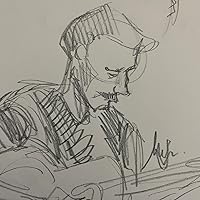
After the award-winning success of NIL NIL, poet Don Paterson moves into yet more dangerous and exhilarating territory. Straight autobiography mixes with invention, exaggeration, technical dazzle, and sheer cheek in a book of poetry quite unlike any other.
Don Paterson (b. 1963) is a Scottish poet and writer. He is the author of sixteen books of poetry, aphorism, criticism, memoir and poetic theory. His poetry has won many awards, including the Whitbread Poetry Prize, the Geoffrey Faber Memorial Prize, the Costa Poetry Award, three Forward Prizes, the T.S. Eliot Prize on two occasions, and the Queen's Gold Medal for Poetry.
He is a Professor Emeritus at the University of St. Andrews, and for twenty-five years was Poetry Editor at Picador MacMillan. He has long had a parallel career as a jazz guitarist.
A litmus test of the quality of a poetry collection is its assumed ability to accompany me throughout a 12-hour train journey without me getting bored. This early collection by Don Paterson - it was published almost 20 years ago - passes the test, although only grudgingly. God’s Gift to Women is a rather wild assortment, with poetic invention spilling over into a riotous variety of forms. Its tone is far from self-consciously bardic. Its more like sitting with Paterson, edgy and half-pissed, in a rowdy bar whilst the poet, occasionally lapsing into Scottish, declaims his irreverent and opaque stanzas. The unfolding landscape is bleak, dystopian at times. There are flashes of horror. There is a feeling of foreboding. There is a sense of being exiled to a dark planet where „our voices sound funny and all the houses are gone and the rain tastes like kelly and black waves fold in very slowly at the foot of Macalpine Road and our mothers and sisters are fifty years dead.” Occasionally there is a resolution into a warmer key, a fleeting awareness of grace, an expectation of redemption. As for instance in the final couplet of the long, tough and complicated poem from which the book draws its title:
„They set you down upon a hill. Your case is huge. Your hands are small. The sun opens its golden eye into the blue room of the sky. A black mare nods up to your side. You take her reins and, and let her guide you over the sky-blue, trackless heather to the hearth, the Home, your real mother.”
Although I must confess to being mystified by the explicit meaning of most of the poems, the richness of Paterson’s imagery and the incisiveness of his language keep me effortlessly involved. After the last poem, on page 56, there follows a short section with notes. Leafing through a few empty pages brings you to a short, enigmatic postscript on an unnumbered page, titled (ix) 02:50 Newbie (note that the open bracket is probably intended):
„Of this white page, ask no more sense than of the skies (though you may believe the rain His tears, the wind His grief, the snow His shredded evidence”
Absolutely gorgeous writing, when I could parse anything of it. Lots of lush descriptions and beautiful imagery (at one point Paterson describes a couple going to sleep on a flag of surrender, and waking up on the flag of Japan. It takes a truly special mind to come up with things like that).
However, I found it often difficult to understand in both form and intention. I usually take that to be my problem rather than the author's, but I do feel like I could have enjoyed it a lot better if it were a little more accessible.
So miserable that when reading it aloud to my gf I omitted a stanza per poem. It is poetic in the full arch sense, name-dropping the ancients and keeping itself obscure. But Paterson is self-aware and apologetic and demotic at the same time.
"A Private Bottling" is one of the all-time great evocations of Scotch darkness, how the persistent rain gets in the end into the marrow.
I remember first reading this at Keele, 1999. A pair of American students came up to me, faces like I'd just swiped their handbags for the purpose of pissing in them. They then asked me a question - or a series of them, given Yanks like to cram as many question marks as humanly possible into a sentence. ('You're like? Reading a book? Called God's Gift to Women???')
Liked 'Advice to Young Husbands', 'A Private Bottling' (and didn't need to have it explained to me what a 'nip' is) and the prankish 'On Going to Meet a Zen Master in the Kyushu Mountains and Not Finding Him.'
Didn't feel as full-bodied as the collection before it, overall.
Just read it! READ it! Say a romantic prayer to Blake and Keats and Frost and Walcott and the few other great masters of English who could ever turn words about themselves in metrical unity and harmony and time this overwhelmingly well! Huzzah!
P.S.: Contains a great poem on the metaphysical complexity of wanking. What further recommendation need I give?
'God's Gift to Women' was definitely my favourite of this collection; I really liked this poem. I enjoyed a few others too but most of them I found to be, whilst well written, just okay and didn't really stay with me.
I would recommend '40 Sonnets' by Don Paterson over this although I still liked this collection.
Another beautiful collection by Paterson,the diversity in the subjects of each poem is outstanding,I particularly enjoyed the Oriental influence of a thousand and one nights,and ibn al ahnaf in candle bird.however my favourite poem is a private bottling.
Long story short, I think Don's a bloody genius and he's been on it since day one. Every poem begs for a rereading, perhaps three, always threatening to unravel on you if you just give it another look.