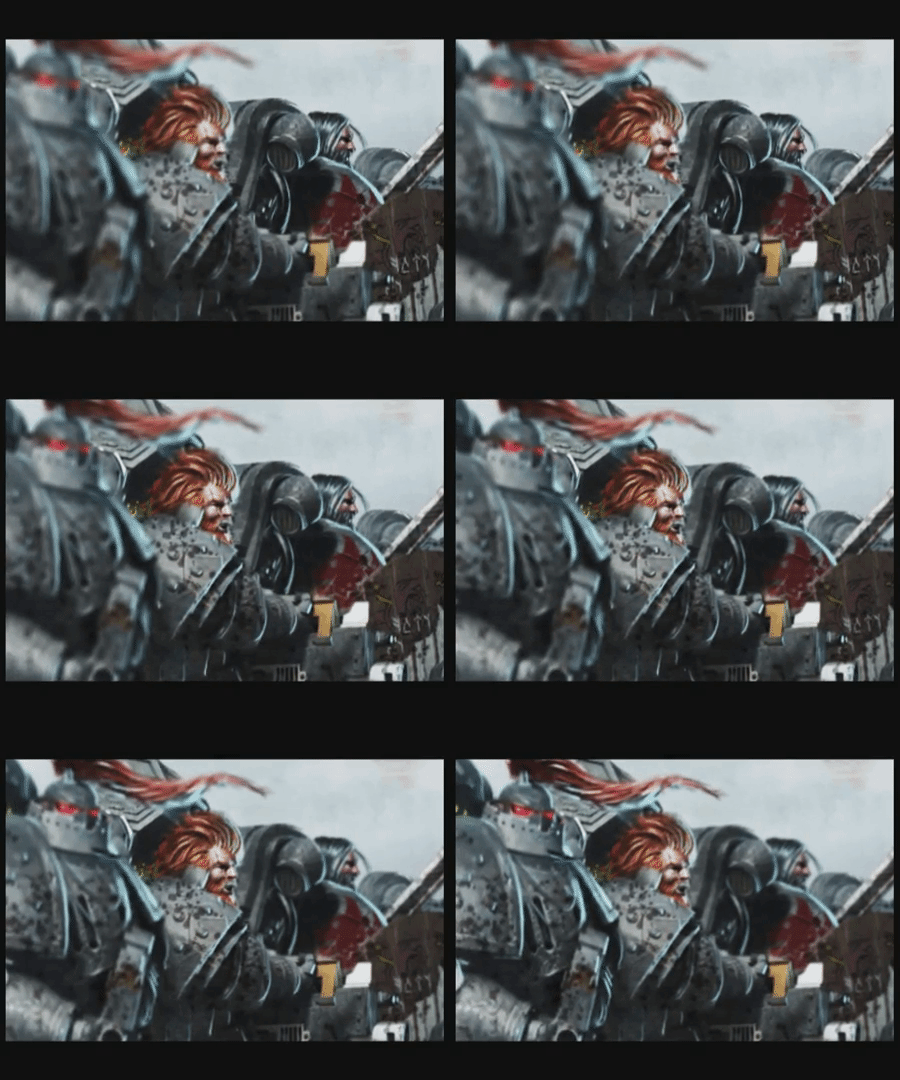
The Emperor is enraged. Primarch Magnus the Red of the Thousand Sons Legion has made a terrible mistake that endangers the very safety of Terra. With no other choice, the Emperor charges Leman Russ, Primarch of the Space Wolves, with the apprehension of his brother from the Thousand Sons home world of Prospero. This planet of sorcerers will not be easy to overcome, but Russ and his Space Wolves are not easily deterred. With wrath in his heart, Russ is determined to bring Magnus to justice and bring about the fall of Prospero.
This book is titled "Prospero Burns" with the subtitle "The Wolves unleashed," but a more accurate title would be "A bunch of boring rememberancer crap" with the subtitle "ZZzzzzz".
Okay, maybe I'm being mean, but this book is frustrating. How do you take eight-foot tall genetically engineered space vikings and make them boring? The answer is making half the book a pointless slog of a flashback. Oh, how I wanted to start skipping pages as the flashbacks droned on and on, serving no purpose and boring the jam out of me. Oh, how I wanted to get back to the present, to see the Space Wolves - who the book is supposed to, you know, actually be about - do something. It would almost be better if I could just dismiss the book totally and say skip it, but the parts of the book actually about the Space Wolves are excellent - action-packed, filled to the brim with interesting characters and situations. And then you cut away from this to see a rememberancer bumbling around in the library for ten pages. Who cares? Having finished the book, I can tell you that the flashbacks are totally pointless - they end up having an impact on the story, but this could have been filled in with ten or fifteen pages, or even just totally axed by keeping the (not very interesting) events they lead up to off-camera. In fact I'll say right now you can safely skip these scenes, which is what I would recommend. You'll need to have read A Thousand Sons for the end to make sense even then, and if you have, I'd just leave it at that.
After reading this novel for the second time after years, I've raised my vote one star. Yes, the first part of Kasper Ansbach Hawser/Ahmad Ibn Rusta adventures among the Space Wolves is still a boring sci-fi version of "The 13th Warrior" movie/"Eaters of the dead" Crichton's novel, but Abnett's tale is still very good and since the part about Nikea it becomes a real page turner. Graham McNeill's A Thousand Sons is still far better, but this version of the story from the Vika Ferynka point of view is a good one too. And the ending is just grimdark at its best.
Unlike any other Warhammer 40k novel I've read, I'd recommend this to those who aren't familiar with the series, on the solitary premise that it is just a damned good story, once you get past the (possibly unfamiliar) terms, characters, and setting.
I've read a lot of Abnett's stuff, as you might be able to see on my bookshelf. Every time something new of his comes out that isn't "Inquisitorial", I wonder if it is going to be good or overhyped. I tend to lean towards overhyped simply because I figure that if I set a low standard (even though I know that Abnett is a good writer), I'll finish being amazed, shocked, and generally glad I read the book.
Did it change my life?
No.
Did it make me totally reevaluate my purpose in life and the meaning our our human existence, or ponder the vagaries of our collective species and eternal questions we grapple with in a pugilistic manner as a species such as "Why are we here?" or "Where are we going?"
No.
Did it make me look into myself and reconsider such things as the way I live, interact, or deal with my friends, family, or my reality, by forcing me to inquire and cross-section some dearly held belief that would turn things on their head only to come out of the reading tunnel a new, changed man?
Fuck no.
Was it a good story?
Yes.
Was it a good story that, at points, got very meta-, and explored the relationship between the tale and the teller, the audience and the performer, the reader and the writer, all simultaneously, while spinning an awesome yarn about one of the most possibly mis-understood Adeptus Astartes chapters during the Great Crusade of the Imperium of Man, led by the Immortal Emperor, Master of Mankind? .
Yes.
Was it a good use of my time to escape, to reflect on my own interest in stories and writing and literature and how we manage to keep stories with us over time, how we remember them, and how we tell them to our friends and family?
YES.
Did it remind me as to why books will never go away, even though they are being today crowded out by things such as the Kindle, Nook, other eReaders, including my own iPhone, and in turn give me a sense of reassurance that this medium will continue, even into the far-flung future of the 40th millenia, and about how our stories become a part of our cultural DNA, allowing us to remember our long lost friends and family, mark special events, and gather together as we did so many centuries ago around the literal (and now metaphorical) campfire, helping us maintain a link to our past while educating us about our futures and the choices we will have to make?
Oh, YES it did.
More than anything else, this story made me feel the sense of wonder I had when I was a child in elementary school. When I was in fourth grade, we had something called "International day", where each class we went to was a different nation (or states, like Hawa'ii) that was represented/taught by a teacher. There were exotic places like Japan, Germany, and Hungary... but the one that I will always remember was England.
It was Ms. Barnes' class. There were only a handful of us, less than ten total, perhaps.
We all assembled around one of those round tables with a well cut in one side for the teacher. Ms. Barnes' turned off all the lights, lit a candle, and began to tell us a story.
A story about a man, a man from a far and distant land, who goes to the aid of a king in need, a king who has reached glory in his time, has gained loyal and strong warriors as his subjects. He has a beautiful wife as his queen, and all is well and good until he is beset by a plague that knows no fear or mercy. An unnatural beast from hell that comes to slay his men out of anger, hatred, and jealousy.
This man comes not for gold, or favors, but out of a genuine desire to not only help but to make a name for himself. To exalt himself with deeds of glory and bravery, to have his story told and retold over and over again around the campfires.
Man and beast meet. They fight. For the first time, Man wins with the visitor grievously wounding the beast, so much that it runs away to hide and die in its den...
... and as we listened, for the first time in my life, I heard the story of Hrothgar, his Hall Heorot, the creature known as Grendel, and the man that would come to best him, known as Beowulf of the Geats.
I remember to this day the look and feel of the class, my teacher's face as she told the tale to us in the old ways, the way an olden bard would have, under the low firelight, surrounded by my companions in battle, after a long day. She moved her hands, showing the action of the story, and her voice told the story in a way I'd never heard a story told before to me.
The next thing I remember was the bell ringing, and walking out of that class utterly blown away by what had just happened.
Years later, when I was substitute teaching a classroom of fifth graders, and we had about twenty minutes before the bell to go home rang, I needed something to do with the kids. We'd finished all our classwork. We were done with the day's plans. The kids wanted to chill and goof off, but then suddenly I had an idea, and had them turn out the lights.
With nothing more than an overhead projector turned on, I carried on that thread, that tradition, and proceeded to hold an entire class of squirrelly fifth grade students enthralled, much the way a skald of the olden days would have. I told the story with detail and movement, embellishing points of interest (at that age, all kids love stuff like gore and violence if its obviously imaginary), and most important of all, making them join me in my story-telling by having them visualize it in their minds.
Much the same way my former teacher, Ms. Barnes, had done so with me more than a decade previously.
That day, I turned on a bunch of kids to a story that was more than a millennia old (one of them even went to look for it in the library later), yet I did so in a way that not only honored its origins but also retold it in the way it was told originally. I had, in effect, transmitted a small piece of culture and tradition to these kids that has been with us for all our existence as a race (meaning the human race).
... so, why this tangent about my past when reviewing a book?
When I was reading it, I was taken back to that time. Not only because of the book being a book and visualizing it in my head, but because that dynamic is present on so many levels in the story. The story in this book is as much about the events surrounding the never-ending blood-feud between the Space Wolves (or as they call themselves, the Vlka Fenryka) and the Thousand Sons legions as it is about stories and story-telling, about the preservation of our past as well as looking into our future (readers of the series will know that these events are just a small glimpse of all that is going on on a galaxy-wide scale at the time, and what is coming later). It is about the way we preserve our past, as well as what we do to remember it in order to not preserve it.
It did change me in one way - it made me realize and reflect on the utter criticality of our culture, and the currency we use to communicate our ideas, concepts, and histories. Be it movies, or music, or song and dance, or theater... not only the story itself, but how it is told, is what is so important. This is an idea that the main character in the story learns over time, and it becomes his calling, in a way.
Funny how it took a story, one that I place on my "utterly fluffy" bookshelf, to realize that how we tell a story is just as important as the story itself being told, and that the matter needs to fit the medium (how many movie adaptations have really, truly nailed it, and how many have been so-so, and all because we can go places in our minds that can't necessarily be reproduced in reality, or even in CG?)
With this one, I would have to say that Mr. Abnett has hit a new high. Yes, it's still a science-fiction novel, but a lot of what it covers are issues that we are facing today - our political and social discourse, how stories are "spun" in the media, and how sometimes people can be used without even knowing it, pawns in a much larger game (ooh, conspiracies!). How we remember our lost loved ones in the stories of theirs we choose to keep and how we keep them alive by retelling those stories. How we, as a species, use story-telling as a means of communication, cultural transmission, memory, and warning (among so many other things).
I won't go more into what the books is about other than to say the following points. Yes, the points of view shift and change, but what story doesn't have that from time to time? There is a lot of fighting and descriptions of it, but instead of just reading it, read it and then visualize it, much like you would if you were having the story told to you verbally. To his credit, Mr. Abnett keeps the "tech-talk" (terms and vocab that anyone familiar with the setting would know) pretty low, instead making up some terms on his own and then posing them as from the point of view of the characters, which is (at least for me) refreshing and clever.
Finally, I have to comment on how this book, this entire story of the blood-feud between these two legions has been done by the Black Library (the publisher). They've had two different authors write about the same account, from the opposing perspectives (the other book being A Thousand Sons, by Graham McNeill), and this is the first time that they've done it in this particular way. It has worked well this time, and more importantly, it was a good move as it does truly offer two different perspectives, as the story is being told by two different authors. It all becomes a story within a story, and getting the full weight of it needs one to read both sides to understand it all.
For the 40k fans:
- Yes, you do get to read/meet Russ, and he is a somewhat refreshing character capable of subtelty.
- Yes, you do get to see the Wolves in action, but more importantly, you get to learn about them as a legion. By this I mean more than the (to date) "Rawr! Let's kill and howl like crazy animals! Awoooo!"
- Other characters from before make appearances, as in Primarchs, Custodians, and the like.
- There is a bit of foreshadowing towards the end of things to come. Both on a large scale and more specific to the Space Wolves themselves. Hint: he makes a major appearance again in the future. You'll know who by the end of the book.
To close, and show how much more to it there is than just ultra-violence, I'll use this quote by the Jarl of Tra (from the book):
"It takes a vast amount of self control to be this dangerous."
Prospero Burns is the second part of an internal duology in the wider Horus Heresy series, paired with Graham McNeill's A Thousand Sons. While the latter book lets the reader witness the downfall of Magnus the Red of Prospero and his Thousand Sons legion, Dan Abnett's version follows the loyalist executors of that downfall, the Space Wolves of Fenris.
I wanted to pick up the next 40k book after a while, and realised I had forgotten I actually read this book. Which is peculiar as I now recall enjoying many aspects of it. Tracking the journey of the Space Wolves and the early beginnings on their homeworld was highly enjoyable as both a Scandinavian and an Old Norse scholar, as the whole legion is essentially a Viking-inspired trope, full with "skjalds", lands of ice and fire, and of course, a strong wolf theme.
Overall, this was a perfect complement to A Thousand Sons, and while neither book was necessarily among my top favourites in the series, they were both welcome additions to what is otherwise starting to feel a bit like a dragging midway section of the series.
There are no wolves on Fenris. LOL. Here Abnett is Rashomon-ing the shit outta a couple of scenes and happenings from earlier books but it is way cool to get the different perspectives and shit as to who is who and what REALLY has been going on. He also introduces an entirely new character, with many unanswered questions from his past, that adds some depth and unsolved mysteriousness to this book and shows a little more personal or rather intimate effects of what Chaos does to a person. Great book and spectacularly gruesome in many parts.
When I began this book, I said, Dan Abnett knows how to devastate, pray for me. Consider me demolished and dismayed, and on top of that: ire. Let's throw all of them away and start fresh with a new batch. Any superhuman, demigod, 8ft, with a supreme intellect over the age of 70 claiming daddy issues is a write off from now on.
I still maintain that Fulgrim's ending is the most gut-wrenching in the Heresy for me, but Russ warning his brother, pleading, reasoning what he had to execute, explaining it to him for understanding...my stomach was turning! What I said about Magnus rings true here, and the fact that his sacrifice ended up meaning NOTHING... If they had just one sister, things would be so different. Every time sense was mentioned, it was discarded with enthusiasm bc all the Primarchs know best!
That being said, this book was soooo good despite the despair. This is my most annotated 40K book so far. I didn't expect some of the cameos and the themes explored. The Wolves were so charming, and are now my favorite legion. Russ might also bump Alpharius and Omegon for my top Primie spot. He has such dad energy, and I enjoyed every minute with him, even when he was unreasonable. There was a character who made me shed a few tears too...haven't done that for a book in almost two years, so there's that.
May Dan Abnett not have ice in his fridge when he needs it next summer. But, may he find a secret batch hidden in the back bc this was a masterpiece, and my head will be ringing from the thought of it forever.
I can't believe I have six more brothers to go through this with. I'm tired, heartbroken, and everyone here is to blame. It's gonna take 2 more years for me to finish the Horus Heresy...God be with me.
Abnett is a damn good author. This book transcends the limitations of its genre and leaves you feeling like you just read a great book. You feel that way, because you just did.
This is a novel of old lore, tenebrous foreboding and startling revelation. It sinks you deep into a culture mysteriously clad in hoarfrost and unfolds it charms and secrets through the repetitious prayers of whispered page turning.
Run with the wolves, hunt, stalk, and fight; bludgeon, bleed and freeze on the red snow of your cut thread. Do not fear. You will not be forgotten. Yours is a story worthy of remembering. It will be told when times have grown cold with ice, when the fire's hot heat and amber light grow wane and calm sleep is disturbed. It is a story of raw courage and it will ignite a spirit-spark that will see the whole indigo-hued world melt in ravenous flame. Hard hearts will be moved and kindled. In our future's farthest gloaming we are going to still know a swift, axe-drawn fondness for you and add laughter to your undshadowed fame. Peace now, brother, for all the wolves of this world hereafter, shall remember and recall your name!
Ne bas ono sto sam ocekivao, sobzirom na naslov, ali svejedno jedna dobra knjiga. Kada niste Prajmarh definitivno ste samo figura na sahovskoj tabli. Jos ako je ulog iznad svakog do tada nista nije previse okrutno i bicete zrtvovani ili korisceni onako kako to igraci zele. Kao i do sada Horusova Heres ispisuje jednu tragediju za drugom i vrline ptrevara u oruzje koje nanosi bol i patnju.
Dan Abnett is a good BL writer, not gonna lie. The book is a nice read as a standalone story or for those curious to learn more about the Space Wolves AND Terra's Conservatory and Administratum. It's more of a cultural study and an intricate spiritual journey, even more so as we talk about the Imperium of Man and its evolution, and I have to give the book its credit.
BUT
As a book pretending to be part of a duology alongside McNeill's A Thousand Sons (which is amazing btw), pretending to be part of the Horus Heresy timeline... This book... Awh Lord, give me strength, this book is AWFULLY BORING and INFURIATINGLY IRRELEVANT.
Prospero Burns? More like... Prospero Gets Bored to Death by this Filler Episode and burns itself after realizing only the last third of the Book has something to do with the Fall of Prospero.
UGHHH it bothered me so much, partly because I know what a good writer Abnett is. Why did they even market it as Prospero Burns when we get, like, two or three chapters about the fall of Prospero from the Space Wolves' perspective...
Oh, wait it's not even THEIR perspective, it's their Skald's... Were you expecting Leman Russ's account and the battle through his eyes? HAHAHAHAHA... Ohh, good Lord, I was so bothered and annoyed that I couldn't even pay attention to the last chapters that were supposed to be necessary for the HH timeline...
Space Wolves and Fenris? Ehhhhhh... I guess it's a check.
Nice descriptions and eloquent writing? Solid check.
Good for newcomers or as a standalone story? Ehhh, check, if you've also read A Thousand Sons.
Awfully boring and infuriating in its irrelevance and misleading title? ABSOLUTE SOLID CHECK, UNFORTUNATELY.
Might as well just read the summary on Lexicanum, or the entire Space Wolves wiki, or just watch Vikings on Netflix and imagine the horses and axes are Thunderhawks and power swords...
A man terrorfied of wolves his entire life decides after a life of academia to travel to Feneris, a planet reportedly filled with them. Upon arriving Kasper Hawser is thought of as a bad star he was pursued by the indigenous people of the planet until one of the demon wolves of Feneris comes to his rescue. He awakens 19 great years later to find himself in the body of his 22 year old self, instead of the 70 year old body he originally arrived in. What was the reason for the rebuilt body and near 80 year slumber? In the book ‘Prospero Burns’ we follow Kasper as he become the skjald, or history keeper of the Third Company
In my short time of doing book reviews I have to say this is the hardest books I have come across to do a review on for various reason. On one side of the coin it was a really well written book, something you would expect Dan Abnett to put out. The character development was well done, you really got to know the narrator and some of the other people that were around him. You do get some insight into the strategic mind of the Wolf King and his sons; seeing them as the strategists that they are, instead of the mindless killers other see them as. The downside is the story focuses on Kasper too much, cluttering the overall plotline with flashback after flashback that repeat the same information. At the end of the book they are finally tied together and you do understand why they were put into the book. My honest feelings is they could have been cut down as they really do bog down the momentum of the story. Honestly you could probably cut away 10 to 15% of this book and not miss out on much, if any at all.
Now I know this contradicts what I said before, but let me explain. I got this book expecting a killer Horus Heresy novel, and while it was exceptionally well written, it had a much slower pace then your typical Horus Heresy novel, especially one with the Space Wolves, known as the Vlka Fenryka in Prospero Burns. I found the book too easy to wonder away from. The book does start off at a great pace, you do get a great feeling of how the Space Wolves started and developed in the beginning; including their traditions, strategies, and the way they conduct business. There are some action scenes before you get bogged down into the flashback hell that gets shoved into your face. The title in itself is very misleading as well as the cover-art as well. While the planet Prospero does in fact burn, it is only at the very end of the book and is finished in one or two chapters and the Wolf King only appears in the last 1/3rd of the book. The rest of the time you are learning about the Skjald Kasper.
In a nutshell as a non-Horus Hersey novel this would be an exceptional piece of literature, but after the hype, title, and cover art you are handed something that does not really feel like a Horus Heresy novel. Overall I would give this book a 4 out of 10, the points lost solely on the overuse of flashbacks, and the title/art that makes you think you are getting one thing while you are handed another. I do have to say that you do need to get this book, it may not be required reading for the Horus Heresy series it does add some nice little details on why the Space Wolves were created.
Well, that was superb! I am a fan of anything that "fills in" the lore of this 40K world. Though, to be fair, this is really set in the 30K Pre-Heresy Era. Well, some of it.
Seen through the eyes of Kaspar Hawser also known as Ahmad Ibn Rustah. Hawser is a Conservator, a historian, who works with the Imperium's Administratum to catalog old information. Some of that information has attracted the attention of Astartes interested in the occult (The Thousand Sons), this causes a huge change in Hawser's life. It leads to him going to Fenris to do a history of the Space Wolves. In time he becomes the skjald of the VI Legion.
Through his eyes, we learn about the traditions of the Wolves. A GR friend (Gianfranco Mancini ) pointed out the similarity of the first part of this book to the Michael Chricton novel "13th Warrior" wherein Hawser, playing the role of Ibn Fadlan, records the deeds of the VI. What makes this momentous is the viewing of the Council of Nikea where psykers are banned and the incredible events that occur. There are some major players from Lehman Russ to Fulgrim that appear. Even the Emperor makes an appearance. We learn about the sanctions later against Magnus and The Rout being called down upon Prospero. Also the bit about Horus and his plans? Excellent! No more spoilers.
A superb Heresy era addition and it gives major lore nuggets. A great look at the VI Legion The Space Wolves. A must read for any 40K fan.
-Mucho más allá del simple producto de marketing cruzado, pero mucho.-
Género. Ciencia ficción.
Lo que nos cuenta. En el libro Prospero en llamas (publicación original: Prospero Burns, 2010) un visitante al planeta Fenris se ve envuelto en un conflicto de tribus originado por su propia presencia. El visitante, Kasper Hawser o Ahmad Ibn Rustah, tiene problemas con su memoria y terminará sirviendo como escaldo entre los Vika Fenryka, más conocida como la VI Legión Astartes, los Lobos Espaciales. A través de sus ojos conoceremos más del peculiar carácter de sus miembros, las costumbres y sus tácticas de combate. Pero los rout vigilan con cuidado a su invitado, que tal vez tenga en su interior voluntades ajenas a él mismo, mientras reciben la orden de luchar contra otra legión astarte, los Mil Hijos. Con el subtítulo Los lobos atacan, decimoquinto libro de la línea narrativa La herejía de Horus.
¿Quiere saber más de este libro, sin spoilers? Visite:
A strange one from Ben Abnett who’s usually very good. Maybe it was the attempt at being artsy or history or whatever, but as a Scandinavian I felt sort of shit on by how he wrote the Space Wolves and the people of Fenris. Especially after coming from A Thousand Sons. I can live with that part though, but the writing in the first couple of chapters is just so bad. The author seems incapable of going a single sentence without mentioning: “murder-make”, “red snow” or “threads” which is bad enough, but the other parts of the sentence are even more wanna-be-speshul-spajs-Viking nonsense.
The book does get better towards the end but it never really tells anything of interest. If you have read A Thousand Sons you’ve basically read the parts of this book that you came for, and if you came for VIKINGDOM herp derp this book somehow manages to be the worst representation of it I’ve ever witnessed.
It’s like 14 hours long as an audiobook and by the end I wished I had just watched the 13th warrior on repeat instead. It would’ve been just as bad but at least I wouldn’t have the word(a) “murder-make” stuck on my mind.
An interesting story of a well written character, yet it took so long to really get intriguing and make sense. I've tried to read it multiple times and it seemed totally impossible to get through the first several chapters when originally I thought this would be similar to A Thousand Sons by Graham McNeill, but from an opposite view point. It turned out well, it made me feel things, it made me look differently at the Wolves even though I sympathize with the sons of Magnus a lot more. This book is not one to skip, it provides a different perspective on the Council of Nikaea, it humanizes Russ to those of us who feel his actions were too brutal and unjustified. There were a few of confusing moment here an there, but overall it's a good story worth reading, I recommend it. Did it blow my mind? Not really. Was in entertaining and enjoyable? Indeed it was.
If you want to read a book about the VI Legion, you better look elsewhere, because this is about some random Terran historian called Kasper Hawser aka Ahmad Ibn Rustah. My biggest problem with this book is that its title and plot synopsis are misleading. (A more fitting title would be “The adventures of Kasper Hawser”, though I doubt anyone would be buying a HH book with that title.) I remember reading a lot of negative reviews about Descent of Angels, because it didn’t progress the plot and instead dealt with events many years before the start of the series; well, at least it was honest about it in its description. The reader knows what to expect. I re-read the back cover of Prospero Burns when I finished this book and realized that I was completely cheated. What I expected to read was only in the last 50 pages of a 400+ book, and even then it was just a secondary plot, happening in the background. I guess people are just too blinded by their love for (overrated author) Dan Abnett to notice the deception. The premise of the book is actually pretty interesting and as a short story it would have worked perfectly, but dedicating a whole book to this random man (who, by the way, never shows up again in this series) is just unnecessary. Prospero Burns is also very repetitive; however it’s not only repetitive in its plot, but also in the use of certain expressions. Let’s take a look at some word counts:
Thread cut: 67 times Wet leopard growl: 41 times Murder-make: 13 times Red snow: 9 times
To me this was the best book in the Horus heresy series so far. Incredible, epic, mysterious, tragic, a great tale and yet a window into all kinds of different lives within the imperium, from great primarchs, astartes, moments of history to life on a human scale over different worlds. Unforgettable characters, a masterfully crafted storyline, new angles from which to see the world and the great events of history... I enjoyed every moment of this book and will be rereading it. And what an ending. Oh my.
I feared that Prospero burns would be mostly combat scenes strung together, like action figures clashing into each other over and over as does occasionally happen in these books with astartes battles but this book actually turned my perspective on the involved legions on it's head, made me care deeply for those involved and expanded the universe greatly. Amazing read!
“I name myself Ahmad Ibn Rustah, skjald of Tra, and I bring to this hearth the account of the Vlka Fenryka’s raid on Prospero, as is my calling.”
/////
“I recognize my failing and will be sure to correct it.”
A vow I now must take on myself. I should have known not to question Abnett.
Because I will admit, I went into this with some pretty set expectations. I knew it was about the Space Wolves, I knew it was supposed to be the other side of the sacking of Prospero, I thought I had a pretty firm handle on what it was going to be.
God-Emperor, beloved by all, was I wrong. And I think I’m extremely happy in said wrongness.
Because what I got was that…but not at all in the ways I was expecting. What Abnett pulls off here is so much deeper and so much more nuanced than what I was thinking, it’s almost embarrassing.
This whole novel just being ABOUT the preconceived notions people have of this legion and of this event, it’s masterpiece level shit. And that’s coming from a guy who has already, by this point in his career, delivered multiple masterpiece level things.
And even better, I think this is one of the majorly rare Heresy novels you could give to someone and they get 1. A complete experience and 2. A full picture of what these are as a thing and how compelling 40k can be as a whole. Sure, you def get more out of it if you’ve invested some time in these, but this is great enough to stand on its own. I’m mega happy I’m finally getting to the truly great HH novels. Not a moment too soon tbh.
Next up; age of darkness. A chaos focused anthology i think? It’s either that or Gay Robots. STAY TUNED CULTISTS
Тази книга можеше да бъде много повече... Да разполагаш с материал като Лиман Рус и неговите Вълци и да направиш 2/3 от историята скучна, неориентирана бъркотия - за това се изисква особен талант.
Оправдания като "Ама така научаваме повече за културата на легиона" не минават. Културата на легиона може да бъде представена и по друг начин, който не е толкова скучен. Както беше с легионите от предишните книги, които прочетох.
Хареса ми, че Вълците са толкова старомодни и суеверни. Хареса ми, че са запазили скандинавската си култура - да наричат журналистите "скалдове", а Императора - "Всеотеца" (едно от имената на Один). И точно през очите на един "скалд" се развива действието, но този "майстор разказвач" е толкова скучен и неуместен на моменти, че бих казал, че опетнява доброто име на разказвачите от Севера.
Давам цели 4 звезди, защото последните глави бяха супер интересни и динамични и компенсираха мудния път към кулминацията.
The book takes a while to get going and barely scrapes a 3-star rating, as the flashbacks to Hawser’s life when he was a Conservator and his experiences as a skjald for the Wolves don’t seem to lead anywhere in particular.
Then comes the final third, the Council of Nikaea, where things begin to take shape before the climax of the final section, in which Prospero really burns. And that’s when everything falls into place: from a well-written but vaguely tedious read, we move on to an excellent work that reveals the duplicity of the forces of the shadows, who play the long game to better manipulate their adversary.
I am not the same person who wrote Horus Rising and First and Only. I won’t be that person again.
Prospero Burns is an easy story to be disappointed by. It is not what was on the cover and Abnett dodges some valid criticism in his afterword. But I'll stand by it being a different kind of story, while acknowledging its flaws.
Serving no one and no thing
"When all else fails, we are the ones expected to do whatever is necessary.’‘
Prospero Burns is explicitly paired with A Thousand Sons. It's natural (and perhaps even expected!) to expect the stories to be mirrors of each other, or at least be about Magnus' hubris vs the nemesis of Leman.
But Prospero Burns is not. Not even a little bit. Even the final denouement on Prospero occurs in a completely different location than in A Thousand Sons. There is a deliberate shying away from "seeing it from the other side".
Abnett's afterword defends Prospero Burns as not a battle report about the actual fight between Magnus and Leman, rather you need to know why it happened. And that's fine, I've always tried to be careful with my expectations as a reader. But that's not the problem.
The problem is the telling of "why" the clash between Magnus and Leman occured.
It sucks.
It's too convoluted and doesn't hold up to even half-hearted analysis. It cuts across earlier stories. Worse, the plot doesn't serve the clash between those Primarchs, instead depowering it by throwing the blame to a blank canvas masquerading as a character, a very bad thing considering that clash is one of the key moments of the Horus Heresy. The character the plot does serve literally gets fridged permanently.
Prospero Burns is a poor book in the context of the Horus Heresy. Battle for the Abyss and Nemesis might have limited relevance to the main thread, but Prospero Burns actively hurts it. The clash of Shakespearean personalities is rendered into a dispassionate chess game between colourless cosmic entities. It's less a question of the book not meeting my expectations than the book taking a wrecking ball to the very clear point of the series: legendary Primarchs and their legendary issues.
...Well, serving oneself
The first thing I did when I set foot on Prospero was kill a man.
Prospero Burns is a standalone story. It's about different kinds of loss and finding meaning in that loss.
Kasper Hawser is a good character, the best human (for a little bit) so far in the series, because he has a meaningful impact on the story rather than as a tool for exposition. He's also a good man. He refuses to commit evil in return for the access and information that he craves. He's brave multiple times in the face of death but in ways other than just being a fearless superhuman. He forms a meaningful relationship with the Space Wolves. His experience of being transformed into an Astartes-lite is well paced - first he notices his youth, then his ability to defend himself, then to actively kill, and finally to kill to defend an Astartes. Finally, there's a clear before and after split between the forms he takes, and the linkages/differences between them provide depth to the character.
Other elements are also enjoyable. There's use of repetition with Hawser's dreams, setting a rhythm and tension as Hawser and others seek to explain them. There are meaningful stakes for "getting it wrong". There are call forwards and call backs in ways that are simple and satisfying, particularly how the mistranslation issues Hawser occasionally has being the subplot that materially impacts the main plot. It's not a difficult trick in itself, but Abnett's execution, such as with the word "crow", makes it organic.
The death scene on Quietude is outstanding, albeit it does remove probably the most interesting side character - this book has much less than an ensemble cast to it despite the number of characters.
As for the Space Wolves themselves? Yeah, they're alright. They're not the smartest Legion, not by a long shot, but Abnett does the job of making them seem less like the dumbest.
‘I think perhaps you malign the Wolves a little,’ Hawser added. ‘It may be that they are misunderstood.’ Korine made a sound, possibly a laugh. ‘Isn’t that what all monsters say?’ he asked.
Servicable?
So you liked the account?’ Hawser asked. ‘It amused you? It distracted you?’‘ It was amusing enough,’ said Longfang. ‘It wasn’t your best. ’‘I can assure you it was,’ said Hawser. Longfang shook his head. Droplets of blood flecked from his beard. ‘No, you’ll learn better ones,’ he said.
That the journey of Kasper Hawser is personal to the author with his own illness adds meaningfulness to this book that it doesn't have within the Horus Heresy. I understand alot of the disappointment other readers have with Prospero Burns.
I started reading the Horus Heresy because of Dan Abnett. I was a fan of his comics work, particularly the cosmic stuff he did at Marvel with Andy Lanning and was curious about his prose. I’ve read the two previous books he wrote for the Heresy and came away from both of them with the feeling of “that was fine for what it was but I don’t get why people love this guy so much.” Prospero Burns is the book where I’m finally starting to get it, Abnett blew me away here.
From the sword-and-sorcery-esque opening, to the weird dream logic throughout the book, to the way it moves backwards and forwards through Hawser’s life, to even just the choice of Hawser himself as a protagonist instead of yet another Astartes, this is a book that constantly defies expectations. Prospero Burns could very easily have fallen in to the trap of being another “Here’s a new legion, now let’s retell the story of a battle you just saw two or three books ago” but it wisely treats that stuff as mostly an afterthought and instead tells a story about memory, and the stories we tell ourselves about each other. This book never stopped surprising me. I just don’t expect anything this thoughtful from Warhammer.
If you’re primarily interested in entries in the series that move the main plot along, or that contain tons and tons of action then this book is going to be a disappointment. But if you’re willing to go along with what Abnett is doing here then I think you’re in for a very pleasant surprise.
This is a reread of one of my favorite novels. Dan Abnett, a man who only recently got the recognition he has genuinely deserved for many years (he wrote the screenplay for the first Guardians of the Galaxy film), is easily the Black Library's best author. And that is high praise indeed. Too often maligned as "...merely cheap, tie in fiction", Black Library has a stable of, mostly, excellent, undervalued authors and writers. And nowhere else should one look for proof of the high quality that a Black Library product can bring than in this novel, Prospero Burns. Written back in the era of the Horus Heresy when they were still giving backstories to the 18 Legions of Adeptus Astartes, Prospero Burns takes everyone's cartoonish Space Vikings (Space Wolves, hint, they hate that name...), and gave them a sense of the real, and of a sacred place for their lineage. Fenris, they're homeworld, comes alive in Dan's hands. Dan manages to add depth, realism, and logic to their homeworld, and their culture, without removing them from the scale of the epic,or fleeing from their Norse mythology inspired roots. However, and this was something that only really clicked for me on this reread, after my having become an Orthodox Christian, he paints a picture of their culture that is colored very much like the pagan Kievan Rus. It makes for a deeper, more fascinating set of Space Vikings than, well, the heretofore cartoony Space Vikings. And he pokes fun at some of Games Workshop's over the top, lore for them. Such as when characters grow annoyed and irritated at being called Space Wolves (they're the Vylka Fenryka), or the Aett being called The Fang, and things of that nature. It's subtle, and it's satisfying. (Yes, I know GW has walked all of that back,in recent years, and now the Space Wolves are even more Spacey and Wolfey and, honestly, not nearly as interesting, sigh...) Dan tells the story through the eyes of Kasper Hawser (a nod to real mystery of the paranormal in German history), who goes by another name: Ahmed ibn Rustah (another nod to history, this time of an Islamic envoy to the Norse and Rus lands, a real life person who inspired Chrichton's "Eaters of the Dead" and the film adaptation "The 13th Warrior"). Through Kasper's eyes we learn about the Vylka Fenryka and their culture, their personas, their way of war, and their philosophy. We also get to see Kasper's backstory through the guise of flashbacks, and these are some of the best parts of the book. We see the closing stages of The Unification Wars, on Terra, and the last days of pre-Imperial rule over Earth. Dan has to have at least some respect for Christianity as he laces nods to it in imagery and allegories throughout the tale, and even speaks a genuine truth when he discusses, vis a vis dialogue between characters, the necessity of religion as Mystery (we in the Church refer to them as the Holy Mysteries). That's important because he juxtaposed those scenes with ones dealing with Chaos, the Primordial Annihilator, and a conspiracy to doom mankind. And, as always, Dan writes gloriously inspiring battle sequences. And when you are reading books about mighty heroes battling great, terrible evil, that's damned important. Some fans didn't like this one, because it was long on story, and short on overall action. Frankly, I like it better this way. Instead of just showcasing the what of the razing of Prospero, and the start proper of the Horus Heresy, Dan shows us the why, and the who. I genuinely love this novel. I think it's one of the finest books written by a Black Library author. And one of the finest books of the Heresy. Gleefully recommended.
This is a good book that showcases Dan Abnett's skill as an auther within the SciFi/WH40 genre and Horus Heresy series. His writing style is makes you want to read on to the next page.
Why only three stars? I was disappointed. We have seen the events leading up to the attack on Prospero from Magnus's point of view in A Thousand Sons. This was the best opportunity to see the same events from Leman Russ's point of view rather than the "obeying orders" type reason that was given. I was expecting more time to be spent with Leman Russ showing his reactions to, and rage at, Magnus's continuing sorcery. I would've liked one of the Jarls, or maybe even Bear, to have been the leading character. Perhaps Ohthere Wyrdmake from A Thousand Sons whould have made a suitable lead. The format left a lot to be desired and plenty of questions unanswered. Why was Russ vocal in speeking against Magnus (something mentioned in A Thousnad Sons but not really covered here)? Why was the Space Wolves Legion chosen to attack Prospero? Why not the Night Lords, whose Warhammer 40,000 background wass dedicated to dishing out justice before Horus Heresy? What were Russ's motives for not liking Magnus?
I think these questions would have been answered with the central character being one such as mentioned above; so valuable page space could have been dedicated to answering them. Much of the first part of the book could have been separated and put into its own dedicated novel, within the same series, about the expansion of the administratum and it absorbing as much data as it can (like the Mechanicum and Nemesis focussing on non-Space Marine parts of the Imerium). Given a few name changes and rank modifications a lot of the second part of the book, where the narrator was learning about the Space Wolves, would not have been out of place within a standard Warhammer 40,000 setting rather than the Horus Heresy.
Overall, not a bad book, but the plot was not up to the same level as the rest of the series. I think Dan Abnett could have got two separate books from the contaents of this book leaving this title free a for plot that matched it more closely.
I must admit, I'd probably have liked Prospero Burns a whole lot more if I hadn't read A Thousand Sons.
You see, it basically follows the other side of the story, the faux-norse and all-wolf-all-the-time Space Wolves Legion, and how they come to wreck the Thousand Sons shit.
It's vaguely interesting, but on the other hand, not really, and a lot of that is due to personal reasons. For one thing, the Space Wolves come across as well, dickish. To everyone (and of course, we've already seen them as dickish in A Thousand Sons) including our would-be protagonist archeologist Kaspar Hawser. A lot of the actual reasoning also feels fairly weak (partially I guess because it involves some of Dan Abnett's little pet plotlines) but really, what I really dislike? And this is really personal?
The cod-norseness of the entire thing. This is a really personal thing, but I have a hard time standing english depictions of vikings. The language is just wrong. The cadence, the feel of it. In the Sagas, or even the better stuff that tries to emulate them (like say, The Long Ships) there is a certain quality to the prose and language that just doesen't translate very well.
Abnett tries, oh god he tries, but it comes across as horrible contrived, and this is by the scale of a universe that is extremely, extremely high in it's contrivance factor.
So yeah, personal issues, but I oculdn't take this one. Other than that the story is fairly straightforward, the twist can be seen a mile away, and it lacks most of the pathos of A Thousand Sons.
I did not think this book would end up with 4 stars and probably more deserving of 3...the first 100 pages WHERE horribly boring. I have also come to the unthinkable I like the Russ's Wolves and Leman Russ.(but not as much as the Thousand Sons and Magnus of course.)Mostly because you see the Space Wolves as the group that does the dirty jobs the Emperor who is suposedly so great won't do himself! I did not like that is was called "Propero Burns" and it was 30 pages on Propero very VERY annoying.(Especially because I was excpeting an actual account of them fighting a lot more.) Lovely twist with the deamon, never saw it coming. But oh my goosh it made me tingle I have that scene ready for a movie. Very interesting human guy finally one that I don't spend the whole book hitting my head against a wall wishing the character would die.
Oh ya and side note: Death to Sisters of Silence...purly because it is a sick joke on women...there is nothing about a "Brotherhood of Silence" Also a random side note: The Empreor and Primarch's need to try counceling or something..:)
This was quite different than I'd expected. Everything from the title to the blurb on the back set this up as "the other perspective of the Burning of Prospero" (to Thousand Sons), but it really isn't. It's more an examination - from the perspective of a Remembrancer - of the Space Wolves as a Legion: their core philosophy, their purpose, and what they're truly like.
It's a neat change of pace. For a group that's usually treated as fairly flat "Rowdy space Vikings," it's interesting getting a more well-rounded view. Warhammer fiction is always at its best when it treats its subjects with complexity. This entry did a good job with that.
I could see many (particularly 40k Space Wolves fans) being disappointed that there's not more fighting, but I think this book is better for it.
Lastly, bringing back the requisite social justice note: this entry has almost zero females. There is one that is incredibly minor and (spoiler) gets blown up, and a handful introduced late that are tough warrior-types, but never get names.
I don't want to nitpick, but in a book entitled 'Prospero Burns: The Wolves Unleashed' I was sort of hoping to see the Wolves being unleashed that time they burned Prospero...
The Burning of Prospero doesn't even start getting built up to until well into the third act, and we see almost none of the setup, almost none of the action, and almost none of the aftermath. Instead, this is the story of an academic remembrancer-type bumbling around with the Wolves, re-living some fairly tedious memories, and generally getting in the way (and not in a comedic way). The book is undeniably well written and I generally like Dan Abnett's work, but despite my great love of Fenrisians, most of this book felt tedious.
It gets that third star for the Fenrisian worldbuilding and the few good times we had with the Wolves
Not what I was expecting from a group of murder-make madmen. I really liked the character and role that Kaspar Hawser played in the novel. I really thought this would be more of a mirror of the events in A Thousand Sons similar to the Clan War novels of Legend of the Five Rings. This was a nice surprise. I gave four stars because I did want a bit more of the Wolves at times. I do think though if you are going to read Battle of the Fang you should really read this one first.
No me lo esperaba así para nada. Para mi gusto peca de demasiada descripción pero a la vez consigue que haya acción todo el rato. Me ha gustado especialmente por su peculiaridad. Trabajazo de Dan Abnett como siempre.