Jump to ratings and reviews
Rate this book

Elements in Quantitative Finance

Machine Learning for Asset Managers

Rate this book
Successful investment strategies are specific implementations of general theories. An investment strategy that lacks a theoretical justification is likely to be false. Hence, an asset manager should concentrate her efforts on developing a theory rather than on backtesting potential trading rules. The purpose of this Element is to introduce machine learning (ML) tools that can help asset managers discover economic and financial theories. ML is not a black box, and it does not necessarily overfit. ML tools complement rather than replace the classical statistical methods. Some of ML's strengths include (1) a focus on out-of-sample predictability over variance adjudication; (2) the use of computational methods to avoid relying on (potentially unrealistic) assumptions; (3) the ability to “learn” complex specifications, including nonlinear, hierarchical, and noncontinuous interaction effects in a high-dimensional space; and (4) the ability to disentangle the variable search from the specification search, robust to multicollinearity and other substitution effects.

152 pages, Paperback

Published April 30, 2020

94 people are currently reading
297 people want to read

About the author

Marcos López de Prado

9 books34 followers

Ratings & Reviews

What do you think?
Rate this book

Friends & Following

Create a free account to discover what your friends think of this book!

Community Reviews

5 stars
30 (45%)
4 stars
24 (36%)
3 stars
7 (10%)
2 stars
4 (6%)
1 star
1 (1%)
Displaying 1 - 5 of 5 reviews
Profile Image for Thiago Marzagão.
220 reviews25 followers
March 4, 2021
I got a lot of value out of this book. I had never thought about how we can adjust the closing price to account for intraday volatility, or about how most Sharpe ratios are inflated because they don't correct for multiple backtests, or about how we can use the Sharpe ratio to size our bets. I'm glad I bought this book and read it through. Also, it's great that the author provides code snippets.

That said, this book needs a major revision. The writing is unacceptably poor. At times it's hard to know who is doing what. Look at this paragraph:

The goal of meta-labeling is to train a secondary model on the prediction outcomes of a primary model, where losses are labeled as “0” and gains are labeled as “1.” Therefore, the secondary model does not predict the side. Instead, the secondary model predicts whether the primary model will succeed or fail at a particular prediction (a meta-prediction). The probability associated with a “1” prediction can then be used to size the position, as explained next.

When he says "...where losses are labeled as '0' and gains are labeled as '1'" is he referring to the primary model or to the secondary model? And the "probability associated with a '1' prediction' is something I can get from the primary model itself - why do I need a secondary model here? The paragraph ends with "as explained next" but what comes next is how to use these probabilities (whose model's?) to size bets, not how the secondary model fits into the picture.

Another issue is that the author doesn't bother to justify many of his choices. Like in his discussion of mean-decrease accuracy, for instance. He suggests shuffling the feature (thus breaking the sample-feature correspondence) to see how much that decreases the model's performance. Sounds reasonable, but what's the advantage of doing that versus simply dropping the feature altogether?

Relatedly, it would be great to see some real-world examples in the book. The code snippets are super helpful (and often necessary to understand the point, given the poor writing). But they all use synthetic data. I'm sold on the "Monte Carlos beat p-values" approach, but real-world examples would give us a sense of how much better the authors' solutions are, compared to the ones he is criticizing.

Finally, the book is missing a chapter on forecasting models. It's great to learn about labeling, feature importance, etc, but the point of all these concepts is to help us produce better forecasts. Where is the chapter that discusses and compares ARIMAX, LSTM, Markov, etc? It feels like the most important topic has been left out of the book.

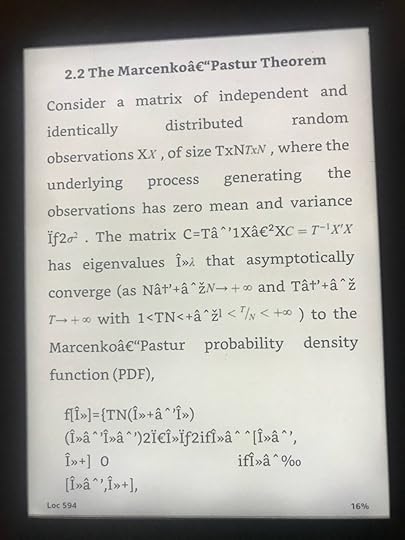
Oh, just one more thing: buy the paper version, not the Kindle version. The author/publisher didn't bother to save the file with UTF-8 encoding and as a result every special character is mangled:


If you google around you can easily find a PDF of the book. In the end that's what I had to resort to (I did it with a clean conscience, since I've paid for the book).
Profile Image for Ferhat Culfaz.
271 reviews18 followers
February 14, 2021
Poorly written, though important points. Not user friendly. Like an amalgamation of his publications. Maybe one or two chapters useful depending on reader. No practical examples. Equations not fully explaining the symbols and meaning.
Profile Image for Jairo Fraga.
345 reviews28 followers
January 13, 2023
Great book, with some interesting/new content which is not usually seen on similar books.

The author tries to summarize many Machine Learning concepts and how they can be applied to finance. The content at times is too much theoretical, with many deductions of formula, which I think it's not really needed for asset managers.

Some interesting topics are on common errors like p-value hacking, when we have a lot of in-sample tests on the same data set, producing a false discovery. The chapter on testing set overfitting is great, and we must consider the number of trials to account for type I and type II errors, like proved on the book.

The book is very hard on the mathematics/statistics, and one must be well versed on those subjects to grasp most of the content. I would consider the title somewhat the other way around, some side subjects of asset management for those who already knows a good amount of machine learning, as topics are a bit advanced (at least for someone not versed in ML subjects, like me).

Estimated reading time: 3h30m
16 reviews1 follower
April 8, 2021
Best book ever ... just the usual for Marcos. The writing is sharper and clearer (although less technical to some extent) than his 2018 book Advances in Fin ML. Really helped me understand better MDI and MDA as a non mathematician/information theorist.

I came in a fan of HRP but happy about the new and improved NCO allocation algorithm.

Trend scanning might be one of his most interesting innovation yet. Need to read in greater detail how the function works.
Profile Image for Hüseyin Çötel.
303 reviews13 followers
September 13, 2025
I liked this book better than the first Prado book since it is more concise. I wish he would focus more on intuition and explanation instead of math which I find hard to understand.
Displaying 1 - 5 of 5 reviews

Can't find what you're looking for?

Get help and learn more about the design.