

What do you think?

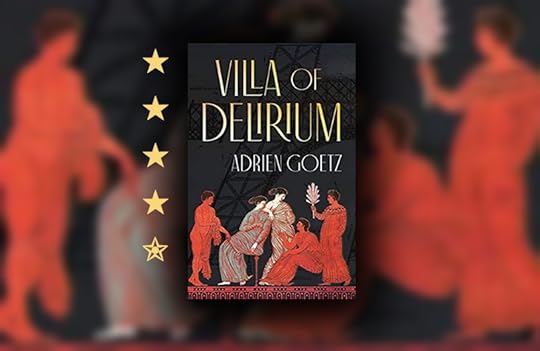
Villa of Delirium
Along the French Riviera in the early 1900s, an illustrious family in thrall to classical antiquity builds a fabulous villa--a replica of a Greek palace, complete with marble columns and frescoes depicting mythological gods. The Reinachs--related to other wealthy Jews like the Rothschilds and the Ephrussis--attempt to recreate "a pure beauty" lost in the 20th century. The narrator of this brilliant novel calls the imposing house “an act of delirium, above all an optimistic act, proof that one could reset time as one could reset a clock and resist the outside world." The story of the villa and its glamorous inhabitants is recounted by the son of a servant from the nearby estate of Gustave Eiffel, designer of the Paris tower, and the two contrasting structures present opposite responses to modernity. The son is adopted by the Reinachs, initiated into the era of Socrates and instructed in classical Greek. He joins a family pilgrimage to Athens, falls in love with a married woman, and survives the Nazi confiscation of the house and deportation to death camps of Reinach grandchildren. This is a Greek epic for the modern era.
321 pages, Hardcover
Published August 18, 2020
Ratings & Reviews
Friends & Following
Create a free account to discover what your friends think of this book!
Community Reviews
Displaying 1 - 26 of 26 reviews

April 22, 2021
The greatest part of this book is the Villa itself. I just wish that there would have bene pictures, because it sounded amazing.
This book is a love affair with architecture, and for that it was very well done. It was easy to see that Adrien Goetz has a love affair with it himself through his words.
This ends my praise for this novel. The start and stop storytelling. The changing of time periods mid-paragraph. The disjointed character relations... I know this is a translated book, so perhaps some of that essence of the novel is lost in translation.
This was both frustrating and boring to read with the flow for me personally. I treasured the architectural passages, but I have little else left to praise.
2 Stars.
This book is a love affair with architecture, and for that it was very well done. It was easy to see that Adrien Goetz has a love affair with it himself through his words.
This ends my praise for this novel. The start and stop storytelling. The changing of time periods mid-paragraph. The disjointed character relations... I know this is a translated book, so perhaps some of that essence of the novel is lost in translation.
This was both frustrating and boring to read with the flow for me personally. I treasured the architectural passages, but I have little else left to praise.
2 Stars.

August 20, 2020
How I read this: Free ebook copy received through Edelweiss
4.5 stars
When I started this one, I wasn't sure what it would be about (I like diving into books without really looking into the blurb too much). I thought the villa was imaginary - turns out, that the people the book was about were real, and the villa actually exists! I had never heard about it before, and it stunned me. I am still spellbound from taking the virtual tour which you should absolutely take and reading the NY Times article on it. Wow. Take that tour and tell me you don’t want to read a book about it?
I can definitely recommend Villa of Delirium. It’s a book that’s rather felt than intellectually understood. It’s a book about living aesthetically, and the whole story is told in a very similar manner. I feel like Villa of Delirium is a work of art itself, and it’s definitely befitting the house it was about. It had a lot of themes - lost love, adopted family, being Jewish before WWII... It's also about living a life where you're escaping reality, and you know you are doing it.
If you want to read more about it, here's my full review:
https://avalinahsbooks.space/villa-of...
I thank the publisher for giving me a free copy of the ebook in exchange to my honest review. This has not affected my opinion.
Book Blog | Bookstagram | Bookish Twitter
4.5 stars
When I started this one, I wasn't sure what it would be about (I like diving into books without really looking into the blurb too much). I thought the villa was imaginary - turns out, that the people the book was about were real, and the villa actually exists! I had never heard about it before, and it stunned me. I am still spellbound from taking the virtual tour which you should absolutely take and reading the NY Times article on it. Wow. Take that tour and tell me you don’t want to read a book about it?
I can definitely recommend Villa of Delirium. It’s a book that’s rather felt than intellectually understood. It’s a book about living aesthetically, and the whole story is told in a very similar manner. I feel like Villa of Delirium is a work of art itself, and it’s definitely befitting the house it was about. It had a lot of themes - lost love, adopted family, being Jewish before WWII... It's also about living a life where you're escaping reality, and you know you are doing it.
If you want to read more about it, here's my full review:
https://avalinahsbooks.space/villa-of...
I thank the publisher for giving me a free copy of the ebook in exchange to my honest review. This has not affected my opinion.
Book Blog | Bookstagram | Bookish Twitter

January 8, 2024
DNF. I am giving up on this book, nothing has happened in it except for a Greek villa being built in France. I like books where something, anything happens.

November 6, 2020
Adrien Goetz’s novel “Villa of Delirium” (New Vessel Press) might have easily been called “False Paradise on the French Riviera.” Kerylos, the villa built by Jewish Theodore Reinach, stands empty when visited by 70-year-old non-Jewish Achilles Lecia in 1956. Achilles not only worked for the family before World War II, but was mentored by Theodore and became close friends with Adolphe, Theodore’s nephew. Theodore and his brothers were a type of scholar that no longer exists: not professionals, but rather skilled amateurs who studied and wrote for the love of learning.
See the rest of my review at https://www.thereportergroup.org/past...
See the rest of my review at https://www.thereportergroup.org/past...

April 13, 2021
What’s ancient Greece doing on the French Riviera? (Beaulieu-sur-Mer, France; early to mid-20th century): A fantastical way to reflect on this fantastical historical novel would be to visit the real villa it’s based on: Villa Kérylos.
Short of that, you can take this 3D tour provided by the two-centuries-old Institut de France that owns the Villa, now a museum. You can further pique your interest reading this New York Times article, lavishly photographed. It led me to this sensuous and complex historically imagined novel written by what feels like the only person who could do it justice, Adrien Goetz, a French professor who teaches art history at the Sorbonne University in Paris. He’s also the editor of the Louvre Museum’s magazine, Grande Galerie. (The Louvre, the world’s largest museum, recently digitized their entire 480,000 piece collection online for free.) Goetz also writes for the French newspaper, Figaro. Turns out he’s also an expert on ancient Greece, telling us in A Few Historical Clarifications and Acknowledgements – few as in a dozen packed pages – that he was introduced to this ancient civilization at an early age by an uncle.
Kérylos is the Greek word for halcyon. In the aptly titled first chapter, The Halcyon Terrace, Goetz defines it in poetic and poignant terms: “The halcyon swoops over the waves; it is the bird of sadness, that bird that weeps in poetry.” The novel inspires many interpretations, poetic and poignant certainly. The overarching theme is the Villa’s exotic and eccentric mystique, although it fits the grand scale and grandeur of the French Riviera.
An unnamed narrator recounts this inventive, fictionalized tale soon after Gustave Eiffel’s landmark Paris Tower opened (Villa Eiffel neighbored Villa Kérylos). Spanning half-a-century, it ends around the time Grace Kelly became the Princess of Monaco in 1956. Which means it takes us through a reawakening to Picasso’s Cubist style, the Belle Époque, and the Nazi’s ransacking of the Villa during WWII as the owner, Théodore Reinach, and his family were Jewish.
Théodore Reinach was an archaeologist obsessed with Greece and making a discovery, a scholar on many other topics, who along with French architect Emmanuel Pontremoli designed and built this “blindingly” white villa perched high up on the edge of the Mediterranean Sea in a small village near Cap Ferrat, peninsula of millionaires.
Théodore was a member of the Institut de France. The museum hosts yearly conferences, which the author has participated in, speaking volumes as to how much there’s to explore and how much Goetz incorporated into his novel.
The narrator says Théodore was “more famous than a movie star.” Then why has no one written a biography on scholarly Théodore? Goetz surely could.
Expect many references to go over your head, as they did mine. And yet, you can’t put this book down. Goetz’s prose captivates. Soak up as much as you can, as I did. There’s still plenty to fascinate, absorb, and sense. Even if you’re not interested in ancient Greece, like I felt, Goetz wants us to appreciate this classical culture’s numerous, lasting contributions to society and language.
That’s why he starts off with this epigraph quoted from Théodore Reinach, explaining why we should care about ancient Greece:
“The Greeks discovered glory, they discovered beauty, and they brought to this discovery such jubilation, such an overabundance of life, that a sense of youthful contagion can still be felt even after the passage of three or four thousand years.”
In Théodore’s eyes, his Greek palace was a symbol of beauty, simplicity, and elegance. The reader will decide if it’s a spectacular feat of genius or madness? Decadence or outrageousness?
Our wistful, astonished, and forlorn narrator recounts this story in his seventies looking back on his youth, the “master of Kérylos,” culture and history with remarkable detail from his teenage years to the end of his twenties when he “watched this white and ocher house being built, lived here, worked here, fell in love here.” Tutored in “Archaic Greek” by Théodore too. His emotions run the gamut from awe of a brilliant man, idyllic contentment, and to an “absurd labyrinth that now seems grotesque to me.” After he left it, the narrator became a well-known Cubist painter and friends with George Braque, the other founder of this abstract art movement.
Théodore was attracted to the narrator’s youthfulness and friendliness, his Corsican Greek roots, and drawing skills taught to him by Eiffel, whose home he’d grown up in as the son of Eiffel’s cook.
“I still have a set of keys to the house,” the narrator begins. Abandoned at the time, he lets himself inside unnoticed to record fifty years of the Villa’s existence before it’s forgotten. The author got permission to write parts of the novel here, so he knows his way around the way the narrator “knew every room.” Which means he knows the names of every room, each named in Greek, listed at the back of the book. Even the dogs bore Greek names. The library overflowed with books on ancient Greece. The narrator’s memories and musings published as this novel.
Besides Théodore, the focus, his brothers Joseph and Salomon also lived here. All three famous in their own right. Why, then, is this family first becoming known to us?
Two mysteries drove the narrator to document the past. The primary one was to find an “extraordinary object” that belongs to him, hidden from most everyone, but the narrator knows the truth about it. Desperate to find it, assuming the Nazis didn’t get to it first, he searches everywhere taking us through the Villa, its courtyard and rooms that dredge up the pain of not solving the mystery of the disappearance of his first love, Ariadne, a watercolorist and “young Greek woman of my dreams.” Hired by Pontremoli, along with her husband, to paint the Villa from all its perspectives.
Renaming this pantheon to Greece Villa of Delirium fits the narrator’s mood when he fled delirious with unrequited love. His sadness comes from the fact that he couldn’t have her for keeps, despite now being a married man with children and grandchildren.
A few words about Joseph and Salomon. Joseph was a politician deeply engaged in the scandalous, anti-Semitic Dreyfus Affair. Salomon was director of the National Museum of Antiquities. In the Dictionary of Art Historians, you’ll see his extensive art and archaeology pursuits.
Théodore’s wife, Fanny, fancied the theater. Léon, their son, became a famous musician and composer. (Oikos, the music room.) Fanny was related to the fabulously wealthy Rothschilds, whose eye-popping Villa Ephrussi and gardens are another neighbor, now also a museum.
You’ll be introduced to new vocabularies steeped in Greek architectural, archaeological, and mythological worlds. An English word makes an impression: graphomaniac. Translated it means an obsessive impulse to write, which the three brothers did profusely.
A word about Natasha Lehrer. An award-winning translator, she pursued translation years after a career as an editor and journalist. In 2015, she wisely perceived a greater need for trans-national conversation.
The Villa was “proof that one could travel back in time.” Goetz has done a wildly superb job of letting us time travel.
Lorraine (EnchantedProse.com)
Short of that, you can take this 3D tour provided by the two-centuries-old Institut de France that owns the Villa, now a museum. You can further pique your interest reading this New York Times article, lavishly photographed. It led me to this sensuous and complex historically imagined novel written by what feels like the only person who could do it justice, Adrien Goetz, a French professor who teaches art history at the Sorbonne University in Paris. He’s also the editor of the Louvre Museum’s magazine, Grande Galerie. (The Louvre, the world’s largest museum, recently digitized their entire 480,000 piece collection online for free.) Goetz also writes for the French newspaper, Figaro. Turns out he’s also an expert on ancient Greece, telling us in A Few Historical Clarifications and Acknowledgements – few as in a dozen packed pages – that he was introduced to this ancient civilization at an early age by an uncle.
Kérylos is the Greek word for halcyon. In the aptly titled first chapter, The Halcyon Terrace, Goetz defines it in poetic and poignant terms: “The halcyon swoops over the waves; it is the bird of sadness, that bird that weeps in poetry.” The novel inspires many interpretations, poetic and poignant certainly. The overarching theme is the Villa’s exotic and eccentric mystique, although it fits the grand scale and grandeur of the French Riviera.
An unnamed narrator recounts this inventive, fictionalized tale soon after Gustave Eiffel’s landmark Paris Tower opened (Villa Eiffel neighbored Villa Kérylos). Spanning half-a-century, it ends around the time Grace Kelly became the Princess of Monaco in 1956. Which means it takes us through a reawakening to Picasso’s Cubist style, the Belle Époque, and the Nazi’s ransacking of the Villa during WWII as the owner, Théodore Reinach, and his family were Jewish.
Théodore Reinach was an archaeologist obsessed with Greece and making a discovery, a scholar on many other topics, who along with French architect Emmanuel Pontremoli designed and built this “blindingly” white villa perched high up on the edge of the Mediterranean Sea in a small village near Cap Ferrat, peninsula of millionaires.
Théodore was a member of the Institut de France. The museum hosts yearly conferences, which the author has participated in, speaking volumes as to how much there’s to explore and how much Goetz incorporated into his novel.
The narrator says Théodore was “more famous than a movie star.” Then why has no one written a biography on scholarly Théodore? Goetz surely could.
Expect many references to go over your head, as they did mine. And yet, you can’t put this book down. Goetz’s prose captivates. Soak up as much as you can, as I did. There’s still plenty to fascinate, absorb, and sense. Even if you’re not interested in ancient Greece, like I felt, Goetz wants us to appreciate this classical culture’s numerous, lasting contributions to society and language.
That’s why he starts off with this epigraph quoted from Théodore Reinach, explaining why we should care about ancient Greece:
“The Greeks discovered glory, they discovered beauty, and they brought to this discovery such jubilation, such an overabundance of life, that a sense of youthful contagion can still be felt even after the passage of three or four thousand years.”
In Théodore’s eyes, his Greek palace was a symbol of beauty, simplicity, and elegance. The reader will decide if it’s a spectacular feat of genius or madness? Decadence or outrageousness?
Our wistful, astonished, and forlorn narrator recounts this story in his seventies looking back on his youth, the “master of Kérylos,” culture and history with remarkable detail from his teenage years to the end of his twenties when he “watched this white and ocher house being built, lived here, worked here, fell in love here.” Tutored in “Archaic Greek” by Théodore too. His emotions run the gamut from awe of a brilliant man, idyllic contentment, and to an “absurd labyrinth that now seems grotesque to me.” After he left it, the narrator became a well-known Cubist painter and friends with George Braque, the other founder of this abstract art movement.
Théodore was attracted to the narrator’s youthfulness and friendliness, his Corsican Greek roots, and drawing skills taught to him by Eiffel, whose home he’d grown up in as the son of Eiffel’s cook.
“I still have a set of keys to the house,” the narrator begins. Abandoned at the time, he lets himself inside unnoticed to record fifty years of the Villa’s existence before it’s forgotten. The author got permission to write parts of the novel here, so he knows his way around the way the narrator “knew every room.” Which means he knows the names of every room, each named in Greek, listed at the back of the book. Even the dogs bore Greek names. The library overflowed with books on ancient Greece. The narrator’s memories and musings published as this novel.
Besides Théodore, the focus, his brothers Joseph and Salomon also lived here. All three famous in their own right. Why, then, is this family first becoming known to us?
Two mysteries drove the narrator to document the past. The primary one was to find an “extraordinary object” that belongs to him, hidden from most everyone, but the narrator knows the truth about it. Desperate to find it, assuming the Nazis didn’t get to it first, he searches everywhere taking us through the Villa, its courtyard and rooms that dredge up the pain of not solving the mystery of the disappearance of his first love, Ariadne, a watercolorist and “young Greek woman of my dreams.” Hired by Pontremoli, along with her husband, to paint the Villa from all its perspectives.
Renaming this pantheon to Greece Villa of Delirium fits the narrator’s mood when he fled delirious with unrequited love. His sadness comes from the fact that he couldn’t have her for keeps, despite now being a married man with children and grandchildren.
A few words about Joseph and Salomon. Joseph was a politician deeply engaged in the scandalous, anti-Semitic Dreyfus Affair. Salomon was director of the National Museum of Antiquities. In the Dictionary of Art Historians, you’ll see his extensive art and archaeology pursuits.
Théodore’s wife, Fanny, fancied the theater. Léon, their son, became a famous musician and composer. (Oikos, the music room.) Fanny was related to the fabulously wealthy Rothschilds, whose eye-popping Villa Ephrussi and gardens are another neighbor, now also a museum.
You’ll be introduced to new vocabularies steeped in Greek architectural, archaeological, and mythological worlds. An English word makes an impression: graphomaniac. Translated it means an obsessive impulse to write, which the three brothers did profusely.
A word about Natasha Lehrer. An award-winning translator, she pursued translation years after a career as an editor and journalist. In 2015, she wisely perceived a greater need for trans-national conversation.
The Villa was “proof that one could travel back in time.” Goetz has done a wildly superb job of letting us time travel.
Lorraine (EnchantedProse.com)

May 20, 2020
Great read
June 16, 2020
This book was really 2.5* but got rounded up to 3*. Not one of my favorite reads. The main character and narrator is Achilles, a young boy who lived/worked for Gustave Eiffel and then is 'adopted' by Theodore Reinach, his wife, his brothers and their family. It's two parallel stories-Achilles' and the Reinach's, intertwined with the history of the house, Kerylos, and lots of Greek mythology. The story moves back and forth in time and is often very difficult to follow. Achilles could be talking about his love for Ariadne in the early '20's, twentieth century, and then you're post WW II. The Reinachs are Jewish, and the author weaves that into the story along with the Dreyfus affair as well as the house having been plundered by the Nazis during WW II. He mentions other wealthy Jewish families who were also art collectors many of whom suffered similar fates at the hands of the Nazis.
As I read the book, I kept looking for characters or storylines that I could hold onto or would hold my interest, but it just never happened. The book went into too much detail about ancient Greek, modern Greek and Latin grammar. It described in too much detail the Greek mythology related to the rooms in the house or artifacts they discovered. At one point I thought there was going to be a really interesting storyline about a tiara sold to the Louvre, its discovery, its provenance, but even that didn't last. The language of the book was prosaic and often beautiful, but not always easy to read. Maybe my reaction would have been different had I read it at another time, in a less stressful environment/climate than the one we're living in now, but sadly it wasn't. Not such a goodread afterall.
As I read the book, I kept looking for characters or storylines that I could hold onto or would hold my interest, but it just never happened. The book went into too much detail about ancient Greek, modern Greek and Latin grammar. It described in too much detail the Greek mythology related to the rooms in the house or artifacts they discovered. At one point I thought there was going to be a really interesting storyline about a tiara sold to the Louvre, its discovery, its provenance, but even that didn't last. The language of the book was prosaic and often beautiful, but not always easy to read. Maybe my reaction would have been different had I read it at another time, in a less stressful environment/climate than the one we're living in now, but sadly it wasn't. Not such a goodread afterall.

April 18, 2017
Une belle élucubration qui permet avec érudition de découvrir la famille Reinach, une de ces riches familles bourgeoises juives et si républicaines et la Belle Époque, folle de culture antique grecque au point de se faire construire une villa qui en soit la juste émanation.

January 16, 2026
Real Rating: 4.5* of five
The Publisher Says: Along the French Riviera in the early 1900s, an illustrious family in thrall to classical antiquity builds a fabulous villa—a replica of a Greek palace, complete with marble columns and frescoes depicting mythological gods.
The Reinachs—related to other wealthy Jews like the Rothschilds and the Ephrussis—attempt to recreate "a pure beauty" lost in the 20th century. The narrator of this brilliant novel calls the imposing house “an act of delirium, above all an optimistic act, proof that one could reset time as one could reset a clock and resist the outside world." The story of the villa and its glamorous inhabitants is recounted by the son of a servant from the nearby estate of Gustave Eiffel, designer of the Paris tower, and the two contrasting structures present opposite responses to modernity. The son is adopted by the Reinachs, initiated into the era of Socrates and instructed in classical Greek. He joins a family pilgrimage to Athens, falls in love with a married woman, and survives the Nazi confiscation of the house and deportation to death camps of Reinach grandchildren.
This is a Greek epic for the modern era.
I RECEIVED A DRC FROM THE PUBLISHER VIA EDELWEISS+. THANK YOU.
My Review: I've been years without writing up my notes on this read. It's shameful. I'm so sorry not to have warbled about it...in my defense, it was COVID time.
First off I want to encourage you to take the virtual tour of the (real) villa itself. It definitely blurs the lines between reality and fantasy...both the fact there is a real place, built by real pre-war Jewish aesthetes, and the fact the novel (a roman à clef, surely, though I don't have the key) treats its subject as so close to the mythical world it embodies conspire to give the story a powerful impact. Attributed to the fictional creator pf the fictional villa is the epigraph: "The Greeks discovered glory, they discovered beauty, and they brought to this discovery such jubilation, such an overabundance of life, that a sense of youthful contagion can still be felt even after the passage of three or four thousand years."
As a statement of purpose for this novel that one is spot-on. It's a bit Tom Ripley/ Line of Beauty / Saltburn -esque in its insertion of a young lad from an impoverished background into a world he could not even have dreamed up, still less entered. He learns vast amounts of cultural information not widely available to boys of his class as he companions, somewhat à la Patroclus, his wealthy young compatriot Adolphe.
Time passes; the education he gets by being whisked out of his dead-end life leads him to, on a trip with Adolphe and his uncle Theodore (benefactor of Achilles), to do something very wrong; in his turn, wrong is done to him by Theodore who dresses it up as redressing the balance. It is not that at all, it is greed. A set of scales falls from Achilles' eyes, and the reader's; being cultured, being educated and deeply humane, does not being a good person.
Time-jumping decades, we meet Achilles in his famous-artist phase. He might not have profited from his bad deed fortyish years before, but his connection to wealth and high culture is solid, and very useful. As it is 1956, the area is abuzz with the marriage of Grace Kelly to Prince Rainier of Monaco. Achilles uses this influx of strangers to mask his return to the now-derelict villa of his childhood. We all know what he has gone to look for: the object purloined by him, then stolen by Theodore.
Greed and the complicated desire to Win, to Beat Them, are deeply enmeshed with the self-justifying desire to be Right, to get the last word. Humans...such irredeemable scum. Recovering an object? No, no more than the madeleine was the object of Swann's memory palace. Recovering a moment once lived with intensity? Okay...recovering lost, doomed first love? Okay...all of these at once, reviving memory's mood board as it was being edited and stuck into place is rather the project of middle age. In Achilles' case it's quite a beautiful reconstruction. Do we trust him? Is he, in the confines of his mind that is this récit, editing, embellishing, altering the raw material of memory, cutting the scenes into the movie he wants to watch?
This is where the story becomes so much more than the sum of its beautiful parts. In any récit, we're not given the momentous clash between narrator and reality because there is only the one person speaking to us. In this story's case that means reckoning with the nature of memory, the pain of identity being formed as it must always be in tension with Other; it is Achilles' story, but of necessity it is only his story of the myriad he comes into consequential contact with. Author and translator let us be in the flow with Achilles, of sacred name, and hurry no revelations to keep us "engaged" by creating an unnatural action. It is meditative, it is dense, and it is going to be obvious to you in twenty pages if it's one for you pursue.
I'm now approaching Achilles' end-age. I see things as he does, in strobe-flashes of intense memory followed by blind black voids of time. I found Achilles and his remarkable life deeply pleasant company, telling me an involving story at an old man's pace.
It was a slow read. It kept calling me back. I was able to pick right back up after literal years away from it because I was that invested in the man. It's a story I think will reward the reader who can just...go with it. I hope you'll read a sample, see if it's for you or not.
The Publisher Says: Along the French Riviera in the early 1900s, an illustrious family in thrall to classical antiquity builds a fabulous villa—a replica of a Greek palace, complete with marble columns and frescoes depicting mythological gods.
The Reinachs—related to other wealthy Jews like the Rothschilds and the Ephrussis—attempt to recreate "a pure beauty" lost in the 20th century. The narrator of this brilliant novel calls the imposing house “an act of delirium, above all an optimistic act, proof that one could reset time as one could reset a clock and resist the outside world." The story of the villa and its glamorous inhabitants is recounted by the son of a servant from the nearby estate of Gustave Eiffel, designer of the Paris tower, and the two contrasting structures present opposite responses to modernity. The son is adopted by the Reinachs, initiated into the era of Socrates and instructed in classical Greek. He joins a family pilgrimage to Athens, falls in love with a married woman, and survives the Nazi confiscation of the house and deportation to death camps of Reinach grandchildren.
This is a Greek epic for the modern era.
I RECEIVED A DRC FROM THE PUBLISHER VIA EDELWEISS+. THANK YOU.
My Review: I've been years without writing up my notes on this read. It's shameful. I'm so sorry not to have warbled about it...in my defense, it was COVID time.
First off I want to encourage you to take the virtual tour of the (real) villa itself. It definitely blurs the lines between reality and fantasy...both the fact there is a real place, built by real pre-war Jewish aesthetes, and the fact the novel (a roman à clef, surely, though I don't have the key) treats its subject as so close to the mythical world it embodies conspire to give the story a powerful impact. Attributed to the fictional creator pf the fictional villa is the epigraph: "The Greeks discovered glory, they discovered beauty, and they brought to this discovery such jubilation, such an overabundance of life, that a sense of youthful contagion can still be felt even after the passage of three or four thousand years."
As a statement of purpose for this novel that one is spot-on. It's a bit Tom Ripley/ Line of Beauty / Saltburn -esque in its insertion of a young lad from an impoverished background into a world he could not even have dreamed up, still less entered. He learns vast amounts of cultural information not widely available to boys of his class as he companions, somewhat à la Patroclus, his wealthy young compatriot Adolphe.
Time passes; the education he gets by being whisked out of his dead-end life leads him to, on a trip with Adolphe and his uncle Theodore (benefactor of Achilles), to do something very wrong; in his turn, wrong is done to him by Theodore who dresses it up as redressing the balance. It is not that at all, it is greed. A set of scales falls from Achilles' eyes, and the reader's; being cultured, being educated and deeply humane, does not being a good person.
Time-jumping decades, we meet Achilles in his famous-artist phase. He might not have profited from his bad deed fortyish years before, but his connection to wealth and high culture is solid, and very useful. As it is 1956, the area is abuzz with the marriage of Grace Kelly to Prince Rainier of Monaco. Achilles uses this influx of strangers to mask his return to the now-derelict villa of his childhood. We all know what he has gone to look for: the object purloined by him, then stolen by Theodore.
Greed and the complicated desire to Win, to Beat Them, are deeply enmeshed with the self-justifying desire to be Right, to get the last word. Humans...such irredeemable scum. Recovering an object? No, no more than the madeleine was the object of Swann's memory palace. Recovering a moment once lived with intensity? Okay...recovering lost, doomed first love? Okay...all of these at once, reviving memory's mood board as it was being edited and stuck into place is rather the project of middle age. In Achilles' case it's quite a beautiful reconstruction. Do we trust him? Is he, in the confines of his mind that is this récit, editing, embellishing, altering the raw material of memory, cutting the scenes into the movie he wants to watch?
This is where the story becomes so much more than the sum of its beautiful parts. In any récit, we're not given the momentous clash between narrator and reality because there is only the one person speaking to us. In this story's case that means reckoning with the nature of memory, the pain of identity being formed as it must always be in tension with Other; it is Achilles' story, but of necessity it is only his story of the myriad he comes into consequential contact with. Author and translator let us be in the flow with Achilles, of sacred name, and hurry no revelations to keep us "engaged" by creating an unnatural action. It is meditative, it is dense, and it is going to be obvious to you in twenty pages if it's one for you pursue.
I'm now approaching Achilles' end-age. I see things as he does, in strobe-flashes of intense memory followed by blind black voids of time. I found Achilles and his remarkable life deeply pleasant company, telling me an involving story at an old man's pace.
It was a slow read. It kept calling me back. I was able to pick right back up after literal years away from it because I was that invested in the man. It's a story I think will reward the reader who can just...go with it. I hope you'll read a sample, see if it's for you or not.
September 2, 2020
The Villa Kerylos, an architectural homage to Ancient Greece, sits perched above the Mediterranean in the French Riviera. Built over several years at the beginning of the twentieth century by a wealthy scholar and classicist, Theodore Reinach, this marvel serves as the home of a fictional character, Achilles. In the story, this local boy with the name of a Greek hero caught the attention of Reinach, not only for his name, but for the boy’s intellectual abilities, and thirst for knowledge about the ancients.
Reinach practically adopts Achilles and brings him into the Reinach household to be a companion to his nephew Aldophe. Reinach has two brothers who frequently visit, Joseph, and Salomon also known for their classical scholarship. The three brothers form a sort of society along with their neighbor, Gustave Eiffel (who built the famous tower). Achilles learns from their conversations as he plays with Adolphe. Later as an older boy Achilles, travels with the Reinachs to visit ancient sites. On a trip to an inaccessible austere monastery, Achilles steals a priceless artifact that points to the location of an even greater archeological treasure hidden in the monastery. Theodore, learning of the theft, promptly takes the find and Achilles never sees it again.
It is now 1956, the day that Grace Kelly marries the Prince of Monaco. Achilles has become a renowned Cubist painter. He has demons to exorcise. He takes this day to sneak into what remains of the Villa Karylos when he knows all attention will be on the royal nuptials. He goes from room to room in the house taking pictures supposedly for his children and reminiscing. Eventually, through his musings, the reader learns he is looking for the artifact taken from him so long ago. Another motivation drives him, he wants to visit the place once again where he fell in love with the wife of the Villa’s architect.
There are several things that stood out to me about the book. Adrien Goetz, the author, is a professor of Art History at the Sorbonne, so his knowledge and appreciation of ancient art, history, and literature form the backdrop of the story. The novel is written entirely from the perspective of Achilles, which is almost all descriptive musings, no dialogue. As the book takes place inside Achilles’s mind, the narrative skips around in time. He moves around the Villa with his memories jumping from one episode to another.
The end of the book contains a nice surprise, yet it raises all sorts of questions leaving the reader re-evaluating Achille’s story in light of this discovery. At times, the book was extremely melancholy. I found it hard to connect with the Achilles's actions, which was my main criticism. I enjoyed the book because I have always been interested in ancient Greece. It will not appeal to those looking for a faster pace or a straightforward linear story. The book is for lovers of the ancient classics and history.
I have received this ARC from the publisher in exchange for an honest review.
Reinach practically adopts Achilles and brings him into the Reinach household to be a companion to his nephew Aldophe. Reinach has two brothers who frequently visit, Joseph, and Salomon also known for their classical scholarship. The three brothers form a sort of society along with their neighbor, Gustave Eiffel (who built the famous tower). Achilles learns from their conversations as he plays with Adolphe. Later as an older boy Achilles, travels with the Reinachs to visit ancient sites. On a trip to an inaccessible austere monastery, Achilles steals a priceless artifact that points to the location of an even greater archeological treasure hidden in the monastery. Theodore, learning of the theft, promptly takes the find and Achilles never sees it again.
It is now 1956, the day that Grace Kelly marries the Prince of Monaco. Achilles has become a renowned Cubist painter. He has demons to exorcise. He takes this day to sneak into what remains of the Villa Karylos when he knows all attention will be on the royal nuptials. He goes from room to room in the house taking pictures supposedly for his children and reminiscing. Eventually, through his musings, the reader learns he is looking for the artifact taken from him so long ago. Another motivation drives him, he wants to visit the place once again where he fell in love with the wife of the Villa’s architect.
There are several things that stood out to me about the book. Adrien Goetz, the author, is a professor of Art History at the Sorbonne, so his knowledge and appreciation of ancient art, history, and literature form the backdrop of the story. The novel is written entirely from the perspective of Achilles, which is almost all descriptive musings, no dialogue. As the book takes place inside Achilles’s mind, the narrative skips around in time. He moves around the Villa with his memories jumping from one episode to another.
The end of the book contains a nice surprise, yet it raises all sorts of questions leaving the reader re-evaluating Achille’s story in light of this discovery. At times, the book was extremely melancholy. I found it hard to connect with the Achilles's actions, which was my main criticism. I enjoyed the book because I have always been interested in ancient Greece. It will not appeal to those looking for a faster pace or a straightforward linear story. The book is for lovers of the ancient classics and history.
I have received this ARC from the publisher in exchange for an honest review.

December 9, 2020
I’m a sucker for elegant and clever domestic architecture, especially when it captures the unique collaboration of owner and architect. I’ve toured the Gamble House, Hollyhock and Robie House, Glessner House, Rietveld-Schröder House, and Villa Müller to name just a selection. So historical fiction about Villa Kerylos on the Côte d’Azur tempted me.
Villa of Delirium is the fictional story of the real Belle Époque Jewish intellectual Reinach family and their circle, set in the first half of the 20th century. The narrator, Achilles, is intimate with, but on the periphery of the great family. Now an old man, Achilles has revisited his childhood home in order to search for a hidden object (the home was designed in neo-Greco style by archeologist Theodore Reinach, obsessed with the ancient Greeks). Goetz, in a nod to Joyce’s Ulysses, structures the novel around the layout of the real Reinach villa. Achilles reveals his own and the family’s history while moving through rooms, documenting the abandoned Villa Kerylos. (A floor plan is provided in the book, and many images of the real Villa Kerylos can be found online.) The structure of the novel is addressed in Achilles observation of the connection between Theodore and his villa,
“He had no interest in real life—except that one day he decided he wanted a house, not any house, so that his family could see the world in which he really lived. He must have thought that stones could be touched, bedrooms entered, beds slept on, plates eaten off, and that this entire world, come forth from his mind, would help his wife and children to live like their father did, or at least to understand him.”
The novel is influenced by Proust in its nostalgia and tristesse as it considers the transient nature of civilizations and lives, Greek or Reinach, and the impermanence of reputations and lost interpersonal relationships.
Villa of Delirium is the fictional story of the real Belle Époque Jewish intellectual Reinach family and their circle, set in the first half of the 20th century. The narrator, Achilles, is intimate with, but on the periphery of the great family. Now an old man, Achilles has revisited his childhood home in order to search for a hidden object (the home was designed in neo-Greco style by archeologist Theodore Reinach, obsessed with the ancient Greeks). Goetz, in a nod to Joyce’s Ulysses, structures the novel around the layout of the real Reinach villa. Achilles reveals his own and the family’s history while moving through rooms, documenting the abandoned Villa Kerylos. (A floor plan is provided in the book, and many images of the real Villa Kerylos can be found online.) The structure of the novel is addressed in Achilles observation of the connection between Theodore and his villa,
“He had no interest in real life—except that one day he decided he wanted a house, not any house, so that his family could see the world in which he really lived. He must have thought that stones could be touched, bedrooms entered, beds slept on, plates eaten off, and that this entire world, come forth from his mind, would help his wife and children to live like their father did, or at least to understand him.”
The novel is influenced by Proust in its nostalgia and tristesse as it considers the transient nature of civilizations and lives, Greek or Reinach, and the impermanence of reputations and lost interpersonal relationships.

December 12, 2020
The Villa Kerylos is an actual place, and this book is the story of it and the family who created it. In the early 1900s the wealthy Reinach family, related to other wealthy Jews like the Rothschilds and the Ephrussis who also built mansions along the French Riveria, built a replica of a classical Greek palace near Beaulieu-sur-Mer, complete with marble columns and frescoes depicting mythological gods. The family was enthralled by classical antiquity, and it was their goal was to recreate a “pure beauty” lost in the 20th century. The narrator of this novel calls the imposing house an act of delirium, “proof that one could travel back in time, just like resetting a clock, and resist the outside world.” The story of the villa and its inhabitants is recounted by a young village boy Achilles who is adopted by the Reinachs, initiated into the era of Socrates and instructed in classical Greek, poetry and art. Ultimately, in spite of their appreciation and dedication to the ideals of beauty and democracy of Greece, the Reinachs are swept into the chaos of the 20th century with the villa neglected and decaying, much of the family lost to the concentration camps and the family fortune destroyed by two world wars. This is a beautiful book as much about the house and art as it is about people. Highly recommended.

July 22, 2021
2✨
DNF; stopped on page 119 (out of 317)
BoooOOOoooriiing!
The first 20 pages are enjoyable, but it becomes very repetitive in its descriptions of the characters, of the nostalgia, of the narrator's love for a woman, of the tragedies and of a mysterious scandal and the treasure. I'm sure that everyone going through that list will be enthusiastic about the book (as I was in the beginning), but it gets dull real quick.
The narrator keeps mentioning the same memories again and again adding some further details, but nothing too exciting, because gods forbid the tone of the book gets any deep emotionally or psychologically or anything at all.
All in all, it felt like an elaborately veiled tourist ad for the real Greek Villa 'Kerylos' (which judging by the photos online is amazing and a real marvel).
P. S.: If you finished reading the book, are the ending and the mysteries the narrator refers to worth finishing the book?
DNF; stopped on page 119 (out of 317)
BoooOOOoooriiing!
The first 20 pages are enjoyable, but it becomes very repetitive in its descriptions of the characters, of the nostalgia, of the narrator's love for a woman, of the tragedies and of a mysterious scandal and the treasure. I'm sure that everyone going through that list will be enthusiastic about the book (as I was in the beginning), but it gets dull real quick.
The narrator keeps mentioning the same memories again and again adding some further details, but nothing too exciting, because gods forbid the tone of the book gets any deep emotionally or psychologically or anything at all.
All in all, it felt like an elaborately veiled tourist ad for the real Greek Villa 'Kerylos' (which judging by the photos online is amazing and a real marvel).
P. S.: If you finished reading the book, are the ending and the mysteries the narrator refers to worth finishing the book?
June 2, 2020
This is story about families, love, history, beauty, loss and discovery, but most of all this story is about a house and what that house was meant to symbolize and what it actually came to symbolize.
Written with dense, rich language, this book is not a light read. Time in the story is fluid as the narrator moves back and forth along his timeline. The whole of the book has a dream like quality to it.
Greek antiquity plays a large role in the story, and my familiarity with Greek mythology and the Greek epics is not as strong as perhaps it should have been to thoroughly appreciate this story. I also found that my lack of familiarity with modern French and Greek history hindered my appreciation.
I received this book free as a goodreads giveaway. That does not impact my review in any way.
Written with dense, rich language, this book is not a light read. Time in the story is fluid as the narrator moves back and forth along his timeline. The whole of the book has a dream like quality to it.
Greek antiquity plays a large role in the story, and my familiarity with Greek mythology and the Greek epics is not as strong as perhaps it should have been to thoroughly appreciate this story. I also found that my lack of familiarity with modern French and Greek history hindered my appreciation.
I received this book free as a goodreads giveaway. That does not impact my review in any way.

April 20, 2026
Primarily, it is not a work of fiction, but a biography and a very exact description of the Villa Kerylos close to Nice. Built by the architect Pontremoli it was a property of the archeologist Theodore Reinach who was in love with ancient Greek culture and desired its decorations in the whole building.
The story is told by a fictive narrator that lived and worked in the villa. Some stories about the villa's inhabitants are invented but most of the plot is historically proven. So it is a demanding reading for "the happy few", especially the historians of architecture.
https://en.wikipedia.org/wiki/Villa_K...
The story is told by a fictive narrator that lived and worked in the villa. Some stories about the villa's inhabitants are invented but most of the plot is historically proven. So it is a demanding reading for "the happy few", especially the historians of architecture.
https://en.wikipedia.org/wiki/Villa_K...

September 19, 2020
Not my kind of narrative. Lots of interesting characters to start but the narrator, the elderly man Achilles remembering his life as it connected to a amazing villa in France built by a wealthy Jewish famiky who were eventually swept away by the Holocaust, just is too jumpy. I don’t really care what happens to him and to me, his introspection just comes across as narcissistic and disjointed. However, on another review I found this virtual tour of the actual villa and it is definitely worth some time.
https://my.matterport.com/show/?m=mKY...
https://my.matterport.com/show/?m=mKY...

November 24, 2020
What a wonderful book. The story of a house and a family, told through the eyes of Achilles, a village boy who worked and lived in the house. But not only is it the story of of the house and family, but the story of a village, a nation, and the end of a way of life - long since gone. Also a love story.
It is so beautifully written - almost lyrical. It is one of the lovelyist books I have read for a very long time.
What a beautiful book!!! I was mesmerised.
Thank you to Edelweiss, the publisher and the author for sending me this ARC.
It is so beautifully written - almost lyrical. It is one of the lovelyist books I have read for a very long time.
What a beautiful book!!! I was mesmerised.
Thank you to Edelweiss, the publisher and the author for sending me this ARC.

September 19, 2020
I had to let this one simmer for awhile but I've decided that I quite like it. It is based on a real place and family. It is set in a fascinating time period. The setting is beyond intriguing and the fact that the villa still exists is surreal. Also, while it seemed a little meandering on plot, the writing was really well done. I bounced along from page to page at an easy pace because of the skill of the author. Definitely worth the read for me.
April 2, 2018
J'ai mis un grand moment à "entrer" dans ce roman et j'ai l'impression de n'avoir commencé à l'aimer qu'à la fin, et plus encore quand j'ai découvert l'énorme documentation sur laquelle il s'est appuyé !
September 25, 2020
Je n'ai pas réussi à finir ce livre, qui m'a ennuyé. Certes, la découverte de cette villa et de la société qui gravitait autour était intéressante, mais le personnage principal n'a rien pour me toucher et j'ai trouvé la construction du roman très brouillonne. Très déçue.

February 11, 2022
Retrouver Kerylos et la lumière si particulière de la maison, la parcourir mentalement, guidé par une bien jolie plume, m'appuyer sur les détails historiques pour faire revenir cette époque et cette atmosphère si particulière...

December 23, 2025
I wanted to like this more than I actually did, and it does feel somewhat disorganised, but there’s an absolutely glorious sense of place and memory in here that I love a lot. In some ways, it’s very reminiscent of Call Me By Your Name, if one of the protagonists was a house.
September 9, 2017
Une retranscription de l'atmosphère qui a pu régner dans ce joyau architectural
May 23, 2020
A wonderful book. Good perspective.
May 16, 2024
Histoire sympa, ms écriture lourde et alambiqué, même si touffue en vocabulaire

July 24, 2026
For the narrating style, the book deserves 4 stars.
For the content/story in itself, it deserves 2 stars.
Because I went to the Villa Kerylos once, I could remember how the place was and how much I liked it. For this reason only it deserves 3 stars.
For the content/story in itself, it deserves 2 stars.
Because I went to the Villa Kerylos once, I could remember how the place was and how much I liked it. For this reason only it deserves 3 stars.
Displaying 1 - 26 of 26 reviews