

What do you think?
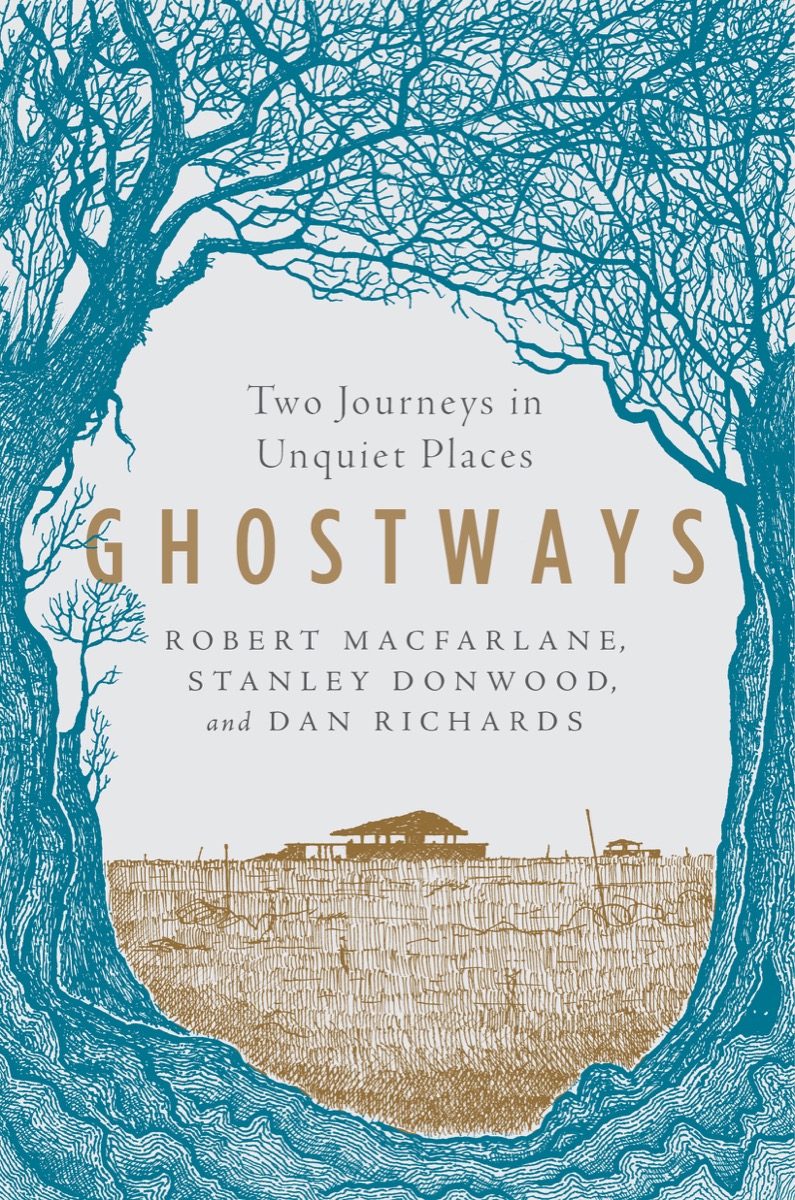
Ghostways: Two Journeys in Unquiet Places
Ghostways brings two of best-selling author Robert Macfarlane’s eeriest works of impressionistic nature writing to American readers for the first time. In Holloway, Macfarlane and his collaborators explore the famed holloways of South Dorset, a landscape of shadows and spectres in the southwestern corner of England. In Ness, they create a modern myth about Orford Ness, the shingle desert of southeast England, for decades the United Kingdom’s secret atomic weapons testing site. Featuring Stanley Donwood’s spectacular etchings of woodland scenes throughout, Ghostways is a beautiful and haunted work of art unlike any other.
144 pages, Paperback
First published November 24, 2020
About the author
Robert Macfarlane
125 books4,948 followersRobert Macfarlane is a British nature writer and literary critic.
Educated at Nottingham High School, Pembroke College, Cambridge and Magdalen College, Oxford, he is currently a Fellow of Emmanuel College, Cambridge, and teaches in the Faculty of English at Cambridge.
Robert Macfarlane is the author of prize-winning and bestselling books about landscape, nature, people and place, including Mountains of the Mind: A History of a Fascination (2003), The Wild Places (2007), The Old Ways (2012), Holloway (2013, with Stanley Donwood and Dan Richards), Landmarks (2015), The Lost Words: A Spell Book (with the artist Jackie Morris, 2017) and Underland: A Deep Time Journey (2019). His work has been translated into many languages, won prizes around the world, and his books have been widely adapted for film, television, stage and radio. He has collaborated with artists, film-makers, actors, photographers and musicians, including Hauschka, Willem Dafoe, Karine Polwart and Stanley Donwood. In 2017 he was awarded the EM Forster Prize for Literature by the American Academy of Arts and Letters.
Educated at Nottingham High School, Pembroke College, Cambridge and Magdalen College, Oxford, he is currently a Fellow of Emmanuel College, Cambridge, and teaches in the Faculty of English at Cambridge.
Robert Macfarlane is the author of prize-winning and bestselling books about landscape, nature, people and place, including Mountains of the Mind: A History of a Fascination (2003), The Wild Places (2007), The Old Ways (2012), Holloway (2013, with Stanley Donwood and Dan Richards), Landmarks (2015), The Lost Words: A Spell Book (with the artist Jackie Morris, 2017) and Underland: A Deep Time Journey (2019). His work has been translated into many languages, won prizes around the world, and his books have been widely adapted for film, television, stage and radio. He has collaborated with artists, film-makers, actors, photographers and musicians, including Hauschka, Willem Dafoe, Karine Polwart and Stanley Donwood. In 2017 he was awarded the EM Forster Prize for Literature by the American Academy of Arts and Letters.
Ratings & Reviews
Friends & Following
Create a free account to discover what your friends think of this book!
Community Reviews
Displaying 1 - 30 of 99 reviews

April 1, 2024
the past is eerily restless.
Ness-- three stars, a dream visit with recurring chorus to a remote island used by the British government to test munitions. DEFINITELY need to reread.
Holloway--five stars, an elegy of place and purpose, perhaps. Simply riveting.
Ness-- three stars, a dream visit with recurring chorus to a remote island used by the British government to test munitions. DEFINITELY need to reread.
Holloway--five stars, an elegy of place and purpose, perhaps. Simply riveting.
November 10, 2021
What is a book? I'm sure there are many definitions that could be applied to the term. Some may include a story with plot and characters, but then we have books of photographs with neither of the aforementioned things. However, if I were to publish two short stories that only added up to 20-30 pages, no one would really call it a book. Maybe it could be considered the beginning of a collection of stories, but certainly not anything full length. However, if I were to add illustrations and a lot of blank pages between each two to three page section to pad it out, the page numbers would double or triple and thicken the spine even though the content would be as thin as a dragonfly's wing. And that's what we have here. Two barely stories (one is a mix between a story and a prose poem) disguised as a book. But that's being nitpicky. A book is anything that's published between two covers whatever the content may be. So this qualifies.
As to the content, I confess I'm surprised by the number of glowing reviews for this work and to each their own, but I must confess I found it a bit pretentious and meandering without much point or poetry. C'est la vie.
As to the content, I confess I'm surprised by the number of glowing reviews for this work and to each their own, but I must confess I found it a bit pretentious and meandering without much point or poetry. C'est la vie.

December 26, 2020
5+ out of 5.
Unexpected and perfect. So up my alley, in every respect. The first journey, Ness, is very reminiscent of Max Porter; the second, more contemplative and almost spooky. Loved it.
Unexpected and perfect. So up my alley, in every respect. The first journey, Ness, is very reminiscent of Max Porter; the second, more contemplative and almost spooky. Loved it.
October 10, 2025
I would give this 4.75 stars. I read this book as I was waiting for another book to be available. Very much by chance and I’m so glad I did.
I loved Ness. Set between five ”beings” and The Green Chapel, I adored the personification and perspective of “beings” then set against a fairytale style story of destruction. Slightly Monty Python-like but not.
The switch to Holloway felt strange. Language was rich and the objective so British. I would love to be driven to follow a path with tenacity as he did twice. I think justified alignment and ampersands choked me in the reading. Left alignment allowing a more natural, uneven right margin would’ve flowed better. Minor point from someone in copy editing and poetry.
I’m so glad to have happen-chanced on this. It won’t be for everyone but many will love it.
I loved Ness. Set between five ”beings” and The Green Chapel, I adored the personification and perspective of “beings” then set against a fairytale style story of destruction. Slightly Monty Python-like but not.
The switch to Holloway felt strange. Language was rich and the objective so British. I would love to be driven to follow a path with tenacity as he did twice. I think justified alignment and ampersands choked me in the reading. Left alignment allowing a more natural, uneven right margin would’ve flowed better. Minor point from someone in copy editing and poetry.
I’m so glad to have happen-chanced on this. It won’t be for everyone but many will love it.

January 9, 2022
There are parts of nature that possess an eerie quality. The writers show these English settings deserve a sort of meditation for these landscape nearly mythical auras.
Certainly worth a read if you enjoy this style of writing or impressionist views of nature that’s unsettling.
Certainly worth a read if you enjoy this style of writing or impressionist views of nature that’s unsettling.
January 8, 2023
It was good but because of my tragically low lexile score I feel as though I missed out on the full experience

August 12, 2020
This is broken into two parts. The first reminded me of reading Homer's Odyssey or Iliad. It is in that style and has a mythological feel. The second is still prose but more a straight forward love of nature and appreciating the beauty of it. He journeys back to a place he explored years earlier with a friend who has since passed away. Both of them are about exploring Nature and appreciating it for what it is. A bonus is is has some cool black and white illustrations in it as well.

October 14, 2021
In the forward, the authors refer to "Aiteanna Tanai" - 'thin places', places where, as they describe it, "the past is eerily restless." In Ghostways, there are 2 pieces that tell the stories of such a place - Ness, an area off the cost of East Anglia where secret weapons tests were done, and the Holloways, old pathways in England, so heavily traveled that over the centuries they have been worn down as much as 10 feet lower than the surrounding ground and are often now covered with brambles and greenery. The forward tells the reader that "Both were written in part to be read aloud, or at least sounded in the mind's eye - and also to flash up the eye in their mixing of word and image." Each of these pieces has a distinctly different style. Ness feels like an epic poem and the rhythm and word choice pull you in and propel you forward. Holloways has more of a prose style to it and is similar in style to some of MacFarlane's other writing. The language and sense of place is what stands out for me - the ability of the authors to make you feel you are there to the point that you feel like you can smell the moss or that you need to move the brambles out of your way. While this might not be for everyone, I loved the evocative writing and the spell that the authors weave.
From Ness: "Look - here she comes, her skin is lichen & her flesh is moss & her bones are fungi, she breathes in spores & she moves by hyphae. She is a rock-breaker, a tree-speaker, a place-shaper, a world-maker."
From Ness: "Look - here she comes, her skin is lichen & her flesh is moss & her bones are fungi, she breathes in spores & she moves by hyphae. She is a rock-breaker, a tree-speaker, a place-shaper, a world-maker."

May 31, 2021
What a thought-provoking meditation on ways to approach the natural and human histories of a geographic space. I personally find myself bogged down and preoccupied by the immediately physical; this helps broaden my perceptions to grasp the role of time that shoots through a place, as well as the mystical and metaphysical.

September 15, 2021
got this in city lights, san francisco.
in the introduction:
...written in part to be read aloud or at least sounded in the mind's ear- and also flash upon the eye in their mixing of word and image.
read part the first of the two segments Ness , the allegory, out loud on stinson beach, as I was walking early one morning. This one was perfect, 5 stars
Second one was a little denser, less poetic.
4 stars overall
in the introduction:
...written in part to be read aloud or at least sounded in the mind's ear- and also flash upon the eye in their mixing of word and image.
read part the first of the two segments Ness , the allegory, out loud on stinson beach, as I was walking early one morning. This one was perfect, 5 stars
Second one was a little denser, less poetic.
4 stars overall

July 5, 2022
Poetic essays about two places in England that could rightly be said to be haunted - however you want to interpret that. I loved the pictures that accompany the spare text. They are evocative and soulful in a lonely way. I loved the explanation of what holloways are, and how they played a part in history.

October 24, 2023
If I were familiar with the places Macfarlane writes of, I am certain this would be a favorite book of mine. It is beautiful: poetic, haunting, with interesting illustrations and lots of negative space. Because I have not walked these paths, I can love the language but not (yet) the places except in my imagination. Really lovely - I hope to scramble along a holloway someday.

September 14, 2024
First part of the book: Ness is a troublesome allegory, a “prose-poem” featuring characters of the drift. It’s eerie and disturbing, with interludes of pure verse and dialogue. At the end, I’m not sure I completely understand, but I definitely felt, if you know what I mean.
Second part: Holloways. This section is so much more relatable. Macfarlane and his friends explore the holloways of Dorset, lanes carved by millennia of feet creating tunnels in the chalk, with curved ceilings of hedgerows and trees. I have now made a promise to myself to find and explore a “Holloway.”
Second part: Holloways. This section is so much more relatable. Macfarlane and his friends explore the holloways of Dorset, lanes carved by millennia of feet creating tunnels in the chalk, with curved ceilings of hedgerows and trees. I have now made a promise to myself to find and explore a “Holloway.”
June 16, 2021
First story was a clear and easy 5 stars. Absolutely stunning. Second story was less poetic and magical - sort of run of the mill for me.
March 3, 2023
One of the most extraordinary books I’ve read. I lit a candle and read it to The Spirits as a devotional with a hagstone rosary in hand. An ode to liminality
Read
August 24, 2024beautiful voices here and never too self serious

July 26, 2026
Everything that Macfarlane writes is a meditation and a gentle walk.
September 14, 2021
The first half resembles experimental art.
The second half is as haunting and captivating as Robert Macfarlane can get. It leaves you wanting more.
The second half is as haunting and captivating as Robert Macfarlane can get. It leaves you wanting more.

April 21, 2023
This book was beautiful to read. Also eerie. I enjoy the way Robert MacFarlane anthropomorphizes concepts in ways that seem to transcend any binary, or linearity. It’s refreshing.
My favorite passage:
“She is committed to redefining decay as a form of Verdancy, individuality as a biological aberration, and gender as a parallax error or species anomaly. If she had to become another kind of organism or organisms she would choose to be a siphonophore for its explosion of conventional notions of community. If you left her on a rock, given time, she would crack it with her acids.”
My favorite passage:
“She is committed to redefining decay as a form of Verdancy, individuality as a biological aberration, and gender as a parallax error or species anomaly. If she had to become another kind of organism or organisms she would choose to be a siphonophore for its explosion of conventional notions of community. If you left her on a rock, given time, she would crack it with her acids.”

August 12, 2024
Pretentious twaddle attempting to be poetical, especially the first section ("Ness"), but relegating the actual nature to the background. And the second piece ("Holloway") adds little to what Macfarlane already wrote about it in his earlier book The Wild Places, and frankly you're better off simply reading Geoffrey Household's Rogue Male.
The worst part, however, is Norton's even passing this off as a book. Its officially 132 pages, but removing the blank pages, the illustrations, and all the expansive blank spaces inserted as gimmickry and 'poetic design', leaves you with probably about 50 pages of actual text at best. It should be referred to as a chapbook, really, and it's criminal that the list price was $16 (I was actually fortunate to find it remaindered in a shop for about $7).
I will no doubt continue to dip into Macfarlane's works, but I'm not in any rush to do so at this point.
The worst part, however, is Norton's even passing this off as a book. Its officially 132 pages, but removing the blank pages, the illustrations, and all the expansive blank spaces inserted as gimmickry and 'poetic design', leaves you with probably about 50 pages of actual text at best. It should be referred to as a chapbook, really, and it's criminal that the list price was $16 (I was actually fortunate to find it remaindered in a shop for about $7).
I will no doubt continue to dip into Macfarlane's works, but I'm not in any rush to do so at this point.

January 11, 2022
English nature writers Robert Macfarlane, Stanley Donwood, and Dan Richards collaborate in the evocative Ghostways: Two Journeys in Unquiet Places, an atmospheric work using striking artwork and poetic language to explore the connections between place, the human and natural worlds, history personal and societal, human time and deep time. Focusing on two specific locales in England, Orford Ness and a “holloway” in Dorset, Ghostways is a lovely merging of art and nonfiction, poetry and nature writing, history and memoir to consider how we experience these specific places in unique ways, connecting the reader to more ways that the past, both human, animal, and environmental, remains part of our daily world.
I discuss other books exploring memory, place, and ghosts at Harris' Tome Corner.
I discuss other books exploring memory, place, and ghosts at Harris' Tome Corner.
November 26, 2020
A one sentence book review might read: "The UK is still full of magic."
If you're a fan of Robert MacFarlane, you're going to love the second part of this book, Holloway. Although short, it is some of his best in terms of the insightful, adventurous, luminescent writing that he is known for. The first part of the book, Ness, is unique, creative, and nothing short of creepy.
Overall, I absolutely loved reading more about holloways ... something we don't have here in the United States, at least not that I'm aware of. The Natchez Trace might be similar, or have some similar sections, but then again not.
If you're a fan of Robert MacFarlane, you're going to love the second part of this book, Holloway. Although short, it is some of his best in terms of the insightful, adventurous, luminescent writing that he is known for. The first part of the book, Ness, is unique, creative, and nothing short of creepy.
Overall, I absolutely loved reading more about holloways ... something we don't have here in the United States, at least not that I'm aware of. The Natchez Trace might be similar, or have some similar sections, but then again not.

July 7, 2021
The first section, “Ness,” was a little weird for me, but I really loved the second piece, “Holloway.”
September 7, 2023
such a good read for early fall! holloway especially was gorgeous and evocative and the perfect length and the word choice felt like a brain massage. + the illustrations!!!!!!!!!! jesus

February 4, 2021
Not what I expected at all, but the first story, 'Ness' was an allegory written with some phenomenal descriptive prose in a long poem format, and I liked it; the second half about holloways less so, very brief and like ghost stories, but boring ones.
Look – here as comes, who exists only as likeness, moves as mist & also as metal, cannot be grasped or forced, is the strongest & strangest & youngest & oldest of all the five, slipping through trees, past houses, rolled by the wind at years each minute – rolled by the wind as if through time & in it.
When you’re with Drift, time does really strange things. Drift is one of those friends who make sequence shiver, lay out odd things side by side, fully disassemble the normal for a while. Today with Drift is pre-Cambrian, today with Drift is Anthropocene. Drift doesn’t really do time, though – Drift more does space. Drift is always becoming. Drift is vast & if you had to describe Drift you would need a new kind of map & a new kind of language. The only end to Drift would be the end of the oceans, which in turn would be the end of the planet – & no one really wants that.
Many of those who have walked these old ways have seen them as places within which one might slip back out of this world, or within which ghosts softly flock.
Down in the dusk of the holloway, the landscape’s pasts felt excitingly alive & coexistent, as if history had pleated back on itself, bringing discontinuous moments into contact & creating correspondences that survived as a territorial imperative to concealment, escape & encounter.
I now understand it certainly to be the case, though I have long imagined it to be true, that stretches of a path might carry memories of a person just as a person might of a path.
Look – here as comes, who exists only as likeness, moves as mist & also as metal, cannot be grasped or forced, is the strongest & strangest & youngest & oldest of all the five, slipping through trees, past houses, rolled by the wind at years each minute – rolled by the wind as if through time & in it.
When you’re with Drift, time does really strange things. Drift is one of those friends who make sequence shiver, lay out odd things side by side, fully disassemble the normal for a while. Today with Drift is pre-Cambrian, today with Drift is Anthropocene. Drift doesn’t really do time, though – Drift more does space. Drift is always becoming. Drift is vast & if you had to describe Drift you would need a new kind of map & a new kind of language. The only end to Drift would be the end of the oceans, which in turn would be the end of the planet – & no one really wants that.
Many of those who have walked these old ways have seen them as places within which one might slip back out of this world, or within which ghosts softly flock.
Down in the dusk of the holloway, the landscape’s pasts felt excitingly alive & coexistent, as if history had pleated back on itself, bringing discontinuous moments into contact & creating correspondences that survived as a territorial imperative to concealment, escape & encounter.
I now understand it certainly to be the case, though I have long imagined it to be true, that stretches of a path might carry memories of a person just as a person might of a path.

December 9, 2020
"Nature writer" hardly covers all that Modern Renaissance Man Robert Macfarlane does.
Right now reading the just released in the US couple of short pieces he published in 2012 and 2018. "Ghostways".
Outdoors, archaeology, adventurer, myth, horror, poetry, history, impressionism, experimental writer, folklore - probably a few more in there.
But he also talks in language gone by.
Like this, which I could not make hide nor hair of....
"A fume quoit caught on this whittled marl peg."
I wish I had been reading this on my kindle, so I could have looked them up on the online dictionary it comes with.
OK, he is exploring holloways (ancient walkways that are now as much as a dozen feet below ground level - often covered above by vegetation and trees, and so unnoticeable to the naked eye) in an area in Sussex that is a series of half and full circles in the landscapes. It is very foggy and misty in the AM. The "whittled marl peg" is the worn down ("whittled") marl (loose ground) that "pegs" (is the ground/basis for, and makes the holloways possible) the geological area.
Whoosh!
He does have a "creative writing" side to him, and that is in evidence here. Kind of impressionistic poetry. Reminds me of reading some poetry from 1930's England - but it still works nearly 100 years later.
Both stories were first released as limited editions it appears. But the etchings by Stanley Downwood are still beautiful and effective in this cheaper format.
Not the book you want to start with for Macfaralne - read 2 or 3 of his more "Nature" books before you open this up for a quick read.
Right now reading the just released in the US couple of short pieces he published in 2012 and 2018. "Ghostways".
Outdoors, archaeology, adventurer, myth, horror, poetry, history, impressionism, experimental writer, folklore - probably a few more in there.
But he also talks in language gone by.
Like this, which I could not make hide nor hair of....
"A fume quoit caught on this whittled marl peg."
I wish I had been reading this on my kindle, so I could have looked them up on the online dictionary it comes with.
OK, he is exploring holloways (ancient walkways that are now as much as a dozen feet below ground level - often covered above by vegetation and trees, and so unnoticeable to the naked eye) in an area in Sussex that is a series of half and full circles in the landscapes. It is very foggy and misty in the AM. The "whittled marl peg" is the worn down ("whittled") marl (loose ground) that "pegs" (is the ground/basis for, and makes the holloways possible) the geological area.
Whoosh!
He does have a "creative writing" side to him, and that is in evidence here. Kind of impressionistic poetry. Reminds me of reading some poetry from 1930's England - but it still works nearly 100 years later.
Both stories were first released as limited editions it appears. But the etchings by Stanley Downwood are still beautiful and effective in this cheaper format.
Not the book you want to start with for Macfaralne - read 2 or 3 of his more "Nature" books before you open this up for a quick read.

February 20, 2021
Beautiful, hallucinatory. The first section, Ness, evokes lyric images of the violent destruction and insistent return of nature. Perhaps an anti-wilderness, if wilderness is understood through Cronan's Trouble with Wilderness terminology-- the final encroachment of the returning green is not a space absent human intervention/destruction, but perhaps post human intervention/destruction. I am the grass, I cover all. The poetry, the recitations, create a space midway (Midway) between church and epic poetry; noting the gradual changes, to form, to description, throughout the piece, as the relationship between competing elements shifts, is like tracing the slow progress of a nurtured plant. (Not sure if I want to teach this, write about it, or just read it again.)
The other section, Holloways, was good but didn't resonate quite as much. It was a bit more located in the individual experience and mourning of the author; the idea of the hollow-way was evocative and chilling, but it didn't quite spark the imagination.
(So much eco-lit reminds me of Susan Cooper-- Greenwitch and The Dark is Rising-- images of an old land just below the contemporary landscape, the grasp on the present that is invisible and unchanging. All of that is drenched in ye olde Brittania mythos, of course, which has tons of race and class nostalgia to unpack. But that was a bit beyond me when I first encountered Cooper; the images of the hollow ways could be lifted straight from those books.)
The other section, Holloways, was good but didn't resonate quite as much. It was a bit more located in the individual experience and mourning of the author; the idea of the hollow-way was evocative and chilling, but it didn't quite spark the imagination.
(So much eco-lit reminds me of Susan Cooper-- Greenwitch and The Dark is Rising-- images of an old land just below the contemporary landscape, the grasp on the present that is invisible and unchanging. All of that is drenched in ye olde Brittania mythos, of course, which has tons of race and class nostalgia to unpack. But that was a bit beyond me when I first encountered Cooper; the images of the hollow ways could be lifted straight from those books.)

March 5, 2021
I loved this book. Ghostways is made up of two pieces, each evocative of a specific place, and both beautifully written. Both were previously available in the UK, and now newly available in the US.
The first piece "Ness", is a prose poem on a visit to Orford Ness, a spit of pebbled land adjacent to the Suffolk coast of England, used for many years as a military testing grounds.
The second, "Holloway" is a story about two visits to a path in Dorset (along England's south coast), a path (or "way"), well used for centuries and so sunk deep into the soft rock of the area to form what today is more like a tunnel, overgrown with bramble and almost hidden from view - a "holloway". On his first visit MacFarlane is accompanied by a friend who has died by the time of the second visit, and so the story can be seen as a journey into the memory of friendship.
The illustrations by Stanley Donwood fit the mood and the narrative of the first piece completely, and compliment the second.
MacFarlane has been called Britain's foremost living nature writer. In this short book, as in his book The Old Ways which I read last year, paths through nature bring understanding of both our humanness and of the natural world.
I rate this book 5 Stars ⭐⭐⭐⭐⭐ - this book is fantastic - I think anyone looking to reconnect with nature from a pandemic (or winter) seclusion will enjoy Ghostways.
The first piece "Ness", is a prose poem on a visit to Orford Ness, a spit of pebbled land adjacent to the Suffolk coast of England, used for many years as a military testing grounds.
The second, "Holloway" is a story about two visits to a path in Dorset (along England's south coast), a path (or "way"), well used for centuries and so sunk deep into the soft rock of the area to form what today is more like a tunnel, overgrown with bramble and almost hidden from view - a "holloway". On his first visit MacFarlane is accompanied by a friend who has died by the time of the second visit, and so the story can be seen as a journey into the memory of friendship.
The illustrations by Stanley Donwood fit the mood and the narrative of the first piece completely, and compliment the second.
MacFarlane has been called Britain's foremost living nature writer. In this short book, as in his book The Old Ways which I read last year, paths through nature bring understanding of both our humanness and of the natural world.
I rate this book 5 Stars ⭐⭐⭐⭐⭐ - this book is fantastic - I think anyone looking to reconnect with nature from a pandemic (or winter) seclusion will enjoy Ghostways.
Read
June 29, 2025i really wanted to like this book...the prose was beautifully written and i was enchanted at the beginning but it lost me pretty quickly after. i liked learning about the portal of hagstones and i liked the foreward and how the povs were introduced as well as how the green chapel was described, but i could not pick up the rhythm of the firing song and i finished the book with a sense that i was missing something fundamental to the theme. Either way, this is countimg towards my Library's Summer Readong Challenge in the category: books with one word as the title.
"Who will take the service in the Chapel?
'I will,' says The Physicist, stepping forwards in his greatcoat, though curiously his feet make no noise on the shingle that increasingly fills the nave and transept.
'I intend in the service to speak only in equations, for they are the purest of utterances and they address only the world of matter, and they have no correlate or purchase in the sphere of politics and yet they possess a vast and calculable power to alter the world we inhabit.'
The Armourer says:
Physicists have long flattered themselves this, and I see you continue the tradition. Nevertheless, I thank you for all your work and preparation. We are ready to bring the bomb to complete its trajectory."
"Who will take the service in the Chapel?
'I will,' says The Physicist, stepping forwards in his greatcoat, though curiously his feet make no noise on the shingle that increasingly fills the nave and transept.
'I intend in the service to speak only in equations, for they are the purest of utterances and they address only the world of matter, and they have no correlate or purchase in the sphere of politics and yet they possess a vast and calculable power to alter the world we inhabit.'
The Armourer says:
Physicists have long flattered themselves this, and I see you continue the tradition. Nevertheless, I thank you for all your work and preparation. We are ready to bring the bomb to complete its trajectory."
Displaying 1 - 30 of 99 reviews