Women and Sabarimala is an answer to the question “why aren’t women of menstrual age allowed to enter Sabarimala?” This book presents a never-before discussed perspective on the science behind the restrictions on women in the Sabarimala temple. Women and Sabarimala is a rare book and is written from a woman’s perspective, explaining the nature of the temple through India’s traditional knowledge systems, such as Ayurveda, Chakras, Tantra and Agama Shastra. At the same time, the author’s personal experiences simplify the understanding of these deep sciences, providing a glimpse into how temples impact the human physiology and, in particular, women’s menstrual cycles. This book will change the way Hindu temples, especially Sabarimala, are perceived and experienced.
This book was more about sharing the experience. Thanks to author for mentioning those temples. I will definitely visit them and follow those procedures. Author being a christian sharing her experience and voicing out that we all should believe indigenous knowledge and there is always a logic behind it. Book also mentioned which temple influence which chakra. It was really amazing to know such things. We need more books like this especially when real knowledge is misinterpreted by the larger public. A very well researched book.
After this book, i will read The Sabarimala Confusion by Nitin Sridhar.
The lone dissenter judge of the SC in Sabarimala case, Indu Malhotra, who happened to be a woman, asserted, 'notions of rationality cannot be invoked in the matters of religion by courts.' I echo her views but this book doesn't.
The book claims that there is the 'science' behind the restrictions on the women's entry and so it tries to rationalise the whole rituals. Let me clarify that my issues are not with rituals but with the word 'science' when nothing is scientific. This work is the hypothesis at the best and the pseudoscience at the worst.
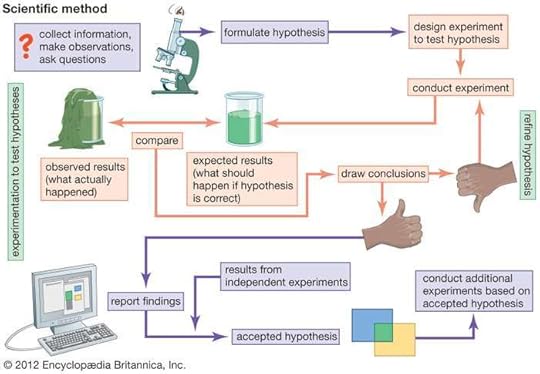
Long read: Here is a simple flowchart to explain what does scientific methodology looks like.
Here, the author has proposed her hypothesis that temples are created in such a way that it can have effects on chakras of the body. Joseph is on the step no 2 only but she goes on to explain that temples have different impacts on the bodies of men and women. She also claims that menstruating women can have different effects on being entered to the temple. In this way, she concludes that it is 'scientific' that women are not allowed to be entered.
She has proofs for her claims. Ask, which are they? Holy scriptures and religious texts, which were written a few hundred years ago.
That's not how science works. She has to take the large sample of men and women, has to do experiments on half of them, has to give placebo effect to the rest half, and observe the proposed harmful effects with scientific instruments. If something specific happens then only it can be said that science is behind that. That's how vaccine trials also work and so is science, in general.
This should also be noted: 'The law of small numbers' also applies which means that the individual experiences don't set the universal or general trend but a systematic study on the large and diverse sample does. As far as chakras, which she mentions repeatedly, are concerned, there is no evidence in modern science that they exist.
Arguments by Joseph are so lame but confident that any person with poor background of science and logicstics can easily be persuaded to believe her. Hailing from the scientific background, I can't buy her any claim.
The book is not recommended to the believers of science. For those who think science is a western conspiracy, please go and read the book to make your confirmation bias more strong with pseudoscience.
Explained in an understandable manner clearing many questions and confusion about this topic. Knowing and awareness of the human body and it's connect with the cosmos is vital.
Before reading on to this book , I had watched a Talk show of Sinu Joseph on YouTube channel 'The Conch'. She covers all the insights of why women have been restricted to the Dharma Sashta Temple Sabarimala since ages. Even though she being a Christian the persistence of her work is applaudable. The experiences she shared by visiting each of these temples are extra-ordinary. Even I got a urge to visit these temples to experience the trigger of particular temples. She didn't visit Sabarimala as of the trigger experiences.
According to agama shastra the temple have to be built in a human form. It explains as such the temple has to be viewed by a human body lying down. The foot area is the entrance to the temple, gentital area is were the dwaja sthambha located, belly region is the ranga mantapa, heart region is the antarala, and the head region where the eyebrows meet is the Garbha griha where the actual god is located.
It states that from entrance to the lord icon the respective chakras get activated.
Ayyappa devotees are ideally required to visit the five temples in a specific order, before going to Sabarimala which is the sixth temple. 1. Sori Muthaiyan Kovil — Muladhara Chakra 2. Achankovil Sree Dharmasastha Temple — Swadisthana Chakra 3. Aryankavu Sree Dharmasastha Temple — Manipura Chakra 4. Shree Kulathupuzha Bala Sastha Temple — Anahata Chakra 5. Erumeli Shri Dharma Sastha Temple — Vishuddhi Chakra 6. Sree Dharma Sastha Temple, Sabarimala — Ajna Chakra
Each of these six temples are said to trigger a specific chakra from the muladhara to the ajna.
Sabarimala triggers the ajna chakra and if the women is exposed to such an environment where only ajna chakra is activated she experience trouble with her menstrual and reproductivity. There are more disorders to occur if exposed for longer period. Hence the Sabarimala restricts the women of particular age who menstruates are restricted to enter the temple.
Even the Sabarimala temple entrance is restricted to the men who doesn't perform vrata for 41 days after the maladhaarana. But now a days it has become a fashion of wearing mala today and visiting the temple next day. The shastras restricts these since the Ayyappa swami is a pure bramhacharya to seek his presence one should perform this vrata to prompt. If this is perform actue then the devotee can attain the 7th chakra i.e.., oneness with the lord (Moksha).
This book is definite answer for the women restriction.
Sinu Joseph, a menstrual educator, presents a contentious argument in support of the age-old tradition barring women of a certain age from entering the Sabarimala temple. Her stance aligns with the patriarchal system, which some see as furthering her career or simply following the status quo.
However, her reasoning lacks scientific backing. While she references Vedas and other ancient texts, these were written in a bygone era and may not reflect current scientific understanding.
Joseph makes some dubious claims. For instance, she suggests that women who pray at Sabarimala will develop a detachment from family and worldly affairs. This assertion lacks evidence. There's no record of women returning from Sabarimala seeking divorce or pursuing sainthood. Joseph's claims, based solely on ancient texts and the concept of Kundalini, lack scientific substantiation.
Similarly, her comparison to the historical exclusion of women from marathons is flawed. Back then, the belief was that women's bodies couldn't withstand long-distance running. This notion, demonstrably false, eventually gave way to women's participation in marathons and other sports.
Joseph's arguments rest on interpretations of ancient texts, not scientific data. Her personal experiences cannot be generalized to all women. Her views align with those who wish to perpetuate gender discrimination.
Finally, the text addresses the broader issue of women's empowerment. It argues that centuries of oppression have conditioned women to see themselves as inferior. Sinu Joseph's views, the text concludes, only reinforce this dynamic.
Good narration of personal experiences. Broad generalizations at odds with Science as practiced today.
Saw a YT video of her speech and picked this up on Kindle. Efforts in public health+Personal experiences: deserves respect. Generalizing based on personal experience and calling that science is at odds with how Science as a subject is practiced, with far robust design of experiments. Proof reading could've been better.
I loved knowing the rich culture and the scientific reasons behind certain practices they we primarily follow in Hindu Culture. This is really a good insight for men and women who have a common question regarding the restriction. Which is to serve the purpose of women in itself.
was a bit conflicted on the entire issue of Sabarimala . was at odds about the practice followed. what has been lost in times is scientific/tantric explanations about Hindu customs and we are paying a price for it.it is like explaining why a toddler cannot do something without giving a reason .had not given much thought to this side of the argument in Sabarimala.well articulated and written.
An excellent comparitive study of subtle energy source namely Cakras and anotomy. In this process both pravrtti and nivirti routes to liberation brought out nicely. The entire book for me is a well researched document on tradition and concept of Mukti advocated in Hindu philosophy. All women who question why I should not go to Sabarimala must read this book. Really a comendable work by Madam Sinu Joseph. But post judgement how this book will help is a question I have
An excellent quick read that explains (with an earnest effort) the intricacies & details with which a temple is created. The science behind the structure of a temple and its relation to human beings on a much deeper level, was intriguing for me. I grew up in India and had come across many words & concepts at home, yet never had the inclination to ask why. The book is written with sincerity that this is the author's own individual experience.
If you've ever been in doubt where you stand with the Sabrimala Case in India, this book can help you understand the argument better.
This book has awakened us into the great insights of the relation between the Chakras in the Human body and the way it functions in relation to consecrated spaces. It is an eye opening must read for all who need to know and realise that their well being is in their hands. Look inside you and awaken the sleeping giants in you and you will be happy and successful.
Until I heard the video of an interview with the author,which, incidentally prompted me to buy the book,I was clueless about the real reason why menstruating women are not allowed into the Sabarimala temple. Thank you Ms Joseph for your vivid explanation and reasoning behind this age old tradition.
Dispelled all doubts about Sabarimala temple. Beautiful illustration about Kundalini shakti. Thank you author for this book. Wish I could visit all those religious places mentioned in the book.
Excellentreading. Very informative. Leart lot about my own temples.
Great information about temples and spiritual enlightenment. It is a great work and might be helpful in resolving the ongoing legal battle. In Honorable supreme court.
This has made me come closer to ayyapa and his devotees. Offcourse my curiosity to experience this all stimulus which felt has increased. Thankyou writer to answer such a popular question in so brilliant manner
This book was recommended to me by a friend. It's a concise account of the author's personal experience of why women of reproductive age should restrain from going to Sabarimala. There is a lot of metaphysics involved in what she has narrated. A reader who is not exposed to such experiences before may find it hard to believe. I recommend this book.
It was good to read about the experieces of the author and cotravelers. The book start very informative and scientific. I thought the concepts will be scientifically explained but it was more about experiences.
Sabarimala is a topic of great personal interest to me due to my own, my immediate & extended family experiences. The memories of my father, my uncles, my cousins taking the annual mandala yatra still remains afresh, as well as my own experiences. When I saw a woman has written about this topic from her experiences, it piqued my interest.
Sinu Joseph’s preface is quite well articulated and makes some imperative points. We don’t know what we don’t know. The best form of explanation is through personal experiences, which is the objective established by the author. Quoting from Agama book by S.K.Ramachandra Rao, the author explains the rationale leading to the establishment of temples in current era. The explanation on Vaastu Purusha mandala is quite comprehensive and good.
The author elaborates about the “shat-chakras” from Ayurveda, along with detailed explanation on each of them and their relevance in physical & spiritual pursuits of humans. One of the key points is about specific temples that can energise the various chakras. The author captures her journey across the 5 different temples, each representing a chakra. A dharmic pursuit with a scientific temper, combining the available information, reinterpreting the same at a metaphysical level & refining the same with one’s own experience.
The travels and experiences of the author is well documented in a crisp, concise manner. Having visited some of these temples & related ones, I could relate to the experiences captured in the book. Don’t miss the interesting experience of Aryankavu Dharmasastha temple. One of the key focus areas of this book is to capture the impact of “energies” of the various kshetra on human body. The author does close the loop by providing an alternate path for women through the path of Devi Upasana.
Personal Anecdote:
For those trekking the shorter route from Pamba to Sannidhanam, the experiences could be metaphorically compared with each of these temples. The challenges of the initial steep climb does play on one’s mind, only to be replaced with a relief and resolve to have darshana (ippo poonal swamiye kaananam - If we go now, we should see Swami). The bliss one achieves at the final darshana can’t be expressed, but only can be experienced. Listening to Harivarasanam by Dr. K. J. Yesudas at 10.45 pm in the night is yet another surreal experience. The inner turmoil, transformation & ultimate happiness is quite noticeable for those undertaking the yatra.
In the modern society with the quite a range of opinions, this book is quite a laudable effort. It definitely does deserve a read, where one can marvel and appreciate the wisdom our ancestors and derive very valuable lessons for the present.
Om Hariharasudhan Anandachitan Ayyan Ayyappan…. Swamiye Saranam Ayyappa
When the Sabarimala issue was in the news, I couldn’t understand why it turned into such a big controversy. Swami Ayyappan is a Brahmachari, and that’s why females between the ages of 10 and 45 traditionally don’t enter the temple. Even the true devotees, including many women, were peacefully holding placards saying, “We are ready to wait.” Still, those with no real devotion or understanding of the tradition turned it into a debate. It was never about inequality. It was always about faith.
The book explained a lot about Chakra and traditions, and I liked reading it. But there were a few points I didn’t fully agree with, and I want to mention them here:
1.The book says that temples started around the 3rd or 4th century after Christ. But we have found numerous shivling and ancient murti that are over 28,000 years old. So clearly, temples existed much earlier.
2.Saying that a deity is a celibate, and females are requested not to visit or touch, does not mean disrespect to women. It’s also not disrespecting the deity. It’s just about understanding and respecting his form and energy.
The book was short, and that was good. It didn’t try to stretch just to add more pages. I also came to know about many granth and shastra that I had never even heard of. There is so much knowledge out there. Sometimes I feel like I'm only scratching the surface of something infinite.
The Science behind restrictions - Women and Sabarimala - Rating 3/5.
Well, the title of the book and the contents of the book appear to be slightly mismatching, for me at- least. I thought the book would be more to do with the science behind the restrictions imposed on women (of certain age groups) on visiting the Sabarimala temple.
I felt the reasons could be summed up in 10 lines, but then why an entire book of 104 pages?
Reasons for restricting entry - Upon visit to the temple 1. Women might give up family life completely and follow a spiritual path altogether. (affects kids, husband and extended family). 2. Temple visit might end up causing issues with womens' menstrual cycle and may lead to endometriosis (as per the book). 3. One needs to observe a strict 41 day pious regime in order to visit Sabarimala temple. Men can do it as their reproductive cycle is voluntary, but women its involuntary.
Rest of the book deals with 1. Sinu Joseph Journey to five of the six Sastha temples. 2. Tried to (self) experience the effect the temple has on women. 3. Introduction to Chakras (energy junctions in human body) and naadis (energy channels). 4. How the six Sastha Temples have effect on the six chakras (energy junctions). 5. Temple construction science introduction.
For me it was a difficult book to read, as I was a complete n00b when it came to chakras, naadis, science behind temple constructions and various other topics. I found it not so easy to follow and even after finishing the book I find it hard to recollect every concept mentioned in the book. It has taken almost 3 weeks for me to write this review, because the technical terms were totally out of my mind, post finishing the book!
Someone who is aware of the concepts of Shat Chakras, Naadis and one who's interested in the topics such as energizing chakras on a visit to a temple, might find this interesting.
Though I am very much interested in the science, I felt this is not the right book. This book definitely did not help, as it isn't meant for a total beginner. It has direct deep dive into too much technicality which is rather discomforting.
Overall a not so easy read. Rating for packing too much technicality under a disguised title.
Before embarking a short journey to understand the metaphysics behind the customs of Sabarimala, I was taken aback because the author is Christian. Since I have read the biased commentary by Christian authors on Hindu text and customs before, Started reading in disbelief.
But the author's effort towards digging into the metaphysical science behind the Sabrimala yatra impressed me though I was aware of the reason beforehand. In the initial chapters, the author has put a phenomenal effort to simplify temple science and Chakra. Rather than confusing readers with games of words, the author directly goes to the point throughout the book.
Since the author has put herself to test the science behind temples and chakras, the Book has come out well.
The author has given a spiritual and metaphysical explanation of how the temples and chakras will have different impacts on men and women individually. The author has used medical science explanation and metaphysical explanation from a Vedic perspective to justify the restriction which has nothing to do with inequality as it is portrayed.
I am not a devotee of Lord Ayyappa and being not of a very religious bent of mind, have never aspired to visit the Sabarimala temple. To be really honest, during childhood and teenage years, I had harboured a slight resentment towards Ayyappa for his discriminative attitude towards women of reproductive age. This feeling had inevitably stemmed from the explanations of elders that the celibate deity does not want the presence of women to defile Him or his abode. Also it was difficult to accept that a good majority of men made scant adherence to the austerities (41 day vrata) to be observed before visiting Sabarimala and visited the hill shrine as if going on a picnic. Growing up, the resentment metamorphosed in to a kind of latent impression that a divine father figure (the Diety) can never be partial to one gender and that women's banishment from Sabarimala must be the result of some primeval custom, which have long since lost its relevance.
And then came the Supreme Court order of September 2018, declaring exclusion of women from Sabarimala as unconstitutional and a violation of the fundamental right to freedom of religion. The events which unfolded across Kerala for the next few weeks following the Judgement were baffling, to say the least. Within no time, the issue got an extreme religious hue and became a political hot potato. Recognising the potential of the issue in influencing votes, politicians took turns and u-turns. Self anointed saviours of Hinduism burst in to the fray and declared their intentions to lay down their lives to save Lord Ayyappa and to protect Hindu rituals. On Prime Time National Television you could find the opposing camps yelling into each others throats, hurling abuses at each other and expounding conspiracy theories, which were at times, of an extreme silly and foolish nature. Well....it was definitely a great entertainment. In all this hullaballoo, isolated sane voices, hinting at well researched alternative possible (not certain) explanations for the exclusion were lost.
It is in this background that Sinu Joseph's 'Women and Sabarimala' gains significance. Written from a women's point of view, this book presents a rarely discussed perspective on the science behind the restrictions on women in the Sabarimala temple. Backed by authentic references and her own personal experiences, Ms Joseph succeeds in bringing out a lucid explanation of heavy terms and processes.
She begins by explaining the special nature of Hindu temples ( living, throbbing consecrated spaces with tremendous chaithanyam), their architecture which is intricately linked with human physiology and the swabhavam/ sankalpam (character/nature) of the diety. She talks about the science of the chakras (the Mooladhara, Swadisthana, Manipura, Anahata, Vishudhi and the Ajna), and the doshas, pancha boothas (five elements) and glands (Pituitary, Pineal, Thyroid etc) associated with each chakra. Each Chakra can be activated through techniques of yoga, specific mantras/chants or simply by going to temples which ares consecrated to energize a specific chakra or set of chakras.
She describes her personal experiences on visiting the five temples, each associated with Sabarimala and which is said to trigger a particular chakra from the Mooladhara (Sori Muthaiyan Kovil in Tamil Nadu) to the Vishudhi (Erumeli , with Sabarimala being associated with the Ajna. Although many devotees consider Lord Ayyappa as a deity who fulfills their wishes, in reality, Lord Ayyappa and Sabarimala Yatra is all about the nivritti marg or the path of renunciation to attain mukthi. The process of renunciation will be triggered for them once they start this journey, whether or not they are prepared.
An important aspect of Brahmacharya (very loosely transalted as Celibacy in English, but which is much beyond the same) and which permeates Sabarimala, is to be able to withhold the human seed and transform it into subtler forms, by raising it higher up the chakras. Therefore, celibacy and prevention of emitting the seed (sperm) becomes important for male devotees to fully experience the spiritual process. However, for women in the menstrual age, the seed, which is the egg is involuntarily released during menstruation.
Sabarimala temple has been conceived with the intention of making it possible for devotees experience spiritual enlightenment through all the rules, austerities and restrictions imposed during the 41 day vrata, with the practice of being able to contain sexual energy and withhold the human seed being at the core of the experience. Therefore if women in the menstruating age take the Ayyappa vrata and enter Sabarimala, they will experience the withholding of the seed as a struggle to menstruate, resulting in menstrual and reproductive disorders.
At the physiological level, the energization of the ajna chakra, leading to a spurt in the production of testosterone by the Pituitary gland, without the sufficient activation of swadisthana and Muladhara will eventually result in the ovaries becoming dysfunctional and unable to covert the testosterone into the female hormone, estrogen.
Ms Jospeh recommends Devi upasana until women are ready to walk the path of renunciation and until we can transcend our gender identities.
Am I convinced that this is the reason behind women's exclusion from Sabarimala? Not fully yet. Intellectual conviction will take much further reading, especially on the views expounded by those in favour of women's entry and on other related well studied treatises. Ultimate conviction can come only from one's own spiritual experiences.
But what the book succeeds in doing is to shatter the argument of those defending the restriction that women will disturb Lord Ayyappa who is a Naishtika Brahmachari, meaning one who has taken the vow of Brahmacharya for life. The assumption that such a Great one would be prone to disturbance by common woman folk shows the little that has been understood about what it means when a deity is considered to be a Brahmachari. Such arguments are not just insulting to women, but also to Lord Ayyappa, who in his capacity as a Naishtika Brahmachari has already conquered the five senses. The book is also the first of its kind to attempt a credible and rationale explanation to the matter, free from religious high handedness and duly backed by documentary evidence. Ms Joseph certainly deserves kudos for the same.
A must read for all those interested in delving into the nitty gritty of the Sabarimala conundrum.
A no bullshit guide to all who blindly wants to conquer Sabarimala!!
This is a knowledge packed book with a little over 100 pages in all. Not a word more and not a word less. I will not ask the readers to agree with the author but at least consider her views before coming to blind conclusions and dismissing our traditions as nonsense. Also this book goes a long way in again proving that all that we used to follow as part of our day to day life were not mere superstitions. It's a way of life based on human experience. Read for yourself to find out more!