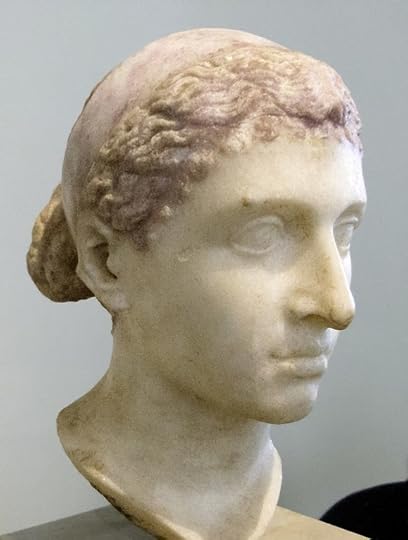
In the 2000 years since Cleopatra's death she has been recreated over and over again, each time in a form that fits the prejudices and fantasies of the age that produced it. To Chaucer she was the model of a good wife, while to Cecil B.De Mille she was "the wickedest woman in all history"; to the Arabic historian Al-Masudi she was a scholar and a sage; to George Bernard Shaw an emotionally retarded sex-kitten. These fantastic Cleopatras can be read as mirror-images of the culture that produced them. This book is about them, and also about politics - sexual, racial and constitutional - and about morality, neurosis and desire. The author is a journalist and critic who won the 1980 Catherine Pakenham Award as a feature writer with "Vogue".
Wow, this one is VERY thought-provoking. Everyone knows Cleopatra, or do they? The one that we know is the seventh of her name. This wonderfully researched & thought-out book takes us through the legends that surround her and gets to the roots of those legends. As it turns out, those legends we think we know were mostly fiction! These fictions were spread by her enemies to disparage her name & the name of Marc Anthony. She was so much MORE than those stories. This book shows us the incredible woman she was, in a time when it was nearly impossible for a woman to rule.
Cleopatra VII Thea Philopater, Queen of Egypt, is a fascinating, elusive and ultimately transformative figure. Ever since her grandiose and poignant death by snake bite in 30 BC Alexandria in order to escape the humiliation of being the captive of Octavian Caesar (known to history as Augustus), Cleopatra’s life, legacy and her tumultuous, ever changing afterlife has endured throughout the centuries. This afterlife has entranced and enraged, beguiled and horrified, all in equal measure, the various denizens of different cultures, societies, centuries, religions and moral beliefs as they each grappled with their own ideas of who exactly Cleopatra was within ancient history and how she came to be individually personified as a historical figure within their own eras.
It is intriguing and inviting prospect to explore and examine the various cultural, historical, literary and social manifestations of Cleopatra as she been portrayed and depicted as a killer Queen, a murderous harlot, a lovelorn damsel and a good girl gone bad. Indeed, Cleopatra has had a long and eventful afterlife, one that has taken twist and turns throughout the centuries always striving forward. As a result, Cleopatra, the woman and the legend, has often not only become a historical figure of the ancient world but a character who has embodied and personified the various socio-cultural constructs of whatever era she currently inhabits.
Even to this day, Cleopatra, as a real historical figure and as a prominent social, cultural and literary character, continues to evoke interest, excitement and debate within our modern. She truly is a timeless, near immortal figure, She may have died over 2000 years ago, she may have suffered vilification, scorn and contempt from male writers and historians throughout her long afterlife and her tomb may be lost to the ages, but it is clear that Cleopatra lives, both in history and in popular culture.
That is the purpose of Lucy Hughes-Hallett’s book Cleopatra Histories, Dreams and Distortions, an insightful, in-depth and engaging examination into Cleopatra’s social, historical, cultural, political and literary transformations and manifestations throughout the centuries and what she has symbolised to each individual historical era. This is, without a doubt, a thoughtful and highly eloquent socio-cultural analysis of Cleopatra with brief forays into the historical records (from Octavian’s and Cleopatra’s perspectives) and a closer, detailed examination of Cleopatra as she has appeared in history, culture, society and literature.
However, this is not a book for beginners. It is a fairly intense, philosophical and, at times, ponderous read that requires some knowledge of historical facts, cultural studies and literary theories. This would probably be somewhat off-putting to general or casual readers. There is quite a bit of lofty musings within the book itself. Complicated, interesting but sometimes ostentatious, this book might not appeal to everyone.
Would I recommend this book?
Yes and No.
YES – it is an intriguing and provoking read. Well-written and clever look at Cleopatra and her various manifestations as a character of popular culture. An excellent and well-researched examination of the famous Queen herself.
NO – Not recommended for a casual or general reader. Can be a bit ponderous and long-winded. Background reading or knowledge of historical facts, cultural studies and literary theories.
Before I start this review, I have to thank Sisimka. She's the reason I have this book. Thank you Sisimka.
Helen might have been the face that launched a thousand ships, but Cleopatra went further with a vulture beak on her face. Honestly, Cleopatra's nose was ugly. Yet, society credits Cleopatra with being a great beauty. A sexual adventuress, a femme fatale, a hot, murdering mama. But not really a mother, though she did have four children.
Lucy Hughes-Hallett examines the myths and views of Cleopatra thoughout the ages. She spends the first section of the book going into detail about Ocatvain's story about Cleopatra versus what Cleopatra's story might have been. It is this first section of the book that provides biographically detail. Readers should be warned, however, that this book is not a biography of Cleopatra. Readers who want a straight forward biography should check out Michael Grant's work. The second half of the book deals with how artists and writers thoughout the ages have treated Cleopatra. The book was published in 199o so more recent treatments such as The Memoirs of Cleopatra are not mentioned.
Hallett raises several interesting points. We are fasnicated by Cleopatra, but even today it is more in terms of her love affairs (and it seems she only had two) more than anything else. How many people reading this review, for instance, knew Cleopatra had four children? Having her as a mother limits the sexual beauty of Cleopatra that society has in its mind. The same is true of Helen, who was a mother when she abanonded husband and child to run off with Paris. Hallett focues on the idea of Cleopatra as other, as the Orient to the West and how each author uses Cleopatra to show how HE and his society sees women.
What I found to be very interesting is the sheer number of paintings that show Cleopatra having the asp bite her breast when she commits suicide (Ouch!). There is proably some deep symbolism here, the inversion of life or something, and I wish Hallett had gone into that aspect of it a bit more.
Hallett's conclusions still ring true today. Even in a pro-Cleopatra novel like The Memoirs of Cleopatrathe plot focuces on the love affairs. Cleopatra comes across as a saint and the men are not good enough for her. Then there is the other extreme, Cleopatra the queenly whore as in For Destiny or Desire. Cleopatra becomes what the writer wants her to be, sainted matyr or trashy romance heroine, not really who she was.
To be honest, I’m not sure we needed a new edition of this book. When it first came out in 1990, it was a critical work in the field, and it still is today, but scholarship on Cleopatra’s cultural afterlife has increased significantly since then. The most recent monograph on the subject, The Reception of Cleopatra in the Age of Mass Media, isn’t even old enough to be in first grade, and Brill is currently compiling a Companion volume on her reception.
Apparently, Hughes-Hallett agrees with me, because while this was marketed as being a “revised” version, the most significant change, besides being available in epub format, is the cover (which, admittedly, I prefer to previous ones). The text itself is fundamentally unaltered, without even a new introduction reflecting on the influence the book's had in the almost forty years since its first release. The bibliography contains not a single work from the twenty-first century. It seems that it was re-released to introduce it to new readers– attention thus turns to how well it holds up.
Scholarship on Cleopatra as an individual has advanced since 1990, and so some of the historical details are outdated. The existence of Cleopatra’s same-named older sister has been largely debunked (and even early scholars like Mahaffy questioned it); even ignoring the recent studies on volcanic eruptions during it, calling Cleopatra’s reign a time of peace and prosperity is overstating the case; the woman on the Portland vase might not be Cleopatra at all; and Hughes-Hallett cannot resist the temptation that strikes so many Cleopatra writers to compare Roman women’s alleged subordination to Egyptian women’s alleged liberation, which would surprise both modern scholars of Roman women and women in Hellenistic Egypt, whose legal rights varied depending on their ethnicity. While they’re not quite errors, the positive citation of Bernal’s radioactively controversial (even in 1990) Black Athena raised my eyebrows, it is not quite clear why Berenice I is singled out as especially powerful, and Hughes-Hallett is surprisingly accepting of the snake bite story (without even adding mentions of the handful of people in the twenty-first century who have died this way). I do acknowledge, however, that a lot of these are nitpicks, and Hughes-Hallett’s handling of the historical Cleopatra is generally solid. While she clearly has some fondness for the queen, she does not delude herself into thinking that the more positive Arabic tradition was any more accurate than the Western one; she is also refreshingly skeptical of the generally accepted Plutarchian factoid of Cleopatra’s polyglotism. She is quick to emphasize the political motivations of all the major players, and does not denigrate either Caesar or Antony to make their mistress’ star shine brighter.
The meat of the book is, of course, the literary portion. Here, Hughes-Hallett is also solid, and the mostly thematic organization is unique. It is apparent how understandings of Cleopatra do not follow a consistent line, and many core parts of her legend were not actually from the ancient sources. Hughes-Hallett should be commended for incorporating a large amount of material, both well-known and obscure, and including non-Western material. She does, however, have a tendency to go into tangents that are not always directly relevant; does Antony’s negative portrayal really have that much in common with a rapist’s defense of their actions, or Cleopatra’s romanticized suicide with sati (to which several pages are then devoted to describing)? Certain works, Shakespeare’s Antony and Cleopatra notably, are given more attention than others, pages that could have, especially in a re-release, been devoted to something else. Hughes-Hallett’s opinionated writing will probably bother some readers.
But a person with some knowledge of Cleopatra reading this in 2026– and this is the intended audience, since Hughes-Hallett assumes that Fulvia and Gnaeus Pompeius are known parts of Cleopatra’s legend– will find it incomplete. The final chapter states that “a few voices have been raised on (Cleopatra’s) behalf”, but in the twenty-first century a paradigm shift has occurred, which might receive the chapter heading of “The Girlboss”, and these voices are becoming the new orthodoxy. Somebody seeking to learn about Cleopatra will probably go to Google instead of a library, where on the first page they will find no shortage of articles from websites like History Hit or Grunge saying that Cleopatra was actually a smart and capable leader whose motives were distorted by the legends Hughes-Hallett explores. The Internet itself is arguably a paradigm shifter in how information on Cleopatra is shared, and how new myths can be created (like the "golden mouth" story, which even has a counter-myth). Many fictional representations of the queen, mostly in non-film media, have increasingly sought to portray Cleopatra in a more nuanced, and often positive, light, with her political career receiving a renewed amount of attention. This is all pretty unprecedented in Cleopatra’s Western reception, yet there is no trace of it here, not even any HBO Rome.
Even if Hughes-Hallett didn’t want to write another chapter on Cleopatra-as-feminist-symbol, there were plenty of other things she could have added. One chapter talks about how in the nineteenth-century, Cleopatra was often perceived as black; this would be a great opportunity to examine how black women have appropriated her legend (this has occurred both at the time and later), but the thread is abandoned. Another possible avenue is characters based off of Cleopatra, at least one of which (Dinah Slade from Susan Howatch’s The Rich are Different) was created when Hughes-Hallett was first writing and would have some connection with the mention of the character named Cleopatra in the movie Freaks, but no interest in this is betrayed. Even the paucity of English Cleopatra movies and shows, despite many such projects being announced, could warrant a paragraph or two about whether this has anything to do with the historical personage of Cleopatra or the failure of the 1963 movie, but instead the extended analyses of long forgotten plays are unaltered. It makes it stand out other treatments of Cleopatra's reception in recent times, and not in a flattering way.
While Hughes-Hallett’s original study still has merit, the re-release is overall a missed opportunity.
I am a big fan of Cleopatra. I am mostly fascinated by what society thinks of the woman and how that came to be. The Cleopatra most of today's world imagines is probably quite far removed from what she actually was. Her story is a classic case of revisionist history. This is a wonderfully researched book, very interesting.
Highly recommended for anybody interested in history or even the general nature of "spin". If you like politics, this might also be a book you will like. The story of Cleopatra is all about spin, from her own spin when she was alive, to the spin of Octavian in the years after her death, to the spin of history.
This was a fantastic book. I wouldn't say it's a history per se but rather an analysis of Cleopatra's myth and how it has been changed depending on the time and the person writing it and how it changes in modern times. From opposing Roman and Egyptian propaganda in her own life time, to the blonde haired European, to the dark oriental foreigner Hughes-Hallet analyses it all. She's a mother, a killer, a childish bimbo, intelligent, stupid, a pacifist, a lover - one contraction after another. And that's why we love her.
2.5 stars, rounded up. It actually starts off pretty good, but loses momentum pretty quickly. As much as I appreciated the method of unraveling the story of Cleopatra through different perspectives and how it shows more about the people that reflect on it as such, it just gets far too dense and repetitive. I am not sure how often exactly the titillating breasts and the asp were mentioned, but I'm quite certain it was too often. I feel like it could have used some good editing, I gave up at "The Foreigner" chapter, roughly two-thirds in.
This is a very good cultural biography on Cleopatra. There is basic biographical information on the queen herself and then the author delves into the legend that has been created over two millennia. She talks of many “Cleopatras” focusing on portrayals of her over centuries, especially on actresses who have portrayed her as well as authors that have written her. A truly interesting read!
A comprehensive look at Cleopatra in history and myth. It could get a little dense, but I really admire the variety of sources that the author used! I also appreciated how the book was organized: after an introduction recapping some of the basic facts and stories, chapters focused on different aspects of Cleopatra's persona through the ages.
This was a fascinating read. Hughes-Hallett doesn't write so much on the history of Cleopatra -- much of which is veiled partly by mystery and partly by propoganda -- but the various perceptions and interpretations of her character. Indeed, how we perceive Cleopatra probably is more of a reflection on society and the various authors rather than her. A lot of information about her has been through the filters of propaganda: the Egyptian queen's and the conquering Octavius'. There have been many movies dealing with Cleopatra, Julius Caesar and Marc Antony, ranging from drama to high camp. While there isn't much known historically about her, there were some tidbits mentioned I thought were interesting and surprising. One, while Cleopatra is often depicted as a femme fatale, she probably wasn't physically attractive (although she was almost certainly very charismatic). Also, the legend of her death by asps is probably not true (if it was snake bite, the author states, it was probably a cobra). There was one mistake and one thing that left me scratching my head. The mistake: when she's describing the famous movie starring Elizabeth Taylor, she describes the golden gown she wears as gold lame. From everything I've read and heard, the golden gown she wore was cloth of gold. There is a BIG difference between gold lame and cloth of gold. The thing that left me puzzled was the author also happened to mention another movie - Cat on a Hot Tin Roof - that Elizabeth Taylor also starred in. Hughes-Hallett compares Maggie (the main female character in "Cat on a Hot Tin Roof") to Cleopatra, and says that Maggie is a fast woman who tries to get another man's husband. Now a disclaimer: I've never seen the movie version of Tennassee Williams' work. But I've read the play and seen a staged version of it, and while it's possible the movie has deviated (a LOT) from the original play, from the movie descriptions I have read this characterization of Maggie seems a huge stretch, at best. Despite these setbacks this was still an informative and insightful read.
A masterful account of an elusive subject-- the entire book was spellbinding, opening up many different channels of thought. The book is not a simple biography of an ancient queen, but a deconstruction of the myth that has surrounded Cleopartra is each successive generation since her famed lifetime. She examines the historical Cleopatra, as well as her symbols and different incarnations. Within the text he is the Killer Queen, the High Camp sex kitten, the sulking child, the frightening Other from the Orient, the Good Wife, the Harlot. Her examinations show that it is not the historical Cleopatra that is in question, but an understanding of gender roles throughout the ages. I cannot recommend this book enough!
The very first sentence of this book captivated me, let’s start there. What I loved the most about the book is that it was written by a female historian and you can feel it, specifically when she questions how Cleopatra has been depicted throughout history and why. For me, it was refreshing to read about Cleopatra through the female gaze and understanding more of her in different times. The fact that the book is divided into “aspects” or, better said, characterizations of Cleopatra makes it easier for the reader to digest the complexity of who she has been for many people. I genuinely enjoyed it.
A great discussion of the various permutations of Cleopatra and her story throughout the ages. A fabulous synthesis of essential ideas. Lucy Hughes-Hallet has read everything, and understands it. She is fantastic, and I wish I had her brain. If you like Cleopatra, or love stories, or stories about women, or literature, or human culture, you should read this book.
I've been obsessed with Cleopatra since I was a kid. I found this book stuffed behind some other old books in a thrift-type store. It had no price on it, so the person sold it to me for a dollar or something ridiculous. I adored it, but if you don't seriously dig Cleopatra, it will bore the pants off of you.
Interesting analysis of Cleopatra in plays, books and movies. I especially enjoyed the analysis of Elizabeth Taylor as Cleopatra and Richard Burton as Antony--both as their movie characters and as their public personas.
A very enlightening read. Quite hard going (not great if you want something quick, light and uncomplicated) but a very interesting insight into how the portrayal of Cleopatra has changed throughout history according to the shift in social opinion and values.