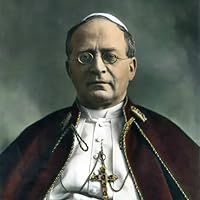
Through his prolific writing, Cardinal John Henry Newman guided Catholics to a deeper understanding and love of the Faith, and his writings continue to move and inspire us today. He combined his profound intellect with the loving heart of a pastor, using both to help Christians enter into a relationship with God, opening their hearts to the love and mercy of the Father's heart. Through this curated collection of essays, sermons, poems, hymns, and letters, you will not only be informed and inspired but will experience Saint John Henry Newman's pastoral care for the entire Body of Christ. "He has not created me for naught. I shall do good, I shall do His work; I shall be an angel of peace, a preacher of truth in my own place, while not intending it, if I do but keep His commandments and serve Him in my calling." - John Henry Newman
Saint John Henry Cardinal Newman was an important figure in the religious history of England in the 19th century. He was known nationally by the mid-1830s. Originally an evangelical Oxford University academic and priest in the Church of England, Newman then became drawn to the high-church tradition of Anglicanism. He became known as a leader of, and an able polemicist for, the Oxford Movement, an influential and controversial grouping of Anglicans who wished to return to the Church of England many Catholic beliefs and liturgical rituals from before the English Reformation. In this the movement had some success. However, in 1845 Newman, joined by some but not all of his followers, left the Church of England and his teaching post at Oxford University and was received into the Catholic Church. He was quickly ordained as a priest and continued as an influential religious leader, based in Birmingham. In 1879, he was created a cardinal by Pope Leo XIII in recognition of his services to the cause of the Catholic Church in England. He was instrumental in the founding of the Catholic University of Ireland, which evolved into University College Dublin, today the largest university in Ireland.
Newman was beatified by Pope Benedict XVI on 19 September 2010 during his visit to the United Kingdom. He was then canonised by Pope Francis on 13 October 2019.
Newman was also a literary figure of note: his major writings including the Tracts for the Times (1833–1841), his autobiography Apologia Pro Vita Sua (1865–66), the Grammar of Assent (1870), and the poem The Dream of Gerontius (1865),[6] which was set to music in 1900 by Edward Elgar. He wrote the popular hymns "Lead, Kindly Light" and "Praise to the Holiest in the Height" (taken from Gerontius).
Perhaps like most admirers of Newman I have spent most of my time admiring the great Saint from a distance. Although I have always viewed him as an intellectual hero and luminary I have often looked at his corpus as a daunting affair, with no truly accessible entry. It is therefore with great joy that I found this slim volume of profound and concise writings by Newman. The book is broken into five manageable sections, consisting of Essays, Sermons, Poems/Hymns, Meditations, and Letters. Almost all the major topics that Newman is famous for are addressing are present (the two lone exceptions that come to my mind are his views on the university, and the views expressed in “Grammar of Assent,” however, I should state that someone better versed in Newman than myself may find these threads in some of these pieces). Staple topics include conscience, development of doctrine, religious liberalism, Christianity and the intellect, the relation between science and religion, and the sufferings of our Lord. For many modern readers the book might be a hard sell since, although he was a distinguished and writer in his time, Newman’s prose may be viewed as too wordy and overstretched by modern standards. That being said: This collection of writings is well worth the trek. I found myself exceedingly blessed and overcome by the truly profound, edifying, and intellectually gratifying thoughts of Newman. It is the perfect introductory text for meeting and getting to know St. John Henry Newman.