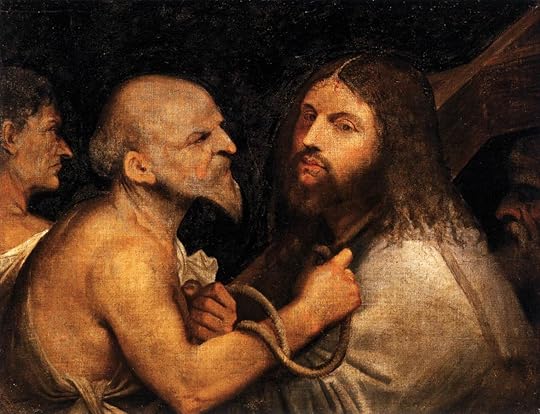
Written in the 16th century, Vasari’s work vividly captures the progression of art through one of the most innovative and creative periods in history
notes:
- the Renaissance was a time of bold experimentation and innovation, driven by individuals who challenged conventions to create timeless masterpieces
- The transformation of European art began with Cimabue, a Florentine painter who challenged the rigid conventions of Byzantine traditions. At a time when art relied on flat, symbolic imagery, Cimabue introduced shading, form, and a sense of movement, giving his figures a lifelike quality that was revolutionary for the era. His work marked a turning point in art history, laying the groundwork for the Renaissance’s focus on naturalism and human emotion.
- Giotto’s success was a direct result of Cimabue’s willingness to experiment and challenge artistic conventions, inspiring a ripple effect that would transform European art.
- Giotto, a student of Cimabue, transformed painting by moving beyond the stiff, symbolic forms of earlier art. His work brought humanity and emotional depth to religious scenes, making them relatable and compelling.
- One of Giotto’s most celebrated achievements is his fresco cycle in the Arena Chapel in Padua. These frescoes vividly depict scenes from the lives of Christ and the Virgin Mary, focusing on human drama and interaction.
- In his depiction of architectural settings, such as the temple in The Presentation of the Virgin, Giotto used overlapping forms and foreshortening to suggest depth and dimension.
on architecture:
- Arnolfo di Cambio was a visionary architect whose work marked a turning point in the evolution of Renaissance architecture. Moving away from the fortress-like structures of the medieval period, he introduced designs that emphasized harmony, proportion, and grandeur. His creations not only showcased technical brilliance but also reflected the cultural aspirations of his time, elevating architecture as a symbol of civic pride and spiritual devotion.
- One of Arnolfo’s most significant contributions was his work on the Florence Cathedral, or Santa Maria del Fiore. He envisioned a structure that would dominate the city’s skyline while embodying ideals of beauty and functionality. The cathedral’s design combined Gothic elements, such as pointed arches and ribbed vaults, with a sense of openness and light that was uncommon in medieval architecture
- Arnolfo’s work not only shaped the physical landscape of Florence but also inspired future architects to push the boundaries of design. His ability to merge structural ingenuity with artistic vision laid the groundwork for a new era in architecture. By reimagining the role of buildings in public and spiritual life, Arnolfo established architecture as a central pillar of Renaissance culture.
- Through his innovative designs, Arnolfo di Cambio bridged the gap between the medieval and Renaissance worlds, demonstrating how architecture could embody both technical mastery and cultural ambition.
artistic expression:
- One of Donatello’s most iconic works is his bronze statue of David. Unlike the rigid, heroic depictions of biblical figures common in medieval art, Donatello’s David is a youthful, contemplative figure, standing in a relaxed contrapposto pose. The sculpture’s subtle details, such as the soft musculature and thoughtful expression, convey both vulnerability and triumph. This blend of naturalism and symbolism was revolutionary, as it celebrated the human aspect of the biblical hero while embodying Florence’s civic identity.
- Another hallmark of Donatello’s work was his ability to convey raw emotion. His wooden sculpture of Mary Magdalene departs from traditional depictions of saintly beauty, portraying the Magdalene as gaunt and weathered, reflecting her life of penance and spiritual devotion.
on perspective:
- Filippo Brunelleschi was a revolutionary figure whose innovations bridged the gap between science and art. His most transformative contribution was the invention of linear perspective, a groundbreaking technique that allowed artists to depict three-dimensional space on a flat surface with mathematical accuracy. This innovation not only changed the way art was created but also influenced architecture, making perspective a cornerstone of Renaissance aesthetics.
- Brunelleschi’s experiments with perspective began with his studies of ancient Roman architecture and his observations of how space could be represented accurately. He famously demonstrated linear perspective with a painting of the Florence Baptistery, using a vanishing point and orthogonal lines to show how objects appear smaller as they recede into the distance. This method gave artists a powerful tool to create realistic and immersive compositions, fundamentally altering the visual language of art.
- Brunelleschi’s design for the dome of Florence Cathedral, Santa Maria del Fiore, is a testament to his mastery of both engineering and artistic vision. The dome, constructed without traditional wooden scaffolding, used a double-shell structure and ingenious support techniques to achieve its monumental scale. Brunelleschi’s understanding of geometry and perspective ensured the dome’s structural integrity while creating a harmonious and visually striking addition to the city’s skyline.
on polymaths:
- Leonardo da Vinci is often regarded as the quintessential Renaissance figure, seamlessly merging art and science to create works of unparalleled depth and innovation. His relentless curiosity and interdisciplinary approach allowed him to explore anatomy, engineering, and natural sciences, all of which informed and elevated his art. This fusion of creativity and intellect set Leonardo apart as a true polymath and a defining figure of his time.
- One of Leonardo’s most iconic works, the Mona Lisa, exemplifies his ability to unite art and science. The painting’s lifelike quality stems from Leonardo’s meticulous study of human anatomy and his innovative use of sfumato, a technique that creates soft transitions between light and shadow. This approach gave the Mona Lisa her enigmatic expression and a sense of depth that was revolutionary for its time.
- His anatomical studies, based on dissections of human and animal bodies, resulted in detailed sketches that revealed the inner workings of muscles, bones, and organs. These drawings were not only scientifically accurate but also artistically rendered, showcasing Leonardo’s ability to combine precision with aesthetic beauty. This dual focus on art and science deepened his understanding of the human form, enriching his artistic creations.
- His sketches of flying machines, hydraulic systems, and war devices demonstrate his visionary thinking and his belief in the interconnectedness of all knowledge. This interdisciplinary approach was revolutionary, breaking down barriers between fields and showing how art and science could complement and enhance one another.
on mastery:
- Michelangelo Buonarroti is celebrated as one of the greatest artists of the Renaissance, renowned for his ability to convey human emotion, physicality, and spirituality with unparalleled skill. His works in sculpture, painting, and architecture redefined artistic perfection, leaving a legacy that continues to inspire.
- One of Michelangelo’s most iconic works is the statue of David. Carved from a single block of marble, the sculpture captures the tension and vitality of the human body in exquisite detail. David’s poised stance, defined musculature, and intense gaze demonstrate Michelangelo’s deep understanding of anatomy and his ability to imbue his figures with life and purpose. This masterpiece became a symbol of Florence’s civic pride and resilience, embodying the ideals of strength, beauty, and human potential.
- Michelangelo’s work on the Sistine Chapel ceiling further showcased his genius, particularly his ability to merge narrative with stunning visual impact. The frescoes, which depict scenes from the Book of Genesis, are a monumental achievement in composition and execution. Figures like Adam in The Creation of Adam are rendered with dynamic energy, conveying both physical strength and spiritual significance.
- His architectural designs embodied the Renaissance ideals of proportion, symmetry, and beauty, elevating architecture to new heights.
- Michelangelo’s relentless pursuit of perfection and his ability to evoke profound emotion through his art redefined what was possible in the creative world.
on competition:
- One of the most notable rivalries was between Filippo Brunelleschi and Lorenzo Ghiberti, who competed for the commission to design the bronze doors of the Florence Baptistery. Ghiberti ultimately won, but this rivalry spurred Brunelleschi to focus on his architectural pursuits, leading to his revolutionary work on the dome of Florence Cathedral. This competition exemplified the Renaissance spirit, where the drive to outdo one another resulted in some of the most iconic works of the period.
- the construction of Florence Cathedral brought together architects, engineers, and craftsmen, each contributing their expertise to realise Brunelleschi’s ambitious vision
- Michelangelo’s dramatic and muscular figures in the Sistine Chapel contrasted with Raphael’s harmonious and balanced frescoes in the Vatican. While their approaches differed, each artist drew inspiration from the other’s work, pushing their craft to greater heights
- During the Renaissance, a lively debate emerged over whether painting or sculpture was the superior art form. This discussion extended beyond technical comparisons, delving into profound questions about art’s purpose—should it prioritise realism, emotional expression, or durability? Both mediums had passionate defenders, and their arguments reflected the evolving role of art in society.
- Sculptors championed their medium for its permanence and realism. Painters, on the other hand, emphasised their medium’s versatility and emotional depth.
- Ultimately, this debate underscored the Renaissance’s broader fascination with the nature of artistic creation