The Hawaiian Islands are known worldwide for gourmet coffee from the Kona Coast, but real aficionados know that in Hawaii, Kona coffee is only the beginning. The only place in the United States growing coffee as a commercial crop, the Aloha State hosts a thriving industry encompassing 11 major regions on five islands producing more than seven million pounds of coffee last year valued at over $30 million. The Hawaii Coffee A Gourmet's Guide from Kona to Kauai is the first-ever comprehensive overview of the Islands most recognizable and highly coveted product.
The Hawaii Coffee Book includes a region-by-region guide and flavor profiles of the major varieties cultivated in the Islands, listings of farms offering tours, cafes that roast on-site, and detailed information on where Hawaii-grown coffees can be purchased in person or online. In addition, the book includes more than a dozen recipes for cooking with coffee, complete with mouthwatering photography. Ranging from entrees of lamb and ahi to desserts that go beyond brulees and brownies, many of the recipes are past winners of the annual Kona Coffee Festival Cooking Contest.
In addition, this comprehensive coffee book dispenses tips on coffee appreciation and provides a thorough education on coffee essentials. Common questions such as, Is it really a good idea to refrigerate my coffee? and, How do I brew the perfect pot of coffee? are answered in an easy-to-digest sidebar format. A resource for everyone, even coffee fanatics who might think they know it all about their favorite beverage, The Hawaii Coffee Book addresses all aspects of the coffee industry and culture, from ethical farming to roasting techniques and coffee tasting to events and festivals.
Shawn Steiman, Ph.D, is a coffee scientist, Q-grader, and consultant based in Honolulu, Hawai‘i. He is a graduate of Oberlin College and the University of Hawaii at Manoa.
His coffee research has included coffee production, entomology, ecology, physiology, biochemistry, organoleptic quality, and brewing. He owns Coffea Consulting, a coffee-centric consulting firm, and Daylight Mind Coffee Company, a multi-faceted business that includes a coffee roastery, a coffee house and a coffee school. Steiman regularly presents seminars, workshops, and tastings for both public and private events. In addition to 3 books, he has authored numerous articles in scientific journals, trade magazines, newsletters, and newspapers.
Fantastic summary book about Coffee farming and business in General, with exactly the right amount of Hawai'i for me to enjoy it here while on the islands. A very useful, tight and short book. Just the right sample of recipes and brewing instructions.
Above all, this collaboration among well connected diverse experts exhibits tremendous polish and coordinated professionalism.
Best to read this industry as the descendant of first sugar and the canned pineapples, both for similarities in capital and ownership, and to check our optimism in the present moment.
This book was a lot more fun that I expected my 3-4 with it to feel, and the vibrant pictures and useful references add hefty depth.
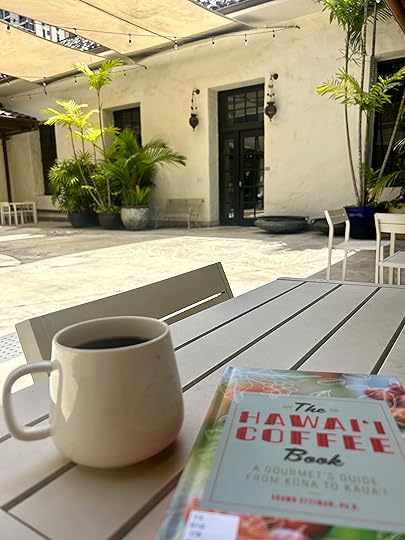
I don’t consider myself a coffee snob…at least, not yet. Moving to Hawaiʻi has given me the perfect opportunity to start getting serious about my morning brew. I weigh out out 20 grams of peaberry coffee beans from Kauai Coffee Company, grind them to a medium-coarse consistency, add them to my brewer and filter (warmed and pre-rinsed with not-quite boiling water), and pour 300 grams of approximately 200℉ water over the ground coffee. I set a timer, and two minutes later I have my coffee. Some mornings the coffee tastes better than others, but I’ve been getting more consistent lately as I take mental notes of any changes to the routine. I had been gathering bits and pieces of coffee knowledge from online coffee content creators, but it was nice to read a more comprehensive book, especially as it is pertinent to my current home. There is a lot of useful information in this book; some of it is specific to Hawaiʻi and some of it is just generally informative stuff about coffee. I appreciate that the tone of the book is not condescending or snobbish, despite the author having a PhD on the subject. I definitely learned a lot reading the book, though if you are already familiar with the intricacies of coffee, the non-Hawaiʻi information may not be revolutionary. I am now more informed about my daily coffee, but hopefully I won’t become a coffee snob. Feel free to call me out if I do. (Ignore the better-than-you-because-I’m-drinking-local-coffee-at-the-art-museum-while-reading-about-coffee picture 🙃☕️)
Saw this on the public library shelf and decided to read it. A college classmate gave an oral presentation on Kaʻū coffee being superior to Kona coffee. This was during the late 90's. Who knew he had the vision back then...besides himself?
I liked this quote from Chapter 6: section "Why is Hawaiian Coffee So Expensive" (page 110). "If one considers the social, economic and environmental justices that exist on a Hawai'i coffee farm, the price of the coffee isn't expensive at all. Rather, it makes the rest of (the) world's coffee uncomfortably cheap."
This book was really interesting and I liked learning more about the industry that I'm in. The only thing is that I would've put the chapter with the recipes at the end of the book instead of in the middle, just so they would be easier to find.