Jump to ratings and reviews
Rate this book

Eumeswil

Rate this book
Originally published in Germany in 1977, when Junger was eighty-two years old, Eumeswil is the great novel of Junger's creative maturity, a masterpiece by a central figure in modern German literature. Eumeswil is a utopian state ruled by the Condor, a general who has installed himself as a dictator and who dominates the capital from a guarded citadel atop a hill - the Casbah. A refined manipulator of power, the Condor despises the democrats who conspire against him. Venator, the narrator of the novel, is a historian whose discreet and efficient services as the Condor's night steward earn him full access to the forbidden zone, at the very heart of power. Every evening, while attending to the Condor and his guests at the Casbah's night bar, Venator keeps a secret journal in which he records the conversations he overhears, delineating the diverse personalities in the Condor's entourage while sketching out an analysis of the different aspects of the psychology of power. Venator's days are spent building a hidden refuge in the mountains, a hermetic retreat where he hopes one day to realize his dreams of utter self-sufficiency. In the meantime, however, he continues to pursue his career as a historian, using the magnificent tool that has been placed at his disposal - the "luminar", a holographic instrument that can summon up any figure or event in human history. Venator, in a word, embodies Junger's ideal of the "anarch" - a heroic figure whose radical skepticism and individualism are not to be confused with mere anarchism. Around the opposite figures of the dictator and the anarch, Junger weaves a hallucinatory and poetic rumination on the nature of history and on the mainsprings of political power. At once tale, essay and philosophical poem, Eumeswil offers a desolate and lucid assessment of totalitarianism by an author who witnessed its horrors firsthand.

384 pages, Hardcover

First published January 1, 1977

115 people are currently reading
2887 people want to read

About the author

Ernst Jünger

251 books904 followers
Ernst Jünger was a decorated German soldier and author who became famous for his World War I memoir Storm of Steel. The son of a successful businessman and chemist, Jünger rebelled against an affluent upbringing and sought adventure in the Wandervogel, before running away to briefly serve in the French Foreign Legion, an illegal act. Because he escaped prosecution in Germany due to his father's efforts, Junger was able to enlist on the outbreak of war. A fearless leader who admired bravery above all else, he enthusiastically participated in actions in which his units were sometimes virtually annihilated. During an ill-fated German offensive in 1918 Junger's WW1 career ended with the last and most serious of his many woundings, and he was awarded the Pour le Mérite, a rare decoration for one of his rank.

Junger served in World War II as captain in the German Army. Assigned to an administrative position in Paris, he socialized with prominent artists of the day such as Picasso and Jean Cocteau. His early time in France is described in his diary Gärten und Straßen (1942, Gardens and Streets). He was also in charge of executing younger German soldiers who had deserted. In his book Un Allemand à Paris , the writer Gerhard Heller states that he had been interested in learning how a person reacts to death under such circumstances and had a morbid fascination for the subject.

Jünger appears on the fringes of the Stauffenberg bomb plot to assassinate Adolf Hitler (July 20, 1944). He was clearly an inspiration to anti-Nazi conservatives in the German Army, and while in Paris he was close to the old, mostly Prussian, officers who carried out the assassination attempt against Hitler. He was only peripherally involved in the events however, and in the aftermath suffered only dismissal from the army in the summer of 1944, rather than execution.

In the aftermath of WW2 he was treated with some suspicion as a closet Nazi. By the latter stages of the Cold War his unorthodox writings about the impact of materialism in modern society were widely seen as conservative rather than radical nationalist, and his philosophical works came to be highly regarded in mainstream German circles. Junger ended his extremely long life as a honoured establishment figure, although critics continued to charge him with the glorification of war as a transcending experience.

Ratings & Reviews

What do you think?
Rate this book

Friends & Following

Create a free account to discover what your friends think of this book!

Community Reviews

5 stars
318 (49%)
4 stars
212 (32%)
3 stars
83 (12%)
2 stars
22 (3%)
1 star
13 (2%)
Displaying 1 - 30 of 73 reviews
Profile Image for Vit Babenco.
1,783 reviews5,784 followers
June 19, 2023
The hero of the story is a thinker and sage… He lives in the distant future in Eumeswil – the dwarf state which boasts simultaneously some features of utopia and dystopia.
They found no mischief in me. I remained normal, however deeply they probed. And also straight as an arrow. To be sure, normality seldom coincides with straightness. Normalcy is the human constitution; straightness is logical reasoning. With its help, I could answer satisfactorily. In contrast, the human element is at once so general and so intricately encoded that they fail to perceive it, like the air that they breathe. Thus they were unable to penetrate my fundamental structure, which is anarchic.

Although Eumeswil is a novel, the fiction in it is bordering on a meticulous and profound essay on the nature of power, state and history…
In the analysis of history, two main perspectives crystallise, one of which is directed at men, the other at might. This also corresponds to a rhythm in politics. Monarchies, oligarchies, dictatorships, tyranny as opposed to democracies, republics, the okhlos, anarchy. The captain as opposed to the crew; the great leader as opposed to the collective. For insiders, needless to say, these antitheses are necessary yet also illusory; they are motives serving to wind up the dock of history. Only seldom does a Great Noon shine, making the antitheses dissolve in happiness.

The narrator is an historian so for everything what happens in the present he finds analogies with what had already happened in the depths of human history…
As a historian, I am convinced of the imperfection – nay, the vanity – of any effort. I admit that the surfeit of a late era is involved here. The catalogue of possibilities seems exhausted. The great ideas have been eroded by repetition; you won’t catch any fish with that bait. In this regard, I behave no differently than anyone else in Eumeswil. People no longer demonstrate publicly for ideas; bread or wine would have to cost a lot more, or there would have to be a rumpus with the racers.
The only liberty that can be found in this world is the inner freedom.
Profile Image for Charles Haywood.
548 reviews1,136 followers
January 21, 2019
Ernst Jünger’s "Eumeswil," one of the famous German’s last works, published when he was eighty-two years old, is often regarded as an exposition of libertarian thought. This is understandable, but completely wrong. Such a reading attempts to shoehorn concepts in which Jünger had little interest, or toward which he was actively hostile, into an exploration of unrelated themes. Moreover, it ignores that in this book, though somewhat masked, Jünger has more contempt for so-called liberal democracy than dislike for what some call tyranny. Thus, this book is not a call to rework society, or individual thought, along libertarian lines. It is instead a call for human excellence, and a criticism of the modern West for failure to achieve it, or to even try.

One cannot really understand "Eumeswil" without reading, preferably first reading, Jünger’s earlier "The Forest Passage," which was published in 1951, twenty-six years before "Eumeswil." On the surface, they are very different—this book is cast as dystopian science fiction, and "The Forest Passage" is a work of philosophical exposition. But Jünger himself explicitly ties the two books together, linking the earlier book’s concept of the “forest rebel” with this book’s concept of the “anarch.” In both books, the author’s focus on freedom, specific to each individual, is easily misinterpreted, because what freedom means to most people today is not what Jünger means by the term. Jünger means an internal, spiritual freedom, an elitist freedom, not the freedom of license and consequent ennui. This confusion drives all the misunderstandings of Eumeswil.

While they fit together, a key difference between the books is often, or always, overlooked. Both are analyses of how a man should live under tyranny. But the tyrannies to which the protagonist in each book reacts are completely different. Thus, while there are some differences between the forest rebel and the anarch, those differences are best explained not by developments in Jünger’s thought, but by the differences in the tyrannies examined in each book. That is to say, Jünger is looking at a general problem of stifled freedom from two radically different angles—in the earlier book, from the perspective of those trapped by Communism or other totalitarian ideologies; in the later book, from those trapped in a much different type of tyranny, one into which Jünger saw the West decaying, having nothing to do with Communism. It is the difference between 1951 and 1977, one which often escapes us now, but was very evident to a person of the time, and should be even more evident to us today, since the defects found in 1977 in bud form are now in full and poisonous flower, while the evils of 1951 have disappeared entirely.

Not much actually happens, plot-wise, in "Eumeswil." Most of the book consists of the private musings of the protagonist, Martin Venator. He lives in the city-state of Eumeswil, somewhere in today’s Morocco, after an unspecified global apocalypse some time before. (The name comes from Eumenes, the most clever of the Diadochi, the “successors” of Alexander, who fought over and divided his empire. The theme of such decline is everywhere in this book, starting with the city name itself.) Eumeswil is ruled by a man referred to only as the Condor, a soldier who overthrew the “tribunes,” the leading men of a broad oligarchic and quasi-democratic order, the “republic,” whose adherents viewed, and still view, themselves as beneficent and liberal, in contrast to the Condor, whom they naturally loathe.

Venator, a young man, has two jobs. By day he is a historian, or rather some type of graduate student; by night he tends bar in the Condor’s palace, at the Condor’s private bar. This permits him to observe the Condor and his aides, as they interact and discuss both high and low events. In Venator’s dispassionate telling, the Condor and his men are far from fiends; they are competent and genial men, highly intelligent and rational, concerned mostly with possible rebellions in the city, maintaining order, keeping the people happy, and not getting on the wrong side of people more powerful than they. Of those latter, there are really two—the Yellow Khan, apparently either a very powerful neighbor or some sort of overlord, who sometimes comes for state visits that are a combination of pleasure and peril for the Condor and his men; and the vague “catacombs,” subterranean realms of some kind from which come advanced technology, still being developed by unspecified people, not unearthed from dead ones. To accompany these external forces, to the south, across the desert, lies the “Forest,” a mutated, wild land, where (spoiler alert) at the end of the book the Condor leads an expedition, joined by Venator, and none of them are ever heard from again.

Under both the tribunes and the Condor, Eumeswil is a place that is waiting, passing the time, forever, so far as can be seen. There are no grand plans or any real hope for the future. Here, at the end of all things, not much happens. Perhaps it will come around again, though there is no sign of it. (As M. John Harrison says of “defeated, resigned landscapes” in "The Pastel City," “Or was it just waiting to be born? Who can tell at which end of Time these places have their existence?”) Those in Eumeswil birth few children; two maximum, not by law but because people can’t be bothered and see no reason to have more children. Abortion is illegal but ignored in practice, along with other vices, such as pederasty and drug use. From a libertarian perspective, pretty much everyone is free to do as he wants, as long as he does not overtly upset the public order (and does not challenge the ruler, on whom more later). History is mostly ignored; the entire society smacks of what is today called postmodernism. In other words, Eumeswil is a stand-in for the modern West, and its people, regardless of their formal type of government, are not analogous to those under Communism in The Forest Passage, but to Jünger’s West German compatriots of the 1970s.

Martin’s father and brother do not approve either of his job with the Condor or of his disinterest in politics. They were prominent partisans of the tribunes, although they were not punished upon their overthrow. (It is not even very risky to oppose the Condor, who executes nobody except a handful of criminals, and governs with a very light touch, though he does exile the most problematic dissidents to offshore islands.) They talk politics incessantly, making family dinners unpleasant, while they hedge their bets, preen themselves, and do nothing, just like all their class. Venator has little sympathy with them (exacerbated by, as he repeatedly notes, his father unsuccessfully having tried to get his mother to kill him in the womb), but fulfils his filial and family obligations. Venator’s repeated references to his father’s attempts to kill him do not seem incidental; what Jünger appears to be saying is that men like Venator’s father, supposedly devoted to freedom, are in fact mediocrities with no future, happy to serve their own interests (“his rights,” as Venator bitterly calls his father’s attempt to kill him) when push comes to shove, and afraid to take responsibility or take action. They are, thus, the opposite of the forest rebel.

Venator respects the Condor; he has nothing but a distant contempt for the tribunes, even though they seemed to offer more political freedom. They “had stylized the word ‘human’ into a sublime concept.” But their lofty ideals “all cost money, which, however, they collected from concrete and not ideal human beings.” The tribunes, moreover, were addicted to regulation, such as forbidding private collection of salt so as to maintain their tax revenue, “patrolling by customers inspectors, who ambushed the poor.” They even required the salt sold in government stores to have “mixed in additives that their chemists praised as useful, even though they were injurious. The fact that men with such minds consider themselves thinkers is forgivable; but they also claim to be benefactors.” Worst of all, the tribunes offered, if not utopias, abstract visions. “ ‘There is no progress,’ I often hear my [father] say; he seems to regard this is a misfortune. He also says, ‘Standing still means going backward.’ ” The little people, in contrast, are satisfied if everyday life remains constant; they prefer to see their chimneys smoking, not their houses.” The type of progress that Venator’s father looks for, in other words, is not progress at all, but false forward movement paid for by others.

Much of the book is taken up with disjointed thoughts, ranging from discussions of how the Condor’s palace, or citadel, the Casbah, is situated a few miles outside the city (complete with references to Machiavelli on such placements), to talk of Venator’s girlfriend, to lengthy expositions of the thought of Venator’s various teachers. To make sense of "Eumeswil," you have to pay close attention, pick out, and weave together what Venator says. The only steady and obvious thread is that he clearly and repeatedly identifies himself as an “anarch”; we can presume, I think, that Venator is here a stand-in for Jünger himself. “Such is the role of the anarch, who remains free of all commitments yet can turn in any direction.” The anarch is emphatically not an anarchist. The anarchist is focused on overthrowing the existing order, which inevitably leads to its replacement by something not to the anarchist’s taste. The anarch’s goal is, on the contrary, to remain aloof from all political systems. He obeys the law of the state, just as he obeys, automatically, the laws of nature. His internal freedom is what matters.

This concept, of internal freedom, is as far as most mention of Eumeswil ever gets. Venator says, “I am an anarch in space, a metahistorian in time. Hence I am committed to neither the political present nor tradition; I am blank and also open and potent in any direction.” He does not oppose the rules of the society in which he lives. “One must know the rules, whether one is moving in a tyranny, a demos, or a bordello. This holds, above all, for the anarch—it is the second commandment, next to the first: ‘Know thyself.’ ” Usually, this conception gets a nod as a type of pure, Zen-like freedom: the sovereign individual, keeping himself internally liberated, but not choosing to fight for formal freedom in the temporal realm. In other words, as with "The Forest Passage," a common present-day interpretation of Jünger’s politics is as libertarian—the freedom to do as one chooses, which is what we would have if everyone could take the actions that germinate in an anarch’s head. This is completely wrong. Jünger is instead pushing an elite freedom, the freedom to avoid the mediocrity and oppression of the collective, not the freedom to do as one pleases. The anarch can move in any direction, true, but to what end?

It is the petty and controlling, fake benefactory and semi-utopian, nature of the tribunes to which Venator objects, rather than to their laws as such. The key is that he rejects the tearing down of authority. “Although an anarch, I am not anti-authoritarian. Quite the opposite: I need authority, although I do not believe in it.” Those would who have unbridled freedom are parasitical and destructive. “Why do people who leave nothing unchallenged still make demands of their own? They live off the fact that gods, fathers, and poets used to exist. . . . In the animal kingdom, there are parasites that clandestinely hollow out a caterpillar. Eventually, a mere wasp emerges instead of a butterfly. And that is what those people do with their heritage, and with language in particular.” That’s what Jünger really thinks of libertarians, and it’s not pretty. And for the same reasons, Jünger pretty obviously had no use for what liberal democracy has become, with its closely related destructive rush to atomized freedom and total emancipation.

Most of all, Venator objects to the tribunes’ utopian schemes. Remember, in my reading, the tribunes, and Eumeswil itself, are stand-ins for the modern society of the West, which by the 1970s was offering so-called liberal democracy as a utopian panacea, with an insufferable smugness that reached its high point only a few years later in Francis’s Fukuyama’s “end of history.” Jünger, a man who lived through all the horrors the twentieth century had to offer, had no interest in offering utopias, whether political or philosophical, and had seen first-hand who pays the price for dreams of false progress. At an early age, Venator, and doubtless his alter-ego, Jünger, “formed [his] conviction of the imperfect and peaceless nature of the world.” Given that conviction, all utopias are a mistake, because they are impossible, and only result in misery. Along these same lines, Venator endorses the core idea of Carl Schmitt that pinning rationales for war on utopian visions of an abstract humanity, rather than a recognition of who the enemy is by nature, results in far worse killing. “If humanity is written on the standard, then this means not only the exclusion of the enemy from society, but the deprivation of all his human rights.” The implication is that for all the supposed freedom under the tribunes, which Venator’s father and brother claim to miss so much, it did not mean anything at all that mattered, and cost more than it brought.

On the other hand, Venator seems to have little objection to the Condor. Yes, Venator regularly, though dispassionately, refers to the Condor as a tyrant. But is he really? If he is, he has nothing to do with modern totalitarianisms. More than once Venator ties him to Periander, the Tyrant of Corinth who died in 585 B.C. Periander was one of the Seven Sages, men of wisdom and power, who also included Thales of Miletus (to whom, among others, the Delphic maxim “Know thyself” is attributed), and Solon of Athens. Eumeswil is not even a police state. In fact, it allows all sorts of ordered freedoms, and many disordered freedoms, within the constraints of not too directly challenging the ruler. A modest amount of vice is allowed and it appears that there is a sizable amount of low-level corruption greasing the skids of day-to-day life. What shows most of all that he’s not a real tyrant is that Condor can and does openly move around, “discreetly accompanied,” on the public streets and the waterfront, talking to and joking with the people, with whom he is popular. If he is a tyrant, he is a tyrant in the mold of Augustus.

The Condor is explicitly not a despot, by which Jünger means capricious or interested in degrading people to show his power. As far as is evident, Eumeswil has the rule of law. A moderately free press exists. The justice system works. “Tyranny [i.e., the Condor] must value a sound administration of justice in private matters. This, in turn, increases its political authority.” The Condor does not offer any ideology and is pleased to encourage education and what culture there is, as well as try to improve himself. “The Condor sticks to Machiavelli’s doctrine that a good military and good laws are the fundaments of the state.” Really, the Condor is not dissimilar to Machiavelli’s “new princedom,” like that of, say, Francesco Sforza (who took over Milan in the fifteenth century). (I suspect that a close reading of "The Prince" with Eumeswil would show quite a few interesting overlaps.) The Condor is fiscally prudent, ensuring a hard money economy and restraining state spending, all of which benefits the common people (and is in contrast to the tribunes, who talked of the common people but despised and harmed them). Jünger may not regard the Condor as ideal, but he regards him as having a form of excellence, of aristocracy, and he thinks little of the mass of the population of Eumeswil, and especially the political class of Venator’s father and brother, where language is degraded, history is ignored, and nobody is very interested in excellence, or, for that matter, true freedom—all just like today’s liberal democracies, but not like Augustan-style “tyrannies.”

Jünger makes it explicit that the anarch is the same as the forest rebel—or at least one conception of the forest rebel. In "Eumeswil," however, Jünger seems less enamored of actual action by the forest rebel in "The Forest Passage." He denigrates partisan bands and other commitments to political change (such as anarchism), as “stuffy air, unclear ideas, lethal energy, which ultimately put abdicated monarchs and retired generals back in the saddle—and then they show their gratitude by liquidating those selfsame partisans.” Joining the partisans makes on dependent on them; the anarch’s goal is to avoid dependence, even while he serves someone, whether the Condor or someone else. “The difference is that the forest [rebel] has been expelled from society, while the anarch has expelled society from himself.” Really, though, that’s a distinction without a difference, because the result is the same. Perhaps, I think, what Jünger is saying is that under a totalitarian tyranny, that of the forest rebel, action may make more sense (something covered in "The Forest Passage" in some detail), but under the modern tyranny of liberal democracy, action is futile, because it is not the government that is the problem, but the society. If you extend Jünger’s line of thought, the Condor points toward a possible solution to the flaws of liberal democracy, not something against which rebellion is either necessary or desirable.

[Review completes as first comment.]
Profile Image for A. Raca.
768 reviews172 followers
June 30, 2021
"Gece karanlık, gündüz aydınlık. Bruno'ya göre gündüzün aydınlığı sadece yönünü değiştirmiş, zayıflamış, süzülmüş karanlıktır."
Profile Image for Philippe.
748 reviews724 followers
October 25, 2019
“Not to remain stuck to one’s own detachment, to that voluptuous remoteness and strangeness of the bird who flies ever higher to see ever more below him - the danger of the flier. Not to remain stuck to our own virtues and become as a whole the victim of some detail in us. One must know how to conserve oneself: the hardest test of independence.” — F. Nietzsche, Beyond Good and Evil, 41.

“I am an anarch in space, a metahistorian in time. Hence I am committed to neither the political present nor tradition; I am blank and also open and potent in any direction.” — E. Jünger, Eumeswil.

“Gymnastics does not require that one get naked to exercise freely. Quite to the contrary, it freely exercises in order to rediscover nakedness. (…) It has become the naked body of nobody. I think naked and I am nobody. I dance naked. I am nothing.” — Michel Serres, Genesis.


Eumeswil is the late Jünger’s literary testament. He didn’t write any major works after the publication of this tome in 1977. It’s labeled a ‘novel’ but it reads as a meandering essay, or rather, as a typically Jüngerian capriccio that blends essayistic, diary-like and narrative elements. Substantively Eumeswil offers an extended character study. The sole focus of the work is the figure of the Anarch, and how it constrasts with the anarchist.

The Anarch is a multivalent archetype, but it is essentially rooted in the way it relates to political power. The Anarch embodies a very particular mode of resistance, quite unreadable to anarchists who are wedded to more activist strategies in pursuing their political goals. The Anarch is provocatively aloof, inoffensive, non-interventionist. Inwardly, he does not commit to any party or any social project. Society may involve him in a conflict and obligingly he will march in rank and file. But inwardly he will not participate. “The archaic figure of the mercenary is more consistent with the anarch than is the conscript, who reports for his physical examination and is told to cough when the doctor grabs his scrotum.” The sole and only project of the Anarch is the embodiment of an aristocratic, existentialist conception of freedom.

The fictional background against which this portrait is drawn, is the autocratic regime of the Condor in the city-state of Eumeswil. The story’s protagonist serves there in the very centre of power, as a scholar-historian by day and as a bar tender in the ruler’s dining quarters by night. This makes him complicit with authoritarian rule in the eyes of those who resist the Condor and are conspiring to bring about a return of the Tribunes. For the anarch these historical movements are merely foam on the waves. Whatever the label, autocracy is the inevitable template for human governance - “even the tribunes need their general” - and society tends to generalised mediocrity by consuming freedom for so-called ‘equality’. Opposition merely serves to reinforce the old templates: “Opposition is collaboration.”

Jünger’s Anarch feels much like Nietzsche’s ‘Free Spirit’. The ‘Freigeist’ distinguishes himself from the ‘Freidenker’. The weak version of the latter - mockingly labeled by Nietzsche as ’all these goodly advocates of modern ideas’ - are not satisfied by any regime. Their resistance is merely a pose. The strong version of the ‘freethinker’ mirrors the anarchist’s ethos in radically challenging the powers-that-be, even if that means imprisonment or death. The Anarch, however, is detached even from his own feeling of detachment. He suspends his achievements and demands. He is the ’neutral observer’ par excellence.

Becoming an Anarch requires intellectual and spiritual self-discipline: “There are, en passant, three dialectical stages: first the personal and material task, then its transcendence through exercises, and finally the liberation leading to universal - which, for me, are historical - perceptions.” The protagonist is a historian, or more precisely a meta-historian, who, via a prototypical internet browser (the ‘luminar’) has access to a vast database of historical data. From his vantage point he looks at the waves and eddies of history with a dispassionate eye, identifying systemic patterns without moral judgment. “As an anarch, I owe it to myself to get to the very heart of things. I then probe them in terms of their contradictions, like image and mirror image. Either is imperfect - by seeking to unite them, which I practice every morning, I manage to catch a corner of reality.”

However, the Anarch’s freedom is not rooted in any transcendental datum. There is nothing metaphysical about it. The basis of his self-confidence is his awareness of being able to kill, both himself and other people. He is free to kill himself, if he finds himself inadequate. And this is what happens in the book, obliquely, when the protagonist eventually vanishes in the forest. The killing of others is a totally conscious and originary act. The anarch’s stance of unconditional freedom creates the gap in which respect and self-respect balance out. Hence, he kills only where and when he likes; it matters little whether he ever actually does. He also grants the possibility to everyone else. Killing is one of the fundamental acts. “It reaches deep in the organic, nay, inorganic world. Every moment is deadly for every other.”

Jünger’s Eumeswil offers a stimulating intellectual adventure. It is certainly challenging for a reader steeped in the political climate of liberalism and social democracy. Because it is precisely that which is trampled underfoot by Jünger’s individualist and elitist worldview. I am willing to be challenged by these ideas. There is no doubt that the hubris of western-style democracies is misplaced. We don’t have answers to all the pressing questions, practical, moral and spiritual.

Note: I perused several editions for this reading. The English version has the advantage of being available for e-reader. Joachim Neugroschel's translation is excellent. The German printed version (included in the Sämtliche Werke) provides unfiltered access to Jünger's scintillating prose. The Dutch translation (by Henry van Sanderburg, Uitgeverij Aspekt, 2016) is rather wooden and tiresome.

description
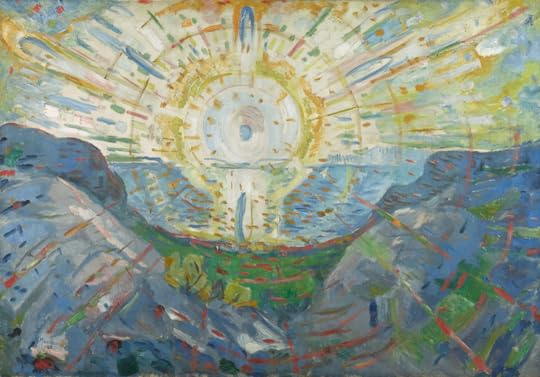
The Sun, Edvard Munch, 1912

“Man should not be the sun’s friend, but the sun itself.” — E. Jünger, Eumeswil.
2 reviews6 followers
August 7, 2015
If Ernst Jünger is my most valued author, Eumeswil is certainly his most important work for me. It is the bible of all Jünger thought and can be read and re-read for literally decades. As one matures, one gets more from this dense compendium of philosophical, historical, mythical, mystical, even spiritual insights. I have been reading it for 15 years now and there is much for me left to learn in it.

In particular, it is essential for understanding the figure of the Anarch.
Profile Image for Andrew.
2,258 reviews931 followers
Read
October 2, 2023
So years after Junger wrote the works which he was more famous for, both in terms of his literary abilities and his dubious to say the least politics, he wrote Eumeswil. Here we have the perspective of the self-styled “anarch,” as he deals with a landscape both self-consciously exotic and strangely familiar, and as he rocks the Condor’s Casbah. I was perhaps less blown away than I was by The Glass Bees or Storm of Steel, but I enjoyed every step of this very self-consciously philosophical novel.
Profile Image for Bbrown.
910 reviews116 followers
Read
April 16, 2017
Eumeswil is the strangest book I’ve read in approximately 6.5 years.* The book largely, almost entirely, consists of the main character speaking about his philosophy and view of the world, but the world in question is a fictional city-state ruled by a tyrant named The Condor. It’s the first section of Dostoyevsky’s Notes from Underground, but written from the perspective of a bartender/historian in a made up totalitarian (post-apocalyptic, spacefaring) state, and it’s ten times longer than that Notes from Underground section.

The action of Eumeswil, what little there is, is subservient to ideas: the main character and narrator Venator is assigned to go to Eumeswil’s central bank, and the next ten pages are discussions of ideas and philosophy of currency and the exchange of currency for goods or services, including an extended analysis of the fictional Eumeswil’s dual currency system. A huge range of topics are mused upon in this book, but the central one is the distinguishing of Venator’s own philosophy of the anarch from that of the anarchist, and his analysis of his role as a historian. Likely even more so than discussing fictional aspects of Eumeswil, Venator expounds upon real-world figures and philosophers, from Brutus to Stirner. Thus, this book is more a work of patchwork philosophy than it is a story, a portrait of a fictional theorizer and secret academic being at the center of this book far more so than any plot (there is effectively no plot for 95% of Eumeswil).

It’s not at all clear how much Junger’s own philosophy matches that of the narrator, though Junger saw himself as an anarch, like the narrator, so at least a portion of it likely does. Much of it is quite out there, but there are lines in the book that struck me as insightful, and that I would have no trouble ascribing to Junger himself. But, despite having now read several of his books and being familiar with the outline of his life and career, I’ve no idea, and Junger never tips his hand within the four corners of the text.

Like many philosophical works, Eumeswil is denser than a work of fiction, I believe I started this work in January, and must have read ten other books while I slowly chipped away at this one. It’s made even slower going by the language of the book. I consider myself to have a solid vocabulary, but much of Eumeswil’s language was unfamiliar to me, every few pages a word appeared like persiflage, epigonic, truculent, embonpoint, phalansteries, adumbrate, and I had to head to the dictionary. Even though it’s less than 400 pages, be prepared to expend some significant effort in getting through Eumeswil, for more reasons than one.

In both On The Marble Cliffs and The Glass Bees Junger gives his strange and interesting take on a genre, completely different than anything I had read before, so I went into Eumeswil expecting strangeness. But I was unprepared for exactly how strange it ended up being, the memoire of a historian’s thoughts and analysis of his fictional setting with no story to speak of. It isn’t a work of fiction so much as it is a fictionalized work of philosophy, and the degree of fictionalization is up in the air for me due to my lack of knowledge concerning Junger’s philosophical beliefs. So, to use an old cliché, after finishing this book I’m left considering this work a mystery wrapped in an enigma, though someone more familiar with Junger might make more of it than I did. Given all this, I rate Eumeswil strange/5.

*6.5 years ago I read Cyclonopedia by Reza Negarestani, which is still the strangest book I’ve ever read because it’s a facsimile of the ramblings of an insane person (with a thin framing narrative). Every page in that book is incomprehensible gobbledygook. What makes me comfortable rating Cyclonopedia—poorly—in contrast to Eumeswil, is that it’s absolutely clear to me that Negarestani doesn’t actually believe a word of his book. How does one tell counterfeit deranged babble from genuine deranged babble? No idea, but you definitely can, and Negarestani was writing weird for the sake of weird with nothing of substance behind it.
440 reviews39 followers
Read
August 6, 2016
If everyone is moving, and in the same direction at that--whether right or left, whether up or down--the stationary person is in the way. He is taken as a reproach, and since people collide with him, they brand him as the offender. (30)

Fate challenges him; he responds. The dream, even in an erotic encounter, comes true. But casually, even here; every goal is a transition for him. The bow should snap rather than aiming the arrow at a finite target. (37)

Distinctions must be drawn here: love is anarchic, marriage is not. The warrior is anarchic, the soldier is not. Manslaughter is anarchic, murder is not. Christ is anarchic, Saint Paul is not. Since, of course, the anarchic is normal, it is also present in Saint Paul, and sometimes it erupts mightily from him. Those are not antitheses but degrees. The history of the world is moved by anarchy. In sum: the free human being is anarchic, the anarchist is not. (41)

A mere toy [Bruno's mechanical pencil]. It is probably meant to indicate the level of technology that has been attained there and to inspire if not fear then respect. And is technology the right word? Metatechnology would, no doubt, be more fitting. It applies not to the perfecting of means, but to their sudden transformation into a different quality. When a runner reaches his top speed, running turns into flying. A sample was supplied by that sparkling script; verbal communication no longer sufficed. (64)

At the same time, Vigo sees the striving for maximum size and the inevitably following decadence as an overall pulsation: "Even a jellyfish moves by unfolding and then closing its umbrella. Thus, in the course of history, the desire for largeness alternates with the desire for smallness. Boutefeu already knew--and we, too, have learned--that the world-state both culminates and disintegrates overnight. The leviathan's limits are not so much spatial as temporal." (85)

This is consistent with my principle that there can be no empty time, no minute without intellectual tension and alertness. If a man succeeds in playing life as a game, he will find honey in nettles and hemlock; he will even enjoy adversity and peril.
What causes the feeling of constantly being on vacation? Probably the fact that the mental person liberates the physical one and observes his game. Far from any hierarchy, he enjoys the harmony of rest and motion, of invulnerability and extreme sensitivity--at times even authorship. He writes his text on a blank page and vanquishes destiny; the world changes through writing. This is the marriage of dance and melody. (91)

This does not mean that I lead a literary existence like an epigone; I actually see the present more sharply; like someone looking up from the carpet on which he has said his prayer. The warp is supplied by the centuries, the woof by the day. This creates a distance for nearby things; people and facts gain a background. They become more bearable. (94)

The view that external things like rank, money, and honors bring happiness has frequently been criticized, but it is not necessarily incorrect. After all, these things belong, as Aquinas would have it, among the "accidents." Accidens is the unessential, which includes the body. If one manages to separate essence from flesh, if one manages, that is, to gain distance from oneself, then one climbs the first step toward spiritual power. Many exercises are geared to this--from the soldier's drill to the hermit's meditation.
However, once the self has been successfully distanced, the essential can be brought back to the accidental. This process, resembling a vaccination with one's own blood, is initially manifested as a reanimation of the body. The physiognomy takes on the kind of features seen in paintings by old masters. They added something of their own. They blended it into the pigments. This also applies to objects; they were meaningful, now they gain a sense. A new light shines on things, they glow. Anyone can manage this; I heard the following from a disciple of Bruno's: "The world seemed hollow to me because my head was hollow." But the head, too, can be filled. First we must forget what we have learned. (140)

Our social existence is exhausted in switching and being switched. Its ideal is the switch to conformity. (145)

Vulture comes from Latin vultur, which is probably cognate with vellere, "to pull, pluck," and also with vulnerable. The German word for vulture is Geier, which is related to Gier, "greed, avidity" (in its earlier form, gihr); the adjective gierig, "greedy, avid," refers to someone who will not give up his prey. Carrion goes back to Latin caro, flesh; the German equivalent, Aas, used to mean simply "food" and is cognate with the English eat; it meant the bait employed by the hunter. The Roman vultur hints at a swift turn, volta. Volturnus was a raging river in Campania, the Volturno. Language has not only frayed out, it has also moralized itself. (166)

Nevertheless, prayer comes from an innate drive. It is more important than food and drink, since it testifies to more than transient life. It takes us behind the bleak stage set with which knowledge disguises the universe. Water is seen differently in retorts than in the aqueducts leading to big cities, and differently again in the ocean--and as the water of life in prayer.
The padres set great store by addressing prayers to personal gods: "Genuine prayer exists only in religions in which there is a God as a person and a shape and endowed with a will."
That was stated by a famous Protestant. The anarch does not want to have anything to do with that conception. As for the One God: while he may be able to shape persons, he is not a person himself, and the he is already a patriarchal prejudice.
A neuter One is beyond our grasp, while man converses with the Many Gods on equal terms, whether as their inventor or as their discoverer. In any case, it is man who named the gods. This is not to be confused with a high-level soliloquy. Divinity must, without a doubt, be inside us and be recognized as being inside us; otherwise we would have no concept of gods.
"For a God reigns within us" (Holderlin). "ONE is the start of everything" (Philollaus). "A God is the greatest among gods and among men, not comparable to mortals in shape or thought" (Xenophanes). "A whirlwind of multiple shapes detaches itself from the Totality" (Democritus).
And, over and over again, Heraclitus. We should not make a fuss about the numinous; it lights on everyone--every man his his Sinai and also his Golgotha. (210-211)

A basic theme for the anarch is how man, left to his own devices, can defy superior forces--whether state, society, or the elements--by making use of their rules without submitting to them. (241)

My father hounded me when my life was frailest. This may be our most exquisite time. My mother concealed me from him in her womb, like Rhea hiding Zeus in the grotto of Ida to shield him from the clutches of a voracious Chronus. Those are monstrous images; they make me shudder--conversations between matter and time. They lie as erratic boulders, uninterpreted, beneath the surveyed land. (243)

I mention my indifference because it illuminates the gap between positions. The anarchist, as the born foe of authority, will be destroyed by it after damaging it more or less. The anarch, on the other hand, has appropriated authority; he is sovereign. He therefore behaves as a neutral power vis-a-vis state and society. He may like, dislike, or be indifferent to whatever occurs in them. That is what determines his conduct; he invests no emotional values. (249)

There are jurists and even theologians who advocate capital punishment as the last resort of justice. Others reject it as immoral. Both sides have good reasons. Both call upon statistics, which, as usual, can be exploited every which way. Numbers should be kept aloof.
This controversy passes the anarch by. For him, the linking of death and punishment is absurd. In this respect, he is closer to the wrongdoer than to the judge, for the high-ranking culprit who is condemned to death is not prepared to acknowledge his sentence as atonement; rather, he sees his guilt in his own inadequacy. Thus, he recognizes himself not as a moral but as a tragic person. (250-1)

Let me repeat that the discussion about the death penalty does not concern the anarch. Since he dictates his own law, the word "punishment" is one of the prejudices on which society lives. Here, everyone is set to punish everyone else.
Killing, by contrast, is one of the fundamental facts. It reaches deep into the organic, nay, inorganic world. Every moment is deadly for every other; it becomes its heir--Cronus survives by devouring his children. (258-9)

To return to Eumeswil: our islands are populated with malcontents whose communities soon turn out to be the same old societies with all their sense and nonsense. They regard the island as an interregnum, a stopover on the journey to a better world. So they prowl through the institutions, eternally dissatisfied, always disappointed. Connected with this is their love of cellars and rooftops, exile and prisons, and also banishment, on which they actually pride themselves. When the structure finally caves in, they are the first to be killed in the collapse. Why do they not know that the world remains unalterable in change? Because they never find their way down to its real depth, their own. That is the sole place of essence, safety. And so they do themselves in.
The anarch may likewise not be spared prison--as one fluke of existence among others. He will then find the fault iin himself. Did he sail too close to Scylla, too near Charybdis? Did he trust the song of the sirens? Odysseus did not stop up his ears, he let the crew stop up their own; but he had himself tied to the mast so he could enjoy the enchantment. He locked himself up. In this way, the prison becomes an island, a refuge of free will, a property. (279)

The anarch is no individualist either. He wishes to present himself neither as a Great Man nor as a Free Spirit. His own measure is enough for him; freedom is not his goal; it is his property. He does not come on as a foe or reformer: one can get along with him nicely in shacks or iin palaces. Life is too short and too beautiful to sacrifice it for ideas, although contamination is not always avoidable. But hats off to the martyrs. (280)

Fourier's basic idea is excellent: namely, that Creation failed in its very casting. His error is that he considers Creation reparable. Above all, the anarch must not think progressively. That is the anarchist's mistake; he thereby lets go of the reins. (312)

I stumble upon crimes that would make one strive against the reformers of systems, the gods, the inventors of hell, the trailblazers. Herodotus once said that the gods are keeping the final horrors for themselves; accordingly, man would have to be better than they and set a standard for them. Also, are certain animals, especially insects, that kill in a highly refined manner, but only if necesssary. The earth needs murder, its economy requires it; but if the earth knows the punishment, it rejects the revenge. (345)

[Attila:] "After that, I swore a lot of oaths, either to gain an advantage or to sidestep a disadvantage. Even the Hippocratic oath was more of a general guideline. Oaths are like virginity. . . . .
In this connection, I must remark that I was way past the time of esteeming resistance as a moral achievement. Those are liberal reminiscences, recipes for suicides who save the police some work. Here there is only one kind of behavior--that of the chamelion. This Greek word means 'earth lion.' I swore allegiance once, I 'resisted' once. Nation and king have no further claims on me." (367-8)

Vigo said: "Martin, I have neer doubted that you prefer the forest. Yet I also know that you regard it as a passage--not as a goal, like Attila, or as a fiction, like the Domo. But what are fictions? A dream comes true in each of our great transformations. You know this as a historian. We fail not because of our dreams but because we do not dream forcefully enough." (379-80)
Profile Image for R.
353 reviews
November 25, 2024
Extraordinary!

It had a lot of things that I liked, a lot that I hated, it's rich, is deep, is enlightening, it's frustrating at times. 5⭐️

I can't really say this is a novel, more of a manifesto, but definitely a must read. Tremendously powerful and political.
Profile Image for Roger Green.
327 reviews29 followers
July 5, 2017
I will give Jünger the benefit of the doubt because of the translation factor. Generally, however, my impression of his anarch protagonist is not an identity that inspires us to dream more forcefully. It is rather a picture of an impotent being who claims a kind of beyond good and evil posture while still being stuck in a pseudo oedipal drama and, strikingly, bourgeois sexual cowardice between his prostitute, Latifah, and his "respectable" lover / student, Ingrid. The narrative fluffs its own tired masculinity. It has some funny quips about the weaknesses of liberalism, though, and Jünger skillfully weaves the importance of myth into politics and history. I read the Telos Press edition, translated by Joachim Neugroschel, with an Introduction by Russell A. Berman. I don't mean to judge Jünger solely by Berman's praise for the novel's prescience with respect to the 21st century and the reading that Martin / Manuel inspires us with "the potential for every one of us to pursue different lives" (xxi), but I do disagree with Berman all the same. I think Jünger's idea of the forest passage is interesting but too entrenched in sentimental attachment to the gravitas of the kind of dad who is a war history buff. There is simply more to life and more to death and the beyond than this novel is capable of elucidating.
Profile Image for Mateusz.
Author 9 books49 followers
July 4, 2017
A most erudite, mature work of Ernst Junger, that surveys the historical landscapes of the omitted, and the elaborate, finery is mixed with succinctness. A great study of "ecce homo" that is deep for these with depth of insight, and intuitively flowing and wise for these that would like to be Neptunian and oneiric about the matter. With typically Jovial, precise, yet nobly drawn picture of an anarch, it is a book by a XXth century magi, and definitely worth reading! One can sense melancholic fire, yet astute vividness of renewal that a magician with scholarly background can write, and absorb to the innermost millieus of his nature! May thus, the "Jupiterian gaseuos fires not burn you" - to astronauts living, dead, and undying!
Profile Image for Jacques le fataliste et son maître.
372 reviews57 followers
November 14, 2010
Bello ma inquietante. Jünger è un “blade runner” dei simboli e un frequentatore delle profondità dell’animo umano: si spinge là dove si tracciano le distinzioni fondamentali – amico-nemico, uguale-diverso ecc. – e dove si radicano gli istinti, anche quelli più crudeli. Parla di cose che paiono sul punto di sfuggirgli di mano da un momento all’altro – ma questo non accade mai e se la cava sempre con eleganza.
Giocare col fuoco alla lunga stanca.
Lui è vissuto 103 anni (ma forse aveva attinto col graal dalla fonte dell’eterna giovinezza – se non l’aveva fatto lui…).
Profile Image for Kyle C.
668 reviews102 followers
January 28, 2025
This is a strange book: the diary of a historian serving as the night-time attendant to the city's tyrant in a dystopian future. Manuel Venator, as he is called, spends his day thinking about global history, supervising dissertations and giving public lectures, but at night, he stands by the side of the Condor, the ruler of Eumeswil. Mostly he listens unobtrusively to the Condor's conversations with other scholars and officials. Venator's brother and father (whom he derisively refers to as his "genitor", refusing to see his father in any affectionate way) are also historians but they are liberal-minded outcasts in this regime and have become somewhat estranged from Venator because of his willingness to work with the Condor, acquiescing, and cozying up, to an autocrat; Venator, however, sees all the professors and liberals as hypocrites who criticize their autocratic government but still expect their comfy salary, who oppose tyranny but still valorize power. The actual realities of Eumeswil are opaque: free speech is curtailed, political enemies are disposed of, public executions occur annually, exile is a frequent punishment, unwanted personality-types are weeded out through psychometric testing. It is a world of advanced technology: elite citizens carry a "phonophore" (a mobile phone, as we would now say); scholars have access to the "Luminar" (a form of artificial intelligence, an archival search-and-retrieve system, which can answer any academic inquiry by finding relevant historical dates, events, quotations and sources). But the book itself is more diary-cum-manifesto.

Venator doesn't seem to care all that much about the Condor and his tyranny. Venator is an anarch—not an anarchist, not a liberal, not a libertarian, not an individualist. Unlike the liberal, he is not committed to any political principles and he does not believe in progress or reform; unlike the libertarian, he does not believe that civic freedom is really attainable; unlike the individualist, he is not concerned with standing apart from, or in opposition to, society or the collective; unlike the anarchist, he does not oppose political and legislative authority. The anarch is, essentially, his own person who acts out of his own desires but understands the nature of his world and behaves accordingly: if he were born a fish, he would swim; if he were born a bird, he would fly; born in a tyranny, he submits—so Venator explains. The anarch, therefore, if he desires to, will obey the demands of tyrants or conform to the will of the collective but he will always maintain an interior independence. He does not wish to topple governments but to bypass them. If the anarch is to be compared to anything, it is the mercenary or the condottiere: his service is contractual but his inner mind is non-committal; he can join a political party but he is fundamentally non-partisan. While Jünger celebrates the anarch, most would find him even more despicable than the lawless anarchist. The anarch is something of an apathetic observer or bystander, a collaborationist and apologist for despotic rule if he so chooses. His views are unpredictable. Venator is skeptical of vaccination and an opponent of compulsory education. He is fundamentally an elitist.

The problem for Venator is not tyranny but a kind of "epigonic decline" and intellectual decadence. Words "have meaning but not sense"; there are no longer "living ideals"; the students are enthused by lectures but they do not think; "people no longer demonstrate publicly for ideas; bread or wine would have to cost a lot more". It reminds me of what Maternus says in Tacitus' Dialogus: in the age of a tyrant, when law and justice reside in the will of one man, rhetoric becomes impoverished—there is no longer a genuine contest of ideas or an attempt at persuasion; all speech becomes empty flattery intended to win the tyrant's favor. One might also think of Orwell's Nineteen Eighty-Four: in a totalitarian world, the powerful control language; words are stripped of their ordinary meaning; subversive ideas are censored out of speech. And so it is in Venator's world: nothing seems real, anything could be possible, pleasure has replaced spirituality, poetry is despised, vulgar language has been normalized (so Venator argues). Venator's freedom in this totalitarian regime is not to challenge authority or to educate the masses, but simply to write in his journal, which is its own act of intellectual resistance. If language is devolving, Venator's response is to preserve words and their nuances: the anarch is not the liberal is not the anarchist is not the solipsist; the tyrant is not the despot (who lawlessly abuses power and degrades his citizens) and the tyrant is not the demagogue (who appeals to the masses). He spends his days identifying historical examples of tyranny or investigating the difference between collectivism and populism. His singular freedom is to practice these philosophical distinctions, keeping alive historical inquiry in a period of intellectual censorship. Caesar non supra grammaticos (not even Caesar is above the grammarians), he says—however much the Condor may suppress liberty, he cannot stop the anarch from recognizing the meanings of words; he cannot contort logic.

But I actually chose to read this because I was more interested in what Jünger had to say about technology. The Luminar of Eumeswil is a kind of AI technology but very different from the language models like ChatGPT that we see today. In Jünger's novel, the Luminar answers queries with raw information: it produces something "anonymous and machine-processed". The historian asks the Luminar for a striking example in which the collective spirit is compelled to unanimity; the Luminar responds, "Paris, rue Saint-Honoré, 2:00 to 3:00AM, August 10, 1792, of the Christian era. Cosmic time follows." The computer is "sphynx-like". Whereas ChatGPT produces human-sounding output (and sometimes outright hallucinations), the Luminar is a fact-processor. The historian, in turn, must interpret and rhetoricize in personal terms the mysterious output. In this technological world, the historian is no longer an archival researcher but a metacritic; the computer provides the information but the historian must take the broader view and assemble the data and realia into a narrative (Venator's father refuses to use it because it lacks precision; Venator retorts that Petrarch too was imprecise and concocted speeches). Just as the anarch has to obey but be inwardly free of the tyrant, the historian has to use but be mentally above the Luminar.

Maybe there is an element of wisdom in this novel: that true freedom is a kind of stoic tranquillity, achieved not through idealistic opposition to tyranny but mental independence; that technology can be useful, so long as we maintain our own metacritical autonomy. But I still find Venator to be a thoroughly contemptible character and I don't find the anarch to be a desirable ideal. I much preferred Jünger's The Glass Bees which pinpointed the dangers of technology and plutocracy rather than offering a philosophical apology for docile resignation.
Profile Image for blue.
25 reviews
November 6, 2018
Jünger was a deep conservative and a post-modernist. He posited that there are different ways of knowing & seeing. "Objective" truth is merely a powerful illusion.
Profile Image for Arthur Meursault.
Author 2 books28 followers
January 19, 2021
In short: life-changing. The kind of book that has a profound influence over one's own experiences and philosophy. There's nothing else quite like it and it is a book that will have the reader debating over its meaning for years, or decades, after.
Profile Image for Ruslan Isfandiyarov.
1 review
May 29, 2015
Contemplation of cooling ruins.
Author (protagonist) loves history of necrophiliac love. His interest in History is interest of pathologist.
28 reviews3 followers
May 5, 2018
The fundamental question: anarchist or anarch?
6 reviews
July 28, 2021
Eumeswil is hard to pin down. Taken purely as a novel, actual narrative material or conversation between characters seems to fill a painfully small part of the whole text. Jünger is here to use protagonist Martin Venator, a remarkably conflicted but outwardly stoic man, as a sort of captive brain for the reader to wander through.

The main question of the book is how the individual can remain self-possessed and inwardly free despite the growth of interlocking technological and political totalitarianisms, such as Jünger experienced in his own long and chaotic life. A man who fought in the trenches of World War I and lived through the heights of the Cold War has seen exactly what earth-shattering political change can mean for the individual, and Jünger brings that experience to bear in Eumeswil . Venator is shown to be a historian by trade, a character trait that allows the novel's "found diary" format to launch into lengthy digressions on history from the Acropolis to the atomic bomb.

Venator moonlights as a night bartender for the dictator of the post-apocalyptic city-state of Eumeswil, a semi-benevolent tyrant known as the Condor. The Condor and his various henchmen, minions and flunkeys are a large part of the book, seen from Venator's point of view over the bar as they talk in hushed tones of the problems of governing a city-state whose previous democratic government they violently overthrew. As the novel progresses, these conversations are used as the basis to discuss what exactly it means to hold political power, the flaws of democracy as a project and a pencil-thin sketch of what Jünger refers to as the "anarch" philosophy.

The anarch is the core of the book, essentially a how-to for maintaining individuality and freedom to oneself no matter the accidents of birth, politics or technology. Venator is shown to have no particular loyalty or alignment to the Condor, despite his position on his staff, nor is he amenable to the various anarchist or pro-democratic factions in the city itself. Venator is interested in no cause that surrounds him, and speaks dispassionately on the ideas of either progress or reaction, attempting to maintain a disinterested and critical eye towards everything.

Essentially, this is an outgrowth of Jünger's earlier philosophical tract The Forest Passage in which he lays out a similar philosophy, but with a crucial difference; the "Forest Rebel" of that book is an essentially isolated individual who detaches themselves from a society they find unjust, while the Anarch is content to live and act within a society - they simply don't allow that society and its ideologies to live within them . Venator struggles with these topics, and as such so does the reader. Jünger does not do the reader any favours with his incredibly out-of-the-way allusions to ancient literature or biblical mysticism, but it does lead to a constant questioning and learning of our own as we follow the protagonist's thoughts.

While an interesting work of philosophy couched in a very strange little novel works most of the time for Eumeswil , it can wear thin. There is a lack of any real narrative development or character exploration besides brief sketches, plus the occasional asides (such as Venator staring at himself in the mirror every morning to try and determine his own individuality) which make it clear that being an anarch is not a particularly vibrant or joyful existence. It can be quite a grim and even nihilistic read, but Jünger does put forward strong and well-reasoned stances through the situations Venator finds himself in. Arguably, two books could have emerged here - either a philosophical sequel to The Forest Passage or a stand-alone novel about the apocalyptic city-state of Eumeswil. Instead, we received both in one, and it is up to the reader whether these two halves work together.
Profile Image for Berkay Kabalay.
4 reviews1 follower
June 20, 2021
Ernst Jünger ile Eumeswil'in ünü ve kitabın arka kapaktaki sunuşu (ve Ulus Baker referansı) oldukça ilgi çekiciydi ve kitaba başlamamın en önemli nedeniydi. Ancak maalesef benim için kitap tam bir hayal kırıklığıydı. Bu hayal kırıklığı kitabın akışından kesinlikle kaynaklanmıyor. Kitapta bir olay örgüsü söz konusu değil, daha ziyade kahramanın içinde bulunduğu dünyaya karşı bir manifestosu gibi kurgulanmış. Beni kitaptan uzaklaştıran olay örgüsünün olmaması değildi. Daha ziyade, "anark" öznesinin düşünce, tutum ve pratiklerini siyasi açıdan oldukça çiğ ve iki yüzlü bulmamdan kaynaklanıyor.

Kahraman Venator'un modern tiranlığa verdiği cevap her koşula ayak uydurmak ve de ormana çekilmek oluyor. Buradaki iki sorundan ilki, politik tiranlığa karşı kaçılabilecek mistik (bkz. Alman nazizmi ve aşırı milliyetçiliğinin orman miti) ve erişilmez bir dışarısının var sayılmasıdır. İkincisi ise, her baskıya ayak uydururken modern zamanların sinik (cynical) öznesinin tipik bir örneğini vermesidir (bkz. Peter Sloterdijk ve Slavoj Zizek). Bu iki sorun da, bir ideoloji olarak tiranlığın (ya da kitapla ilgisi olmasa da kapitalizmin) devamını sağlamak gibi bir işleve hizmet etmektedir. Anark, anarşistin aksine sanki iktidardan kaçıyormuş gibi sunulmasına rağmen; mitik bir kaçış hayali ya da sinik boyun eğme aracılığıyla iktidarın yeniden üretiminin bel kemiğini oluşturmaktadır. Üstelik hem iktidara boyun eğmenin hem de bu konudaki bütün sorumluluğunu reddetmenin hazzını da çıkarmaktadır.

Sonuç olarak "anark"ın sinikliği ve modern sinikliğin günümüzdeki yaygınlığının bendeki "travması" kitaptan uzaklaşmama neden oldu.
Profile Image for Artur.
254 reviews5 followers
Read
December 17, 2023
Zadziwiająca, kuriozalna i nieznośna książka. Bohater to ultimate sigma male.

Powiem tak - nie rozumiem odniesień do rzeczywistości niemieckiej lat 70. (o czym informuje posłowie), a większość bogatych odniesień do literatury (historiograficznej, historycznej, ideologicznej) całkowicie mi umyka. Więc ocenię tę książkę tak jak ją odebrałem:

główny bohater jest dupkiem. Egotystycznym, egoistycznym, egocentrycznym, narcystycznym, namolnym, zakochanym w sobie bubkiem. Na dodatek, na współczesne czasy, byłby kiepskim historykiem (z dużą wiedzą). Oczywiście w tym jest sens książki, co nie zmienia faktu, że przebywanie z Manuelo/Martinem jest męczące. Heglowsko-stirnerowska filozofia jest ciekawa, ale też dość niebezpieczna. Mam nadzieję, że książki tej nie odkryje alt-right (swoją drogą Junger chyba był trochę takim reakcjonistycznym alt-rightowcem swoich czasów?).

Oczywiście należy docenić końcowe unieważnienie, jako jakiś dowód autoironii, ale jestem zbyt zmęczony, żeby próbować odkopywać prawdziwe intencje autora.

Co jest fantastyczne w tej książce, to element science-fiction, zupełnie wyjątkowej postapokalipsy. To jest prawdziwe science-fiction, takie jakby chciał widzieć Darko Suvin. Technologia nie jest ozdobą, tylko elementem narracyjnego wyobcowywania rzeczywistości, oglądanej z perspektywy przyszłego upadku cywilizacji. Jest to też wizja wyjątkowa. Ja tylko żałuję, że nie była bardziej wyeksponowana, bo ciekawiła mnie bardziej niż setne masturbacje nad definicją anarchy
Profile Image for Aslihan Yayla.
530 reviews65 followers
July 7, 2022
Kimisine kale kimisine ülke gibidir Eumeswil. Fakat bize "taşın altına bak" diyen yazar metafor olarak sistemin işleyişini tanımlar.

İktidarda olanı ve yanı başındaki muhalefet edenleri eleştirirken aslında biz dünyada vurgu yapan yöneticilere gönderme yaptığını anlarız. Destekçileri ve körlemesine inanan insanlığı parmakla gösterir. Yazarın Hitler'e suikast girişiminden dolayı açılan davada yargı alması da niçin Nazi Almanlarına nefret kustuğunu da az çok gösterir. Tarih ile politikanın üstünde durması bu türde hoşlanacaklar adına güzel bir olanak iken şahsen ben politika okurken oldukça yoruldum.

Distopik bir türde fakat kitapta ilerledikçe pek çok tür ile bağdaştırmak daha doğru bir tabir olur. Güç politikasında her şey mübah mıdır? Peki ya adalet? Bu kitabı okurken istemsizce bu soruları düşündüm. Prospero kitaplığında ilerledikçe okumalar daha da zor bir hal alıyor. Bu serinin içinde okuduğum en zor kitaptı. Özellikle zaman ve mekan kavramlarını algılayabilmek hakikaten dikkat isteyen bir durum oldu. Sizlere tavsiyem şu ki okuyacaksanız mutlaka berrak bir zihinde okumanız.

#eumeswill #ernstjunger #jaguarkitap
Profile Image for Майя Ставитская.
2,282 reviews232 followers
September 3, 2020
Ночной стьюард
Он пьет свой кофе - лучший, чем тогда,
и ест рогалик, примостившись в кресле,
столь вкусный, что и мертвые "о да!"
воскликнули бы, если бы воскресли.

Был момент, когда пыталась определить для себя отличие модерна от постмодерна, и коренным (если без наукообразной зауми) оказалось то, что при идентичности приемов и средств, модерн заново воссоздает картину мира, хотя бы даже гротескно измененную, а постмодерн оставляет разобранный на части универсум в обломках и осколках. Это к тому, что "Эвмесвиль" считается вершиной позднего модерна. И да, целостная вселенная имеет быть. Хотя в остальном, описанный в романе социум, скорее постжизнь.

Зачем читают умные сложные книги? По разным причинам, но главным образом для того, чтобы разогнать собственные мыслительные способности. Закон среды: ты таков, каков круг твоего общения, и если интеллектуальный максимум, какой он может предложить - сериалы, очень скоро деградируешь до того же уровня. Мистер Фёст всегда проигрывает мистеру Секонду в борьбе за симпатии большинства. Умная книга не введет тебя в круг интеллектуальной элиты, но может служить симулякром социального окружения. Ты проводишь с ней много времени, вкладываешь большое количество интеллектуальной энергии, она работает как ментальный катализатор.

"Эвмесвиль" из таких, не особенно важны при этом совершенная чуждость тебе политических взглядов автора, его идеологических установок и моральных принципов; для игр ума нет ограничений ни в каких сферах, кроме мыслительной. А что, что там про идеологию и мораль? Ну, великий мыслитель XX века Эрнст Юнгер был фашистом. Да кадровым военным, талантливым и храбрым, прошел всю Первую Мировую, Вторую начал в капитанском чине и должности командира роты, и на Восточном фронте воевал, а после окончания войны отказался заполнить денацификационную анкету.

Суть даже не в действующей на русофилов как красная тряпка на быка подробности биографии, а в том, что я по убеждениям пацифист и не могу приветствовать теоретика военной науки, даже если бы в той войне поставил свои таланты на службу нашей стороне. Еще, я принципиально отказалась от стимуляторов (чай, кофе не в счет), в то время,как Юнгер видный экспериментатор с разного рода веществами. Не просто баловался время от времени тем или другим, но целенаправленно пробировал в десятках сочетаний, написав на эту тему труд "Сближение. Наркотики и Опьянение"

И невзирая, получила от "Эвменсвиля" немалое удовольствие. Для начала, что в имени тебе моем? В таком сложном объемном романе название не может быть случайным. Так вот, восходит оно к культу Эвменид (благих богинь), чье имя суть эвфемизм для Эриний (божеств ярости и мщения). Объясняю: в разное время и различных исторических условиях у людей возникает единое стремление не называть Зло по имени (помяни чёрта, он и явится, да-да, "добрые господа" для фейри у ирландцев, "бурый" для медведя у лесных народов, "тот, кого не называют" в Гарри Поттере).

Эринии преследовали матереубийцу Ореста, помните, эта история с Ифигенией в Авлиде? Ахейские корабли из-за штиля не могли отплыть в Трою, нужна была жертва, Агамемнон вызвонил красавицу дочь, намекнув на замужество с первым парнем на деревне Ахиллом, когда девушка прибыла, ее закололи. После
мать несчастной Клитемнестра, убила, мстя за дочь, мужа, а сын, мстя за отца - убил мать. И спасаясь от эриний, бежал в Афины, ареопаг которых оправдал его, а для того, чтобы умаслить гневных богинь, афиняне учредили их культ, назвав милостивыми, Эвменидами.

Как все непросто, но в этом-то вся и прелесть, "Эвмесвиль" книга ярости под маской добросердечия. Роман из намеков и недосказанностей, предполагающий в читателе не только обширный бэкграунд, но и умение фильтровать информацию, читая между строк. Фабула при этом предельно проста: город-государство Эвмесвиль - один из последних оплотов порядка и законности, постцивилизация на обломках уничтожившего себя мира. Климат, культура, менталитет, социальное устройство сильно тяготеют к Балканам советских времен: земля обильно плодоносит, все относительно благоденствуют. Способ правления тирания, не тоталитарного и не деспотического типа: почти полная свобода в интимной сфере, прикормленная оппозиция, за которой бдят.

Герой-рассказчик Мартин Венатор историк "по крови" (потомственный и по сильнейшей душевной склонности), уровень квалификации примерно сопоставим с доктором наук в нашей табели о рангах. Работает ночным стьюардом (барменом) на касбе. Касба - укрепленная цитадель эвмесвильского тирана Кондора. Стоп, так профессор или стьюард? То и другое. Часть времени, не занятую за барной стойкой, может посвящать научным изысканиям, может преподавать и является научным руководителем норвежской аспирантки. А как вышло со сферой обслуживания?

Кондор предложил, он не отказался. Отказаться пришлось от имени, эстетическое чувство тирана сделало героя Мануэлем. Но! Кроме прочего, приближенность к правителю предполагает серебряный фонофор (прообраз мобильника, описан в семьдесят седьмом году, господа) и почти неограниченный доступ в луминар - род машины времени, отменяющей время, интернет не для всех с 7D уровнем погружения в интересующие обстоятельства. А кроме прочего, эта должность хорошо оплачивается, дает возможность для собственных социо- и культурологических исследований в области сравнительного сопоставления анарха и анархиста, тирана и деспота, физики и лирики, гармонии и алгебры etc.

И главное, функции интеллектуальной элиты, в общем, сфера обслуживания власти. Так есть ли разница, каким способом служить? Собственно, содержание романа - житейские воззрения и научные взгляды Венатора (занятные, в области естественных наук, тяготея к Линнею, отрицает Дарвина). А также рассказ о его учителях, его женщинах, об убежище, которое обустраивает себе на случай свержения тирана. Обрывается повествование внезапно, приглашением сопровождать царскую охоту в Лесу, где герой давно мечтал побывать. Ученый в нем не устоял перед фаустовым соблазном, возобладал над анархом, желавшим отсидеться в норке. Крутая книга, хотя сильно не для всех.
Profile Image for Nate Padley.
43 reviews
May 23, 2023
I have neither the time nor space to compose my full thoughts on this book. I will need to meditate on what Jünger wrote for a while before I give a full opinion. For now I will say only a few things.

As a novel, this book is incoherent. Do not approach this as a conventional story.

As a work of philosophy, this book is rambling and extremely obscure. In several places, it is esoteric to the point of being impenetrable.

All that being said, this book has inspired me in a way that few other works have. It moved me to deep contemplation on several serious questions, and I know I will be thinking about this book for years to come.

I will return to Eumeswil, and I believe that I will be able to access more of its secrets as I get older.
Profile Image for Pablo.
123 reviews5 followers
May 28, 2024
Some of it I didn’t understand, some of it was, I think, not properly explored, but not a terrible book. There’s just enough interesting stuff for the book to lend itself to reading. The main issue I found was that, while I understand the anarch’s attitude towards the world, I cannot quite understand what he means by attaining freedom by knowing oneself, or how this is to be achieved.
Profile Image for Mason Masters.
97 reviews1 follower
September 9, 2019
Not a book for plot lovers. It's more of a manifesto or screed in fictional form. I'm not complaining though. The writing is brilliant and it is endlessly quotable, but if you are looking for a story maybe look elsewhere. Fascinating philosophy and world building.
135 reviews
July 20, 2024
Zor bir metin🧐belli bir entellektüel düzey lazım sanki. Notlar ve Google sağ olsun 📚bilmediğim keşiflere sebep oldu. İlginç anlatımı olan ama zor okunan bir metin özetle
Profile Image for noblethumos.
745 reviews75 followers
June 16, 2023
“Eumeswil" by Ernst Jünger, published in 1977, is a thought-provoking novel that delves into the themes of power, individual freedom, and the interplay between society and the individual. Jünger, a prominent German writer and philosopher, presents a dystopian narrative set in the fictional city of Eumeswil, where the protagonist, Martin, navigates a world marked by authoritarian rule and moral ambiguity. In this academic review, we explore the key themes, strengths, limitations, and scholarly significance of Jünger's work, highlighting its contributions to our understanding of power structures and the complexities of human existence.


"Eumeswil" offers a nuanced exploration of power and its effects on the individual and society. Jünger presents a future society where a dictatorial regime governs with an iron fist, yet within this oppressive framework, individuals find various ways to exercise agency and pursue personal freedom. Through Martin's experiences and reflections, Jünger delves into the moral dilemmas, compromises, and subtle acts of resistance that emerge in such a society.

One of the strengths of Jünger's narrative lies in his ability to blend philosophical and political discourse with elements of literary fiction. "Eumeswil" not only raises profound questions about power and freedom but also offers vivid descriptions of the city and its inhabitants, creating a rich and immersive reading experience. Jünger's prose is evocative and engaging, allowing readers to delve into the psychological depths of the characters and the intricacies of the societal structures they navigate.

Moreover, Jünger's work invites critical reflection on the complexities of power dynamics and human agency. He explores the fine line between submission and resistance, presenting a range of characters who embody different strategies for navigating the oppressive system. By doing so, Jünger prompts readers to question their own role in power structures and to consider the moral implications of their choices.

However, it is important to acknowledge the limitations of Jünger's work. Some readers may find the narrative overly abstract or challenging to follow, as Jünger incorporates philosophical and political musings into the storyline. Additionally, the novel's portrayal of women and their limited agency has been subjected to criticism for its lack of depth and nuance.


"Eumeswil" by Ernst Jünger is a significant literary work that raises profound questions about power, individual freedom, and moral responsibility. Jünger's skillful blending of philosophical discourse and fictional storytelling offers a unique and thought-provoking reading experience. The novel's exploration of power dynamics and the various strategies individuals employ within oppressive systems adds depth and complexity to the narrative.

The scholarly significance of Jünger's work lies in its ability to prompt critical engagement with themes of power and agency. "Eumeswil" encourages readers to reflect on their own relationships with power and the moral dilemmas they may face in navigating complex societal structures. Furthermore, Jünger's work serves as a valuable source for interdisciplinary discussions on philosophy, politics, and literature.


"Eumeswil" by Ernst Jünger stands as a significant work that explores the complexities of power, individual freedom, and moral responsibility. While acknowledging its limitations, this academic review recognizes the scholarly significance and enduring relevance of Jünger's work. By merging philosophical and literary elements, Jünger creates a captivating narrative that challenges readers to consider their own roles within power structures and the moral choices they make in their pursuit of freedom.

GPT
Profile Image for Paithan.
196 reviews19 followers
December 5, 2025
Clearly a vehicle for Juenger's personal philosophy of the Anarch. In itself, that wouldn't be a problem, although I disagree with that philosophy.

But there is no tension in the story. No conflict. It is a series of observations.

One star would have been a betrayal. I salute the man if not the book.
Displaying 1 - 30 of 73 reviews

Can't find what you're looking for?

Get help and learn more about the design.