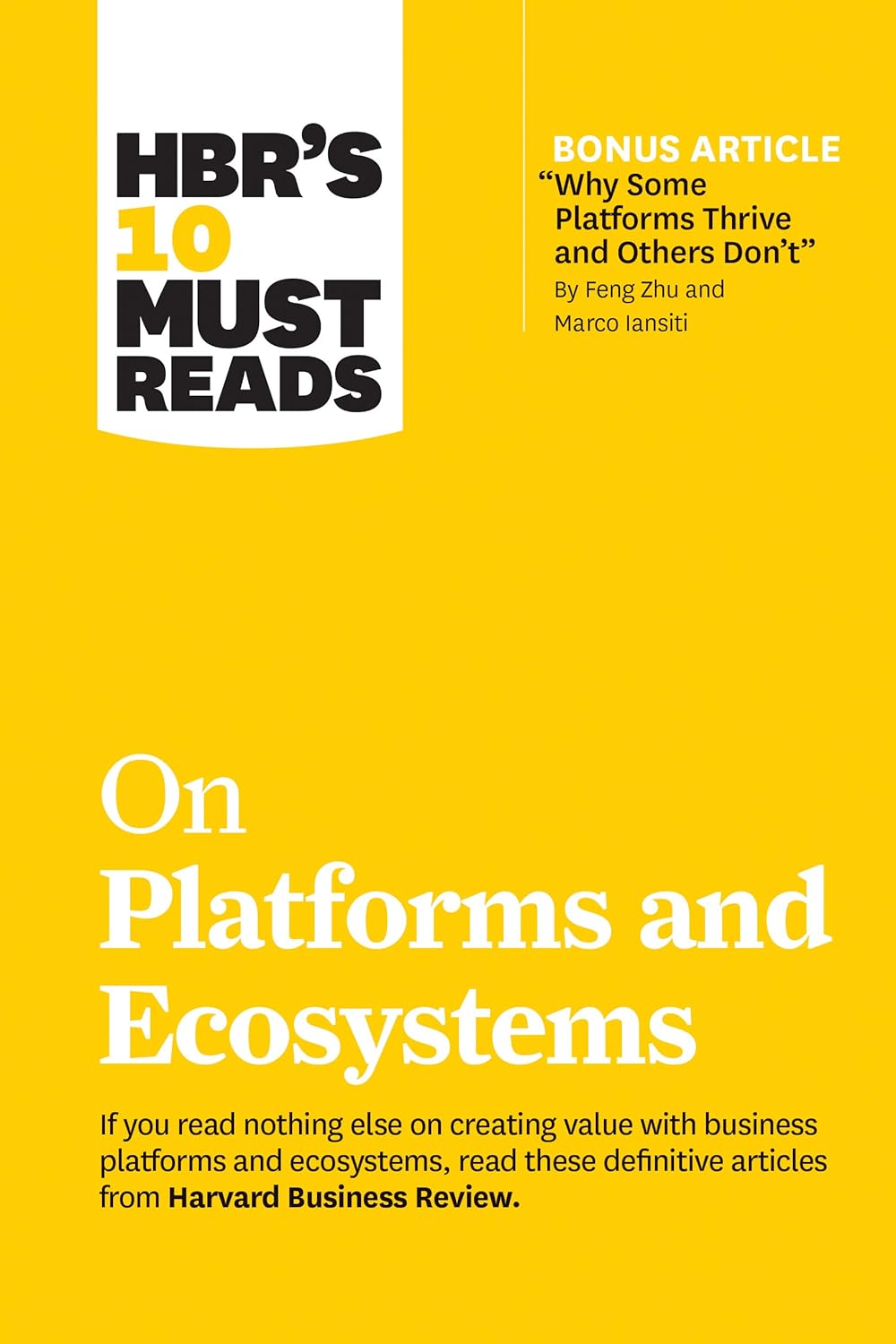
This book is a collection of Harvard Business Review articles on subjects relating to platforms and ecosystems. As these collections go, this one is fairly good and worth reading.
I am ambivalent regarding business trade books. On the one hand, they are books and occasionally quite good. Sometimes the informational value alone makes them worth reading. On the other hand, business trades far too often seem overly packaged and even formulaic treatments of straightforward and even “common sense” topics that allow for quick ingestion by busy readers. The leading practitioner presses and their associated journals have a role in this. Harvard Business Review is perhaps the best known of these and it is not uncommon to look for the one or two pieces worth reading in an issue - sort of like the bits on Saturday Night Live, in that there are only a few that are funny in a given week. The typical trade volumes from HBS press sometimes seem to be built around one of two articles, with the other chapters serving to fill out the volume. This is a stereotype, of course, but it comes close to reality more frequently than it should.
… so when you see the collections of greatest hits (or as here “must reads”) you get a topical assembly of fairly recently articles that are the best in a given topic area. Some of these can be good, for example the collection on health care. The volume here on platforms is also good and helps to clarify some of the mysteries of high tech and internet firms.
The important question behind many of the eleven pieces in this collection has to do with “platforms” - by which is meant firms that serve two or more sets of users at the same time and present a technology/business model that requires high volume usage for multiple markets to be successful. The critical idea here is that of “network effects”, where the value of a business is directly related to the number of users, which grows exponentially in internet space. While traditional businesses focus more on scale and scope economies in high volume supply chains, the development of platforms focuses on demand side rather than supply side scale and scope in multiple markets simultaneously. This means that when platform firms succeed, they can quickly more to monopoly and market dominance and easily drive away competitors. The key example of this is Amazon.com although all of the top FAANG firms would qualify (Facebook, Apple, Amazon, Netflix, Google). For example, I do lots of shopping at Amazon and found a good exercise to be to ask “Just what is the firm doing that is objectionable? Why should Amazon be vulnerable to antitrust action?” That may seem like a missable or unimportant point but more recently the Federal Trade Commission has been looking more carefully at these issues.
The articles in this collection present different variations on why the Internet firms are so different and why platforms, when successful, represent new business strategies. The collection will raise the key issues and provide some good examples, To cover these ideas requires more depth than one get here, but at least its a start that can aid in explaining why Amazon is different.
The questions that tend to be featured in these pieces are predictable, but it is surprising how competitors either do not pay attention or else presume too much of their incumbency when a strong platform firm comes into their market. The chapters help to identify the issues but also consider what can be done, often in specific detail looking at the case histories of firms who had experienced such challenges and adapted (or failed to adapt).
A related buzzword that comes up in this collection is “ecosystem”. This buzzword in business books does not concern the environment but rather a grouping of firms tied together by complementarities. For example, when the iPhone premiered, it was just a phone. But when Apple opened up the App Store to third parties to provide new apps for the next version of the iPhone, the business stopped being a traditional product and became one of the first of the current wave of platforms, that combine the actions of Apple with the many firms providing supporting software and products for the iPhone — one of the latest being hearing aids.