Alien: a história ilustrada pode muito bem ser a única adaptação em quadrinhos bem-sucedida de um filme. É um romance gráfico incrível.” Frank Miller (Sin City, Batman: O Cavaleiro das Trevas) Vencedor do Harvey Awards, um dos maiores prêmios do mercado de HQ americano. A adaptação best-seller de Archie Goodwin e Walter Simonson para o inovador filme de ficção científica de Ridley Scott é uma verdadeira obra-prima. Temos aqui a famosa tenente Ripley, interpretada nos cinemas por Sigourney Weaver, combatendo uma ameaça alienígena e se eternizando como a precursora máxima das heroínas dos filmes de ação. Ao lado, é claro, dos famosos personagens que estão em nossos sonhos – e pesadelos – há décadas, como Lambert, Ash, Dallas, Parker, Kane e Brett. A história se passa a bordo da nave espacial Nostromo, que recebe estranhos sinais vindos de uma lua distante e acaba à mercê de um organismo cujo único instinto é matar para sobreviver. Um verdadeiro clássico! Elogios sobre a obra: “Um incrível exemplo de como adaptar um filme em um romance gráfico.” – TG Daily “Incrível... a história ilustrada de Alien é diferente de qualquer adaptação de filme que eu já li. Ela consegue capturar a essência, o ritmo, o terror e o realismo do filme melhor do que qualquer outra adaptação filme-quadrinhos que eu já encontrei. Lendo a revista, eu podia até mesmo ouvir as notas da trilha sonora de Jerry Goldsmith e os próprios efeitos sonoros. A narrativa sequencial, uma incrível colaboração entre Goodwin e Simonson trabalhando apenas com o roteiro (e cortes preliminares do filme), é tão elegante e bem balanceada quanto é possível para uma história em quadrinhos.” – Huffington Post “Inteiramente satisfatório... deve ser procurado por todo fã da franquia.” – Geek New Wave
Archie Goodwin was an American comic book writer, editor, and artist. He worked on a number of comic strips in addition to comic books, and is best known for his Warren and Marvel Comics work. For Warren he was chief writer and editor of landmark horror anthology titles Creepy and Eerie, and for Marvel he set up the creator-owned Epic Comics as well as adapting Star Wars into both comics and newspaper strips. He is regularly cited as the "best-loved comic book editor, ever."
When I was a kid, my local drugstore fed my addiction for comic books. There was a huge wall-rack in the back of the store where the magazine section was. One whole section of the rack was devoted to comic books, about 20-30 titles. I could spend hours there. The drugstore—-a family-run place run by a nice older couple—stocked all the main superhero titles from DC and Marvel, as well as a lot of the Archie comics and miscellaneous kid’s stuff like Richie Rich, Caspar the Friendly Ghost, and Little Lulu. You know: safe stuff. You would never find Heavy Metal or Creepy in these racks, because they would never allow it.
Except one time, which I can only assume was a mere oversight on behalf of the little old lady who made the orders and did the inventory, a few issues of a magazine-size graphic novel made its way on the shelves one day. Out of curiosity, I picked it up and leafed through it. And my life would never be the same.
It was a copy of “Alien: The Illustrated Story”, written by Archie Goodwin (based on the screenplay by Dan O’Bannon) and illustrated by Walter Simonson. It was a graphic novelization of Ridley Scott’s classic horror film, published by the makers of Heavy Metal magazine..
Now, I remember seeing “Alien” the first time when I was (I think) ten years old. ABC aired it one night back in the early 1980s, and my dad let me stay up and watch it with him. It scared the living bejeezus out of me. I had nightmares for months, and I was—years later—-still looking under the bed sometimes for face-huggers that may have snuck into the house. I had a legitimate fear, every time we ate spaghetti and meatballs, that I would start having chest pains and a little alien monster would pop out of my chest onto my plate.
I wouldn’t watch the movie again until I was in high school.
But if the movie scared the crap out me, the graphic novel fucked me up for life.
Simonson’s beautiful but graphic (and Technicolor) visuals were terrifying to a ten-year-old. Okay, I’m 51, and they’re still terrifying. When I discovered that this was reissued in a new paperback edition by Titan Books, I was excited. Also, a little nervous.
I remember—way back then—-reading the graphic novel in the drugstore, cover to cover, and putting it gently back on the shelf. I took my pile of comic books I was going to purchase to the counter, where the nice old lady was waiting. As she rang up my comics, she looked down and asked, “Are you alright, young man? You look a bit pekid.”
I think I smiled and mumbled a “I’m fine.”
But I wasn’t. I so wasn’t fine. And I never would be again…
The graphic novel adaptation of the landmark science fiction film was adapted by Archie Goodwin, illustrated by Walt Simonson and published by Heavy Metal magazine in 1979. Alien: The Illustrated Story actually hit the New York Times trade paperback bestseller list, the first comic book to do so.
Simonson's panels really capture the movement of a haunted house thriller in space, and he preserves H.R. Giger's frighteningly beautiful extraterrestrial designs. The edition I bought is a small, threadbare reprint (7" x 10") with no goodies, but a must for fans of Alien like me.
Un comic que sintetiza y adapta la historia de Ridley Scott "Alien: El octavo pasajero". Ideal para fanáticos de la saga, para quienes quieran acercarse al mundo del terror en el cómic, o para quienes no se animen a entrarle de lleno a esta serie de películas. Mantiene perfectamente el hilo conductor de la trama, y lo esencial de esta maravilla de SciFi Horror.
An excellent adaptation that, if I'm not mistaken, was released before the movie even came out. Quite the spoiler!
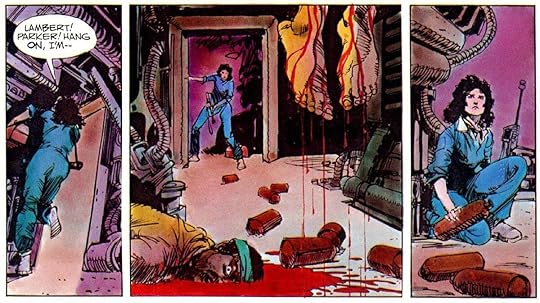
The artwork is fantastic, Walter Simonson has a nice sketch quality that shows off some serious draftsmanship chops. For some, it may be a bit too loose.
The whole thing is barely over 60 pages and it doesn't miss any story beats as far as I can tell - it's faithful to the script. But this does mean it lacks breathing room, lots of things happening on each page. Thankfully, the scripter Archie Goodwin allows the art to do the heavy lifting with very little extraneous text.
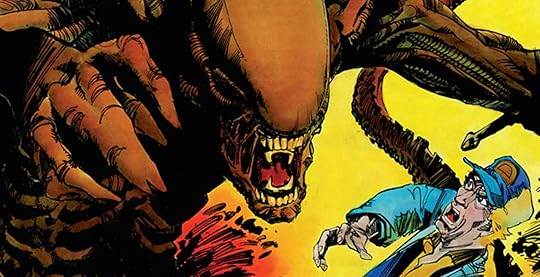
I would have liked to have seen more of the alien spacecraft at the start. The alien monster looks really good.
It's not really as good as the movie, but does highlight how great of a script that movie had. Great scenery, great characters, a great simple but effective plot. And the key for me is it has a fully-fleshed out world that feels genuine without any narrative baggage. We're just thrust into this realistic future world.
There's a blurb by Frank Miller on the back stating that this is the only successful movie adaptation in comics. But its not even the only successful Ridley Scott movie adaptation in comics because Blade Runner also exists (also adapted by Archie Goodwin)
I came across this comic and was pleasantly surprised about it. The art is excellent and the story is done in an excellent way. Lacking is the brilliant ambiance and design as Ridley Scott delivered with the movie ALIEN, but the monster story is very well told. An excellent comic representation of a brilliant and original movie, well worth your reading time.
This is a pretty good adaptation. Great art, good pacing, takes all the advantage it can out of the different medium... except with the narration boxes, which all too often state the obvious and get in the way of things.
If you haven't seen the movie and for whatever reason are unable to, the comic is a good substitute.
This is a book I wanted so much to own that I pre-ordered it which I rarely do for such a pricey tome. Sadly. it never arrived but I was fortunate enough to have borrowed a copy from a friend.
The book is gorgeous. It is produced from the original art pages from the artist Walter Simonson and presented as is. No colors, no size reduction and showing all his corrections and stains of age. The lettering was added in order to present it as a graphic novel on which is essentially a coffee table art book.
I am a huge Walter Simonson fan and this a great resource for anyone curious to know his creative process. This was an important project for him, it reunited him with his frequent collaborator and fried Archie Goodwin with whom he worked on the critically acclaimed Manhunter story. This was also the first time he worked with John Workman who did all of his lettering afterwards.
Any Simonson fan worth his salt should have this book. It is an excellent companion to his Thor Artist Edition. This book is huge and would be a challenge to find place in a shelf but the goodies outweigh that inconvenience.
First published in 1979, this is certainly one of the best graphic novels based a film. The dailogue is kept brief & the story zips along at a fast pace. Excellent, full colour artwork enhance this science fiction classic.
I am so happy to see this reprinted. It truly deserves its reputation as one of the best comic book adaptations of a movie ever made. On the script we've got the late Archie Goodwin, one of the more underrated writers of his time. Writing good comics isn't nearly as easy as he made it look. And on the art we've got Walter Simonson, who was a relative unknown at the time. While he's gone on to bigger and better things, his storytelling skills were still top notch. Put the both of them on the task of adapting one of the best SF/Horror films ever made, and the result is sublime. Excellent book!
Let’s face it, most movie to book adaptations are usually a pile of boring cliches hurled together by a two-bit ghost writer trying to make a buck. They lack the energy of the original film and beg the question why bother adapting it as a book in the first place?
Thankfully, Alien: The Illustrated Story has none of those issues. The comic book keeps the dynamism of the film in place with great illustrations and an adaptation that doesn’t slow the story down. Comics suit movie adaptations far more than novels because of the visual nature of film. Films come from storyboards, essentially a basic style of frame-by-frame storytelling.
Alien: The Illustrated Story is a re-release by Titan Books of the 1979 comic first published by Heavy Metal. Eisner award winning editor Archie Goodwin adapted the story, having adapted several other science-fiction films into comic books, including The Empire Strikes Back and Return of the Jedi. Walter Simonson illustrated the book; his other illustrating credits include Manhunter, Batman, Superman and Uncanny X-Men. The book has been restored from Simonson’s original artwork.
In Alien, the crew of the space ship Nostromo are wakened from their cryogenic state by an SOS call emanating from a nearby planet. When they go to investigate, they stumble upon an enormous space ship and discover that the message is not a cry for help but a warning. One of the crew is infected with an alien life form… and the chaos begins. The Alien script writers acknowledged Agatha Christie’s Ten Little Indians as part of the inspiration for Alien, where ten people trapped on an island are slowly murdered one by one. If you haven’t seen the film, I’d recommend watching it before reading the comic book.
Reading the Alien story is much different to watching it. It allows you to take time with the designs and story. Despite seeing the film countless times, I still garnered new appreciation for elements of the story in written form. Little details, like Ripley’s role as warrant officer, or the technical jargon that gets delivered quickly in the film can be fully appreciated in the comic. The comic also provides a good bridge between Prometheus and the Alien films, with the illustrations adding extra detail to the story.
No matter how many times I’ve seen the film, I never get sick of the Alien story. The cameraderie between the crew members establishes the tension and sense of loss in the second half of the story. Many horror storytellers forget the importance of establishing the characters before killing them. Growing up, Ripley was my hero, a strong and intelligent woman who could take on anything. There were few films at the time that had a strong female lead; part of the revolutionary aspect of Alien was casting a woman instead of a man in the lead role.
The comic book retains this camaraderie and characterisation in a condensed format. It’s tricky condensing a film into a shorter format, but Goodwin adapted the film’s major moments without making the book feel rushed. One thing I got out of reading the comic was seeing how much people ignored Ripley’s advice in the story – if they’d listened to her in the first place, then the Alien wouldn’t have got on board. But that’s always the case in a great horror tale… if only we’d locked the door!
Walter Simonson’s artwork is full of movement, creating a sense of urgency in his illustrations. Smoke and wind effects are all interpreted through brush strokes; there are very few frames of static imagery. His illustration of the alien coming out of Kane’s body has a great sense of forward movement, the red blood splashing across a double page. Which beats the underwhelming film alien squirming across the floor! Of course, it wouldn’t be Alien without a grand serving of gore.
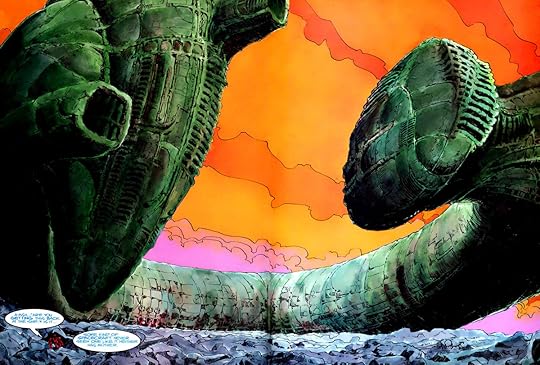
Simonson uses a great deal of contrasting colours in the colouring, with greens set against the bright orange hues of the planet’s sky. I particularly liked the “Alien” title typography, the words filled in with layers of alien exoskeleton. There is a good level of detail in the images, reflecting HR Geiger’s classic designs of the alien species.
While you may think you’ve heard the story before, Alien: The Illustrated Story is a great adaptation and well worth a look for any Alien fan.
As far as movie adaptations go, this comic is probably pretty great. The art is nice, and it includes some scenes that were deleted from the final version of the film, which is interesting.
But I really love the film for its ambiance - the blue light and beepy-boopy sounds of the computers are very appealing, and the slowly-building suspense is crucial to the film. The comic version has none of this - it's fast and it's full of action and shouted dialogue. And that's okay. It's a comic, it's supposed to be action-packed. It's just very different from the quiet, suspenseful horror that I love the film for.
Un trabajo brillante de Goodwin y Simonson: Las composiciones de página fueron rompedoras en su época (aún hoy en día son un modelo de narración) y los diálogos reflejan muy bien la ambientación de la historia.
Estas adaptaciones suelen estar muy limitadas por su propia naturaleza, pero aquí los autores aprovechan todos los recursos del medio al máximo y superan con creces esos límites. Además de conseguir sintetizar toda la trama de la película en pocas páginas, transmiten muy bien la sensación de agobio y la sorpresa del original (aunque en un estilo propio)
Bom, não sei se é preciso falar que o filme Alien, de Ridley Scott é um clássico tanto dos filmes de terror como dos de ficção científica. Ele consegue trazer para os filmes uma atmosfera de desconfiança e de ansiedade que poucos filmes ditos de ficção científica conseguem. Mas ok, não vamos ficar falando somente do filme, mas sim dessa adaptação em quadrinhos que a Editora Excelsior trouxe para o Brasil depois de anos em que ela foi publicada aqui. Na contracapa desta publicação encontramos uma fala de Frank Miller dizendo que esta é uma das melhores adaptações feitas de um filme para os quadrinhos. Realmente, na minha opinião, ela passa este mesmo sentimento, já que consegue traduzir de forma bastante eficaz toda a atmosfera de vulnerabilidade e clima do desconhecido que o filme nos transmite. Ser feito por dois grandes nomes dos quadrinhos, um em pleno ápice dos roteiros, como é o caso de Archie Goodwin e outro logo no começo de sua carreira nos desenhos, Walter Simonson, são apenas mais dois motivos de que devemos conferir este trabalho e chegam a um veredito próximo ou diferente do de Miller.
Adaptations are rarely as good as the original (in this case, Ridley Scott's horror/SF masterpiece), but I'm calling out this book (rare, OP, and published by Heavy Metal back in the day) because it's not just visually entertaining, especially if you're a fan of the film, but also a wonderful example of how to tell a story in picture form. This short books reads as if the artist, Walt Simonson, just sat down at his coffee table and banged it out one afternoon--by which I mean that it's disarmingly loose and easy, but at the same time a virtual one-volume master-class in narrative storytelling and comics layout.
El octavo pasajero Alien, una creación de las más antiguas tanto del mundo del cine como de los cómics. Esta ilustración nos trae un pequeño recuerdo de uno de los momentos más épicos de tu extraterrestre favorito. Nos ponemos a bordo del famoso Nostromo, con la tripulación de 7 ejecutivos al mando de Dallas y Ripley. Repasaremos su encuentro con el artefacto custodiado, y por supuesto la invasión en el interior de Nostromo por parte del octavo pasajero. Los dibujos y las viñetas conservan las características de la época a pesar de ser un “remake”. Una lectura rápida, sencilla y bastante corta con mucha sangre y tensión. Recomendada a cualquier fan de Alien.
Do sada nisam imao priliku da čitam strip-adaptaciju nekog filmskog ostvarenja, pa nisam tačno siguran kako ovaj naslov treba vrednovati. Scenario je radnja filma, i ni jedna nova reč nije dodata u dijalozima ili naraciji. Sa druge strane crtež preslikava likove i scene iz filma sa pomalo drečavim bojama. Jedina zamerka bi bila što nisu uspeli da predstave klaustrofobični ambijent svemirksog broda, što je jedna od najbitnijih stvari u filmu.
A tremendous adaptation of an incredible film. Faithful and truly beautiful— it captures the essence of the film while still having a little bit of its own style.
If you are one who has stuck around with my "reviews" on this website for a long time, then you would know that 90% of all of the pieces of literature that I do cover on this website is that of comic books. There is a reason for this, as not only is it a form of literature that I myself was pretty much blind to throughout most of my life, but there's also the fact that there are so many interesting and unique comic books out there, even ones based on plenty of other pieces of fiction that I am very familiar with, that I wanna take a look at as many comic books as I can to see what the medium truly has to offer. So far, I have covered WAY more comics then the average person would, over 1,000 issues over many different series, but there is one sub-category of comics that I have yet to take a look at, and that sub-category is that of the graphics novel. You know what I mean, books that may as well just be a more extended version of a regular comic, one that is given much more room, time and page numbers to tell their story with, and sometimes it can be for the better or for the worse, depending on what story is being told within the medium. So, I decided that I wanted to take a look at some graphic novels for myself, starting with some familiar territory with Alien: The Illustrated Story.
If you have stuck around here for a while, then you would know that I have read a FUCK-TON of Alien comics, some of which I am still trying to get through to this day, and as a whole, I have really enjoyed my time with a lot of them. Sure, not all of them are that great, and they mostly end up being exactly what you would expect from Alien in comic form, but they do manage to adapt the world of Alien into the format very well and offer plenty of unique, fun and exciting tales that you wouldn't get from the series simply by just watching the movies. However, the lovely people at Dark Horse didn't stop at just making comics for the Alien series, however, as there were also a few graphic novels they released on top of that, including this one, which, if you couldn't tell from the title, is an illustrated version of the original Alien movie, adapting it into a completely new format for fans old and new alike to enjoy. This is actually one that I have been wanting to cover for quite a while now, but I was sort of hesitant on doing so, not only because of how it was longer then the average comic, but also due to the fact that, if this was going to fit in line with the other comic adaptations of some of the other films, it wouldn't end up being all that good. Regardless, I went ahead and checked it out anyways, and thankfully, it did turn out to be good! I wouldn't say that it was anything amazing, as it did end up having some problems that held it back, even for what it was, but as a whole, I still ended up liking it plenty, with it being a very faithful adaptation of the original movie that does a good job at translating the story and plenty of moments from the film into comic form, while also having plenty of solid elements holding it together to make for a good adaptation as a whole.
The story is exactly what you would expect, with it pretty much being a one-to-one retelling of the events of the original Alien film, with there being some differences here or there when it comes to structure that I will go into later, but as a whole, it stays very faithful to the original film and does work pretty well for what it is, both for those that have seen the film and those that haven't, the characters are good, where all of the characters from the film are represented here in some shape or form, and while you obviously can't get as attatched to them in this as you probably could with the movie, they still end up being pretty likable for what they are, such as with Ripley and, of course, the xenomorph itself, the writing is pretty good, where some of it can come off as being pretty cheesy and unnecessary, along with the novel having a tendency to just fill up pages with dialogue for no reason, something that a LOT of comics out there suffer from, but thankfully, it does end up being pretty solid for the most part and does help get you more into whatever is going on at any given point, the art is really good, definitely being fitting for the time that it came out in with the general art style and the way that certain characters and moments look, but as a whole, it still looks pretty solid, everyone and everything looks exactly as it should, and for being the first proper comic made for the franchise, it still holds up very well to this day, and the kills are really good as well, where they obviously aren't as great as they are in the movie, but they do make for some of the best moments in the entire adaptation, having a lot more flair and blood added to them to make them feel more exciting, which is great to see from a book like this.
Unfortunetly though, I can't say with a straight face that I ended up really loving it, as despite how there is plenty to love about this adaptation as a whole, there are still a good handful of problems that do end up holding it back for what it is. For starters, there is the fact that this is pretty much exactly what you would expect from a comic adaptation of Alien: yeah, I know this sounds like a really stupid thing to complain about, and the novel does have its own merits when compared to the original film, but it is still a straight one-to-one adaptation of the film with not many differences to be seen, to where the only reason you would ever read it is if you were morbidly curious about what the original Alien film would look like as a comic. Sure, that in itself doesn't necessarily make the adaptation worse, but it does make it so that those who didn't like the original Alien, the Alien franchise or novels like this in general, probably won't end up liking this one either. Not only that, but with an adaptation like this, it does run into a problem that a lot of other, similar adaptations run into, and that problem is with simplification. This novel is only arond 60 pages long or so, which is definitely not enough pages to detail the ENTIRE story of Alien, which made it so that the author went ahead and made it so that he SPED through a lot of the different scenes and moments that happened in the movie to make sure to get to the next part quick. To give the adaptation some credit, they do manage to fit every single major plot point, scene and memorable moment in the novel, which is great to see, but a good amount of these scenes do end up feeling trunkated or shrunken down simply for the sake of getting a move on when all is said and done, which does kind of suck. Again, this isn't necessarily that big of an issue, but it is something that you will definitely notice when reading for yourself, especially for me, the guy who LOVES the original Alien and the subsequent franchise that it created. It's like one of my favorite movie franchises of all time, of course I am gonna be anal on the stupid details like that.
Overall, despite it not hiding any surprises beyond what it initially promises, along with it feeling abridged in some instances throughout, Alien: The Illustrated Story still ended up being good for what it was, doing a really good job at not only adapating the original Alien movie into comic form, but also for being able to translate this series into one of the most popular formats that it would still continue to use all the way up to this day, all of which is brought together with some good elements to make for a novel that I did have a good time with, what with its simple, yet effective enough retelling of the original story, a set of good characters mixed with some pretty good writing, some really good art that does help get you into the adaptation and a lot of solid moments, along with some gory and over-the-top kills to go along with it to make for some of the best moments throughout the whole thing. I would recommend it for those that LOVED the original Alien film, as well as for those that are huge fans of both Alien and graphic novels like this as a whole, as while it isn't anything too extraordinary that you really need to get your hands on, there is enough good content here to where it is worth reading at least once, which is all that anyone can ask from it at the end of the day. Either way though, I'm just glad that I finally managed to get this one knocked out and out of the way, so that I can move onto other Alien comics and graphic novels to read. And hey, maybe even when I get done with those, I could also start covering the actual Alien books next!.......... maybe. I dunno, that would mean I actually have to read a REAL book, and not just stick with a bunch of childrens' books, comics and manga like I always do, so I dunno, I'm gonna have to work up to it....... like that's something regular people suffer from.
Book #126
This entire review has been hidden because of spoilers.
Alien: la historia ilustrada es una adaptación al cómic de la película Alien: el octavo pasajero. Es una adaptación tremendamente fiel a la película, y no encontrarás nada en este que no encontraras en aquella, aquí no hay ningún esbozo de mundo expandido como en los cómics de star wars. Encontraremos muy pocas diferencias con la película en escenas, diálogos... por lo general todo es muy parecido: los personajes, los interiores de la nostromo, incluso el alien, que sin embargo aquí se nos muestra en todo su esplendor mientras que en la película apenas se advertía entre las sombras. Muchas de las escenas parecen copiadas de la película plano a plano, aunque eso si, el ritmo es distinto, no podría ser de otra manera.
El arte de Simonson me ha parecido genial, se nota que está trabajado con mimo, sin sentir la excesiva presión que podría sentir en las publicaciones periódicas, el color en concreto es espectacular, merece la pena disfrutarlo en una edición de lujo como la de Diábolo, de gran tamaño y con papel de mcuha calidad
The ALIEN franchise is on my Top 5 All Time Favorite List of Movies, Books, Comics and, well, everything. I love every movie made within the franchise (both the ALIEN and PREDATOR series), every book published, and every comic created about them. I just can’t seem to get enough of those indestructible, hideous killing machines! Because of my obsession, the fine folks at Titan Books saw fit to send me a copy of their re-release of ALIEN: THE ILLUSTRATED STORY. I am beyond ecstatic that they did because this is an amazing adaptation of the movie and a welcome addition to my ALIEN collection.
As I mentioned above, I *love* all things that deal with the ALIEN franchise, so it’s no wonder ALIEN: THE ILLUSTRATED STORY was on my “must have” list. I actually have a rather worn copy of the original Heavy Metal issued graphic novel from way back in ’79. But I have to be honest: this re-release looks WAY better than the original, with remastered artwork and emblazoned color recreation.
ALIEN: THE ILLUSTRATED STORY captures the mood and tone of the movie with perfect detail. I have seen many graphic novel adaptations of movies over the years that fall far short of the mark. Fortunately, this is not the case here; this graphic novel is the ideal companion to Ridley Scott’s visionary film, and it is a must have for any fan.
ALIEN: THE ILLUSTRATED STORY is a beautiful, lavish graphic novel that will fit perfectly into any science-fiction or horror lover’s collection. It features exquisite artwork , painstaking detail, and the superb storyline that was made famous by the movie. I highly recommend this and suggest you pick it up soon.
Comic book adaptations are quite common nowadays, as well as movie-comic books accompanying the full-length features, more often the properties based on a comic book franchise, but back then, to have this format was uncommon, and to see that a newly released film also had an “illustrated” companion meant something. “Alien”, the 1979 Ridley Scott film, was the director’s second feature, but it was the one that put him on the map, and while something like 1977 “Star Wars” popularized the “space-adventure” flick, “Alien” is the film that delivered on the promise of a mix between genres, offering a fully fleshed sci-fi story, with horror and haunting elements that, to this day, maintains as some of the best in cinema history. To talk about the film’s popularity would be pointless; it was an immediate success, and a gamble by FOX that paid off in a way the studio wouldn’t have imagined. The comic book essentially came during the same month of the film’s release, basically portraying every single visual element depicted in the movie, with the team in charge of Archie Goowdin as the writer adapting Dan O’Bannon, and Ronald Sushett’s screenplay for the format, and with Walter Simonson helming the artwork. Rather than show extra content or anything foreign to the film’s script, Goodwin limits his own to showcase almost every single element from the film, with condensed scenes, and minimal use of dialogue that gets the job done for anyone anticipating a quick-but-loyal read. However, the real spectacle comes from Simonson’s art, who not only worked on the pencils, but also in the coloring of the entire thing, adding a more complete, refined piece of artistry to each panel. Simonson’s style is sketchy, and abundant on the use of shadows, and excessive details, not only in the backgrounds, but also in the characters themselves, resembling in a decent way their live-action counterparts, even in the smaller panels in which Goodwin maintains the minimal action possible, and takes advantage of the dialogue-exposition present in the film. As a complementary element, Simonson’s colors are vintage, and truthful to the spirit of the film’s ambience; the atmosphere, the dreadful environment, the danger in every corner, somehow the artist manages to bring every single visual resonance to his own work, and his use of colors are both, mechanical, as well as vibrant, and warm, recreating the breathtaking effect of Giger’s original works in a rather colorful, more vivid way. Perhaps the best attribute given to Simonson’s style is the use of splash panels for specific iconic moments in the movie, example of those are the discovery of the “Juggernaut” once the crew of the “Nostromo” arrives to LV-426, or the “facehugger” attacking Kane afterwards, the “chestburster” sequence halfway through, and the first time the “Xenomorph” makes an appearance are all illustrated magnificently, and they’re just as shocking, and impactful as they are in the movie. The dominance from Simonson is undeniable, knowing which sequences deserved the more attention to detail, as well as the scenes in which the characters needed to share specific lines of dialogue; it’s a well-paced comic book that knows when to shine, although, I will say, Simonson’s art is so powerful and jaw-dropping, even the smaller panels are worth appreciating. For anyone expecting extra content, or perhaps, some scenes from the 2003 ‘Director’s Cut’ of the film, Goodwin is strictly focused on adapting the original 1979 script, without any of the material Scott would add to the film’s special edition 25 years later. To no one’s surprise, that material wasn’t available, but the comic book doesn’t need to show anything not-seeing in the film; it’s a straightforward adaptation that doesn’t add or remove anything slightly important for the progression of the story. Maybe the biggest criticism this adaptation might receive is the lack of “Xenomorph” presence within these pages, although remembering the movie, the alien didn’t appear until later in the film, essentially during the final act of it, so is no surprise Goodwin applied the same effect in his script. However, the sequences presenting the “Xenomorph” in the book are more than worthy of the creature’s reputation, as well as Simonson. He might not be the same artist he was back in the day, but his Xenomorph will always be among the better illustrated ones, speaking of the further “Dark Horse Comics” publications in the late 80s, and early 90s. Artists such as Mark A. Nelson, Denis Beauvais, Sam Keith, Kelley Jones, or my personal favorite, Bernie Wrightson, they all essentially came after Simonson had the first shot at a comic version of the Alien creature, and his work maintains itself as some of the best on page. It’s not an understatement to claim the artwork in this book excels and makes it worth the acquisition. I cannot really say much about this unique piece of collector’s item. It’s not really a key element to understanding the film, much less a companion of the same, but it’s a fantastic addition for any fan who’d like to experience the same story in a different format. The script is concise, and it doesn’t change anything of the original material, maintaining a similar graphic pacing as the one in the film, and Simonson’s draws capture every visual trait, and graphic element to recreate the film’s unparalleled aesthetical identity, and easily his art is the show stealer for this title. If I can compare this adaptation with another one with the same amount of quality put to it, it might be “Marvel Comic Super Special: Blade Runner”, which also happens to be written by Goodwin, but with the artwork of Al Williamson, and Carlos Garzon. Maybe is more of a personal choice, but I consider these two titles to be some of the best regarding the adaptation of movies to comic book material, ironically, two films directed by Ridley Scott, that happens to be his two best works. Of course this is recommended, and fortunately its 2012 re-print is easy to find, and at reasonable prices. Is an essential piece for anyone claiming to be a fan of the 1979 classic, and for any comic book collector. It’s also a quick read- between 30-40 minutes- although I’d say most art appreciators will immerse themselves in the beautifully looking display of art within each page, just as I did. A fantastic addition to anyone’s “Alien” collection.
The art can be somewhat rough, and may even at times feel rushed, but it does seem to fit well with the "spirit" of the story.
The story is pretty rushed as well, skipping key scenes from the movie, or zipping thru them at too quick a pace. This is a case of too much information trying to be crammed into too little of a space. Both story and art could have used a few more pages.
Not to say that I didn't like, I actually liked it a lot. If it weren't for the movie, this would make a great graphic novel. But alas, comparisson to the movie are innevitable at this point, and I guess you can't really relay the feel, the noise, the music, the anticipation from film to graphic novel.
I didn't buy this when it first came out at the same time as the movie... I was a lowly College student and couldn't really affors the fancy graphic novel. And later... well I couldn't really justify paying the over-priced e-boob ones available. But I am glad it got re-published and has given me a chance to "get it", so yeah, I am grateful and happy I finally got to get this after oh-so-many years.