Summary of The House of Silence from https://www.oldstyletales.com/: The House of Silence” is a real skin crawler that follows a brawny burglar as he breaks into a mansion while the owner is out of town. It calls to mind the plot of several stories and movies wherein the hunter finds himself over his head, in particular Lovecraft’s “The Terrible Old Man” and the recent Stephen Lang movie, “Don’t Breath” (although, without revealing too much, this plot is very different from both). Going from room to room, he seems to plunge into the mind of a decadent libertine – he even finds a warm bed that smells of a woman’s perfume. But it isn’t until he reaches the courtyard in the center of the mansion that he notices the thing on the ground… Oh, and the flies feeding on it…
Edith Nesbit (married name Edith Bland; 15 August 1858 – 4 May 1924) was an English author and poet; she published her books for children under the name of E. Nesbit. She wrote or collaborated on over 60 books of fiction for children, several of which have been adapted for film and television. She was also a political activist and co-founded the Fabian Society, a socialist organisation later connected to the Labour Party.
Edith Nesbit was born in Kennington, Surrey, the daughter of agricultural chemist and schoolmaster John Collis Nesbit. The death of her father when she was four and the continuing ill health of her sister meant that Nesbit had a transitory childhood, her family moving across Europe in search of healthy climates only to return to England for financial reasons. Nesbit therefore spent her childhood attaining an education from whatever sources were available—local grammars, the occasional boarding school but mainly through reading.
At 17 her family finally settled in London and aged 19, Nesbit met Hubert Bland, a political activist and writer. They became lovers and when Nesbit found she was pregnant they became engaged, marrying in April 1880. After this scandalous (for Victorian society) beginning, the marriage would be an unconventional one. Initially, the couple lived separately—Nesbit with her family and Bland with his mother and her live-in companion Maggie Doran.
Initially, Edith Nesbit books were novels meant for adults, including The Prophet's Mantle (1885) and The Marden Mystery (1896) about the early days of the socialist movement. Written under the pen name of her third child 'Fabian Bland', these books were not successful. Nesbit generated an income for the family by lecturing around the country on socialism and through her journalism (she was editor of the Fabian Society's journal, Today).
In 1899 she had published The Adventures of the Treasure Seekers to great acclaim.
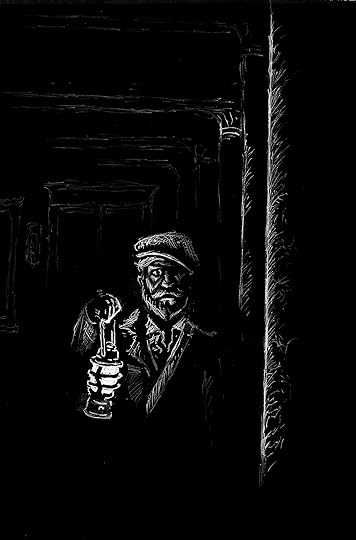
The tale follows a thief who stumbles upon a mysterious house, hidden behind a formidable wall. As he attempts to infiltrate the property, he discovers unsettling signs of its eerie nature. He then breaks into the empty mansion and is unnerved by the brooding silence. As he explores the eerie silence, he encounters strange and unsettling occurrences, leading to a chilling conclusion.
Well written, well rounded. But as ghost stories go, not much action to be seen. Eerie, yes, but no haunting spirits. And one sentence I rather would have liked to skip. Sign of the times, I guess, but still.