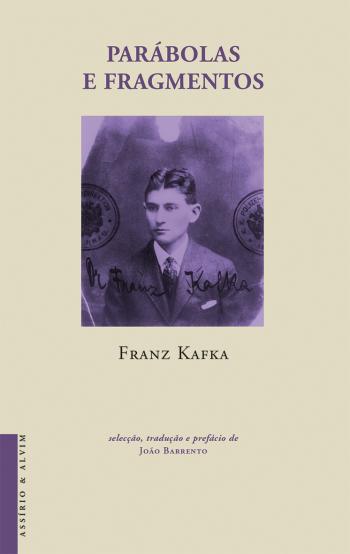
As parábolas de Kafka e uma selecção de fragmentos, com tradução e prefácio de João Barrento, e desenhos de Kafka. "[…] a nossa tendência natural diante de uma parábola de Kafka, e face à sua carga de enigma, é a de seguir a ilusão hermenêutica, essa vontade ocidental de tudo explicar e reduzir a um "sentido" - nem que seja para concluir, depois de muito ter interpretado e tentado explicar, que não se pode explicar o inexplicável É isto que diz o próprio Kafka pela boca de um indefinido narrador, na metaparábola que abre este volume: "Todas essas parábolas querem dizer, no fundo, que o inexplicável é inexplicável, e isso já nós sabíamos."" (João Barrento, no prefácio)
Franz Kafka was a German-speaking writer from Prague whose work became one of the foundations of modern literature, even though he published only a small part of his writing during his lifetime. Born into a middle-class Jewish family in Prague, then part of the Austro-Hungarian Empire, Kafka grew up amid German, Czech, and Jewish cultural influences that shaped his sense of displacement and linguistic precision. His difficult relationship with his authoritarian father left a lasting mark, fostering feelings of guilt, anxiety, and inadequacy that became central themes in his fiction and personal writings. Kafka studied law at the German University in Prague, earning a doctorate in 1906. He chose law for practical reasons rather than personal inclination, a compromise that troubled him throughout his life. After university, he worked for several insurance institutions, most notably the Workers Accident Insurance Institute for the Kingdom of Bohemia. His duties included assessing industrial accidents and drafting legal reports, work he carried out competently and responsibly. Nevertheless, Kafka regarded his professional life as an obstacle to his true vocation, and most of his writing was done at night or during periods of illness and leave. Kafka began publishing short prose pieces in his early adulthood, later collected in volumes such as Contemplation and A Country Doctor. These works attracted little attention at the time but already displayed the hallmarks of his mature style, including precise language, emotional restraint, and the application of calm logic to deeply unsettling situations. His major novels The Trial, The Castle, and Amerika were left unfinished and unpublished during his lifetime. They depict protagonists trapped within opaque systems of authority, facing accusations, rules, or hierarchies that remain unexplained and unreachable. Themes of alienation, guilt, bureaucracy, law, and punishment run throughout Kafka’s work. His characters often respond to absurd or terrifying circumstances with obedience or resignation, reflecting his own conflicted relationship with authority and obligation. Kafka’s prose avoids overt symbolism, yet his narratives function as powerful metaphors through structure, repetition, and tone. Ordinary environments gradually become nightmarish without losing their internal coherence. Kafka’s personal life was marked by emotional conflict, chronic self-doubt, and recurring illness. He formed intense but troubled romantic relationships, including engagements that he repeatedly broke off, fearing that marriage would interfere with his writing. His extensive correspondence and diaries reveal a relentless self-critic, deeply concerned with morality, spirituality, and the demands of artistic integrity. In his later years, Kafka’s health deteriorated due to tuberculosis, forcing him to withdraw from work and spend long periods in sanatoriums. Despite his illness, he continued writing when possible. He died young, leaving behind a large body of unpublished manuscripts. Before his death, he instructed his close friend Max Brod to destroy all of his remaining work. Brod ignored this request and instead edited and published Kafka’s novels, stories, and diaries, ensuring his posthumous reputation. The publication of Kafka’s work after his death established him as one of the most influential writers of the twentieth century. The term Kafkaesque entered common usage to describe situations marked by oppressive bureaucracy, absurd logic, and existential anxiety. His writing has been interpreted through existential, religious, psychological, and political perspectives, though Kafka himself resisted definitive meanings. His enduring power lies in his ability to articulate modern anxiety with clarity and restraint.
Ya no es novedad mi amor incondicional hacia la literatura de Franz Kafka. Luego de leer toda su obra se ha transformado en mi escritor preferido junto con Fiódor Dostoievski. Lo quiero, lo admiro y aprendo a partir de su inmensa sabiduría. Podría releer sus libros de un modo infinito (como revela el contenido de su obra) siempre encontrando cosas nuevas ya que eso es lo que genera Kafka en el lector: descubrir en sus escritos una fuente inagotable de conocimientos. Este pequeño librito de menos de cien páginas encierran algunas de sus tantas parábolas y paradojas y se disfruta de principio a fin. También posee relatos, reflexiones y pensamientos del gran escritor checo que nos invitan a pensar, a ver el otro costado de las cosas, de la vida y de las personas; todo ello explicado a su manera y con su sello indiscutible.
Si buscamos la definición de los dos términos, encontraremos que la "La parábola designa una forma literaria que consiste en un relato figurado del cual, por analogía o semejanza, se deriva una enseñanza relativa a un tema que no es el explícito. Es en esencia, un relato simbólico o una comparación basada en una observación verosímil. Al igual que la fábula, la parábola suele narrar una acción simple, singular y consistente, sin detalles extraños ni circunstancias que conlleven a la distracción. Una parábola es como una metáfora que ha sido extendida para conformar una ficción breve y coherente." Para graficar esto fácilmente, encontramos este diálogo hecho por el propio Kafka:
"Con referencia a esto, dijo un hombre una vez: -¿Por qué tantas reservas? Si ustedes sólo se limitan a seguir las parábolas, ustedes mismos se volverían parábolas y de ese modo se desembarazarían de todos sus cuidados diarios. Otro dijo: -Apuesto a que esto también es una parábola. El primero dijo: -Ha ganado. El segundo dijo: -Pero desafortunadamente sólo en parábola. El primero dijo: -No; en realidad. En parábola usted ha perdido.
Con respecto a la paradoja, se afirma que "La paradoja es una figura de pensamiento que consiste en emplear expresiones que aparentemente envuelven contradicción. Concretamente en retórica, es una figura literaria que consiste en emplear expresiones o frases que implican contradicción, es decir, en la paradoja se niega lo mismo que se afirma." En este caso, la amplitud de Kafka es increíble en este sentido, no sólo en este libro sino en el resto de su obra porque es su especialidad. Encontraremos muchísimas referencias paradójicas en sus novelas y cuentos, además de reflexiones que son en sí mismas paradojas realmente interesantes. Cito algunas:
"El hombre es una ciénaga infinita. Pero a veces lo ataca el entusiasmo, y parece como si en un punto determinado de esa ciénaga se viera a una rana que se zambulle, produce una pequeña turbulencia y desaparece." "Si apenas fuera posible que alguien se detenga un instante, una palabra, a la vista de la verdad. Pero parece imposible: todo el mundo, yo inclusive, nos aproximamos a la verdad y la derrumbamos a fuerza de centenares de palabras." "¿No es increíble que hasta el más duro de los conservadores sea capaz de aceptar el radicalismo de la muerte?"
Qué afortunado me siento cuando abro un libro de Franz Kafka. Leer su obra, inclusive sus escritos más oscuros, le da un brillo muy especial a mis días. Felices 136, Franz...
"Parables and Paradoxes" brings together almost everything the Czech author wrote, except for his novels and novellas—a journey through the human condition in modernity, between system and chaos.
Σ’ αυτό το βιβλίο, ο Κάφκα επιλέγει μύθους από την Αρχαία Ελλάδα, το Ισραήλ, την Ανατολή και τη Δύση, τους οποίους ξαναγράφει και σχολιάζει με τρόπο παράδοξο, διασκεδαστικό και πιασάρικο. Συμπεριλαμβάνονται επίσης ιστορίες και σκέψεις του συγγραφέα που μας προκαλούν να σκεφτούμε και να δούμε την άλλη πλευρά των πραγμάτων, της ζωής και των ανθρώπων, σύμφωνα πάντα με την οπτική και την αδιαμφισβήτητη σφραγίδα του Κάφκα. Ξεχώρισα το «Μπροστά στο Νόμο» που μιλάει για το νόμο και τις περιπλοκές του -αγαπημένο θέμα του συγγραφέα. Αν και ένοιωσα το μεγαλείο του Κάφκα να ανατρέπει το συνηθισμένο και οικείο, ομολογώ ότι μου φάνηκε κάπως καταναγκαστικό να πρέπει να διαβάσω τόσα μικρά κείμενα που το καθένα απαιτούσε να μπεις σε μία άλλη ιστορία. Σαφώς προτιμώ τα βιβλία που τα διατρέχει μια κεντρική ιδέα, σε βάζουν σιγά σιγά στον κόσμο τους και δεν απαιτούν τόση εγκεφαλική και μόνο προσπάθεια.
--- If --- The flat has an impression of furniture and movement: the sofa is composed of discarded sports jerseys wrapped in duct tape, a cabinet is nothing more than wooden crates stacked upon each other. There's an oak table angled catercorner in a far right alcove with two cardboard boxes on top - one staked on the second: uneven. The boxes have handles drawn on the flaps with permanent markers and the bed is an oversized haversack filled with cotton. The golden pothos and cactus are dying on one of the several industrial style window sills. A cold draft that sounds like a wet cough comes from the wood paneling.
They're living in an anorexic textile factory; fabrics cut in jagged squares and circles litter the floor. There is a self-acting mule beneath the two men; weaving invisible thread, and always active: its operator is unknown. The warped floorboards assure the couple's ascension seven stories above earth.
He sits at the farthest northeast corner of the flat, back towards the other, sitting on a wicker chair, hunched over a splintering mahogany wood desk. He is always typing on an Oliver 5 typewriter.
The other sits Indian style at the southwest corner in a cocoon of polyester blankets that itch his skin, leaving crimson rashes: sweat falls onto a spiral notebook. The other is constantly wiping droplets off his forehead with a dirty wool nightgown that's draped across swollen legs and frostbitten feet.
They share an open and isolated space, never turning to make eye contact. However, if their curiosity looked, they wouldn't be able to see through the daylighting, as it cast a veil of dust turned to sparkles, and black into gold. ------------- A Conversation ------------- "Let's talk."
Fine.
"We have fragments.... say poetic. But fragments."
That sounds nice... how you say: poietic... Three. That's all. I need work.
"These fragments have meaning? Yes? But you're not always clear on their meaning. Right?"
What do you mean: right?
"It's a mistake... to be unclear. To not state your meaning."
Meaning?
"Let me put it like this. If you taught, let's say, another you, so "you" becomes "he." Would he want to confuse a pupil? Confuse students I mean. As if, you're calling a single student to the front of the class, call him Mike, and all the Mikes come, are you mocking those that share the same name? Do you follow what I'm saying... All want your attention, but only one will get it. There is one and only one to understand what you mean... My wording is making a mess."
Perhaps he had made no mistake at all, his name really was called, it having been the teacher's intention to make the rewarding of the best student at the same time a punishment for the worst one.*
"Why do this?"
The first question has been answered. Is this your second question?
"No. I'll move on. There's also fear in these fragments. Why fear? Why so much? Is it because fear "brands" memory? Do you agree?"
Your second question is more than the first. Slim it.
"Say you're a predatory animal, you naturally instill fear into your prey. In a way, your fragmented story is this animal, feeding on the minds of its prey, or students, because you're not completing the message. Besides, why make the message fear. Right? Or do you believe this helps? I fear I'm still making a mess."
If they [the students] could and if they dared, they would long ago have enticed the animal to come yet closer to them, so that they might be more frightened than ever. But in reality the animal is not at all eager to approach them, as long as it is left alone it takes just as little notice of them as of the men, and probably what it would like best would be to remain in the hiding place where it lives in the periods between the services, evidently in some hole in the wall that we have not yet discovered*... That's your second question, move on to the final one. This is tedious.
So the animal is... No... let's get to the point. I want to know if these parables and paradoxes are incomplete on purpose, which would give a limited scope, limited in vision. Aren't you binding your readers with inadequate words?
You miss my point but understand it perfectly. Yes, they bind but human nature, essentially changeable, unstable as the dust, can endure no restraint; if it binds itself it soon begins to tear madly at its bonds, until it rends everything asunder, the wall, the bonds and its very self*. Once they free themselves from the restraint, they will understand more, instead of it just handed to them... That is three. I need work.
"May I ask a fourth?"
No.
"Where are you going?"
Me? Sir... You misunderstand... There's nowhere to go.
------------ 5 out of 5 ------------ * Quoted text from Franz Kafka's Parables and Paradoxes
"De que te queixas, alma abandonada? Por que razão esse voo agitado em torno da casa da vida? Porque não olhas os longes que te pertencem em vez de lutar contra o que é alheio? Mais vale o pombo vivo no telhado que o pardal semi-morto que, na mão, se debate, crispado de terror."
Amusement is likely to be the aim of most people who read this book, but those who can appreciate a deeper side, in those moments when our relationship with reality is in bad shape, might also study this book as a higher intellectual calling. If intellectuals in modern society have lost the high standing that they had when intellectuals could be expected to support basic norms, it might be due to their ability to identify with the level of mental activity evident in this book more readily than with the norms of a society in which people desperately need to believe that they are being understood. First, I would like to recommend this book to people who would like to do some original thinking in the area of religion. In my own religious history, it was surprising how well I could identify with the Edgar Allan Poe-ness of my nature, whenever ultimate problems needed to be faced. I have come to realize that, for the intellectuals of the world, the works of Edgar Allan Poe are like a collection of worn out American horse feathers compared to the depth which can be imagined by those who read the works of Kafka. I'll vouch for that, too.
Hallucinatory, amusing, and gripping, Kafka always has his hand placed accurately on the pulse of what drives, haunts, beleaguers, and transversely propels society and humankind. I believe he used biblical and ancient Greek stories and parables, as well as more modern literary classics (Don Quixote), as the basis for each lesson/allegory and I found myself being simultaneously confused (much how I felt when I first read Don Quixote, actually) and also feeling as if I understood the gist of each story’s moral, so much so that I finished the book questioning and examining how I view modern society’s structure and my place in it. Quick and thought provoking read.
Really paradoxical ! I wouldn't say I could dive into the depth of Kafka's mind. Most of them didn't reach me. Only a few of them I could understand felt as if he talked about various political, religious & long-traditional drawbacks .
در تکههائی که در تمثیلها و لغزوارهها گرد آمدهاند، کافکا برخی داستانهای اساطیری خاور و باختر باستان را از نو بازجست و دلیرانه بازنوشت و آفریدههای تخیل خودش را بر آنها افزود. نامه به پدر، که هرگز به مخاطبش نرسید، نمایانگرِ فراگیرترین کوششی است که کافکا در پی نوشتن یک نقد حال صادقانه بدان دست یازید. به این حیث، برخی زیر لایههای جان دردمند او را آشکار میکند و فهم ما را از هنرمندانگیاش غنا میبخشد.
Human nature, essentially changeable, unstable as the dust, can endure no restraint; if it binds itself it soon begins to tear madly at its bonds, until it rends everything asunder, the wall, the bonds and its very self.
Tot i que no és ni de bon tros la millor antologia de relats de Kafka, qualsevol dels textos ressona en el cap com si no es pogués escriure de cap altra manera, cada text (aquí, de vegades, només esbossat) t'ofereix una clau de significat que al mateix temps rellisca, fuig i es perd. Entenc qui hi intueix sentits teològics o socials, qui hi veu la transposició simbòlica de la biografia de l'autor, entenc, també, qui nega el valor d'aquestes interpretacions. L'edició de Flâneur és exquisida (de fet, tots els títols de l'editorial ho són). "Davant la Llei" i "Missatge de l'emperador" són Kafka en el seu més gran esplendor.
Kafka, Kafka, Kafka… Suposo que vas gastar la majoria del teu talent a l’hora d’escriure “El procés” i, després, tot el que va quedar empastifant la catifa, la corbata i els dits, ho vas aprofitar per tacar el paper de tinta, tinta lògica i paradoxal. Els alemanys tenen costums de ser ésser lògics, racionals (i mira que van inventar el romanticisme!) i Kafka, en tots aquests relats, ho corrabora.
Una literatura simple que veu dels grans mites de la cultura occidental i dels darrers missatges d’una Àsia perduda en el temps, guardada en ceràmiques provinents de la ruta de la seda i en papirs salvats de la gran biblioteca d’Alexandria. Kafka utilitza tot aquest imaginari per crear relats breus, paradoxes lògiques que juguen amb la filosofia més arrelada en el llenguatge i en la matemàtica. El títol no enganya:“Paràboles i paradoxes”, un recull d’aquests textos tancats en si mateixos que guarden entre les seves linees dilemes lògics i enrevessats. Malgrat alguns són magnífics i brillants en la seva ironia, altres són massa lògics per arribar a fer-me gràcia o massa complicats com per ara —precisament ara?!— posar-me a pensar.
La burocràcia. El gran enemic de Kafka apareix diverses vegades i coincideix que d’aquí surten les historietes més divertides i còmiques. El famós Posseidó encara firma permisos a calamars i sirenes mentre que el gran emperador de la Xina (suposo que en aquella època encara en restava algun d’emperador) construeix muralla i espera cartes i a la seva població. També participo d’aquest odi a la paperassa, a la tinta feta perdre i als Estats que t’atrapen entre els seus vistosos tentacles.Malgrat tot, aquesta literatura tan teòrica m’esgota.
Dividits en blocs temàtics, l’edició de Flaneur recull, en versió bilingüe, aquesta obra del geni de la novel·la moderna. Una edició magníficament cuidada i, si podeu, compreu algún dels seus llibres! El món editorial és difícil i totes les seves traduccions són sublims. Es nota que tenen verdader amor per la literatura.
No sé si es possible aprendre alemany a través dels textos que tinc en aquest llibre però quedaria molt bé per quan m’entrevistin em el futur en un plató de televisió. Jo ja vell, amb els pulmons trinxats i molt molt pedant, seuria davant del presentador. Estaria celebrant el 50é aniversari de la publicació d’alguna cosa segurament sobrevalorada i, a la pregunta de, Vostè va estudiar a la Universitat de Viena, entenc que sap parlar alemany? En aquell moment els ulls em brillaren! Fixat, hauria esperat aquesta pregunta des dels 19 anys, des d’ara mateix! Respondria, Llegint Kafka en vaig apendre. Pedant desgraciat! T’agafaré pel coll i et fotré escales a vall! Puto vell dels cullons!
Which one is it? The barred shut door to Paradise or the open gate that leads to infinite nowheres? Is the redemptive struggle of man a function of his animal nature, of the beasts that toil and hunt and flee and chase themselves in circles around his brain stem, or is it the tug and pull of divinity? Are we spoiled tainted by our earthly pleasures or is it the fabrication of that very disease, the misplaced guilt over our own finitude, that cuts us off from the Law? Are we meant to celebrate or cower? To obey or revolt? Is it, maybe, maybe, maybe, is it maybe the paradox itself, the great wheel yet again, the fatherless and unbearing, where the answer lies? In the unanswerable? Or is this yet another delusion by unseen rot? Are we running around in circles for a reason, or to divert us from the true and narrow path? Is the state of unknowing a natural gift or a great curse?
Kafka finds us preserved in amber while also blossoming into a thousand different directions. He measures humanity with the precise eye of a jeweler measuring a perfectly cut stone for imperfections, for the myriad forms glittering in between the bevels, to figure out whether it’s a trick of the light or an error in processing, or something perhaps more - something of an intent behind the centuries of pressure bearing down on a swirling concoction of elements that formed it into this. Whether there is or not is, of course, irrelevant. But look we must.
”The structure of a wheel [is such that] multiple sets of points [are] positioned at seemingly opposite ends of an ultimately self reinforcing circuit. But which is at the center and which at the outer edge? The ongoing churn of code sucked from the primordial marrow or the jagged spikes of instinct cracking open its casings? The stubborn old and amnesiac new ride the tides of history side by side enacting a dance of eternal destruction and rebirth.”
Meu primeiro contato com as obras de Kafka. Não sinto que 3 estrelas seja uma avaliação justa, tendo em vista de que isso se deve ao fato de eu não ter entendido algumas passagens em sua completude, tenho certeza. A obra tem muitas referencias culturais, intelectuais e literárias que são utilizadas como base para certos fragmentos. Se você não entender um nome, um personagem, o fragmento inteiro deixa de ter sentido. Percebo que são pensamentos bem construidos e que constituem fontes inesgotaveis de conhecimento em pouquíssimas linhas, aparentando, ainda assim, algo muito sucinto e prático, como se não tivesse saído de uma costura de reflexões acerca de obras robustas. Acho que minha avaliação só vai "contar" quando eu fizer uma releitura da obra, em alguns anos, após ter consumido outros trabalhos do autor e outros referenciais aos quais ele se cercava. Por ora, posso dizer que o estilo de pequenos contos não me cativou, apesar de ter alguns que apreciei mais a leitura. Muito mais interessante foi a parte final, que inicia com o "esboço de autobriografia", o que me dá pistas de que eu provavelmente gostaria de ler os diarios publicados do autor.
I was led to pull this out of my library after reading Forest Dark by Nicole Krauss (she references it throughout). I bought Parables and Paradoxes over thirty-five years ago in an attempt to rekindle my basic knowledge of German, as this edition contains both English and German; alas, I abandoned both the language study and Kafka, my bookmark left at 25% done. This time I ignored the German and was surprised to find that Kafka was humorous and multifaceted in his exploration of both language and myth/religion. The collection, though, consisting of fragments and snippets of larger pieces, is very inconsistent, so it wasn't a great read.
2.75* it was an okay read Picked this book at Feira do Livro 2026 because the text on the back spoke to me. It's a book full of bits of writing, some short, some a bit longer. They are separate from eachother and very visual. What can I say other than : what an interesting read! Aaaalthough... I can't pretend I fully understood everything Kafka was trying to say.
Some of the texts feel almost like fever dreams. They are strange, some unsettling, and very often difficult to interpret. I found myself wondering whether I was missing something important (often coming back to the beginning of the tale), but I think that's partly the nature of Kafka's writing here. (felt like Kafka was trolling me tbh) Even when I didn't fully grasp the meaning, I appreciated how thought-provoking some ofthe pieces were. Many stayed in my mind long even after I finished reading them, and I found myself returning to them, trying to make sense of what I read (specially the creature he creates, a creature between cat and lamb) I just love to be able to enter Kafka's mind and, I think even, some of his memories. It fascinates me that we can peer into his childhood in some of the fragments.
It's not the easiest book to connect with, and some fragments worked better for me than others, but overall I found it worthwhile. Even when Kafka confused me, he never bored me.
Kafka's universe is a sphere whose circumference is everywhere, center nowhere. You are always on the farflung edge of infinity, waiting for something you don't remember, something that will not arrive until its arrival is superfluous. You feel desolation without sorrow, humor without joy.
If literary greatness is the perfect marriage of ubiquity and singularity, Kafka is probably the greatest writer of the 20th century. His voice is powerfully echoed in Borges, Beckett, Barthelme, and dozens of other significant writers that came after him. Indeed, as Borges argued in a wonderful paradox (Borges' paradoxes are not merely Kafkaesque, for they also derive from Wilde, Chesterton, and a keen but bemused interest in the problems of metaphysics and logic), Kafka also influenced writers that came before him.
In the essay "Kafka and His Precursors," Borges runs through a list of writers prior to Kafka, in whom he finds the voice of this writer he had thought "was as unique as the phoenix of rhetorical praise." He notes, first of all, the paradoxes of the ancient philosopher Zeno of Elea (themselves derived from the godfather of paradoxology, Parmenides), in which conceptual infinity of space denies the possibility of motion. A similar infinite regress occurs in a story in this volume, "An Imperial Message." Borges also mentions Kierkegaard, Browning, Bloy, and the fantasist Lord Dunsany. (I would like to add to this fine and miscellaneous company the name Herman Melville, not everywhere but at moments and certainly in the short story "Bartleby the Scrivener.") He concludes:
If I am not mistaken, the heterogeneous pieces I have listed resemble Kafka; if I am not mistaken, not all of them resemble each other. This last fact is what is most significant. Kafka's idiosyncrasy is present in each of these writings, to a greater or lesser degree, but if Kafka had not written, we would not perceive it; that is to say, it would not exist. . . . The fact is that each writer creates his precursors. His work modifies our conception of the past, as it will modify the future. In this correlation, the identity or plurality of men doesn't matter.
A writer like Kafka is like a great sun, whose gravity pulls objects around it, whether past or present makes no difference, into its orbit, until it describes a new system in the universe.
As for this slim volume, it would be a worthy place for the new reader to enter into this system, this labyrinth. It could just as well have been titled "Ellipses and Aporias," for the pieces here, most of which radically reinterpret ancient myths (mostly from the Greek or Jewish traditions), elevate incompleteness to a structural and thematic principle. Absence becomes sublime; the fragment is born as a major literary genre. Often this is on purpose, no doubt, but some of these pieces read simply as notebook sketches for larger works (one, perhaps the most beguiling, "Before the Law," is an excerpt from the novel The Trial). Are they? One of the fascinating things about Kafka is that we often have no way of knowing, and we must wonder what difference it makes. His three novels are all incomplete, though that is an accident. He didn't intend for them to be published, but handed them off to his friend Max Brod to be committed to the flames in an incident which itself has the aura of a myth. Not only do these works not suffer from their unfinished state, but one cannot imagine them in any other way.
After reading and absolutely loving Borges’s Ficciones, and now knowing how much Kafka shaped him as a writer, I feel almost bad giving only 2 stars to Parables & Paradoxes but six months later I can’t think of any lasting impact from any story. And I know in the moment reading it I was generally puzzled and uninterested.
Maybe I need to reread this because honestly I think most of the stories went over my head. I can’t say this collection of parables was bad at all—I actually remember feeling the timelessness of the quality of writing—but unfortunately it didn’t personally click for me.
Eine Sammlung, die nur Kafka hätte schreiben können. Die Kurzgeschichten handeln von vielen literarischen Figuren, sind aber nicht alle in ihrer Bedeutung klar. Sie werden mit Sicherheit diejenigen Kafka-Leser erfreuen, die gerne darüber nachdenken, was Kafka sagen wollte. Für weniger engagierte Leser wechselt die Sammlung zwar von verständlich zu Kauderwelsch und wieder zurück.
I picked this up at a used bookstore. I had read Kafka's fiction. The novels and the short stories. But never essays. This lent itself perfectly to fractured reading. I was able to leave this on my coffee table and pick it up whenever I had a few moments. While nothing here was revelatory it really shows the thoughts that inspired some of his best work.
Just how I like my Franz: fragmented, indeterminate, succinct, mythopoetic etc. Absolute belter collection-if compelled to choose, I'd probably sooner just read this over and over than any of the novels.
I stumbled upon an old copy of this translation and didn't think different translations meant that much but this version made me look completely differently upon Kafka and this story.
Philosophical musings. Interesting structure. A student of writing who hasn't seen much variation byway of verbal structure would be wise to study this Kafka book.