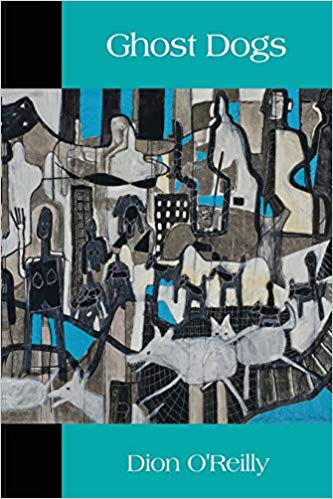
Dion O’Reilly’s Ghost Dogs is polished, powerful, and deeply rooted in the landscape of the Pacific West. The poems tell a compelling story of a life with many challenges, exalted by a sense of the marvelous. Her writing sings with astonishingly fresh imagery, and fully experienced emotion. The poems touch every sense, her metaphors are strikingly original. Ghost Dogs gives a summation of a life, with the poet finding wells of emotion in the most unlikely places—a pig about to be shot by a butcher, or a thumb she sucked until well into adulthood. There is such a fierce appetite in this book, a hunger for the depths and heights of human experience, described with abandon mixed with great refinement.
—Zack Rogow, author of Irreverent Litanies and The Number Before Infinity
I may be a little biased because I had Dion as a teacher both for English class and Spanish.
As a teacher she was a fascinating woman and very entertaining; it’s been nice to see the person who taught me my grammar to put it so eloquently into practice. (Forgive my grammar now, I lost most of it I’m sure)
“Ghost Dogs” takes you into the life of Dion O’Reilly. You are shown her most intimate moments of pain and struggle that eventually shaped her to become the poet she is today. She doesn’t shy away from the scary thoughts we all have from time to time that we try to alienate and push away. We see this in poems like Alaska and Looking.
Anyone who has lived in Santa Cruz, grew up on a farm, has lived through parental or spousal abuse or has loved a dog will strongly relate to these poems.
The collection is quite pleasant as a full read, recalling themes of fire, nature, abuse, primordial time, love, and mans best-friend throughout.
Dion, humble in her approach with poems mentioning the insecurity of arrogance all artist have, has actually done what she has set out to do: to put into words moments of love and sorrow and transport us there alongside her.
Dion I hope this book was as cathartic to write as it was for me to read. Thank you for sharing who you are and letting us know we’re not alone in our thoughts and experiences.
Quite a set of poems - ranging from very good dogs and an abusive childhood to aging as an adult and looking back on the past. My favorites were "Everything That's Old," "Ode to the Dog," "Afterlife," and "Given." Honorable mentions to "Dead Dog" and "Ghost Dogs."
'Indelibly visceral' are the first words that come to mind when reflecting upon Dion O’Reilly’s poetry, and her first major collection is both unflinchingly transparent and starkly defiant in tone. Ghost Dogs invoked no small measure of delight, sorrow, wonder, horror, and laughter within my reading experience, but it’s the reflective aftermath her work inspires that makes me so hungry for more. How to pay homage to such a radically honest depiction of the heights and depths of a life lived so far? Declare it as the triumph it is.
These are the kind of poems that sneak up on you. The mundane is juxtaposed with the horrifying, so that the mundane becomes horrible and the horrifying becomes ordinary. The best poems in this collection are the ones which feel like a gentle caress to the cheek immediately following a slap. My favorites were "Liberal Father", "White Hawk", and "Afterlife".
I did a reading with Dion O'Reilly and she was SO GOOD I basically immediately bought her book. Funny and sad and a little bit transgressive sometimes, which is a combo I quite enjoy.
A collection of poems about family, abuse, the Pacific Northwest, trauma, and survival.
from Scavenged: "The body's scarred terrain becomes / consecrated field. We gather to pick / through the pieces that remain— / an ear hanging from its hinge of skin, / diamond stud in the lobe, ring finger / shining with its promise-band of gold."
from Afterlife: "I wish I could tell you how seldom / I go to the bottomland, how there are gates / on the trails, and the land, disgruntled, / sends up walls of slick poison oak. / How the herons lift and glide away, legs trailing, / their calls on the wind."
from Disappearing: "Isn't it better / to see the future as fierce joy? / Feel the wonder of knowing our gods / take guidance from other gods / who chose us."
A short while ago, I had the honor of driving Ms O'Reilly home after a poetry reading. She killed at the reading evoking laughter and tears with ease and in equal measure. I looked forward to reading her work and I was not disappointed. Ghost Dogs is her debut collection and although it circles around many topics the focal point seems to be child abuse when the abuser is the Mother and it's the Father who is tragically inactive. The poems in this collection individually and collectively do what poetry does better than any other artform, turn trauma into art.
Dion’s poetry is knock you over powerful. I read each poem multiple times and only one or two per sitting to fully digest the nuance, word choice, and layers of meaning. While I know her personally as well as the locale that serves of so much of the subject and setting, each poem was a revelation.
I was given this book in my NOR internship class, to write a book review on. I found it to be a touching collection of poems about aging, loss and the effects of abuse.
French kiss is such an amazing poem that I think exemplifies the primal themes of this book, so many incredible deep dives into humanity and what makes us tick and want
The following review is in the cDion O’Reilly’s debut collection reflects her life in California. The book is divided into five numbered sections. These poems reveal fresh connections that take the reader by surprise. “Pilgrim” starts as a poem about surfers who “can’t stop travelling west, an endless summer/ of shore breaks and peak breaks to a sun that never sets.” And then the turn that grabs the reader and doesn’t let go: “I knew a man who wanted me like that.”
The title poem, included in the second section, is an ode to “companions/through the long years of childhood.” A lovely premise, until the speaker tells us these dogs were mastiffs, followed by vivid description such as “ferocious muzzles breathing steam.”
O’Reilly masters the unexpected with twists and turns like a kaleidoscope; her poems start with a universal and turn inward, the connection subtle, or the reverse, as in “Scavenged,” where the speaker tells us about a burn so severe it required hospitalization, where “Each day, they peeled me/like velcro from my sheets.” She then shares that, like those who want to know what happened to her. She’s “stared/at a leg’s nubbed end” and “wanted to know how that man was alive.”
One of my favorite poems is “Scars.” It took me two readings to recognize this as a list poem. The poem begins with obvious scars received “from playing barefoot all summer,” progresses to “knee-bruises of childhood,” and concludes with emotional scars, the speaker wondering “if these are lacerations so deep/there is no greater pain.”
While O’Reilly doesn’t hold back on the hard stuff-subject matter includes child abuse and dissolution of relationships-these poems are so well-crafted that the reader will keep returning to them, looking for more connections, and delighting in discovering them.