Interesting little book about language which i'm super interested in because i believe that the language you use can genuinely impact behavior. What you say you think and what you think you become …..
Here are the best bits from the book:
How, in the best instances, false beliefs and discoveries totally without credibility could then lead to the discovery of something true (or at least something we consider true today.
In the course of the following centuries- until the seventeenth- translated and paraphrased many times into various languages and versions, the letter had a decisive importance in the expansion of the Christian West toward the Orient. The idea that Beyond the Moslem territories there could be a Christian kingdom justified all ventures of expansion and exploration. Prester John was discussed by Pian del Carpine, William of Rubruck, and Marco Polo. Around the middle of the fourteenth century the kingdom of Prester John shifted from a vague Orient toward Ethiopia, as the Portuguese navigators began their African explorations. Attempts to communicate with John were made in the fifteenth century by Henry IV of England, by the duc de Berry, by Pope Eugene IV. In Bologna, at the time of the coronation of Charles V, there was still talk of Prester John as a possible ally in the reconquest of the Holy Sepulcher.
Where did Prester John's letter come from? What was its purpose? Perhaps it was a document of anti-Byzantine propaganda, produced in the scriptoria of Frederick I. But the problem is not so much its origin (fakes of every description were abundant at that lime) as its reception. The geographical fantasy gradually generated a political project. In other words, the phantom called up by some scribe with a knack for counterfeiting documents (a highly respected literary activity of the period) served as an alibi for the expansion of the Christian world toward Africa and Asia, a welcome argument favoring the white man's burden.
The text revised by Rachovskij probably represented the primary source of the Protocols of the Elders of Zion. Rachovski's version reveals its novelistic source because it is scarcely credible, except in a novel of Sue, that the bad guys should express so openly, so shamelessly, their evil plans. The Elders freely declare that they possess "boundless ambition, devouring greed, a pitiless desire for vengeance and an intense hatred." They want to abolish freedom of the press, but they encourage libertarianism. They criticize liberalism but support the idea of capitalist multinationals. To provoke revolution in every country they mean to exacerbate social inequality. They want to build subways the better to mine the big cities. They want to abolish study of the classics and ancient history; they mean to encourage sport and visual communication in order to make the working class stupid.
Thus Creation itself arose through an act of speech; it was only by giving things their names that God created them and gave them an ontological status.
Language must reflect the order of ideas
Adam could conceive ideas only through hearing linguistic sounds.
Before the Renaissance, a Christian thinker would scarcely wish to admit publicly that he drew on Hebrew doctrine. Like heretics, the Jewish community belonged to a category of outcasts that as Le Goff shrewdly observes the Middle Ages officially despised but at the same time admired, regarding them with an admixture of attraction and fear, keeping them at a distance but making sure that the distance was fixed near enough so they would always remain close at hand. *What was termed charity in their regard more resembled the game that cats play with mice."
We (in the sense of human beings) travel and explore the world, carrying with us some "background books." These need not accompany us physically; the point is that we travel with preconceived notions of the world, derived from our cultural tradition. In a very curious sense we travel knowing in advance what we are on the verge of discovering, because past reading has told us what we are supposed to discover. In other words, the influence of these background at books is such that, irrespective of what travelers discover and see, they will interpret and explain everything in terms of these books.
They had pelts like buffalo, and their hooves were as big as elephants. Their horns, too, were not white but black, their tongues were spiky, and their heads looked like wild boars? In fact, what Marco Polo saw was the rhinoceros. We cannot say Marco Polo lied. He told the simple truth, namely, that unicorns were not the gentle beasts people believed them to be. But he was unable to say he had found new and uncommon animals; instinctively, he tried to identify them with a well-known mage.
The advantage of this way of speaking is that you become philosophers, learning the prime elements, and in this country, nothing can be named without explaining at the same time its nature, which would seem miraculous to those unaware of the secret that they use to this end.
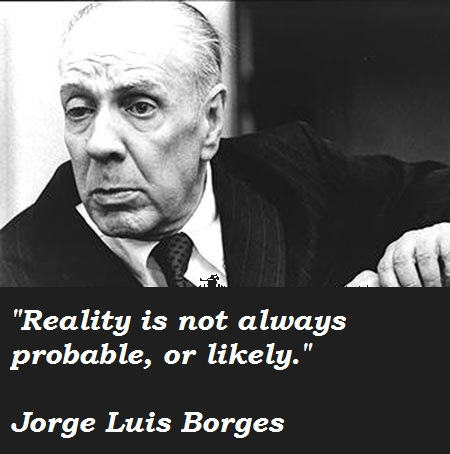
Borges speaks of a language structured spatially and not temporally, which proceeds not through agglutinations as in the languages so far examined but only by expressing temporal flow. In this language, nouns do not exist, but only impersonal verbs qualified by monosyllabic suffixes and prefixes with adverbial value. In brief, " there is no word corresponding to the noun moon, but there is a verb to moon or to moondle. The moon rose over the sea would thus be written hlör u fang axaxaxas mlö, or, to put it in order: upward beyond the constant flow there was moondling" (which suggests some passage in Joyce's Finnegans Wake)
I would like, however, to underline a fact, whose obviousness is undeniable, namely, the prodigious talent demonstrated by young peoples in forming words and, on the other hand, the absolute inability of philosophers to do the same, in the most refined centuries.
From these three words, CAro DAta VERmibus they have formed the word CA-DA-VER, "meat abandoned to the worms.? From two other words, MAgis and voLO, they have made MALO and NOLO, two splendid verbs that every language, Greek included, can envy Latin.
..The French have not totally ignored this system. For example, to give a name to those who were our ancestors, they formed the word AN-CETRE, joining part of the word ANCien [old, ancient] with the verb ETRE to be], just as they formed the term BEF-FROI [alarm bell], joining Bel [beautiful] and EFFROI [fright]. You see then how they utilized the two terms DUo and IRE to form the verb DUIRE, [to go in a pair] and, through natural extension of the verb condurre [conduct, lead], diriger [direct]. With the personal pronoun SE, with the relative adverb of place HORS [outside] and with the verbal ending TIR, they formed S-OR-TIR [to go out], that is, SE-HORS-TIR "to put one's own person outside the place where it was." All this to me seems wondrous.