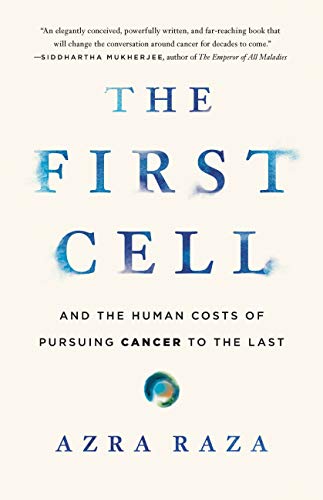
Azra Raza is a professor of medicine at Columbia University and a practising oncologist. She specializes in and researches myelodysplastic syndromes (MDS), which the Canadian Cancer Society describes as “a group of diseases in which the bone marrow doesn’t make enough healthy mature blood cells.” Immature blood cells—blasts—don’t function properly, and they build up in the bone marrow and blood. Healthy red blood cells, white blood cells, and platelets are crowded out; there are fewer of them to do their vital work. MDS patients, who are usually older, often have debilitating anemia and require frequent blood transfusions, though some can be successfully treated with thalidomide. MDS used to be thought of as disease of low malignant potential, pre-leukaemia, but the syndrome is now considered blood cancer. One third of MDS patients go on to develop acute myeloid leukaemia (AML), another disease researched and treated by the author.
In over three decades of practice, Dr. Raza has cared for thousands of people with blood cancers. In her book, she tells the stories of several of these patients, as well as providing accounts of bright young people with other cancers—one, an intellectually gifted family acquaintance diagnosed with an aggressive sarcoma of the shoulder; the other, her daughter’s close friend, a young man in his early twenties, stricken with a lethal glioblastoma of the spinal cord. In a tender touch, she provides photographs of these patients, making them even more real and present for the reader. She documents how they negotiated their illness, made medical decisions, and confronted their end.
The author notes that over the years the billions of dollars directed towards cancer research have yielded valuable knowledge about its biology, but medicine has frustratingly little to show for this enormous investment in terms of actual treatments. Most of what is offered to the AML patients she sees (as well as to those with the most common types of cancer) has changed very little over the last forty to fifty years. Raza’s husband, cancer researcher Dr. Harvey Preisler—who himself succumbed to lymphoma in the early 2000s and whose suffering she describes in one chapter of her book—received the same combination of drugs that was used in 1977. Only about five percent of new cancer drugs are actually approved, and 70 percent of those provide no improvement in survival rates and are even harmful to patients. (America’s FDA is willing to approve an agent if it can prolong survival by 2.5 months over existing treatments—even if that additional couple of months is a living hell.) Treatments that are deemed “successful” employ the same old “slash-poison-burn approach” to cancer that’s always been used. While some novel immune therapies for lung cancer, lymphoma, and melanoma have come on the scene in recent years, they benefit only a few, and their cost is prohibitive. Even families with insurance plans frequently lose their life savings pursuing treatment for an afflicted loved one. Recent declines in cancer mortality rates are due to early detection—as is seen with colon and cervical cancer, for example—and smoking cessation. Given these realities, it’s not at all surprising that Raza’s impassioned main argument in the book is that cancer research needs to radically change.
The author aptly describes cancer as an example of malevolent “intelligence at a molecular level”. Perceiving its environment, it “takes actions that maximize its chances of survival,” becoming “stronger, smarter, and more dangerous with each successive cell division.” Many cancers are are still only diagnosed when they are quite advanced and extremely complex, having quickly transformed themselves, eliminating genes and entire chromosomes and acquiring multiple mutations. At this point, they are next-to-impossible to successfully treat. What is needed, says the author, is a commitment “to stop chasing after the last cancer cell and focus on eliminating the first” or, even better, “prevent the appearance of the first cancer cell by finding its earliest footprints.” She points out that oncologists and researchers are “already using sophisticated technologies to detect residues of disease that linger after treatment.” Why not harness and redirect these technologies to discover cancer early before it has laid waste to the body, she asks, pointing to the work of Bert Vogelstein’s team at Johns Hopkins, whose members are looking for the earliest markers (mutations, molecules, and metabolites) of breast, colon, lung, and pancreatic cancers in body fluids.
Early in her career, Dr. Raza treated a woman her age, a young mother in her thirties, who was terminally ill with acute myeloid leukaemia. Heartbroken that she could do little for a patient she had quickly grown to love, she took a decisive step in 1984: She began to build an MDS-AML tissue repository, banking samples from bone-marrow biopsies in order to study how these blood cancers evolve. Her tissue bank, which contains over 60,000 samples from thousands of patients, is the world’s oldest one created by a single doctor. A great challenge for Dr. Raza is actually gaining the research funds to carry out her work. She often has to court celebrities and hold benefits to get the financial backing needed to keep her project going.
The idea of actually harnessing new technology to look at “disease-caused perturbations” years ahead of their clinical appearance is not yet widely embraced by a “sclerotic” cancer industry. Over the years a huge bureaucracy and byzantine funding process has developed around in vitro and animal studies, even though these have yielded little of practical value to patients with cancer. Raza does not advocate for the abandonment of these studies, but she does offer an illuminating explanation of their limitations. Cultured cells are grown in controlled environments, quite unlike their natural ones, and the cells are forced to adapt to this hostile habitat. In time, they diverge wildly from their parents, genetically and in form and structure. Their doubling time is also much faster. While animal models may offer cell lines an environment more comparable to a human’s than petri dishes do, the complexity of the human environment is not fully understood and consequently can’t be replicated. Mice and human lineages diverged approximately 85 million years ago, and human and mice genomes are only about 50 percent identical. The life cycle of a mouse is short (three years), and the animal reaches sexual maturity at six to eight weeks. Furthermore, its metabolic rate is seven times faster than a human’s, so drugs are very rapidly metabolized in mice. Doses for clinical trials have to be drastically reduced because of the much slower metabolism of humans. Perhaps most critically, the immune system of mice evolved to be very different from that of humans. Ours developed to combat airborne pathogens and mice’s to handle earth-borne ones. A target lab mouse is healthy—not debilitated, as a human cancer patient is. Its immune system would naturally reject transplanted human cells; therefore, its immune system has to be destroyed before human cells are introduced. Needless to say, the tiny bodies of immunocompromised creatures hardly resemble the ones in which human cancer cells thrive. Yet, writes Raza, scientists have expected these transplanted cells to help them identify useful drugs for cancer patients.
The First Cell
is an ambitious, rich, and informative book. It is also a demanding one at times. It will reward the persistent and motivated lay reader. My chief criticism is that it is occasionally repetitive. I believe some judicious cuts would have served the book well. As a lover of literature, Dr. Raza includes passages from great novelists and poets, but I’ll admit to having struggled at times with their pertinence. However, these are relatively minor complaints about an illuminating book that I’m glad to have read—one with a message that deserves to be heard.
Thanks to the publisher and to Net Galley for providing me with a digital copy for review purposes.