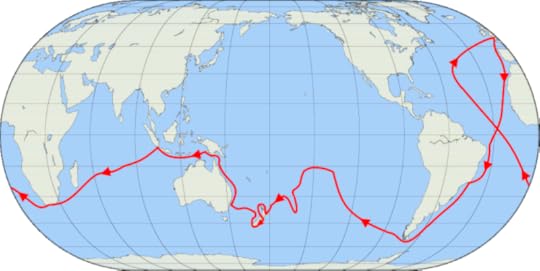
In 1768 Captain James Cook and his crew set sail on a small British naval vessel, the boldly named Endeavour , bound for the Pacific Ocean. He was ordered to establish an observatory at Tahiti in order to record the 1769 transit of Venus, and – with the skills of naturalist Joseph Banks and his team – to collect natural history in this far part of the world. But Cook’s brief also included a secret mission from the British to discover Terra Australis Incognita, an unknown southern land that might prove to be larger and richer than Australia.
Cook was not alone in this quest, and the Endeavour shared the Coral Sea and coastal New Zealand with an armed French merchant ship commanded by Jean de Surville. Eventually in 1770 Cook’s ship crossed the Tasman Sea and reached the southern coast of New South Wales. Sailing north, he charted Australia’s eastern coastline and claimed it for Great Britain. It was the most significant of Cook’s voyages, transforming the world map and the way Europeans viewed the South Pacific Ocean and its lands and peoples.
On this 250th anniversary of his major discovery, Captain Cook’s Epic Voyage reveals the hardships, adventure and achievements of Cook’s most important voyage. Reshaping his previous book, Sea of Dangers, Professor Geoffrey Blainey takes us on a vivid journey, challenging accepted views and the intersection of myth, science and exploration.
Geoffrey Blainey, one of Australia's most eminent historians, was appointed the foundation Chancellor of the University of Ballarat (UB) in 1993 after an illustrious career at the University of Melbourne. He was installed as UB Chancellor in December 1994 and continued until 1998. The Blainey Auditorium at the Mt Helen Campus of UB is named in his honour. Blainey, always a keen exponent of libraries and the acquisition of books, has donated part of his extensive book collection to the UB library. In 2002 the honorary degree of Doctor of Letters was conferred on Blainey in recognition of his contribution to the University of Ballarat and to the community in general.
Educated at Ballarat High School, Blainey won a scholarship to Wesley College, before attending Melbourne University where he studied history. He worked as a freelance historical author writing mainly business histories such as The Peaks of Lyall; Gold and Paper; a History of the National Bank of Australasia; and Mines in the Spinifex. Blainey accepted a position at the University of Melbourne in 1962 in the Faculty of Economics and Commerce. He held the positions of Professor of Economic History (1968-77); Senior Lecturer 1962; and from 1977-1988 he occupied the Ernest Scott Chair of History at Melbourne University. Professor Blainey also held the chair of Australian studies at Harvard University.
As an economic historian, Blainey challenged the conventional view, questioning accepted contemporary understandings of European settlement of Australia as a convict nation, Aboriginal land rights, and Asian immigration. He is described as a 'courageous public intellectual, a writer with rare grace and a master storyteller'. In a reassessment of the life of Blainey, 'The Fuss that Never Ended' considers his ideas, his role in Australian history, politics and public life, and the controversies that surrounded him.
He was always popular with students. According to the Melbourne University home page 'When Geoffrey Blainey spoke to final-year students in the Friends of the Baillieu Library HSC Lectures in the 1970s, the Public Lecture Theatre was packed to capacity and his audience carried copies of his books to be signed, a tribute to what Geoffrey Bolton characterised as his "skills in interpreting technological change in admirably lucid narratives that appealed to both specialist and non-specialist audiences".
Among his most popular works are the 'The Rush that Never Ended: A History of Australian Mining'; 'The Tyranny of Distance'; 'A Shorter History of Australia'; 'A Short History of the World'; and 'The Origins of Australian Football'.
In 2000 Professor Blainey was awarded the Companion of the Order of Australia for service to academia, research and scholarship, and as a leader of public debate at the forefront of fundamental social and economic issues confronting the wider community. At that time the University's Vice-Chancellor Professor Kerry Cox said 'Geoffrey Blainey guided the new and inexperienced university through its first four years with a benevolent but firm hand. This time was challenging as the university strove to make a place for itself in higher education, grappled with funding cuts and the eventual merger with neighbouring TAFE institutes. For those at the university fortunate enough to work with Geoffrey Blainey during his time as Chancellor, they witnessed first hand his humility, and we are proud of his role in our history.'
In 2002 the degree of Doctor of Letters was conferred on Professor Blainey in recognition of his contribution to the University of Ballarat and the community in general. The same year Blainey donated a collection of material to the University of Ballarat. Included in this collection are historical books, papers and other material relating to the early history of mining and the central Victorian goldfields. A second generous donation of material was received in 2005. 'The Geoffrey Blainey Mining Collection' is l
the one where captain cook puts on his big boi pants and sails on his first ever round-the-earth voyage. (took him 3 years)
the official mission was to take measurements of the rare venus transit somewhere in tahiti, but the secret mission (there was always a secret mission) was to find the mysterious continent in the south (terra australis) - and i dont mean australia, that had already been discouvered at that point by the dutch (hence the name new holland). no, terra australis was a different beast entirely and why were they so sure of the existence of this mythical continent? well, it's obvious! why would god put so much land in the north but not in the south to even things out?? made no sense, man.
(spoiler alert! they found jackshit)
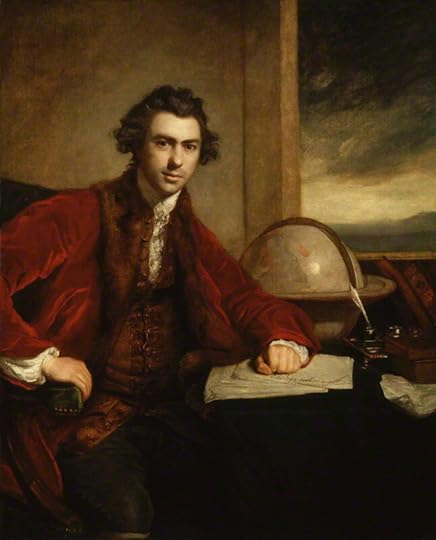
besides cook, we have another big player entering the picture. joseph banks, the gentleman scientist.
those two couldnt be more different. mr. grumpy & mr. sunshine trope in action.
the book was a quick and easy read albeit a bit inflated round the edges. like, we have some chapters devoted to a french ship captained by de Suville that just happened to be in the same area around the same time. why we needed that information im not sure esp since they never even crossed paths.
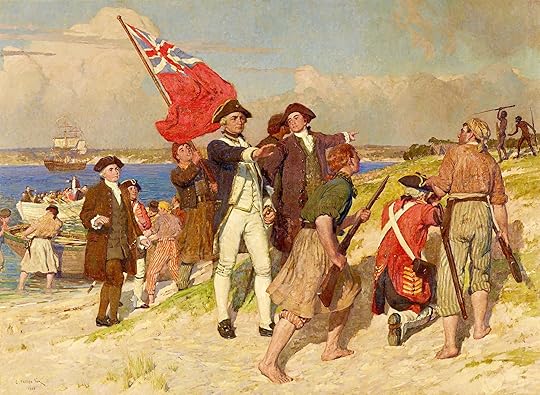
captain cookie doing what he does best - pointing at things. (actually his gesture made no sense to me until i realized he was trying to stop the roughshod sailors from shooting at the aborigines)
all in all a decent read but not as good as the wide wide sea.
This is a very comprehensive story of Cook's voyage to "discover" and chart New Zealand and Australia. What really impresses is the bravery of these guys. Imagine trying to navigate Australia's Great Barrier Reef with no charts. One bad mistake and you and your crew are at best shipwrecked and at worst dead half a world from home with no chance of rescue. Cook was smarter or luckier or both than the French ship which was in the area at the same time. Very impressive person, Cook.
A good but not great volume. The magnificent voyage of James Cook and Joseph Banks is worth chronicling, and luckily there are now several modern volumes on the subject. Cook was a brilliant navigator, his task was of the kind so daunting as to be almost impossible for us to imagine now (aside from space travel), and its implications - for both science and geopolitics - endlessly reverberating. Blainey is one of our most eminent historians (in spite of some rather notable lapses in terms of his publicly-proclaimed views over the last 40 years) and is a good fit for such a tale. This book is actually a rewriting of a volume from a few years ago which focused more strongly on comparing the voyage of the Endeavour with that of the French vessel St Jean Baptiste which came in the other direction at the same time, narrowly missing Australia in an almost comical, but understandable, set of circumstances.
This is a well-told tale with a sound bibliography and a sense of excitement for how the journey must have felt to those onboard. If I may be bold, it occasionally betrays the challenges of an elderly writer (Blainey turned 90 the year this was published) and an editorial team who perhaps weren't inclined to push against the wishes of a local luminary. Sentences occasionally read a bit boorishly; there are adjectives repeated ad nauseum, for example the word "retarded" (in its original sense), which is fine although one begins to wonder when it is used so many times!; and not infrequently one ponders a particular word choice, as with the book's subtitle: "The strange quest for a missing continent". I see how "strange" is not inaccurate, but it doesn't seem especially apposite either.
These are minor complaints, although the book never reaches the grandeur and depth that made Blainey's classic works so vital to our understanding of Australian history. Nevertheless, a useful overview of a pivotal moment in time.
A very readable history of Cook's first great voyage of discovery. There are lots of pleasing colourful details: the Endeavour's cook had one arm so Cook tried to get rid of him but the Navy insisted he be employed as it was their way of looking after injured sailors; Joseph Banks took two grey hounds with him on the tiny ship which seems extraordinary, the stories of the two dogs is followed so we don't wonder what happened to them, one was set after a kangaroo but lost it in the long grass etc
There is a gentleness and confidence that I find lacking in most works written by professional historians. generally they can't bring themselves to leave things out and don't write very well, you get the feeling they are more worried that their academic colleagues will criticise them over some trifling point than they are about writing a readable story.
As a NZer I enjoyed especially the careful reconstruction of d'Urville and Cook's almost meeting near the top of the North Island, surely one of the most remarkable things that could have ever happened in history had they met. There are a few other "what ifs" that Blainey focuses on, such as the breath of wind that allowed them to escape a passage to clear sea or if the Endeavour had not floated off the rocks and how different the fate of the voyage and history would have been. This also extends to the fragility of the knowledge gained, if the Endeavour had sunk anywhere along the voyage - a freak wave perhaps or captured by a rival power in a war that had been declared in their absence and the whole enterprises would have been almost for nought.
The last little detail of the globe trotting goat aboard the Endeavour that lived out its days with Mrs Cook wearing a collar with a special inscription by Dr Samuel Johnson is typical of this charming book. Blainey is careful to present the point of view of the Maori and the other indigenous peoples as well and this is done thoughtfully. Learning that the famous Aboriginal words like kangaroo, wombat, didgereedoo etc were actually words used by a very localised indigenous group was fascinating.
This is an interesting book. The passion for Cook and his achievements clearly shines through. However, certain parts of the book covering some of the more abhorrent interactions between Europeans and various indigenous peoples come across as extremely callous, almost as though they are scientific curiosities rather than people.
Maybe that just reflects the source material, but a bit more acknowledgement from Blainey wouldn’t have gone astray.
I also think some of the more sweeping statements in the post-script about western civilisation were probably unnecessary. For mine, Rob Mundle remains the go-to author for Australian maritime history.
A terrific story of magnificent sea voyages and the people involved. Blainey brings history alive with huge amounts of research underlying vivid storytelling. This one became a bit tedious - probably like the voyage itself...
Outstanding and well documented compilation of events. A must read for Australians and those interested in exploration, 'discoveries', colonisation, geography and human history.
This is a gem, although I don't think I have ever read a book by Geoffrey Blainey that I haven't fully enjoyed. OK, so I am prejudiced in his favour so you can either disregard or not read any more of my review. I must admit I wish I had have been a student at Melbourne University when he was the Prof as he seems so much depth to what he writes. This is the best history of Cook that I have read and as well as the narrative Blainey tells a great deal about sailing and the conditions of seaman, the diet and other aspects of the age. Just as an example, I always thought that Cook was short, 5 ft 2 or 5 ft 4, in common with the age, which I think I got from Captain Cook's Cottage in Melbourne Fitzroy Gardens, whereas he was above average for the period and was 6 ft plus. I totally recommend this to anyone who likes reading about history, particularly of Australia.,