In the dusty north Texas town of Thalia, young Lonnie Bannon quietly endures the pangs of maturity as a persistent rivalry between his grandfather and step-uncle, Hud, festers, and a deadly disease spreads among their cattle like wildfire.
Larry Jeff McMurtry was an American novelist, essayist, and screenwriter whose work was predominantly set in either the Old West or contemporary Texas. His novels included Horseman, Pass By (1962), The Last Picture Show (1966), and Terms of Endearment (1975), which were adapted into films. Films adapted from McMurtry's works earned 34 Oscar nominations (13 wins). He was also a prominent book collector and bookseller. His 1985 Pulitzer Prize-winning novel Lonesome Dove was adapted into a television miniseries that earned 18 Emmy Award nominations (seven wins). The subsequent three novels in his Lonesome Dove series were adapted as three more miniseries, earning eight more Emmy nominations. McMurtry and co-writer Diana Ossana adapted the screenplay for Brokeback Mountain (2005), which earned eight Academy Award nominations with three wins, including McMurtry and Ossana for Best Adapted Screenplay. In 2014, McMurtry received the National Humanities Medal. In Tracy Daugherty's 2023 biography of McMurtry, the biographer quotes critic Dave Hickey as saying about McMurtry: "Larry is a writer, and it's kind of like being a critter. If you leave a cow alone, he'll eat grass. If you leave Larry alone, he'll write books. When he's in public, he may say hello and goodbye, but otherwise he is just resting, getting ready to go write."
Larry McMurtry wrote this brilliant coming-of-age novel in 1962 when he had barely come-of-age himself, at just 25 years old. This, the first of thirty-something novels he'd write in his life, is a gorgeous commencement to a remarkable career. It's also a gorgeous commencement to my reading year.
The story is set in Thalia, Texas (the same little town I visited in The Last Picture Show), on a cattle ranch belonging to Homer Bannon, a tough, grizzled horseman. He's old, and is the grandfather of the narrator, 17 year old Lonnie. It's through Lonnie's eyes that we see the both the brutal and the beautiful aspects of ranch life. It's mainly brutal, I'd say, and lonely, and dangerous. No romanticizing the cowboy here. But there are lovely moments too, all the more meaningful for their rarity, in the occasional spark of wild freedom, sweet cherry pie made by a kind soul, a magnificent sunrise.
Lonnie is motherless, and full of the hungers of a young man his age. So the severe life on the ranch is also coloured with his longings, a startling juxtaposition, and one that moved me. It warms the melancholic story, infuses it with the hopeful energy of desire, whether it's for the soft tops of a woman's breasts, or for a better life.
We can't blame him for wanting something better. While he has a friend in Halmea, the housekeeper, his life is hard and uncertain, especially after a case of foot-and-mouth infests the cattle. He's also got an unpredictable step-uncle, Hud, who is extremely cruel and violent.
At times, the description gets a little long for my liking. I do understand the importance of setting in this book, and how McMurtry needs to put us there (and he does, with such fine, atmospheric prose). But there are parts that seem a bit much, stalling momentum. Long paragraphs really are the death of me. That aside, what an elegant debut - and only 171 pages?? Yeehaw!
As I mentioned, this isn't a romantic, sentimental take on western life. At the end, though, I couldn't help but feel my heart quicken for those old horsemen of the past. I caught my breath, I wiped a tear.
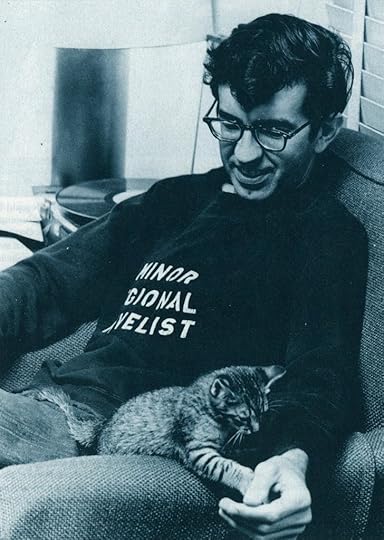
Larry McMurtry sometimes referred to himself in interviews as a “Minor Regional Novelist.”
From what I can tell, he was always sincere in downplaying his craft and his work’s impact on the world.
I can’t speak to The Cowboy’s impact on the world, but his influence on my own life has been exceptional, and I can’t credit any other writer with having inspired me more than he has.
I have dangled his debut novel, HORSEMAN, PASS BY, in front of me for decades now; not like a simple garden variety carrot, but, rather, a Kyoto Red. Dangled it, knowing that, as soon as I’d read it, I’d never be able to read it for the first time again.
When I saw that it was time for my to write my 1,000th review, I thought: Okay, the time is good. The time is now.
As I was reading it, marveling at, frankly, every sentence, I kept thinking: I can’t give this 5 stars! If LONESOME DOVE is 5 stars (5 trillion stars), then how can this little debut, published in 1961, garner the same damned attention?
Here’s my conclusion: it just does.
This is a coming-of-age novel so immersive, Larry McMurtry must have blinked and scratched his head, wondering who he was, every time he looked up from his typewriter.
The title was taken from a famous line in one of Yeats’ poems, “Under Ben Bulben,” and it is a nod to this fleeting journey we take here as human beings.
There is violence here, including a brutal rape and cruelty to animals. It is, in essence, what I don’t want to read, and if it had been written by someone less than a master, I’d never have bothered to subject myself to such misery.
I made the mistake of finishing this story in a waiting room at my daughter’s school, filled with other parents. I got to the point where I was crying so hard, I was literally pressing my fist to my mouth, to try and slow the flow of tears.
Minor Regional Novelist? I don’t think so, sir.
All of them wanted more and seemed to end up with less; they wanted excitement and ended up stomped by a bull or smashed against a highway; or they wanted a girl to court; and anyway, whatever is was they wanted, that was what they ended up doing without.
4+ stars - The only book I’d ever read by Larry McMurtry before this one was ‘Lonesome Dove.’ I tried one other, can’t remember which, but it didn’t go down like the first, and I put it aside. ‘Horseman, Pass By’ is McMurtry’s first novel, written when he was 25 years old, published in 1961. It’s remarkable for its rich characters, place setting, and complex themes.
Halmea was probably my favorite character. She is a black housemaid and cooks for the Bannon household, living in a shack on the property. Of note is her ability to please Grandma, Homer Bannon’s second wife, undoubtedly the hardest job on the ranch. Admittedly, she will sit and read a romance novel and put off washing the dishes, but she unabashedly lives in her own skin. 17-year-old Lonnie Bannon is the main character and it is from his perspective that we will see everything unspool. This is a novel that shows the objectification of women. Men speak about women in blatant sexual terms and this is the environment in which Lonnie is coming of age. He has a crush on Halmea but he also knows her as a person. McMurtry shows that Lonnie is also a creature of his environment and as such will have this push-pull between seeing her as a person and as an object.
Lonnie’s grandad is Homer Brannon, an octogenarian who owns their ranch in Texas. Homer puts in a hard day’s work and he’s ready to go to bed not long after eight at night, just after the train goes by and blows its whistle, reminding him of lonesome days when he would gather with his cowboy friends around the fire on roundups. Homer owns a couple of longhorns and an old bull. They are emblematic of Homer, reminiscent of the old ways and times gone by. Homer is an active person, lining up the work for the day, in charge of the two cowboys who work for him, and Lonnie falls in line with this, spending days fencing and other laborious jobs. For the first time, Lonnie is starting to notice that his Grandad is old. When a young heifer falls dead, and a veterinarian is called to ascertain the cause, a series of events unfold that will take a toll. Homer Brannon has survived many hard and tragic times, but he’s older now.
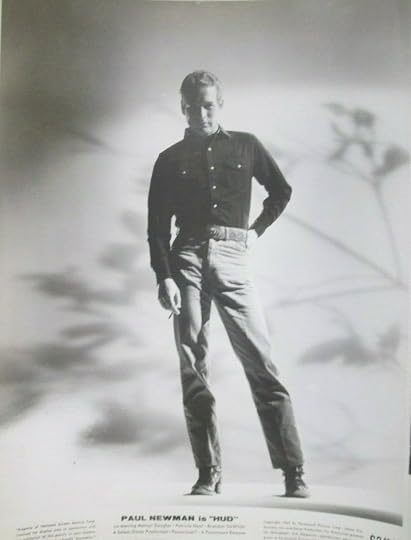
Homer’s stepson is Hud. The title of the movie based on this book is ‘Hud.’ Paul Newman stars and the trailer says “the man with the barbed wire soul.” That’s an apt description. In the first two pages of Hud’s introduction, McMurtry uses words like “shoved,” “smirked,” and “sourness.” The violence in this man is clearly evident, but the family members have accepted it and step around it, look away from it, or deal with it the best they can. I’ve known people like Hud, who are determined to cause trouble any way possible, but most are more subtle. The barbed wire in them will cut you coming and going, but you might not know what hit you till you start pumping blood. There’s a cruelty in them that wants to see somebody else bleed. The brutality in Hud is too deep for subtlety. Catalysts for change in real life just as they are in novels, they will suck the air out of a room or off of a page. Seldom have I met a character that I disliked more intensely.
Jesse is the hired hand. He’s a lonesome type and Lonnie thinks Jesse is always feeling sorry for himself. Lonnie spends a lot of time with Jesse, soaking up stories about the rodeo circuit, being on the road, and seeing a myriad of different places. It seems like Jesse is settling for the life he has without the will to try for anything better.
The movies that McMurtry writes about, the songs they listen to on the radio, and the setting all immerse me in Thalia, Texas in 1954. Lonnie was the perfect protagonist, young enough for those indelible impressions and too young to have any influence on outcomes. This is a solid 4-star book for me but goes to a 4+ for McMurtry’s beginnings and endings. This book ends twice, the first time so simply and perfectly that it just left my mouth and heart in a sigh of oh. The second time, in the epilogue, I say to myself, how can he do that again in so few pages.
“He told me that nature would always work her own cures, if people would be patient enough, and give her time.”
“Horseman, Pass By” was Larry McMurtry’s first novel. It is also the first book in what become known as the Thalia trilogy. For the first 20 pages or so the story did not grab me, and then suddenly it did, and I was in full throttle. It is a short text, so once it grabs you it tears you across the finish line quickly! The story takes place on a ranch outside of Thalia Texas in the years after WW II. Told mostly from the point of view of 17-year-old Lonnie Brannon, the primary focus of the novel is Lonnie, his 85-year-old grandfather, and Lonnie’s step uncle, known as Hud. These men, in different stages of life, create as a whole the picture of Texas manhood in all its increments. This is the fifth McMurtry novel I have read thus far, and in all of them there is no judgment. The author does not telegraph how you are supposed to feel or interpret events. He just depicts events with flesh and blood characters, people whose motives you may partially know, or think you know. But judgment on their choices and actions lays squarely on the reader’s shoulders. McMurtry wants no part of telling you how to take it. I love that about his writing! Some highlights in this text for me include: There is a beautiful and atmospheric moment where Lonnie takes a ride on the ranch at sunup. The writing is, in a word, lovely. Late in the book Lonnie attends a funeral of someone close to him, and through his perspective we get a view of death that those of us who have reached middle age have probably forgot we ever had. It is honest, but not cloying. One of the best depictions of a person’s thoughts during a funeral that I have come across. The last line of the Epilogue is a perfect ending, and one that takes a few minutes after reading it to understand why it is so. “Horseman, Pass By” is a modern story of the American west. It is a story about men, and what that can mean. It is about life. It is a book that will still resonate 100 years from now.
So I just finished my reread. It’s 3 1/2 years since my first read. And I did this second read to take in the beauty and strength and depth of McMurtry’s prose once more. It was all there. But I forgot it was going to deal with the tragedy and the pain again, all that I’d pushed to the back of my mind. And reading the words wasn’t any longer about just reading the words. The story took me by the heart and cut me open. And now it’ll never sit at the back of my mind again. Never. But it’ll sit with me, just there, the rest of my days.
🌖 🌒 The sun was going into the great western canyons, the cattleland was growing dark. I saw the road and the big sky melt together in the north, above the rope of highway. I was tempted to do like Jesse once said: to lean back and let the truck take me as far as it was going. I saw the lights of houses as we flashed by in the darkness, the little houses, the ranches and the farms I knew.
Bobby Don drove and hummed some old song whose tune I had forgotten, and I sat thinking about Thalia, making the rounds in my mind. At home it was time for the train to go by, and nobody was sitting on the porch. But for a little while, as the truck rolled on across the darkened range, I had them all, those faces who made my days: Jesse and Granddad, Halmea and Hud.
The cab was dark and the dash light threw shadows across the driver’s face, so that when I looked at him, and saw him pull down his old straw hat and face the road, he reminded me of someone that I cared for, he reminded me of everyone I knew.
🌖 🌒
From my first reading February 2023
🐎 McMurtry like Hemingway tells you the deepest and often enough the hardest things by describing them in how people walk, what the river is like at sunrise, how the sweat feels on your body at high noon, what the stars mean to a man or woman who can’t sleep.
🐎It’s different writing than his Old West novels. The blood and slaughter is gone but the tragedy is still there. It’s very much the realism and reality of everyday life and everyday hurts offered to the reader in rugged everyday prose but prose like a river, a river of shifting colors and poetry in every kind of hue, poetry we all understand and feel to the marrow.
🐎 🐎 🐎
🐂 Riding a bull was the kind of thing you did to prove you didn’t give a shit.
🐄 “Now you go on, Mr. Burris,” Granddad said quietly. “I know this here ain’t your doin’s. I imagine you got enough worries without takin’ on any a mine. I’ll last over this here. You just see about the burnin’, and then get that feller there off my ranch.”
“Well, all I can say is I’m sorry,” Mr. Burris said. “I’m sure sorry.” “
“So’m I,” Granddad said. “Things are just put together wrong. There’s so much shit in the world a man’s gonna get in it sooner or later, whether he’s careful or not. But you go ahead, we ain’t mad at you.”
He held out his hand, and he and Mr. Burris shook
🐴 “I can’t do much about, but the oil-field stuff I can. I don’t like it an’ I don’t aim to have it. I guess I’m a queer, contrary old bastard, but there’ll be no holes punched in this land while I’m here. They ain’t gonna come in an’ grade no roads, so the wind can blow me away.” He looked up again, across the land. “What good’s oil to me,” he said. “What can I do with it? With a bunch a fuckin’ oil wells. I can’t ride out ever day an’ prowl amongst ’em, like I can my cattle. I can’t breed ’em or tend ’em or rope ’em or chase ’em or nothin’. I can’t feel a smidgen a pride in ’em, cause they ain’t none a my doin’. Money, yes. Piss on that kinda money. I used to think it was all I was after, but I changed my mind. If I’d been in this business just for the money I’d a quit an’ started sellin’ pencils or something back before you were born. I still like money as well as any man, nearly, and I done with it an’ without it as much an’ more than most people have, and I don’t ever intend to let on I don’t want a big share of it. But I want mine to come from something that keeps a man doing for himself.”
⛪️ I could hear them whispering how Granddad had gone to a better place. They could think so and go to hell; I didn’t believe it. Not unless dirt is a better place than air. I could see Granddad in my mind a thousand ways, but always he was on the ranch doing something, he wasn’t in any loaf-around eternal life. I could see him riding, enjoying his good horses; or I could see him tending the cattle; or see him just standing in the grass, looking at the land and trying to figure out ways to beat the dry weather and the wind. Those were good places to me, and any one of them was a damn sight better than being in a church house, in a coffin, with a chickenshit snooping around you and a lot of old ladies talking. They could talk Bible till they were blue in the face, and end up dirt too someday. The longer I sat and watched it—the man, the old ladies, the little girls coming in fluffed up like cotton candy—the colder I got, and the worse I hated it all.
🐴 Then I went back outside and stood on the walk in front of the church house, looking at the grass, at the skim-milk clouds, at those blue church-house windows, thinking of the horseman that had passed by.
🌒 The cab was dark and the dash light threw shadows across his face, so that when I looked at him, and saw him pull down his old straw hat and face the road, he reminded me of someone that I cared for, he reminded me of everyone I knew.
This entire review has been hidden because of spoilers.
A powerful and beautifully written book about day to day life on a cattle ranch, which is upended when hoof and mouth disease makes an appearance. Gritty realism from the 17 year old grandson of the ranch's owner who narrates this one. I loved this story of the meeting place of the old West and the new breed. 82 year old Homer Bannon doesn't understand why the government can tell him what to do with his own land. His stepson Hud is an unscrupulous man with no morals, and grandson Lonnie is just trying to make sense of it all. Add in two ranch hands and a cook/housekeeper who is jaded and not surprised at anything, and you have the makings of a classic western drama.
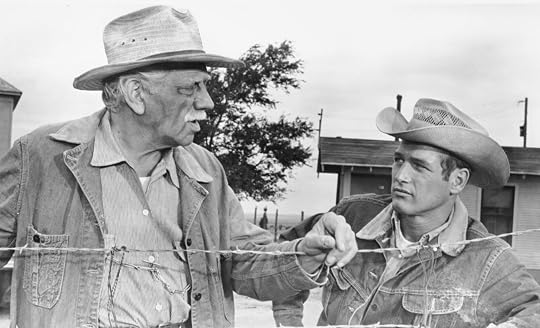
This novel was the basis of the 1964 movie "Hud", starring Paul Newman as Hud and Patricia Neal as the housekeeper, for which she won a best actress Oscar. I saw this movie at least 50 years ago, but it is available on Hulu, so I plan to watch it again soon. I'm not sure what liberties Hollywood took with the book, but I do know of one big one. In the book, the housekeeper Halvea is a black woman.
McMurtry has to be my favorite author because he wrote my favorite book "Lonesome Dove "and so many more classics. This is a fantastic story and McMurtry shows off his uncanny ability to create lovable characters and lives so real you want to try and find them.
Maybe the reason I love McMurtry is the powerful way he evokes the emotional truth of a place through its disparate physical details: the way a man slaps his gloves against his leg or “two young dog coyotes trotting along the edge of a ridge” or “a big freezerful of peach ice cream, rich as Jersey milk.”
In the foreground of this story is the narrator, Lonnie, whose heart is an adolescent reservoir of sexual and spiritual longing. He is the stoic poet, a boy who spends many a night beneath the big fins of the ranch’s windmill to see “across the dark prairie.” Below him, the lights and sounds of the far off town of Thalia, chickens and whippoorwills, create a deep and beautiful melancholy. He says,
Sitting there with only the wind and the darkness around me, I thought of all the important things I had to think about: my honors, my worries, my ambitions.
External to Lonnie’s rich inner life are the relationships of the ranch he lives on. Raised by his grandfather (and the second grandmother), Lonnie is not completely orphaned. The love and admiration he feels for his grandfather, the old-time rancher Homer Bannon, is tempered by the knowledge that Homer has his flaws. Included in the cast are particular “types”: the sour and cynical Jesse, the goofy Lonzo, the hypochondriac grandmother, and the laughing/irreverent/soulful black housekeeper Halmea. Despite the conventional nature of their characters, all seem genuine. I know these people. The stranger in their midst is the boy-man Hud, the son of Homer’s second wife, who has also been raised on the ranch. His mind and heart are unreadable. He is the cruel poison of the book.
“Dey’s a snake in this yard,” says Halmea to Lonnie, “I stay right here and watch him.” She’s referring to the cottonmouths and rattlers that inhabit the grasses in the yard – but the presence of the dangerous Hud is more frightening than the snakes, and later even more toxic than the disease that infects and destroys Homer’s cattle.
Still, reading the book a second time made clear to me what might have happened to Hud. He wanted to go to college – but Homer made him enlist. He wants more power on the ranch, but Homer (like so many old men) is not going to share. He may have been born mean, but the reader will never be certain of the “why” of it. We’ll only ever know the results.
The events that happen in the book are tragic, but the writing is gorgeous and deeply moving. I fully empathize with the teen-age Lonnie who doesn’t totally understand the emotional landmines that surround him and doesn’t like the changes he sees.
"Things used to be better around here,” I said. “I feel like I want something back.”
"Pity,” [Halmea] said. She picked up her pillow and held it in her lap. “you mighty young to be wantin’ things back,” she said.
Horseman, Pass By is Larry McMurtry’s very first novel, published in 1961 when he was only 25 years old. I recently read an older article in Texas Monthly written about McMurtry and how he came to write this novel. I cannot sum up McMurtry’s introduction into the Texas literary scene with a novel that caused a stir any better. Here is a link to the article.
I enjoyed the plush prose that described the North Texas landscape. Having lived many years in Wichita Falls, Texas, I can attest to the beauty of the ruggedness. McMurtry describes it in this way:
I remember how green the early oat fields were, that year, and how the plains looked in April, after the mesquite leafed out. Spring had come dry for seven straight years, and Granddad and the other cattlemen in Dry Bean County had had to watch the bare spots widening in their pastures. But that year the month of March was a long slow drizzle, and when it ended, the bare spots shrunk again and new grass carpeted the flats.
McMurtry creates very realistic characters that evoke the atmosphere of the harsh and brutal realities of 1950’s ranch life in Texas. Homer Bannon, Granddad, is the patriarch who has spent his 80+ years working his cattle ranch to prosperity. His joy is seen in his riding over his land of which he is affectionate. A typical old-time rancher, he is loved by few and feared and respected by many. His 17 year old grandson, Lonnie, is his only living blood relative whom he loves and tries to pass on the ways of the old cowboy traditions with his stories. Jewel, Homer’s second wife, is whiny, complaining and never satisfied. Her 25 year old son, Hud, is selfish, reckless, despicable, meaner than a snake without any compassion for anyone or anything. Hud only views the land for its material value (oil), for what it can get him. His actions throughout the novel are downright cruel and heartless.
Lonnie is a restless dreamer who is torn between his duty to his Granddad and his desire to get out of Thalia to richer pastures. His life’s experience has been all about the ranch life and he wants to broaden his horizons especially after listening to the tales of the ranch hands. Lonzo and Jesse’s stories of rodeos and lots of women are enticing and create conflict for the young Lonnie. Lonnie is also enamored my their black cook and housekeeper, Halmea who is kind, wise and understanding. She’s a bit quirky and sassy but she really understands Lonnie and his restlessness.
The novel tells a tragic and merciless story of the hard life of Texas cattlemen. When a cow turns up dead the plight of the ranch comes into question. Granddad is faced with his known way of life fading away and how he will or won’t fit in to the new ways. McMurtry explores loss on several different plains and the effects of these losses on those who experience them. There is much to ponder in this short volume but definitely worth your time.
Larry McMurtry's first novel is a Western set in rural Texas in 1954. It's narrated by Lonnie Bannon, the seventeen-year-old grandson of Homer Bannon. Homer owns a cattle ranch where the state veterinarian is running tests to determine if a cow has died of hoof and mouth disease. The whole herd would have to be destroyed if the tests turn out positive.
Homer's stepson, Hud, also lives in the ranch house. He's violent with a taste for women and alcohol. There are also two ranch hands that tell Lonnie stories about rodeos and big cities, giving the restless boy a desire to see the world. The African-American housekeeper, Halmea, is the maternal figure in the home.
"Horseman, Pass By" shows a small ranch run by a man with traditional values. Author McMurtry grew up on a remote ranch, and there is a strong sense of realism in the novel.
The book is also a coming-of-age story for Lonnie. After the rodeo Lonnie listens to some country music about the wild side of life. He thinks about how the songs reminded him of the guys he knows:
All of them wanted more and seemed to end up with less; they wanted excitement and ended up stomped by a bull or smashed against a highway; or they wanted a girl to court; and anyway, whatever it was they wanted, that was what they ended up doing without. (page 145)
I'm not as enamored as my husband is with cowboy stories, but I did love the Lonesome Dove series on TV (some of the best cowboy characters I've ever come to love--"Lori darlin'"), and this was rated positively by some GR friends so I decided to give it a try. I was in the mood for a change of pace and this seemed to fit the bill.
It's a quiet story, reflective of a way of life some relish and some run from. Where the dust and heat and fatigue from a hard day's work sends you early to bed; where visions of bigger and better and more exciting can fill your dreams, or harden you into a scoundrel. We see this family through the eyes of a teenage boy, as he comes to grips with the nature of those around him: an aging grandpa, a cantankerous grandma, a nefarious stepbrother, and a housemaid who appears to be his closest friend.
While there are some dramatic moments in the novel, the bulk of it is a mosey through the daily struggles to get along, to take care of the land and animals, to find moments of pleasure where they are to be had, and to understand...each other and life...to deal with the losses and challenges that are thrust upon us. Even when things seem bleak, there can be windows of hope looking out to the horizon.
Horseman, Pass By is the third novel I have read written by Larry McMurtry, having first read Lonesome Dove and recently Terms of Endearment. They are all very good novels and I would rank them in the order I have read them. This was McMurtry’s first novel, written when he was young and it causes me to remember back to my youth.
My first introduction to this story happened when I was 13 or 14 years old (1963 or 1964). My mother, who had her hands full with my 3 younger siblings, did not especially like going to the movies, although I do think she liked Paul Newman (who didn’t?). So my stepfather asked me to go with him to see Hud — rather creepy now that I think about it, considering the rape scene, but at the time, that probably went somewhat over my head.
In following years, when I was a bit older, we would drive down the mountain to town, where he took me to see Harper and The Valley of the Dolls (1966, 1967), also an interesting choice of movies. Perhaps it was his way of making a closer connection with me, treating me more as an adult, and the memories are fond ones. Otherwise, our relationship was difficult in my youth. He was not cut out to be a father of four kids when he was in his early 20s. Once I became an adult, our relationship improved.
This book, its story and its writing, reminded me of Elmer Kelton’s The Time It Never Rained. Both stories are about the difficulties of cattle ranching in Texas dry country, and they are about families as well. Both books are well written and well worth praise. They would be good companion reads. McMurtry’s book is more raunchy and if rape scenes are a trigger for you, you might consider skipping this book in favor of the Kelton.
Horseman, Pass By is also a coming of age story for Lonnie, the grandson of the ranch owner. It is Lonnie who tells the story. Hud is actually not the book’s focal character; he floats in and out of the story. As Lonnie listens to a Hank Williams tune, he contemplates the life he sees around him.
“City people probably wouldn’t believe there were folks simple enough to live their lives out on sentiments like those – but they didn’t know. Laying there, thinking of all the things the song brought up in me, I got more peaceful. The words I knew of it, about the wild side of life, reminded me of HUD and Lily, but more than that the whole song reminded me of Hermy and Buddy and the other boys I knew. All of them wanted more and seemed to end up with less; they wanted excitement and ended up, stomped by a bowl or smashed against the highway; or they wanted a girl to court; and anyway, whatever it was, they wanted, that was what they ended up doing without.”
This sentiment turns out to be true for Lonnie’s grandfather, as well.
If you have not seen the movie, read the book first — always a good rule — but also see the movie, an important one in Newman’s filmography. It garnered multiple Academy Award nominations and many winners. There are some differences. Casting Patricia O’Neal as Halmea took away the racial element of the story, probably a safer choice by the producer in the early 1960s.
I am so happy to have read this book. McMurtry's writing is amazingly vivid, conjuring up scenes of dusty ranches and small towns, introducing a cast of characters who seem authentic to the times (1954 post-WWII Texas) and creating a complete story in 179pp. I knew nothing about Horseman, Pass By before reading it and am thankful I went in with fresh, unprejudiced eyes.
Horseman, Pass By is told through the eyes of 17-year old Lonnie, Grandson of ranch owner Homer Bannon. Lonnie is both observer and participant in the family and ranch operations. He has lost his mother, father and grandmother and gained a step-grandmother and step-uncle when his grandfather remarried. We are dropped into this book just as Homer has learned that he possibly has a case of the very contagious hoof and mouth disease in his herd, which sets off a whirlwind couple of supercharged weeks of uncertainty and decision-making that brings out the best and worst in the family, their maid and its ranch hands. McMurtry's storytelling swept me up, as the ranch comes to grip with what's happening, going on with their day-to-day lives, but with the backdrop of the uncertainty of the fate of the cattle. All the while, Lonnie remains a little at arms length. and we can see he is grappling with how he wants to be in life as he listens to stories told by the ranch hands and his Granddad.
As he tells his story, he talks about his step-uncle, Hud, who plays a small but pivotal role in the book. Hud?!!, I said. The Hud?! Yes, indeed it is the Hud of the movie of the same name, a classic from the early 1960's. Hud is not an admirable character in the book nor the movie, and as I read the book, I kept thinking "don't be like Hud, Lonnie!".
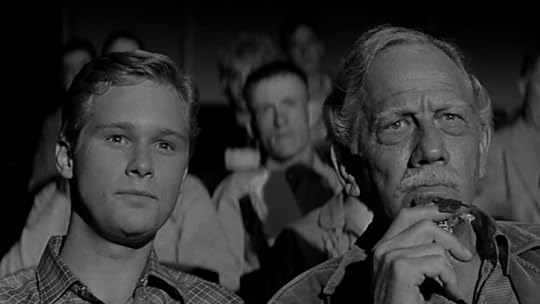
I watched the movie again the other day and clearly saw why it was nominated and won Academy Awards. The movie substantially changed the book, especially as Hud was the star of the show, not the minor character in Horseman, although I think if filmed as written it would not have been the stellar film that it was. So my conclusion is that the book is a much richer experience, but the movie is a classic of black and white filmmaking. And what's not to like when it stars Paul Newman!
End note: McMurtry was only 25 when he wrote this his first novel. Imagine that then it was almost immediately made into a movie that was Paul Newman and the director's first project in their new film production company. And the rest is history, folks!
Why I'm reading this: This is the January pick for On the Southern Literary Trail so I thought I'd join in since it was available from my library. It also fits my current favorite category of books - those under 200pp.
The debut novel by the author of the Pulitzer Prize winning "Lonesome Dove." This is a magnificent book, beautifully written and incredibly moving. As Lonesome Dove told the epic story of the old west, this novel set in the new west, i.e. 1950's, also tells a riveting story. For those not aware, the great Paul Newman movie "Hud" is based on this book.
This being my first Larry McMurtry book, I didn't know what to expect. I was pleasantly surprised! But boy howdy, he sure does take his time getting around to the story! There's so much in the world to describe and he doesn't seem to want to miss a bit of it. When he does get around to the plot and the action rolls out, it's a regular kick to the gut!
Pensavo di aver letto un romanzo di formazione, solo alle pagine finali ho capito di aver letto il racconto della fine di un'epoca.
Primo romanzo di McMurtry e primo capitolo di (fonte Wikipedia.org)
"Thalia: A Texas Trilogy"
Larry McMurtry's first three novels, all set in the north Texas town of Thalia following World War II.
1961: Horseman, Pass By, adapted for film as Hud 1963: Leaving Cheyenne, adapted for film as Lovin' Molly 1966: The Last Picture Show, adapted as film of the same name
Ora c'è da sperare che oltre a ripubblicarlo perché introvabile, Einaudi provveda anche a tradurre Leaving Cheyenne.
Il titolo originale del romanzo, Horseman, Pass By (traducibile come Cavaliere, passa oltre) è una citazione dei versi finali della poesia Under Ben Bulden di William Butler Yates a indicare proprio il tramonto del mito del cowboy e del Vecchio West americano:
Cast a cold eye On life, on death. Horseman, pass by.
Set in the 1950s on a ranch in Texas, this novel is a slow moving western and coming of age tale. Teenage Lonnie tells the tale of his grandfather’s power struggle with his step-uncle, Hud, a malicious man who wreaks havoc on the family’s ranch. This is not my type of book. There are very few positives here. I liked the relationship between Lonnie and his grandfather. Other than that, it is filled with violence, abuse of women, and racist comments. Oh, and don’t forget the slaughter of diseased cattle. I found it a most unpleasant reading experience. It was originally published in 1961 and has not aged well. It was the basis for the movie Hud (which is actually better than the book). I should have passed this one by.
Sweet natured teenaged Lonnie is growing up on a dusty post WWII Texas ranch where his stern grandfather Homer Bannon and his carousing step Uncle Hud frequently lock horns leaving him mostly dreaming of life away from the ranch. This is a simple melancholy tale that’s been called a novel worth being rediscovered, and is the basis of an old Paul Newman film titled Hud. This is McMurtry’s debut novel and since later he went on to write Lonesome Dove a personal all-time favorite, I was happy when one of my clubs chose it this month. 4 stars - read for 1/21 OTSLT Club
My first McMurty novel, and I am certainly going to read more of him. He captures the American West with great flair and understatement, and avoids all the Hollywood cliches, even though many of his books have been turned into films, and he himself had a screenplay writing career in Tinseltown.
Lonnie Bannon is the sensitive 17-year-old living with his grandparents, having lost his parents along the way (we are not told much about when, where, or how). He idolizes his 86-year old Grandpa Homer, who is resisting change and trying to make a go of it at raising cattle. Hud is the villain of the piece, Homer’s stepson, misogynistic, opportunistic, sadistic. Hud hates his step-father for sending him off to the war, and doesn’t do much around the ranch except run around at night, partying and sleeping with other men’s wives. Hud’s openly stated ambition is to usurp the Bannon ranch from his aging stepfather.
There are also some secondary characters who are well drawn: Halmea the black domestic help, and Jesse the lonesome cowhand who has spent his years in the rodeo business amassing many experiences but not a nickel to his name. The suppressed sexual tension oozing between Lonnie, Halmea, and Jesse is palpable, although Hud is the only one able to act upon it—and how he does!
With some foreshadowing of what’s to come, we realize that there is trouble when the dreaded Hoof and Mouth Disease strikes the Bannon herd, forcing Homer to make tough choices: kill the herd, liquidate, or sell oil rights on his land? He rails, “What good’s oil to me? What can I do with it? With a bunch a oil wells. I can’t ride out ever day an’ prowl amongst ’em, like I can my cattle. I can’t breed ’em or tend ’em or rope ’em or chase ’em or nothin’. I can’t feel a smidgen a pride in ’em, cause they ain’t none a my doin’.” One wonders whether this cattle disease is too convenient for Hud or whether he has had something to do with it, although according to Lonnie, “Hud had done everything he could to keep Homer from buying the Laredo cattle—he hated the whole South Texas area, and especially the Mexicans that were in it.”
The annual rodeo comes to town and Lonnie tries to escape his domestic strife by looking for girls, booze, and entertainment, all of which seem hard to come by for him, given his deeply introspective and sensitive nature. McMurty evokes the atmosphere of the rodeo very well, a time when women and men drink to excess and cross boundaries, when animals go onery and maim their riders, when everyone lives an unnatural existence for four days and returns to normal life a bit changed.
There were some elements of stagecraft that were lost on me. I couldn’t understand how Hud had such a hold over his step-father, and how old Homer made it so far from home in his nightshirt on the fateful last night of the rodeo. And most importantly, why someone didn’t beat the crap out of Hud for his in-your-face, upstart and immoral behaviour. Cowboys, you custodians of the upstanding moral code of the American West, where were you hiding?
This is a tale of loss. For not only is the beloved herd lost (midway in the book, so no spoiler), but Lonnie starts to lose the people who matter to him, including his home. And even though the events leading to the ending are dramatic, the climax fizzles out. The avenging cowboy laying the bad guy low does not happen, cliché though it is; instead the ending reinforces that Might is Right in America, that change is hard-to-impossible for the older generation, and that crooked people win over honest ones. I was reminded of that Shakespearean quote “The evil that men do lives after them, the good is oft interred with their bones.” McMurty seems to modify it slightly to imply, “The evil men live after the good ones are interred with their bones.”
If you've ever been a frustrated boy on a ranch, or a farm, isolated and yearning, you will be able to relate to this 17 year old protagonist. McMurtry offers an authentic case of spare prose, no adornments or sentimentality, of this lad as he watches a generation (his grand dad) pass and the takeover of a rapacious new order (Hud, the son of his grand dad's second wife). This book offered the everyday sights, smells, angst and beauty of north Texas in the 50's. The black servant provides unwittingly a source of humanity to the lonesome Lonnie, as well as sexual intrigue. She's onto him, though, and gently teaches him what it means to suffer and the strength of survival. They find joy together in small things and humor. This book had parallels to The Last Picture Show, the slow paralytic nature of life in small town Midwestern America, and the yearning that is always present. The cruelty of Hud, who cares little for Lonnie and inflicts pain on all those around him, reminds me of the tyranny of Curley in Steinbeck's Of Mice and Men. This is a quick read, and told in the simple language of a people in a place and time. I appreciate Larry laying this down, its real, you will taste the dust and retch in the afternoon heat. But he will cool you down in the evening, when the sun drops on the horizon and spreads its brilliant crimson and yellows across the barren land. The animals will call and the cool springs will flow, and you may get lost in this paced out summer of longing and physical deprivation. These types of experiences would be lost if not for fine novels such as this.
This was the start of a 40+ book career, a book he wrote while attending North Texas State. Imperfect, but astounding first work.
"All of them wanted more and seemed to end up with less; they wanted excited and ended up stomped up by a bull or smashed up against a highway; or they wanted a girl to court; and anyway, whatever it was they wanted, that was what they ended up doing without."
After finishing Larry McMurtry’s debut novel Horseman, Pass By, I do feel a little divided. I appreciate that McMurtry was able to write this at such a youthful age, and clearly the workings of what would be an illustrious writing career are there in some respects. For example, the writing itself is very high quality, and I like how in this novel he can create a sense of time and place so effortlessly.
And, one of my biggest takeaways is how this novel is representative of the coming-of-age novel, as we hear everything from young Lonnie Bannon’s perspective and the angst and difficulties and pain of life that come his way.
All this being said, I felt a little lukewarm about the novel in general. For one thing, I just felt a lack of connection to the characters, and I think it is because they felt very predictable and one dimensional. A prime example of this is the character of Hud, who is pretty much an ornery, unlikeable you know what the entire duration of the story. (I find it odd how Hollywood would make a film after him, and not a more sympathetic character in Lonnie, but I do hear that they changed up quite a bit for the Paul Newman film). So, the characters seem to have very little arc and are not very sympathetic: who you see is who you get throughout the story.
Also, while the writing and prose itself is very good, the actual story line was not very appealing to me. One primary conflict comes early on when Homer, Lonnie’s grandfather, finds out from a veterinarian that his cattle have a potential deadly disease that could threaten his entire herd. Also, we have the thematic conflict of “old ideas vs new ideas” in the old-fashioned Homer and the egotistical, selfish Hud. So, I see how these are the main focuses of the novel, but because the novel is so short, these are never fully fleshed out. It just feels like things just happen, and like I said, in a very predictable way.
So, I found some of the things in the novel either bleak or somewhat unfulfilling, but I appreciate certain things about the book. I read Lonesome Dove last year, and in comparison, you see how the story digs so much into relevant themes, and the characters have a deeper complexity.
Still, I want to read more McMurtry in the future. Maybe someone could recommend another of his works.
The novel that started it all. Always to the point, McMurtry keeps the narrative brisk. Told from the viewpoint of seventeen year old Lonnie, the book details the trials and tribulations of growing up on a Texas ranch. Lonnie wrestles with a bit of wanderlust as he watches his grandfather's cattle kingdom go up in smoke. Along the way we get to know Lonzo, Jesse and most of all Hud. The book provides the background for the motion picture Hud starring Paul Newman. Definitely a worthwhile effort and probably my favorite McMurtry novel.
Having loved HUD (1963) for decades, I was shocked-- Shocked!!-- to find young Lon's original prose narration full of words like fucker, chickenshit, nigger, and nooky, and to see him killing frogs with a pistol out of sheer boredom. What can I say? This is a finely-observed debut novel, but I'll take Hollywood's censored, gorgeously-photographed depiction of small town malaise any day.
Larry McMurtry's first novel is a rather remarkable slice of Texas life in the relatively modern era. HORSEMAN, PASS BY was made into a popular movie, HUD. But the novel is darker than the film, which nudged one character's moral character slightly toward the sympathetic and shoved another character into an entirely different race. Paul Newman, at the height of his coolness and fame when HUD was filmed, played the title character with menace, anger, and plenty of moral turpitude. But he also played him cool, with a radiant charm that almost succeeded in overcoming the darkness at Hud's heart. It is unlikely that Newman would have ever taken the role of Hud had it been certain to follow precisely in the book's depiction. It's just as unlikely that the film itself would have been made had it been a requirement not to water it down. In the movie, Hud is an anti-hero, and Newman in the role became the pinup boy for such types. In HORSEMAN, PASS BY, Hud is more than an anti-hero. He is largely despicable. At one point in the book, he commits an act so outrageous and horrifying that it is hard to imagine how anyone ever thought of making a movie with Paul Newman out of the book. But the rest of the book is reflected rather well in the film, and there is the same taste of loneliness, isolation, and desperation in both, a reflection of the harsh life in the North Texas ranchlands. Hud's father Homer faces obstacles every day in running his cattle ranch, but the discovery of one dead heifer catapults him into the greatest challenge of his life. His grandson Lonnie, the book's (and film's) viewpoint character, loves his grandfather and the ranch, but yearns for some inchoate desire he can't quite define. McMurtry is a master at the dialogue of these cattle folk, people identical to the ones he grew up with in North Texas in a town very much like Thalia, the town he focuses on in this and several other books. It's a moving and affecting ride through the lives of some hard people and some harder hearts.
This was Larry McMurtry's first novel, published in 1961, long before "Lonesome Dove." It's also his first of several books set in and around the small Texas town of Thalia. The story was quickly transformed into a Paul Newman film "Hud" in 1963, which is the version of the story most people know. In spirit, the two stories are similar - they are both anti-westerns, in which code of the West is subverted and corrupted by failure of moral character.
But McMurtry's novel tells a story with a darker vision. At the center is Lonnie, the teenager growing up on his grandfather's ranch, and it's through his eyes that we see the cold, self-serving indifference of his uncle Hud. Still a boy, unschooled in much of anything besides the dawn-to-dusk labor of ranch work, Lonnie is no moral center, following his grandfather's example. In many ways, he accepts Hud's violent behavior, his disrespect for the old man, and his ruthless use of women as a kind of norm. In the end, as he leaves the ranch, he takes the first steps toward a life that may well be no more rewarding or purposeful than that of the regretful hired hand Jesse, who gets too drunk to ride his cutting horse in the rodeo.
To streamline the story, the film has scaled back or eliminated interesting key characters like Jesse, another ranch hand Lonzo, a neighbor Hank, and a friend Hermy, who is badly injured trying to ride a bull. Also, by casting a white woman in the role of the black cook Halmea (Patricia Neal's Alma), the film sidesteps a racial dimension that the novel brings to the story.
So for readers who know and like the film, this is a very different telling of the story and well worth reading. As usual in McMurtry's early novels, there is a richly detailed capturing of character, speech, and setting. He knows these people inside and out, how they think, talk, and behave. He also totally deromanticizes ranch work, representing it as mercilessly hot, dusty, and exhausting. The small-town rodeo, with its drinking, womanizing cowboys, fares little better. I heartily recommend this novel for anyone interested in the rural West and ranching, along with McMurtry's more melancholy but less bleak "Leaving Cheyenne."
McMurtry’s debut novel was a sensation when published in 1961. Here was a contemporary Western showing the conflict between the then current generation with the values of the Old West still prevalent at the time. The novel was made into the movie Hud, starring Paul Newman in the titular role.
McMurtry’s novel, however, is narrated by young Lonnie Bannon, grandson of an old-time cattleman, Homer Bannon. Hud is the son of Homer’s second wife, and he is in constant conflict with the old man about how the ranch operates. When a plague hits the herd, decisions no rancher wants to make are forced upon the Bannons. Lonnie is caught in the middle; torn between his love and admiration of his grandfather and the old man’s principles, and his fascination with the exciting, unscrupulous and dangerous, step-uncle, Hud.
Boy, but McMurtry can write a scene! I could feel the grit, taste the cold drinks, hear the bellow of cattle, and smell the dung at the rodeo arena. (It probably helped that I had just attended a rodeo in real life.) His characters come alive on the page. They are not particularly likeable, but the reader gets to know them through their actions and reactions. Each one, even those appearing for the briefest of scenes, is fully fleshed out.