

What do you think?

Incerto #5
Jugarse la piel. Asimetrias ocultas en la vida cotidiana
Goodreads Choice Award
Nominee for Readers' Favorite Nonfiction (2018)From the New York Times bestselling author of The Black Swan, a bold new work that challenges many of our long-held beliefs about risk and reward, politics and religion, finance and personal responsibility
In his most provocative and practical book yet, one of the foremost thinkers of our time redefines what it means to understand the world, succeed in a profession, contribute to a fair and just society, detect nonsense, and influence others. Citing examples ranging from Hammurabi to Seneca, Antaeus the Giant to Donald Trump, Nassim Nicholas Taleb shows how the willingness to accept one’s own risks is an essential attribute of heroes, saints, and flourishing people in all walks of life.
As always both accessible and iconoclastic, Taleb challenges long-held beliefs about the values of those who spearhead military interventions, make financial investments, and propagate religious faiths. Among his insights:
• For social justice, focus on symmetry and risk sharing. You cannot make profits and transfer the risks to others, as bankers and large corporations do. You cannot get rich without owning your own risk and paying for your own losses. Forcing skin in the game corrects this asymmetry better than thousands of laws and regulations.
• Ethical rules aren’t universal. You’re part of a group larger than you, but it’s still smaller than humanity in general.
• Minorities, not majorities, run the world. The world is not run by consensus but by stubborn minorities imposing their tastes and ethics on others.
• You can be an intellectual yet still be an idiot. “Educated philistines” have been wrong on everything from Stalinism to Iraq to low-carb diets.
• Beware of complicated solutions (that someone was paid to find). A simple barbell can build muscle better than expensive new machines.
• True religion is commitment, not just faith. How much you believe in something is manifested only by what you’re willing to risk for it.
The phrase “skin in the game” is one we have often heard but rarely stopped to truly dissect. It is the backbone of risk management, but it’s also an astonishingly rich worldview that, as Taleb shows in this book, applies to all aspects of our lives. As Taleb says, “The symmetry of skin in the game is a simple rule that’s necessary for fairness and justice, and the ultimate BS-buster,” and “Never trust anyone who doesn’t have skin in the game. Without it, fools and crooks will benefit, and their mistakes will never come back to haunt them.”
In his most provocative and practical book yet, one of the foremost thinkers of our time redefines what it means to understand the world, succeed in a profession, contribute to a fair and just society, detect nonsense, and influence others. Citing examples ranging from Hammurabi to Seneca, Antaeus the Giant to Donald Trump, Nassim Nicholas Taleb shows how the willingness to accept one’s own risks is an essential attribute of heroes, saints, and flourishing people in all walks of life.
As always both accessible and iconoclastic, Taleb challenges long-held beliefs about the values of those who spearhead military interventions, make financial investments, and propagate religious faiths. Among his insights:
• For social justice, focus on symmetry and risk sharing. You cannot make profits and transfer the risks to others, as bankers and large corporations do. You cannot get rich without owning your own risk and paying for your own losses. Forcing skin in the game corrects this asymmetry better than thousands of laws and regulations.
• Ethical rules aren’t universal. You’re part of a group larger than you, but it’s still smaller than humanity in general.
• Minorities, not majorities, run the world. The world is not run by consensus but by stubborn minorities imposing their tastes and ethics on others.
• You can be an intellectual yet still be an idiot. “Educated philistines” have been wrong on everything from Stalinism to Iraq to low-carb diets.
• Beware of complicated solutions (that someone was paid to find). A simple barbell can build muscle better than expensive new machines.
• True religion is commitment, not just faith. How much you believe in something is manifested only by what you’re willing to risk for it.
The phrase “skin in the game” is one we have often heard but rarely stopped to truly dissect. It is the backbone of risk management, but it’s also an astonishingly rich worldview that, as Taleb shows in this book, applies to all aspects of our lives. As Taleb says, “The symmetry of skin in the game is a simple rule that’s necessary for fairness and justice, and the ultimate BS-buster,” and “Never trust anyone who doesn’t have skin in the game. Without it, fools and crooks will benefit, and their mistakes will never come back to haunt them.”
392 pages, Paperback
First published June 1, 2018
About the author
Nassim Nicholas Taleb
56 books15k followersNassim Nicholas Taleb spent 21 years as a risk taker (quantitative trader) before becoming a flaneur and researcher in philosophical, mathematical and (mostly) practical problems with probability.
Taleb is the author of a multivolume essay, the Incerto (The Black Swan, Fooled by Randomness, Antifragile, and Skin in the Game) an investigation of opacity, luck, uncertainty, probability, human error, risk, and decision making when we don’t understand the world, expressed in the form of a personal essay with autobiographical sections, stories, parables, and philosophical, historical, and scientic discussions in nonover lapping volumes that can be accessed in any order.
In addition to his trader life, Taleb has also written, as a backup of the Incerto, more than 50 scholarly papers in statistical physics, statistics, philosophy, ethics, economics, international affairs, and quantitative finance, all around the notion of risk and probability.
Taleb is currently Distinguished Professor of Risk Engineering at NYU's Tandon School of Engineering (only a quarter time position). His current focus is on the properties of systems that can handle disorder ("antifragile").
Taleb believes that prizes, honorary degrees, awards, and ceremonialism debase knowledge by turning it into a spectator sport.
See Wikipedia for more details.
Taleb is the author of a multivolume essay, the Incerto (The Black Swan, Fooled by Randomness, Antifragile, and Skin in the Game) an investigation of opacity, luck, uncertainty, probability, human error, risk, and decision making when we don’t understand the world, expressed in the form of a personal essay with autobiographical sections, stories, parables, and philosophical, historical, and scientic discussions in nonover lapping volumes that can be accessed in any order.
In addition to his trader life, Taleb has also written, as a backup of the Incerto, more than 50 scholarly papers in statistical physics, statistics, philosophy, ethics, economics, international affairs, and quantitative finance, all around the notion of risk and probability.
Taleb is currently Distinguished Professor of Risk Engineering at NYU's Tandon School of Engineering (only a quarter time position). His current focus is on the properties of systems that can handle disorder ("antifragile").
Taleb believes that prizes, honorary degrees, awards, and ceremonialism debase knowledge by turning it into a spectator sport.
See Wikipedia for more details.
Ratings & Reviews
Friends & Following
Create a free account to discover what your friends think of this book!
Community Reviews
Displaying 1 - 30 of 2,908 reviews

March 1, 2018
Skin in the Game is at the same time thought-provoking and original but also contradictory and sometimes absurd.
Let’s start with the cons:
1. I certainly won’t be the first to notice that Taleb can be mean-spirited. But why does he insist on presenting his views in this way? The communication of his ideas, often profound, does not require a mean-spirited or condescending tone. For however brilliant Taleb thinks he is, his skills in persuasion are severely lacking; he’s alienating a significant readership that may have otherwise been more receptive to his ideas.
Not very far into the book we see Taleb take cheap shots at Steven Pinker, out of nowhere, discussing a topic that has nothing to do with any of Pinker’s actual ideas or positions. One wonders why Taleb cannot just present his ideas without the incessant personal attacks and condescension.
2. His overall philosophy appears to be self-refuting. He reviles “intellectuals,” professors, and thinkers while praising “doers” and men of practice. He’s particularly distrustful of those who give advice for a living. Here’s Taleb:
“Avoid taking advice from someone who gives advice for a living, unless there is a penalty for their advice.”
So should we then ignore this advice? As far as I can tell, Skin in the Game is a work of philosophy, an intellectual exercise that argues against the value of intellectual exercise. This is the same self-refuting logic of relativism—in that the statement “everything is relative” is self-refuting because the statement itself needs to be absolute.
If Taleb is wrong in any part of his philosophy it doesn’t appear that he would incur any penalty (no skin in the game). The upside for him is book sales with little to no downside risk, so by using his own logic we should conclude to not trust him.
Also, to the extent that you believe ideas have power you might find yourself disagreeing with Taleb’s extreme position that no good ideas could possibly come from someone in an academic position (particularly from the reviled economists).
Except that Taleb uses economic theories to frame his thinking. The Tragedy of the Commons, something Taleb discusses in his book, was developed by the economist William Forster Lloyd in his armchair. Even Taleb’s Black Swan concept is a reformulation of the Peso problem developed by...economists.
I’m sure anyone can think up examples, rather easily, of useful ideas that were discovered by intellectuals or from university research. How about Einstein's theory of relativity, which preceded GPS technology, which wouldn't exist without it.
3. Taleb obsesses about the superiority of practice over academics and theory. This is a questionable proposition.
As just one example, a recent study in the American Journal of Medicine concluded that “patients whose doctors had practiced for at least 20 years stayed longer in the hospital and were more likely to die compared to those whose doctors got their medical license in the past five years.”
My own personal experience corroborates this, as a medical student was able to correctly diagnose what the attending physician had missed on a trip to the ER. Very experienced, practical individuals sometimes perpetuate bad habits and fail to keep informed of the theories and academics that lead to better practice. This point is completely lost on Taleb.
4. Taleb’s definition of rationality as any action that promotes survival is patently false, as a simple thought experiment can show. Imagine a hypothetical survival machine is available for your use. By plugging yourself in, it will guarantee and maximize your life span and, on a social scale, maximizes reproduction. The price is that the machine also inflicts a high degree of pain and cuts you off from contact with other people.
According to the logic of Taleb, the rational thing to do would be to plug into this machine. Of course, no one would volunteer to do this because survival is not what motivates rational behavior. Any rational agent would choose one year of pleasant life over 100 years in the survival machine, because actions have value according to how they promote or are perceived to promote well-being or pleasure.
Taleb, using this more believable definition of rationality, could have used it to argue the same points, namely how religious belief cannot be called irrational if it promotes well-being, which includes psychological well-being and survival but not survival alone.
The pros:
That Taleb is antagonistic and holds some questionable views does not mean that he’s wrong about everything. When not being demeaning or taking extreme positions, Taleb writes about some of the most original, thought-provoking, and profound ideas. And even when you find yourself disagreeing with him, he makes you think. For this reason alone, the book is worth checking out.
The idea that the extent of people’s stakes in particular outcomes is a critical yet underrated determinant of events is a profound idea with several implications, which Taleb skillfully explores throughout the book. And his idea that you should have to pay some kind of penalty for decisions that negatively impact others—risk sharing vs. risk transfer—is a solid framework for thinking about a host of issues. Of course, these ideas would be easier to swallow if presented with a little more humility, but I suppose we should know what to expect from Taleb by now.
Let’s start with the cons:
1. I certainly won’t be the first to notice that Taleb can be mean-spirited. But why does he insist on presenting his views in this way? The communication of his ideas, often profound, does not require a mean-spirited or condescending tone. For however brilliant Taleb thinks he is, his skills in persuasion are severely lacking; he’s alienating a significant readership that may have otherwise been more receptive to his ideas.
Not very far into the book we see Taleb take cheap shots at Steven Pinker, out of nowhere, discussing a topic that has nothing to do with any of Pinker’s actual ideas or positions. One wonders why Taleb cannot just present his ideas without the incessant personal attacks and condescension.
2. His overall philosophy appears to be self-refuting. He reviles “intellectuals,” professors, and thinkers while praising “doers” and men of practice. He’s particularly distrustful of those who give advice for a living. Here’s Taleb:
“Avoid taking advice from someone who gives advice for a living, unless there is a penalty for their advice.”
So should we then ignore this advice? As far as I can tell, Skin in the Game is a work of philosophy, an intellectual exercise that argues against the value of intellectual exercise. This is the same self-refuting logic of relativism—in that the statement “everything is relative” is self-refuting because the statement itself needs to be absolute.
If Taleb is wrong in any part of his philosophy it doesn’t appear that he would incur any penalty (no skin in the game). The upside for him is book sales with little to no downside risk, so by using his own logic we should conclude to not trust him.
Also, to the extent that you believe ideas have power you might find yourself disagreeing with Taleb’s extreme position that no good ideas could possibly come from someone in an academic position (particularly from the reviled economists).
Except that Taleb uses economic theories to frame his thinking. The Tragedy of the Commons, something Taleb discusses in his book, was developed by the economist William Forster Lloyd in his armchair. Even Taleb’s Black Swan concept is a reformulation of the Peso problem developed by...economists.
I’m sure anyone can think up examples, rather easily, of useful ideas that were discovered by intellectuals or from university research. How about Einstein's theory of relativity, which preceded GPS technology, which wouldn't exist without it.
3. Taleb obsesses about the superiority of practice over academics and theory. This is a questionable proposition.
As just one example, a recent study in the American Journal of Medicine concluded that “patients whose doctors had practiced for at least 20 years stayed longer in the hospital and were more likely to die compared to those whose doctors got their medical license in the past five years.”
My own personal experience corroborates this, as a medical student was able to correctly diagnose what the attending physician had missed on a trip to the ER. Very experienced, practical individuals sometimes perpetuate bad habits and fail to keep informed of the theories and academics that lead to better practice. This point is completely lost on Taleb.
4. Taleb’s definition of rationality as any action that promotes survival is patently false, as a simple thought experiment can show. Imagine a hypothetical survival machine is available for your use. By plugging yourself in, it will guarantee and maximize your life span and, on a social scale, maximizes reproduction. The price is that the machine also inflicts a high degree of pain and cuts you off from contact with other people.
According to the logic of Taleb, the rational thing to do would be to plug into this machine. Of course, no one would volunteer to do this because survival is not what motivates rational behavior. Any rational agent would choose one year of pleasant life over 100 years in the survival machine, because actions have value according to how they promote or are perceived to promote well-being or pleasure.
Taleb, using this more believable definition of rationality, could have used it to argue the same points, namely how religious belief cannot be called irrational if it promotes well-being, which includes psychological well-being and survival but not survival alone.
The pros:
That Taleb is antagonistic and holds some questionable views does not mean that he’s wrong about everything. When not being demeaning or taking extreme positions, Taleb writes about some of the most original, thought-provoking, and profound ideas. And even when you find yourself disagreeing with him, he makes you think. For this reason alone, the book is worth checking out.
The idea that the extent of people’s stakes in particular outcomes is a critical yet underrated determinant of events is a profound idea with several implications, which Taleb skillfully explores throughout the book. And his idea that you should have to pay some kind of penalty for decisions that negatively impact others—risk sharing vs. risk transfer—is a solid framework for thinking about a host of issues. Of course, these ideas would be easier to swallow if presented with a little more humility, but I suppose we should know what to expect from Taleb by now.

April 7, 2018
Taleb’s ‘Skin in the Game’ has been put together in a somewhat disorderly way, but the reasoning goes as follows:
1. The world in which we live is complex and eludes our sense-making faculties.
2. Our society has cultivated a privileged class of Intellectuals Yet Idiots (IYIs). These people monopolize positions of authority and routinely take decisions to intervene in that complex world, without however doing the effort to think through the cascading impacts of these decisions and being conveniently isolated from any tangible repercussions on themselves. In other words, these people have nothing at stake. They have no skin the game.
3. The absence of skin in the game comes with undesirable epistemological consequences. Because people who are isolated from the impacts of their decisions do not learn. They remain captive to their erroneous ideas about how the world works. As a result our systems ‘rot’, i.e. they become ever more fragile.
4. Sooner or later this is going to cause a lot of trouble. The geopolitical and military deadlocks in the Middle East are just one example of severe and long-term implications of misguided efforts to engage in ‘nation building’. As our technological powers grow and our systems mushroom and interconnect, the likelihood of catastrophic downside consequences ratchets up too.
5. Absence of skin in the game also leads to objectionable ethical consequences. It leads to an inequitable distribution of risks and resources in society.
6. To mitigate adverse effects of incautious and irresponsible courses of action, authorities are wont to create an ever more granular web of rules and regulations. Getting rid of these regulations is much harder than to create them. But opportunistic operators with deep pockets always find loopholes in this tangle.
That’s the problem situation that is sketched out by the author. Now, what can we do about this?
1. We need to compartmentalize risks by focusing on our immediate environment. We need to decentralize and reduce the scale of the systems we meddle with.
2. We need to honor the precautionary principle: "if we don’t understand something and it has a systemic effect, just avoid it."
3. Rather than masterplans and fixed strategies we need practical ethical and operational rules to guide local experimentation and problem solving. One way to unearth these rules is by deep knowledge of probability theory (Taleb’s speciality).
4. From probability theory follows that uncertainty can be beneficial, if we engage in ‘convex tinkering’, i.e. engage in small bets where gains and harm are asymmetric. So we need to find or construct settings that exhibit this ‘convexity bias’ (this material was discussed more extensively in Taleb’s Antifragile).
5. Insisting that as many people in the community should have skin in the game is ethically sound. The principle emerges at the intersection of three main ethical systems: Kantian, consequentialism, and classical virtue.
6. Also, we need as many decision makers as possible to have skin in the game for the ‘intelligence of time’ to filter out what harms and select what contributes to our survival.
7. Taleb puts great store in the property of ergodicity. I understand it to work at different logical levels. Not having skin in the game leads to a non-ergodic system, i.e. a system that shows some absorptive capacity that lowers risks for a minority to the detriment for the majority. So, in a non-ergodic system a person who gets rich will stay rich. Perfect ergodicity would imply that each person, should (s)he live forever, would spend a proportion of the time in the economic conditions of the entire cross-section. At the higher logical level, ergodicity links my personal fate to the fate of the community and larger ecosystem from which I am part. Loss of my personal life is a necessity to lower the risk for the collective as shorter shelf life for humans allows genetic changes across generations to be in sync with the variability of the environment.
8. We need to leverage the minority rule, "mother of all a asymmetries”, to strategically exercise influence. A small, intransigent group in society is able to impose its preferences on a much larger flexible group because of the asymmetry in choices that defines their relationship (at least as long as the minority group is not spatially ghettoized and the cost structure associated with their preferences is more or less comparable to the original societal norm). So, given asymmetry somewhere (“and asymmetry is present is about everything”) it is possible to build scale in influencing the dynamics of large, complex socio-technical systems.
9. Vice versa, we need to mindful about the fact that the minority rule can also be used to advance extremist agendas. Hence democracy has to be uncompromising vis-à-vis the intolerant minority that wants to destroy it.
10. In general: good (market) structures neutralize the stupidity of those participating in them.
Whatever one may think of Taleb’s confrontational style, I find his ideas are extremely valuable. He is a genuine systems thinker, informed by a deep knowledge of probability theory and what that means for how we (ought to) deal with risk and uncertainty. Much of what today passes for 'systems thinking’ has a high cuddle factor. It flourishes on a nebulous jargon of ‘interconnection’, ‘wholes’ and ‘emergence’. Taleb’s systems talk is hard-edged and unsentimental, and it reflects an attractive ethos of classical virtue that meshes courage and prudence. Now the challenge is not only to read the book, but also to absorb it and reflect it in the conduct of one's life.
1. The world in which we live is complex and eludes our sense-making faculties.
2. Our society has cultivated a privileged class of Intellectuals Yet Idiots (IYIs). These people monopolize positions of authority and routinely take decisions to intervene in that complex world, without however doing the effort to think through the cascading impacts of these decisions and being conveniently isolated from any tangible repercussions on themselves. In other words, these people have nothing at stake. They have no skin the game.
3. The absence of skin in the game comes with undesirable epistemological consequences. Because people who are isolated from the impacts of their decisions do not learn. They remain captive to their erroneous ideas about how the world works. As a result our systems ‘rot’, i.e. they become ever more fragile.
4. Sooner or later this is going to cause a lot of trouble. The geopolitical and military deadlocks in the Middle East are just one example of severe and long-term implications of misguided efforts to engage in ‘nation building’. As our technological powers grow and our systems mushroom and interconnect, the likelihood of catastrophic downside consequences ratchets up too.
5. Absence of skin in the game also leads to objectionable ethical consequences. It leads to an inequitable distribution of risks and resources in society.
6. To mitigate adverse effects of incautious and irresponsible courses of action, authorities are wont to create an ever more granular web of rules and regulations. Getting rid of these regulations is much harder than to create them. But opportunistic operators with deep pockets always find loopholes in this tangle.
That’s the problem situation that is sketched out by the author. Now, what can we do about this?
1. We need to compartmentalize risks by focusing on our immediate environment. We need to decentralize and reduce the scale of the systems we meddle with.
2. We need to honor the precautionary principle: "if we don’t understand something and it has a systemic effect, just avoid it."
3. Rather than masterplans and fixed strategies we need practical ethical and operational rules to guide local experimentation and problem solving. One way to unearth these rules is by deep knowledge of probability theory (Taleb’s speciality).
4. From probability theory follows that uncertainty can be beneficial, if we engage in ‘convex tinkering’, i.e. engage in small bets where gains and harm are asymmetric. So we need to find or construct settings that exhibit this ‘convexity bias’ (this material was discussed more extensively in Taleb’s Antifragile).
5. Insisting that as many people in the community should have skin in the game is ethically sound. The principle emerges at the intersection of three main ethical systems: Kantian, consequentialism, and classical virtue.
6. Also, we need as many decision makers as possible to have skin in the game for the ‘intelligence of time’ to filter out what harms and select what contributes to our survival.
7. Taleb puts great store in the property of ergodicity. I understand it to work at different logical levels. Not having skin in the game leads to a non-ergodic system, i.e. a system that shows some absorptive capacity that lowers risks for a minority to the detriment for the majority. So, in a non-ergodic system a person who gets rich will stay rich. Perfect ergodicity would imply that each person, should (s)he live forever, would spend a proportion of the time in the economic conditions of the entire cross-section. At the higher logical level, ergodicity links my personal fate to the fate of the community and larger ecosystem from which I am part. Loss of my personal life is a necessity to lower the risk for the collective as shorter shelf life for humans allows genetic changes across generations to be in sync with the variability of the environment.
8. We need to leverage the minority rule, "mother of all a asymmetries”, to strategically exercise influence. A small, intransigent group in society is able to impose its preferences on a much larger flexible group because of the asymmetry in choices that defines their relationship (at least as long as the minority group is not spatially ghettoized and the cost structure associated with their preferences is more or less comparable to the original societal norm). So, given asymmetry somewhere (“and asymmetry is present is about everything”) it is possible to build scale in influencing the dynamics of large, complex socio-technical systems.
9. Vice versa, we need to mindful about the fact that the minority rule can also be used to advance extremist agendas. Hence democracy has to be uncompromising vis-à-vis the intolerant minority that wants to destroy it.
10. In general: good (market) structures neutralize the stupidity of those participating in them.
Whatever one may think of Taleb’s confrontational style, I find his ideas are extremely valuable. He is a genuine systems thinker, informed by a deep knowledge of probability theory and what that means for how we (ought to) deal with risk and uncertainty. Much of what today passes for 'systems thinking’ has a high cuddle factor. It flourishes on a nebulous jargon of ‘interconnection’, ‘wholes’ and ‘emergence’. Taleb’s systems talk is hard-edged and unsentimental, and it reflects an attractive ethos of classical virtue that meshes courage and prudence. Now the challenge is not only to read the book, but also to absorb it and reflect it in the conduct of one's life.

March 2, 2018
SITG is an angry rant. It lacks structure. The core message - mainly because of the author’s often misplaced and wrong arguments against his self-created adversaries - is never examined beyond the title’s most known or intuitive conventional meaning. The basic concept is at least as old as the adage itself. The author does little to bolster the claim while spending all efforts on slamming real or imagined opponents. The book’s frequent diversions along with internal contradictions amid a rather inchoate verbiage cause some of the good points to vanish in the flames of the next rant before they make any lasting impressions.
Mr Taleb is a very smart author, but not necessarily a right one. He uses a plethora of subterfuge and polemic to diss potential criticism. Yet, he fails to realise that this does not make many of his arguments any more right or less incomplete than they are. The following is his usual modus operandi, and it is in the most jarring display all through the latest book:
- He would begin by loudly and repeatedly claiming some massively important and amazing “discovery” which is a part controversial, a lot fully known for centuries, and presented as if discovered indisputably by the author.
- Rather than providing any meaningful proofs behind his outlandish, over-generalising, without shades of grey statements, he would boast his own mathematical prowess and keep claiming how he has already shown substantial proofs. Effectively, the proofs are never presented but claims of them are everywhere. It is likely that wherever those proofs exist, they are on sketchy data and little analysis but his loud claims would hint as if they are as indisputable as two and two make four. He will repeat this so many times assuming that if he repeats enough number of times he has shown the proof, he has!
- He would spend all the energy belittling the potential critics. Without addressing the likely counterarguments, he would begin by castigating the present or future contradicting voices as people without even basic knowledge, integrity, brains, reputational or financial interests. Mr Taleb would keep advertising his own mathematical mastery (likely rudimentary based on the scant pieces of evidence) while first accusing others of not knowing anything and if cornered, dismissing them for knowing too much/being pedantic/being too mathematical/academic etc. Even if one is to fully disagree with a Picketty, a Pinkell, a Thaler or a Dawkins, the likely path is not by simply smashing their intelligence or theoretical knowledge. Mr Taleb genuinely believes that such thinkers would not know the basics of theories like probability. According to the author, these quantum physics quoting personalities otherwise know nothing but words. Of course, the inequality loving author sees himself as the better champion of the oppressed!
- Effectively, the shouting down will alternate between two forms: “the others do not know anything” and “pseudo-intellectuals just know too much and as a result cannot see the woods for the trees”.
Mr. Taleb has fixed views. Some of his views are archaic, some self-serving, some sensible and some downright abhorrent - with most under more than one categories. There is little consistency in his thesis and most of what he writes is to prove that he has figured it all out and the life he leads is the ideal. His all-pervasive braggadocio in the book is only trumped by the justification for arrogance - a new trend which was not so visible in his earlier works.
As before, he takes an extreme position to bash many of his pet hates not only without recognising those adversaries’ positions but also turning a blind eye to the many weaknesses of his own arguments. Let’s start with the basic message of the book that fails to recognise that a reasonable man would try to minimise his SITG where possible even if a society may want to be at the opposite end.
- As the author himself would like to do in his own financial world, at the individual or micro level, every being will try to minimise risks for maximum possible returns. Without the author’s despised theoretical constructs to argue this in a structured way, one would expect a rational man to take only the risk needed and no more. If there is an opportunity, for whatever reason, whereby a woman can, say, mine all the remaining bitcoins in the next ten minutes without risk, the author himself would suggest the woman take the chance and make merry.
- To make this fair, a system or society - however defined - might attempt to remove situations where some have asymmetric risk-return. This would be a worthy goal for a society to reduce the role played by chance of any kind. However, given the way the practical life is, any system will always be playing a catch-up against individuals perpetually on the hunt for easy opportunities. The smartest in the society will be continuously unearthing low personal risk, high personal gain situations while quietly transferring some of the hidden risks affecting their own bodies to the rest. This is how most individuals would behave - a basic human tendency that cannot be wished away. The author has no clear suggestions on how a system could get ahead of the return-seeking, Adam Smith’s rational individuals except the clarion call for this to somehow be done.
Another broad point that the author misses is what the skin in the game is and for what types of causes it should exist:
- A typical human being pursues many goals. And a majority of them are where failures do not need to cause any personal hurt. If I am trying to cause a child to smile, feed a sick, run a mile under five, learn quantum mechanics for self-fulfilment, a failure does not have to come with pain. This is true in commercial aspects of life too: an entrepreneur may want to spend efforts tutoring a person she cares about, a programmer is writing an app just to see it being used, a financial investor decides not to invest in sin companies are some examples.
- What causes hurt is highly personal and situation specific. A rich person, like the author himself perhaps, feels no hurt shedding a few million on a risk if his wealth is in billions. For someone sensitive, a word of disapproval could spark suicidal thoughts. The author describes SITG as absolute in physical and financial forms - nothing could be more wrong than such absolute claims.
- Externalities: So many risk-takers never understand or care about far higher risks they could be taking for many others who do not know or do not have a say. Entrepreneurs who go bust often hurt others in the society/family around through their failures apart from bankers and investors. The same is true for generals who love to be on the war front, putting themselves at risk, and countless others on the battlefield and outside.
- A complex society like today needs far many who are non-entrepreneurs, advisers, academics and likes along with its entrepreneurs. The author - who hates to even have assistants - cannot live this life without a bevvy of legal advisers, infrastructure designers, financial planners, cleaners, accountants etc, most of whom cannot be entrepreneurs. One cannot create an iPhone, a road, an army or even an investment firm where no one works for anyone else.
A functioning society needs many risk takers, as it needs people of many other types who do not need to take risks. May be, what the author wanted to write was how as a society, there is not enough risk-taking. However, the main purpose of the book is effectively to pound those the author has strongest dislikes for. These people - from diverse groups of life - are bureaucrats, academicians, company executives, journalists, book reviewers (!), and even those who study, believe in theoretical pursuits of any kind, philosophers, and of course, the politicians. The author despises them because they do not take “physical” or “financial” risks. An academic who espouses a wrong theory and as a result suffers through a sub-par career, or a bureaucrat who is perpetually sidelined for making an incorrect critical decision, or an executive who loses the entire career (along with reputation) for a misplaced decision are not losing anything as per the author. For the author, risk means if you have some chance of losing something financially or physically.
Before I go on, I must admit that in saner moments at various points in the book, the author would go against his own over-generalised, grandiose statements and make sensible points. He would quote academicians he finds agreeable with love (Hagel, Kant, Nietzsche). He would use theories to make a case for employment contracts. He would talk about repetitional and other types of SITG - but, only where it suits his preformed specific conclusions.
This is one of the things that makes the book full of internal contradictions:
- “Whatever works cannot be stupid” - this is Talebian definition of rationality. Rationality, according to the author, is not in beliefs or words but in revealed preferences and actions. Rational, it seems, is anything that helps you survive over a period despite the tail risks that exist for existence. This is the logic behind which the author would debunk behavioural finance and advocate heeding to granny’s advise. By this logic, combined with the Lindy, slavery and misogyny need undergo no modification. The author does not attempt to apply this principle too rigidly for sciences, but he occasionally flirts there too in dismissing whatever technological or scientific achievements he disapproves under scientism. The author never realises how his definition of rationality - even if right - would only cause my granny versus your granny type of arguments (best case) without any progress towards universal truths or technological advancement.
- If a person’s starting point in life, like most in the real world, is with near zero savings, she cannot have the financial skin that the author likes for so many walks of life. So, perhaps the only option as per the author is for her to put the body at risk?
- Forecasting, as per the author is stupid although most activities of entrepreneurs, investors or even army generals involve implicit and explicit forecasting. In a way, the author hates those who “forecast” without much to lose but many professional forecasters have a lot of skin in the game through reputation and financial rewards/not. Many may far likely have problems with the kind the author likes that benefit from few lucky calls initially through disproportionate gains by simply placing right bets with little efforts before they get anything wrong. From this viewpoint, the author’s own business is full of incidents where the money manager has agency issues, and not sufficient SITG the moment she admits external money.
- Some of the book’s biased contradictions are hilarious because of the way they come about. One begins to pity the author - supposedly smart - who cannot notice even the most obvious of errors. Take this example: at one point in the book, the author goes from slanted wedges in NY metro to slapping academicians one more time, this time for “always” writing academic papers in a complicated way simply because “they do not have skin in the game”. Within five statements, he goes on to define “non-boring”, like footnotes in corporate reports, from the viewpoint of those with the skin in the game (aka investors). By this definition, who is the author to pass value-judgment on the boringness of academic reports?
- The author hates straw men analysis but performs many of his own all the time - imputing senseless ideas to others he hates. The worst one is at the end when the author seems that over 250 years, no theoretician figured out the time value of probabilistic patterns - example, taking one bet where you may lose everything with probability of 1% might keep you alive with 99% certainty at the end of the first bet but eventually you always end up losing all. This is such a hogwash that anyone who breathes knows this from time immemorial- the chances of one breathing the next breath is very high but eventually all die! In academic theories too, joint probability is as old as the probability science. Take another example: he indirectly bashes Mr Pinkel, perhaps his top pet hate, for not recognising that violence is down because the vigilance is up. The author shouts that the violence going down is perhaps the reason to step up the vigilance, rather than what the others seem to claim as per the author. Surprisingly, this is exactly the point Mr. Pinkel makes.
Such contradictions are supplemented by contortions to prove that only the way he does things is right: for example, the right level of transparency is what the author employs in his investment methods and not more or less. The right amount of armchair criticising is what he does, like in this book. Same about the skin in the game - where his risk-taking is great but not of many others who take far higher risks that he will not understand. The bashing of academics is plain ridiculous without acknowledgement of the benefits the classroom theories have created from the days of Galileo to the machine learning classes today, but even the roles of large corporate executives, employees everywhere (as against entrepreneurs), consultants, advisors etc are laughably undermined compared to whoever happens to be in the author’s good books.
The author does make many good points in between. There is an admirable section on scale-dependent political ideology - why he is a libertarian at the federal level, a republican at the state level, at a municipal level a democrat and a socialist with friends and family. The discussion on dynamic inequality through the concept of ergodicity, was exceptionally good if one removed the vitriol towards others and too perfunctory a dismissal of inequality conclusions without sufficient proof. The author shines when talking about Lindy effect, although this topic was better covered in the previous book on anti-fragility. Those who survive have a stronger chance of surviving longer is a good concept. In the author’s hands, its extreme application is what leads to some completely misplaced conclusions.
Given the simple and singular nature of the main theme , the book has many unrelated diversions through contradictions, contortions, critiquing where the author makes more interesting points: apart from the one on politics above, there is a good section on how a minority stringent choice impact could have on overall impact on the broad population choice. Another unrelated topic is the differential spread of different religions due to differences in laws (a non-Muslim marrying a Muslim has to convert while in cases under Judaism or Zoroastrianism, the follower might be ostracised).
Overall, the author could have used his fame and popularity better to make more constructive points, even if obvious, rather than waste so much energy bashing some other highly relevant and important analysis.
Mr Taleb is a very smart author, but not necessarily a right one. He uses a plethora of subterfuge and polemic to diss potential criticism. Yet, he fails to realise that this does not make many of his arguments any more right or less incomplete than they are. The following is his usual modus operandi, and it is in the most jarring display all through the latest book:
- He would begin by loudly and repeatedly claiming some massively important and amazing “discovery” which is a part controversial, a lot fully known for centuries, and presented as if discovered indisputably by the author.
- Rather than providing any meaningful proofs behind his outlandish, over-generalising, without shades of grey statements, he would boast his own mathematical prowess and keep claiming how he has already shown substantial proofs. Effectively, the proofs are never presented but claims of them are everywhere. It is likely that wherever those proofs exist, they are on sketchy data and little analysis but his loud claims would hint as if they are as indisputable as two and two make four. He will repeat this so many times assuming that if he repeats enough number of times he has shown the proof, he has!
- He would spend all the energy belittling the potential critics. Without addressing the likely counterarguments, he would begin by castigating the present or future contradicting voices as people without even basic knowledge, integrity, brains, reputational or financial interests. Mr Taleb would keep advertising his own mathematical mastery (likely rudimentary based on the scant pieces of evidence) while first accusing others of not knowing anything and if cornered, dismissing them for knowing too much/being pedantic/being too mathematical/academic etc. Even if one is to fully disagree with a Picketty, a Pinkell, a Thaler or a Dawkins, the likely path is not by simply smashing their intelligence or theoretical knowledge. Mr Taleb genuinely believes that such thinkers would not know the basics of theories like probability. According to the author, these quantum physics quoting personalities otherwise know nothing but words. Of course, the inequality loving author sees himself as the better champion of the oppressed!
- Effectively, the shouting down will alternate between two forms: “the others do not know anything” and “pseudo-intellectuals just know too much and as a result cannot see the woods for the trees”.
Mr. Taleb has fixed views. Some of his views are archaic, some self-serving, some sensible and some downright abhorrent - with most under more than one categories. There is little consistency in his thesis and most of what he writes is to prove that he has figured it all out and the life he leads is the ideal. His all-pervasive braggadocio in the book is only trumped by the justification for arrogance - a new trend which was not so visible in his earlier works.
As before, he takes an extreme position to bash many of his pet hates not only without recognising those adversaries’ positions but also turning a blind eye to the many weaknesses of his own arguments. Let’s start with the basic message of the book that fails to recognise that a reasonable man would try to minimise his SITG where possible even if a society may want to be at the opposite end.
- As the author himself would like to do in his own financial world, at the individual or micro level, every being will try to minimise risks for maximum possible returns. Without the author’s despised theoretical constructs to argue this in a structured way, one would expect a rational man to take only the risk needed and no more. If there is an opportunity, for whatever reason, whereby a woman can, say, mine all the remaining bitcoins in the next ten minutes without risk, the author himself would suggest the woman take the chance and make merry.
- To make this fair, a system or society - however defined - might attempt to remove situations where some have asymmetric risk-return. This would be a worthy goal for a society to reduce the role played by chance of any kind. However, given the way the practical life is, any system will always be playing a catch-up against individuals perpetually on the hunt for easy opportunities. The smartest in the society will be continuously unearthing low personal risk, high personal gain situations while quietly transferring some of the hidden risks affecting their own bodies to the rest. This is how most individuals would behave - a basic human tendency that cannot be wished away. The author has no clear suggestions on how a system could get ahead of the return-seeking, Adam Smith’s rational individuals except the clarion call for this to somehow be done.
Another broad point that the author misses is what the skin in the game is and for what types of causes it should exist:
- A typical human being pursues many goals. And a majority of them are where failures do not need to cause any personal hurt. If I am trying to cause a child to smile, feed a sick, run a mile under five, learn quantum mechanics for self-fulfilment, a failure does not have to come with pain. This is true in commercial aspects of life too: an entrepreneur may want to spend efforts tutoring a person she cares about, a programmer is writing an app just to see it being used, a financial investor decides not to invest in sin companies are some examples.
- What causes hurt is highly personal and situation specific. A rich person, like the author himself perhaps, feels no hurt shedding a few million on a risk if his wealth is in billions. For someone sensitive, a word of disapproval could spark suicidal thoughts. The author describes SITG as absolute in physical and financial forms - nothing could be more wrong than such absolute claims.
- Externalities: So many risk-takers never understand or care about far higher risks they could be taking for many others who do not know or do not have a say. Entrepreneurs who go bust often hurt others in the society/family around through their failures apart from bankers and investors. The same is true for generals who love to be on the war front, putting themselves at risk, and countless others on the battlefield and outside.
- A complex society like today needs far many who are non-entrepreneurs, advisers, academics and likes along with its entrepreneurs. The author - who hates to even have assistants - cannot live this life without a bevvy of legal advisers, infrastructure designers, financial planners, cleaners, accountants etc, most of whom cannot be entrepreneurs. One cannot create an iPhone, a road, an army or even an investment firm where no one works for anyone else.
A functioning society needs many risk takers, as it needs people of many other types who do not need to take risks. May be, what the author wanted to write was how as a society, there is not enough risk-taking. However, the main purpose of the book is effectively to pound those the author has strongest dislikes for. These people - from diverse groups of life - are bureaucrats, academicians, company executives, journalists, book reviewers (!), and even those who study, believe in theoretical pursuits of any kind, philosophers, and of course, the politicians. The author despises them because they do not take “physical” or “financial” risks. An academic who espouses a wrong theory and as a result suffers through a sub-par career, or a bureaucrat who is perpetually sidelined for making an incorrect critical decision, or an executive who loses the entire career (along with reputation) for a misplaced decision are not losing anything as per the author. For the author, risk means if you have some chance of losing something financially or physically.
Before I go on, I must admit that in saner moments at various points in the book, the author would go against his own over-generalised, grandiose statements and make sensible points. He would quote academicians he finds agreeable with love (Hagel, Kant, Nietzsche). He would use theories to make a case for employment contracts. He would talk about repetitional and other types of SITG - but, only where it suits his preformed specific conclusions.
This is one of the things that makes the book full of internal contradictions:
- “Whatever works cannot be stupid” - this is Talebian definition of rationality. Rationality, according to the author, is not in beliefs or words but in revealed preferences and actions. Rational, it seems, is anything that helps you survive over a period despite the tail risks that exist for existence. This is the logic behind which the author would debunk behavioural finance and advocate heeding to granny’s advise. By this logic, combined with the Lindy, slavery and misogyny need undergo no modification. The author does not attempt to apply this principle too rigidly for sciences, but he occasionally flirts there too in dismissing whatever technological or scientific achievements he disapproves under scientism. The author never realises how his definition of rationality - even if right - would only cause my granny versus your granny type of arguments (best case) without any progress towards universal truths or technological advancement.
- If a person’s starting point in life, like most in the real world, is with near zero savings, she cannot have the financial skin that the author likes for so many walks of life. So, perhaps the only option as per the author is for her to put the body at risk?
- Forecasting, as per the author is stupid although most activities of entrepreneurs, investors or even army generals involve implicit and explicit forecasting. In a way, the author hates those who “forecast” without much to lose but many professional forecasters have a lot of skin in the game through reputation and financial rewards/not. Many may far likely have problems with the kind the author likes that benefit from few lucky calls initially through disproportionate gains by simply placing right bets with little efforts before they get anything wrong. From this viewpoint, the author’s own business is full of incidents where the money manager has agency issues, and not sufficient SITG the moment she admits external money.
- Some of the book’s biased contradictions are hilarious because of the way they come about. One begins to pity the author - supposedly smart - who cannot notice even the most obvious of errors. Take this example: at one point in the book, the author goes from slanted wedges in NY metro to slapping academicians one more time, this time for “always” writing academic papers in a complicated way simply because “they do not have skin in the game”. Within five statements, he goes on to define “non-boring”, like footnotes in corporate reports, from the viewpoint of those with the skin in the game (aka investors). By this definition, who is the author to pass value-judgment on the boringness of academic reports?
- The author hates straw men analysis but performs many of his own all the time - imputing senseless ideas to others he hates. The worst one is at the end when the author seems that over 250 years, no theoretician figured out the time value of probabilistic patterns - example, taking one bet where you may lose everything with probability of 1% might keep you alive with 99% certainty at the end of the first bet but eventually you always end up losing all. This is such a hogwash that anyone who breathes knows this from time immemorial- the chances of one breathing the next breath is very high but eventually all die! In academic theories too, joint probability is as old as the probability science. Take another example: he indirectly bashes Mr Pinkel, perhaps his top pet hate, for not recognising that violence is down because the vigilance is up. The author shouts that the violence going down is perhaps the reason to step up the vigilance, rather than what the others seem to claim as per the author. Surprisingly, this is exactly the point Mr. Pinkel makes.
Such contradictions are supplemented by contortions to prove that only the way he does things is right: for example, the right level of transparency is what the author employs in his investment methods and not more or less. The right amount of armchair criticising is what he does, like in this book. Same about the skin in the game - where his risk-taking is great but not of many others who take far higher risks that he will not understand. The bashing of academics is plain ridiculous without acknowledgement of the benefits the classroom theories have created from the days of Galileo to the machine learning classes today, but even the roles of large corporate executives, employees everywhere (as against entrepreneurs), consultants, advisors etc are laughably undermined compared to whoever happens to be in the author’s good books.
The author does make many good points in between. There is an admirable section on scale-dependent political ideology - why he is a libertarian at the federal level, a republican at the state level, at a municipal level a democrat and a socialist with friends and family. The discussion on dynamic inequality through the concept of ergodicity, was exceptionally good if one removed the vitriol towards others and too perfunctory a dismissal of inequality conclusions without sufficient proof. The author shines when talking about Lindy effect, although this topic was better covered in the previous book on anti-fragility. Those who survive have a stronger chance of surviving longer is a good concept. In the author’s hands, its extreme application is what leads to some completely misplaced conclusions.
Given the simple and singular nature of the main theme , the book has many unrelated diversions through contradictions, contortions, critiquing where the author makes more interesting points: apart from the one on politics above, there is a good section on how a minority stringent choice impact could have on overall impact on the broad population choice. Another unrelated topic is the differential spread of different religions due to differences in laws (a non-Muslim marrying a Muslim has to convert while in cases under Judaism or Zoroastrianism, the follower might be ostracised).
Overall, the author could have used his fame and popularity better to make more constructive points, even if obvious, rather than waste so much energy bashing some other highly relevant and important analysis.

December 17, 2024
Incerto, Book 5.
This book is about fairness and responsibility. 🙏
The author believes that the results of decisions should also affect those who give advice or make them.
People who make decisions should face both positive and negative consequences.
Leaders and experts must be held accountable for their actions.
Experience is more valuable than theory alone.
Be cautious of advice from people who are not affected by the outcomes.
When people have something at stake, they tend to make better choices.
A system where everyone shares both risks and benefits is fairer.
To sum up, this book encourages us to consider who is giving advice, why they are giving it, and to value real-world experience over theoretical knowledge.
This book has completely changed how I view expertise and trust. 🧐
This book is about fairness and responsibility. 🙏
The author believes that the results of decisions should also affect those who give advice or make them.
People who make decisions should face both positive and negative consequences.
Leaders and experts must be held accountable for their actions.
Experience is more valuable than theory alone.
Be cautious of advice from people who are not affected by the outcomes.
When people have something at stake, they tend to make better choices.
A system where everyone shares both risks and benefits is fairer.
To sum up, this book encourages us to consider who is giving advice, why they are giving it, and to value real-world experience over theoretical knowledge.
This book has completely changed how I view expertise and trust. 🧐

September 18, 2018
From the back cover of the book jacket:
I am sure that Taleb makes new enemies with each book he writes. If, by the end of the book, you have not been offended by something he has written, then you haven't been paying attention. Taleb is blunt, sometimes obtuse, and often right. But it really irks me that his very strong opinions are not always backed up by reasoning. Like a mathematics professor, he will often "let the reader fill in the lines of his proof."
The basic premise of the book, is that one should not believe opinions or forecasts of others, unless they have some "skin in the game." Results are all that count--opinions and talk are worthless. It is so easy for people to spout utter nonsense, so unless they could potentially suffer consequences of being wrong, you should ignore them. This goes especially for intellectuals in academia. However, "hard" science seem to be immune to this problem, because of the redeeming nature of falsification, while "scientism" -- the excessive belief in science is worthless.
The broad sweep of his aphorisms are overwhelming. Here are some examples that actually are given some logical reasoning:
Genes follow majority rule. Languages follow minority rule.
Islam is widespread because of its rules of conversion and parentage.
"Someone with a high public presence who is controversial and takes risks for his opinion is less likely to be a bullxxxt vendor."
"Employees are slaves."
And then there are aphorisms that may very well be true, but do not seem to have much back-up reasoning:
"Courage (risk taking) is the highest virtue. We need entrepreneurs."
"Anything that smacks of competition destroys knowledge."
"Academia has a tendency, when unchecked (from lack of skin in the game), to evolve into a ritualistic self-referential publishing game."
Among the people Taleb dislikes: Steven Pinker, Hillary Clinton, journalists, intellectuals who are idiots, the Saudi regime, Monsanto, ... the list goes on and on. Taleb goes into some detail about how psychologists totally misunderstand "loss aversion", due to the concept of ergodicity.
Taleb introduces so many quirky words and expressions, that he devotes a glossary in the back of the book to explain the terms. And, the end of the book is filled with a technical appendix with some very technical mathematical proofs about probability theory.
With so many issues that I have with this book, why do I recommend it with five stars? Because the book is so thought-provoking. It jabs me everywhere, and gets me to think about a lot of things, basic assumptions about life. Take a risk--read this book.
The problem with Taleb is not that he's an asshole. He is an asshole. The problem with Taleb is that he is right.This is the third book I've read by Nassim Taleb (The Black Swan: The Impact of the Highly Improbable and Antifragile: Things That Gain from Disorder: Here is my review of Antifragile.) And this book, Skin in the Game is more quirky than either of his previous books--if that is at all possible. This book is poorly written. It jumps around from one topic to another, almost stream of consciousness.
I am sure that Taleb makes new enemies with each book he writes. If, by the end of the book, you have not been offended by something he has written, then you haven't been paying attention. Taleb is blunt, sometimes obtuse, and often right. But it really irks me that his very strong opinions are not always backed up by reasoning. Like a mathematics professor, he will often "let the reader fill in the lines of his proof."
The basic premise of the book, is that one should not believe opinions or forecasts of others, unless they have some "skin in the game." Results are all that count--opinions and talk are worthless. It is so easy for people to spout utter nonsense, so unless they could potentially suffer consequences of being wrong, you should ignore them. This goes especially for intellectuals in academia. However, "hard" science seem to be immune to this problem, because of the redeeming nature of falsification, while "scientism" -- the excessive belief in science is worthless.
The broad sweep of his aphorisms are overwhelming. Here are some examples that actually are given some logical reasoning:
Genes follow majority rule. Languages follow minority rule.
Islam is widespread because of its rules of conversion and parentage.
"Someone with a high public presence who is controversial and takes risks for his opinion is less likely to be a bullxxxt vendor."
"Employees are slaves."
And then there are aphorisms that may very well be true, but do not seem to have much back-up reasoning:
"Courage (risk taking) is the highest virtue. We need entrepreneurs."
"Anything that smacks of competition destroys knowledge."
"Academia has a tendency, when unchecked (from lack of skin in the game), to evolve into a ritualistic self-referential publishing game."
Among the people Taleb dislikes: Steven Pinker, Hillary Clinton, journalists, intellectuals who are idiots, the Saudi regime, Monsanto, ... the list goes on and on. Taleb goes into some detail about how psychologists totally misunderstand "loss aversion", due to the concept of ergodicity.
Taleb introduces so many quirky words and expressions, that he devotes a glossary in the back of the book to explain the terms. And, the end of the book is filled with a technical appendix with some very technical mathematical proofs about probability theory.
With so many issues that I have with this book, why do I recommend it with five stars? Because the book is so thought-provoking. It jabs me everywhere, and gets me to think about a lot of things, basic assumptions about life. Take a risk--read this book.

April 23, 2018
Fun Fact: Apparently, this review hit a little too close to home for the author of Skin in the Game. I’ve never interacted with them, never tagged them, just casually shared the link on my Twitter—and voilà, blocked! Clearly, someone’s skin wasn’t as thick as they’d like us to believe.
Cherry-picking meets ignorance of human nature meets naive interpretation of history meets erroneous assumptions.
If you cherry-pick the data, you can make ANY ridiculous hypothesis sound convincing.
Unlike those who complain about Taleb’s unresolved teenage angst, his thin-skinned hubris, or his lack of civility, I couldn’t care less about his crass remarks. My problem is with the ideas in this book, not its author, although I do question the intelligence of its author when his prose lapses into pseudoscientific drivel.
Most of the ideas in Nassim Nicholas Taleb’s ‘Skin in the Game’ are characterized by a shameless lack of nuance, are supported only by dishonest misrepresentation and overgeneralization of samples, and will probably make the world much worse if implemented. The only other book I can think of which more strongly exemplifies confirmation bias, and which is more blind towards overwhelming contradictory evidence, is Rhonda Byrne’s ‘The Secret’, and parallels between these two books run deep—deep enough to call this ‘Taleb’s The Secret’. (Even Byrne’s book draws heavily upon ancient mythologies to make one absurd point after another).
Taleb all but begs the reader to take note of his SITG chivalry. Yes, good Sir Knight, your chivalry is noted.
SITG isn’t just a reward-punishment model; punishment is what a centralized justice system does AFTER screwing up. Rather, it’s a decentralized, reward-or-punishment-through-risk-exposure model where your exposure to the consequences is ensured BEFORE the implementation, so that screwing up automatically punishes on its own. It’s (supposedly) a self-corrective model.
Now, there are not two but four combinations of idea-consequence scenarios that can be neatly represented as below.
The premise: You present an idea to the world, which is then implemented. In all four scenarios listed below, other people are respectively affected as a result of the implementation, but the ramifications for you are different in each.
1) Symmetry: You gain something valuable (to you) if it works, and you lose something valuable if it doesn’t.
2) Positive asymmetry: You gain something valuable if it works, but you lose nothing if it doesn’t.
3) Negative asymmetry: You gain nothing if it works, but you lose something valuable if it doesn’t.
4) Neutral: You gain nothing if it works, and you lose nothing if it doesn’t.
(1 and 3 are SITG scenarios; 2 and 4, not)
The book is rather disingenuous in its front-cover illustration and subtitle, which make it seem that this book is somehow a crusade against positive asymmetries—the “heads I win, tails you lose” bets. I would have showered this book with so much praise as to exhaust the nation’s supply of accolades if this book REALLY were about replacing only asymmetries with symmetries.
But since nuance isn’t Taleb’s forte, he goes all the way to the other extreme and says that EVERY idea-consequence situation must be symmetrical. (Along with numerous instances throughout the book, he ends the book by suggesting “[do] nothing without skin in the game.”) In a nutshell, Taleb argues that SITG eliminates bad ideas by disfiguring both the reputation and the bank accounts of those who concocted the ideas. An investment advisor who is investing your money with his ideas should have a significant personal stake in the same fund. If the idea fails, he almost drowns in bankruptcy and nobody will ever take his investment advice seriously again. Over time, many similar events will eliminate other bad ideas and the people who parented those ideas. As a result, the system overall is better off, and it is precisely SITG that allowed these self-corrections to happen. In a non-SITG environment, such people can persist.
Sounds great, and symmetries are indeed well suited to some situations. But the problem is that this solution is not at all generalizable and is very restricted in its applicability. Recall that there are two kinds of non-SITG scenarios, and if applied to the wrong one, Taleb’s model harms the system more than it rehabilitates it.
Many decades ago, Stanley Kubrick, the acclaimed filmmaker, pronounced his verdict on human nature in this eloquent quote: “We are capable of the greatest good and the greatest evil, but the problem is that we often can't distinguish between them when it suits our purpose.”
Paraphrased to befit the context of this review, the above quote simply says that if a man has his SITG, he will do just about ANYTHING to save his skin. He will lie, cheat, deceive, exaggerate, lobby, wield power, or do a million other wicked things just to save his skin.
Here are some ways in which SITG, by incapacitating the ability of the skin-owners to tell the difference between good and evil, can harm the system:
1. Taleb maintains that SITG and conflict of interest should not be conflated, but he fails to grasp that if, as he demands, politicians were to have their SITG, it would INEVITABLY lead to conflict of interest as a nasty side-effect. The reason why the powers-that-be, economic advisers to the president, and top-level bureaucrats are required NOT to have any SITG is because it’s a textbook example of conflict of interest—they could use the power of their office to recommend or implement only those policies which save their own skin, while the benefits for others might not be as, or at all, profitable. Carl Icahn, who is currently under federal investigation, briefly served as Adviser to the President and attempted to use the power of his office to save himself $200 million in taxes through a biofuel company that he owned. (He was allowed to have SITG because of bureaucratic loopholes; normally, this is rightly prohibited). If a man has SITG AND the government-given power to save his skin, he will do ANYTHING to save his own skin. [Additional checks, which currently do not exist, must be in place to ensure that even a conflict-of-interest-free public servant doesn’t directly profit from the policies they implemented, AFTER they leave the office]. However, someone who has the official power but who has nothing to gain or lose (as in the case of pure neutrals), either in the present or in the future, is more likely to do good to others rather than serve himself like Icahn did.
2. Financial SITG is the reason why tobacco companies, despite their own research showing that smoking tobacco is strongly correlated with lung cancer, suppressed those findings, lied to the public for decades that there is no evidence, let millions die of preventable cancer, got caught lying, and were sued for billions—all in a misguided attempt to save their invested skin. And unsurprisingly, owing to SITG, something very similar is happening with oil companies now. (Read Oreskes and Conway’s ‘Merchants of Doubt’ for more on this). Along with the rest of mankind, these people and their descendants will also be exposed to the downside risk of carbon emission—so there’s both financial AND literal SITG, but that doesn’t stop them from defrauding the public. All these companies lose a lot of money should things not go in their favor, and make a lot of money otherwise, so they are never honest about their data or their true intentions—a typical trait of those with SITG. Taleb himself stood to make a lot more money in 2007 had all the Big Banks been allowed to fail; he had placed bets that they would fail. Only the truly gullible can fail to see why he (fruitlessly) demanded that the Fed let those banks fail.
3. NOT having any SITG game lets you think objectively about a situation in a way that having your skin at stake hardly can. The slave-holding states of the American antebellum South wanted to secede from the Union primarily, though not solely (I am not nuance-averse), because of the issue of slavery. The abolitionists of the North had no skin in the cotton production game; only the southern cotton plantation/industry owners did, and cotton was the prime mover of the Southern economy. Slavery was crucial to the cotton business, and the slave-holding states of the South would have taken a huge economic hit if slavery were abolished. Small wonder, then, that the South wanted to keep slavery alive by seceding from the Union, thus initiating the Civil War. There was nothing inherently evil or stupid about the Southerners; they were driven by an inability to tell the difference between good and evil because their own interests were involved. Slavery did not resolve itself at the hands of those with skin in the cotton game. It took the intelligence and objectivity of non-slaveholders—the abolitionists of the North who, if the logic of this book were applied, would be labeled “virtue signalers”—to rid the US of slavery and better the system. It was Lincoln and his cohorts, not slaveholders or Southerners, who ratified the Thirteenth Amendment to the Constitution, the one abolishing slavery.
Coming to the second recurring theme in the book, the Lindy effect: Here, Taleb’s loose grasp of reality takes on a life of its own. This idea is mathematically beautiful but ultimately stands on the quick soil. (Taleb generally likes to point out that you cannot question the mathematics of his published papers without having your own sanity questioned, but the problem isn’t with the mathematics; it’s with the assumptions that get you started. Kurt Gödel once “proved” that God exists using mathematical logic; see Gödel's ontological proof. What’s not above criticism, though, are his assumptions—nor anybody else’s!) In essence, it states that the projected lifespan of non-perishable cultural entities is in direct correlation with its current age. If a book has survived for 100 years in print, it will likely survive another 100.
If you are familiar with ‘the Wisdom of the Crowds,’ it only takes a small leap of imagination to arrive at the Lindy effect: Lindy is nothing but the Wisdom of the Crowds applied across time. At its foundation, both ideas require people—lots of common, hardworking people—who make collective decisions about accepting or rejecting an idea through small decisions that accrue. In the Wisdom, the decisions accrue across space; in Lindy, across time. But in both, it is the hoi polloi—and not the academics, the bureaucrats, or some other group of chosen experts—who truly put the ideas to the test.
Studying the Wisdom sheds light on the nature of Lindy, and to that end I’ll quote an insightful excerpt from an essay by Warren Buffett that decries the Efficient Market Hypothesis, an absurd, absolutistic theory built on the Wisdom of the Crowds: “EMH was embraced not only by academics, but by many investment professionals and corporate managers as well. Observing correctly that the market was FREQUENTLY efficient, they went on to conclude incorrectly that it was ALWAYS efficient. The difference between these propositions is night and day.”
Lindy is indeed good at eliminating some bad cultural objects from the past. But since Taleb is fond of saying “Lindy and Lindy alone is the real expert,” I think Lindy’s consistency is worth examining. Is Lindy only FREQUENTLY or ALWAYS effective? The difference matters. A lot.
My first brush with the core assumption underlying this idea—though not the idea itself—was in Taleb’s ‘Fooled by Randomness,’ which I read back when I was an admirer of his. In that book, he is careful to distinguish between survival through chance and survival through competence. A stockbroker can have a long career making successful bets, despite being clueless about stocks. The laws of stochastic probability make room for such anomalies. However, a dentist or a doctor can have a long career if and only if they are competent, and no law of probability will rescue them otherwise. It’s not really malpractice lawsuits or losing medical license that removes them from the profession, although that contributes, too; rather, it’s public verdict that nails their metaphorical coffin: You cannot fool people for long stretches of time in a profession where luck plays no role.
Or so I thought...
I learned this many unfortunate years later: The case he makes for non-stochastic professions turns out not to be true at all and illuminates a rot in the assumptions that Lindy stands on. Not only CAN incompetent doctors have decades-long career, but there actually IS a precedent for it.
The noise caused by the placebo effect can sometimes deafen people to the fraudulence of most alternative medicines which generally treat non-life-threatening conditions. But there is one particular case of a “doctor” in South Asia whose “cure” for the most intractable of human miseries—cancer—essentially makes it impossible to fail to tell the difference between success and failure of the medicine for long periods. If any alternative medicine fraud claims to have a cure for cancer, the claim can be put to the test as easily by the public as by scientists. People should, given a decade or more of hearsay, arrive at a verdict about the efficacy of the treatment—if Taleb is to be believed.
This “doctor” goes by the name of Vaidya Narayana Murthy who, along with his ancestors for centuries, has been “curing” all forms of cancer and other incurable ailments by making people ingest pieces of tree barks grown in his native village. He boasts of a success rate of 60%, clearly fabricated, since he would be awarded the Nobel Prize in Medicine if he could cure ANY cancer, let alone ALL forms of cancer, with that level of success. Every week, an exodus of benighted, gullible, illiterate, and even semi-literate people from all across the country arrive at his doorstep and stand in miles-long queue for hours to get a 10-second appointment with him. If Lindy were to be an “expert,” such oddities would necessarily have to be eliminated over time as people realize this man’s fraud and stop seeking his appointments, regardless of how much he charges for the appointments—but quite the opposite is happening, as his patient numbers rise every year. Even his online ratings are consistently high. Nothing about their behavior even remotely suggests that you can’t fool them for long, even at something so basic as the efficacy of a cure for cancer.
Vox populi? Vox humbug!
Many more such examples abound. When Lindy cannot even eliminate fraud in simple systems like detecting the success of a miraculous cure for cancer, to expect it to arrive at reliable heuristics in complex systems in the form of time-tested aphorisms is naïve wishful thinking. Aphorisms survive because of their rhetorical effect, not necessarily because they are agents of truth. Only by woefully cherry-picking them can you present them in a positive light. Superstitions survive for thousands of years, and horrible myths that are demonstrably untrue are inherited through generations of descendants, completely unfiltered by Lindy. (Conversely, many great books of science and math from the antiquity, including five books by Euclid, have been irretrievably lost, unprotected by Lindy.) In India, a practice called “sati”—in which a widowed wife would be cremated alive with her husband’s corpse—prevailed for more than 1500 years before it was forcefully abolished in 1821 through government intervention. Lindy tolerated it for 1500 years; bureaucrats and reformers ended it in just 15. If you wish to make hard life choices based on one-liners handed down from the social “wisdom” of the ancients, the Romans, or any other people who owned human slaves and committed atrocities for recreation, be my guest.
Page after page of this book is filled with vignettes from classical literature, to give it the feel of Lindyness. It never ceases to amuse me how Taleb combs through historical mythologies to find stories that vaguely metaphorically resemble an agenda he has already made up his mind about. (Even the typeface of this book is given a historical context for, geez!) Taleb likes to chastise psychologists, but psychologists have also committed the same error that Taleb is committing in abundance here: Drawing a little too much inspiration from ancient vignettes. Freud was inspired by the vignette of Oedipus when he came up with his ridiculous hypothesis of Oedipus complex. Jung produced an equally ridiculous variant called the Electra complex after the Greek mythological character. Another perverse complex, also inspired by classical Greek stories, goes by Jocasta complex.
Romanticizing the genius of the “elders” can produce idiotic filth, not always profundity. Even evolution by natural selection, which Taleb claims is a sophisticated form of SITG, is only a crude method of problem-solving that doesn’t eliminate all errors, no matter how much time passes. Cancer genes can survive in a species for millions of years.
However, none of this is to say that Lindy is totally useless. In the philosophy of science, consilience is a method of converging on the truth through multiple, independent sources of evidence that are themselves imperfect and prone to errors. We know that the theory of evolution is true not just because fossils hint at it, but because seven independent sources of evidence converge at the same conclusion. A theory which is supported only by one form of evidence is a lot weaker than a theory that is vindicated by multiple sources that do not depend on each other. In the event of a disagreement between sources—which is bound to happen given that each source is imperfect—all it means is that further investigation is needed, not that one source is necessarily better than the other, or that the other source must be discarded altogether. In consilience, Lindy can act as ONE of these independent sources, rather than replacing other sources. But by clownishly interjecting that “Lindy alone is the real expert,” Taleb only makes the cavernous depths of his ignorance official.
—
There are no more characters left to write more here.
If intellectuals can be idiots, Taleb is its most shining example. He is better suited for trolling on Twitter and peddling conspiracy theories about GMOs than for sermonizing on how societies should function.
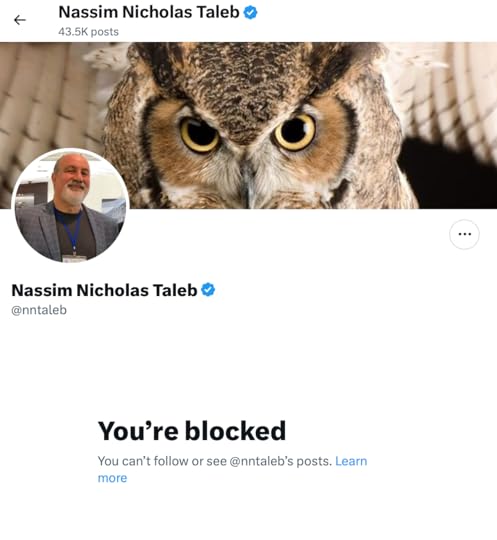
Cherry-picking meets ignorance of human nature meets naive interpretation of history meets erroneous assumptions.
If you cherry-pick the data, you can make ANY ridiculous hypothesis sound convincing.
Unlike those who complain about Taleb’s unresolved teenage angst, his thin-skinned hubris, or his lack of civility, I couldn’t care less about his crass remarks. My problem is with the ideas in this book, not its author, although I do question the intelligence of its author when his prose lapses into pseudoscientific drivel.
Most of the ideas in Nassim Nicholas Taleb’s ‘Skin in the Game’ are characterized by a shameless lack of nuance, are supported only by dishonest misrepresentation and overgeneralization of samples, and will probably make the world much worse if implemented. The only other book I can think of which more strongly exemplifies confirmation bias, and which is more blind towards overwhelming contradictory evidence, is Rhonda Byrne’s ‘The Secret’, and parallels between these two books run deep—deep enough to call this ‘Taleb’s The Secret’. (Even Byrne’s book draws heavily upon ancient mythologies to make one absurd point after another).
Taleb all but begs the reader to take note of his SITG chivalry. Yes, good Sir Knight, your chivalry is noted.
SITG isn’t just a reward-punishment model; punishment is what a centralized justice system does AFTER screwing up. Rather, it’s a decentralized, reward-or-punishment-through-risk-exposure model where your exposure to the consequences is ensured BEFORE the implementation, so that screwing up automatically punishes on its own. It’s (supposedly) a self-corrective model.
Now, there are not two but four combinations of idea-consequence scenarios that can be neatly represented as below.
The premise: You present an idea to the world, which is then implemented. In all four scenarios listed below, other people are respectively affected as a result of the implementation, but the ramifications for you are different in each.
1) Symmetry: You gain something valuable (to you) if it works, and you lose something valuable if it doesn’t.
2) Positive asymmetry: You gain something valuable if it works, but you lose nothing if it doesn’t.
3) Negative asymmetry: You gain nothing if it works, but you lose something valuable if it doesn’t.
4) Neutral: You gain nothing if it works, and you lose nothing if it doesn’t.
(1 and 3 are SITG scenarios; 2 and 4, not)
The book is rather disingenuous in its front-cover illustration and subtitle, which make it seem that this book is somehow a crusade against positive asymmetries—the “heads I win, tails you lose” bets. I would have showered this book with so much praise as to exhaust the nation’s supply of accolades if this book REALLY were about replacing only asymmetries with symmetries.
But since nuance isn’t Taleb’s forte, he goes all the way to the other extreme and says that EVERY idea-consequence situation must be symmetrical. (Along with numerous instances throughout the book, he ends the book by suggesting “[do] nothing without skin in the game.”) In a nutshell, Taleb argues that SITG eliminates bad ideas by disfiguring both the reputation and the bank accounts of those who concocted the ideas. An investment advisor who is investing your money with his ideas should have a significant personal stake in the same fund. If the idea fails, he almost drowns in bankruptcy and nobody will ever take his investment advice seriously again. Over time, many similar events will eliminate other bad ideas and the people who parented those ideas. As a result, the system overall is better off, and it is precisely SITG that allowed these self-corrections to happen. In a non-SITG environment, such people can persist.
Sounds great, and symmetries are indeed well suited to some situations. But the problem is that this solution is not at all generalizable and is very restricted in its applicability. Recall that there are two kinds of non-SITG scenarios, and if applied to the wrong one, Taleb’s model harms the system more than it rehabilitates it.
Many decades ago, Stanley Kubrick, the acclaimed filmmaker, pronounced his verdict on human nature in this eloquent quote: “We are capable of the greatest good and the greatest evil, but the problem is that we often can't distinguish between them when it suits our purpose.”
Paraphrased to befit the context of this review, the above quote simply says that if a man has his SITG, he will do just about ANYTHING to save his skin. He will lie, cheat, deceive, exaggerate, lobby, wield power, or do a million other wicked things just to save his skin.
Here are some ways in which SITG, by incapacitating the ability of the skin-owners to tell the difference between good and evil, can harm the system:
1. Taleb maintains that SITG and conflict of interest should not be conflated, but he fails to grasp that if, as he demands, politicians were to have their SITG, it would INEVITABLY lead to conflict of interest as a nasty side-effect. The reason why the powers-that-be, economic advisers to the president, and top-level bureaucrats are required NOT to have any SITG is because it’s a textbook example of conflict of interest—they could use the power of their office to recommend or implement only those policies which save their own skin, while the benefits for others might not be as, or at all, profitable. Carl Icahn, who is currently under federal investigation, briefly served as Adviser to the President and attempted to use the power of his office to save himself $200 million in taxes through a biofuel company that he owned. (He was allowed to have SITG because of bureaucratic loopholes; normally, this is rightly prohibited). If a man has SITG AND the government-given power to save his skin, he will do ANYTHING to save his own skin. [Additional checks, which currently do not exist, must be in place to ensure that even a conflict-of-interest-free public servant doesn’t directly profit from the policies they implemented, AFTER they leave the office]. However, someone who has the official power but who has nothing to gain or lose (as in the case of pure neutrals), either in the present or in the future, is more likely to do good to others rather than serve himself like Icahn did.
2. Financial SITG is the reason why tobacco companies, despite their own research showing that smoking tobacco is strongly correlated with lung cancer, suppressed those findings, lied to the public for decades that there is no evidence, let millions die of preventable cancer, got caught lying, and were sued for billions—all in a misguided attempt to save their invested skin. And unsurprisingly, owing to SITG, something very similar is happening with oil companies now. (Read Oreskes and Conway’s ‘Merchants of Doubt’ for more on this). Along with the rest of mankind, these people and their descendants will also be exposed to the downside risk of carbon emission—so there’s both financial AND literal SITG, but that doesn’t stop them from defrauding the public. All these companies lose a lot of money should things not go in their favor, and make a lot of money otherwise, so they are never honest about their data or their true intentions—a typical trait of those with SITG. Taleb himself stood to make a lot more money in 2007 had all the Big Banks been allowed to fail; he had placed bets that they would fail. Only the truly gullible can fail to see why he (fruitlessly) demanded that the Fed let those banks fail.
3. NOT having any SITG game lets you think objectively about a situation in a way that having your skin at stake hardly can. The slave-holding states of the American antebellum South wanted to secede from the Union primarily, though not solely (I am not nuance-averse), because of the issue of slavery. The abolitionists of the North had no skin in the cotton production game; only the southern cotton plantation/industry owners did, and cotton was the prime mover of the Southern economy. Slavery was crucial to the cotton business, and the slave-holding states of the South would have taken a huge economic hit if slavery were abolished. Small wonder, then, that the South wanted to keep slavery alive by seceding from the Union, thus initiating the Civil War. There was nothing inherently evil or stupid about the Southerners; they were driven by an inability to tell the difference between good and evil because their own interests were involved. Slavery did not resolve itself at the hands of those with skin in the cotton game. It took the intelligence and objectivity of non-slaveholders—the abolitionists of the North who, if the logic of this book were applied, would be labeled “virtue signalers”—to rid the US of slavery and better the system. It was Lincoln and his cohorts, not slaveholders or Southerners, who ratified the Thirteenth Amendment to the Constitution, the one abolishing slavery.
Coming to the second recurring theme in the book, the Lindy effect: Here, Taleb’s loose grasp of reality takes on a life of its own. This idea is mathematically beautiful but ultimately stands on the quick soil. (Taleb generally likes to point out that you cannot question the mathematics of his published papers without having your own sanity questioned, but the problem isn’t with the mathematics; it’s with the assumptions that get you started. Kurt Gödel once “proved” that God exists using mathematical logic; see Gödel's ontological proof. What’s not above criticism, though, are his assumptions—nor anybody else’s!) In essence, it states that the projected lifespan of non-perishable cultural entities is in direct correlation with its current age. If a book has survived for 100 years in print, it will likely survive another 100.
If you are familiar with ‘the Wisdom of the Crowds,’ it only takes a small leap of imagination to arrive at the Lindy effect: Lindy is nothing but the Wisdom of the Crowds applied across time. At its foundation, both ideas require people—lots of common, hardworking people—who make collective decisions about accepting or rejecting an idea through small decisions that accrue. In the Wisdom, the decisions accrue across space; in Lindy, across time. But in both, it is the hoi polloi—and not the academics, the bureaucrats, or some other group of chosen experts—who truly put the ideas to the test.
Studying the Wisdom sheds light on the nature of Lindy, and to that end I’ll quote an insightful excerpt from an essay by Warren Buffett that decries the Efficient Market Hypothesis, an absurd, absolutistic theory built on the Wisdom of the Crowds: “EMH was embraced not only by academics, but by many investment professionals and corporate managers as well. Observing correctly that the market was FREQUENTLY efficient, they went on to conclude incorrectly that it was ALWAYS efficient. The difference between these propositions is night and day.”
Lindy is indeed good at eliminating some bad cultural objects from the past. But since Taleb is fond of saying “Lindy and Lindy alone is the real expert,” I think Lindy’s consistency is worth examining. Is Lindy only FREQUENTLY or ALWAYS effective? The difference matters. A lot.
My first brush with the core assumption underlying this idea—though not the idea itself—was in Taleb’s ‘Fooled by Randomness,’ which I read back when I was an admirer of his. In that book, he is careful to distinguish between survival through chance and survival through competence. A stockbroker can have a long career making successful bets, despite being clueless about stocks. The laws of stochastic probability make room for such anomalies. However, a dentist or a doctor can have a long career if and only if they are competent, and no law of probability will rescue them otherwise. It’s not really malpractice lawsuits or losing medical license that removes them from the profession, although that contributes, too; rather, it’s public verdict that nails their metaphorical coffin: You cannot fool people for long stretches of time in a profession where luck plays no role.
Or so I thought...
I learned this many unfortunate years later: The case he makes for non-stochastic professions turns out not to be true at all and illuminates a rot in the assumptions that Lindy stands on. Not only CAN incompetent doctors have decades-long career, but there actually IS a precedent for it.
The noise caused by the placebo effect can sometimes deafen people to the fraudulence of most alternative medicines which generally treat non-life-threatening conditions. But there is one particular case of a “doctor” in South Asia whose “cure” for the most intractable of human miseries—cancer—essentially makes it impossible to fail to tell the difference between success and failure of the medicine for long periods. If any alternative medicine fraud claims to have a cure for cancer, the claim can be put to the test as easily by the public as by scientists. People should, given a decade or more of hearsay, arrive at a verdict about the efficacy of the treatment—if Taleb is to be believed.
This “doctor” goes by the name of Vaidya Narayana Murthy who, along with his ancestors for centuries, has been “curing” all forms of cancer and other incurable ailments by making people ingest pieces of tree barks grown in his native village. He boasts of a success rate of 60%, clearly fabricated, since he would be awarded the Nobel Prize in Medicine if he could cure ANY cancer, let alone ALL forms of cancer, with that level of success. Every week, an exodus of benighted, gullible, illiterate, and even semi-literate people from all across the country arrive at his doorstep and stand in miles-long queue for hours to get a 10-second appointment with him. If Lindy were to be an “expert,” such oddities would necessarily have to be eliminated over time as people realize this man’s fraud and stop seeking his appointments, regardless of how much he charges for the appointments—but quite the opposite is happening, as his patient numbers rise every year. Even his online ratings are consistently high. Nothing about their behavior even remotely suggests that you can’t fool them for long, even at something so basic as the efficacy of a cure for cancer.
Vox populi? Vox humbug!
Many more such examples abound. When Lindy cannot even eliminate fraud in simple systems like detecting the success of a miraculous cure for cancer, to expect it to arrive at reliable heuristics in complex systems in the form of time-tested aphorisms is naïve wishful thinking. Aphorisms survive because of their rhetorical effect, not necessarily because they are agents of truth. Only by woefully cherry-picking them can you present them in a positive light. Superstitions survive for thousands of years, and horrible myths that are demonstrably untrue are inherited through generations of descendants, completely unfiltered by Lindy. (Conversely, many great books of science and math from the antiquity, including five books by Euclid, have been irretrievably lost, unprotected by Lindy.) In India, a practice called “sati”—in which a widowed wife would be cremated alive with her husband’s corpse—prevailed for more than 1500 years before it was forcefully abolished in 1821 through government intervention. Lindy tolerated it for 1500 years; bureaucrats and reformers ended it in just 15. If you wish to make hard life choices based on one-liners handed down from the social “wisdom” of the ancients, the Romans, or any other people who owned human slaves and committed atrocities for recreation, be my guest.
Page after page of this book is filled with vignettes from classical literature, to give it the feel of Lindyness. It never ceases to amuse me how Taleb combs through historical mythologies to find stories that vaguely metaphorically resemble an agenda he has already made up his mind about. (Even the typeface of this book is given a historical context for, geez!) Taleb likes to chastise psychologists, but psychologists have also committed the same error that Taleb is committing in abundance here: Drawing a little too much inspiration from ancient vignettes. Freud was inspired by the vignette of Oedipus when he came up with his ridiculous hypothesis of Oedipus complex. Jung produced an equally ridiculous variant called the Electra complex after the Greek mythological character. Another perverse complex, also inspired by classical Greek stories, goes by Jocasta complex.
Romanticizing the genius of the “elders” can produce idiotic filth, not always profundity. Even evolution by natural selection, which Taleb claims is a sophisticated form of SITG, is only a crude method of problem-solving that doesn’t eliminate all errors, no matter how much time passes. Cancer genes can survive in a species for millions of years.
However, none of this is to say that Lindy is totally useless. In the philosophy of science, consilience is a method of converging on the truth through multiple, independent sources of evidence that are themselves imperfect and prone to errors. We know that the theory of evolution is true not just because fossils hint at it, but because seven independent sources of evidence converge at the same conclusion. A theory which is supported only by one form of evidence is a lot weaker than a theory that is vindicated by multiple sources that do not depend on each other. In the event of a disagreement between sources—which is bound to happen given that each source is imperfect—all it means is that further investigation is needed, not that one source is necessarily better than the other, or that the other source must be discarded altogether. In consilience, Lindy can act as ONE of these independent sources, rather than replacing other sources. But by clownishly interjecting that “Lindy alone is the real expert,” Taleb only makes the cavernous depths of his ignorance official.
—
There are no more characters left to write more here.
If intellectuals can be idiots, Taleb is its most shining example. He is better suited for trolling on Twitter and peddling conspiracy theories about GMOs than for sermonizing on how societies should function.

September 25, 2018
I’m improperly awed and professionally depressed by this guy. While I’ve been in love with the concept of asymmetry since, like, forever, he puts on it such an excruciating spin that… a lot of professions suddenly attain the unmistakable bullshit (or maybe swanshit!) flavor.
Anyway, this book lost a bit of its charm due to aggressive and seemingly random things aggregated together. I'm sure it's another case of 'it's not you, it's me', still, I felt the previous volumes were better grounded and more founded in reality. Anyway, the eruditic approach to even the most disjointed things: Assassins, politics, Knights Templar.... etc, you name it, made this an irresistible read.
Q:
DATA, SHMATA
Another lesson from Piketty’s ambitious volume: it was loaded with charts and tables. There is a lesson here: what we learn from professionals in the real world is that data is not necessarily rigor. One reason I—as a probability professional—left data out of The Black Swan (except for illustrative purposes) is that it seems to me that people flood their stories with numbers and graphs in the absence of solid or logical arguments. Further, people mistake empiricism for a flood of data. Just a little bit of significant data is needed when one is right, particularly when it is disconfirmatory empiricism, or counterexamples: only one data point (a single extreme deviation) is sufficient to show that Black Swans exist.
Traders, when they make profits, have short communications; when they lose they drown you in details, theories, and charts.
Probability, statistics, and data science are principally logic fed by observations—and absence of observations. For many environments, the relevant data points are those in the extremes; these are rare by definition, and it suffices to focus on those few but big to get an idea of the story. If you want to show that a person has more than, say $10 million, all you need is to show the $50 million in his brokerage account, not, in addition, list every piece of furniture in his house, including the $500 painting in his study and the silver spoons in the pantry. So I’ve discovered, with experience, that when you buy a thick book with tons of graphs and tables used to prove a point, you should be suspicious. It means something didn’t distill right! But for the general public and those untrained in statistics, such tables appear convincing—another way to substitute the true with the complicated. (c)
Q:
There is a vicious domain-dependence of expertise: the electrician, dentist, scholar of Portuguese irregular verbs, assistant colonoscopist, London cabby, and algebraic geometer are experts (plus or minus some local variations), while the journalist, State Department bureaucrat, clinical psychologist, management theorist, publishing executive, and macroeconomist are not. This allows us to answer the questions: Who is the real expert? Who decides who is and who is not an expert? Where is the meta-expert?
Time is the expert. (c)
Q:
Currently, most civil servants tend to stay in civil service—except for those in delicate areas that industry controls: the agro-alimentary segment, finance, aerospace, anything related to Saudi Arabia …
A civil servant can make rules that are friendly to an industry such as banking—and then go off to J.P. Morgan and recoup a multiple of the difference between his or her current salary and the market rate. (Regulators, you may recall, have an incentive to make rules as complex as possible so their expertise can later be hired at a higher price.)
So there is an implicit bribe in civil service: you act as a servant to an industry, say, Monsanto, and they take care of you later on. They do not do it out of a sense of honor: simply, it is necessary to keep the system going and encourage the next guy to play by these rules. The IYI-cum-cronyist former Treasury Secretary Tim Geithner—with whom I share the Calabrese barber of the Prologue—was overtly rewarded by the industry he helped bail out. He helped bankers get bailouts, let them pay themselves from the largest bonus pool in history after the crisis, in 2010 (that is, using taxpayer money), and then got a multimillion-dollar job at a financial institution as his reward for good behavior. (c)
Q:
As I mentioned earlier in Prologue 3, I have held for most of my (sort of) academic career no more than a quarter position. A quarter is enough to have somewhere to go, particularly when it rains in New York, without being emotionally socialized and losing intellectual independence for fear of missing a party or having to eat alone. (c)
Q:
And recall that, a free person does not need to win arguments—just win. (c)
Q:
Hard science might be robust to the pathologies—even then. So let us take a look at social science. Given that the sole judges of a contributor are his “peers,” there is a citation ring in place that can lead to all manner of rotting. Macroeconomics, for instance, can be nonsense since it is easier to macrobull***t than microbull***t—nobody can tell if a theory really works.
If you say something crazy you will be deemed crazy. But if you create a collection of, say, twenty people who set up an academy and say crazy things accepted by the collective, you now have “peer-reviewing” and can start a department in a university. (c)
Q:
Knowing “economics” doesn’t mean knowing anything about economics in the sense of the real activity, but rather the theories, most of which are bull***t, produced by economists. (c)
Q:
The deprostitutionalization of research will eventually be done as follows. Force people who want to do “research” to do it on their own time, that is, to derive their income from other sources. Sacrifice is necessary. It may seem absurd to brainwashed contemporaries, but Antifragile documents the outsized historical contributions of the nonprofessional, or, rather, the non-meretricious. For their research to be genuine, they should first have a real-world day job, or at least spend ten years as: lens maker, patent clerk, Mafia operator, professional gambler, postman, prison guard, medical doctor, limo driver, militia member, social security agent, trial lawyer, farmer, restaurant chef, high-volume waiter, firefighter (my favorite), lighthouse keeper, etc., while they are building their original ideas.
It is a filtering, nonsense-expurgating mechanism. I have no sympathy for moaning professional researchers. I for my part spent twenty-three years in a full-time, highly demanding, extremely stressful profession while studying, researching, and writing my first three books at night; it lowered (in fact, eliminated) my tolerance for career-building research. (c)
Q:
he first group are terrorists for about everyone, that is, for every person equipped with the ability to discern and isn’t a resident of Saudi Arabia and doesn’t work for a think tank funded by sheikhs; the second are militia groups largely called terrorists by their enemies, and “resistance” or “freedom fighters” by those who don’t dislike them.
The first includes nonsoldiers who indiscriminately kill civilians for effect and don’t bother with military targets, as their aim isn’t to make military gains, just to make a statement, harm some living humans, produce some noise, and, for some, find a low-error way to go to paradise. Most Sunni jihadis, of the type who take incommensurable pleasure in blowing up civilians, such as Al Qaeda, ISIS, and the “moderate rebels” in Syria sponsored by former U.S. president Obama, are in that category. (c)
Anyway, this book lost a bit of its charm due to aggressive and seemingly random things aggregated together. I'm sure it's another case of 'it's not you, it's me', still, I felt the previous volumes were better grounded and more founded in reality. Anyway, the eruditic approach to even the most disjointed things: Assassins, politics, Knights Templar.... etc, you name it, made this an irresistible read.
Q:
DATA, SHMATA
Another lesson from Piketty’s ambitious volume: it was loaded with charts and tables. There is a lesson here: what we learn from professionals in the real world is that data is not necessarily rigor. One reason I—as a probability professional—left data out of The Black Swan (except for illustrative purposes) is that it seems to me that people flood their stories with numbers and graphs in the absence of solid or logical arguments. Further, people mistake empiricism for a flood of data. Just a little bit of significant data is needed when one is right, particularly when it is disconfirmatory empiricism, or counterexamples: only one data point (a single extreme deviation) is sufficient to show that Black Swans exist.
Traders, when they make profits, have short communications; when they lose they drown you in details, theories, and charts.
Probability, statistics, and data science are principally logic fed by observations—and absence of observations. For many environments, the relevant data points are those in the extremes; these are rare by definition, and it suffices to focus on those few but big to get an idea of the story. If you want to show that a person has more than, say $10 million, all you need is to show the $50 million in his brokerage account, not, in addition, list every piece of furniture in his house, including the $500 painting in his study and the silver spoons in the pantry. So I’ve discovered, with experience, that when you buy a thick book with tons of graphs and tables used to prove a point, you should be suspicious. It means something didn’t distill right! But for the general public and those untrained in statistics, such tables appear convincing—another way to substitute the true with the complicated. (c)
Q:
There is a vicious domain-dependence of expertise: the electrician, dentist, scholar of Portuguese irregular verbs, assistant colonoscopist, London cabby, and algebraic geometer are experts (plus or minus some local variations), while the journalist, State Department bureaucrat, clinical psychologist, management theorist, publishing executive, and macroeconomist are not. This allows us to answer the questions: Who is the real expert? Who decides who is and who is not an expert? Where is the meta-expert?
Time is the expert. (c)
Q:
Currently, most civil servants tend to stay in civil service—except for those in delicate areas that industry controls: the agro-alimentary segment, finance, aerospace, anything related to Saudi Arabia …
A civil servant can make rules that are friendly to an industry such as banking—and then go off to J.P. Morgan and recoup a multiple of the difference between his or her current salary and the market rate. (Regulators, you may recall, have an incentive to make rules as complex as possible so their expertise can later be hired at a higher price.)
So there is an implicit bribe in civil service: you act as a servant to an industry, say, Monsanto, and they take care of you later on. They do not do it out of a sense of honor: simply, it is necessary to keep the system going and encourage the next guy to play by these rules. The IYI-cum-cronyist former Treasury Secretary Tim Geithner—with whom I share the Calabrese barber of the Prologue—was overtly rewarded by the industry he helped bail out. He helped bankers get bailouts, let them pay themselves from the largest bonus pool in history after the crisis, in 2010 (that is, using taxpayer money), and then got a multimillion-dollar job at a financial institution as his reward for good behavior. (c)
Q:
As I mentioned earlier in Prologue 3, I have held for most of my (sort of) academic career no more than a quarter position. A quarter is enough to have somewhere to go, particularly when it rains in New York, without being emotionally socialized and losing intellectual independence for fear of missing a party or having to eat alone. (c)
Q:
And recall that, a free person does not need to win arguments—just win. (c)
Q:
Hard science might be robust to the pathologies—even then. So let us take a look at social science. Given that the sole judges of a contributor are his “peers,” there is a citation ring in place that can lead to all manner of rotting. Macroeconomics, for instance, can be nonsense since it is easier to macrobull***t than microbull***t—nobody can tell if a theory really works.
If you say something crazy you will be deemed crazy. But if you create a collection of, say, twenty people who set up an academy and say crazy things accepted by the collective, you now have “peer-reviewing” and can start a department in a university. (c)
Q:
Knowing “economics” doesn’t mean knowing anything about economics in the sense of the real activity, but rather the theories, most of which are bull***t, produced by economists. (c)
Q:
The deprostitutionalization of research will eventually be done as follows. Force people who want to do “research” to do it on their own time, that is, to derive their income from other sources. Sacrifice is necessary. It may seem absurd to brainwashed contemporaries, but Antifragile documents the outsized historical contributions of the nonprofessional, or, rather, the non-meretricious. For their research to be genuine, they should first have a real-world day job, or at least spend ten years as: lens maker, patent clerk, Mafia operator, professional gambler, postman, prison guard, medical doctor, limo driver, militia member, social security agent, trial lawyer, farmer, restaurant chef, high-volume waiter, firefighter (my favorite), lighthouse keeper, etc., while they are building their original ideas.
It is a filtering, nonsense-expurgating mechanism. I have no sympathy for moaning professional researchers. I for my part spent twenty-three years in a full-time, highly demanding, extremely stressful profession while studying, researching, and writing my first three books at night; it lowered (in fact, eliminated) my tolerance for career-building research. (c)
Q:
he first group are terrorists for about everyone, that is, for every person equipped with the ability to discern and isn’t a resident of Saudi Arabia and doesn’t work for a think tank funded by sheikhs; the second are militia groups largely called terrorists by their enemies, and “resistance” or “freedom fighters” by those who don’t dislike them.
The first includes nonsoldiers who indiscriminately kill civilians for effect and don’t bother with military targets, as their aim isn’t to make military gains, just to make a statement, harm some living humans, produce some noise, and, for some, find a low-error way to go to paradise. Most Sunni jihadis, of the type who take incommensurable pleasure in blowing up civilians, such as Al Qaeda, ISIS, and the “moderate rebels” in Syria sponsored by former U.S. president Obama, are in that category. (c)

August 16, 2019
Update July 22, 2021: Read the book a 4th time. When I got annoyed with vulgarity or repetition, I skipped a bit. I usually never had to skip more than a paragraph or two. The book read much more smoothly. I also read this book a page or two at a time at the beach or on a bus. It's a great book to read for a fourth time this way.
Update September 4, 2020. I changed my mind. I decided to rate this book after all.
Any book that has passages that are better on the third reading deserves five stars. On my third reading, there were parts of the book I skipped, but most of the book was still remarkable, and I would argue even better on the third reading. Ergo, 5 stars are necessary. And anything less would be dishonest.
I will leave the original review as it was written around this time last year, but keep in mind that all my remarks about the book being unrateable have now been overturned.
1. I can't rate this book. This seems an absurd thing to say, but it's hard to rate a book that often comes off as a pre-pubescent twitter rant. I think the problem is that Taleb's classical (and anti-modern) sense of honor screeches against my modern ears. Also, his classical sense of honor often devolves into the aesthetics of blue-collar water cooler bullshit sessions (I've been around too many of these), twitter rants, and toxic masculinity.
2. The actual philosophy of this book is wonderful and deserves at least two readings. I own the paperback in question, so I can just cross out flagrant vulgarity with a black pen. There isn't that much of it (just enough to make the book unrateable).
3. If you've read Antifragile and Black Swan, much of what is written in this book (but not all) will seem redundant. I think once you've figured out the core of Taleb's philosophy you can start applying it to your own problems with ease. It does help, however, to go back and see how he applies it. I consider Fooled by Randomness to be less essential than Antifragile and Black Swan, but an interesting case study to understand how philosophies evolve.
Since apparently, I'm not a real man unless I deadlift, and deadlifting is more important than book lifting at a library, and since I haven't deadlifted since high school football, I guess I should get back to deadlifting. Sadly, 350 pounds was my max in high school and all I've been doing since then is trying to improve myself with book learning.
That, or I can embrace a very hidden asymmetrical truth about modernity. Modernity has unlocked the once hidden power of women -- women thinkers, women writers (some who deadlift, many who don't) -- thus, roughly doubling the amount of ingenuity and talent (at least in places that are modern). An interesting question, one I think deserves some thought: How do intelligent, working women -- and to be fair entrepreneurs -- read Taleb? I think I'll explore the Goodreads comment sections and find out.
Update September 4, 2020. I changed my mind. I decided to rate this book after all.
Any book that has passages that are better on the third reading deserves five stars. On my third reading, there were parts of the book I skipped, but most of the book was still remarkable, and I would argue even better on the third reading. Ergo, 5 stars are necessary. And anything less would be dishonest.
I will leave the original review as it was written around this time last year, but keep in mind that all my remarks about the book being unrateable have now been overturned.
1. I can't rate this book. This seems an absurd thing to say, but it's hard to rate a book that often comes off as a pre-pubescent twitter rant. I think the problem is that Taleb's classical (and anti-modern) sense of honor screeches against my modern ears. Also, his classical sense of honor often devolves into the aesthetics of blue-collar water cooler bullshit sessions (I've been around too many of these), twitter rants, and toxic masculinity.
2. The actual philosophy of this book is wonderful and deserves at least two readings. I own the paperback in question, so I can just cross out flagrant vulgarity with a black pen. There isn't that much of it (just enough to make the book unrateable).
3. If you've read Antifragile and Black Swan, much of what is written in this book (but not all) will seem redundant. I think once you've figured out the core of Taleb's philosophy you can start applying it to your own problems with ease. It does help, however, to go back and see how he applies it. I consider Fooled by Randomness to be less essential than Antifragile and Black Swan, but an interesting case study to understand how philosophies evolve.
Since apparently, I'm not a real man unless I deadlift, and deadlifting is more important than book lifting at a library, and since I haven't deadlifted since high school football, I guess I should get back to deadlifting. Sadly, 350 pounds was my max in high school and all I've been doing since then is trying to improve myself with book learning.
That, or I can embrace a very hidden asymmetrical truth about modernity. Modernity has unlocked the once hidden power of women -- women thinkers, women writers (some who deadlift, many who don't) -- thus, roughly doubling the amount of ingenuity and talent (at least in places that are modern). An interesting question, one I think deserves some thought: How do intelligent, working women -- and to be fair entrepreneurs -- read Taleb? I think I'll explore the Goodreads comment sections and find out.
February 21, 2018
Pop-science in it's lowest form. Book reads like a poorly researched, hastily written college essay. Strings together a few nuggets of common sense wisdom with sizeable amounts of unreferenced BS. Taleb is a shark, living off a reputation and using his own fanbase like an ATM.
March 4, 2018
In this book #4, Taleb is more arrogant and pretentious than ever. You can never let go of the feeling that this book is about him, rather than any other topic. He's become profoundly obnoxious and negative. Despite some good points in the book, reading it feels like carrying a burden.
In this new book Taleb goes to extra lengths to attack David Runciman, head of the politics department at Cambridge, and a Guardian book reviewer who had torn apart his previous "Antifragile" book. Runciman's criticisms for book #3 are totally valid here in book #4 as well: that Taleb is profoundly antisocial, self-contradicting, and disorganized; that "Black Swan" and "Fooled by randomness" will remain classics, while "Antifragile" - and I'm sure "Skin in the game" as well - will be forgotten quickly because of their mediocrity.
In this new book Taleb goes to extra lengths to attack David Runciman, head of the politics department at Cambridge, and a Guardian book reviewer who had torn apart his previous "Antifragile" book. Runciman's criticisms for book #3 are totally valid here in book #4 as well: that Taleb is profoundly antisocial, self-contradicting, and disorganized; that "Black Swan" and "Fooled by randomness" will remain classics, while "Antifragile" - and I'm sure "Skin in the game" as well - will be forgotten quickly because of their mediocrity.

November 13, 2018
Taleb has a few basic rules of writing, to wit:
* Never be boring
* Be sure to insult those you disagree with
* Remind the reader frequently of how smart you are, as evidenced by a multitude of quotations, in Latin wherever possible
* Mix the brilliant with the banal, the insightful with the sophomoric, the wise with the petty
* Keep the chapters short
* Roam widely across history to draw examples from, especially the classical world of the Eastern Mediterranean
* Remind the reader that although you are, like, really smart, you are also salt of the earth, in fact much more salt of the earth than your worthless critics with their fancy degrees and their secure tenured perches who probably never ever go to New York gyms reeking of stale sweat and never ever do dead-lifts
* Never mention "moral hazard", even though that's what the book is mainly about, because moral hazard sounds dull and well-worn whereas "skin in the game" sounds like a man's man kind of thing
In short, the author is erudite and entertaining even if his style is often cringe-worthy and irritating, possessing a personality that shines through on every page. That personality reminds the reader of a much, much smarter version of a certain orange-faced head of state given to frequent outbursts on Twitter. I don't think Taleb is the tweeting sort but if he were his tweets would be...Trumpian, but coherently so, with many more polysyllabic words, and probably without the Random Capitalization so characteristic of our Dear Leader. But I digress.
The main idea of this book is that you shouldn't trust the opinions of people without skin in the game, who won't suffer painful consequences, financial or otherwise, if their opinions are wrong. An extension of this idea is that you shouldn't trust people who don't have first-hand, in-the-trenches experience in whatever their chosen profession may be, from cutting hair to running companies to leading armies. However, Taleb leaves little doubt that the best profession of all is being a Wall St. trader, which he was for 20-odd years. The author's curiously narrow working experience, of little value to society or to the economy, consists of skimming some profit off the river of money coursing through the financial exchanges, while avoiding taking major losses from the markets' periodic wild gyrations. At this, Taleb excelled, by his own account, which I have no reason to doubt. But he wasn't even an investor, let alone an entrepreneur, much as he glorifies the entrepreneur. He was a risk-taker, but of the short-term speculator variety. It's by no means a dishonorable profession, and certainly a challenging if lucrative one. But it does tend to shape a certain worldview, especially towards risk. And what Taleb is all about is managing risk, and understanding it quantitatively.
A key concept in his idea of risk is his notion of "ergodicity", a branch of probability theory I have not studied. As Taleb uses the term, a system is ergodic if the probability of some outcome as a result of 100 independent iterations is the same as the probability of that outcome from one individual running 100 iterations. If 100 people jump off a cliff into the sea and #42 dies, while all the others survive, the chances of death are 1%. If one individual has to jump off that same cliff 100 times, the chances of death for that person approach 100%, not 1%. Hard to argue that you shouldn't run the same 1% risk 100 times and expect to survive if the 1% entails what Taleb calls "ruin". In the financial world, if you make enough speculative bets where one of the very low probability outcomes is financial disaster, you will eventually encounter financial disaster. Lone rogue traders have been known to take down entire banks.
So why is this idea interesting? As an individual, it tells you not to take repeated life-threatening and solvency-threatening risks if you can instead take smaller risks with expected positive outcomes -- and zero risk of ruin. Applying the idea to problems at the social level, such as GMOs and climate change, Taleb argues that these are the kind of risk scenarios where ruin is a real possibility, where the number of iterations of this risky bet is very high, and where we therefore should not take these risks in the first place. I didn't need any convincing of this with respect to climate change, but Taleb has definitely given me reason to re-assess what I think of GMOs. I am still not sure what to make of the high risk of our planet outrunning its food supply as population grows inexorably towards its peak somewhere between 10-12 billion VS. the risk of GMOs having unforeseen nasty consequences for both human and other forms of life. Taleb says the latter risk is too high because it could be terminal; he says nothing about the risk of the former.
A curious feature of the book is that Taleb, who worshipped behavioral economics in his previous book Fooled by Randomness, turns against it in this volume. He does not explicitly attack the fathers of the field, Tversky and Kahneman (who won the Nobel Prize in Economics for his work), but does go on the rampage against some of the other thinkers in the field, such as Cass Sunstein and Richard Thaler. The gist of Taleb's argument is that individuals' irrational behaviors due to cognitive biases don't amount to sub-optimal system behavior because systems are not simply the sum of the individual components. He illustrates this with the example of the invisible hand of the market, where purely self-interested individual behaviors nonetheless result in a market that efficiently self-regulates through price signals. I think this is major confusion on his part. Take retirement savings, a problem he mentions. American workers notoriously save too little and put too much of their savings in low interest money market accounts, due in part to certain cognitive biases such as weighting the pleasures of the present (spending the money NOW) disproportionately heavily relative to the the future (having much more money to spend in retirement). Meanwhile, the market does a very efficient job of pricing in myriad factors to determine the constantly-adjusted price of a typical ETF such as Vanguard's VT fund. Does this mean that the retirement savings behavior of individual American workers is going to add up to a rational, optimal retirement savings system somehow, just because the price of the fund these workers might invest in is efficiently determined?
Meanwhile, the behavioral economists of whom Taleb is so contemptuous have some very pragmatic ideas about how to nudge the behavior of workers today -- such as making voluntary enrollment in company 401K retirement plans the default rather than something the employee has to proactively select -- so that they will in fact make more rational retirement savings decisions that will serve them well in the future.
While there is much that I think Taleb is wrong about -- behavioral economics, the importance of economic inequality, the level of social mobility across classes, the role of government beyond the small scale, the role of a free press, the appropriate number of Latin quotations to put in books about risk and uncertainty ... -- there is much he is right about. And he's right about one central thing: beware of advice from people with no skin in the game, who will suffer no great discomfort if the advice they give you proves disastrous.
* Never be boring
* Be sure to insult those you disagree with
* Remind the reader frequently of how smart you are, as evidenced by a multitude of quotations, in Latin wherever possible
* Mix the brilliant with the banal, the insightful with the sophomoric, the wise with the petty
* Keep the chapters short
* Roam widely across history to draw examples from, especially the classical world of the Eastern Mediterranean
* Remind the reader that although you are, like, really smart, you are also salt of the earth, in fact much more salt of the earth than your worthless critics with their fancy degrees and their secure tenured perches who probably never ever go to New York gyms reeking of stale sweat and never ever do dead-lifts
* Never mention "moral hazard", even though that's what the book is mainly about, because moral hazard sounds dull and well-worn whereas "skin in the game" sounds like a man's man kind of thing
In short, the author is erudite and entertaining even if his style is often cringe-worthy and irritating, possessing a personality that shines through on every page. That personality reminds the reader of a much, much smarter version of a certain orange-faced head of state given to frequent outbursts on Twitter. I don't think Taleb is the tweeting sort but if he were his tweets would be...Trumpian, but coherently so, with many more polysyllabic words, and probably without the Random Capitalization so characteristic of our Dear Leader. But I digress.
The main idea of this book is that you shouldn't trust the opinions of people without skin in the game, who won't suffer painful consequences, financial or otherwise, if their opinions are wrong. An extension of this idea is that you shouldn't trust people who don't have first-hand, in-the-trenches experience in whatever their chosen profession may be, from cutting hair to running companies to leading armies. However, Taleb leaves little doubt that the best profession of all is being a Wall St. trader, which he was for 20-odd years. The author's curiously narrow working experience, of little value to society or to the economy, consists of skimming some profit off the river of money coursing through the financial exchanges, while avoiding taking major losses from the markets' periodic wild gyrations. At this, Taleb excelled, by his own account, which I have no reason to doubt. But he wasn't even an investor, let alone an entrepreneur, much as he glorifies the entrepreneur. He was a risk-taker, but of the short-term speculator variety. It's by no means a dishonorable profession, and certainly a challenging if lucrative one. But it does tend to shape a certain worldview, especially towards risk. And what Taleb is all about is managing risk, and understanding it quantitatively.
A key concept in his idea of risk is his notion of "ergodicity", a branch of probability theory I have not studied. As Taleb uses the term, a system is ergodic if the probability of some outcome as a result of 100 independent iterations is the same as the probability of that outcome from one individual running 100 iterations. If 100 people jump off a cliff into the sea and #42 dies, while all the others survive, the chances of death are 1%. If one individual has to jump off that same cliff 100 times, the chances of death for that person approach 100%, not 1%. Hard to argue that you shouldn't run the same 1% risk 100 times and expect to survive if the 1% entails what Taleb calls "ruin". In the financial world, if you make enough speculative bets where one of the very low probability outcomes is financial disaster, you will eventually encounter financial disaster. Lone rogue traders have been known to take down entire banks.
So why is this idea interesting? As an individual, it tells you not to take repeated life-threatening and solvency-threatening risks if you can instead take smaller risks with expected positive outcomes -- and zero risk of ruin. Applying the idea to problems at the social level, such as GMOs and climate change, Taleb argues that these are the kind of risk scenarios where ruin is a real possibility, where the number of iterations of this risky bet is very high, and where we therefore should not take these risks in the first place. I didn't need any convincing of this with respect to climate change, but Taleb has definitely given me reason to re-assess what I think of GMOs. I am still not sure what to make of the high risk of our planet outrunning its food supply as population grows inexorably towards its peak somewhere between 10-12 billion VS. the risk of GMOs having unforeseen nasty consequences for both human and other forms of life. Taleb says the latter risk is too high because it could be terminal; he says nothing about the risk of the former.
A curious feature of the book is that Taleb, who worshipped behavioral economics in his previous book Fooled by Randomness, turns against it in this volume. He does not explicitly attack the fathers of the field, Tversky and Kahneman (who won the Nobel Prize in Economics for his work), but does go on the rampage against some of the other thinkers in the field, such as Cass Sunstein and Richard Thaler. The gist of Taleb's argument is that individuals' irrational behaviors due to cognitive biases don't amount to sub-optimal system behavior because systems are not simply the sum of the individual components. He illustrates this with the example of the invisible hand of the market, where purely self-interested individual behaviors nonetheless result in a market that efficiently self-regulates through price signals. I think this is major confusion on his part. Take retirement savings, a problem he mentions. American workers notoriously save too little and put too much of their savings in low interest money market accounts, due in part to certain cognitive biases such as weighting the pleasures of the present (spending the money NOW) disproportionately heavily relative to the the future (having much more money to spend in retirement). Meanwhile, the market does a very efficient job of pricing in myriad factors to determine the constantly-adjusted price of a typical ETF such as Vanguard's VT fund. Does this mean that the retirement savings behavior of individual American workers is going to add up to a rational, optimal retirement savings system somehow, just because the price of the fund these workers might invest in is efficiently determined?
Meanwhile, the behavioral economists of whom Taleb is so contemptuous have some very pragmatic ideas about how to nudge the behavior of workers today -- such as making voluntary enrollment in company 401K retirement plans the default rather than something the employee has to proactively select -- so that they will in fact make more rational retirement savings decisions that will serve them well in the future.
While there is much that I think Taleb is wrong about -- behavioral economics, the importance of economic inequality, the level of social mobility across classes, the role of government beyond the small scale, the role of a free press, the appropriate number of Latin quotations to put in books about risk and uncertainty ... -- there is much he is right about. And he's right about one central thing: beware of advice from people with no skin in the game, who will suffer no great discomfort if the advice they give you proves disastrous.

May 8, 2019
با ترجمهی خودم با عنوان «پوست در بازی» انشاالله که بیرون اومد، میخونین و لذت میبرین(:

February 26, 2018
I wanted to like this and I certainly did at the beginning. All of his insults are complex, original and amusing but he insults so many people so frequently that the process itself becomes tedious. I do enjoy his historical anecdotes, but again there are a large volume of them, and not always obviously with a point, other than a demonstration of his research or recall abilities. It is the fact that he criticises many individuals in passing with a specific but cryptic reference to something they have said or written, but then offers no detail or explanation as to what they said or wrote or why they were wrong that annoys me the most. In the end, whilst interesting and amusing there was little of use to take from this book - and that is ignoring how pompous and arrogant he sounds all the time as well.

March 1, 2018
Five stars only because six weren't available.

March 1, 2018
Hey, another one who doesn't give a fuck.
NNT is a bit of a diva, and it is obvious that he has some beef with a lot of people. He certainly sounds right. But is he? I don't know.
The book revolves around the notion that people not having skin in the game will fuck us up, somehow. Turns out that the idea of skin in the game can be applied to a wide variety of fields and professions. Especially the ones Taleb doesn't like, like academics, policy makers, journalists. Oh, and rationality as you know it sucks because it is made by academics, and other interesting insights.
NNT is like your funky weekend drug dealer, comes with something interesting that he stole from the big guns, then goes away mumbling hateful speech about the government. I love the guy, now sue me.
NNT is a bit of a diva, and it is obvious that he has some beef with a lot of people. He certainly sounds right. But is he? I don't know.
The book revolves around the notion that people not having skin in the game will fuck us up, somehow. Turns out that the idea of skin in the game can be applied to a wide variety of fields and professions. Especially the ones Taleb doesn't like, like academics, policy makers, journalists. Oh, and rationality as you know it sucks because it is made by academics, and other interesting insights.
NNT is like your funky weekend drug dealer, comes with something interesting that he stole from the big guns, then goes away mumbling hateful speech about the government. I love the guy, now sue me.

May 23, 2018
Taleb has lost it. Regrettably. This book is a good example of someone doing a "Lord Kelvin", that is, making strong claims about things that are not within your field of expertise. Taleb is a statistician, but of course that doesn't hinder him from having very strong opinions on other matters such as other researchers' fields, politics, banking, journalism, to mention just a few.
That's a shame because I loved his first two books. However since Antifragility, quality has been on a downward slope. In this book, Taleb doesn't even bother to back up his claims. Take this claim: old people is right 90 percent of the time but a psychologist is right only 10 percent of the time. Thats interesting for sure but where is the data? Why should I believe this? Last time old people did something they broke the UK by kicking it out of the EU via Brexit. He also claims that - because of the Lindy effect - the only theory that is worthwhile is theory that has "survived" the test of time. Like what the ancients wrote about: honor, love, cognitive dissonance. Of course he conveniently leaves out all the counter examples. Oppression, tyranny and dictatorship has survived the test of time. Are those things better ways of organizing a society than democracy? Machiavelli is a classic, and Aristotle maintained that society should be ruled by a thinking class (of philosophers of course, who did you think?). Is that good theory? It's sloppy thinking and I'm disappointed.
In fact, Taleb writes off whole professions with the stroke of his pen. The all-knowing, omnipotent thinker that he seem to think he is. Instead of actual corroboration of the many many, many claims, we get to read some ancient story about the Assyrians, or a very technical statistical term that seem to obscure Talebs claims instead of illuminating them. It's funny actually with the terminology in this book. I read a lot of science books and I rarely come across a book that uses so many obscure terms and concepts. For a guy who dislikes scientists (and scientism), he sure likes to sound like one.
In summary, the book is severely incoherent - ancient stories are mixed with Talebs observations about modern life, his dismissal of his thought up enemies, and disjointed anectodes from his life. Somehow I get the feeling that the book is actually about Taleb himself.
That's a shame because I loved his first two books. However since Antifragility, quality has been on a downward slope. In this book, Taleb doesn't even bother to back up his claims. Take this claim: old people is right 90 percent of the time but a psychologist is right only 10 percent of the time. Thats interesting for sure but where is the data? Why should I believe this? Last time old people did something they broke the UK by kicking it out of the EU via Brexit. He also claims that - because of the Lindy effect - the only theory that is worthwhile is theory that has "survived" the test of time. Like what the ancients wrote about: honor, love, cognitive dissonance. Of course he conveniently leaves out all the counter examples. Oppression, tyranny and dictatorship has survived the test of time. Are those things better ways of organizing a society than democracy? Machiavelli is a classic, and Aristotle maintained that society should be ruled by a thinking class (of philosophers of course, who did you think?). Is that good theory? It's sloppy thinking and I'm disappointed.
In fact, Taleb writes off whole professions with the stroke of his pen. The all-knowing, omnipotent thinker that he seem to think he is. Instead of actual corroboration of the many many, many claims, we get to read some ancient story about the Assyrians, or a very technical statistical term that seem to obscure Talebs claims instead of illuminating them. It's funny actually with the terminology in this book. I read a lot of science books and I rarely come across a book that uses so many obscure terms and concepts. For a guy who dislikes scientists (and scientism), he sure likes to sound like one.
In summary, the book is severely incoherent - ancient stories are mixed with Talebs observations about modern life, his dismissal of his thought up enemies, and disjointed anectodes from his life. Somehow I get the feeling that the book is actually about Taleb himself.

December 21, 2017
3.5* - rounding up to 4.
Be warned: this book is a ranty, largely unstructured, flow-of-consciousness type stuff. It has an equal probability or either delighting the reader or driving them mad. I personally enjoy the erudite style of Taleb's argumentation and find his references and vignettes of the 'times gone by' intellectually stimulating. Also, the black-and-white bluntness of his position makes the book feel refreshing. You may not agree with Taleb's side, but you are never left in doubt which side that is.
If you read his other books, Skin in the Game is a largely continuation of Antifragile: Things That Gain from Disorder rather than The Black Swan: The Impact of the Highly Improbable. If you have never read Taleb before I urge you to start with the Black Swan. This new book is an awful place to get to know the author. You need to warm up to him first... And if you hated Antifragile. Well, grab something else to read :) Skin in the Game is unlikely to be your thing either.
Be warned: this book is a ranty, largely unstructured, flow-of-consciousness type stuff. It has an equal probability or either delighting the reader or driving them mad. I personally enjoy the erudite style of Taleb's argumentation and find his references and vignettes of the 'times gone by' intellectually stimulating. Also, the black-and-white bluntness of his position makes the book feel refreshing. You may not agree with Taleb's side, but you are never left in doubt which side that is.
If you read his other books, Skin in the Game is a largely continuation of Antifragile: Things That Gain from Disorder rather than The Black Swan: The Impact of the Highly Improbable. If you have never read Taleb before I urge you to start with the Black Swan. This new book is an awful place to get to know the author. You need to warm up to him first... And if you hated Antifragile. Well, grab something else to read :) Skin in the Game is unlikely to be your thing either.

March 25, 2018
Some really good insights in a very small book -
1. "When it comes to the country, I'm a libertarian, when it comes to the state, I'm a republican, when it comes to my city, I'm a Democrat, when it comes to my family, I'm a Socialist".
2. Cost benefit analysis is not possible when there is a probability of Ruin.
3. The west is in the process of committing ideological suicide (on minority rule).
4. Its easier to Macrobullshit than it is to Microbullshit.
5. What matters is not what a person has, but what he or she is afraid of losing.
6. I don't own Microsoft and I am not short on Microsoft, therefore I have no opinion on Microsoft.
7. Don't tell me what you think, tell me whats in your portfolio.
1. "When it comes to the country, I'm a libertarian, when it comes to the state, I'm a republican, when it comes to my city, I'm a Democrat, when it comes to my family, I'm a Socialist".
2. Cost benefit analysis is not possible when there is a probability of Ruin.
3. The west is in the process of committing ideological suicide (on minority rule).
4. Its easier to Macrobullshit than it is to Microbullshit.
5. What matters is not what a person has, but what he or she is afraid of losing.
6. I don't own Microsoft and I am not short on Microsoft, therefore I have no opinion on Microsoft.
7. Don't tell me what you think, tell me whats in your portfolio.

March 16, 2018
“The mark of a charlatan is to defend his position or attack a critic by focusing on some specific statement (“ look at what he said”) rather than blasting his exact position (“ look at what he means” or, more broadly, “look at what he stands for”)— for the latter requires an extensive grasp of the proposed idea.”
This quote from Mr. Taleb perfectly summarizes my problems with his book.
The general theme of the book is that one should be wary of those making decisions who lack consequences of those decisions. The book shines when he focuses on that major theme. His perspectives on every from foreign affairs and the economy were both fascinating and and fair.
It is when he dives into his personal disagreements from recent years that he begins to bluster. He disagrees with author Steven Pinker, doesn't trust modern medicine, and doesn't want to eat GMOs, Fine. But he can't seem to go very long without going back to those three things over and over again. And he refuses to take his own advice on those topics. Rather than bothering to look at what those he disagrees with stands for, he just insults them and insinuates delusional smear campaigns against himself.
And while this may be a cherry picked quote from the book, as it is blatantly dangerous, I feel it needs to be said. Mr. Taleb tells his readers not to listen to their doctors when they are advised to take statins. This advice could literally kill people, and is the reason I felt the need to lower it to only 1 star.
In the end he sounds like an old man yelling at clouds. He is living a lonely life and wants to spend entire chapters explaining why he is better than everyone that has a different lifestyle. Like any old man he has some good advice mixed in with the incoherent rambling.
This quote from Mr. Taleb perfectly summarizes my problems with his book.
The general theme of the book is that one should be wary of those making decisions who lack consequences of those decisions. The book shines when he focuses on that major theme. His perspectives on every from foreign affairs and the economy were both fascinating and and fair.
It is when he dives into his personal disagreements from recent years that he begins to bluster. He disagrees with author Steven Pinker, doesn't trust modern medicine, and doesn't want to eat GMOs, Fine. But he can't seem to go very long without going back to those three things over and over again. And he refuses to take his own advice on those topics. Rather than bothering to look at what those he disagrees with stands for, he just insults them and insinuates delusional smear campaigns against himself.
And while this may be a cherry picked quote from the book, as it is blatantly dangerous, I feel it needs to be said. Mr. Taleb tells his readers not to listen to their doctors when they are advised to take statins. This advice could literally kill people, and is the reason I felt the need to lower it to only 1 star.
In the end he sounds like an old man yelling at clouds. He is living a lonely life and wants to spend entire chapters explaining why he is better than everyone that has a different lifestyle. Like any old man he has some good advice mixed in with the incoherent rambling.

read_summary
December 5, 2021“The curse of modernity is that we are increasingly populated by a class of people who are better at explaining than understanding, or better at explaining than doing.”
― Nassim Nicholas Taleb, Skin in the Game: Hidden Asymmetries in Daily Life
― Nassim Nicholas Taleb, Skin in the Game: Hidden Asymmetries in Daily Life

May 7, 2019
كتب نسيم طالب ذات طابع خاصٍّ جدًا. أفكارها مميّزة وصادمة. أمثلتها متنوعة جدًا وتطبيقاتها واسعة. وأسلوب "طالب" مربكٌ –بل ومزعج- يحتاج إلى اعتياد وإلى قراءة متأنية ونَفَسٍ صبور، يؤلف الصورة بجمع أجزائها ويصبر على اكتمالها بعد تشتيت أظنّه متعمّدًا من الكاتب في محاكاة لـ"لا خطية" *
يدور هذا الكتاب حول فكرة بذل الذات ووضعها على المحكّ، وإتاحة التأثير المباشر للفكرة أو الرأي على صاحبه لبلوغ الرأي السديد. وأعجز عن ترجمة دقيقة شافية للمصطلح الذي اختاره **
ومن عالم الأعمال إلى عالم الأديان، ومن عالم الإدارة إلى عالم السياسة والاقتصاد، ومن الحقل التاريخي إلى حقل العلم التجريبي والنظري يذهب بنا "طالب" في تطوافٍ مثير وغريب ليعرض لرأيه ويبني حجّته، ويشقّ الطريق لنقده اللاذع القاسي في ونصائحه المثيرة للإعجاب أو الإزعاج أو الجدل. (أجد في طريقة نسيم طالب في النقد نَفَسًا شرقيًا لا يُخطأ)
ستخرج من كتاب نسيم طالب هذا –كما في كلّ كتبه السابقة- بكمٍّ هائل من الأفكار الذكية والجميلة والمختلفة، وسترى تكاملها المنطقي الباهر يتشكّل شيئًا فشيئًا، إلى أن تصل إلى نسختك الخاصة من أفكاره. وفي ذلك تكمن عظمة أعماله.
كتب نسيم طالب لا تُلخّص ككلّ متكامل ولا يمكن كتابة مراجعة شافية لها. لكني أنصح بالكتاب وأتمنى أن يُترجم وسابقه.
-------
*NON-LINEARITY
** SKIN IN THE GAME
يدور هذا الكتاب حول فكرة بذل الذات ووضعها على المحكّ، وإتاحة التأثير المباشر للفكرة أو الرأي على صاحبه لبلوغ الرأي السديد. وأعجز عن ترجمة دقيقة شافية للمصطلح الذي اختاره **
ومن عالم الأعمال إلى عالم الأديان، ومن عالم الإدارة إلى عالم السياسة والاقتصاد، ومن الحقل التاريخي إلى حقل العلم التجريبي والنظري يذهب بنا "طالب" في تطوافٍ مثير وغريب ليعرض لرأيه ويبني حجّته، ويشقّ الطريق لنقده اللاذع القاسي في ونصائحه المثيرة للإعجاب أو الإزعاج أو الجدل. (أجد في طريقة نسيم طالب في النقد نَفَسًا شرقيًا لا يُخطأ)
ستخرج من كتاب نسيم طالب هذا –كما في كلّ كتبه السابقة- بكمٍّ هائل من الأفكار الذكية والجميلة والمختلفة، وسترى تكاملها المنطقي الباهر يتشكّل شيئًا فشيئًا، إلى أن تصل إلى نسختك الخاصة من أفكاره. وفي ذلك تكمن عظمة أعماله.
كتب نسيم طالب لا تُلخّص ككلّ متكامل ولا يمكن كتابة مراجعة شافية لها. لكني أنصح بالكتاب وأتمنى أن يُترجم وسابقه.
-------
*NON-LINEARITY
** SKIN IN THE GAME

April 5, 2020
ریویو های منفی اینجا غالبا نتونسته بودن لحن کنایه آمیز(در بعضی موارد توهین کننده) وخودپسندانه طالب رو تاب بیارن.
به نظرم باید بتونیم ایده هاش رو از لحنش جدا کنیم. به علاوهی این که برای لحنش هم دلایل قانع کننده ای داره.
کتاب ایدهی محوری داره ؟ هم بله هم خیر. خود طالب هم به این موضوع اعتراف میکنه.
کتاب ارزش خوندن داره؟ قطعا.
من احتمالا تو یکی دو سال آینده برگردم و مجموعه اینسرتو رو از اول و با دقت بسیار زیاد تری بخونم. این مرد احتمالا اسمش میره کنار بزرگان تاریخ.
به نظرم باید بتونیم ایده هاش رو از لحنش جدا کنیم. به علاوهی این که برای لحنش هم دلایل قانع کننده ای داره.
کتاب ایدهی محوری داره ؟ هم بله هم خیر. خود طالب هم به این موضوع اعتراف میکنه.
کتاب ارزش خوندن داره؟ قطعا.
من احتمالا تو یکی دو سال آینده برگردم و مجموعه اینسرتو رو از اول و با دقت بسیار زیاد تری بخونم. این مرد احتمالا اسمش میره کنار بزرگان تاریخ.

July 9, 2018
Taleb, whose politics I did not pay attention to in Black Swan (and I skipped reading Antifragile), come off as a mix of right-neolib, classic liberal and Hayekian libertarian. It’s certainly possible, in addition, that he’s a Trump Train fellow traveler, though not riding the main line himself.
He’s anti-regulatory as part of libertarian part of him. Yes, agencies can suffer regulatory capture, but the libertarian idea espoused by him of regulation through private lawsuit doesn’t work. Most people don’t have the money for lawyers, not even to sue over being forced into arbitration, and contra his classical pseudo-erudition, we’re not classical Athens where one has to defend their own case without lawyers.
Second, he hates academics, and this book was presumably being written before Mary Beard punked him over people of color in Roman Britain. Given all the other things he says that relate to academia and are clearly wrong, such as claiming that the Essenes merged with Christianity, I’d hate academics and academia were I him too, because they clearly point out how fricking wrong he is.
He has privilege of dual Lebanese-French citizenship at birth and picked up BA and grad degree in Paris.
Hypocrite — says he’s no longer an active trader, thus HAS NO SKIN IN GAME, directly undercutting the main premise of this book.
Hypocrite 2 — says a lot of things don’t scale up or down well, yet seems to wish for the whole world, all nations, to be organized like Swiss cantons
His “good fences good neighbors make” for countries inside the Middle East comes an unspoken awfully close to justifying apartheid. He only mentions Arab states, but Israel-Palestine is surely in the back of his Lebanese Christian mind.
Related to that, his calling all Sunni Muslims barbarians is ridiculous. It might, or might not, be a stretch to make that claim for all Salafists within Sunni, but all Sunnis? And, when he attacks Sunnis, praising Shi’ites while ignoring Iran?
BSes himself about hedge funds having skin in the game. They have some, but not as much as other investors, and the fund manager usually draws a salary plus a percentage.
Seems to be strongly anti-GMO, and claims that Seralini was persecuted by Monsanto. Wrong. He had crappy research. His set of anti-GMO rants throughout this book are not just incredibly wrong, above all about risk factors and testing, but they border on the paranoiac. https://grist.org/series/panic-free-g... And he believes in homeopathy.
He’s even more laughable when he claims the US was a low-rentier society until Obama. Dude ….. or duuuuuddeeee, the CDO slice-and-dice world, the housing bubble, and the bursting of the housing bubble all began under Shrub Bush.
Worse yet, Taleb seems to be some degree of fanboy of Trump on economic grounds. You mean, the four-times bankrupt Trump who gamed the American bankruptcy system to keep his skin out of the game? At this point, Taleb is basically becoming a parody of himself.
Also, a kind of one-trick pony, like Robert Wright with non-zero stuff.
Cognitive dissonance is not at all about sour grapes. Possibly the stupidest explanation of cognitive dissonance I’ve ever read.
The intuitional insight of a grandmother is not right 90 percent of the time. I note from my life that wearing hats does NOT make you go bald. And “masturbation makes you go blind” is of course a moral injunction disguised as insight.
Taleb is also wrong about relative economic mobility in the US vs. Old Europe. (Shock me.)
To the degree he has anything good to say, I steal from another reviewer: “His ideas are easy to summarize, because they are simplistic: People who commit risk are more interested in outcomes; systems that last longer have undergone more stress tests; and random events affect all plans.”
And, you could find that from somebody else.
He’s anti-regulatory as part of libertarian part of him. Yes, agencies can suffer regulatory capture, but the libertarian idea espoused by him of regulation through private lawsuit doesn’t work. Most people don’t have the money for lawyers, not even to sue over being forced into arbitration, and contra his classical pseudo-erudition, we’re not classical Athens where one has to defend their own case without lawyers.
Second, he hates academics, and this book was presumably being written before Mary Beard punked him over people of color in Roman Britain. Given all the other things he says that relate to academia and are clearly wrong, such as claiming that the Essenes merged with Christianity, I’d hate academics and academia were I him too, because they clearly point out how fricking wrong he is.
He has privilege of dual Lebanese-French citizenship at birth and picked up BA and grad degree in Paris.
Hypocrite — says he’s no longer an active trader, thus HAS NO SKIN IN GAME, directly undercutting the main premise of this book.
Hypocrite 2 — says a lot of things don’t scale up or down well, yet seems to wish for the whole world, all nations, to be organized like Swiss cantons
His “good fences good neighbors make” for countries inside the Middle East comes an unspoken awfully close to justifying apartheid. He only mentions Arab states, but Israel-Palestine is surely in the back of his Lebanese Christian mind.
Related to that, his calling all Sunni Muslims barbarians is ridiculous. It might, or might not, be a stretch to make that claim for all Salafists within Sunni, but all Sunnis? And, when he attacks Sunnis, praising Shi’ites while ignoring Iran?
BSes himself about hedge funds having skin in the game. They have some, but not as much as other investors, and the fund manager usually draws a salary plus a percentage.
Seems to be strongly anti-GMO, and claims that Seralini was persecuted by Monsanto. Wrong. He had crappy research. His set of anti-GMO rants throughout this book are not just incredibly wrong, above all about risk factors and testing, but they border on the paranoiac. https://grist.org/series/panic-free-g... And he believes in homeopathy.
He’s even more laughable when he claims the US was a low-rentier society until Obama. Dude ….. or duuuuuddeeee, the CDO slice-and-dice world, the housing bubble, and the bursting of the housing bubble all began under Shrub Bush.
Worse yet, Taleb seems to be some degree of fanboy of Trump on economic grounds. You mean, the four-times bankrupt Trump who gamed the American bankruptcy system to keep his skin out of the game? At this point, Taleb is basically becoming a parody of himself.
Also, a kind of one-trick pony, like Robert Wright with non-zero stuff.
Cognitive dissonance is not at all about sour grapes. Possibly the stupidest explanation of cognitive dissonance I’ve ever read.
The intuitional insight of a grandmother is not right 90 percent of the time. I note from my life that wearing hats does NOT make you go bald. And “masturbation makes you go blind” is of course a moral injunction disguised as insight.
Taleb is also wrong about relative economic mobility in the US vs. Old Europe. (Shock me.)
To the degree he has anything good to say, I steal from another reviewer: “His ideas are easy to summarize, because they are simplistic: People who commit risk are more interested in outcomes; systems that last longer have undergone more stress tests; and random events affect all plans.”
And, you could find that from somebody else.

December 8, 2021
نویسنده معتقداست برای پذیرفتن نظرات وحرفهای کسی باید ببینیم آیا او " پوست دربازی " دارد ؟ یعنی هم ذینفع وهم ذی ضرراست ؟ اگردرسود جریانی شریک است ، زیانش هم به اوآسیب می رساند یا نه ! فقط دستمزد مشاوره های بی پشتوانه ای رامیگیرد که اگرهم اشتباه باشد ، نه جریمه ای پرداخت میکند ونه مواخذه می شود. ازجمله نظریه پردازان دخالت نظامی آمریکا درخاورمیانه ، بدون توجه به عواقب وحشتناک آن برای مردم . واضافه میکند مشاوران مالی ، مشاوران تغذیه ، مشاوران سبک زندگی و..
"پوست دربازی "داشتن مثل "دست زیرساطور" بودن یا " باگوشت وخون درگیربودن ". کتاب سراسر طنزوطعنه ومثال هایی از اقتصاد و دین وزندگی و..است . مثال هایی که به فکرمن رسید :
کارمندان حقوق بگیردولت که ذینفع شغلشان نیستند ودرکمال بی علاقگی کارموظف رابه سختی انجام میدهند .یا آنها که ازآن سوی مرزدرجای امن نشسته برای حمله نظامی ، تحریم و..توصیه صادرمیکنند یابرای مردم نسخه می پیچند .
نویسنده با تلنگرها ومثالهای فراوان به جنبه های شاید کمترفکرشده مسایل می پردازد والبته دربسیاری موارد اگرمثل من تخصص کافی درآن زمینه نداشته باشید می توانید بدون قضاوت درگوشه ای از حافظه نگه داریش کنید . بسیاری از اسامی شخصیتهای آمریکایی مذکوردرکتاب رانمی شناختم بنابراین آن موضوعات برایم ملموس نبود.شایدمطالعه آن به زبان اصلی بهترباشد . ترجمه کتاب آسان نبوده ولی به نظرمی رسد با عجله هم انجام شده است . اشکالات حروف اضافه هم درآن قابل توجه است . مثلا:
کتاب "پادشکننده " درمورد ناتوانی میانگین برای نمایندگی مسائل مختلف ، درصورت حضورغیرخطی بودن وحضورعدم تقارن های مشابه با قانون اقلیت بود. ...
یا
فردی که حضورعمومی بالایی دارد، جدل آمیزاست وبه خاطرعقایدش ریسک می پذیرد ، احتمال چرندگویی کمتردارد.
"پوست دربازی "داشتن مثل "دست زیرساطور" بودن یا " باگوشت وخون درگیربودن ". کتاب سراسر طنزوطعنه ومثال هایی از اقتصاد و دین وزندگی و..است . مثال هایی که به فکرمن رسید :
کارمندان حقوق بگیردولت که ذینفع شغلشان نیستند ودرکمال بی علاقگی کارموظف رابه سختی انجام میدهند .یا آنها که ازآن سوی مرزدرجای امن نشسته برای حمله نظامی ، تحریم و..توصیه صادرمیکنند یابرای مردم نسخه می پیچند .
نویسنده با تلنگرها ومثالهای فراوان به جنبه های شاید کمترفکرشده مسایل می پردازد والبته دربسیاری موارد اگرمثل من تخصص کافی درآن زمینه نداشته باشید می توانید بدون قضاوت درگوشه ای از حافظه نگه داریش کنید . بسیاری از اسامی شخصیتهای آمریکایی مذکوردرکتاب رانمی شناختم بنابراین آن موضوعات برایم ملموس نبود.شایدمطالعه آن به زبان اصلی بهترباشد . ترجمه کتاب آسان نبوده ولی به نظرمی رسد با عجله هم انجام شده است . اشکالات حروف اضافه هم درآن قابل توجه است . مثلا:
کتاب "پادشکننده " درمورد ناتوانی میانگین برای نمایندگی مسائل مختلف ، درصورت حضورغیرخطی بودن وحضورعدم تقارن های مشابه با قانون اقلیت بود. ...
یا
فردی که حضورعمومی بالایی دارد، جدل آمیزاست وبه خاطرعقایدش ریسک می پذیرد ، احتمال چرندگویی کمتردارد.

June 20, 2019
By the end I was so tired of hearing a man child complaining about literally everything in the world. He complains about teachers, politicians, academics, doctors. There are a few good ideas but they are all wrapped in Talib’s aura of crap.

March 20, 2018
Taleb's the hero.

December 31, 2018
Reads like the Burn Book from Mean Girls.
Taleb spares no one, ripping professions, beliefs, jobs, and people—by name—apart. Especially Steven Pinker, whom he calls out more than twice.
Highly offensive, I found this book a riotous good time, hilarious, and razor sharp.
This ended up being one of my favorite books of 2018, completed on December 31st.
I will read this one again next year, for, as Taleb points out:
"... learning is rooted in repetition and convexity, meaning that the reading of a single text twice is more profitable than reading two different things once, provided of course that said text has some depth of content."
"Extending such logic, we can show that much of what we call 'belief' is some kind of background furniture for the human mind, more metaphorical than real. It may work as therapy."
"Give me a few lines written by any man and I will find enough to get him hung" goes the saying attributed to Richelieu, Voltaire, Talleyrand (a vicious censor during the French revolution phase of terror), and a few others."
"The IYI (Intellectual Yet Idiot) joins a club to get travel privileges; if he is a social scientist, he uses statistics without knowing how they are derived (like Steven Pinker and psycholophasters in general); when in the United Kingdom, he goes to literary festivals and eats cucumber sandwiches, taking small bites at a time; he drinks red wine with steak (never white); he used to believe that dietary fat was harmful and has now completely reversed himself (information in both cases is derived from the same source); he takes statins because his doctor told him to do so; he fails to understand ergodicity, and, when explained to him, he forgets about it soon after; he doesn't use Yiddish words even when talking business; he studies grammar before speaking a language; he has a cousin who worked with someone who knows the Queen; he has never read FrédéricDark, Libanius Antiochus, Michael Oakeshott, John Gray, Ammianus Marcellinus, Ibn, Battuta, Saadia Gaon, or Joseph de Maistre; he has never gotten drunk with Russians; he never drinks to the point where he starts breaking glasses (or, preferably, chairs); he doesn't even know the difference between Hecate and Hecuba (which in Brooklyn's is 'can't tell sh**t from shinola'); he doesn't know that there is no difference between 'pseudointellectual' and 'intellectual' in the absence of skin in the game; he has mentioned quantum mechanics at least twice in the past five years in conversations that had nothing to do with physics."
Taleb spares no one, ripping professions, beliefs, jobs, and people—by name—apart. Especially Steven Pinker, whom he calls out more than twice.
Highly offensive, I found this book a riotous good time, hilarious, and razor sharp.
This ended up being one of my favorite books of 2018, completed on December 31st.
I will read this one again next year, for, as Taleb points out:
"... learning is rooted in repetition and convexity, meaning that the reading of a single text twice is more profitable than reading two different things once, provided of course that said text has some depth of content."
"Extending such logic, we can show that much of what we call 'belief' is some kind of background furniture for the human mind, more metaphorical than real. It may work as therapy."
"Give me a few lines written by any man and I will find enough to get him hung" goes the saying attributed to Richelieu, Voltaire, Talleyrand (a vicious censor during the French revolution phase of terror), and a few others."
"The IYI (Intellectual Yet Idiot) joins a club to get travel privileges; if he is a social scientist, he uses statistics without knowing how they are derived (like Steven Pinker and psycholophasters in general); when in the United Kingdom, he goes to literary festivals and eats cucumber sandwiches, taking small bites at a time; he drinks red wine with steak (never white); he used to believe that dietary fat was harmful and has now completely reversed himself (information in both cases is derived from the same source); he takes statins because his doctor told him to do so; he fails to understand ergodicity, and, when explained to him, he forgets about it soon after; he doesn't use Yiddish words even when talking business; he studies grammar before speaking a language; he has a cousin who worked with someone who knows the Queen; he has never read FrédéricDark, Libanius Antiochus, Michael Oakeshott, John Gray, Ammianus Marcellinus, Ibn, Battuta, Saadia Gaon, or Joseph de Maistre; he has never gotten drunk with Russians; he never drinks to the point where he starts breaking glasses (or, preferably, chairs); he doesn't even know the difference between Hecate and Hecuba (which in Brooklyn's is 'can't tell sh**t from shinola'); he doesn't know that there is no difference between 'pseudointellectual' and 'intellectual' in the absence of skin in the game; he has mentioned quantum mechanics at least twice in the past five years in conversations that had nothing to do with physics."

April 12, 2022
Skin in the game is needed in a lot of things and I love Taleb’s books and ideas. However, this book has fewer interesting ideas and less depth compared to his previous works. I had a hard time looking at everything from the prism of skin in the game.
There were only a few appearances of likeable characters like fat Tony. He was using the same old punching bags that he likes: economists, institutions, academics, social sciences, etc. Though he has issues with behavior economics but he keeps picking and using what he finds useful from Daniel Kahneman and Gerd Gigerenzer to make his points.
Even the philosophical digressions were not very interesting in this book. Only when he talks about the ancient history i.e., Greeks and Romans is what make the book interesting in parts. I hope his next book is as interesting as his previous ones.
He makes a few interesting points:
“Courage is the only virtue you cannot fake.”
“You can define a free person precisely as someone whose fate is not centrally or directly dependent on peer assessment.”
“Bureaucracy is a construction by which a person is conveniently separated from the consequences of his or her actions.”
“Don’t tell me what you think, tell me what you have in your portfolio.”
“Entrepreneurs are heroes in our society. They fail for the rest of us.”
“When you buy a thick book with tons of graphs and tables used to prove a point, you should be suspicious. It means something didn’t distill right!”
“Treasury secretary Tim Geithner was overtly rewarded by the industry he helped bail out. He helped bankers get bailouts, let them pay themselves from the largest bonus pool in history after the crisis, in 2010 (that is, using taxpayer money), and then got a multimillion-dollar job at a financial institution as his reward for good behavior.”
“Robert Rubin, a former Secretary of the United States Treasury, one of those who sign their names on the banknote you just used to pay for coffee, collected more than $120 million in compensation from Citibank in the decade preceding the banking crash of 2008. When the bank, literally insolvent, was rescued by the taxpayer, he didn’t write any check—he invoked uncertainty as an excuse. Heads he wins, tails he shouts “Black Swan.” Nor did Rubin acknowledge that he transferred risk to taxpayers.”
There were only a few appearances of likeable characters like fat Tony. He was using the same old punching bags that he likes: economists, institutions, academics, social sciences, etc. Though he has issues with behavior economics but he keeps picking and using what he finds useful from Daniel Kahneman and Gerd Gigerenzer to make his points.
Even the philosophical digressions were not very interesting in this book. Only when he talks about the ancient history i.e., Greeks and Romans is what make the book interesting in parts. I hope his next book is as interesting as his previous ones.
He makes a few interesting points:
“Courage is the only virtue you cannot fake.”
“You can define a free person precisely as someone whose fate is not centrally or directly dependent on peer assessment.”
“Bureaucracy is a construction by which a person is conveniently separated from the consequences of his or her actions.”
“Don’t tell me what you think, tell me what you have in your portfolio.”
“Entrepreneurs are heroes in our society. They fail for the rest of us.”
“When you buy a thick book with tons of graphs and tables used to prove a point, you should be suspicious. It means something didn’t distill right!”
“Treasury secretary Tim Geithner was overtly rewarded by the industry he helped bail out. He helped bankers get bailouts, let them pay themselves from the largest bonus pool in history after the crisis, in 2010 (that is, using taxpayer money), and then got a multimillion-dollar job at a financial institution as his reward for good behavior.”
“Robert Rubin, a former Secretary of the United States Treasury, one of those who sign their names on the banknote you just used to pay for coffee, collected more than $120 million in compensation from Citibank in the decade preceding the banking crash of 2008. When the bank, literally insolvent, was rescued by the taxpayer, he didn’t write any check—he invoked uncertainty as an excuse. Heads he wins, tails he shouts “Black Swan.” Nor did Rubin acknowledge that he transferred risk to taxpayers.”

February 27, 2018
Aah, Taleb. I have read all his non-technical books at least twice, so of course it was with great enthusiasm that I bought this... SITG.
Bit of a bummer.
SITG has some great insights, but most of them were shared on his Twitter account, and his posts on Medium. That is:
(SITG book - Previous works - Medium posts = few new insights)
Also, a bit of complaining about how his ideas were not listened to.
But of course applaud the man for pursuing his ideas for more than 2 decades. Have learned quite a lot, and there is a door to new knowledge through his references to other great thinkers.
Bit of a bummer.
SITG has some great insights, but most of them were shared on his Twitter account, and his posts on Medium. That is:
(SITG book - Previous works - Medium posts = few new insights)
Also, a bit of complaining about how his ideas were not listened to.
But of course applaud the man for pursuing his ideas for more than 2 decades. Have learned quite a lot, and there is a door to new knowledge through his references to other great thinkers.

March 10, 2018
Brilliant book. Many chapters of the book are available on medium, for example https://medium.com/incerto/the-most-i...
Caveats:
* Taleb is **not** meant to be read literally.
* Read "Antifragile" or "Black Swan" before reading this to better appreciate the content, especially if Taleb's article on "Intellectual Yet Idiot" offends you https://medium.com/incerto/the-intell... Better get some "skin in the game" :D
Caveats:
* Taleb is **not** meant to be read literally.
* Read "Antifragile" or "Black Swan" before reading this to better appreciate the content, especially if Taleb's article on "Intellectual Yet Idiot" offends you https://medium.com/incerto/the-intell... Better get some "skin in the game" :D
Displaying 1 - 30 of 2,908 reviews