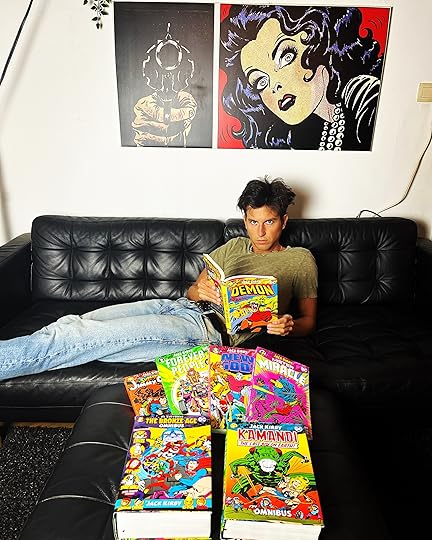
Seas lo que seas... ¡El Demonio no huirá! “Vete, vete, forma mortal... Que se alce el demonio... ¡Etrigan!” Jack Kirby reinventó el género superheroico con su extensa saga del Cuarto Mundo –una valiente visión narrativa adelantada décadas a su tiempo. En honor al centenario de este extraordinario talento, DC Comics se enorgullece en volver a presentar el innovador trabajo del Rey de los Cómics en una nueva serie de tomos que recopilan sus títulos clásicos de DC en toda su gloria en cuatricomía. Tras el éxito de los títulos del Cuarto Mundo, Kirby le dio a los fans del cómic su creación más impactante hasta el momento: ¡Demon! Invocado de las profundidades estigias por el mismísimo Merlín para que defendiera el legendario reino de Camelot, un engendro infernal rimador conocido como Etrigan fue vinculado a una forma mortal en el cuerpo de un huésped muy humano, Jason Blood. Pero las aventuras de Etrigan continuarían mucho más allá del pasado mítico y medieval. Viviendo hasta la época presente, Jason Blood se convirtió en uno de los maestros de la magia y el ocultismo más poderosos del Universo DC... ¡y durante todo ese tiempo, su alter ego demoníaco ha estado listo, siempre dispuesto a desatar sus poderes infernales al servicio de la incansable batalla de Blood contra el mal! Descubre una escritura de lo más atrevida y un dibujo de lo más dinámico del mundo del cómic –y emociónate con el poder imaginativo de uno de los mayores maestros del medio –en Demon, de Jack Kirby, que recopila toda la etapa de 16 números del Rey en esta aclamada serie
Jack Kirby (born Jacob Kurtzberg) was one of the most influential, recognizable, and prolific artists in American comic books, and the co-creator of such enduring characters and popular culture icons as the Fantastic Four, the X-Men, the Hulk, Captain America, and hundreds of others stretching back to the earliest days of the medium. He was also a comic book writer and editor. His most common nickname is "The King."
CHANGE! CHANGE! O' form of man! Release the might from fleshy mire! Boil the blood in heart of fire! Gone! Gone! The form of man! Rise! The Demon ETRIGAN!!
By the latter months of 1971, comics artist and writer Jack Kirby was a busy man. He was deep in the midst of both writing and drawing his epic “Fourth World” titles for DC Comics, although with them being bi-monthly titles he did seem to have a bit of extra time on his hands. Carmine Infantino, who was the publisher of DC Comics at that point in time, challenged Kirby to come up with another title that he could work on, perhaps something in the adventure or occult vein. Kirby agreed, but with the catch that he would only edit the books, not write or draw them. Taking on the idea of an occult title, and naming it “The Demon,” was one of his first projects with this new assignment. It was at a fateful trip to a Howard Johnson’s for a steak dinner that Kirby got quiet and wrote the entire synopsis for what would become the first issue of “The Demon” right there at the table. He rushed home and got a bunch of art on the boards and sent it off to Infantino, who loved the idea so much that he immediately put Kirby’s “Fourth World” titles on hiatus so that he could focus on the new series (“Kamandi, The Last Boy on Earth” being the other magazine that Kirby was tasked with). And Kirby’s idea about only editing the strips was quickly thrown out the window, he would have to both write and illustrate each of the new books. Although unhappy with this setup, he was a true professional and took on both projects with gusto.
And so it was that Kirby began a 16-issue run on what would surely stand as one of the most unusual and fantastic occult comics of all time…”The Demon!!!” DC Comics has been following in the trend set by Marvel and unearthing a lot of its older and more obscure titles and reissuing them as omnibus editions. Aesthetically this compilation hits it out of the park. The art leaps out and the colors are fresh and vibrant. You get 384 pages of awesomeness, with a great introduction to the work by Mark Evanier, who apprenticed with Kirby. There is also a section of Kirby’s line art for “The Demon” at the end of the book, so you can get an idea of how he laid out his panels before they were inked. All in all it’s a freaking spectacular piece of work that will sit proud on my bookshelf.
My personal memories of “The Demon” go back to childhood, when my brother left a bunch of his comics and books at home while he lived in the dorms at college. I gobbled up “The Demon” and Marvel’s “Son of Satan” mags like forbidden candy, and gained a lifelong love of occult-themed comics. I was ridiculously happy when I found that DC had reissued this series in an omnibus format. No more searching the racks at used comics shops looking for missing (and usually highly priced) issues. Both DC and Marvel spent a goodly portion of the early 1970s putting out a fair portion of strange and unhinged occult titles, and nerds like me couldn’t have been happier. Smart readers will also be interested in the DC omnibus editions of “Swamp Thing” and Marvel’s compilations of the majestic “Man-Thing” and “Son of Satan.”
The basic plot of “The Demon” is pretty simple. Merlin the Magician, he of the Arthurian fame, is to do eternal battle with his nemesis Morgaine Le Fey (Kirby’s spellings used here). As an aid to his efforts, he has summoned the assistance of a true being from the underworld, “ Etrigan The Demon.” Etrigan is one powerful demon, possessed of both superhuman strength and agility coupled with an extensive knowledge of magic and sorcery. He can also shoot demon flame from his hands, a handy-dandy skill that gets him out of trouble more than once. Etrigan is a real demon in every aspect, being that he is the son of Belial. His turn to good is merely a consequence of his bond to Merlin and his merging with the human soul and body of one Jason Blood. Blood starts out as a medieval character, but is imbued with immortality when he is bound with Etrigan. He resurfaces in modern times as an accomplished and very rich demonologist and antiques collector in Gotham City. But the war with Morgaine Le Fey continues on to the present day, and Blood must navigate a series of supernatural attacks that span the world, bringing him into contact with all sorts of heinous baddies. A few of the adventures are multi-part mini epics, and quite a few of the issues don’t deal with Morgaine Le Fey at all. Jason Blood has a cadre of friends that he leans on to help him out when things get rough. Harry Matthews is a rough around the edges man about town who perpetually chomps a cigar, while Randu Singh plays the Indian foil whose ESP powers get Jason out of a scrape or two. Blood also has a love interest in the form of blonde bombshell Glenda Mark.
I don’t think that there were any weak issues in the entire 16-issue run. My personal favorites deal with a villain named Klarion the Witchboy, a young but powerful escapee from Salem out to do evil deeds in the present day. He shows up in three issues and causes all sorts of trouble. I did catch one error in continuity, though, as Klarion’s feline companion, Teekl, suddenly changes sex between issues from a male to a female. I get why Kirby did it, and you will too, but it’s there and I need to point it out. Otherwise the action is fierce and furious throughout the book. And yes, I will once more go on about Kirby’s spectacular artwork. You REALLY have to take your time and scan each page and panel carefully, especially on the two-page spreads where Kirby lets it all hang out with total abandon. There is so much attention to small detail to be found that it literally staggers the mind. Jack Kirby was one of the absolute maestros of comic art back in the day, and it only takes a few pages of “The Demon” to illustrate that reality. The fact that he could maintain such a high output with such depth of quality is almost unbelievable. No one, but no one, could draw like Kirby, and you know his signature style the moment that you see it.
Etrigan would go on to further appearances across a variety of DC titles after this initial introduction was over. There was more emphasis on his demonic and violent qualities in later iterations of the character, and the uneasy fusion of Etrigan and Jason Blood becomes a more existential issue in future stories. That friction between Blood and his demonic counterpart is hinted at in this first series, but it becomes an integral part of the storytelling from here on out.
“The Demon” is an essential addition to your comics library if you have any interest at all in Jack Kirby or occult themes in your cheesy entertainment. This omnibus is an absolute joy to behold and I’m sure that I will reread and reference it frequently.
I'm a fan of Jack Kirby, obviously. And I'm a fan of 70s horror comics. And this combines the best of both, along with a good helping of Silver Age superheroics and something that could be called proto-Hellboy. Most of the time I read old Jack Kirby monster comics for the art of the creatures, and for the lightweight, escapist silliness of the plotlines. This is a different story. While it's still a product of its time, and how, it's just a great bit of comic awesomeness, and in a very nice package to boot.
Cool art (especially those big splash pages) but The stories get very repetitive very quickly. Also, Etrigan doesn't rhyme all the time like he does now.
The Demon is another kinetic, wild, fun, and beautifully ugly 1970s explosion from Jack Kirby. With this 16 issue work, the stellar master of living, moving, furious comic art acknowledges the most sterling of all comic art perfectionists, Hal Foster, who created the look of the Demon in an early (and incredible) Prince Valiant strip, but otherwise, this series is pure Kirby in my favorite era of his work.
Whereas I felt like the humongous concepts and stories and worlds in New Gods required far more space and time and lucid writing than they were given, The Demon is the opposite approach---a simple premise loaded with forty megatons of visual TNT that Kirby detonates again and again and again in weird and wonderful ways. The story--a man who turns into a Demon to fight evil--is a catalyst, rather than a parameter for the fever brain madness that issues from Kirby's pencil and Mike Royer's lush, bold inks. And yet, it is always easy to follow--both plot and character motivations--and the issues unfold more engrossingly for me as a result of not getting too bogged down in overly ambitious storylines. This yellow beast leaps across pages and at throats and at you, but always with clear (wrathful) intentions.
It is known than Kirby was less interested in this title than his others, but this might have compelled him even further to make his takes on Wolfman, Frankenstein, Phantom of the Opera stories all that much more original and bizarre, as none of these science-shizo riffs could have been created by anybody other than Kirby. Frankenstein's monster cowed by a shock wand, surrounded by devils, and communicating via ESP to a telepath certainly didn't come from Mary Shelley or Todd Browning...
The Demon ranks with my other favorites from The King, which for me are Kamandi, OMAC, Captain America and the Falcon: Madbomb, Devil Dinosaur, and Fantastic Four 45-50. Still, I have a knee-high pile of work by Kirby that I'm exploring (Losers, Dingbats, Silver Star, Thor, etc.) and I expect other crackling tales by this master creator to join this list...
I've not really read a lot of Kirby stuff. Writing styles from 50s-70s can be difficult for me to read. This is so out there that I don't know that it matters.
King Kirby is obviously in rare form while writing this one. No filters. Just straight from his brain to the paper. And it works.
Also, Klarion the Witchboy makes his first and I think second appearance in this collection. And seeing what Kirby did with Teekl (his familiar) in that second story...all stories with them takes on a whole new meaning.
The Demon and Jason Blood are pretty much front and center this whole time, as well they should be. I'm still looking for when Demon starts speaking only in iambic pentameter, though. I thought that would have been there from the beginning, but no.
Since supernatural comics were all the rage in the 1970s, DC mandated that Kirby create this comic rather than work on projects that he was more interested in. The result is a fairly interesting occult comic, but not anywhere near Kirby at his best. It falls quickly into a moster-of-the-week cycle of stories. The monsters are not all that interesting--a Dr. Frankenstein clone, a Phantom of the Opera, and so on. However, the appearance of Klarion the Witchboy is a plus.
The Demon.One of Kirby's most long-lived comics at DC, and perhaps his most notable outside of the Fourth World. It's an enjoyable look at "What Kirby would do if he was developing a fantasy world (rather than one focused on science-fantasy or science-fiction or super-heroes)." Blood and the Demon and their friends are all fine enough, and the stories are a nice blend of gothic horror, with the Evilstein arc being particularly notable for its body horror, despite the awful name of the villain. However, Klarion is clearly the prize of this whole comic. Overall, a nice bit of invention that's influenced DC for decades afterward [4+/5].
As a Christian, I find 'heroes' of a demonic nature incredibly annoying. Having said that, I still love Kirby's artwork on this series. Storywise, I think it's fine. Entertaining enough. But I was also bothered by the fact that several of the conflicts contained in the series happen in Gotham without a single appearance from Batman, Gotham's alleged guardian. I thought it was strange overall that no other DC characters guest starred.
Old capsule reviews I posted on a now-defunct Facebook account and pasted into an e-mail to a friend on February 1, 2010:
The Demon vol. 1 #1 Except for the bit about Mary Kelly, everything about Etrigan that I've read so far in Matt Wagner's_Madame Xanadu_ is recap from this issue. Matt Wagner wrote volume 2 of this series (a four issue limited series) back in the eighties, so that shouldn't be too surprising. He didn't mess with the genius of Jack Kirby.
The Demon vol. 1 #2 So far, Etrigan doesn't seem too much different from the interdimensional beings Marvel calls "demons" even if they have no relationship to any mythology's hell. this is overall a good issue. There is no indication of much more than a mystical superhero here. The idea that Etrigan's demonic nature is evil and hellish found in later comics (like in Swamp Thing and Madame Xanadu) really isn't seen here, though it may show up before the end of the series.
The Demon, vol. 1 #3 More development of Etrigan. He does not speak consistently in rhyme as he would later. There is only one rhyme other than the transformation spell in this issue. The Demon shows the dark side of his nature in attacking Randu Singh when there is no one else to attack, but is more concerned with fighting those who harm others. In this case, a cult called The Reincarnators is forcing people to undergo physical past life regressions that can be manipulated to commit murder.
The Demon vol. 1 #4 I'm not too crazy about this cover relative to the others, but it holds a great issue. The two on the cover are the Iron Duke and Ugly Meg, and the latter has summoned the Kamara, the hideous white monkey-thing that later appeareed in Alan Moore's first Swamp Thing story arc. I did think it funny that Harry Matthews'...s biggest fear is dragons. Overall, the Kamara is not as scary to the reader here as it was there. Merlin shows up in the present at the end of the issue, for a decidedly different feel in the second part of the story, next issue.
The Demon vol. 1 #5 An exciting change of scenery as we enter the Iron Duke's castle, only for him to be betrayed and enslaved by Ugly Meg (unlike Eve, she is proud to call herself "ugly"). Jason Blood learns to turn himself into the Demon, and he fights lots of Kirby giant-monster types. The Iron Duke's castle is revealed to hold a Lovecraftian monster called Somnambula, a dream monster that shoves its tentacles into Merlin's head.
The Demon was created in the space of time between when Kirby ordered a burger at Howard Johnson's, and when the burger arrived. Despite some fantastic dynamic layouts, some memorable characters, and the chance to use his limited horror palette - it never quite stops feeling that way. The creation story (from the forward) is meant to be endearing and to show how JK thought, and it is - but as you make your way into this collection (particularly when you arrive at the Phantom of the Opera and Frankenstein... I mean "Evilstein", yeah/no not making that up, issues) that endearing creation story starts to depress.
Kirby was shoehorned into this book - concepts were all his, but it was intended to be handed off to other writers and artists (w/ Kirby editing). Instead, DC killed Kirby's lifetime masterwork books (the Fourth World books) and left him to complete creative control of a concept book (and genre attempt) that his heart just wasn't into.
Some of the artwork is unforgettable, though. There are tons of spreads and panels that I was thinking "this would be perfect on my wall - maybe if The Demon wasn't in it, though". Other creators would run with The Demon later on, and do what they could, but for the most part - he'd always remain a character you can't really pin down or sympathize with.
The Klarion The Witch Boy issues were strangely fun (only two of them, but it feels like more), and there are some issues with ideas that clearly influenced many other creators. Hellboy may not have existed without The Demon, and Alan Moore's Swampthing probably would have had less scope (if he'd have still done it, w/o The Demon having existed in DC's back issues).
For a Kirby fan, it's unmissable - and this new centennial printing is a bargain and beautifully assembled.
When the New Gods series ended, Kirby needed a new project, and fell back on monsters. When Camelot fell, Merlin unleashed a demon, in hopes of saving the kingdom. It didn't work out, and in order to get control over Etrigan, Merlin fused the demon with a young Jason Blood.
Jump ahead to Gotham city in the 70's, Jason Blood is an occult investigator and there's a shadowy creature lurking in the shadows...
Love this series with its weird miss-mash of monsters archetypes filtered through KIrby and the mix of supernatural detective and the monster as the hero.
Also, Etrigan is a great design, looking like something you'd see hunched up on a cathedral. He wasn't a big monster, like the Hulk, he was shorter and squat. Great series.
This man loved to draw comics - you can see it on every page. The work is dynamic and unique. Kirby created a whole new language of comic-book art, and it sings in the pages of "The Demon". I only wish his extreme visual talent was matched by his storytelling abilities. I think he does a terrific job in coming up with the initial story idea and characters, but it seems like he could have used more writers to help him keep the ideas coming after the first couple of issues. The fact that he was the artist, writer, and editor of this and so many other comic magazines speaks to his incredibly active mind and immense work ethic.
It's a fun comic, but it's not as good as Jack's other early 70s DC work. The Fourth World stuff and OMAC were complete experiments in building a universe, an entire cosmology, while the Demon is basically about Jason Blood and his alter ego fighting random occult threats every month. There's very little sense of a coherent back story underpinning the entire series, which makes the separate adventures feel random, rather than building a sense of wholeness.
Still, Kirby's art is as great as ever, and if you don't mind the Demon vs. Phantom of the Opera/werewolf/Frankenstein's monster-type horror movie du jour monster of the month, the stories are fairly upbeat and fun.
The stories were entertaining though occasionally it seemed that they would wrap up suddenly due to lack of space more than anything else. The art is classic Kirby and produces a cool, creepy vibe like from a 60's Batman colored occult horror movie of the early 70's (the time the comics were originally published). I would recommend this book to those who like cheesy old horror-hero type comics with faux occultism as only a comic-book could present it particularly if you like monsters as there is at least one monster per issue.
Absolutely love seeing Kirby get out of his comfort zone and still kick ass. Etrigan is an absolute lad and there are plenty of genuinely spooky moments in this. It's such a shame that this and Fourth World aren't his most well-known creations because I'm now entirely convinced that the 70's was Kirby's peak. Marvel be damned!
I always liked the look of this character from the Batman and Justice League cartoons but admittedly knew nothing else about him. I'm not a big fan of his more recent portrayals in comics but I have to say, I loved these Jack Kirby stories! I might just have a new favorite DC character.
Merlín unió el alma de Jason Blood a la de su medio hermano el demonio-bardo Etrigan, uniéndolos para siempre. Conoce los orígenes de una de las creaciones del Rey Kirby para DC Clásicos DC: Demon, de Jack Kirby Liberar al que aguarda, última acción del gran mago Merlín antes de desaparecer junto al castillo de Camelot bajo los ataques del furioso ejército espectral del Hada Morgana. Así dan comienzo las aventuras del Demonio Etrigan, el de la tez dorada, en agosto de 1972 de la mano de Jack Kirby (Nueva York, 1917–1994) durante su breve participación en la editorial DC (de 1970 a 1975) donde cuajó un brillante a la par que irregular trabajo con series como la saga El Cuarto Mundo o este Demon que ahora se reedita en un solo tomo en blanco y negro y al que acompañan en los kioscos otras versiones del personaje de autores posteriores (Wagner, Ennis & McCrea, Grant).
Si Kirby marchó a Detective Comics (antes National) fue porque Marvel (antes Timely y luego Atlas) se le hizo pequeña, demasiadas restricciones, pautas a seguir (principalmente las dictadas por Stan Lee), estatus ideológicos que defender y sostener, y sobre todo por los derechos de autor sobre sus creaciones, de los que fue privado, y por los que peleó durante el resto de su vida a través de soportes como el tebeo-manifiesto Destroyer Duck (Pacific, 1981). Y es que si hablamos de Jack Kirby estamos refiriéndonos a la mente creadora de iconos como el Capitán América (1940) o los Cuatro Fantásticos (1961), así como de Hulk, Thor, Iron Man, X-Men, Los Vengadores…
Estos personajes, hoy estereotipados y edulcorados, pervertidos a lo largo de series infinitas y adaptaciones a la gran pantalla normalmente desafortunadas, surgieron de un ímpetu creativo optimista, fresco, ligeramente teñido del ingenuismo que la posguerra necesitaba, símbolos sin fisuras para esperanzar y aleccionar a una infancia en construcción. Superhéroes que eran paradigmas a seguir y que encajaban en la idiosincrasia estadounidense la cual impulsaba a la superación de los obstáculos mediante el solipsismo más radical, aquí reflejado a través del desarrollo de poderes paranormales (de toda índole); de la necesidad de ocultar la verdadera y asombrosa identidad bajo un disfraz de mediocre cotidianidad, insinuando que la posibilidad del triunfo estaba al alcance de todos (¿o de unos pocos elegidos?); de la responsabilidad de contener ese potencial y/o emplearlo con oportunidad: una alternativa a la ley ordinaria y una propuesta que mitifica la Libertad dando Clásicos DC: Demon, de Jack Kirbyla espalda a la Justicia. Y quizá con necesidad de explotar más ese universo superheroico, Kirby entró en DC, donde no le impusieron condición alguna para escribir y dibujar historias que fueron menos comerciales, más oscuras, ambiguas, alejándose de ese modelo de tebeo que acabó siendo una pieza más del engranaje ideológico de la sociedad del bienestar norteamericana (corrupta en sus entrañas por asuntos como el maccarthysmo, contra el que el autor combatió a través del tebeo The Fighting American, 1954).
Jack Kirby nació Jacob Kurtzberg en el seno de una familia judía proveniente de Austria; al parecer fue su madre, devota practicante, quien le instruyó en la tradición y el folklore hebreos que tendrían gran peso en su producción gráfica, junto a la mitología tradicional y la ciencia ficción contemporánea. Demon en efecto es un cómic inmerso de lleno en lo sobrenatural, donde lo fantástico interactúa con la realidad empírica pero siempre en un estrato subyacente, influyendo sólo parcialmente en la existencia de los humanos a quienes espera desvelar las señales sincrónicas para alcanzar lo trascendente. En Demon las criaturas, sean espíritus, homúnculos o demonios, son de índole mágica o alquímica, siempre mediados por algún ser humano con innatas capacidades o sofisticados artilugios mecánicos, sacerdotes en cualquier caso. Y un demonio es el mismo protagonista, huésped alojado en la persona de Jason Blood, demonólogo (muy apropiado) cuya apariencia no se altera con el transcurrir de los siglos pero su memoria alcanza sólo un corto espacio de tiempo. A lo largo de los 16 números de Demon que dibujó Kirby, Jason Blood irá desvelando el enigma que él mismo aloja, sabrá que se trata de un terrible demonio del inframundo que espera en letargo a ser invocado por el amo Merlín cuando éste le requiera, pero también aprenderá a controlar parcialmente a la criatura, a transformarse con relativa autonomía, aprenderá a temerle y a necesitarle, y a compartir el secreto con sus amigos y enemigos.
Clásicos DC: Demon, de Jack Kirby Sin embargo el autor expone torpemente esta compleja evolución del personaje, sin apenas matices, demasiado precipitado en momentos que hubiesen requerido algo más de mesura y sutileza. Las historias se desenvuelven rápidamente, los instantes de suspense y tensión resultan efímeros, a las secuencias de acción parecen faltarles alguna toma, las conversaciones se resumen en unas cuantas viñetas, evidenciando el hastío que debía provocar el dibujarlas al bueno de Kirby. Los capítulos en los que se divide cada episodio no dejan respiro y someten al lector a un ritmo frenético que si bien permite consumir el producto a enorme velocidad y garantizan entretenimiento, resultan insostenibles en grandes cantidades. Además, el ojo no acostumbrado a la peculiar línea de este dibujante, desenfrenada, apabullante (las dobles páginas de Kirby son siempre un ejercicio para la vista), a sus acusadísimos escorzos, sus forzados encuadres, sus no siempre académicas anatomías (gigantescas manos e hipertrofiadas rodillas) y a sus escenas de escalas desequilibradas, en las que cada figura se injerta artificialmente, puede encontrar aún más difícil la lectura de las aventuras del de la tez dorada.
Merlín unió el alma de Jason Blood a la de su medio hermano el demonio-bardo Etrigan, uniéndolos para siempre. Conoce los orígenes de una de las creaciones del Rey Kirby para DC
Por cierto, sobre el por qué del aspecto de Etrigan existen unas curiosas teorías que aluden a un episodio del Príncipe Valiente (Foster, diciembre de 1937) en el que éste se disfraza de demonio utilizando la piel amarilla de un ganso desollado (los pies palmeados corresponderían a las orejas): la similitud entre los dos dibujos no deja lugar a dudas. Sin embargo, un documental de Benjamin Christensen sobre ciencias ocultas llamado Häxan (1921), muestra un demonio con las mismas características. En realidad, aunque Kirby se inspirara probablemente en Foster (ambos cómics guardan relación con el mundo artúrico), lo cierto es que la tipología de ser diabólico que ofrece Etrigan se puede encontrar más o menos parecida en pinturas escatológicas medievales y renacentistas así como en aquellas de naturaleza moralista o las que ilustran las tentaciones de los santos (Bosch, Brueghel, Floris, o diablerías en general). Con todo, esta estética resulta la adecuada para Demon, historia netamente expresionista de trasfondo centroeuropeo. Lejos del convencionalismo que acabaron adquiriendo sus anteriores creaciones para Marvel, Demon está impregnado de un esoterismo que nunca acaba de desvelarse, presentando una serie de significantes que han prevalecido sobre sus significados encriptando todo discurso para los no iniciados. Empero, los símbolos utilizados por el autor, muchos de los cuales pertenecen a la Cábala, han sido en cierta medida traducidos al gran público. Así la piedra filosofal (que casualmente Jason Blood conserva en un cajón de su escritorio), figuración de las metas epistemológicas de alquimistas y otros embrionarios pensadores y científicos, es presentada como un artilugio más o menos útil: pasa de generar frío o calor a voluntad (alusión a la transmutación del material) a, tras unas cuantas páginas, obedecer a todos los deseos del propietario;Clásicos DC: Demon, de Jack Kirby las criaturas contra las que combate Etrigan, con rostro humano las más (tradición mediterránea como arpías y esfinges junto al símbolo del mal absoluto que es la sierpe de faz antropomorfa del Antiguo Testamento), aparecen con extremada facilidad, pervirtiendo el misterio de la manifestación de lo desconocido, y el conjunto, conjuros y artefactos incluidos, carece de cierta sofisticación y glamour. Porque el exotismo de Demon es el mismo que encontramos en los filmes de terror de los sesenta y setenta, como los del sello Hammer, entrañable productora de títulos atrevidos, irónicos y un tanto adocenados. Así pues Etrigan combate contra algún que otro émulo de Frankenstein, unos cuantos imitadores del Lon Chaney peludo y la versión más histriónica del Fantasma de la Ópera de Herbert Lom. Randú es el estereotipo eurocentrista del místico hindú (quién si no podía gozar de poderes telepáticos); los rostros, los recursos escénicos, los diálogos, todo resulta conocido, todas son construcciones occidentales del más allá a partir de retazos de leyendas rescatadas por anglosajones en territorios considerados marginales para el motor cultural dominante: por ejemplo el este europeo (sorprendentemente, la tumba de Merlín se halla en Moldavia), los temidos Cárpatos, las selvas de Europa Central. Y aunque se trate de una publicación juvenil, algo bulle en el fondo de este cómic, algo que intranquiliza, que inquieta porque es inaprensible. En la primera de las historias, Jason Blood recibe la visita de un extraño emisario, impasible y mudo, que le entrega un singular documento, momento en el que da comienzo el inexorable deambular del demonio de la tez dorada en el mundo de los vivos del siglo XX. La misma escena que urdió Meyrink cuando el silencioso individuo de ojos rasgados y piel amarillenta dejó al maestro Pernath el libro Ibbur, despertando de su milenario sueño al Golem de Praga. La historia de Kirby bien podría ser un homenaje al cabalista austriaco. Clásicos DC: Demon, de Jack Kirby Como el Golem, Etrigan es un esclavo, es el siervo de Merlín; Blood es siervo del monstruo que alberga. La responsabilidad de los actos de Etrigan no depende de sí mismo, es el ejemplo opuesto al diseñado en caracteres como El Capitán América: la personalidad secreta y poderosa no es una parábola del Triunfo, la Superación o la Responsabilidad, es una lacra letal y es tabú (quizá algo similar ocurre con Hulk). Blood posee una descontrolada identidad social, no puede asignarse a tiempo o lugar alguno, y del mismo modo su otro yo, quien debe su existencia a la definición mediante el nombre (la invocación recitada) que un tercero, su amo, pronuncia. Como el Golem, Etrigan depende de la definición escrita y de la mediación de elementos normativos (el mago, el sacerdote). En definitiva, Etrigan es en sí miso un conjuro, existe en un terreno intermedio no definido que interminable y tormentosamente aguarda la acción de la voluntad del mago, telépata o quien le invoque, como Randú. Demon se sitúa en un terreno volátil, fluctuante, especulativo, estadio imperecedero de espera -leit motiv de la tradición judía-, sin meta o cristalización inmediata, estadio que, tras largos e intrincados procesos, es llevado idealmente a su fin por el alquimista-sacerdote cuyo objeto es la búsqueda de la perfección suprema, la afirmación absoluta del propio albedrío (mística cabalística, Jung y las doctrinas mesiánicas nazis), mediante la obtención de Oro, la generación de homúnculos y golems o la liberación de diablos que aguardan. De diablos, eso sí, de tez dorada.
The Demon by Jack Kirby is a wonderful throwback to the early years of my love of comics. Like most of the books of the seventies, it felt in many ways as if it was written for a much older audience than the kids that fell enthralled to the Demon Estrigan and his human host, Jason Blood.
In the early 1970s, Jack Kirby went to DC Comics for the freedom of writing and illustrating characters that were not part of the Marvel pantheon. He wanted to work on the Fourth World titles (The New Gods, the Forever People and Mister Miracle) but DC wanted Kirby to take on more. DC wanted a different character than what Kirby was working on. They wanted a horror title and that was something Jack Kirby had no interest in doing. His concession was to create a character steeped in Arthurian legend and much to his dismay, the character was well received and sold well. He had created The Demon.
Arthur and his knights were under attack from beings not of the Earth or realm of reality, drawn into this world by the evil witch, Morgaine Le Fey! Knowing that the Knights of the Round Table would not be enough to combat these creatures, the wizard Merlin called forth a hero and monster; The Demon Estrigan! When the battle was won and Morgaine and her dark evil beaten back, the Demon changed into the form of a lone man who walked away into the forest. The man who would be, Jason Blood, the human host of the Demon Estrigan.
Blood lives on, taking various identities throughout the years and decides to reside in Gotham as the resident demonologist. This would, from time to time align him with Batman on various adventures though it would seem as of late that he would work more so alongside John Constantine. Strangely, after the initial 16 issue run by Kirby, The Demon as a character faded into the background of DC comics. Becoming the occasional supporting character for whenever a little muscle was needed in dealing with paranormal entities.
That is really too bad because this is certainly a strong candidate for a Jekyll and Hyde storyline that comics love so much. To convert into Estrigan, Jason must recite a short poem, which in the seventies seemed pretty cool, but now seems to be a weakness. After all, if you wanted to keep the Demon Estrigan trapped, then remove Jason's Blood ability to speak.
Whatever the reason for Estrigan being left out in the cold; I believe in the right hands, there is a good Estrigan story out there waiting to be told.
At the height of Kirby's creativity on his Fourth World, he was pulled off the project to create something new to tap into the interest in horror in the 70s. Kirby allegedly came up with The Demon all in one night, stealing the new character's design from a particularly cursed Prince Valient panel in which the prince fashions a mask from a dead goose. (To be fair, it is a very cool design.)
The resulting series is a bit of a mixed bag. The artwork is very much peak Kirby, stretching beyond his sci-fi wheelhouse and experimenting in his own unique take on pulp fantasy weirdness. If you like snarling, grotesque Kirby monsters with unhinged, gaping jaws you will not be disappointed. But it is also clear that Kirby's heart is really not in this as far as the story goes.
The supporting cast consists of a normal schmuck who points at everything slack-jawed, a South Asian diplomat with ESP (?), and a love interest who suffers from Kirby's fetish for enormous foreheads. It is unclear why any of these people are friends with Jason Blood or why they seem to spend all their life just hanging out in his apartment without any interior life of their own.
Kirby also just doesn't really know what to do with this character.The opening ancient conflict set up between Merlin and Morgana is sort of quietly dropped in favor of a number of lazy pastiches of Frankenstein and the Phantom of the Opera and the like. There's this great untapped potential with the character that goes mostly unexplored. There isn't any tension between the goals and ideals of Jason and the Demon, until suddenly Jason decides to finally rid himself of the Demon without any explanation, only to unceremoniously bring him back the next issue.
I know this review sounds pretty negative, but that's really only because it felt like such a missed opportunity. What we have here is pretty fun, there's lots of weird characters (Witchboy and Morgana have particularly great designs) and awesome Kirby splash pages. I just wish Kirby had been able to continue working on the storylines that he was really passionate about.
I hate to say that this is my first Kirby, but this is my first Kirby. TECHNICALLY it isn't the first Kirby I've ever read, but it is the first I've owned AND appreciated.
When I was a kid, comics were my main form of entertainment and literature. As the internet was still in its infancy, Wizard was my main source for comic book information and I read it obsessively. By reading Wizard I would learn about current comic creators, companies and their upcoming projects, and I would also learn about other comics that I wanted to get my hands on.
Jack Kirby was a name that would pop up over and over again in the Wizard magazines. Everyone seemed to love him. Everyone seemed to cite him as an influence and the magazine itself would constantly praise his name and accomplishments. Since I got into comics in the 90's, the Extreme Studio style was what I tended to prize the most. The effect of which made me think that the first Kirby comic I got my hands on was garbage. I subsequently dismissed him and his comic work through my comic collecting youth as simply a relic of the past that was no longer relevant in any way.
I value comics VERY differently now and this was my first venture into Kirby since my youthful dismissal. Whoa. Suddenly, I understand why Kirby is often referred to as "The King." All in all, I was just too young for Kirby, especially coming up in an era of Jim Lee, Todd McFarlane, Marc Silvestri and a whole slew of others. I just couldn't see the value of something that wasn't from my era or why it could be important. I see now, but I had to take a look at it all with different eyes.
All in all, Kirby's Demon run is better to look at than read. He's not the strongest writer, and the Demon character is not fully formed into what you know him as today. The real treat here is seeing Kirby do monsters on splash and double page spreads.
Get it if you're a Kirby fan, a comic maker, a comic historian, or an aspiring comic artist.
It's impossible to read a Kirby creation from his 70s DC run and not absolutely love it. Etrigan has been one of my favorite under the radar DC characters ever since I first came across him in Hitman, and his origins here are as fantastical & fleshed out as any Kirby book. The art is vibrant and the storylines are entertaining, though ultimately somewhat lacking in deeper meaning beyond "look at this awesome monster who fights monsters!"
The origins of the Demon are pretty simple. Bound to Merlin, Etrigan was granted the body of a human, Jason Blood, who was doomed to both eternal life and eternal ignorance to the fact that he is Etrigan at the drop of a simple rhyme. Etrigan here is nowhere near as distinct as later writers make him- no speaking in rhyme, no out of control bouts or anger & aversion to control, no complex relationship with the depths of Hell. He's simply a shapeshifting, firebreathing super demon who works for Merlin. Easy! The highlight of this volume for me was the introduction of perennial creeper Klarion the Witchboy, as he inserts himself into Jason Blood's life in an attempt to gain control over the Demon. Kirby's best attributes are on display here- romantic monster stories with occult, supernatural going-ons & lots and lots of dramatic exclamation. Another highlight is a bizarre three part Phantom of the Opera riff that ends with Etrigan actually doing something kinda sorta nice.
Overall this isn't the best of Kirby's DC work, nor is it especially close. It is, however, extremely fun to see him mess with genre conventions and write a combination horror-romance-superhero-vintage adventure comic with one of the most shameless Prince Valiant ripoffs in history. Kirby cut loose is a Kirby worth celebrating, and this opening volume of The Demon Etrigan's run of havoc in the DC universe is perfectly entertaining for what it is.
Tive experiências bem ruins lendo outras edições de "Lendas do Universo DC" (mais especificamente as do Superman e do Lanterna Verde/Arqueiro Verde), porque eram histórias bem bobas e extremamente verborrágicas. Era MUITO pleonasmo, um atrás do outro, com o texto explicando coisas que já estavam na arte, meio que como isso:
Achei que provavelmente esse estilo mais antigo de quadrinhos simplesmente não eram pra mim, mas a verdade é que eu não havia encontrado os autores corretos, e acabei de descobrir que o mestre Jack Kirby é mais do que correto pra mim.
Aqui acompanhamos as primeiras histórias do personagem-título, Etrigan, um demônio conjurado por Merlin para ajudar na ultima batalha de Camelot e que depois é transformado em um homem imortal chamado Jason Blood, que vive através das eras e divide o corpo com o Demônio.
Blood é um demonologista e trabalha colecionando artes, documentos e tudo o mais relacionado ao oculto, e é assim que as aventuras chegam até ele — algo meio parecido com o estilo de histórias do Hellboy, que gosto bastante também.
Kirby usa várias mitologias e até monstros originais para que seus personagens possam enfrentar em batalhas em histórias que, por mais que não deixem de ser um pouco verborrágicas e redundantes, ainda assim conseguem entreter e não causam aquela sensação de tédio que tive ao ler outras edições dessa linha editorial.
Só não dou cinco estrelas porque pelas primeiras 100 páginas eu ainda estava naquele estigma de achar que tudo ali seria chato como nas outras histórias do estilo que eu já havia tido contato, mas assim que comecei a perceber a magia do storytelling do Kirby, fui imediatamente arrebatado, por isso minha nota final é 4,5 estrelas!
Jack Kirby's Demon plays an interesting role in the development of the graphic novel. The moving back-and-forth of creators has played a large part in the long battle between Marvel and DC for comic book dominance in America. Jack Kirby's creations dominate media today, so his switch from Marvel to DC in the 1970's was monumental. His Fourth World series was one of the best ever series ever, and in some ways the culmination of his work. However, sales lagged and DC cancelled the Fourth World books (sigh). I was so disappointed at the time that I immediately had a prejudice against the books Kirby subsequently created. I did not give The Demon much of a chance when this series first appeared, except for liking he way he looked. Kirby drew every genre in comics, but did other than monsters comparatively few in the horror genre, and the horror hero was then almost always a minor hero. I really missed out at the time. This reprint of Kirby's entire run of The Demon has all the bursting off the screen (or out of the book), non-stop action that is patented Kirby. True, the characters indulge in some corny dialogue, but maybe living in a turbulent Jack Kirby world would make anyone talk that way. One character I thought especially interesting was the Witch Boy, Klarion, the only villain in this run to have two story arcs. The whimsical young character was finally sent to the "Beyond Region" by the Demon. Jack Kirby's relentless imagination birthed another intriguing character with great potential. Maybe DC will bring him back. In any case, you can still meet him here and many others.
Sempre gostei do personagem Etrigan, o Demônio, quando ele aparecia rimando seus diálogos em diversas publicações dos heróis da DC Comics. Essa é a primeira vez que os leitores brasileiros poderão ter acesso aos volumes originais do herói criado na década de 70 pelo "Rei" Jack Kirby. Ao ler essa edição, qual não foi minha surpresa, ao verificar que em seu início, o demônio Etrigan não rimava em seus diálogos. Porém pude perceber vários elementos que influenciaram a criação de Kirby, além das Lendas Arthurianas da Cavalaria. O Príncipe Valente de Hal Foster deu vasão às páginas duplas lindamente ilustradas e cheias de detalhes. A New Age encheu os enredos com personagens e enredos místicos e sobrenaturais. Até o Fantasma da Ópera acabou sendo mimeografado para um vilão. Etrigan é mais um personagem da leva de criaturas que surgiram na Marvel e na DC Comics com o afrouxamento do Código dos Quadrinhos, que na época começava a permitir seres sobrenaturais nas publicações. É interessante ver personagens que viríamos a presenciar em diversas revistas da DC posteriormente, como Morgana LeFay e uma dos meus personagens favoritos, Klarion, o Menino-Bruxo. Etrigan é um quadrinho divertido, cheio de conceitos interessantes e com a arte característica de Kirby. E esse foi apenas o primeiro volume!
I remember buying several issues of this short lived comic book back in the mid-1970s, but I don't think I was a big fan at the time. I certainly remembered nothing more than the basic concept of a man who has lived without aging for centuries who is also a demon conjured into existence by Merlin at the tail end of the Camelot days. Kirby, whose creativity knew no bounds, came up with this idea planning to just write and draw the first issue before turning it over to others to carry on. It certainly feels as though, unlike the Fourth World books, or Kamandi, he didn't have as strong a vision for where he wanted the Demon to go. He played a little with horror tropes, created one truly memorable villain - Klarion, the Witchboy - and kept the action moving throughout 16 short issues. I would have enjoyed more development of the supporting characters - Harry, Randu, and Glenda had some potential, but got pushed aside as page counts started shrinking after only a few issues. Several of these stories seemed to have rushed endings, as if Kirby couldn't get used to the pacing with fewer pages (though he'd spent years at Marvel doing it that way, so who knows?). The artwork, all inked by Mike Royer, is beautiful and exciting from start to finish. I'm glad to have finally caught up to what is probably Kirby's least major successful book.
Jack Kirby working in gothic horror shouldn’t work on paper. His overblown, imaginative storytelling doesn’t lend itself to subtle, shadowy occultism, but that’s what he attempts here. I’m still not completely sold on it – especially with this reprint accentuating the bright colors. What we're left with is basically a traditional Kirby superhero book. Etrigan battles a bunch of weird threats, some of which are more memorable than others. I’ve seen Etrigan in a bunch of other comics, and while I like when he shows up, I’m not convinced he/Jason Blood can manage a good ongoing series. Or maybe Kirby just isn’t the right fit for it. An Etrigan series, to my mind, needs to be creepier and more mysterious (imagine Bernie Wrightson drawing an Etrigan series). Aside from some awesome Kirby images, I can’t recommend this to anyone other than Kirby completists.
Vintage Jack Kirby writing and art, but disappointing storytelling
The problem with supernatural storytelling is that it is too easy to fall into the Deus Ex Machina trap, and resolve the storyline with magic. It is also too easy to carry the story with magic and forego explanations of key plot points. Kirby b fell into at least one of these traps at some point in almost every story in this collection. The characterizations and art are still vintage Kirby, and the stories are enjoyable, aside from the above. He gives a couple of moral quandaries that make you think. There is entertainment in the stories, but I can't wholeheartedly recommend the collection. Moat of the stories ended up disappointing me.
La serie in sè è abbastanza carina, sopratutto la parte del simil fantasma dell'opera. Solito Kirby con idee ottime e dialoghi latitanti con un personaggio che mischia, in egual misura, Hulk, Il Cavaliere nero e Ghost Rider. Tuttavia, il voto si riferisce all'edizione della Planeta DeAgostini, pessima sotto ogni punto di vista. Traduzioni con parole in spagnolo, baloon sballati, carta finissima che rischia di rompersi come neve al sole appena la toccate. Non è un caso che l'abbia rivenduta ormai da parecchio tempo. Evitatela come la peste nera e farete la cosa giusta.