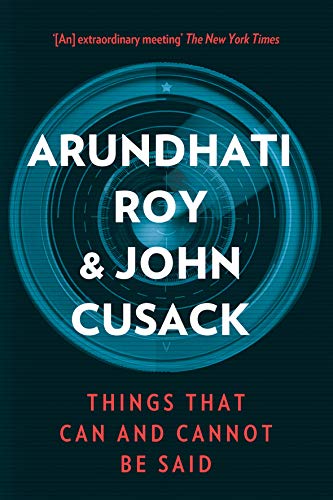
In the winter of 2014, Arundhati Roy met Edward Snowden, along with the actor and writer John Cusack and Daniel Ellsberg, the Snowden of the 1960s. Their conversations touched on some of the great themes of our times ֠the nature of the state, surveillance in an era of perpetual war, and the meaning of patriotism. Disturbing, powerful, and provocative, this is an extraordinary work.
John Cusack is an actor, producer, screenwriter and political activist. He gained fame in the 1980s for his starring roles in movies such as "Say Anything" and maintained his popularity in the following decade while creating his own production company.
After the turn of the century Cusack increased his political outspokenness and began writing blogs for publications such as the Huffington Post. After meeting Edward Snowden in Moscow, the conversations were converted into the book "Things That Can and Cannot Be Said."
Let me stipulate from the beginning of this review that my objection to it is not because I disagree with the politics of the authors or the two other participants in their discussions: Daniel Ellsberg and Edward Snowden. Debates about the advisability or legality of Snowden's actions, in particular, are grist for a different mill.
No, what annoys me about this slender volume is the smug, self-congratulatory voice in which it is written, as if these precious intellectuals have a corner on the market of radical, leftist thought. On the contrary, to me they appear to be self-congratulatory hedonists without much of a clue as to the realities of people on the ground, in the middle of the struggle.
And, yes, I recognize that this is quite unfair to Arundhati Roy in particular, she of the activist bent and enormous courage in facing the bigoted and inequitable reality of her home country of India. In fact, I think that all four of these people have the best of intentions. I quite like Cusack as an actor and what I have heard of him in other contexts. It is simply this particular book with which I take exception, based as it is on the assumption that because they find each other fascinating we must, too, that every uh huh and other stray utterance must be so valuable as to require a place on the page. When, in fact, they seem to be wandering around in an intellectual wilderness, spouting platitudes, the sum total of which add up to not much.
These four are so sharp and their intent so pure that I feel certain that, should they put their minds to it, they could write a truly worthwhile book that would spur their fellow leftists to some sort of action, or at a minimum to a sense of moral outrage. This is not that book.
4 renegades (3.5, if you please) assemble in a hotel room to talk about war, greed, terrorism, basically all those things that make you anti-national. The build-up to the conversation was brilliant. But, the conversation itself, well….. how should I put it…..leaves you keep wanting. As Ms. Roy put it, "what mattered, perhaps even more than what was said, was the spirit in the room." How I wish I were there in that room. As a lamp post, perhaps. Darn! Doesn't he stand against the idea of surveillance?
Want to read more by Arundhati Roy, but maybe next time she could talk to Noam Chomsky (for example) instead of John Cusack? I mean, I was slightly obsessed with John Cusack for a significant subset of the years between 1989 and 2005, and he's not a dummy. But he doesn't quite have the chops for this conversation.
This is a re-read for me, but really...this is one of those books that I am sort of ALWAYS reading, you know? It's a book that I often grab and flip through and highlight and underline, etc. It's one that is never truly closed forever. It's a book I re-visit often, and I'm so glad to own a copy. It's an important work, and constantly relevant. (UPDATE = Currently there's another 'whistleblower' story in the US news, and the same questions the books tackles about privacy, deception, patriotism, government, etc are ongoing once more. This book will always be 'current'!)
This book was fantastic. When the main complaint that I have is: "I wish it were longer", then that is pretty dang great, really. John Cusack, journalist/author Arundhati Roy and one of the whistleblowers in the days of Nixon all travel to Moscow and meet with Edward Snowden and also to London to meet with Julian Assange. The book is made up of composites of their conversations as they discuss things like refugee crises, patriotism, nuclear war, the surveillance state, etc. It is just TOO SHORT though and I felt like there could have been more meat on these bones. They were unable to record these overseas conversations, so it's based on recollections only; but it is still well written and discusses important topics. It's a book that really makes you think. An important read. --Jen from Quebec :0)
“Things that Can and Cannot Be Said” by John Cusack and Arundhati Roy is one of the most disappointing things I have ever read. I think many of the ideas brought up in the text are worth discussing. But it a paranoid, self-congratulatory, shallow, and ultimately futile work that promises much but is at heart “all sound and fury, signifying nothing”
The book is essentially a series of essays built around an “extraordinary” meeting between Cusack (an American actor), Arundhati Roy (an Indian author), Daniel Ellsberg (the whistleblower who exposed the Pentagon Papers), and Edward Snowden, who leaked information on the US Government’s spying capabilities, in Moscow.
The book is an “extraordinary work” (it says so on the back cover). It consists of short, paranoid essays and chummy, arrogant interviews between Cusack and Roy. The conversations had good points, but I could not help but feel like it was an internal conversation between two righteous liberal “intellectuals.” I know that they are not idiots, but these conversations did not really have a center or purpose. It just felt like intellectual masturbation—a series of platitudes and slogans endlessly repeated.
The book was building up to this “extraordinary” meeting. The preparations were described in great details. The pre-conversations were described in detail. But when we get to the climax of the meeting, Roy writes
“The Moscow Un-Summit [Roy’s clever name for the meeting] wasn’t a formal interview. Nor was it a cloak-and-dagger underground rendezvous. The upshot is that we didn’t get the cautious, diplomatic, regulation [the book was full of many typos] Edward Snowden. The downshot (that isn’t a word, I know) is that the jokes, the humor, and repartee that took place in room 1001 cannot be reproduced. The Un-Summit cannot be written about in the detail it deserves. Yet it definitely cannot not be written about. Because it did happen. And because the world is a millipede the inches forward on real conversations. And this, certainly, was a real one” (81).
This paragraph is the equivalent of saying “we went to the best party / concert / play / dinner that has ever happened in the history of humanity. It was life changing and has the power to change the world. And only if you had been there!” It is the textual equivalent of Tenacious D’s song “Tribute,” which is tribute song to the “Greatest Song in the World,” not the song itself. When we get to the interview, it is only about eleven large-type pages and only discusses one or two points about nuclear weapons, giving the reader the most tantalizing glimpse into Room 1001.
What makes me the angriest about a text like this is that the issues that Snowden, Esllberg, and other have raised about the power of the State are important conversations to have. But this sort of smug text only detracts from the debate and makes one not want to engage with the topic in the first place, which is the last thing the authors wanted or hoped. This book is not worth reading and not worth purchasing.
Required reading; for someone not versed much in international politics or history, it lays bare some of the tidy assumptions I had about nation states and how they inevitably wield power. Short version: It's not pretty.
One of those books that opens up a whole new way of thinking...exhilarating to feel that much closer to the truth, humbled by being able to see what you did not know before.
This book's closing sections on nuclear weapons were particularly hard-hitting for me - as an Air Force officer I operated the Minuteman III nuclear ICBM weapon system in Wyoming for a few years. By the time I was on launch crew, we had taken a lot of the overt death and brinksmanship out of it, but every once in a while you'd get a Colonel reminding you your job, after all, was to "kill people and break things". Some wonder I developed a drinking problem, eh:
"Finally in '83 somebody calculated the effect of just one of these things...what 150,000 tons of smoke and soot would cause, lofted into the stratosphere, reducing sunlight for a decade...basically it's nuclear famine...crops die, livestock dies...everybody dies. With a small war between India and Pakistan, fifty Hiroshima-size bombs each, smoke would reduce sunlight enough to starve two billion people to death...In a US-Russian war - it's nuclear winter."
- Daniel Ellsberg
It's certainly putting my time in the military in a new light.
As some have noted, this is a vignette "peak" at the ugly underbelly of global capitalism, the surveillance state & empire; those familiar with the themes may find this book wanting. But for someone unexposed, I think it serves as a great primer.
In a world of capitalism, mass surveillance and perpetual warfare, we often give into the common narratives perpetuated by the state and its puppets. ‘The Things That Can And Cannot Be Said’ challenges every aspect of the normal public discourse.
Who defines what can be said? Who defines normal? The most powerful, the most dominant people in society, the powers that be – most importantly, the state. ‘Many acts that are termed extreme go beyond what we currently define as normal, the status quo and challenges the powers that be.’
History does not seem to have taught us the tough lessons we ought o have learnt from it. The same old policies, in much more palatable form, is being served worldwide by states.
The book explains, through thoughtful conversations, how states have drawn contours of what is and is not acceptable. From the wars to humanitarian aid to, from economic sanctions to the quest for human rights - Arundhati Roy and John Cusack blandly expose the hypocrisies and excesses of the state. They seek to change the very nature of the hollow conversations we usually have in our public discourse.
Thought provoking and entirely relevant little read. An eclectic but brilliant collection of bright minds talking honestly on the most critical social, political and moral topics of our time. Thanks Arundhati and John for talking about all the things that cannot be said that should be said.
Ahem, I have mixed feelings about this book. I absolutely love Roy, have a lot of respect for Ellsberg, mixed feelings for Snowden (and this book doesn't change them to the better or worse as his input is modest, although he serves as the pretext for the book), and nothing at all (perhaps just some curiosity) for John Cusack, I do think his sister is brilliant, though.
There are limits to such transcript-books, of course, and I guess some of the eyebrow raising paragraphs the book generously produces are in fact "you had to be there" moments, and perhaps many of the editing decisions were not all that inspired. The book raises many valid points, challenges the status quo, denounces forgotten genocides and crimes and brings things to the table that the world needs to address. Just that the overall rhetoric is too leftist for my centrist taste, and I agree with Roy in that that socialism has produced, intellectually and philosophically, a great many valuable ideas and the should not be banned from ever being mentioned, but the acknowledged helplessness in producing constructive views to the visited fatalities (I am aware the book and its authors don't have such ambitions but nevertheless when scrutinising history for fatalities, maybe one should contemplate scrutinising it for valuable alternatives) leaves me with a funeral aftertaste, like this would be a book of mourning for this World's terrors and misery.
What a huge disappointment. First, this is NOT narrated by Arundhati Roy and John Cusack. Every place I looked had them as the narrators. They are not. It is EXTREMELY misleading, and leads to a very disjointed, confusing audiobook. There is very little about Edward Snowden in here, and it cuts off at the end suddenly and you are left wondering what the heck just happened and what DID you just listen to. I did not enjoy this at all and really feel it was a complete waste of time.
"Who comes out smelling sweet in the atrocity analysis? States have invested themselves with the right to legitimize violence—so who gets criminalized and delegitimized? Only—or well that’s excessive—usually, the resistance. JC: So the term human rights can take the oxygen out of justice? AR: Human rights takes history out of justice. JC: Justice always has context . . . AR: I sound as though I’m trashing human rights . . . I’m not. All I’m saying is that the idea of justice—even just dreaming of justice—is revolutionary. AR: Look at the Israel-Palestine conflict, for example. If you look at a map from 1947 to now, you’ll see that Israel has gobbled up almost all of Palestinian land with its illegal settlements. To talk about justice in that battle, you have to talk about those settlements. But, if you just talk about human rights, then you can say, “Oh, Hamas violates human rights,” “Israel violates human rights.” Ergo, both are bad.
JC: You can turn it into an equivalence . . . AR: . . . though it isn’t one. But this discourse of human rights, it’s a very good format for TV—the great atrocity analysis and condemnation industry."
Did you know John Cusack was an ardent activist from a long line of lefty agitators? Well, you certainly know that Arundhati Roy is one of the most fierce, intelligent, and compassionate people on the planet, right? Oh, and they went to hang out with Daniel Ellsberg and Edward Snowden in Russia.
If that ain't enough to intrigue, I must therefore harangue you into reading this accessible, deadly collection of conversations and thoughts.
Consider yourself harangued. Go read now.
It's short--I read it while watching a football game at a bar.
"Human rights are fundamental rights, they are the minimum, the very least we demand. Too often, they become the goal itself. What should be the minimum becomes the maximum-all we are supposed to expect-but human rights aren't enough. The goal is, and must always be, justice."
3.5 Stars In 2014, John Cusack brought together whistleblowers Edward Snowden, Daniel Ellsberg (who leaked the Pentagon Papers exposing USA's position during the Vietnam war, and on which the movie The Post was made recently) and Arundhati Roy for a discussion on the nature of the state / nation, on a surveillance led world where patriotism and dissent are narrowly defined and the role of propaganda driving interests of capitalist economies.
That 2 day meeting in Moscow, resulted in this short collection of essays and conversations about things that were considered too controversial or inconvenient by their govts. At one point, Cusack says that in America, it is ok to talk about ISIS but not about Palestine. To which, Roy says, that in India, it is ok to talk about Palestine but not about Kashmir.
And that is really what sets the flavour of the conversations recorded here. I really enjoyed listening to Roy's incisive comments and found her essay extremely eloquent. It's one that could easily be read up as an independent article.
My main gripe with this book is format. Sometimes the “conversations” seemed like nothing more than a transcribed stream of consciousness. That kind of delivery in nonfiction literature tends to give off pseudo-intellectual vibes to me. To clarify, Arundhati Roy dropped some real nuggets of wisdom (e.g corporate-funded NGO, US role in foreign regime change, TTIP), but I’m still trying to figure out what John Cusack brought to the table other than his star power.
Everything builds up to the meeting with Snowden in Russia. Spoiler: However, the summarized version of how we are “sleeping walking into a surveillance state” was still enough to send shivers down my spine. The mind attempts to fill in the gaps of the story. It’s even more terrifying when you don’t know what you don’t know.
The book starts with a chapter where John Cusack is the narrator & he imagines a conversation between Daniel Ellsberg, Edward Snowden & Arundhati Roy whom he had met several times in the past. John Cusack recorded several discussions of theirs which helps him to pen down some of the talks. They discussed about patriotism, flags, capitalism, surveillance & the brave acts of Mr. Snowden & Mr. Ellsberg to stand up for the right thing. One fine day John Cusack planned to meet Snowden after all & took Ms. Roy & Mr. Ellsberg along with him to Moscow. As four curious minds meet, one can’t even imagine the depths to which their discussions might have went. Read the full review on Just Another Bookaholic
“Things that Can and Cannot Be Said: Essays and Conversations” by Arundhati Roy, John Cusack An eye-opening slap in the face! Must read! Outraged to find out more about the US policy of “kill everything that moves” during the war in Vietnam. Other significant revelations include:
“[T]he language of the Left, the discourse of the Left, has been marginalized and is sought to be eradicated. The debate -- even though the protagonists on both sides betrayed everything they claimed to believe in -- used to be about social justice, equality, liberty, and redistribution of wealth. All we seem to be left with now is paranoid gibberish about a War on Terror whose whole purpose is to expand the War, increase the Terror, and obfuscate the fact that the wars of today are not aberrations but systemic, logical exercises to preserve a way of life whose delicate pleasures and exquisite comforts can only be delivered to the chosen few by a continuous, protracted war for hegemony -- Lifestyle Wars.” (p37)
“When you look around and see how many NGOs are on, say, the Gates, Rockefeller, or Ford Foundation’s handout list, there has to be something wrong, right? They turn potential radicals into receivers of their largesse -- and then, very subtly, without appearing to -- they circumscribe the boundaries of radical politics. And you’re sacked if you disobey… sacked, unfunded, whatever. And then there’s always the game of pitting the 'funded' against the 'unfunded,' in which the funder takes center stage.” (p51-52)
“My question is, if, let’s say, there are people who live in villages deep in the forest, four days’ walk from anywhere, and a thousand soldiers arrive and burn their villages and kill and rape people to scare them off their land because mining companies want it -- what brand of nonviolence would the stalwarts of the establishment recommend? Nonviolence is radical political theatre… [“Effective only when there’s an audience,” interjects Cusack]… and who can pull in an audience? Gandhi was a superstar. The indigenous people in the forest don’t have that capital, that drawing power. So they have no audience. “Nonviolence should be a tactic -- not an ideology preached from the side-lines to victims of massive violence,” she argues. (p53)
AR: Look at the Israel-Palestine conflict, for example. If you look at a map from 1947 to now, you’ll see that Israel has gobbled up almost all of Palestinian land with its illegal settlements. To talk about justice in that battle, you have to talk about those settlements. But, if you just talk about human rights, then you can say, “Oh, Hamas violates human rights,” “Israel violates human rights.” Ergo, both are bad. JC: You can turn it into an equivalence . . . AR: . . . though it isn’t one. But this discourse of human rights, it’s a very good format for TV—the great atrocity analysis and condemnation industry. Who comes out smelling sweet in the atrocity analysis? States have invested themselves with the right to legitimize violence—so who gets criminalized and delegitimized? Only—or well that’s excessive—usually, the resistance. JC: So the term human rights can take the oxygen out of justice? AR: Human rights takes history out of justice. JC: Justice always has context . . . AR: I sound as though I’m trashing human rights . . . I’m not. All I’m saying is that the idea of justice—even just dreaming of justice—is revolutionary. (p56-57)
“Cage the People, Free the Money. The only thing that is allowed to move freely – unimpeded – around the world today is money … capital.” (p59)
“[Th]e world is a millipede that inches forward on millions of real conversations,” writes Arundhati Roy. (p81)
Cusack shares a quote from Daniel Berrigan, the now deceased Jesuit priest and anti-war activist: “Still it should be said that of the political left, we expect something better. And correctly. We put more trust in those who show a measure of compassion. We agree, conditionally but instinctively, with those who denounce the hideous social arrangements which make war inevitable and human want omnipresent; which foster corporate selfishness, pander to appetites and disorder, waste the earth.”
Security work demonstrated “how armies were being turned into police forces to administer countries they have invaded and occupied, while the police, even in places like India and Pakistan and Ferguson, Missouri, in the United States -- were being trained to behave like armies to quell internal insurrections.” – Ed Snowden
“In the Public Security versus Mass Surveillance debate that is taking place in the establishment Western media, the Object of Love is America. America and her actions. Are they moral or immoral? Are they right or wrong? Are the whistle-blowers American patriots or American traitors? Within this constricted matrix of morality, other countries, other cultures, other conversations -- even if they are the victims of US wars -- usually appear only as witnesses in the main trial. They either bolster the outrage of the persecution or the indignation of the defense… Is it shocking that Barack Obama approved a ‘kill list’? What sort of list do the millions of people who have been killed in all the US wars belong on, if not a ‘kill list’?” – A.R.
“[T]he conversation around whistleblowing is a thrilling one -- it’s realpolitik -- busy, important, and full of legalese. It has spies and spy-hunters, escapades, secrets, and secret-leakers. It’s a very adult and absorbing universe of its own. However… it sometimes threatens to [become] a substitute for broader more radical political thinking…” – A.R.
“Washington’s ability to destroy countries and its inability to win a war.”
“What sort of love is this love that we have for countries? What sort of country is t that will ever live up to our dreams? What sort of dreams were these that have been broken? Isn’t the greatness of great nations directly proportionate to their ability to be ruthless, genocidal? Doesn’t the height of a country’s ‘success’ usually also mark the depths of its moral failure?” “And what about our failure? Writers, artists, radicals, anti-nationals, mavericks, malcontents – what of the failure of our imaginations? What of our failure to replace the idea of flags and countries with a less lethal Object of Love?” – A.R. (p91-92)
“If there is something to be done, then one thing is for sure: those who created the problem will not be the ones who come up with the solution. Encrypting our emails will help, but not very much. Recalibrating our priorities might.”
“[C]apitalism will fail too. We need a new imagination. The wisdom of the resistance movements, which are ragged and tattered and pushed to the wall, is incredible. So…I look to them and keep the faith.” – A.R.
i had expectations for this book that were not met and im still a little baffled (angry about? frustrated?) by this even though its been 2+ months since i read it. the thing is that i expected to uhhhhh learn something? i did not and i am by no means well-read in terms of leftist texts or any texts, really.
in my personal opinion this book holds very little value and the little it does hold comes entirely in the form of arundhati roy's commentary. her ideas taste of complexity and a deep understanding towards what she is talking about. no one else involved in this text gives that impression. to the contrary, my opinion towards these white men lessened - if i had one - and the text is quite fully at fault bc the way its pulled up... the way its written... there is some kind of smugness to it that is so VERY distracting? there just arent that many tomatoes on this tomato plant, if you catch my meaning, theres like one here or there and then you got this person telling you LOOK AT THIS BEATIFUL PLANT FULL OF RIPE SWEET TOMATOES and you just want to ask "where! where are they!" surely not here...
frustrating mostly bc there were some parts that had me go HMM and underline a line or two, that were worthy of exploration and discussion (that did not happen!!! bc nothing happened!!!) but god, that was NOT worth the amount of eye-rolling i went through. all i want now is to finally figure out what arundhati roys opinion on trans rights is bc if they are what i hope they are im just. full stan. give me her collection of political essays now.
Cool concept, half baked, kinda smug. Want to read more from Arundhati Roy. She carried this text and Cusack was really only there for her to bounce ideas off of. I can already tell she's gonna radicalize my ass. Roy has really fresh and foreboding views on modern humanitarianism and NGOs and borders and power. I'm afraid of the hopeless cynic I might become as I read more of her work but I'm going to read it anyway. These two flew all the way to Moscow to chat with Ed Snowden and Daniel Ellsberg, some of the most famous whistleblowers alive, but didn't actually wind up sharing much of the wisdom from that encounter. They used most of the pages to wax on about their various big picture beefs with power, which is fine, but that's not how they sold the book. I hate when books are mis-marketed. Expectation-setting is a big deal. It's so annoying to feel like you've been duped into spending your time on something that isn't what you thought you agreed to spend your time on. Also, what do we think of Roy's reverence for Assange? Strong "separate the abusive artist from the art" vibes there🥴
Interesting, observant, evidently good for culling quotes and slapping sticky notes onto poignant passages. Not incredibly expansive, though I certainly learned new things. In short, an unexpected motley of intellectuals hammering out thoughtful examinations on nationalism, surveillance, whistle-blowing, capitalist rebranding, NGO-ization, etc.; though John Cusack's presence seemed mostly like a perfect avenue for him to drop punctual, screenplay-worthy quips on stately affairs rather than to forward the conversation as per Roy's exceedingly gifted ability to do so.
Arundhati Roy's powerful critique of the world order is often engaging and challenging. I don't always (or often) agree but it's important to read things by authors that challenge your perspective. But this book... Ugh, the presentation of this book - and Cusack's sycophantic responses to what she's saying, even when it's absurd, just made my skin crawl. It made me long for president Trump to start on the book-burnings as soon as possible, and that's not a feeling I want to have, so I stopped reading.
The by-line on Goodreads is very misleading - it's actually by Arundhati Roy AND John Cusack, and it's about a trip they took with Daniel Ellsburg (who leaked the Pentagon Papers during the Vietnam War) to visit Edward Snowden in Russia. It is a very short but very personal book, mostly containing transcriptions of conversations between Roy and Cusack. It is very deep and the information is conveyed in conversations, so it is very accessible. I really liked intimacy of the book.
I personally liked this book, and would recommend it to anyone who is open to the idea that "everything is not what it seems".
A lot of different thoughts are covered, and while not all of the thoughts are nicely wrapped up with a socially accepted conclusion, you are definitely left thinking that even if the world is currently a mess, there are at least some people who recognize that and are prepared to voice their concerns.
Cusack and Roy are excellent. I'm going to keep this near me so as to re-read at every opportunity. There is so much insightful commentary in every section, from both the authors and Daniel Ellsberg and Edward Snowden are amazing to 'meet' in the flesh, as such.