What do you think?
Rate this book


416 pages, Hardcover
First published March 12, 2019
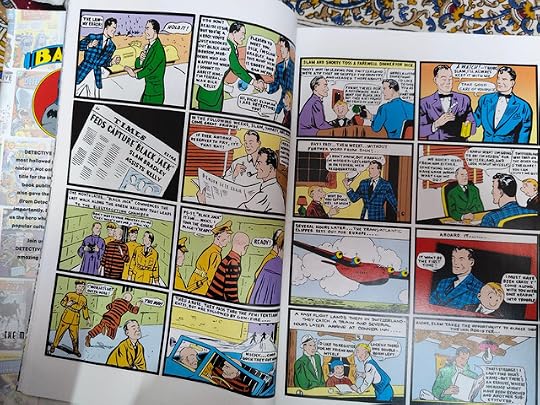
Very early issue:
Bad guy, pointing a gun: "Raise 'em -- you dumb cluck."
Slam Bradley: "What's the idea of --?"
next panel
Slam Bradley, giving bad guy an uppercut to the chin: "I'll raise 'em all right -- straight to your chin!"
Batman and Robin are described as "the groping duo"
(why 'groping'? ... they are searching through a labyrinthine maze for the Riddler)
In her first comic book appearance The Batwoman carries a purse as part of her costume. And how does she battle the bad guy?
(narration): "The amazing Batwoman extracts a large powder-puff from her bag and..."
(bad guy speach balloon): "She shook a whole cloud of powder in my face - - achoo - - can't stop sneezing!"
There's the first ever Bat-Mite story, which was the stupidest thing I've read in a long time. It appeared in "Detective Comics" but seemed targeted at 7-year-olds. Quite credulous 7-year-olds.
Now it's 1967. The new character Batgirl is smart, tough, and resourceful. Yay progress. But she still carries a purse while fighting crime (in this case the totally lame Killer Moth). And how does she catch the bad guy? She sniffs out the smell of her own perfume that had rubbed off on him earlier.
Also, why did the artist draw their capes flowing up off their backs even when they're standing still?
And what's the deal with the comically oversized objects? Early in the book Batman and Robin find themselves, inexplicably, in a hall full of super-sized Hi-Fi equipment where they battle a bunch of bad guys. In a later issue Batman is at a convention hall where he battles Deadshot on a huge electric typewriter, one where the keys are a bit larger than their feet. And it's actually a functioning typewriter, not just a cardboard display. Who would ever actually build such a thing? So stupid.
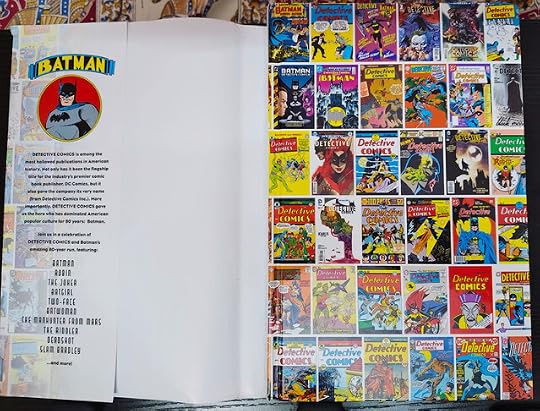
Although the individual stories that comprise this collection are almost uniformly bad, the book as a whole is terrific. I can’t speak to how truly representative this collection is of the history of Detective Comics - like most living Detective Comics readers, I have known the Batman era exclusively - it is fun to see a Batman collection that spans not just the entire history of Batman, but also the entire history of Detective Comics itself.
The art, of course, is quite primitive until the Neal Adams era, although some early Jack Kirby work is also included here (his work on “Boy Commandos”). The writing remains primitive a little longer, but Harlan Ellison, Brad Meltzer, and Scott Snyder offer highlights closer to the present day.
I would also say of many of these stories that contemporary standards of political correctness would forbid something like Powwow Smith from appearing today; this isn’t any real loss, but I’m glad the editor included it as a glimpse into the mass culture of a prior era. In an era when there are a lot of complaints about wokeness “ruining” superhero comics, it is good to have a reminder that the older comics - even when chock full of racism and misogyny - were an order of magnitude worse than any “woke” comic today. Maybe wokeness isn’t advancing graphic storytelling; but surely racism didn’t advance it either.
Other highlights: Martian Manhunter’s first appearance (I had no idea this was in Detective Comics!), the first appearances of Robin, Batwoman and Batgirl, and stories from basically forgotten pre- or non-Batman pulp heroes like the Crimson Avenger and Slam Bradley.
All told, this is a great collection for any more-than-casual Batman fan. I wouldn’t recommend this book as an introduction to Batman, but for anyone looking to get a taste of the Detective Comics archive without having to take the plunge and simply start with Detective Comics #1, this is a great start.