When Samantha's tenth birthday party is spoiled by the boy next door, Aunt Cornelia and her young twin sisters try to ease Samantha's disappointment by inviting her and Grandmary to visit them in New York City.
Valerie Tripp is a children's book author, best known for her work with the American Girl series.
She grew up in Mount Kisco, New York with three sisters and one brother. A member of the first co-educated class at Yale University, Tripp also has a M.Ed. from Harvard. Since 1985 she has lived in Silver Spring, Maryland. Her husband teaches history at Montgomery College.
Right out of college, Tripp started writing songs, stories, and nonfiction for The Superkids Reading Program, working with Pleasant Rowland, the founder of American Girl. For that series, Tripp wrote all the books about Felicity, Josefina, Kit, Molly, and Maryellen and many of the books about Samantha. She also wrote the "Best Friends" character stories to date, plays, mysteries, and short stories about all her characters.. Film dramatizations of the lives of Samantha, Felicity, Molly, and Kit have been based on her stories. Currently, Tripp is writing a STEM series for National Geographic and adapting Greek Myths for Starry Forest Publishing. A frequent speaker at schools and libraries, Tripp has also spoken at the Library of Congress, the Smithsonian, The New York Historical Society, and Williamsburg.
"Samantha felt fluttery with excitement as she stood in front of the house..."
Samantha Parkington's birthday party is today and she is so excited. She's awoken by Aunt Cornelia's twin sisters (Agnes and Agatha) - they're sweet but mischievous (they stole Mrs. Hawkins's roses for a birthday bouquet!).
Grandmary allowed Samantha to invite a group of girls for her tenth birthday party, and as part of the party, Samantha got to make an extra special dessert.
"This ice cream is going to be the best ice cream anyone ever ate,"
Soon the rest of the girls arrive but the party doesn't quite go as Samantha hoped.
The girls felt all shy and nervous, as they pretended to be grown up, and then just when the party got better, her awful neighbor (Eddie) plays a mean prank on her and the party is ruined.
Agnes and Agatha invite her to New York to help make up for the horrible party and Samantha is eager to accept. Once she gets to New York, there's a whirlwind of adventure that awaits.
This book seemed a bit...fluffier...than the others - not quite as serious in tone and while they did throw in the suffrage movement, this book just didn't feel quite as focused on historical and social justice issues of the times.
I liked how they wove in the Woman's Suffragist movement into this one. I felt like this book did a decent job of explaining why this was such a pivotal moment in American history and how it affected women.
I also appreciated that the book even showed some of the backlash - not every woman was excited about the right to vote - and it is important to understand both sides of the story. But these bits felt liner they were tacked on at the end rather than the focus of the story.
That being said, even though this one felt lighter, I did think this was a rather sweet addition to the Samantha books. I'm always impressed by how well-written these books are.
Samantha is a wonderful protagonist and I really enjoy seeing her learn and grow with every book.
My biggest criticism is that Agnes and Agatha feel like they could be one character. Yes, they are twins but honestly, they act and talk like the same person. I wish they had stronger and more distinct personalities.
Overall - I'm excited to continue the story!
A Peek into the Past
Like all of the main and mini Samantha Parkington books, this one has a mini historical section at the back called a Peek into the Past.
In this Peek into the Past, we learn about childhood in 1904 - specifically what it was like to have a baby in that time and how children were treated. Nurseries were where children spent much of their time and often they were only visited a few times a day by their parents (caregiving was left to the servants). We also get to see what kind of toys were popular and what fashions children wore.
All I wanted in life was to have Samantha's life. And all I wanted for my 10th birthday was to have the same birthday party as Samantha's pink lemonade and petit four party. The book single-handedly started my obsession with the following:
pink stripes pink lemonade petit fours pinafores peppermint ice cream
Those are lots of "p" things. And I still love them today.
This was one of my least favorite American Girl books, mostly because the story is a discordant package of mini-stories that are rather boring. Samantha has a princess birthday party rather, almost, sort of, kind of ruined by sabotaged ice cream. Samantha the rich Victorian beauty gets to go to the rich and beautiful side of New York. Samantha's mischevious cousins lose her puppy, and in the end learn not to be so mischevious. Samantha finally gets non-sabotaged ice cream.
The clashing of Aunt Cornelia and Grandmary over women's suffrage is the book's saving grace, and could have been expanded into a much more central thread. Grandmary's quick conversion from a crotchety, Aunt-Polly-like traditionalist into one of Cornelia's supporters is significant but not very convincing or well divulged.
“There are some things that are too good to change.” 📚☕
Samantha is turning ten and she has no idea all the good times, challenging times, and learning moments to come.
I liked some of the themes in this one:
1) It's great to grow up and make decisions, but choices always have consequences. 2) It’s wise to listen with an open mind to both sides of an argument for change. 3) It’s best to think long and hard about important decisions. 4) It’s ok to change your mind after learning the facts.
Friendship, growing up, following rules, and the women’s suffrage movement were just a few of the fun topics addressed in this adorable story.
But where was Samantha's friend, Nellie, in this one? It seems odd that her friend - right next door - would not be around for any of the birthday festivities.
✨📚☕💙☕📚✨More in-depth reviews on my weekly Youtube videos.
I don't like this one as much. Lots of racing around chasing the dog. Here's what I notice re-reading it as an adult:
- Nellie's still gone, but this time in her place we get Agnes and Agatha, Cornelia's interchangeable twin sisters. They're basically chaos Muppets. For all that we first Meet Samantha as she falls out of a tree, she tends to be a Do The Right Thing person. Still, she enjoys their energy. I find it kind of stressful.
- Cornelia, Agnes, and Agatha don't interact like sisters. Cornelia is established as much more of an authority figure than I think a sister would be, even with a ten-year age difference.
- We always HEAR about how firm Grandmary's rules are, but in the moment, she always seems to be lenient and forgiving.
Samantha receiving a teddy bear for her birthday is exactly the sort of content I want in my life. On a more serious note, I appreciated that this book introduces the reader to suffragettes, that some changes/ideas are good and some are not, and that it's possible to change your mind no matter how set in your ways you appear. I did, however, feel sorry for Uncle Gard, who probably spent a good bit of money on that pram.
None of the AG books are exactly literary masterpieces, though they're pretty solid as far as kid chapter books go, and if you're a kid who's a history nerd, the historical detail is great. HOWEVER. This is by far the weakest of Sam's books. What's that you say, show my work? Okay, here's my non-comprehensive list of everything wrong with this book:
- It's choppy. It feels more like a collection of short stories than a novel, though it does gain some consistency in the latter two-thirds. I think it would be vastly improved if Sam's fancy party were skipped altogether and her birthday celebrations began with the trip to NYC. The party could happen there instead, and there would be more time to develop the tradition vs change theme and the conflict between Grandmary and Cornelia's beliefs. - Not a single mention of Nellie? Yet "all" of Samantha's friends came to her party. 😒😒😒 Without Nellie, Sam's story is just rich kid shenanigans with no heart at all. Also, Agnes and Agatha can't hold a candle to Nellie. - Grandmary's 'conversion' to feminism happened way too fast and Cornelia's speech wasn't nearly profound enough to warrant her change of heart. I know it's a kids' book but come on.
So... Samantha doesn’t even notice or make a passing comment that Nellie isn’t at her birthday party? That’s a missed opportunity to highlight the divisions of class in 1904. Also, I’m disappointed that the historical note didn’t devote more space to women’s suffrage.
Because on a rainy, dreary evening, who wouldn't want to take in a little springtime nostalgia?!? And can I just tell you- I totally remember reading this as a child and ordering peppermint ice cream the next time Dad took me to Baskin Robbins after a good report card.
It was alright. I enjoyed the historical note at the back!
I didn't care for the two girls Samantha was friends with. They were disobedient and a bit rude. I missed Nellie, and was hoping it would show her coming to the birthday party, and what that might have been like, but she didn’t make an appearance.
Women in New York wanting the right to vote was mentioned. I felt like both sides could have been explained better.
Rating is for Book Four, review is for the original six-book Samantha series published in the 1980s
Historical fiction is my all-time favorite genre, and it isn't hard for me to pinpoint when/where my love for the genre started.
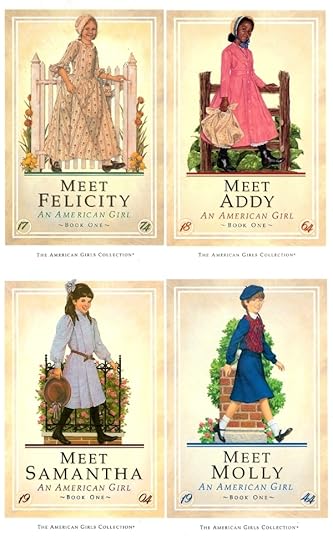
At my elementary school library, I discovered chapter books in The American Girls Collection, published by what was once the Pleasant Company. My favorite series in the collection were (in the order of their eras) the ones about:
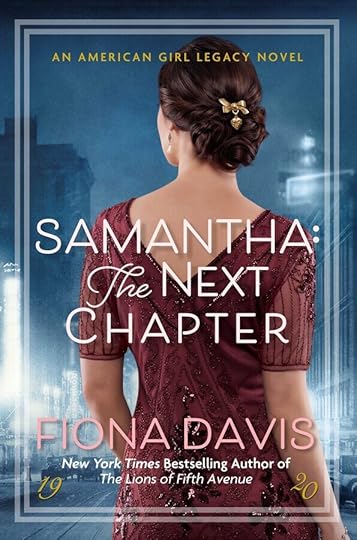
Well, I recently found out there's an upcoming novel about one of these heroines as an adult. Samantha: The Next Chapter.
So, I decided to revisit the adventures of nine- then ten-year-old Samantha.
For me as a child, it was the turn-of-the-century settings of the stories, combined with the pages of rich and colorful illustrations, that most drew me into the books about Samantha's great times as well as her lessons to learn. History wise, the issue that stood out to me the most in the series was women's suffrage.
Now for me as an adult, I better recognize how much important history the series touches on, and while these relatively short tales don't go deep into character development, I can appreciate Samantha's character a little more.
She's very compassionate, and she's at her most courageous when she's helping others in need. In addition to women's rights, Samantha's stories take a young reader-appropriate but still serious look at issues like race and class. There are also instances of alcohol abuse and thievery, and Samantha begins to learn about the hardships that different families and children face, including cramped and run-down living conditions, child labor, harsh and bleak orphanages, and childhood homelessness.
And even as well-off as Samantha is, she as an orphan herself does have her somber moments when she thinks about the two parents she lost before she would be able to remember them better.
On a different note, features I didn't remember but am glad I've rediscovered about the series are the history sections following the stories, with facts and photographs adding more historical context to the world Samantha lives in—and will live in when she grows up.
Here's hoping my grown-up self will enjoy reading about grown-up Samantha as much as I enjoyed this series, whether the first time I read the books or during my revisit.
It’s Samantha’s birthday! She plans to have a lovely tea party, complete with all sorts of sophisticated big city treats. When a prank ruins her party, an even bigger big city treat is in store. It’s out with the old and in with the new, as Samantha turns 10. This book was a little better than the first three Samantha books, but not much. The characters were all either rude or annoying. Samantha’s neighbor Eddie Ryland is supposed to be the pest in the story, but honestly I felt more empathy with him than with the girls. They could’ve offered Eddie a bowl of ice cream and still had their all girls party. The twins were just over the top with their immediate physical threats of violence on Eddie as soon as he popped into the story. Sure, he was annoying in the first couple of books, but the girls were just unnecessarily mean. I didn’t like the whole girls vs. boy theme with the children although it was interesting that this was the story where the suffrage historical aspect was introduced. However the girl vs. boy childish antics were never related to the women’s suffrage movement directly within the storyline. Grandmary’s constant disdain toward anything “new” was a bit tiresome as well. Did we really need so many instances of her frowning upon progress in order to get that she’s stuck in her traditional mindset? I think even young readers could figure that out without it being painted with such an obvious brush. Also found it unrealistic that Grandmary had such a sudden change of heart about the new ways vs. old ways from the pretty nondescript speech offered by Cornelia. My final complaint is pretty consistent with all of the books. The Peek into the Past section tends to portray Samantha’s life as a wealthy child as the “ordinary” in America, when it definitely was not. The casual mentions of servants or immigrants is just in the background in this privileged view on history.
While I am glad to read about an American girl that did not have to struggle in life, reading about Samantha a 10 year old girl of privilege is just not as compelling. One of the great things about these American Girl Series is the history of events that is going on in our nation during that time. This book literally added the women's suffrage movement in during the last few pages as though it was an after thought.
We’re getting back to addressing social issues at the turn of the century in this one, but it feels like it’s quickly shoved in at the end. Samantha learns her new aunt is a suffragette who is able to show her old fashioned grandmother that things for women should change.
Also, this book introduced me to petit fours when I was a kid and I’ve been obsessed with them since.
my favorite part of this book was when samantha and her two twin cusens were chaseing thar dog and that was really funny to me so that is why my favorit part of the book!i thought the book is really good!
no because the way that the salty ice cream was such a big deal as a kid. did I process much of anything about the women's suffrage bits? not that I recall; all I knew was that THAT LITTLE PEST EDDIE RYLAND RUINED THE PRETTY ICE CREAM