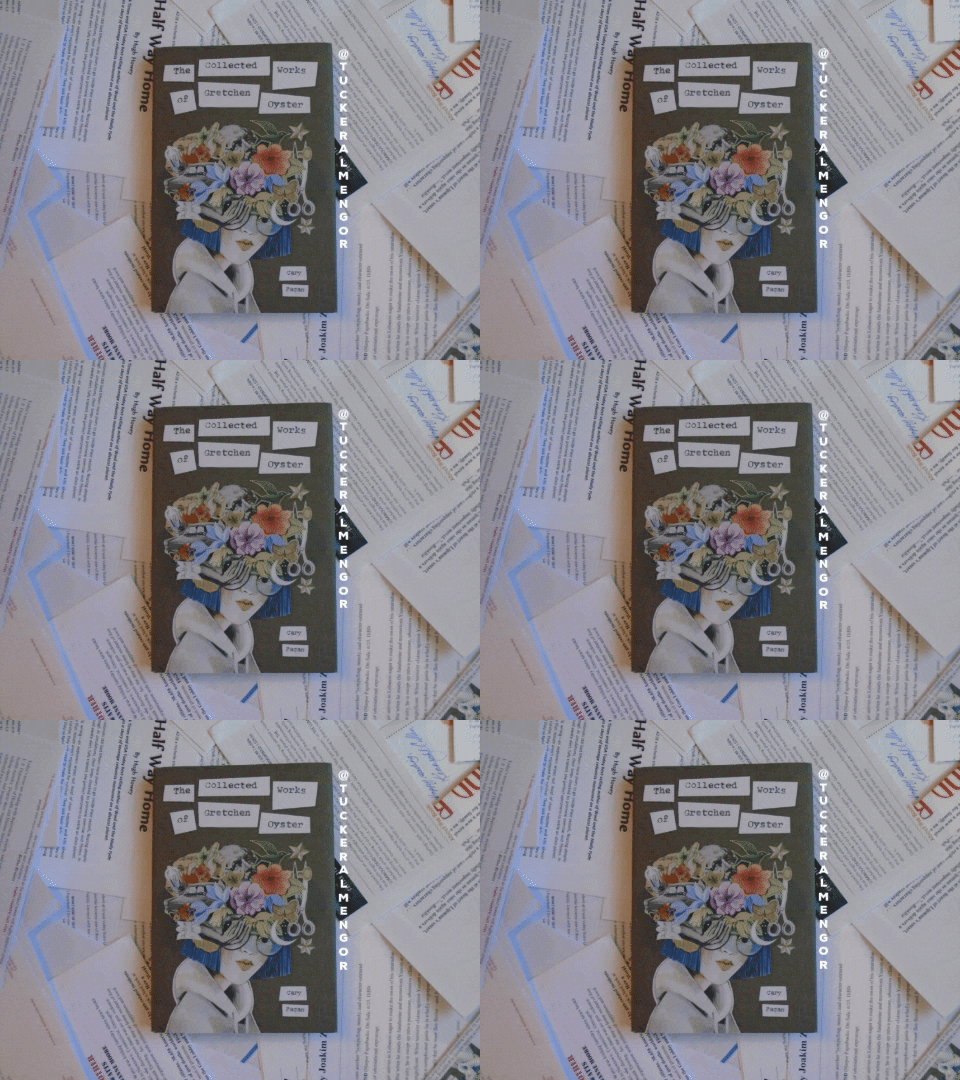
“what i’ve realized is you never know what will happen next”
Thirteen-year-old Hartley Staples’ troubled brother, Jackson, disappeared nine months ago. It isn’t the first time he’s run away. Jackson made previous escapes when he was eleven and fourteen, but those attempts, being of shorter duration, did not shake the family’s foundations the way this one has. Jackson’s twin sister, Heather, has withdrawn from the world. The youngest Staples child, George, is the least troubled. His quirky imagination helps him bob along, like a cork in a river. Hartley’s parents are so distraught over their eldest son’s disappearance, they barely notice Hartley exists.
To add to the pain and confusion, Hartley’s best friend, Zack, has withdrawn from him. Like many people, Ms. Mirani, Zack’s mother, thinks other people’s misfortune is contagious. The Miranis were initially supportive of Hartley’s family, but then abruptly distanced themselves. Hartley had phoned over for his friend one day and got Mrs. Marini instead. “Zack is a special boy,” she told Hartley, “he needs to surround himself with positive influences.” She’d gone on to say that for people to succeed in life, they sometimes had to ruthlessly cut out all the negative influences in their lives. Still, she really did wish Hartley’s family the best: the Staples would remain foremost in the Marinis’ “positive thoughts.”
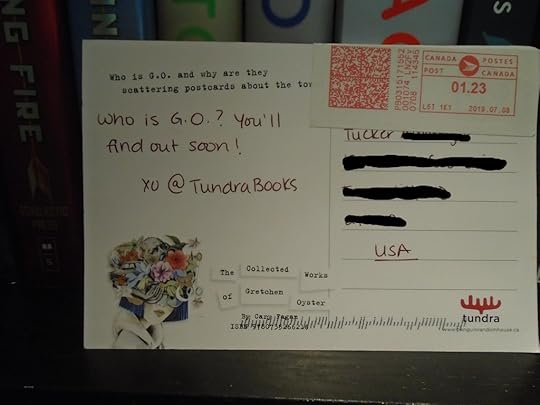
The story proper opens one Saturday afternoon when Hartley slips unnoticed out of the family home. With nothing better to do, he goes to the Whirton Library, housed in a mobile home presented to the town by one of its many eccentrics. The Whirton Library, aka “the Place Where Books Go to Die,” has no budget. Its stacks are filled with cast-offs, donations direct from musty basements of family homes: lots of paperback romances, true crime, and an almost complete set of a magazine called Funeral Service Monthly. Looking for something in teen fiction that isn’t “about a kid whose mother was dying or father was dying or whose mother, father, or girlfriend had been turned into a zombie,” Hartley finds, sticking up from the pages of a book, the first of nine post-card sized artworks, each a small collage with enigmatic poetry formed of cut-out type and sighed “g.o.”. This one reads—all in lower case: “i hate all kinds of flags except pirate flags.” In the following weeks, the last few of the school year, Hartley finds more of these cards—stuck in trees, between bicycle wheel spokes, and in fences. He carefully stores them in a small tin box, with a view to presenting them to his missing brother, should he ever return. Hartley also does his best to discover the identity of the elusive artist poet who is placing them.
Another of Hartley’s challenges in these last days before he graduates from elementary school is to come up with and research a topic of his own choosing. Ms. Gorham, Hartley’s sensitive and sympathetic grade-eight teacher, is willing to allow him to forego this assignment. She is as aware as the next person in Whirton that it is hard for Hartley to feel passionate about anything given his brother’s disappearance. However, the boy will accept no special treatment. When pressed for the subject of his project, he is as surprised as his teacher to hear the word “tractors” escape from his mouth. What?! Where did that idea come from?
Hartley’s only real passion at this point is, of course, finding “g.o.” who, as the title of Fagan’s book announces, is actually Gretchen Oyster. Gretchen has a story of her own, which the reader gains real satisfaction in eventually coming to know.
I love Cary Fagan’s unconventional writing, the unique sensibility and sensitivity that informs it. I don’t quite know how he does it. His books for children are works of some depth, yet they are also characterized by humour and a remarkable lightness of touch. They are probably not for everybody, but they are special gifts to those of us who appreciate something different.
I loved this book and I’m very grateful to the publisher for providing me with a free copy of it to review.