Jump to ratings and reviews
Rate this book
Rate this book
Barcelona. 17 cm. 260 p. Encuadernación en tapa blanda de editorial ilustrada. Colección 'Colección "Nebulae"', numero coleccion(v. 3). Heinlein, Robert A. 1907-1988. Los negros fosos de la luna. Traducción de Ramírez S. Galmieu. Emegé]. Traducción The green hills of earth .. Este libro es de segunda mano y tiene o puede tener marcas y señales de su anterior propietario.

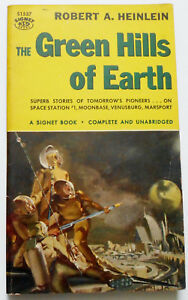
288 pages, Mass Market Paperback

First published January 1, 1951

47 people are currently reading
2182 people want to read

About the author

Robert A. Heinlein

1,053 books10.5k followers
Robert Anson Heinlein was an American science fiction author, aeronautical engineer, and naval officer. Sometimes called the "dean of science fiction writers", he was among the first to emphasize scientific accuracy in his fiction, and was thus a pioneer of the subgenre of hard science fiction. His published works, both fiction and non-fiction, express admiration for competence and emphasize the value of critical thinking. His plots often posed provocative situations which challenged conventional social mores. His work continues to have an influence on the science-fiction genre, and on modern culture more generally.
Heinlein became one of the first American science-fiction writers to break into mainstream magazines such as The Saturday Evening Post in the late 1940s. He was one of the best-selling science-fiction novelists for many decades, and he, Isaac Asimov, and Arthur C. Clarke are often considered the "Big Three" of English-language science fiction authors. Notable Heinlein works include Stranger in a Strange Land, Starship Troopers (which helped mold the space marine and mecha archetypes) and The Moon Is a Harsh Mistress. His work sometimes had controversial aspects, such as plural marriage in The Moon Is a Harsh Mistress, militarism in Starship Troopers and technologically competent women characters who were formidable, yet often stereotypically feminine—such as Friday.
Heinlein used his science fiction as a way to explore provocative social and political ideas and to speculate how progress in science and engineering might shape the future of politics, race, religion, and sex. Within the framework of his science-fiction stories, Heinlein repeatedly addressed certain social themes: the importance of individual liberty and self-reliance, the nature of sexual relationships, the obligation individuals owe to their societies, the influence of organized religion on culture and government, and the tendency of society to repress nonconformist thought. He also speculated on the influence of space travel on human cultural practices.
Heinlein was named the first Science Fiction Writers Grand Master in 1974. Four of his novels won Hugo Awards. In addition, fifty years after publication, seven of his works were awarded "Retro Hugos"—awards given retrospectively for works that were published before the Hugo Awards came into existence. In his fiction, Heinlein coined terms that have become part of the English language, including grok, waldo and speculative fiction, as well as popularizing existing terms like "TANSTAAFL", "pay it forward", and "space marine". He also anticipated mechanical computer-aided design with "Drafting Dan" and described a modern version of a waterbed in his novel Beyond This Horizon.
Also wrote under Pen names: Anson McDonald, Lyle Monroe, Caleb Saunders, John Riverside and Simon York.

Ratings & Reviews

What do you think?
Rate this book

Friends & Following

Create a free account to discover what your friends think of this book!

Community Reviews

5 stars
2,346 (26%)
4 stars
3,409 (38%)
3 stars
2,665 (30%)
2 stars
377 (4%)
1 star
60 (<1%)
Displaying 1 - 30 of 232 reviews
Profile Image for Lyn.
2,009 reviews17.6k followers
November 30, 2019
Dated. Campy. Corny. Sexist – and wonderfully, absolutely Heinlein.

His 1951 collection of “Future History” short stories, all written in the 1940s, represents some of his earlier works. Fans of his juveniles will especially like this publication.

Modern readers will point to stories like "Delilah and the Space Rigger" and "Space Jockey" and will scream that Heinlein was a male chauvinist pig; but progressive for his time Heinlein was carrying Rosie the Riveter into space and expanding her importance in a later, progressive culture.

"The Black Pits of Luna" and "It's Great to Be Back!" describe plucky Lunar dwellers with a pioneering soul. “The Long Watch” is an unapologetically homely ode to courage.

"—We Also Walk Dogs" is a pragmatic and sanguine exploration of future capitalism and libertarianism; and this story, to me at least, demonstrates what is best about Robert A. Heinlein. In a literary landscape flooded with dystopian and post-apocalyptic nightmares, Heinlein’s unabashed optimism about the future is a warm reminder that literature, especially science fiction, can be bright.

description
Profile Image for Manny.
Author 48 books16.1k followers
November 12, 2010
In Robert Heinlein's short story collection, we get to read about a future history that never happened, where the Solar System is colonized by a bunch of ambitious, optimistic, happy-go-lucky space entrepreneurs. They cut corners, break the rules, and quite often get themselves killed. But it works. The American dream reaches the stars, or at least the planets.

In the real world, manned space-flight reached its peak around 1970 with the Apollo landings and then stagnated. Reagan went into the blind alley of building the Space Station, ignoring all his science advisers. Under Dubya, the US had a goal to repeat Apollo (more or less) by 2020, but funding has been cut and it's almost certainly not going to happen. No one at NASA is surprised. I made a bet about four years ago with a senior manager there that someone would set foot on the Moon again by the end of the present decade. He said he hated to be so blunt, but he'd already decided how to spend my money.

So here's the odd thing. The only manned space program which ended up looking the least bit like Heinlein's vision was the Soviet one. They had totally inadequate money and took a lot of risks, but they are still keeping it going. The US program became mired in a vast, inefficient government bureaucracy, and is slowly thrashing itself to death. Things are so bad that the US will soon have to rely entirely on Russian spacecraft to provide transport to the Space Station, unless there's a last-minute change of plan and the Shuttle is not retired next year.

However could that have happened? I really don't blame Heinlein for getting it wrong, and if any SF writer managed to call it correctly I tip my space helmet to him.
_________________________________________________

Do you know, I think I spoke too soon. There are suddenly intriguing rumours about "Hundred Year Starship", a one-way trip to Mars which may be partly or even wholly funded by super-rich entrepreneurs. For example, check out this recent article.
Profile Image for Jim.
Author 7 books2,089 followers
June 26, 2018
This is one of the great short story books of my youth & it was wonderful to revisit them. The stories were some of my first introductions to space at a time when we were first landing on the moon which made them especially exciting. Each is a common issue on Earth in a space setting full of little bits & facts that make space real without lecturing. Very well done.

I knew some of the settings were unreal, but that didn't hurt them. Mars is peopled by a dying race & has canals. Venus is steamy & hot. Both were staples at the time even though RAH probably knew by then they weren't like that at all even if it wasn't until 1962 that Mariner 2 flew by Venus & 1965 that Mariner 9 flew by Mars, a couple of decades after most of these stories were written.

There were some old social references, too. RAH did pretty well by women, but everyone smoked a lot & cigarettes were handed out like bottles of water are now. In one story, a couple of kids were playing mumbley peg on Luna. How cool! Never happen today, of course. One was 5 or 6. I had a pocket knife at that age & so did my kids, but I doubt any do today. I'll have to teach my grandson next year.
:)

"Delilah and the Space Rigger" (1949; originally published in Blue Book) RAH was for women's rights before it was cool. Great setting, a construction crew in space.

"Space Jockey" (1947; originally published in The Saturday Evening Post) Some jobs are tough for a married couple to deal with. Police put their lives on the line every time they walk out the door. Truckers are gone for long periods of time. So what is it like for the pilots of spaceships?

"The Long Watch" (1949; originally published in The American Legion Magazine) This story gives me chills each time. Some people just do their job & follow orders. Others do what's right.

"Gentlemen, Be Seated!" (1948; originally published in Argosy Magazine) Even in the high tech area of space travel, sometimes repairs have to be jury-rigged. This is both hilarious & scary. It's some of the best characterization RAH has done.

"The Black Pits of Luna" (1948; originally published in The Saturday Evening Post) A spoiled child caused big problems once before in these stories & here's another.

"It's Great to Be Back!" (1947; originally published in The Saturday Evening Post) shows how much we adapt, change, & take for granted.

"—We Also Walk Dogs" (1941; originally published in Astounding Science Fiction) is a fun story showing RAH's fondness for the free market. The addition of an art object was really good & needed.

"Ordeal in Space" (1948; originally published in Town & Country) I'm surprised it took so long to get to a story featuring a cat. A man has to face a very real & well deserved fear. The ending is magical, but it's still a good story.

"The Green Hills of Earth" (1947; originally published in The Saturday Evening Post) features poetry by RAH. Not terrible. Good story with a fun character.

"Logic of Empire" (1941; originally published in Astounding Science Fiction) is one I've never cared for. It's long & depressing. A lot more could have been done with it, especially since it is so true. That's what makes it so depressing.

All in all, a fine collection of short stories from the Golden Age of SF that was very well narrated.
Profile Image for Tomislav.
1,161 reviews99 followers
October 7, 2021
This is a collection of Robert A. Heinlein’s stories originally published in the 1940s, and collected into book form in 1951. They all fit within the 1975-2000 timeframe of his Future History, which is diagramed on one of the first pages. At the time the stories were written, there was no human space flight, and nuclear bombs and power were a recent invention. In his Future History, the 1960s were forecast to be a time of social and economic collapse, followed by a corporate-led build back that included the commercialization of space travel, exploration, and colonization within the Solar System. Mars and Venus are inhabitable. After these stories, his Future History forecast a theocratic American state in the 21st century.

When I picked up this book, I wasn’t sure if I had read this collection as a kid, when I read many other Heinlein stories and novels – in particular his juvenile adventures. After reading it now, I feel that I probably did not, although a few of the stories in anthologies for sure. So, I’m not reviewing them from a nostalgic point of view. In fact, their target audience was my parents’ generation. Consider my mediocre rating as an assessment of readability in the context of 2021, not that of the time they were written.

Delilah and the Space-Rigger (originally published in the December 1949 issue of the Blue Book Magazine) - ***. Orbital construction contractor is confronted with his first female worker, and he does not take it well. Written for a men’s adventure magazine, it reflects RAH’s perspective as a member of an all-male US Navy during the 1930s.

Space Jockey (originally published in the April 26, 1947 issue of the Saturday Evening Post) - **. It’s tough being a crack pilot on the Earth/Moon run, and tough on your wife too. Culture has changed so much since the 1940s, that it’s hard to even understand the nature of their relationship.

The Long Watch (originally published in the December 1949 issue of The American Legion Magazine) - ***. The actions of one individual soldier do matter, even in an age when nuclear weapons are cached on the moon.

Gentlemen, Be Seated (originally published in the May 1948 issue of Argosy Magazine) - *. A reporter is guided in exploration of a Lunar Tunnel by two construction workers who know about the Moon when an incident occurs. Heinlein has them tell us that there is high risk of moonquake because tidal forces are 80 times those on the Earth. He should have known better – the Moon is tidally locked with the same side facing the Earth, not rotating through its gravitational field. The gravitational pull is there, but it is almost fixed in place. The only variable parts are due to the Moon’s elliptical orbit and minor eccentricities. Moonquakes are small and infrequent when compared to Earthquakes.

The Black Pits of Luna (originally published in the January 10, 1948 issue of the Saturday Evening Post) - **. When a family tours the moon and their youngest son goes missing on the surface his brother saves him. Juvenile fiction featuring a pair of nincompoop parents.

It’s Great to be Back (originally published in the July 26, 1947 issue of the Saturday Evening Post) - ***. Dissatisfied with their move to Luna City, a husband and wife return to Earth only to find they truly are Lunies.

“-We Also Walk Dogs” (originally published in the July 1941 issue of Astounding Science-Fiction) - ***. General Service will perform any mundane service – ANY. They even agree to take on a task that calls for violation of the laws of gravitation. Ah, the eternal optimism of the business of engineering.

Ordeal in Space (originally published in the May 1948 issue of Town & Country Magazine) - ***. Scarred emotionally by his heroic experience in space, a spaceman returns to Earth and attempts to live under an assumed name. William Saunders, hiding from his past and protecting himself from his phobias, is challenged by a lost kitten.

The Green Hills of Earth (originally published in the February 8, 1947 issue of the Saturday Evening Post) - **. A space “jetman” who is responsible for the operation of nuclear rocket engines is blinded and becomes a bard, a favorite of spacer bars. RAH derived the title from a story by C. L. Moore, and credits her. This story began to be widely anthologized immediately after publication, perhaps because of the swash buckling romanticism of the main character.

Logic of Empire (originally published in the March 1941 issue of Astounding Science Fiction) - ****. Making a bet that laborers on Venus are not held in slavery, a lawyer finds himself locked in to a 6-year contract as a marsh laborer on Venus, from which he can never expect to earn his way out. RAH recreates a somewhat simplistic version of antebellum slavery to make his point about it being the inevitable consequence of colonial economic expansion rather than intentional evil. The figure of Nehemiah Scudder is mentioned, who will later become instrumental in the theocratic American state of the 21st century in RAH’s future history.
Profile Image for Jim.
Author 7 books2,089 followers
October 23, 2014
Despite the title, Earth is mostly in the background in this wonderful collection of short stories. It's mostly concerned with everyday life off the planet. Heinlein has taken a lot of mundane situations & put them a head a century or three. People are still people, although they've traded in their cars for spaceships.

Some of the stories are a bit dated, such as "Delilah & the Space Rigger" - what happens when a girl shows up to work on a space project with an all boy crew? Heinlein examines the sexual revolution before it actually happened. It's still a fun read.

Most of the stories are good, clean fun, with a large element of suspense, such as a boy lost on the moon & his brother the boy scout helps in the search. What does a confirmed spacer do when he gets acrophobia? If you've lived on the moon, is it really good to be home again? Where is home?

Others are sad & a bit scary. The title story is about Rhysling, a spacer who lost his eye sight to shoddy maintenance & finally bums a ride home. "Logic of the Empire" is chilling, especially if you know any colonial history. The same old ills of an expanding 'civilization' heaped on the indigenous population.
Profile Image for Gendou.
633 reviews332 followers
June 5, 2013
This collection of short stories is classic Heinlein. That is to say, sexism, chauvinism, rocketry without computers, a bit of magic, and heaps of bravery. The later is the most fun.

I find the rockets without computers quaint; it reminds me, not surprisingly, of the Apollo Program. It's seldom boring, because Heinlein so often insists on teaching the reader something.

Sometimes, though, the bad guys go out of their way too much to be bad. Like the guy who wouldn't let girls on the space station, or the guy who planned to nuke Earth from Luna.

My favorite scene was in that later story, where the hero sacrifices himself. (Yes, I'm a sucker for bravery.) The narrator of the story is revealed to be telling a tale about the monument to the hero. It's a minor change in perspective, but very effective. I think that's part of what makes a story special, and memorable: its encapsulation. A story is just a story... unless its being told you you as history! That places it in a more credulous realm, for me, somehow.

The title story is about a folk singer in space. If you're a fan of limericks, you'll surely like it. I actually thought they were pretty silly, but I still liked it.
Profile Image for Kevin Kuhn.
Author 2 books690 followers
October 18, 2019
Classic Heinlein short stories. One minute I think its dated, but then I remember he wrote it 60/70 years ago. Despite trying to take on some heavier themes, it has a certain innocence that is charming. And more than anything a cracker of a title!
Profile Image for Craig.
6,330 reviews179 followers
June 26, 2018
I first read this book about fifty years ago (my Dad had the Shasta 1951 first edition with the Hubert Rogers cover and the Future History timeline printed on the end pages), and I'm sure I've read all of the stories at least two or three times again in the intervening years. I've enjoyed listening to this audio version and seeing how well I remembered them. My favorite remains "- We Also Walk Dogs," along with the title story. I never did care overly much for "Logic of Empire" in comparison with the others and still don't, but there's really not a bad story in the book. "Delilah and the Space-Rigger" is one of the best and earliest pro-feminist stories in the genre, while "Space Jockey"... may not be. I love the way the stories have the shared background and fit together, sometimes subtly and sometimes not so much.... Remember that RAH was the first in the field to do this successfully. His vision of the future was optimistic and hopeful overall, not so accurate because he was too hopeful, but he was never trying to be a prophet, just tell good stories and teach his readers something. His characters tend to be braver and more intelligent than normal people, and they're meant to inspire the reader to improve themselves, not just entertain, a most noble goal indeed.
Profile Image for Buck.
620 reviews28 followers
December 31, 2016
This is an early collection of stories by Heinlein. As a Heinlein fan, I found some of them corny and dated, but others were not bad. They seemed to improve as I progressed through the book.
Profile Image for Angela Blount.
Author 4 books692 followers
May 28, 2017
Suggested Alternate Title: SPACE BARD--PORT TO PORT

"I pray for one last landing
On the globe that gave me birth;
Let me rest my eyes in the fleecy skies
And the cool, green hills of Earth."


This "Future History" short story is essentially an account of the life and death of a renowned minstrel named Rhysling--a man who'd worked haphazardly on many a space mission until a radiation accident left him blind and he continued making his way by playing his accordion, writing songs, and hitch-hiking his way around the solar system. A sometimes vulgar wanderer with no offspring, Rhysling's legacy persists in the form of the songs that long outlived him. The story focuses on one in particular--which he happened to put the finishing touches on at the end of his life. His final hurrah is at once sad, fitting, and legendary.

I'll admit, I'm a sucker for rhyme and verse--particularly when it's used to enrich a literary work.
I got choked up trying to relay the intricacy and symmetry of this tale to someone recently. (I don't know that that's ever happened to me before with a short story.) But beyond sentiment, Heinlein's vision for the beginnings to space expansion feels on-key. (Some have called it optimistic, but I think there's far too much low-budget grunge and high mortality rates for that.)
Profile Image for Brad.
Author 2 books1,917 followers
April 20, 2013
Yep ... I love the stories of Robert A. Heinlein. Got a problem with that?

The Green Hills of Earth, the titular short, and Logic of Empire are particularly excellent.
Profile Image for John Warner.
965 reviews45 followers
January 4, 2019
My first 2019 read; only 74 to go to achieve my 2019 reading challenge. Although this short story collection was published in the early 50s, it includes fourteen science fiction stories, part of his Future History series, written in the 40s. Most are set on space ships, space stations or in a moon colony. Most of these stories deal with the psychological and social impact of living in space rather than the technology itself. The physics appear accurate for what was known during the 40s, but the prediction of future technology for some items were way off the mark. Heinlein predicted the cellular phone, but he did not predict the calculator or PC. During the short story, “__We also Walk Dogs”, one of the scientists pulls out his slide rule to solve a problem.

A couple of the short stories had me chuckling. because the stories read like “Ozzie and Harriet” go to the moon. For example, "Delilah and the Space Rigger" deals with introducing women employees into a space station. (Holy Rosie the Riveter, Batman!) The language between the spaceship pilot and his stay-at-home wife was dated and read like a 50s situation comedy episode. Another short story, “It’s Great to be Back!”, deals with the impact on a family that returns to Earth after years in space something astronauts in the International Space Station are too aware of. Again, like others in this collection, the social mores have not changed since the 1950s. For example, the wife asks her husband if she can crawl into his bed for warmth indicative that both were sleeping in separate beds.

Profile Image for Chan Fry.
280 reviews9 followers
January 31, 2021

(3.8 of five, averaged from the individual reviews of all 10 short stories.)

For a variety of reasons, this collection defines Heinlein. Not only does it contain much foundational material for his Future History, but the work here is typical of early Heinlein. His penchant for brief and easy technical explanations, his flair for the slang of the times, and his inherent cynicism about both government and big business are all on display here. (Most of his shortcomings are on display here too — his inability to think of women as full-fledged human beings — despite wanting badly to include them in his stories, his paper-thin side characters, his childlike optimism about how quickly and easily humanity would get into space, and his paradox of admiring capitalists while also detesting them.)

(I have published a longer review on my website, including mini-reviews for each of the 10 short stories.)

Profile Image for JCyborg Aperture.
55 reviews
December 8, 2025
How did the past imagine the future? Considering the "old" meme of 'how I imagined the future as a kid and how it is now' this is always a topic that can cause a lot of funny and/or sad confusion. We might live in a green, sustainable utopia by now. Instead ChatGPT is now inserting ads in its answers. Well.
The short stories are a hit and miss. The first one literally answers the question: Can women be on space stations??? What a preposterous insane idea!
Heinlein tries his best to incorporate social and moral lessons into his stories which unfortunately makes them unwieldy or absurd in some parts. Children should be supervised on moon walks? What a novel idea.
The last and longest story of the bunch - 'The Logic of Empire' - tries a critique of colonialism and capitalism on a Venus full of farms employing slaves/indebted servants. The two wealthy protagonists who end up there as a drunken social experiment succeed in their critique of the system but then fail to act upon it - superficially because of the ideology surrounding the system propping itself up (humans will live in the society they deserve and there is nothing we can do about it) not realizing that their wealth allows them to transcend the rules. Strange.
Profile Image for Andrew Brine.
61 reviews1 follower
February 17, 2022
I'm a sucker for a short story collection. 'We also walk dogs' probably my personal fave story.
The foresight in this book is crazy, for something written almost 70 years ago there are very few cracks in the science/technology.
Profile Image for George K..
2,758 reviews368 followers
May 19, 2019
Τελευταία φορά που διάβασα βιβλίο του Ρόμπερτ Χάινλαϊν ήταν τον Ιούλιο του 2014, τότε που πραγματικά απόλαυσα το κλασικό "Οι στρατιώτες του γαλαξία", χωρίς αμφιβολία ένα από τα σημαντικότερα μυθιστορήματα επιστημονικής φαντασίας. Αυτό είναι το πέμπτο βιβλίο του συγγραφέα που είχα την τύχη να πιάσω στα χέρια μου (επανεκδόθηκε πριν λίγες μέρες, όντας για χρόνια εξαντλημένο), όμως είναι η πρώτη φορά που διαβάζω συλλογή διηγημάτων του.

Λοιπόν, το βιβλίο περιέχει δέκα πολύ ωραία, ενδιαφέροντα και καλογραμμένα διηγήματα επιστημονικής φαντασίας (για την ακρίβεια εννιά διηγήματα και μια μικρή νουβέλα), τα οποία ανήκουν στην κλασική εποχή του είδους. Όπως είναι φυσικό, οι αντιλήψεις και οι γνώσεις του συγγραφέα σχετικά με την τεχνολογία, τα επιστημονικά δεδομένα και τις κοινωνικοπολιτικές αναφορές, αποτελούν προϊόντα της εποχής τους. Προσωπικά ευχαριστήθηκα όλα τα διηγήματα -σε μικρότερο ή μεγαλύτερο βαθμό-, απόλαυσα εικόνες, ιδέες και σκέψεις, ενώ όχι μόνο ψυχαγωγήθηκα, αλλά μπήκα στη διαδικασία να σκεφτώ και κάποια πράγματα, μιας και ο συγγραφέας μέσω των διηγημάτων του έθιξε ορισμένα ενδιαφέροντα και σημαντικά ζητήματα που έχουν σχέση με την ανθρώπινη συμπεριφορά.

Ο Ρόμπερτ Χάινλαϊν θεωρείται ως ένας από τους εμβληματικότερους συγγραφείς επιστημονικής φαντασίας, μαζί με τους Ισαάκ Ασίμοφ και Άρθουρ Κλαρκ, και κατά τη γνώμη μου με αυτή τη συλλογή το επιβεβαιώνει σε πολύ μεγάλο βαθμό. Όλα τα διηγήματα με ικανοποίησαν, είτε με τις ιδέες τους, είτε με τις περιγραφές τους, είτε με την πλοκή τους, είτε απλώς με τις εικόνες τους. Σίγουρα κάποια διηγήματα είναι πιο δυνατά από κάποια άλλα, όμως νιώθω ότι όλα τους είναι σε πολύ καλό επίπεδο ποιότητας. Αν ήταν να επιλέξω τα τρία αγαπημένα μου, πιθανότατα θα ήταν αυτά: "Η λογική της αυτοκρατορίας", "Τι ωραία που είναι να γυρίζουμε πάλι στο σπίτι" και "Η μεγάλη αγρύπνια".
419 reviews42 followers
March 30, 2009
This a another of the very few Robert Heinlein short story collections. They ten stories are all quite good. Speical favorties of mine among the then stories are "The Green Hills of Earth" and "Ordeal in Space".

Heinlein's short stories are not as well known as his novels, but he is a good story teller whether writing novels or short stories.
Profile Image for Pamela Shropshire.
1,455 reviews72 followers
May 22, 2020
This is a collection of early short stories by Heinlein. It’s interesting to read these imaginative writings about a future-that-might-have-been. Humanity has advanced differently than Heinlein imagined — he bet on rockets and radio; instead we have computers and cell phones. Heinlein’s world is muscular and masculine. As a woman, I prefer the world we have, imperfect though it is.
Profile Image for Jeff Yoak.
834 reviews55 followers
September 22, 2025
This is a fantastic short story. I came to love "Noisy" from his appearances as a minor character in other Heinlein stories, but this this short piece describing his history and heroic end always gets me right here.
Profile Image for Fredrick Danysh.
6,844 reviews195 followers
May 4, 2020
Explores probe the deepest reaches of space while wondering if they will ever see Earth again. This collection of short science fiction stories by Heinlein is is suitable for middle school readers. Included is a table featuring many of Heinlein/s stories and characters.
Profile Image for Mark.
692 reviews176 followers
January 26, 2019
The Green Hills of Earth is generally regarded as the second collection of Heinlein’s Future History stories, which showed us, in the Golden Age of SF, how Heinlein saw humans expanding beyond Earth into space. It includes love, sibling rivalry, annoying parents and ancient Martians.


After the stories of the first collection (The Man Who Sold the Moon,), we now see the result of Delos D. Harriman’s efforts. Mankind has extended beyond Earth and is now not only building more space-stations but also establishing a permanent base on the Moon.

The stories included here (in order) are:

It's Great to Be Back (1947; Heinlein’s thirtieth published story, originally published in The Saturday Evening Post, July 1947)
The Green Hills of Earth (1947; Heinlein’s twenty-seventh published story, originally published in The Saturday Evening Post, February 1947)
Logic of Empire (1941; Heinlein’s eleventh published story, originally published in Astounding Science Fiction, March 1941)
We Also Walk Dogs (1941; Heinlein’s sixteenth published story, originally published in Astounding Science Fiction, July 1941)
The Black Pits of Luna (1948; Heinlein’s thirty-third published story, originally published in The Saturday Evening Post, January 1948)
Delilah and the Space-Rigger (1949; Heinlein’s thirty-ninth published story, originally published in The Blue Book Magazine, December 1949)
Gentlemen Be Seated (1948; Heinlein’s thirty-fourth published story, originally published in Argosy Magazine, May 1948)
The Long Watch (1949; Heinlein’s fortieth published story, originally published in Beyond Time and Space, a collection edited by August Derleth, May 1950)
Ordeal in Space (1948; Heinlein’s thirty-fifth published story, originally published in Town & Country Magazine, May 1948) and
Space-Jockey (1947; Heinlein’s twenty-eighth published story, originally published in The Saturday Evening Post, April 1947)


I’ll look at each one in turn.

We begin with It’s Great to be Back! , being the story of a couple who have spent years on the Moon and are desperate to return to Earth, but find that when they get there that things are not as rosy as they remember them. The ending is a little convenient, but this one portrays the differences between fact and fiction of living on the Moon well. By this stage, a Moonbase is an established feature of this Future History. The story was first published in 1947 in The Saturday Evening Post. Like much of the first Future History collection The Man Who Sold the Moon, it buys into that post-WW2 feeling that the future will be better, if we as a race continue to expand out into Space.

The Green Hills of Earth is the title story and one that is often lauded, telling of the legend of blind balladeer and space rogue, “Noisy” Rhysling. First published in The Saturday Evening Post in 1947, this was the first of Heinlein’s stories to appear there and caused a furore when published. For Heinlein, it was a return to writing after his war effort work curtailed it. Although the germ of the story, about a ‘Blind Singer of the Spaceways’, originates from 1941, he used his experience of working with a blind machinist at the Philadelphia Ship Yards to type the story up in four hours.

However, I must admit that I’ve never really liked this story or really got why others like it so much. (There’s even a Rhysling Award every year.) Perhaps it’s because I’m not a fan of Heinlein’s lyrics / poetry, or perhaps it is that the story, once you’ve got past the main character, is not that engaging.

I get that Rhysling is one in a line of folk singers who tell tales of stories past, to preserve those memories, and that the songs remind people now so long in space that they feel homesick for their original home planet, but otherwise the story leaves me strangely cold. At the time of its first publication, though, in 1947 in The Saturday Evening Post, it was hailed as a triumph. I still read it as an adventure story that could be told about travelling on the sea as much as it is here about travelling through space. Perhaps that is its attraction.

Next we have Logic of Empire, first published in Astounding in 1941, a story of slavery that echoes the history of the British Empire and the darker side of the cotton trade of the Southern USA. As this is science fiction, here the story is transferred to swampy Venus. The story itself is engaging, and I enjoyed it up to the point where the solution to our heroes’ plight was the use of family money to bail him out. The slaves who helped him decide to return to slavery as they don’t feel life would be better afterwards. It is a fair enough story, but seems limited in its purpose. The moral message is not given subtly.

It is the first time that I remember hearing of the prophet Nehemiah Scudder, who in the Future History is the self-proclaimed prophet who becomes President of the USA in 2012 and creates a theocracy leads the world into another Dark Age. (I refrain from further comment here, except to give space to ruminate on the law of coincidences…). Nehemiah will be mentioned in other Future History stories, most notably “If This Goes On” and To Sail Beyond the Sunset.


We Also Walk Dogs is one of my favourites in this collection. First published in Astounding in 1941, it’s a story of future commercialism gone rampant – an intergalactic company who are paid to get things done, from walking dogs to interplanetary relations. Here the company is given a particularly unusual problem to solve, but in Heinlein-fashion, they do, buying the services of a grumpy scientist to do so. I must admit that the thought of leaving interplanetary relations to a business felt a little – unusual - and that the scientific solution is a little convenient – oh look, we have an anti-social scientist who can solve your problem just like that – there are some nice Heinlein touches that I recognise in later work, without them becoming too overbearing. Pleasingly, we have a competent female with a primary role (unusual for 1941 but not for RAH) and some, but not too much, of that snappy Heinlein-style dialogue. In the end, it made me think of what could happen in a solar system run by Amazon, or Elon Musk…

The Black Pits of Luna is a story style that we will see again from Heinlein in the future. It was originally written in one sitting of about four hours.

Originally titled “Little Boy Lost”, it is a story written from the viewpoint of a teenager and at first seems not that different from those juvenile novels he was writing at the time. (At the time this was written, Heinlein had just had Space Cadet published, and it is easy to see similarities here.) The teenager has travelled to the Moon with his family, but when his ‘brat’ of a brother goes missing on the Luna surface, we are subject to his hysterical mother and his ineffectual father.

First published in The Saturday Evening Post in 1948, I can see why readers unused to s-f might find this interesting – there’s some interesting description of what it would be like to be on the Moon’s surface – but personally I found the characterisation annoying.  The weak mother is an unfortunate stereotype that Heinlein in other stories does well to distance himself from, but non-sf readers may enjoy. Heinlein has done sibling relationships much better elsewhere (see The Menace from Earth and Podkayne of Mars, for example).

Delilah and the Space-Rigger was first published in 1949. It’s a story of what happens when women enter an otherwise all-male working environment, in this case the building of a space-station in Earth orbit. It has dated, but shows its inspiration as the changing role of women in WW2. According to Heinlein scholar William H. Patterson, it was a story written for the Saturday Evening Post that fitted a common theme of how industries get things done, but from the perspective of someone in the support services. (I believe that this was also mentioned under the banner, “We Also Serve.”)

Critics have seen the story as sexist, but perhaps have to remember that the world of the 1940’s was very different from today, and what Heinlein was actually doing here was advocating women as equals in the workplace. It’s Heinlein’s version of WW2 icon ‘Rosie the Riveter” (https://en.wikipedia.org/wiki/Rosie_the_Riveter ), but set in Space.

Patterson also states that Heinlein was criticised of dumbing down his science fiction for a more general public with this story. It basically takes soap-opera scenarios but puts them in a future setting. They were popular and generated an important response, which to some extent justified Heinlein’s answer that he was basically bringing science fiction to a wider audience.

Onto more typical Heinlein fare now. Gentlemen Be Seated is a story that tells us of how humans, through the Harriman Corporation, are expanding living space on the Moon, and the hazards of such living. First published in 1948 in Argosy Magazine, it’s another story that shows us hard-working men trying to do their best in dangerous circumstances - what Patterson refers to as showing “the fundamental decency of the ordinary Joe“. A story with a lesson – human exploration is dangerous – but one with a certain degree of dark comedy, as the solution to the situation is rather ribald humour. I thought that it was OK, but not one of Heinlein’s best - some of those wise-cracking good-guys that become a Heinlein staple are on show here.

The Long Watch is an unabashed “hero story” that plays to Heinlein’s own beliefs from his naval days – a story of individual sacrifice, for the greater good, against an attempted coup. First published in December 1949 in the American Legion Magazine, a magazine for US military veterans, and it’s clearly a story that would be attractive to their readers.

Lastly, we have two stories I was less impressed with.  Ordeal in Space is a lesser tale of a man who struggles on his return to Earth to come to terms with the effects of an accident in space. Think Alfred Hitchcock’s Vertigo and you get the idea. It is well written, but for me the story was ruined by the improbability of finding a kitten on a window ledge thirty-five stories up that had to be rescued. Here’s perhaps the first sign of the Heinlein’s love of cats – it will surface again later in many other works – but it all read as rather inconsequential to me. Strangely, this is one of the later stories in this collection (published 1948) sold to an unusual clientele (Town and County magazine). Perhaps that explains the importance of the cat…

Space-Jockey is another one of those type of “just-doing-my-job” type stories, was first published in 1947. It’s a story that takes a present-day setting - very much reminiscent of the lifestyle and journey of an airline pilot – but extrapolates it to the future, telling us how flying spaceships between Earth and the Moon may become increasingly routine in the future, with some important differences! I liked most of it, though letting an annoying child loose in the cockpit/control room was an obvious step too far.

In short, the collection The Green Hills of Earth continues to show progression - of Mankind into space and also Heinlein as a writer. The stories here show an author increasingly more confident and clearly beginning to think of his stories as part of a grand plan. I'm sure that this will continue with the next volume in this series.
Profile Image for Jerry.
Author 10 books27 followers
August 14, 2020
Many of the stories in this collection take place in the Luna City of The Moon Is a Harsh Mistress; however, while they’re good stories in their own right, they don’t add much to the understanding of that novel. It’s more the other way around, with the knowledge of what’s going to happen in the novel coloring what happens in these short stories.

I bought the book for the title story; it was recommended by an acquaintance online. All of these stories take place in a retro future of rocket pioneers, space bums, colonies on Venus and Mars interacting with Venusians and Martians, and the restless mankind spreading out from a not-quite-decadent Earth civilization. “The Green Hills of Earth” is specifically about one of the space bums, once a pioneer spaceman blinded in an accident, who becomes a famous singer/songwriter after he dies. And written before the golden era of singer/songwriters.

My copy of the book has a copyright of 1951. All of the stories were written in the forties. One in 1941, and the rest in 1947 or later.

The highlight for me, besides the title story, was “Space Jockey”. It takes place during a period when being a spaceman is becoming a job, like long haul trucker, except that the haul is a lot longer. The main characters are having marital problems because of their long times apart.

Heinlein touches on privacy issues in some of the stories, especially in “Ordeal in Space”. An astronaut who has had to leave space travel due to what we would now call PTSD works on Earth under an assumed name; because of biometric identification, the recruiter knows he’s an astronaut, but the hiring companies can’t use that information unless he provides it personally.

Of the stories, only “Logic of Empire” really relies on extraterrestrial colonies, in this case Venus and the Venusian swamp natives. This makes it the most outdated of the stories, and the sense of being outdated is made worse by the internal inconsistencies that were noted but not dealt with, such as the waiting list for becoming a worker on Venus vs. the trickery involved with getting the main character on Venus.

Where it really looks dated, though, is the main character’s inability to sell his exposé at the end of the story. It’s not due to government censorship, but due to publishers being unwilling, in about the year 2000-2020, to publish nonfiction books that only appeal to specialized markets.
825 reviews23 followers
Read
March 28, 2021
The first book that I ever stayed up all night reading. I was probably around ten or so. I loved it. This and Fredric Brown's Space on My Hands - and my older brother's subscriptions to Galaxy Science Fiction and The Magazine of Fantasy and Science Fiction - influenced my reading choices for many years. I know how controversial Heinlein's work became subsequently and I don't know how I would feel if I reread this now; I suspect that I would still like it.
Profile Image for Lucas.
158 reviews
June 29, 2021
This book is another exhibit in the gallery of reasons why I like short story collections (and episodic storytelling in television). The stories here are incredibly uneven, but the ones I connected with were incredibly good.
Profile Image for Danada.
162 reviews2 followers
February 13, 2018
3.5

A collection of short stories in his Future History series. I quite enjoyed most of these, but couldn't get into The Green Hills of Earth. They seem quite dated in many ways, and of course sexist, but still fun.
Profile Image for Naomi.
70 reviews1 follower
August 30, 2020
Boy’s own classic sci fi featuring tales of adventure and men proving their mettle in space.

Heinlein’s version of the universe is an interesting one (if dated): the beautiful glass towers of Mars, the tropical swamp colonies of Venus. It’s not progressive but it’s good fun.
Profile Image for Andy.
1,154 reviews2 followers
March 4, 2021
classic sci-fi from one of the Masters
Displaying 1 - 30 of 232 reviews

Can't find what you're looking for?

Get help and learn more about the design.