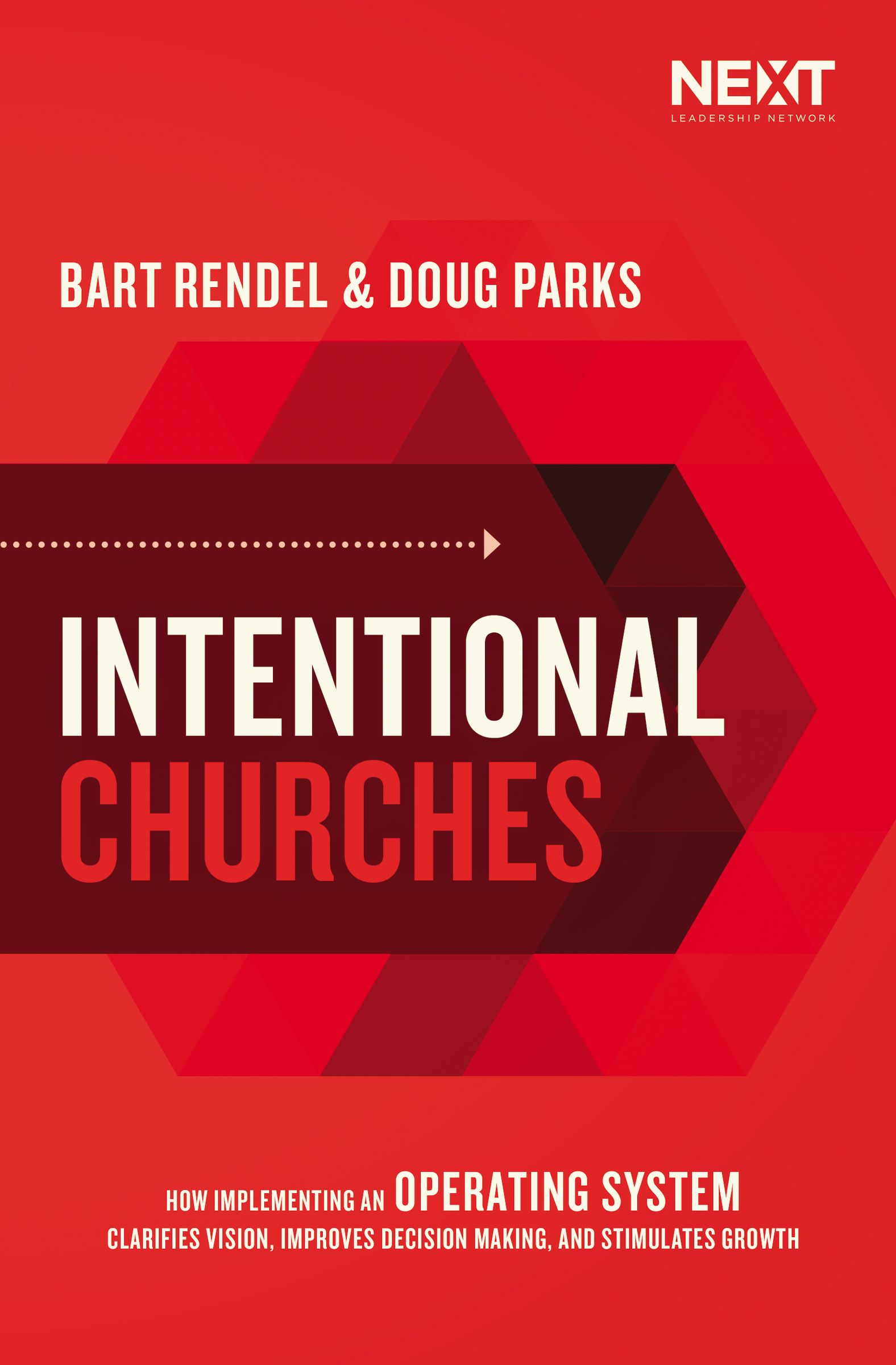
In spite of many church leaders and Christian researchers doubt about the local church’s relevancy and ability to grow, there are many churches growing and making disciples. They are implementing a revolutionary new Intentional Growth Planning™ operating system.
Pastors and church leaders are frequently frustrated and overworked, not knowing how to create systems and structures to support church growth and the making of more and better disciples. Just as laptops and smart phones have an operating system, the church needs a biblically-based operating system which its various programs and activities can effectively plug in to. In Intentional Churches, church growth leaders Doug Parks and Bart Rendel unveil a proven and practical operational system that will help leaders clarify their unique vision, filter trends and new idea through their mission, improve implementation abilities, and maintain unity and alignment to what matters most. It is a repeatable and transferable process any church can learn!
I listened to this- but will get a hard copy to reread. It’s loaded with insight into making the local church the best for its community. Being intentional is huge in expanding the Kingdom. So much to think about.
I really appreciated this book. As I’ve stepped into this new role, this is one of the books that I believe I will look back and say that it helped teach me to be a lead pastor.
The brilliance is in the simplicity. I could go on and on about the practical and proven tools that Doug and Bart unpack. One of the things that really separates Intentional Churches is that - it moves beyond ideas and theory - having the potential to really rewire how teams operate and lead.
There are simple tools that my team has immediately implemented - providing a better framework for making decisions, creating team alignment, and unity.
I can't wait to share the book with other leaders that are feeling stuck or just looking to accelerate the vision of the church.
I just got done reading the first three chapters and WOW...this book is a cup of cold water in a desert full of silver-bullet strategies for church health/growth. As a pastor in a local church, it can be easy to get overwhelmed at the vast number of resources out there for ministry application. The Intentional Churches' approach is simple and clear--systems thinking using a practical framework to pursue Biblical mandates for the local Church. So helpful!
I'm also thankful for the posture of IC's authors. Their writing is winsome and sincere, humble yet authoritative. These guys aren't trying to reinvent the wheel--they're just trying to help each of us make sure all of ours are in alignment for the journey ahead.
“We suspect that some parts of the book will confirm what you’ve already been thinking or possibly even trying. Other parts could lead to a revelation. We are praying for both confirmation and revelation and ultimately insight that will lead to courageous decisions, deep confidence that eradicates fear, and a clear plan to accomplish Christ’s mission.”
I will update my review once I've finished the book but, so far, 10/10...highly recommend!
UPDATE:
Wow. Wow. Wow. The amount of highly-practical and immediately-applicable content for the local church in this book is off the charts. I will be digesting this content for months to come and cannot wait to implement it's foundational principles in our leadership rhythms.
Every pastor in America is trying to rethink how to do churches in a COVID-19 and post-COVID-19 context. The game has changed. I confess that context probably shaped my reaction to Rendel and Parks’s book Intentional Churches.
Rendel and Parks’s book is very much in line with a widely accepted method of best church practices that I would say is alive and well in various forms in churches such as Elevation or NorthPoint, Life Church, or Saddleback. I was first introduced to this focused methodology in Rainer and Geiger’s Simple Church over a decade ago, which oddly isn’t mentioned by Rendel and Parks.
Rendel and Parks call their unifying theory: ChurchOS (Church Operating System). I admit, even that name put me off a bit. What I had to work harder to get through was the sales pitchy tone that tended to seep through. Even the stories at the end of chapters that serve as testimonials felt a little bit too close to blurbs that you would find on the Intentional Church website.
But I’ve started off on too negative a tone. Rendel and Parks’s book is helpful and had I read it pre-pandemic, I would have likely found it very helpful. I appreciate how they start the book by encouraging the pastor to grade their church on the following categories (which they explain well): leading with a team; common language;, systematic approach; objective evaluation; complete honesty; smart bullets, not silver bullets; zero-sum leadership; priorities, focus, and follow-through; powerful habits and routines; constant improvement. As you can tell by these ten categories, Rendel and Parks aren’t reductionistic. Their approach is balanced and thoughtful.
Their fairly complex ChurchOS could easily get the leader tied up in knots figuring where to start, but they do a good job of breaking things down and encouraging leaders to make improvement on the most needed area (which they say will have a multiplicative effect).
The break those areas down even further into 21 sub-areas for evaluation and improvement: 1. Mission 2. Vision 3. Evaluation 4. The last 10 percent 5. The Great Commission engine 6. Priorities for impact 7. Focus on our one 8. Engagement pathway 9. Activation dashboard 10. The next season’s work 11. Structure and roles 12. Meetings 13. Common language 14. Intentional growth plan deployment and training 15. Activation ownership 16. Silver bullets 17. Governance and decision-making 18. Generosity 19. Leadership development 20. Prayer 21. Multiplying
Rendel and Parks throw most of their energy at encouraging churches to become evangelistically activated. They encourage churches to do so by focusing on their “one.” They mean that individually and corporately. They believe churches ought to tailor their approach for the “one” lost person they believe God has called them to reach out to in their community (you might be familiar with Saddleback Sam).
They urge churches to not substitute foreign missions for local evangelism. “We’ve seen more than one church die a slow death while celebrating its foreign victories.”
They then urge churches to have a streamlined next step approach as opposed to a buffet approach to ministry. Ministry bloat not only takes up the resources of the church, it is confusing and unclear to newcomers. One church says it this way, “We build next steps for everyone and first steps for their friends.” Where are you leading your people? Is it clear to them? How can you make it clearer? Are those steps going to achieve what you want the culture of your church to be? “Most churches say too many things to their church family at once,” Rendel and Parks say. “It’s not too different from receiving a Valpak in the mail.” In your overwhelm, you’re just going to chuck the whole thing.
Rendel and Parks move on to breaking down how to organize and quantify your goals and then how to activate your congregation.
Intentional Churches is a helpful book with lots to gain from. In a world that has had to quickly shift to online church and new systems, the confidence felt a bit misplaced at times. That especially felt apparent in their more attractional mindset that I wasn’t bought into to begin with. I am sure I will return to Intentional Churches to benefit from a lot of very practical information. I appreciate how Rendel and Parks get down to the nuts and bolts of their ideas and they don’t hesitate to hand you the playbook and tell you to run it just so. There is great benefit in that. Just less so in 2020.
The authors have really done a good job of applying 'operational management' with the old 'management by objectives' focus to a church context. Of course many in church leadership lack this foundational expertise... but then so do many in business really. Therefore this fills a need.
It is cleverly titled because although they use the analogy of a computer operating system for the church, really what they have presented is the creation of their own 'system' in order to apply 'operational' management. This system with all its tools and catch phrases reminds me of Covey's 7 Habits, but it is also familiar territory to say McKinsey's consultants or alike coming in with a 'universal' fix for all your problems (without diagnosing them first!) Indeed Parks and Rendel have sett up just such a church consultancy, but it is at least good of them to release their 'tricks' and 'secrets' to the general market via a cheap book (Covey did the same).
There is some really good thinking and modelling in this - like their three piston engine (Great Commission Engine -GCE) describing the mutually reinforcing importance of Sunday worship, small groups relationship and actually living out your faith. However (and now I make some critiques) - this is only a tool rather than any revelation; and such has been said before in many different ways. The key concept concept around which everything is based is also not quite original in church nor in management - that strategy is orientated around an imaginary stereotypical 'customer' who embodies the key demographics that the church can/wants to reach.
A big section of the book which is much weaker, deals with old hat mission statements and evaluation; and is much less creative. Indeed the disconnect between 'words', no matter how well intended, from reality is now well established and not addressed. The three scriptural underpinnings in the Great Commission, leave the 99 for one, and Acts 2 church are a bit contrived and honestly it is risky territory to create a theology (ecclesiology) on isolated verses, the 'head of the church' too easily becomes its management rather than Christ. All that's necessary actually is to say - "this is being a good steward". What is missing, that they could have identified instead, is what is different about church as opposed to NGO's and businesses.
There are potentially good lessons for every church here (I realised the need for explaining a common language in order to help leadership orientation), but the examples and target seemingly is to make a 1000 person church reach 5000 - I guess that market which can afford consultancy - in order to break through the plateaus of attendance. Church is actually a lot more complex and diverse than this and some of the expectations are plainly pie in the sky rather than anything truly attainable in every context. Nevertheless this is a valuable tool kit for any church.
Working with Bart and Doug for many years has provided the opportunity to see the principles and constructs in their book as they were first being tested and iterated in real-life settings amid the churches we were serving together. As a result, I came to this book expecting to know what was in it. I’d heard and seen it many times before, right? Instead, I was impacted anew by the clear, in-depth biblical grounding, consistency, and simplicity that anchors ChurchOS. I saw connections I hadn’t seen before. I was challenged, and my convictions surrounding the Great Commission were reignited. Moving forward, I will be a better pastor, leader, and coach having read this book from cover to cover. I recommend it to any lead or executive pastor, “second chair” leader, elder, or church board member. J. Stanley - Indianapolis
Good book highlighting a operating system for church. If you've read many books on church ministry, there isn't a great deal of new information but the author's put it together into a helpful system. It felt a bit like the first half of Purpose Driven Church, meets Simple Church, with some Unstuck added in. Yet, it appears it could provide a good tool for keeping a focus on reaching the lost. What I really liked is that it wasn't about techniques, styles or even models. But rather a system to run your unique ministry on. I was aware of several churches using and profiting from it. I'm impressed enough, I plan to attend one of their workshops. I recommend Intentional Churches for church leaders looking for a way to keep their focus on reach people away from God.
Instead, Gospel-centered smart bullets that get the job done. I have a shelf full of leadership book in my office. Many of these books are built on solid business wisdom... but no Gospel connection. Many of these leadership books are filled with great Biblical wisdom, but lack a solid plan of how to activate change.
Intentional Churches ties both together in a powerful way.
If you are looking for a Biblical leadership book for how to change your church to be more Gospel-centered and Gospel-impactful, this is the book for you!
This book has the potential to profoundly impact the Church! It's one of those essential reads for every church leader and ministry student in seminary. I haven't read this good of a book on how to lead and grow a church since Purpose Driven Church came out more than 20 years ago. Doug Parks and Bart Rendel explain in detail from Scripture the nuts and bolts of what it takes to grow a thriving community of believers driven by a passion to realize the Great Commission of Jesus. Well done!
I have an advanced copy. The clarity this book brings to discovery of the state of your church is incredible. Leaders who read this will be able to assess today's reality, tomorrow's challenges, and a vision for the future. As someone who helps several churches in their journey towards intentional growth, this book will be a catalyst for Kingdom impact in local churches everywhere.
This is a practical system for operating a modern, western church. It helps you move from a vague vision to a specific way of planning, measuring and executing. It's not a new way of doing church. The outcome is a pretty standard American church. It's the tools and tactics that get you to that place.
I'd give this 3.5 stars - There's a good bit of vision casting and pastoral conceptualizing that is extremely helpful, but the book begins to drone and become rather repetitive around the chapter 7 mark. While I do understand that the concepts can be challenging and a quite a bit of clarity is necessary at some points, it ain't gotta be all that. Read it and you'll see what I'm talking about...
This is an incredible tool that has helped us work through some of the barriers we have faced as a congregation on the mission field. Primarily, it has helped us on becoming a church that is focused on the lost rather than the insider.
The intentional churches church operating system is one of the greatest resources available to the church today. If you're like me, you will find this book and the practices it suggests immensely helpful for your church to do the things that Jesus thought mattered most!
Excellent book with a strong Biblical foundation. Very practical methods described with detailed steps for implementation. Loved the concept of building to reach the ONE.
There are some theological flaws in building an entire church model around an "ideal consumer," but there are some good thoughts that can be applied to all levels of church life.
Wally RendelA fantastic read. Very focused on why God put the church in the world and put us in the church.....to lead that one lost lamb into the fold of God’s redemptive care. Highly recommend reading it, especially pastors, elders and church leaders!!
Barbara Rendel also reviewed this book. She gave it a 5 star rating. She said the book is so clear regarding the Great Commission and how churches should focus on the lost people and plan every part of the church system around a plan to "Go into all the world and preach the Gospel, baptizing and teaching". Cycle this over and over and your church will grow!!!
Started reading and this book is difficult to put down! Relevant on so many levels today. Every pastor, church leader, volunteer, missionary, elder, deacon, and even those who only attend church services should read this book. This is already reading like a revolution that needs to happen in our Churches.
I received an advanced copy from the publisher. This book is amazing for church leaders! A step-by-step process on how to identify your "one" and explode your gospel potential. It's a must-read for any church ready to go to the next level!
Just read the first few chapters and I'm blown away by this back-to-basics approach to leading a Great Commission church. The 5 components of the Great Commission Engine provide such clarity for what truly needs ongoing attention. And keeping the focus on the lost One is what so often gets forgotten. Can't wait for the full book to be available—going to be such a game changer for so many churches!
got an advanced copy and am so grateful for this wonderful book. our church has been using this OS for 3 years now and the results are amazing. The book is a such a great reminder of what every church should be about and how we can all get closer to what Jesus intended for us.