

What do you think?

The House of Sixty Fathers
Tien Pao and piglet he names "Glory-of-the-Republic" after baby sister "Beauty-of-the-Republic" drift free in storm downriver back to Japanese territory. Following tiny mountain trails back to parents, he meets American aviator. Guerillas sneak them free. Based on real story of boy adopted by squadron of sixty flyers in bunkhouse.
189 pages, Hardcover
First published January 1, 1956
About the author
Meindert De Jong
43 books81 followersMeindert De Jong was an award-winning author of children's books. He was born in the village of Wierum, of the province of Friesland, in the Netherlands.
De Jong immigrated to the United States with his family in 1914. He attended Dutch Calvinist secondary schools and Calvin College, in Grand Rapids, Michigan, and entered the University of Chicago, but left without graduating.
He held various jobs during the Great Depression, and it was at the suggestion of a local librarian that he began writing children's books. His first book The Big Goose and the Little White Duck was published in 1938.
He wrote several more books before joining the U.S. Army Air Corps during World War II, serving in China. After the war he resumed writing, and for several years resided in Mexico. He returned for a time to Michigan. After settling in North Carolina, he returned to Michigan for the final years of his life.
De Jong immigrated to the United States with his family in 1914. He attended Dutch Calvinist secondary schools and Calvin College, in Grand Rapids, Michigan, and entered the University of Chicago, but left without graduating.
He held various jobs during the Great Depression, and it was at the suggestion of a local librarian that he began writing children's books. His first book The Big Goose and the Little White Duck was published in 1938.
He wrote several more books before joining the U.S. Army Air Corps during World War II, serving in China. After the war he resumed writing, and for several years resided in Mexico. He returned for a time to Michigan. After settling in North Carolina, he returned to Michigan for the final years of his life.
Ratings & Reviews
Friends & Following
Create a free account to discover what your friends think of this book!
Community Reviews
Displaying 1 - 30 of 225 reviews

February 14, 2023
I never thought I'd live to see the day that my youngest child became verklempt from a book, but it happened last night.
Naturally I was already gasping and crying, reading the ending of this middle grades chapter book to her, but when I saw my daughter swallow down a sob, I knew we'd finally hit the literary jackpot.
(Neither The Bridge to Terabithia nor Charlotte's Web brought her to tears, to give you an idea of her emotional threshold).
But, finally, this fictional story, based on the real life events of a boy, orphaned by war in China and then “adopted” by an outfit of American soldiers, made this daughter's jaw twitch, and, even though it was barely perceptible, I saw that sleeved arm rubbed quickly across both eyes.
This story, written in 1956 by Dutch-American author, Meindert DeJong, and illustrated by the incomparable Maurice Sendak, is a must-read for any lovers of middle grades or juvenile fiction.
Naturally I was already gasping and crying, reading the ending of this middle grades chapter book to her, but when I saw my daughter swallow down a sob, I knew we'd finally hit the literary jackpot.
(Neither The Bridge to Terabithia nor Charlotte's Web brought her to tears, to give you an idea of her emotional threshold).
But, finally, this fictional story, based on the real life events of a boy, orphaned by war in China and then “adopted” by an outfit of American soldiers, made this daughter's jaw twitch, and, even though it was barely perceptible, I saw that sleeved arm rubbed quickly across both eyes.
This story, written in 1956 by Dutch-American author, Meindert DeJong, and illustrated by the incomparable Maurice Sendak, is a must-read for any lovers of middle grades or juvenile fiction.

September 22, 2018
I finished this book with a lump in my throat and tears in my eyes. Why? Because, while this book is tough and raw to read for realistically portraying its subject, it’s beautifully written and acutely heartwarming.
The New York Times reviewed the book as, “Not only a tense adventure story but also a moving picture of one small boy’s tenacious courage.” I give that assessment a hearty amen!
The action of this book is quite gripping, but it was the pull to root for Tien Pao, this little Chinese boy, and his little piglet against all odds that was the heartthrob of the story.
Tien Pao and his family have just escaped from their Japanese-attacked village that the Japanese and have escaped in their tampan, a boat, upriver to the city of Hengyang, now the 2nd largest city in China. When the tampan is accidentally unmoored and washed downriver with Tien Pao and the piglet he names Glory-of-the-Republic, his endurance is tested. On the long journey back to Hengyang, he risks his own life to save an injured American airman lieutenant, helping the Chinese fight the Japanese, as well as encountering the Chinese resistance, who act as guerrillas by night and farmers by day.
When he finally arrives in the city it is only as the Japanese do, and Tien Pao bravely tries to find his family in the chaos. And that is how his sixty fathers find him, on a rock overlooking the road out of Hengyang asleep and curled up with his piglet.
I loved seeing the interaction between the boy and the American airmen, who “adopted” Tien Pao out of gratefulness for how he saved their lieutenant’s life! Finding out that the book is based off a true story only endeared this book and those scenes to me more.
This is my third Meindert Dejong book and certainly not my last. I’ve found him to be an author capable of masterfully writing to capture my heart and move me to tears, even in his simplest novels. I look forward to reading more by this author.
The New York Times reviewed the book as, “Not only a tense adventure story but also a moving picture of one small boy’s tenacious courage.” I give that assessment a hearty amen!
The action of this book is quite gripping, but it was the pull to root for Tien Pao, this little Chinese boy, and his little piglet against all odds that was the heartthrob of the story.
Tien Pao and his family have just escaped from their Japanese-attacked village that the Japanese and have escaped in their tampan, a boat, upriver to the city of Hengyang, now the 2nd largest city in China. When the tampan is accidentally unmoored and washed downriver with Tien Pao and the piglet he names Glory-of-the-Republic, his endurance is tested. On the long journey back to Hengyang, he risks his own life to save an injured American airman lieutenant, helping the Chinese fight the Japanese, as well as encountering the Chinese resistance, who act as guerrillas by night and farmers by day.
When he finally arrives in the city it is only as the Japanese do, and Tien Pao bravely tries to find his family in the chaos. And that is how his sixty fathers find him, on a rock overlooking the road out of Hengyang asleep and curled up with his piglet.
I loved seeing the interaction between the boy and the American airmen, who “adopted” Tien Pao out of gratefulness for how he saved their lieutenant’s life! Finding out that the book is based off a true story only endeared this book and those scenes to me more.
This is my third Meindert Dejong book and certainly not my last. I’ve found him to be an author capable of masterfully writing to capture my heart and move me to tears, even in his simplest novels. I look forward to reading more by this author.

July 18, 2009
Here's one I've picked up for my little guy's library. We can't resist a book with a shiny medal on the cover. I like to read kid books between my "grownup" books because they are easier to focus on during my "book hangovers". You know, when a particular book is so thought provoking that your mind is foggy with it's images and characters that it's rather hard to begin another book.
Okay, well now that I've read it I will declare it to be one of my new all time favorites. I can't believe I haven't even heard of this little gem. I cried like a baby at the end. Just blubbered. What a treat. I highly recommend this to anyone. I rarely give five stars and this one deserves it. Don't worry about the slow start, the momentum picks up a quarter of the way through and rushes like a river toward the end.
Okay, well now that I've read it I will declare it to be one of my new all time favorites. I can't believe I haven't even heard of this little gem. I cried like a baby at the end. Just blubbered. What a treat. I highly recommend this to anyone. I rarely give five stars and this one deserves it. Don't worry about the slow start, the momentum picks up a quarter of the way through and rushes like a river toward the end.

August 8, 2014
A few years ago when reading The Rape of Nanking: The Forgotten Holocaust of World War II, I learned more about the extreme animosity Chinese people hold for the Japenese.
This 1957 Newbery Honor book reinforced what I learned. This is a tale of the Japenese invasion of China. As they systematically descerated the land, murdering the poor peasants, bullets shot throughout the air, finding helpless targets, and in the aftermath, red fire raged through the huts, burning livestock and people within.
This is a tale of Tien Pao, a brave little boy whose family fled their village in the only remaining sampan. Rowing day and night to move further internally, they finally found a place to moor their sampan. Exhausted and hungry, Tien Pao's mother carried his baby sister on her back and she and his father sought work.
Leaving Tien Pao alone during the day with only the family pig for company. Lonely, he watched as a group of water buffalo played dangerously close to the sampan. Unaware that one of them loosened the rope that bound the sampan to the shore, Tien Pao drifted alone as the current took him right back into the mountainous territory where the Japanese were now invading.
In his journey, he miraculously rescuing an American soldier. When they were found by Chinese resistance fighters, the soldier was sheltered and then returned to his troop. Keeping Tien Pao with them, they felt it a mission to try to return him to his parents. As the fighting increased, they were not able to do so.
Once again, alone and frightened, Tien Pao was rescued. This time by American soldiers who whisked him to their barracks. As 65 men became his father, he was grateful, but still, knowing despite all odds, he vowed to find his parents.
Throughout his journey, his trusted friend the pig, now called "Beauty of the Republic", accompanied him in his sheer determination to be reunited with his biological parents.
Highly recommended.
This 1957 Newbery Honor book reinforced what I learned. This is a tale of the Japenese invasion of China. As they systematically descerated the land, murdering the poor peasants, bullets shot throughout the air, finding helpless targets, and in the aftermath, red fire raged through the huts, burning livestock and people within.
This is a tale of Tien Pao, a brave little boy whose family fled their village in the only remaining sampan. Rowing day and night to move further internally, they finally found a place to moor their sampan. Exhausted and hungry, Tien Pao's mother carried his baby sister on her back and she and his father sought work.
Leaving Tien Pao alone during the day with only the family pig for company. Lonely, he watched as a group of water buffalo played dangerously close to the sampan. Unaware that one of them loosened the rope that bound the sampan to the shore, Tien Pao drifted alone as the current took him right back into the mountainous territory where the Japanese were now invading.
In his journey, he miraculously rescuing an American soldier. When they were found by Chinese resistance fighters, the soldier was sheltered and then returned to his troop. Keeping Tien Pao with them, they felt it a mission to try to return him to his parents. As the fighting increased, they were not able to do so.
Once again, alone and frightened, Tien Pao was rescued. This time by American soldiers who whisked him to their barracks. As 65 men became his father, he was grateful, but still, knowing despite all odds, he vowed to find his parents.
Throughout his journey, his trusted friend the pig, now called "Beauty of the Republic", accompanied him in his sheer determination to be reunited with his biological parents.
Highly recommended.

May 30, 2017
Oy, talk about an adventure story. Takes place in China during WWII, so, educational - but also ever so exciting. A reissue would def. appeal to modern children. Sendak's art is wonderful, but not as highly personal as his work for the books he writes himself, more straightforward... and more apt, imo. Inspired by DeJong's own experience in China.
Looking forward to the reread Oct. 2018 with the Children's Books group Newbery club.
....
My comment there:
Talk about a horror story. There's nothing of the supernatural in this but rather it's all too real. And apparently the real life situation that inspired this doesn't even have the happy-ish ending that the book has.
I wonder how it got published. I certainly don't know how it could now.
A fairly quick read that will haunt a reader for a long time.
(Unfortunately, there are not many pages spent on the title setting. But I can't imagine any other title fitting, can you?)
Looking forward to the reread Oct. 2018 with the Children's Books group Newbery club.
....
My comment there:
Talk about a horror story. There's nothing of the supernatural in this but rather it's all too real. And apparently the real life situation that inspired this doesn't even have the happy-ish ending that the book has.
I wonder how it got published. I certainly don't know how it could now.
A fairly quick read that will haunt a reader for a long time.
(Unfortunately, there are not many pages spent on the title setting. But I can't imagine any other title fitting, can you?)

April 13, 2010
Meindert DeJong is one of the greats at writing emotionally involved stories for younger readers, using uncomplicated sentence structures that serve as a superb introduction to fine literature.
The House of Sixty Fathers is a classic adventure, with the main character Tien Pao becoming separated from his parents in China near the story's beginning. Danger surrounds him at every turn; the Japanese army has taken a major portion of China, and Chinese civilians are in mortal danger. Through a bit of innocent carelessness, Tien Pao and his pig, Glory-of-the-Republic, get lost down the river from the temporary station he and his parents have been living on, and he becomes lost Japanese territory. Capture would likely mean torture and death for even a young Chinese citizen such as Tien Pao.
Racing across the war-torn countryside, Tien Pao must at every turn outwit the Japanese forces swarming the mountains, while at the same time trying to find his way back to his parents and keeping himself and Glory-of-the-Republic alive in the uncertain wilderness. Tien Pao finds allies and enemies everywhere, and it's not always easy to tell where they fall in the spectrum. After all, the displaced Chinese citizens are desperate and starving the same as Tien Pao, and that kind of desperation is sure to attract trouble to a boy possessed of a healthy young pig.
Dangers and snares seem to swallow Tien Pao and his pet with each step that they take, but finally the boy sees the unmistakable glimmer of hope when he is found by American soldiers on the long pathway that stretches away from the horrors of the Japanese occupied land. Tien Pao now no longer faces imminent death, though he is still lost from his parents and baby sister. But who could ever find such a commonplace family among the throngs of evacuating Chinese travelers milling across the land? What hope does Tien Pao have, really, of ever reconnecting with the family that he has lost?
The House of Sixty Fathers didn't have to be written as thoughtfully as it was. Meindert DeJong could have easily taken shortcuts in the making of this novel, but he never did so, and we as readers are better off for it. I want to note that the illustrations drawn by Maurice Sendak seem especially appropriate for this book; in fact, some of the most stirring moments in The House of Sixty Fathers are to be found in its understated illustrations. The most important of all these illustrations, I would say, can be seen on the book's dedication page. That picture speaks volumes about the simple emotional value of this story.
It was a hard decision whether to round up or down on my rating, but I would definitely give two and a half stars to The House of Sixty Fathers.
The House of Sixty Fathers is a classic adventure, with the main character Tien Pao becoming separated from his parents in China near the story's beginning. Danger surrounds him at every turn; the Japanese army has taken a major portion of China, and Chinese civilians are in mortal danger. Through a bit of innocent carelessness, Tien Pao and his pig, Glory-of-the-Republic, get lost down the river from the temporary station he and his parents have been living on, and he becomes lost Japanese territory. Capture would likely mean torture and death for even a young Chinese citizen such as Tien Pao.
Racing across the war-torn countryside, Tien Pao must at every turn outwit the Japanese forces swarming the mountains, while at the same time trying to find his way back to his parents and keeping himself and Glory-of-the-Republic alive in the uncertain wilderness. Tien Pao finds allies and enemies everywhere, and it's not always easy to tell where they fall in the spectrum. After all, the displaced Chinese citizens are desperate and starving the same as Tien Pao, and that kind of desperation is sure to attract trouble to a boy possessed of a healthy young pig.
Dangers and snares seem to swallow Tien Pao and his pet with each step that they take, but finally the boy sees the unmistakable glimmer of hope when he is found by American soldiers on the long pathway that stretches away from the horrors of the Japanese occupied land. Tien Pao now no longer faces imminent death, though he is still lost from his parents and baby sister. But who could ever find such a commonplace family among the throngs of evacuating Chinese travelers milling across the land? What hope does Tien Pao have, really, of ever reconnecting with the family that he has lost?
The House of Sixty Fathers didn't have to be written as thoughtfully as it was. Meindert DeJong could have easily taken shortcuts in the making of this novel, but he never did so, and we as readers are better off for it. I want to note that the illustrations drawn by Maurice Sendak seem especially appropriate for this book; in fact, some of the most stirring moments in The House of Sixty Fathers are to be found in its understated illustrations. The most important of all these illustrations, I would say, can be seen on the book's dedication page. That picture speaks volumes about the simple emotional value of this story.
It was a hard decision whether to round up or down on my rating, but I would definitely give two and a half stars to The House of Sixty Fathers.
August 14, 2012
Yaya: I wish that there were five stars, but nobody else wanted five stars. I find it was cool when Tien Pao floated away by the bulls in the water and he didn't notice that one of them undid the twig. So then, how did they float away? They floated away when the pig was running and Tien Pao was screaming and running at the same time. I found it scary when the man didn't try to get him when it was raining with the umbrella. It was funny when the two mans found him and it was funny when they took him to the house of sixty fathers. And, yeah, that's it.
,
Chloe: I learned a bit about history, before I read the book, I thought that sixty fathers was just a random number. But then, daddy told me that it was because there were sixty american soldiers fighting in china against the japanese at the end of the second world war. I found it sad when they were escaping from a city and one of the trains burnt down. Tien Pao managed to keep his pig the whole time. There were Chinese guerrillas that helped him. I don't mean monkey gorillas, I mean soldier guerrillas.
,
Chloe: I learned a bit about history, before I read the book, I thought that sixty fathers was just a random number. But then, daddy told me that it was because there were sixty american soldiers fighting in china against the japanese at the end of the second world war. I found it sad when they were escaping from a city and one of the trains burnt down. Tien Pao managed to keep his pig the whole time. There were Chinese guerrillas that helped him. I don't mean monkey gorillas, I mean soldier guerrillas.
February 9, 2014
This book was not what I was expecting, pretty intense at parts and emotional to read to the kids but we all thought it was a great book and loved the ending!

January 29, 2019
Oh, this book - the ending. So heart wrenching and so well told.
Definitely makes for good discussions with your kids.
My 13 year old likes this book as much as I do.
Definitely makes for good discussions with your kids.
My 13 year old likes this book as much as I do.

October 22, 2018
My kids read this in third grade at their school, and one of my sons mentioned that this was his favorite book from all of elementary school, so I thought I should finally read it for myself. It's an astonishingly suspenseful story—the kind that would likely be rated R for violence and intense situations if it were made into a movie—but also surprisingly sweet.
The book follows the journey of Tien Pao, a little Chinese boy who must flee upriver during flood season with his parents, baby sister, and the family pig when Japanese bombers burn his family's village to the ground. As he waits in the boat (the "sampan") for his family to return from working for food, the boat is knocked loose from the shore by a water buffalo, and he is sent, all alone, back down the river into enemy territory all alone, with only his little pig as a companion. Traveling secretly, through the woods and under cover of darkness, he endures starvation, injury, a hail of Japanese bullets, and other struggles. He witnesses a bloody battle between an American airman (whose life he saves) and Japanese ground forces, finds friendly but limited help from a group of Chinese guerillas, and falls into the greedy hands of starving and deranged old woman in the burning city where he had hoped, at last, to find his parents.
I found the book to be far more moving and far more suspenseful than I'd expected, and I could hardly bring myself to put it down to go to sleep each night. Highly recommended for middle-grade kids* and parents alike.
———
* For any kids who have witnessed real-life violence or loss of a parent this book would likely be too traumatic. Use caution.
The book follows the journey of Tien Pao, a little Chinese boy who must flee upriver during flood season with his parents, baby sister, and the family pig when Japanese bombers burn his family's village to the ground. As he waits in the boat (the "sampan") for his family to return from working for food, the boat is knocked loose from the shore by a water buffalo, and he is sent, all alone, back down the river into enemy territory all alone, with only his little pig as a companion. Traveling secretly, through the woods and under cover of darkness, he endures starvation, injury, a hail of Japanese bullets, and other struggles. He witnesses a bloody battle between an American airman (whose life he saves) and Japanese ground forces, finds friendly but limited help from a group of Chinese guerillas, and falls into the greedy hands of starving and deranged old woman in the burning city where he had hoped, at last, to find his parents.
I found the book to be far more moving and far more suspenseful than I'd expected, and I could hardly bring myself to put it down to go to sleep each night. Highly recommended for middle-grade kids* and parents alike.
———
* For any kids who have witnessed real-life violence or loss of a parent this book would likely be too traumatic. Use caution.
July 15, 2014
This is of the types of books I read as a second, third and fourth grader in a communist country. I happen to like such books. Митко Палаузов и Овчарчето Калитко are the two books that come to mind. Now, this particular story has a sequence of low probability events so you have to be smart when reading it to differentiate the truth from the fiction, from what is likely and what is very unlikely to happen. So a lesson in that too. The book does contain a few scenes which can make you discuss war in more detail. The book has also tons of holes which is not a bad thing but a thought-provoking opportunity. Such a 1)why is the kid left at the boat alone when evidently he can be taken to the field 2) what happens to the old man 3) how does the guerrila guy know that the old woman's house has exploded with her inside 4)what happens to the young woman in the second shelter and many many more, and of course don't forget to talk about the title of the book because I don't think this is the appropriate title for this book. It is not even catchy. Fathers are notable people while all these sixty men are just the same, they blend into one, and they are not even the ones carring for the boy-the doctor and one seargent and one pilot are. All things to question. But as I said I did enjoy reading the book, mostly because of my background and the memories the story brought back from my childhood and especially my grandmother who was in love with such books.
January 4, 2014
After about 50 pages I was not very impressed. every description was absurdly repetitive. It seemed like for every sentence there was a second with the same content with different words, like a translation. I think DeJong needs to invest in a thesaurus. The word sampan appeared probably ten times on every page for the first half of the book. I just once wanted to see the word boat in its place. (no such luck)
As the story progressed there was more action and was not so boring or redundant to read. The plot is a nice story. It is nice how everything comes together in the end, even though it was not realistic. I am amazed at how long it took me to read this book. I took three days to read what usually takes three hours. I guess I never felt invested in the story and therefore didn't want to pick it up as often and just generally moved at a slower pace than usual.
As the story progressed there was more action and was not so boring or redundant to read. The plot is a nice story. It is nice how everything comes together in the end, even though it was not realistic. I am amazed at how long it took me to read this book. I took three days to read what usually takes three hours. I guess I never felt invested in the story and therefore didn't want to pick it up as often and just generally moved at a slower pace than usual.
April 9, 2014
Best children's book I have ever read.
This book is a gripping story of a chinese child struggling through the Japanese invasion of China. In my opinion, it is one of the most incredible pieces of children's literature ever written. An easy read that's completely worth it.
This book is a gripping story of a chinese child struggling through the Japanese invasion of China. In my opinion, it is one of the most incredible pieces of children's literature ever written. An easy read that's completely worth it.

July 13, 2013
My 5th grade teacher read this aloud. Never forgot it. I have bought it for my grandchildren.

June 6, 2022
Another fabulous novel by DeJong, though very different from the other two I've read, set in his homeland of The Netherlands. Based on how much I've enjoyed these three, I'm definitely going to seek out his other books for young readers. This one takes place in war-torn China where a young boy is separated from his parents and baby sister and must make his way back through enemy territory to try and find them. It is jam-packed with tension and action throughout and his interactions with an American airman, Chinese guerilla fighters, a squadron of American flyers (the titled House of the Sixty Fathers) and the family pig (possibly the first instance in history of an emotional support animal ... lol!) felt very real and filled with emotion. The illustrations by Maurice Sendak added to the story, though I wish there had been more of them. A great ending that had me in tears.
May 15, 2012
The House of Sixty Fathers is a book I listed with the theme of war and overcoming adversity in a reading list I compiled recently. Teaching lower secondary students, I wanted to expand my knowledge of Young Adult (YA) fiction which explains my foray into them. I had this book for a while, but bumped it up my reading list to commemorate the passing of its illustrator, Maurice Sendak. I bought his book from the local independent bookstore that specialises in picture books, www.woodsinthebooks.sg, at Club Street. The bookshop is so pretty, I could not not buy a book from it.
The House of Sixty Fathers tells the tale of hope, sheer determination, the pivotal kindness of strangers and good judgement. True, the protagonist had a lot of help from good people who came to his aid along the way to get him reunited with his family, but Tian Pao also had to stay single-minded and persevere beyond what he had ever experienced. Young Adult readers will be able to identify with Tian Pao's fear of loneliness, abandonment and his struggle with inadequacy.
Although Tian Pao seemed to be assisted in his efforts to surmount one challenge after another, the book does not sugar coat the terror of war, especially of the Japanese invasion of China in the 1930-1940s.
I particularly like these two references of the horrors of war and its effect on children. The author's description of war does not glamourise war, nor does it take war lightly.
--------------------
Tian Pao looked at her doubtfully. "But, Mother, if the airman should come again?"
She shook her head. "Not for two hundred yen - no, not for two hundred thousand yen could I go through it again ... Tien Pao, have you considered? What if you should try to cross and the river should take you?"
"The wonderful airman would help me row again," Tien Pao said sturdily.
"Tien Pao, do you know where the river would take you?" his mother said very slowly. "Suppose you risked it again! Suppose the terrible river current should wrench just one oar away. Your wonderful river-god airman has no experience with sampans. Tien Pao do you know what would happen if the river took you and that American airman? Where it would take you? Back where we came from! Back to the Japanese! Do you know what would happen to your helpless airman? The Japanese would torture him - he is an airman. They would drive bamboo splinters under his tender nails until he told all about this great new field for airplanes we are building at Hengyang. And when he had told, they would kill him.
---------------------
He heard voices. He peered though the bushes. A group of boys and girls were coming up the hill with baskets on their backs and grass knives in their hands. They came slowly and weakly - like old people. They even looked like old people! Their skin was drawn like old paper over their cheekbones. The children stopped halfway up the hill, put their baskets down, and began sawing at the sparse grass with their hooked knives. Those children ate grass! They stuffed whole handfuls into their mouths before they put as much as a blade of grass into their baskets. Then one little boy began to eat mud!
Tien Pao looked on horrified. The mud-eating boy was the smallest of the lot. He kept away from the others, as if he were ashamed. He dragged himself around behind his bloated, huge stomach. His sticks of legs looked silly under that big stomach. And now the little boy scooped up a handful of dirt again and brought it to his mouth. His sister saw it, and scolded him in a tired, old way. The other children looked up, but did not seem to care. The little fellow hung his head. He slowly opened his hand and let the mud dribble out of it. He looked at his empty, dirty hand and began to cry.
--------------------
My favorite line of the book however has to this single line from earlier on in the text.
"Tian Pao refused to be silenced by her silence."
This is in reference to Tiao Pao's mother's stern rage at the disappearance of him and their sampan against her explicit instruction. That line suddenly lit up a bulb in my head to illuminate exactly what happens when silence rebukes a guilt so much more than any spoken word.
The House of Sixty Fathers tells the tale of hope, sheer determination, the pivotal kindness of strangers and good judgement. True, the protagonist had a lot of help from good people who came to his aid along the way to get him reunited with his family, but Tian Pao also had to stay single-minded and persevere beyond what he had ever experienced. Young Adult readers will be able to identify with Tian Pao's fear of loneliness, abandonment and his struggle with inadequacy.
Although Tian Pao seemed to be assisted in his efforts to surmount one challenge after another, the book does not sugar coat the terror of war, especially of the Japanese invasion of China in the 1930-1940s.
I particularly like these two references of the horrors of war and its effect on children. The author's description of war does not glamourise war, nor does it take war lightly.
--------------------
Tian Pao looked at her doubtfully. "But, Mother, if the airman should come again?"
She shook her head. "Not for two hundred yen - no, not for two hundred thousand yen could I go through it again ... Tien Pao, have you considered? What if you should try to cross and the river should take you?"
"The wonderful airman would help me row again," Tien Pao said sturdily.
"Tien Pao, do you know where the river would take you?" his mother said very slowly. "Suppose you risked it again! Suppose the terrible river current should wrench just one oar away. Your wonderful river-god airman has no experience with sampans. Tien Pao do you know what would happen if the river took you and that American airman? Where it would take you? Back where we came from! Back to the Japanese! Do you know what would happen to your helpless airman? The Japanese would torture him - he is an airman. They would drive bamboo splinters under his tender nails until he told all about this great new field for airplanes we are building at Hengyang. And when he had told, they would kill him.
---------------------
He heard voices. He peered though the bushes. A group of boys and girls were coming up the hill with baskets on their backs and grass knives in their hands. They came slowly and weakly - like old people. They even looked like old people! Their skin was drawn like old paper over their cheekbones. The children stopped halfway up the hill, put their baskets down, and began sawing at the sparse grass with their hooked knives. Those children ate grass! They stuffed whole handfuls into their mouths before they put as much as a blade of grass into their baskets. Then one little boy began to eat mud!
Tien Pao looked on horrified. The mud-eating boy was the smallest of the lot. He kept away from the others, as if he were ashamed. He dragged himself around behind his bloated, huge stomach. His sticks of legs looked silly under that big stomach. And now the little boy scooped up a handful of dirt again and brought it to his mouth. His sister saw it, and scolded him in a tired, old way. The other children looked up, but did not seem to care. The little fellow hung his head. He slowly opened his hand and let the mud dribble out of it. He looked at his empty, dirty hand and began to cry.
--------------------
My favorite line of the book however has to this single line from earlier on in the text.
"Tian Pao refused to be silenced by her silence."
This is in reference to Tiao Pao's mother's stern rage at the disappearance of him and their sampan against her explicit instruction. That line suddenly lit up a bulb in my head to illuminate exactly what happens when silence rebukes a guilt so much more than any spoken word.

August 14, 2011
I really liked this book. It shows good character development and good strong emotion. It is also an adventure with bravery and heroism. Granted, it was obvious what the ending would be as soon as he rattled their little river-hut too much during the storm. However, it was still fun to get there.
As background to this book, during the 2nd Sino-Japanese War Japan invaded China. After Japan allied itself with Germany, this Sino-Japanese War became, of sorts, part of World War II. Anyway, during WWII, with over 15,000,000 China had more casualties, by far, than any other nation on earth except for Russia. It was the beginning of an all-out Chinese genocide attempt, and most of the casulties were civilian. This is the story of a boy who lives through a few horrific Japanese attacks and gets separated from his family and falls into Japanese-controlled territory. It is fun and exciting, but it might be a little much for younger kids as you read about villages and cities getting destroyed, people getting killed, etc. It is also somewhat antagonistic toward the Japanese, but since this is from the point of view of a little kid who say the Japanese planes destroy his town, this is very reasonable.
As background to this book, during the 2nd Sino-Japanese War Japan invaded China. After Japan allied itself with Germany, this Sino-Japanese War became, of sorts, part of World War II. Anyway, during WWII, with over 15,000,000 China had more casualties, by far, than any other nation on earth except for Russia. It was the beginning of an all-out Chinese genocide attempt, and most of the casulties were civilian. This is the story of a boy who lives through a few horrific Japanese attacks and gets separated from his family and falls into Japanese-controlled territory. It is fun and exciting, but it might be a little much for younger kids as you read about villages and cities getting destroyed, people getting killed, etc. It is also somewhat antagonistic toward the Japanese, but since this is from the point of view of a little kid who say the Japanese planes destroy his town, this is very reasonable.

January 2, 2016
Just days after his family escaped from their home and the Japanese, one little boy finds himself back in enemy territory, this time alone. Well, almost. He has his piglet, Glory-of-the-Republic. Together the pair must find their way home – an impossible task. But when hope comes, a choice is laid out before him. He must decide between a new life or continuing his hopeless search. Which will it be?
The word that comes to mind when I think of this book is ‘haunting’. It is set in China during the second Sino-Japanese War. The horror of the war is portrayed with almost frightening vividness. Intense pain lies just beneath the surface in even the most joyful moments. Many of the illustrations are of children, their faces wearing expressions of terror or sadness deeper and heavier than any they should ever have had to bear. Others are of dark, faceless, human-shaped shadows.
But against this oppressively dark backdrop, human tenderness and compassion shine all the brighter. Love makes the impossible possible.
An easy read? No. A worthwhile read? Absolutely.
The word that comes to mind when I think of this book is ‘haunting’. It is set in China during the second Sino-Japanese War. The horror of the war is portrayed with almost frightening vividness. Intense pain lies just beneath the surface in even the most joyful moments. Many of the illustrations are of children, their faces wearing expressions of terror or sadness deeper and heavier than any they should ever have had to bear. Others are of dark, faceless, human-shaped shadows.
But against this oppressively dark backdrop, human tenderness and compassion shine all the brighter. Love makes the impossible possible.
An easy read? No. A worthwhile read? Absolutely.

August 20, 2013
Meindert DeJong is excellent reading for young people. He uses a simple writing style that repeats and reinforces main themes. And the themes of his books are glorious.
In House of 60 Fathers, the Japanese are attacking the Chinese, and a little Chinese boy, the main character, gets separated from his family. The Americans are involved, portrayed positively, and help bring him back.
If you have seen the Pianist movie, it reminded me of this (except age appropriate for young people and without gratuitous violence). Hapless person caught in the middle of the ravages of war, finds mercy and redemption.
Highly recommended to introduce children to the evils of mankind.
In House of 60 Fathers, the Japanese are attacking the Chinese, and a little Chinese boy, the main character, gets separated from his family. The Americans are involved, portrayed positively, and help bring him back.
If you have seen the Pianist movie, it reminded me of this (except age appropriate for young people and without gratuitous violence). Hapless person caught in the middle of the ravages of war, finds mercy and redemption.
Highly recommended to introduce children to the evils of mankind.

August 11, 2011
My favorite book last year in school - it was so interesting.

November 25, 2019
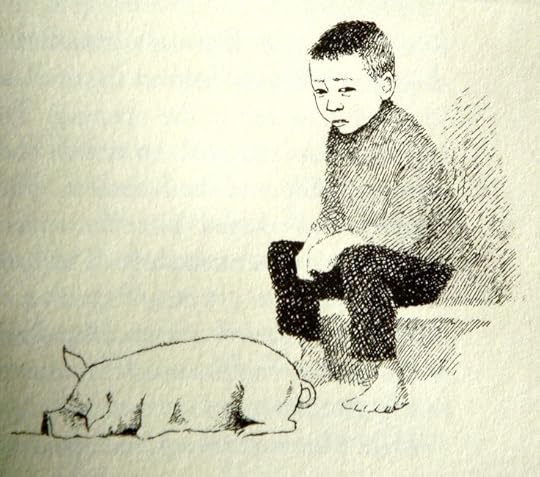
What brought me to this book is the fact that Maurice Sendak drew the illustrations. Those were very interesting to see because there were elements of his unique style, however all of the picture were done in crosshatch which I had never seen him do.
I rarely read war novels, but I found this one to be very solid. It did not gloss over some of the harder things that refugees face in war time and it also dealt heavily with the emotional turmoil that a child separated from his parents would face.
I rarely read war novels, but I found this one to be very solid. It did not gloss over some of the harder things that refugees face in war time and it also dealt heavily with the emotional turmoil that a child separated from his parents would face.
May 15, 2020
I read this a thousand times as a little girl, I would read it again now... Such a good book
Read
November 2, 2020Since we are studying China right now and my kids loved The Wheel on the School, I checked this out from the library. It's a little old for them yet (my oldest is 8). The plot is a bit intense. But it is a good book!
March 31, 2023
3,75 ✨
March 14, 2024
Exellent book!!!!!

July 13, 2025
The first half was very slow, the second half had better action and pacing.

Want to Read
July 1, 2021Available to borrow via archive.org:
https://archive.org/details/houseofsi...
https://archive.org/details/houseofsi...

July 7, 2024
After a reading slump of more than a few months, this book has helped me get out of being stuck. This middle-grader read is such a page-turner that I had a hard time putting it down. I wanted to savor it longer being such a good read and my first time reading Meindert DeJong's riveting writing but I had trouble letting go of it. I would be in the lookout for more of his books going forth.

January 7, 2017
this book had a very good plot full with tones of great things. so first off Tien Pao was on a boat with his family trying to escape the Japanese but wile his parents are out a heard of buffalo come and push the ship out of the harbor he falls asleep and doesn't realize that he is being pushed down the river from whence his family had recently came. He awakened up in deep fog and was petrified that he was so alone he only had one thing a pig Gònghéguó de róngyào(glory of the republic). he and his pig met a kind American pilot and even though they could not use words they found a way to communicate. so all three of them so journeyed back to where his family was along the way they met a group of men who were fighting off the Japanese and were more than willing to help Tien Pao find his mother, father, and baby sister. Tien Pao and the American Pilot were separated, but Tien Pao went on he soon got back to the village where his family was but the Japanese were overtaking it. Tien Pao was petrified that he would never see his family again but he did not give up he searched and found no one that would be of use he was crazed up the boats were all gone from the harbor and he felt alone once again, other than his pig of course. then a crazy old lady came and brought Tien Pao to the train station but it was so crowded it was solid of people. soon the train started and he was so happy to get out of the burning village behind but they left a cart behind and people were in it so they went back got the cart and then they left but Tien Pao fell out of the train and he and his pig would have to journey alone once again. He and his pig found the American forces and when they took him in he was overjoyed.soon though he remembered his family and the possibility that they escaped. so he got a supersize by the Americans they let him see the American pilot. so the American pilot flew him around to see if he was able to see his parents form the sky soon evening overcame the sky and it was almost dark but he was still alert as ever. Soon at a near by air field he spotted his mother so they flew down to see if it was really her. he was over joyed to see that it was she called down to her husband and the whole family got reunited once again.
there can be a great lesson to be leaned form this book such as people should be willing to let others help them. one example is when his gets washed down the river the American pilot helps him get to the others to help him get back to his family. another example is when he is given rice from the others and he was starved he was humble enough to except there charity and there kind deeds. the last example that shows that people should be willing to except charity and help is when the Americans hired a doctor to come see him. Tien Pao was sketched over a little about a American seeing him, but he was willing to except that the Americans Just want the best for him. this is just one of the many things to be learned from this amazing book.
I really enjoyed reading this amazing novel and how deep it cuts in to your brain this is not a book to be brushed off your shoulders but one to be pondered on to really get the full potently of it this book is easily a five star it has great lessons and shows the good in people. It also shows that words aren't the only way to show your gratitude to someone this book has tones of things that will help better peoples understanding of Chines culture. I feel as if this book can show that war can challenge the love of a family but can never win if they have a true love for each other.
there can be a great lesson to be leaned form this book such as people should be willing to let others help them. one example is when his gets washed down the river the American pilot helps him get to the others to help him get back to his family. another example is when he is given rice from the others and he was starved he was humble enough to except there charity and there kind deeds. the last example that shows that people should be willing to except charity and help is when the Americans hired a doctor to come see him. Tien Pao was sketched over a little about a American seeing him, but he was willing to except that the Americans Just want the best for him. this is just one of the many things to be learned from this amazing book.
I really enjoyed reading this amazing novel and how deep it cuts in to your brain this is not a book to be brushed off your shoulders but one to be pondered on to really get the full potently of it this book is easily a five star it has great lessons and shows the good in people. It also shows that words aren't the only way to show your gratitude to someone this book has tones of things that will help better peoples understanding of Chines culture. I feel as if this book can show that war can challenge the love of a family but can never win if they have a true love for each other.

June 28, 2017
All I remembered about this book from 5th grade was that I liked it and that it had a visceral scene of a starving kid eating a bowl of rice. Upon rereading, I found out that my memory served me well. I like this book. And there is a descriptive scene with a starving boy eating a bowl of rice.
Because I forgot the plot once, it is likely I’ll forget again, so I’ll jot down a couple particulars. The action starts immediately as Tien Pao and his family escape the horrors of the Japanese offensive during World War II and make their way up river. While they find some relative safety in a town upstream, Tien Pao is soon separated from his family after drifting down past enemy lines. His only companions: the family pig and some ducklings. From there, Tien Pao works his way back towards where his family is, running into--and helping--a downed American pilot in the process.
While I just mentioned the war and America, the book is far more subtle than that. This is a Chinese boy’s view (not literally, it’s still 3rd person), and all we know is that the Japanese are advancing against this boy and his family’s home, and there are yellow-haired, white-skinned soldiers helping the Chinese. That is part of the beauty and strength of this novel: it does not feel as if it is a history lesson, agenda-driven work. It is simply about survival and finding family. Especially nowadays, where thematically-heavy-laden stories about World War II practically have their own shelf in bookstores, this simple but exciting and ultimately powerful story demonstrates how something like this should be done (not to mention that it takes place in that so easily forgotten Pacific Theater of the war).
Because if you want to dig into meaning, I believe it is there. I believe that it has been carefully, even shrewdly, layered into this story … though not at the expense of the story itself. Tien Pao’s renaming of his pig, Glory-of-the-Republic, and his efforts to try to rescue the pig against the starving people who would thoughtlessly devour it, feels like a strong correlation to China’s status as a Republic. Perhaps my favorite connection is the nuance between Tien Pao and the Americans. The Americans are undoubtedly the heroes in this part. That is something most fashionable historians or scholars would shy away from nowadays: the hero narrative is far too self-congratulatory and does not turn heads on lectures, books, or reviewed articles. Yet, to those Chinese people in that situation, the Americans were clearly selfless heroes, as The House of Sixty Fathers so deftly shows. At the same time, I love how, as heroic and well-meaning as the Americans are, they just don’t get Tien Pao or his situation, and what they think is best for him ends up not always being what is best for him. In my mind, this is a strong endorsement of the United States’s actions in fighting with China, but a coy rebuttal against any budding imperialistic tendencies afterwards.
All of that is me digging way into a very simple, enjoyable, exciting, and powerful story--maybe what I saw is really there, maybe it isn’t. But the important thing is that it’s a great story, worthy of its Newbery Honor status, without regards to whether the words intended a deeper meaning or not. Because, as the final line of the story says, “The heart understands without words”... and if this story has anything, it is heart.
Because I forgot the plot once, it is likely I’ll forget again, so I’ll jot down a couple particulars. The action starts immediately as Tien Pao and his family escape the horrors of the Japanese offensive during World War II and make their way up river. While they find some relative safety in a town upstream, Tien Pao is soon separated from his family after drifting down past enemy lines. His only companions: the family pig and some ducklings. From there, Tien Pao works his way back towards where his family is, running into--and helping--a downed American pilot in the process.
While I just mentioned the war and America, the book is far more subtle than that. This is a Chinese boy’s view (not literally, it’s still 3rd person), and all we know is that the Japanese are advancing against this boy and his family’s home, and there are yellow-haired, white-skinned soldiers helping the Chinese. That is part of the beauty and strength of this novel: it does not feel as if it is a history lesson, agenda-driven work. It is simply about survival and finding family. Especially nowadays, where thematically-heavy-laden stories about World War II practically have their own shelf in bookstores, this simple but exciting and ultimately powerful story demonstrates how something like this should be done (not to mention that it takes place in that so easily forgotten Pacific Theater of the war).
Because if you want to dig into meaning, I believe it is there. I believe that it has been carefully, even shrewdly, layered into this story … though not at the expense of the story itself. Tien Pao’s renaming of his pig, Glory-of-the-Republic, and his efforts to try to rescue the pig against the starving people who would thoughtlessly devour it, feels like a strong correlation to China’s status as a Republic. Perhaps my favorite connection is the nuance between Tien Pao and the Americans. The Americans are undoubtedly the heroes in this part. That is something most fashionable historians or scholars would shy away from nowadays: the hero narrative is far too self-congratulatory and does not turn heads on lectures, books, or reviewed articles. Yet, to those Chinese people in that situation, the Americans were clearly selfless heroes, as The House of Sixty Fathers so deftly shows. At the same time, I love how, as heroic and well-meaning as the Americans are, they just don’t get Tien Pao or his situation, and what they think is best for him ends up not always being what is best for him. In my mind, this is a strong endorsement of the United States’s actions in fighting with China, but a coy rebuttal against any budding imperialistic tendencies afterwards.
All of that is me digging way into a very simple, enjoyable, exciting, and powerful story--maybe what I saw is really there, maybe it isn’t. But the important thing is that it’s a great story, worthy of its Newbery Honor status, without regards to whether the words intended a deeper meaning or not. Because, as the final line of the story says, “The heart understands without words”... and if this story has anything, it is heart.
Displaying 1 - 30 of 225 reviews