

What do you think?

The Age of Wood: Our Most Useful Material and the Construction of Civilization
A groundbreaking examination of the role that wood and trees have played in our global ecosystem—including human evolution and the rise and fall of empires—in the bestselling tradition of Yuval Harari’s Sapiens and Mark Kurlansky’s Salt.
As the dominant species on Earth, humans have made astonishing progress since our ancestors came down from the trees. But how did the descendants of small primates manage to walk upright, become top predators, and populate the world? How were humans able to develop civilizations and produce a globalized economy? Now, in The Age of Wood, Roland Ennos shows for the first time that the key to our success has been our relationship with wood.
Brilliantly synthesizing recent research with existing knowledge in fields as wide-ranging as primatology, anthropology, archaeology, history, architecture, engineering, and carpentry, Ennos reinterprets human history and shows how our ability to exploit wood’s unique properties has profoundly shaped our bodies and minds, societies, and lives. He takes us on a sweeping ten-million-year journey from Southeast Asia and West Africa where great apes swing among the trees, build nests, and fashion tools; to East Africa where hunter gatherers collected their food; to the structural design of wooden temples in China and Japan; and to Northern England, where archaeologists trace how coal enabled humans to build an industrial world. Addressing the effects of industrialization—including the use of fossil fuels and other energy-intensive materials to replace timber—The Age of Wood not only shows the essential role that trees play in the history and evolution of human existence, but also argues that for the benefit of our planet we must return to more traditional ways of growing, using, and understanding trees.
A winning blend of history and science, this is a fascinating and authoritative work for anyone interested in nature, the environment, and the making of the world as we know it.
As the dominant species on Earth, humans have made astonishing progress since our ancestors came down from the trees. But how did the descendants of small primates manage to walk upright, become top predators, and populate the world? How were humans able to develop civilizations and produce a globalized economy? Now, in The Age of Wood, Roland Ennos shows for the first time that the key to our success has been our relationship with wood.
Brilliantly synthesizing recent research with existing knowledge in fields as wide-ranging as primatology, anthropology, archaeology, history, architecture, engineering, and carpentry, Ennos reinterprets human history and shows how our ability to exploit wood’s unique properties has profoundly shaped our bodies and minds, societies, and lives. He takes us on a sweeping ten-million-year journey from Southeast Asia and West Africa where great apes swing among the trees, build nests, and fashion tools; to East Africa where hunter gatherers collected their food; to the structural design of wooden temples in China and Japan; and to Northern England, where archaeologists trace how coal enabled humans to build an industrial world. Addressing the effects of industrialization—including the use of fossil fuels and other energy-intensive materials to replace timber—The Age of Wood not only shows the essential role that trees play in the history and evolution of human existence, but also argues that for the benefit of our planet we must return to more traditional ways of growing, using, and understanding trees.
A winning blend of history and science, this is a fascinating and authoritative work for anyone interested in nature, the environment, and the making of the world as we know it.
336 pages, Hardcover
First published December 1, 2020
Ratings & Reviews
Friends & Following
Create a free account to discover what your friends think of this book!
Community Reviews
Displaying 1 - 30 of 232 reviews

February 15, 2021
A fascinating look at the history of tools and materials
Well okay, this is not for everyone. Naturally, it reminded me of John Harrison's ingenious wooden gears from Longitude: The True Story of a Lone Genius Who Solved the Greatest Scientific Problem of His Time.
The section with the orangutans is worth a star.
*************************************
Reviews:
https://www.washingtonpost.com/outloo...
https://www.kirkusreviews.com/book-re...
https://www.wsj.com/articles/the-age-...
*************************************
Generously provided by

Well okay, this is not for everyone. Naturally, it reminded me of John Harrison's ingenious wooden gears from Longitude: The True Story of a Lone Genius Who Solved the Greatest Scientific Problem of His Time.
The section with the orangutans is worth a star.
*************************************
Reviews:
https://www.washingtonpost.com/outloo...
https://www.kirkusreviews.com/book-re...
https://www.wsj.com/articles/the-age-...
*************************************
Generously provided by

December 19, 2020
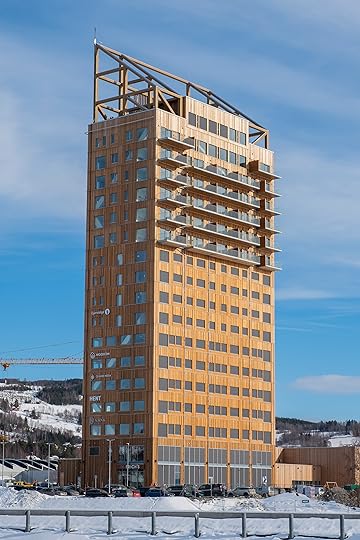
(Mjøstårnet -- the world's tallest timber skyscraper in Brumunddal, Norway. It was completed in March 2019 and is 85.4 meters (280 ft) high.)
I think it's safe to say everyone knows wood has been very important to humans throughout our history. I didn't realise just how important though, and crucial to both our existence and our civlization in many ways.
In The Age of Wood, author Roland Ennos takes us on a journey exploring the connection between humans and trees. From our ancestors who lived in them, to the ancestors who gradually moved to the ground and used wood for simple tools, from the Vikings with their elaborately carved wooden ships, to modern-day skyscrapers being built of wood, Mr. Ennos explores the myriad ways we humans use wood and trees.
Unfortunately, I mainly listened to this book, meaning I didn't retain much and thus my review will not be full of facts or a thorough discussion of the book. My extreme dry eyes are gradually improving and so I was able to read some of this -- but listened to more than I read. Thanks to Amazon's brilliant text-to-speech feature on my Kindle, I was able to read a paragraph here and there as my eyes allowed, and have the Kindle read to me as soon as I needed to stop, which was often.
I love that feature! "Salli" with her Yankee accent is a terrific reader, as is "Brian the British narrator". It's fun to switch back and forth.... don't ask me why! Maybe it's because these are computer-generated voices, not professional narration, and so I had to find other ways to be entertained than by the narrator's ability to read well and with inflection, emotion, etc? I don't know.
What I do know though is that "Nicole the Aussie narrator" is creepy. The gravelly depth of her voice evoked an image of an exceptionally large, hirsute woman, saliva dripping from the shaggy hairs on her chin as she wields an ax over some hapless...... tree.
Back to the book, I found most of it vastly interesting. However, my interest waned once we got to the Industrial Age and talk turned to using wood for fires to make cast and wrought iron, and how exactly those are made. It did pick back up when the author discussed modern ways of working with wood to build wooden skyscrapers and apartment buildings that are more fireproof than steel skyscrapers. The glulam and CFL they're constructed of "are up to five times lighter than ones made of conventional reinforced concrete. Pretty amazing!
I will probably re-read this when my eyes return to normal-dry versus Saharra-Desert-dry. And if I do, I'm sure I'll have lots of fun facts to share with you to entice you to read the book. I will leave you with one that I retained from my listening:
"Humans are the only one of the 193 species of monkeys and apes to have its own species of flea".
How special it is to be human!

May 22, 2021
He starts by pointing out that there is a Stone Age, Bronze Age, & Iron Age, but no Wood Age which is ridiculous. I really enjoyed the tour of the importance of wood to our cousins (orangutans making nests & primitive tools) & he ends the book with how important it is today complete with some interesting data on forest use & climate change. That wasn't as obvious as I'd thought. There's a lot of misinformation in the common narrative today both historically & current.
I also really liked his points about how much even a little bit of woodworking can teach us, something I've long been a proponent for. I taught a 14 year old woodworking last summer & it was an amazing experience. Even though I've been a woodworker for 50 years, I had no idea just how many disciplines & sciences simple projects encompassed until I had to break it down for him. The old saw about the teacher learning with the student is true.
He recommends taking kids to outdoor museums which I also encourage. I always get a lot more out of them & so have my kids. He's never been to Colonial Williamsburg, but says he's been told it is great. It is. My wife & I spent a long weekend there & it was amazing. There is the Eric Sloane museum in NY, various Shaker Villages, & many other Colonial museums dotted around the US. We used to live near the Steppingstone Museum, a restored working farm in Aberdeen, MD. We live near a Shaker Village now. It's a 3000 acre farm, so we go there to horseback ride the trails more often than we visit the village. That's a great place to spend time with visiting relatives. I've been to a handful of others both with & without my kids. I always found we got far more out of them than the indoor sort, but then we live on a farm. Comparing old & new methods is informative. Some things haven't changed much at all while others are far different.
His explanations of wood, both its strengths & limitations, were of great interest even though I knew most of it. He didn't get too in depth, so it should be appreciable by anyone. The history of woodworking & availability of trees was also well done. He may have stretched a few points occasionally, but nations really have risen & fallen on wood. In many ways, wood has been both wealth & power.
This was a 5 star read up until about 1820 & became one again after that, but I'm taking a star off the book for skipping the invention of the circular saw. He describes splitting, manual pit sawing, & the change to mechanizing it very well. Then he jumps to US balloon framing which was, as he acknowledges, only made possible by a leap in the speed & accuracy of sawing. How did that leap get made? He never says, but it was the invention of the circular saw. No one knows for sure, but it was thought to be invented in England sometime early in the 1800s & was brought to the US by the Shakers about 1820, IIRC. I don't know how or why he could have skipped this. It just seems so unlikely. Could it have been inadvertently left out of the audiobook?
He's from the UK & I appreciated the point of view which varies a bit from most I've read, especially in the species of trees & their names. For instance, what we call basswood is what the English commonly call a lime tree. (I think their lime is a little tougher than basswood, slightly different species, just as there are some differences in our walnuts. Fairly close, though.) In most ways his narrative is broader since he's quite familiar with Europe as well. His knowledge of the US is not profound, but was adequate for most. I could have added quite a bit, but I'm a wood nerd.
He mentioned copiccing more than most & said that most ash handles were made that way. That varies from what I've read in other books such as The Man Who Made Things Out of Trees: The Ash in Human Culture and History where clear trunks were all the rage. He also contends it was the best way to get firewood before the introduction of wood stoves. Interesting & that explains some early US government publications on the economics of farming that I've read which recommend coppicing as a money maker. It's less common now, but we used to be able to get chestnut that way since sprouts would still grow from their old stumps until they hit puberty at about 14 years old, same as Ash. (The few ash trees on my farm that escaped the Emerald ash borer were all prepubic when that invasive bug came through. Several are now reproducing. The one next to my house is usually mixed sex, so I have a lot of ash sprouts in my gardens.)
The book was very well narrated & definitely recommended. I'm sure it will have a lot of new material for most.
Nature published an article about a new archeological find that shows woodworking may have started about 1/2 million years ago!
https://www.nature.com/articles/d4158...
I also really liked his points about how much even a little bit of woodworking can teach us, something I've long been a proponent for. I taught a 14 year old woodworking last summer & it was an amazing experience. Even though I've been a woodworker for 50 years, I had no idea just how many disciplines & sciences simple projects encompassed until I had to break it down for him. The old saw about the teacher learning with the student is true.
He recommends taking kids to outdoor museums which I also encourage. I always get a lot more out of them & so have my kids. He's never been to Colonial Williamsburg, but says he's been told it is great. It is. My wife & I spent a long weekend there & it was amazing. There is the Eric Sloane museum in NY, various Shaker Villages, & many other Colonial museums dotted around the US. We used to live near the Steppingstone Museum, a restored working farm in Aberdeen, MD. We live near a Shaker Village now. It's a 3000 acre farm, so we go there to horseback ride the trails more often than we visit the village. That's a great place to spend time with visiting relatives. I've been to a handful of others both with & without my kids. I always found we got far more out of them than the indoor sort, but then we live on a farm. Comparing old & new methods is informative. Some things haven't changed much at all while others are far different.
His explanations of wood, both its strengths & limitations, were of great interest even though I knew most of it. He didn't get too in depth, so it should be appreciable by anyone. The history of woodworking & availability of trees was also well done. He may have stretched a few points occasionally, but nations really have risen & fallen on wood. In many ways, wood has been both wealth & power.
This was a 5 star read up until about 1820 & became one again after that, but I'm taking a star off the book for skipping the invention of the circular saw. He describes splitting, manual pit sawing, & the change to mechanizing it very well. Then he jumps to US balloon framing which was, as he acknowledges, only made possible by a leap in the speed & accuracy of sawing. How did that leap get made? He never says, but it was the invention of the circular saw. No one knows for sure, but it was thought to be invented in England sometime early in the 1800s & was brought to the US by the Shakers about 1820, IIRC. I don't know how or why he could have skipped this. It just seems so unlikely. Could it have been inadvertently left out of the audiobook?
He's from the UK & I appreciated the point of view which varies a bit from most I've read, especially in the species of trees & their names. For instance, what we call basswood is what the English commonly call a lime tree. (I think their lime is a little tougher than basswood, slightly different species, just as there are some differences in our walnuts. Fairly close, though.) In most ways his narrative is broader since he's quite familiar with Europe as well. His knowledge of the US is not profound, but was adequate for most. I could have added quite a bit, but I'm a wood nerd.
He mentioned copiccing more than most & said that most ash handles were made that way. That varies from what I've read in other books such as The Man Who Made Things Out of Trees: The Ash in Human Culture and History where clear trunks were all the rage. He also contends it was the best way to get firewood before the introduction of wood stoves. Interesting & that explains some early US government publications on the economics of farming that I've read which recommend coppicing as a money maker. It's less common now, but we used to be able to get chestnut that way since sprouts would still grow from their old stumps until they hit puberty at about 14 years old, same as Ash. (The few ash trees on my farm that escaped the Emerald ash borer were all prepubic when that invasive bug came through. Several are now reproducing. The one next to my house is usually mixed sex, so I have a lot of ash sprouts in my gardens.)
The book was very well narrated & definitely recommended. I'm sure it will have a lot of new material for most.
Nature published an article about a new archeological find that shows woodworking may have started about 1/2 million years ago!
https://www.nature.com/articles/d4158...

August 22, 2021
This book probably deserves 4 stars, but I'm giving it 3.
When I started this book, I was expecting something more along the lines of Cod: A Biography of the Fish that Changed the World or any of a number of book by MarkK Kurlansky.
Kurlansky provides fun anecdotal stories about common items and the role those items play in world history. They are often fun or even irreverent. There is a touch of humor or irony within the book.
Ennos book is neither irrevereant or ironic.
The book presents the role that wood played in global history. Often times, the ideas presented were based upon his (or his doctoral students) studies on the subject of wood.
Ennos is an academic and a scientist. Kurlansky is a historian and a story teller.
This does not make one appraoch better or worse than the other, but it does affect how you appraoch the books.
When I first started reading this book (expecting something ala Kurlanky) I was disappointed. By the time I finished the book, I was able to really appreciate Ennos approach.
In all honesty, the book deserves more than 3 start. If I had approached it knowing what it was, I probably would have enjoyed it more. Instead, I have to give it 3 stars.
Definitely worth reading.
When I started this book, I was expecting something more along the lines of Cod: A Biography of the Fish that Changed the World or any of a number of book by MarkK Kurlansky.
Kurlansky provides fun anecdotal stories about common items and the role those items play in world history. They are often fun or even irreverent. There is a touch of humor or irony within the book.
Ennos book is neither irrevereant or ironic.
The book presents the role that wood played in global history. Often times, the ideas presented were based upon his (or his doctoral students) studies on the subject of wood.
Ennos is an academic and a scientist. Kurlansky is a historian and a story teller.
This does not make one appraoch better or worse than the other, but it does affect how you appraoch the books.
When I first started reading this book (expecting something ala Kurlanky) I was disappointed. By the time I finished the book, I was able to really appreciate Ennos approach.
In all honesty, the book deserves more than 3 start. If I had approached it knowing what it was, I probably would have enjoyed it more. Instead, I have to give it 3 stars.
Definitely worth reading.

September 28, 2020
Maybe I overestimated my interest in wood? No, I don’t think so. I mean, obviously I’m not as passionate about the subject as the author, I love very few things as much as he loves wood, but nevertheless I was completely committed to learning all about it. Plus I like object histories or whatever you call it when history is framed and told from a specific perspective involving a specific thing. Usually those are some of my favorite historical nonfiction reads. This one, though, didn’t quite work for me. Disappointing, really, especially since I’m the first person reviewing this book, ideally this ought to have been a more encouraging review. I mean, objectively, this was very, very informative. I learned a lot about wood. Significance of wood throughout history often gets underestimated, after all for as practical as it has been throughout the centuries, there’s never been a wood age the way there’s been a stone age, bronze age, iron age, etc. Metals in general are huge in age classifications. Wood got kinda shafted by history, if you think about, though first weapons, fires, abodes, etc. were all built with wood. Books were printed with it. All major major things, crucial to developing of civilization as we know it. So the author decided to set the thing to rights and make an Age of Wood, the book. Admirable, for sure. But also in forest lingo, dense, very dense, and in plain lingo…pretty textbooky. Tons of information and the author’s passion and erudition for the subject very transparent and drives the book diligently, but it doesn’t really engage as a narrative. Great facts on deforestation, different types of trees, clever historical observations, even a fascinating original theory on the Rapa Nui people, whose fate has long been blamed on unsound tree harvesting practices. All the good things. But as a reading experience the book was something of an effort to get through, which it absolutely shouldn’t have been given the great concept and the relatively short page count. It certainly tried my mental vigor and academic discipline. I’m glad to have learned new things, as always. Just wish it was a more enjoyable experience, ideally as enjoyable as it was informative. I don’t mean to discourage readership of this book, just maybe prepare the readers going in. This was a major publisher book that read more like a university press one. So now that you know, proceed at will, arboreal delights await. Thanks Netgalley.

August 21, 2021
This is a non-fic about the role of wood and trees for our evolution, pre-history, history, present and future. It is well-written with a lot of info with sources in academic research. I read it as a Buddy Read for August 2021 at Non Fiction Book Club group.
This book is dense with information, ideas and theories. It looks at the usage of wood from our hominid ancestor (the famous Australopithecus Lucy dated 3.2 mn years ago, who died falling from a tree) to present-day creation of strong transparent wood glass. As I noted at the beginning it can be split into evolution, pre-history, history, present and future. Now some nitpicks from each part.
evolution
Self-awareness may be a result of size (and weight) with the great apes heavier than monkeys, so they have much greater difficulty moving around the canopy of trees, and in particular moving between trees, than a small one, so they have to account for own mass as they move.
Our bipedalism maybe developed from walking on branches, not ground: a study of Sumatran orangutans showed that they move quite differently when they travel along branches of different diameter. In contrast, on branches less than 4 centimeters (1.6 inches) in diameter, they either clamber, holding their body horizontal and gripping several branches, or walk upright on their hind legs while holding on to branches above them with their hands, distributing their weight between several branches, making their locomotion much safer.
As Africa became more arid, diet of hominids moved from fruits to roots and to dig-up roots wooden sticks were used – early tool.
Our soft fingertips instead of claws like squirrels use, allow to spread area of contact, giving better grip
pre-history
We talk about age of stone/bronze/iron, but the main material was wood. Alas, it mostly hasn’t survived being bio-degradable. Stone axes are to drop wood, to make wooden structures, to get fire from wood. The stone is brittle. It makes the material weak in tension, since small surface cracks can readily run through the whole stone; rods of stone, just like sticks of blackboard chalk, are easily snapped. Stone knives therefore need to be short and thick to prevent their blades from being loaded in tension, and even if a stone spear could be fashioned, it would be far too delicate to use; it would fall apart at its first throw. In contrast, wood has evolved in trees to be strong in both compression and tension, and extremely tough along the grain, which is why tree trunks and branches are so good at resisting bending.
Both bronze melting and pottery need high temperatures, higher than wood can provide. So wood coal or charcoal was made.
Cooking was a crucial step in the evolution of modern humans, it affects both mechanical properties, and on their chemistry of food. In meat, the most important structural material is collagen, a long-chain protein, whose ropelike molecules are joined together into sheets that provide a framework for the muscle cells they surround. Heating meat breaks up the collagen molecules and therefore weakens the sheets. Cooking also softens plant material; heat breaks down the pectin that sticks the cell walls together and weakens the hemicelluloses that hold the cellulose fibers in the cell walls.
history
Most stone buildings had hidden wooden supports within walls.
Chinese buildings have traditionally been regarded by Western engineers as fairly primitive structures, since they do not incorporate the trusses that Western architects use to support the roofs of their buildings. All the beams in a Chinese building are at right angles to each other, the pillars at the front and back of the building simply support a large horizontal beam. This supports a shorter beam above, and in turn this supports a still shorter beam. The heavy roof is supported via brackets at the ends of each of the beams. This design means that the beams are all loaded in bending and have to be thick and heavy to withstand the weight of the roof. Research shows that the flexible design of the buildings and the shock-absorbing dougong joints protect them from earthquake damage. Tests on models have shown that these buildings can withstand shocks that reach over 10 on the Richter scale, more powerful than any earthquake yet recorded. Paradoxically, therefore, apparently ephemeral and primitive wooden buildings can survive where stone ones are destroyed.
Unlike in Europe, where the railways were built with iron and stone, Americans built their railroads for the most part with timber. They mounted the rails on wooden sleepers, while they built wooden railway carriages whose timber frames were joined together using iron rods and bolts. They even experimented with wooden rails. Logging trains were often run along pole roads—essentially just logs laid parallel on the ground—staying on the track by using wheels with cup-shaped rims like huge pulleys. The temporary tracks cost only $75–$250 per mile, though they soon rotted away. And early mainlines were often built with strap rails, thin strips of wrought iron pinned to a wooden rail. The result was an exceptionally cheap railway—American railroads typically cost $20,000–$30,000 per mile, less than a sixth of the $180,000 a typical European railway cost. It was this, more than any other factor that enabled the Americans to build their long-distance railroads so early, from the mid-1830s onward.
present
Now we moved away from wood to iron and cement in buildings and to plastic in small tools.
There are changes to wood that make it tough as steel. The new skyscrapers and apartment buildings constructed from glulam and CFL are up to five times lighter than ones made of conventional reinforced concrete. This means they use less energy to build and need shallower foundations, so that the amount of embodied energy they contain can be as low as 20 percent that in a normal building.
However, there are problems with this high-tech approach. For a start, none of these wood products are carbon neutral. Energy is needed to harvest, transport, and machine the wood, for instance. And the most energy-intensive step in all modern wood production is kiln drying.
future
Our estrangement from the practical worlds of forestry and carpentry and our resulting mechanical incompetence have impoverished our lives in several ways and made us more insecure and unhappy, as generally occurs whenever one of our relationships breaks down.
Those of us who live in cities are already benefiting from the many urban forestry initiatives that have sprung up around the world, and which are regreening these most artificial environments.
Urban foresters could also use portable sawmills to process the timber from larger street trees, providing the basis for further woodworking projects. Similar sorts of urban forestry initiatives have already been tried in Bangladesh, where city dwellers are paid to look after young teak trees that are planted in their neighborhood, with a final payment being made to them when the mature trees are harvested after around twenty years.
This book is dense with information, ideas and theories. It looks at the usage of wood from our hominid ancestor (the famous Australopithecus Lucy dated 3.2 mn years ago, who died falling from a tree) to present-day creation of strong transparent wood glass. As I noted at the beginning it can be split into evolution, pre-history, history, present and future. Now some nitpicks from each part.
evolution
Self-awareness may be a result of size (and weight) with the great apes heavier than monkeys, so they have much greater difficulty moving around the canopy of trees, and in particular moving between trees, than a small one, so they have to account for own mass as they move.
Our bipedalism maybe developed from walking on branches, not ground: a study of Sumatran orangutans showed that they move quite differently when they travel along branches of different diameter. In contrast, on branches less than 4 centimeters (1.6 inches) in diameter, they either clamber, holding their body horizontal and gripping several branches, or walk upright on their hind legs while holding on to branches above them with their hands, distributing their weight between several branches, making their locomotion much safer.
As Africa became more arid, diet of hominids moved from fruits to roots and to dig-up roots wooden sticks were used – early tool.
Our soft fingertips instead of claws like squirrels use, allow to spread area of contact, giving better grip
pre-history
We talk about age of stone/bronze/iron, but the main material was wood. Alas, it mostly hasn’t survived being bio-degradable. Stone axes are to drop wood, to make wooden structures, to get fire from wood. The stone is brittle. It makes the material weak in tension, since small surface cracks can readily run through the whole stone; rods of stone, just like sticks of blackboard chalk, are easily snapped. Stone knives therefore need to be short and thick to prevent their blades from being loaded in tension, and even if a stone spear could be fashioned, it would be far too delicate to use; it would fall apart at its first throw. In contrast, wood has evolved in trees to be strong in both compression and tension, and extremely tough along the grain, which is why tree trunks and branches are so good at resisting bending.
Both bronze melting and pottery need high temperatures, higher than wood can provide. So wood coal or charcoal was made.
Cooking was a crucial step in the evolution of modern humans, it affects both mechanical properties, and on their chemistry of food. In meat, the most important structural material is collagen, a long-chain protein, whose ropelike molecules are joined together into sheets that provide a framework for the muscle cells they surround. Heating meat breaks up the collagen molecules and therefore weakens the sheets. Cooking also softens plant material; heat breaks down the pectin that sticks the cell walls together and weakens the hemicelluloses that hold the cellulose fibers in the cell walls.
history
Most stone buildings had hidden wooden supports within walls.
Chinese buildings have traditionally been regarded by Western engineers as fairly primitive structures, since they do not incorporate the trusses that Western architects use to support the roofs of their buildings. All the beams in a Chinese building are at right angles to each other, the pillars at the front and back of the building simply support a large horizontal beam. This supports a shorter beam above, and in turn this supports a still shorter beam. The heavy roof is supported via brackets at the ends of each of the beams. This design means that the beams are all loaded in bending and have to be thick and heavy to withstand the weight of the roof. Research shows that the flexible design of the buildings and the shock-absorbing dougong joints protect them from earthquake damage. Tests on models have shown that these buildings can withstand shocks that reach over 10 on the Richter scale, more powerful than any earthquake yet recorded. Paradoxically, therefore, apparently ephemeral and primitive wooden buildings can survive where stone ones are destroyed.
Unlike in Europe, where the railways were built with iron and stone, Americans built their railroads for the most part with timber. They mounted the rails on wooden sleepers, while they built wooden railway carriages whose timber frames were joined together using iron rods and bolts. They even experimented with wooden rails. Logging trains were often run along pole roads—essentially just logs laid parallel on the ground—staying on the track by using wheels with cup-shaped rims like huge pulleys. The temporary tracks cost only $75–$250 per mile, though they soon rotted away. And early mainlines were often built with strap rails, thin strips of wrought iron pinned to a wooden rail. The result was an exceptionally cheap railway—American railroads typically cost $20,000–$30,000 per mile, less than a sixth of the $180,000 a typical European railway cost. It was this, more than any other factor that enabled the Americans to build their long-distance railroads so early, from the mid-1830s onward.
present
Now we moved away from wood to iron and cement in buildings and to plastic in small tools.
There are changes to wood that make it tough as steel. The new skyscrapers and apartment buildings constructed from glulam and CFL are up to five times lighter than ones made of conventional reinforced concrete. This means they use less energy to build and need shallower foundations, so that the amount of embodied energy they contain can be as low as 20 percent that in a normal building.
However, there are problems with this high-tech approach. For a start, none of these wood products are carbon neutral. Energy is needed to harvest, transport, and machine the wood, for instance. And the most energy-intensive step in all modern wood production is kiln drying.
future
Our estrangement from the practical worlds of forestry and carpentry and our resulting mechanical incompetence have impoverished our lives in several ways and made us more insecure and unhappy, as generally occurs whenever one of our relationships breaks down.
Those of us who live in cities are already benefiting from the many urban forestry initiatives that have sprung up around the world, and which are regreening these most artificial environments.
Urban foresters could also use portable sawmills to process the timber from larger street trees, providing the basis for further woodworking projects. Similar sorts of urban forestry initiatives have already been tried in Bangladesh, where city dwellers are paid to look after young teak trees that are planted in their neighborhood, with a final payment being made to them when the mature trees are harvested after around twenty years.
January 1, 2021
The strongest part of this book was the beginning. I really enjoyed the fist couple chapters and was happy that Ennos really did start at the beginning of time when discussing the uses of wood. For some reason, I was expecting this book to focus just on the history of wood, but there was quite a bit of science mixed in, which I liked.
The book slowly went downhill for me though. I think metals were focused on too much. I get that wood is used when melting metals down, but I didn’t need a lengthy discussion of everything that metal was then used for. And this discussion happens several times as Ennos moves through time and more metals are discovered.
The deforestation discussion was also really disappointing. The way that it’s written makes it seem like Ennos believes that deforestation is a myth. Which it is not. But really the only thing that Ennos discusses in relation to deforestation is soil erosion, but that is only one of many effects from deforestation.
While this book isn’t very long, just over 300 pages, I think most people will struggle to finish it. It’s not an exciting read, which I think is expected, but I think this really is written for a niche market.
Thanks to Scribner and Ennos for providing me a free ebook through NetGalley in exchange for an honest review!
The book slowly went downhill for me though. I think metals were focused on too much. I get that wood is used when melting metals down, but I didn’t need a lengthy discussion of everything that metal was then used for. And this discussion happens several times as Ennos moves through time and more metals are discovered.
The deforestation discussion was also really disappointing. The way that it’s written makes it seem like Ennos believes that deforestation is a myth. Which it is not. But really the only thing that Ennos discusses in relation to deforestation is soil erosion, but that is only one of many effects from deforestation.
While this book isn’t very long, just over 300 pages, I think most people will struggle to finish it. It’s not an exciting read, which I think is expected, but I think this really is written for a niche market.
Thanks to Scribner and Ennos for providing me a free ebook through NetGalley in exchange for an honest review!

February 17, 2025
Roland Ennos is an academic biomechanist (specializing in the study of movement and function of biological creatures) who's written several popular science books. 2020's The Age of Wood hits a sweet spot for me as a nonfiction reader, as it relates human evolution from a scientific perspective (specifically, the progression of human ancestors from full-time tree dwellers to ground dwellers) to a broader historical native using a common thread to guide the story -- in this case, trees. The book transitions nicely through focused chapters highlighting particular uses of trees -- as homes (in whole or in parts), as firewood, as raw materials from which humans have constructed large transport vessels, tools, weapons, paper, etc.
My statistics:
Book 56 for 2025
Book 1982 cumulatively
My statistics:
Book 56 for 2025
Book 1982 cumulatively

November 21, 2021
Aproximei-me deste livro por causa da capa, mas também porque sei o quão importante tem sido a madeira para a nossa história e evolução enquanto espécie. Desse modo, quando vi o comparativo com Sapiens de Harari, pensei que seria um livro que nos iria levar ao longo da história por meio de uma perspectiva centrada na madeira. Mas não. Apesar do autor aparentar tentar, não é isso que acontece. Temos um livro carregado de informação sobre madeira, a sua constituição, densidades, proveniências, etc. Tudo temas interessantes, mas para os quais não tenho qualquer bagagem que me permita entender o que vai sendo dito. A meio do livro comecei a desligar, e li o resto em diagonal.
Julgo que o problema é meu, e não do autor. Eu percebo demasiado pouco de madeira para poder chegar ao que o autor vai expondo. Desse modo, a leitura acabou a servir-me na análise de um tópico do meu trabalho, o engajamento.
O engajamento, ou envolvimento, só pode acontecer quando os artefactos, neste caso o livro, conseguem acionar em nós conhecimentos pré-existentes. A ligação entre o que os artefactos contam, e aquilo que já conhecemos, cria uma relação de ideias capaz de produzir novos significados na mente do leitor, captando assim a atenção, o interesse, acabando a produzir engajamento.
Julgo que o problema é meu, e não do autor. Eu percebo demasiado pouco de madeira para poder chegar ao que o autor vai expondo. Desse modo, a leitura acabou a servir-me na análise de um tópico do meu trabalho, o engajamento.
O engajamento, ou envolvimento, só pode acontecer quando os artefactos, neste caso o livro, conseguem acionar em nós conhecimentos pré-existentes. A ligação entre o que os artefactos contam, e aquilo que já conhecemos, cria uma relação de ideias capaz de produzir novos significados na mente do leitor, captando assim a atenção, o interesse, acabando a produzir engajamento.

August 10, 2022
Not sure what I was hoping for but this was not it

November 19, 2022
As others have noted, the title is somewhat misleading. I'm stalled at about halfway and may not go on.
The author is an academic and it shows. Another book I wanted to like more than I could, so far anyway, You may want to browse some of the lower-starred reviews to see what others think. Such as the one that opens "This book probably deserves 4 stars, but I'm giving it 3." And the next 3-star: "Maybe I overestimated my interest in wood? No, I don’t think so." You get the idea. I haven't quite given up, but unless I get really hard up for reading matter, likely headed for DNF soon. Don't bother with the metal-working stuff if you know anything about that topic.
Your mileage may vary. Two usually-reliable of my GR friends both rated it 4 stars and wrote long, detailed reviews. So read Jim and Oleksandr Zholud's reviews too.
So it sat on the shelf at the half-way mark until it came due. Our library give us 5[!] auto-renewals unless someone else requests it. Obviously not a hot item. 2.5 stars for what I read, which was pretty good, but not compelling. Your mileage may vary! But I'm done with it.
The author is an academic and it shows. Another book I wanted to like more than I could, so far anyway, You may want to browse some of the lower-starred reviews to see what others think. Such as the one that opens "This book probably deserves 4 stars, but I'm giving it 3." And the next 3-star: "Maybe I overestimated my interest in wood? No, I don’t think so." You get the idea. I haven't quite given up, but unless I get really hard up for reading matter, likely headed for DNF soon. Don't bother with the metal-working stuff if you know anything about that topic.
Your mileage may vary. Two usually-reliable of my GR friends both rated it 4 stars and wrote long, detailed reviews. So read Jim and Oleksandr Zholud's reviews too.
So it sat on the shelf at the half-way mark until it came due. Our library give us 5[!] auto-renewals unless someone else requests it. Obviously not a hot item. 2.5 stars for what I read, which was pretty good, but not compelling. Your mileage may vary! But I'm done with it.

October 6, 2020
Mr. Ennos, I Read This Book On A Kindle. ;) This was a fascinating and at times novel look at how wood - not stone or metals - has allowed and even encouraged human biological and civilizational evolution. Written by a British academic-engineer, this book looks to the bioengineering of woods of various forms and how the material's strengths and versatilities have allowed so much human progress, from eras before homo sapien sapien appeared through the future of the species. While the text does have a couple of weaknesses - he assumes that the book will be read on paper and there is a distinct lack of bibliography, at least in this advanced review copy I read - overall the book really is an amazing look at an oft-overlooked feature of human history. Very much recommended.

August 9, 2021
This might as well be titled “The History of Humanity” as wood and trees have enabled us to be who we are. Wood is the Rodney Dangerfield of commodities. It gets no respect. Age of Wood is the Age of Man. We are a lignocentric people.
The author traces our movement from the trees to hunter gatherers and farmers while using wood for tools, shelter, heat, and weapons. Even when iron and bronze came into fashion they stimulated demand for wood and were used to make wood even more useful. During the Iron Age wood dominated people’s lives. Iron enabled us to do more with wood. Wooden barrels were the equivalent of today’s tin cans, plastic bottles, and shipping containers.
There’s an interesting discussion of wood imposing conservative values. Ancient knowledge was revered at the expense of growth and confidence in the present. Guilds stifled innovation and dissemination of information. Mistakes were repeated.
Lots of deforestation myths. There was no shortage of wood either. Wood distribution was the problem. Roads were limited. Rivers used to float wood. Why most of towns that grew were on rivers. Industry located in rural areas- that’s where the wood and minerals were. Coal changed things and the steam engine allowed industry to relocate away from rivers and rural areas.
Tree farming is a problem. Not natural. Monoculture. We’ve lost our attachment to the forest. Finland is the nation with the strongest forest culture. Trees have been with us since prehistory. When they are gone, we will be too.
The author traces our movement from the trees to hunter gatherers and farmers while using wood for tools, shelter, heat, and weapons. Even when iron and bronze came into fashion they stimulated demand for wood and were used to make wood even more useful. During the Iron Age wood dominated people’s lives. Iron enabled us to do more with wood. Wooden barrels were the equivalent of today’s tin cans, plastic bottles, and shipping containers.
There’s an interesting discussion of wood imposing conservative values. Ancient knowledge was revered at the expense of growth and confidence in the present. Guilds stifled innovation and dissemination of information. Mistakes were repeated.
Lots of deforestation myths. There was no shortage of wood either. Wood distribution was the problem. Roads were limited. Rivers used to float wood. Why most of towns that grew were on rivers. Industry located in rural areas- that’s where the wood and minerals were. Coal changed things and the steam engine allowed industry to relocate away from rivers and rural areas.
Tree farming is a problem. Not natural. Monoculture. We’ve lost our attachment to the forest. Finland is the nation with the strongest forest culture. Trees have been with us since prehistory. When they are gone, we will be too.

January 24, 2021
When I heard about The Age of Wood, I was excited and immediately placed a hold on the book at the library. I was expecting it to be like The World in a Grain: The Story of Sand and How It Transformed Civilization by Vince Beiser (an excellent book, by the way), but I was disappointed. The Age of Wood was just... not good. It was dull, and the author was too caught up in little details that are more suited to carpenters, architects, materials engineers, and the like, rather than for the general public who were hoping to read an overall history of wood and how it's played a role in construction and human civilization, as the title implied.
I am educated, and I have no difficulty reading books that delve into the science or technical details of the topic at hand. In fact, I am often frustrated when books don't go into enough detail. However, Roland Ennos overdid it with going into the nitty gritty details about the properties of wood and how it has affected architecture. I was often lost, and bored. While the last two parts of the books were a lot more interesting and engaging (Part 3: Wood in the Industrial Era and Part 4: Facing the Consequences), it wasn't enough for me to bump it up to three stars.
It also annoyed me how temperature in the book was cited in Fahrenheit. I get it -- the United States of America is the most important country in the whole world, but come on -- this was a pseudo-science book, and the scientific community uses the metric system. Come on 'Merica, even Burma uses Celsius!
This book was a chore to read, and I should have given up on it. I won't be reading any future books by Ennos, however, if Vince Beiser or Bill Bryson were to write a book about the history of wood or other materials, I will not hesitate to read it.
I am educated, and I have no difficulty reading books that delve into the science or technical details of the topic at hand. In fact, I am often frustrated when books don't go into enough detail. However, Roland Ennos overdid it with going into the nitty gritty details about the properties of wood and how it has affected architecture. I was often lost, and bored. While the last two parts of the books were a lot more interesting and engaging (Part 3: Wood in the Industrial Era and Part 4: Facing the Consequences), it wasn't enough for me to bump it up to three stars.
It also annoyed me how temperature in the book was cited in Fahrenheit. I get it -- the United States of America is the most important country in the whole world, but come on -- this was a pseudo-science book, and the scientific community uses the metric system. Come on 'Merica, even Burma uses Celsius!
This book was a chore to read, and I should have given up on it. I won't be reading any future books by Ennos, however, if Vince Beiser or Bill Bryson were to write a book about the history of wood or other materials, I will not hesitate to read it.

August 12, 2021
I listened to this on audio (Bookbeat service), but there's no audio option here. Anyway, I thought it would be interesting but it was actually so boring that it ended up being my "if I can't sleep audiobook", and it put me to sleep within like 10-15 minutes without fail even on the worst insomnia nights like no other book. Can't give it 2 stars though, because it helped me sleep effectively 😂😅

March 7, 2021
I'm a sucker for a single-item "history of" books. The best books of this nature, I've found, are those that are telling a *story* of the history versus those that are simply a history. Books like Salt (Mark Kulansky) or Longitude (Dava Sobel) are terrific examples of the narrative nonfiction that will pull the reader in to the world of the subject, riding along like a time traveler following a single strand of history.
There were instances where I felt that same tug from The Age of Wood, but unfortunately, I found them to be rare. The book is still quite interesting, chasing down the use of wood over the centuries and to the current day, assuming you're interested in a rather dry overall tone.
Those with an acute interest in wood, or people just looking to learn something on the subject will likely be more willing to get through an almost textbook-like reading than the casual reader, and it's worth it, in my opinion. It's relatively short, which brought to my mind the question of whether the storytelling was not enough to push it to a longer page count and more relaxed narrative, or whether the publisher or author decided about 300 pages was all they were willing to venture into the subject. Either way, the book suffers for it.
There are numerous discussions of things built with wood versus metal, and a somewhat questionable (to me) passage about Amazonian deforestation, and into the modern time period, quite a bit of page count given over to metal - not what I was here for.
Overall, it isn't terrible, but it isn't great, for a book about a resource indispensable to humans ancient and modern, which I'd think is a fascinating topic.
Three out of five stars.
Thanks to Scribner and NetGalley for the review copy.
There were instances where I felt that same tug from The Age of Wood, but unfortunately, I found them to be rare. The book is still quite interesting, chasing down the use of wood over the centuries and to the current day, assuming you're interested in a rather dry overall tone.
Those with an acute interest in wood, or people just looking to learn something on the subject will likely be more willing to get through an almost textbook-like reading than the casual reader, and it's worth it, in my opinion. It's relatively short, which brought to my mind the question of whether the storytelling was not enough to push it to a longer page count and more relaxed narrative, or whether the publisher or author decided about 300 pages was all they were willing to venture into the subject. Either way, the book suffers for it.
There are numerous discussions of things built with wood versus metal, and a somewhat questionable (to me) passage about Amazonian deforestation, and into the modern time period, quite a bit of page count given over to metal - not what I was here for.
Overall, it isn't terrible, but it isn't great, for a book about a resource indispensable to humans ancient and modern, which I'd think is a fascinating topic.
Three out of five stars.
Thanks to Scribner and NetGalley for the review copy.

September 1, 2025
The Scaffolding Beneath History.
Roland Ennos’s 2020 "The Age of Wood" offers a compelling reappraisal of a material overlooked in grand narratives of civilization. Where history tends to spotlight stone, bronze, and iron, Ennos argues persuasively that wood has been just as foundational—shaping human evolution, architecture, transportation, and even cognition. But because of its (relatively, in archaeological terms, transitory nature), we don't hear much of it.
The book’s strength lies in its interdisciplinary approach. Ennos draws from anthropology, (LOTS of) biomechanics, and environmental science to build a case for wood’s centrality, and he does so with clarity and conviction. His chapters on early human tool use, the development of wooden infrastructure, and the ecological implications of deforestation are especially engaging.
However, the book occasionally narrows its focus to the point of distraction. Extended passages on the mechanics of woodworking, how to split planks efficiently, the physics of different axes, the grain behavior of specific tree species, can feel overly granular. These sections, while technically impressive, risk sidelining the broader historical and cultural narrative.
Still, Ennos’s commitment to his subject is admirable. The Age of Wood is an enjoyable, brief, focused account that succeeds in elevating a material long taken for granted. It’s a valuable contribution to material history, even if its gaze sometimes lingers too long on the workbench.
Roland Ennos’s 2020 "The Age of Wood" offers a compelling reappraisal of a material overlooked in grand narratives of civilization. Where history tends to spotlight stone, bronze, and iron, Ennos argues persuasively that wood has been just as foundational—shaping human evolution, architecture, transportation, and even cognition. But because of its (relatively, in archaeological terms, transitory nature), we don't hear much of it.
The book’s strength lies in its interdisciplinary approach. Ennos draws from anthropology, (LOTS of) biomechanics, and environmental science to build a case for wood’s centrality, and he does so with clarity and conviction. His chapters on early human tool use, the development of wooden infrastructure, and the ecological implications of deforestation are especially engaging.
However, the book occasionally narrows its focus to the point of distraction. Extended passages on the mechanics of woodworking, how to split planks efficiently, the physics of different axes, the grain behavior of specific tree species, can feel overly granular. These sections, while technically impressive, risk sidelining the broader historical and cultural narrative.
Still, Ennos’s commitment to his subject is admirable. The Age of Wood is an enjoyable, brief, focused account that succeeds in elevating a material long taken for granted. It’s a valuable contribution to material history, even if its gaze sometimes lingers too long on the workbench.

March 18, 2022
"I liked it." - 3 out of 5 star rating.
A prologue that opens up like a wood love story, but then... it reads like the "Age of Primates" for seriously the first ~30% of the book. I was learning so much about monkeys, baboons, homo erectus, homo neanderthalensis, rolling into modern day homo sapiens... I really forgot I was reading a book about wood.
Honestly though, it was interesting and entertaining to read, even if I felt like it was a mismatch title scenario. It does start to slowly roll more into a wood focus nonfiction, with ship building, home construction, and a sincere focus on tools made of wood.
I've read some really awful books, and this is by far not one of them. It's slightly above average and I learned some things, so I can honestly say I would recommend it... just as a low priority when you're in the mood for something like this.
A prologue that opens up like a wood love story, but then... it reads like the "Age of Primates" for seriously the first ~30% of the book. I was learning so much about monkeys, baboons, homo erectus, homo neanderthalensis, rolling into modern day homo sapiens... I really forgot I was reading a book about wood.
Honestly though, it was interesting and entertaining to read, even if I felt like it was a mismatch title scenario. It does start to slowly roll more into a wood focus nonfiction, with ship building, home construction, and a sincere focus on tools made of wood.
I've read some really awful books, and this is by far not one of them. It's slightly above average and I learned some things, so I can honestly say I would recommend it... just as a low priority when you're in the mood for something like this.
October 3, 2021
Reading this was like listening to a story from my uncle Milo. There is so much irrelevant detail, the book was an absolute chore to read. The author’s style is way too academic for my tastes. I think this suffered from a lack of storytelling prowess that have made some other single-subject histories (looking at you, Longitude) much more compelling reads. There was much more general anthropology in this than I was expecting as well which left me feeling the author was really working hard to hit a page count. I will say, in all honesty, most people don’t love anything as much as this guys loves wood.

June 5, 2023
Although the amount of research that has gone into writing of this book, it reads more like an anthropological nature book with some chapter tagged on to the end to update the anthropological nature book. I wanted to know more, not just indications or hints of more. The work is shorter rather than longer, simplified rather than amplified. Overall this book reads as though an academician and his graduate students' work has been showcased and not amplified upon. . . . .Any suggestions for a better book on the topic of wood?
March 18, 2021
This book is utterly devoted to wood in a way I had not considered possible. I've seen it compared to Sapiens by Harari but I think a more apt comparison is the faux-educational film "A World Without Zinc" from the Simpsons (https://youtu.be/U1iCZpFMYd0). It's a charming book and the author's enthusiasm for the topic kept me engaged throughout.

December 16, 2020
Though informative, this book falls into the common popular-science trap of sacrificing nuance for argument's sake—it misses the trees for the forest.

March 10, 2021
If you’re asking yourself, “Do I care *that* much about wood?” you probably don’t.
I felt like I was being punked by this book.
I felt like I was being punked by this book.

July 18, 2025
This was a good book that I think needs a slightly different layout to really succeed. I got it on sale at one of my favorite bookstores (we love you, Brookline Booksmith) and it came as a standard-sized paperback. I was anticipating a broad survey of wood's use in human history, especially relating to large objects and structures, like ships and building. I realized while reading the book that Ennos has a more scholarly approach, with more technical writing than I anticipated and a focus on the relationship between wood's uses in society and the biological features which make it apt (or inapt) for those uses. While I still enjoyed the book and learned a lot, I think the approach needed a little refining for a book you'd pick off the bookstore shelf.
What Ennos addresses is, for the most part, very interesting. He begins with our ancestral origins, discussing how other Homo species and great apes interact with trees, and how the anatomical development of modern humans indicates an arboreal heritage. He moves through the development of wood structures and wood tools (a section I thought went a tad too long and specific) before describing the use of wood for burning, cooking, and smelting - a use which transformed wood's use and the shape of our world. These sections were especially interesting, blending Ennos' detailed understanding of the specific properties of wood's internal structures and his gift for describing broad technological and scientific changes. In general, I felt the less granular he got, the more interesting and fluid the pace felt. Though this emphasis on burning led to extensive sections about copper, coal, iron, and steel, it never felt unrelated to wood, and it was interesting enough to really carry the text.
The book also includes descriptions of advanced wood usage in the past few millennia, including shipbuilding, building construction, and a particularly impassioned section about aircraft. These sections were tons of fun to read and contained lots of interesting information, but many of his explanations required understandings of woodworking or carpentry that I didn't understand. Discussions of different types of wood joints and engineering strategies flew over my head without a clear understanding of the jargon. Here, I think some added description for novices like myself, or especially additional illustrations (the axe vs. adze illustration was very helpful earlier in the text) would help me understand what Ennos described throughout the text. A more extensive photo insert section could also work, or a QR code to a website with images. A glossary with illustrations would also be extremely useful. Each of these things may impact the book's format, which may have limited these opportunities, but ultimately I think it would improve the reading experience and my depth of understanding. (Stopping every paragraph to google wood terminology was not immersive).
The book concludes with an interesting section about the consequences of human interaction with wood, particularly in the modern context. Ennos' passion for the topic is even more strongly felt, even if the arguments are surprisingly local given the book's broad time period approach.
Overall, an interesting book I learned a lot from, but I wonder if it wouldn't be better with more illustrations or even as a television special, where different artifacts, concepts, and techniques can be visually depicted. Definitely worth the read. I would recommend it lightly to my friend Carter, who enjoys nature and history.
What Ennos addresses is, for the most part, very interesting. He begins with our ancestral origins, discussing how other Homo species and great apes interact with trees, and how the anatomical development of modern humans indicates an arboreal heritage. He moves through the development of wood structures and wood tools (a section I thought went a tad too long and specific) before describing the use of wood for burning, cooking, and smelting - a use which transformed wood's use and the shape of our world. These sections were especially interesting, blending Ennos' detailed understanding of the specific properties of wood's internal structures and his gift for describing broad technological and scientific changes. In general, I felt the less granular he got, the more interesting and fluid the pace felt. Though this emphasis on burning led to extensive sections about copper, coal, iron, and steel, it never felt unrelated to wood, and it was interesting enough to really carry the text.
The book also includes descriptions of advanced wood usage in the past few millennia, including shipbuilding, building construction, and a particularly impassioned section about aircraft. These sections were tons of fun to read and contained lots of interesting information, but many of his explanations required understandings of woodworking or carpentry that I didn't understand. Discussions of different types of wood joints and engineering strategies flew over my head without a clear understanding of the jargon. Here, I think some added description for novices like myself, or especially additional illustrations (the axe vs. adze illustration was very helpful earlier in the text) would help me understand what Ennos described throughout the text. A more extensive photo insert section could also work, or a QR code to a website with images. A glossary with illustrations would also be extremely useful. Each of these things may impact the book's format, which may have limited these opportunities, but ultimately I think it would improve the reading experience and my depth of understanding. (Stopping every paragraph to google wood terminology was not immersive).
The book concludes with an interesting section about the consequences of human interaction with wood, particularly in the modern context. Ennos' passion for the topic is even more strongly felt, even if the arguments are surprisingly local given the book's broad time period approach.
Overall, an interesting book I learned a lot from, but I wonder if it wouldn't be better with more illustrations or even as a television special, where different artifacts, concepts, and techniques can be visually depicted. Definitely worth the read. I would recommend it lightly to my friend Carter, who enjoys nature and history.

May 26, 2023
I don’t know who I’d recommend this book to… engineer, architect, a biomechanics. It’s very detailed and interesting or slow in parts depending on the reader’s interests.

August 28, 2021
The Age of Wood
Non-Fiction about humankind's history with wood and trees, 4 Stars
This could also be titled "The Engineer's Guide to Social Sciences" as there are a lot of mechanical and technical specs about wood that are presented within the story of human evolution and then the evolution of human society from roaming to farming to factories.
This is not a typical 'microhistory' like Paper: Paging Through History, Cod: A Biography of the Fish that Changed the World, or Uncommon Grounds: The History of Coffee and How It Transformed Our World but more of a look at how wood and trees have influenced human development or how developing humans have increasingly used wood. What is most fascinating is that even as we develop tech that seems to reduce our use of or reliance on trees the usage actually increases. For instance, burning coal allows us to live in larger cities that aren't dependent on nearby forests for wood to burn--but that just allows for more houses to be build and bigger buildings to be constructed to house the large populations and more wood to be needed for the other infrastructure like transportation.
Some of the discussions and a sort-of summary: Using sticks and branches as tools leads to manipulating them to be more useful and do more work. Cooking food is essential to our intelligence and strength. Sleep patterns of early humans were likely changed by wood. The separation of society kept the different trades from sharing between each other their undertanding of wood. The Enlightenment allowed philosophers, scientists and workers to begin a sort of hybrid collaboration to further mankind's understanding of wood. Industrialization brought about ways to move massive amounts of wood. Colonization reduced the world population right at the dawn of industrialization possibly off-setting some of the warming effects on the climate of burning fossil fuels. Trees are prolific and will overtake cleared land if allowed. As we attempt to return to wood-based 'natural' products we are using increasingly energy-heavy processes do develop them. Urbanites should embrace wood and trees because all evidence points to great health benefits from being in contact with nature.
I read this with the Non-Fiction Book Club and we had a good discussion here
"Surprisingly, we were preadapted to our life on the ground by the evolution of our relatives' bodies and brains to live in the canopy: in a world made of wood."
"...a stick twice as thick is sixteen times as rigid and eight times as strong."
There's a great description of what happens in a fire (page 34):
"The processes involved when dry wood burns are quite complex...cellwall material is chemically stable, even at temperatures above 212F...[at 300F] hemicellulolse molecules between the cellulose fibers cyrstallize, making them stiffer...at around 400F does heat start to break the wood down...pyroloysis, releases energey which for the first time starts to generate heat and drive the burning...400F-600F, these small molecules evaporate, and some gases escape...along with some carbon...and are released as smoke. Finally when the breakdown of the cell wall has been completed, only carbon is left; the wood has been transformed into charcoal...and only burns when the temperature reaches 900F...no flame is produced and there is no smoke, which is why the embers of a fire just glow red hot."
"The longer lived a tree and the warmer the climate in which it grows, the more defense chemicals it needs and hence the darker the wood."
Non-Fiction about humankind's history with wood and trees, 4 Stars
This could also be titled "The Engineer's Guide to Social Sciences" as there are a lot of mechanical and technical specs about wood that are presented within the story of human evolution and then the evolution of human society from roaming to farming to factories.
This is not a typical 'microhistory' like Paper: Paging Through History, Cod: A Biography of the Fish that Changed the World, or Uncommon Grounds: The History of Coffee and How It Transformed Our World but more of a look at how wood and trees have influenced human development or how developing humans have increasingly used wood. What is most fascinating is that even as we develop tech that seems to reduce our use of or reliance on trees the usage actually increases. For instance, burning coal allows us to live in larger cities that aren't dependent on nearby forests for wood to burn--but that just allows for more houses to be build and bigger buildings to be constructed to house the large populations and more wood to be needed for the other infrastructure like transportation.
Some of the discussions and a sort-of summary: Using sticks and branches as tools leads to manipulating them to be more useful and do more work. Cooking food is essential to our intelligence and strength. Sleep patterns of early humans were likely changed by wood. The separation of society kept the different trades from sharing between each other their undertanding of wood. The Enlightenment allowed philosophers, scientists and workers to begin a sort of hybrid collaboration to further mankind's understanding of wood. Industrialization brought about ways to move massive amounts of wood. Colonization reduced the world population right at the dawn of industrialization possibly off-setting some of the warming effects on the climate of burning fossil fuels. Trees are prolific and will overtake cleared land if allowed. As we attempt to return to wood-based 'natural' products we are using increasingly energy-heavy processes do develop them. Urbanites should embrace wood and trees because all evidence points to great health benefits from being in contact with nature.
I read this with the Non-Fiction Book Club and we had a good discussion here
"Surprisingly, we were preadapted to our life on the ground by the evolution of our relatives' bodies and brains to live in the canopy: in a world made of wood."
"...a stick twice as thick is sixteen times as rigid and eight times as strong."
There's a great description of what happens in a fire (page 34):
"The processes involved when dry wood burns are quite complex...cellwall material is chemically stable, even at temperatures above 212F...[at 300F] hemicellulolse molecules between the cellulose fibers cyrstallize, making them stiffer...at around 400F does heat start to break the wood down...pyroloysis, releases energey which for the first time starts to generate heat and drive the burning...400F-600F, these small molecules evaporate, and some gases escape...along with some carbon...and are released as smoke. Finally when the breakdown of the cell wall has been completed, only carbon is left; the wood has been transformed into charcoal...and only burns when the temperature reaches 900F...no flame is produced and there is no smoke, which is why the embers of a fire just glow red hot."
"The longer lived a tree and the warmer the climate in which it grows, the more defense chemicals it needs and hence the darker the wood."
April 22, 2021
Ennos provides a comprehensive history of the use of wood by humans, detailing the physical properties of wood thereby showing why it is well suited to specific applications.
Chapter 1 - "Our Arboreal Inheritance"
The "clambering hypothesis" attributes the development of larger brains in apes to their need to navigate through the trees, a more complex problem than for the lighter monkeys as a fall is much more serious. While monkeys balance on branches to sleep, the apes make nests and are able to attain greater periods of deep sleep.
Wood is hard to break across the grain because this involves fracturing the tracheid walls, whereas it is easily split along the grain, as this just involves separating the tracheids from each other and breaking a few ray cells. Nest are built by bending branches until they develop greenstick fractures, where bending produces tension on one side of the branch causing it to crack to the center, then separate down the length.
A current theory on the origin of bipedalism sees it starting with the apes walking along branches, using adjacent branches for support and balance.
Chapter 2 - "Coming Down from the Trees"
The early Australopithecus Lucy and her relatives were semiarboreal. As the tropical forest gave way to savanna, the australopiths moved to roots and plant material as a food source. In addition to developing large molars, the early hominins developed the technology of digging sticks.
Wood is tough as the cell walls are stiffened by crystalline microfibrils of cellulose which, when broken, absorb huge amounts of energy, making
wood around a hundred times as tough as fibreglass. Moreover, as wood dries it becomes stiffer. If wood is broken off a tree and starts to dry out, its mechanical properties improve, making it ideal for making digging sticks.
Ennos believes that the only way that early hominins could have permanently left the trees was to use fire to protect themselves from predators. The combustion process starts only once the wood reaches 400 degrees F. It is likely that early man depended on lightning initiated fires, and carried smouldering logs much as Australian aborigines have done.
Cooking breaks down the collagen in meat and the pectin in plant material. Cooking significantly cuts down the effort of grinding food - modern hunter-gatherers chew for less than an hour a day compared to five or six hours for chimpanzees. Cooking increases the available energy in food from 60 to 60 percent, reduces the energy required for digestion and halves the digestion time.
Chapter 3 - "Losing Our Hair"
While most mammals lose heat by panting, the ability of humans to sweat allows them to remove heat at several times the rate. It is estimated that humans lost their hair around one million years ago. In hot climates this is a disadvantage as hair protects from solar radiation. It is now thought that the loss of hair was an adaptation to communal living where ectoparasites would thrive. Savannas are cold at night. Clothes appear to have been developed only later - scraped hide three hundred thousand years ago, and sewn clothes just twenty thousand years ago - and so it is expected that primitive man built huts for protection from the cold and weather.
Many tribes of hunter-gatherers still build small semi-permanent huts from thin branches that they cut off savanna trees; they insert the thick ends of the branches into a ring of post holes in the ground and fasten them together at the top in the same way that apes weave their nests together.
Chapter 4 - "Tooling Up"
Most of the tools used by early hominins were wooden, with stone being used for scraping and cutting. The next step was the use of stone to fabricate larger wooden spears, digging sticks and large branches for their shelters; this confirmed by wear patterns on 1.6 million year old stone tools. Next was the development of composite tools such as spears with stone heads. Later, techniques were used to "extend" the human arm such as throwing thongs and spear throwers like the South American atlatl and the Australian woomera.
The bow and arrow were developed in Africa about 65,000 years ago. Even a simple example is a complex object - it has been estimated that fabrication requires 102 tasks, spread across 10 sub-assemblies.
Chapter 5 - "Clearing the Forest"
The development of the axe lead to more sophisticated structures for shelters with posts implanted in the ground and the placement of horizontal beams at the top. Using wedges, tree trunks could also be split longitudinally to make thinner, more usable beams and planks.
Wood was first used in the making of boats to form the keel for skin boats, and the use of the entire tree to make dugouts.
As agriculture spread in the northern countries, the need to clear the land of trees lead to the development of more effective axes. Thick broad heads with polished sides were found to be the most effective for felling trees. A critical part of the axe is the handle as the force of each blow tends to split the handle. Part of the solution was to use the natural V of a branch as the base for the head as the wood fibers wind around each other at the junction to strengthen it. One experimenter found that it took three days of work to reproduce an effective axe handle.
The LBK people from around 5000 BC built large buildings, some being 10 by 50 metres with three lines of posts to support the roof. Other dwellings from the period include simple furniture such as benches.
Around the same period, coppicing was developed. Certain trees, if cut to the ground, produce offshoots that can be harvested each year. Their small size and high growth rate make harvesting easy. This system produces more wood per unit area than a mature forest. The shoots are straighter than branches making them more suitable for construction, wickerwork being an example.
Chapter 6 - "Melting and Smelting"
Earthenware is made when clays reach 900 degrees F, while stoneware requires 1800 F. Wood fires are normally at 40 to 600 F until the volatiles have evaporated when the temperature will rise to 1100 F. Charcoal is made by heating wood to 600 F to drive off the volatiles, but keeping it below 1100 F where the carbon will start to burn. Charcoal-fired kilns were the key to the production of strong pottery, and later glass.
The use of metal started with native copper which could be easily shaped. Later it was discovered that copper ores could be heated with charcoal fires to produce the pure metal. While copper made very effective tools, adding 12 percent tin made a strong alloy - bronze.
Metal tools allowed wood to be cut across the grain and led to precise joints such as the mortise and tenon, overlapping joints, and dovetails. New wood technologies resulted, including plank ships and wheels.
Chapter 7 - "Carving Our Communities"
Trees grow in a fashion whereby the outer layers of wood are under tension, making up for the fact that wood is less strong in compression than tension. When the wind bends a tree, the pre-stressed wood on the less side reduces the compressive forces. When trees are cut down, this imbalance in forces can result in splitting - often dangerously. Eucalyptus is particularly susceptible to this (the splits being termed shakes), making the wood useless for ship masts.
Two great advances in architecture were the placement of wooden pillars on stone foundations to prevent water accumulation and rot, and the development of the roof truss. The truss tied the rafters together in an "A" shape, preventing the roof from sagging. The Viking longboats are notable for their construction of planks split radially from logs, and for members such as the ribs that were made from natural branchings of the tree.
The development of iron tools such as saws and planes allowed wood to be worked more precisely, allowing carpenters to make three-dimensional structures by joining planks and battens to each other with mortise-and-tenon, dovetail, miter, and a host of more complex joints. The development of lathes to turn wood and steam heating to bend wood allowed the construction of even more complex objects such as barrels and spoked wheels.
Chapter 8 - "Supplying Life’s Luxuries"
The density of wood varies with the type of tree, fast growing species producing wood with densities as low as 0.35 while slow growers have much narrower vessels and thicker-walled fiber cells, producing denser, harder timber. Seasonal growth produces wider vessels in some woods which creates weaknesses and visible figures. Wood color often depends on the production of defensive chemicals, with tropical woods tending to be darker than that of temperate trees.
The construction of high end furniture made use of these variations and led to the development of veneers and marquetry and inlays.
The properties of wood made it a natural choice for musical instruments. While maple and sycamore were used in Renaissance instruments, the subsequent use of darker and harder woods such as box, cherry, and blackwood which conduct sound at higher velocities and preferentially amplified higher frequencies, extended the range of the instruments upward and gave them a brighter tone.
In string instruments craftsmanship in wood reached its peak, with the construction of fine keyboard instruments, violins, cellos, viols, lutes, and guitars.
Chapter 9 - "Supporting Our Pretensions"
The wooden Neolithic buildings gave way to larger, more long-lasting constructions of stone. The lighter weight of wood meant is still had a place in the trussed roofs and the spires. Stone buildings are cold beacuse of their large thermal mass. Wood has been used to provide panelling on the inside as it conducts heat ten times less quickly than stone, insulating the walls. Many European stone buildings are supported by wooden piles which do not rot because of the anaerobic conditions underground.
Chapter 10 - "Limiting Our Outlook"
The author examines the logistics of wood use in medieval Europe. Estimates are that the firewood requirement for England and Wales would have been met if 1.6 percent of the land were devoted to coppiced production. A similar area would have been needed for timber production. However, the transportation of wood to the population center becomes the limiting factor.
It is estimated that wood production and gardening would have requires an exploitation area of six miles in diameter around a town of 5,000. A city of 500,000 would require an zone 60 miles in diameter and transportation becomes a major problem. Paris in 1600 (population 400,000) was supplied by firewood from the Morvan mountains of Burgundy. The entire Seine basin was adapted to allow the rafting of wood. Industrial production of salt, potash, soap and gunpowder involved heating processes fuelled with wood, meaning they had to be located away from cities and adjacent to forests.
Chapter 11 - "Replacing Firewood and Charcoal"
With a heat density five times that of wood, coal became the primary fuel in Britain. Between 1600 and 1700, London's population tripled and so did it's coal usage, allowing expansion of the British economy and diversity into such industries as glass and pottery.
Initially iron was smelted with charcoal, a reasonably pure for of carbon being needed to produce good quality iron. The supply of charcoal became a limitation on iron production. It was found that coal could be heated to drive off impurities, forming coke which could be used for smelting iron.
Unlike Britain, Europe did not have large coal reserves. The continued dependence on wood led to better forest management. Stoves replaced open fireplaces, improving the efficiency of use from 10–20 percent to 40–60 percent. Stoves were more efficient with larger pieces of wood and so the length of the coppice rotations increased to fifty and eventually to eighty years.
Chapter 12 - "Wood in the Nineteenth Century"
The use of cast iron was limited as, although it withstood large compressive forces, it was weak in tension. While bridges were made of cast iron, the support structures were designed as arches which were in compression. However, timber was still vital for most construction.
Wrought iron was made by reducing the carbon content of the cast iron, incorporating slag fibres and folding / rolling the product. As it is three times stronger in tension than wood, it was practical for many more applications such as chains to support bridges, boilers for steam engines and building beams to reduce the need for support pillars.
The move toward iron machinery actually advanced the use of wood in many ways. Notable was the British Admiralty block house where ten men running 43 machines produced 130,000 ship locks each year. The development of machine made nails greatly reduced their price and allowed wooden structures to be built more easily.
While paper was made of flax and cotton rags in the 17th and 18th centuries, the demand for paper rose and the methods for making paper from wood pulp were invented.
Chapter 13 - "Wood in the Modern World"
The development of plastics lead to the invention of laminated wood products such as plywood, chipboard and MDF. Crossed-fiber laminates (CFL) have been used to create arches of 300 feet, especially desirable for arenas and sport halls. High rise buildings are starting to be constructed from wooden beams covered with thick plates of CFL. These huge skyscrapers weigh only around a fifth as much as conventional concrete and-steel structures, have only around a half of the embodied energy, and despite wood’s reputation for flammability, are better at resisting fires.
Chapter 14 - "Assessing Our Impact"
Ennos looks at the effect of logging on soil erosion, the recent increases in logging made possible by modern machinery, the effect of humans on the species of trees in forests, the possible effect of deforestation on the climate, and the issue of plantations being mono-cultures.
Chapter 15 - "Mending Our Strained Relationship"
Ennos regrets the modern move away from trees and wood: "Our estrangement from the practical worlds of forestry and carpentry and our resulting mechanical incompetence have impoverished our lives in several ways and made us more insecure and unhappy ...". He sees urban trees and the re-wilding of marginal land as partial solutions.
Chapter 1 - "Our Arboreal Inheritance"
The "clambering hypothesis" attributes the development of larger brains in apes to their need to navigate through the trees, a more complex problem than for the lighter monkeys as a fall is much more serious. While monkeys balance on branches to sleep, the apes make nests and are able to attain greater periods of deep sleep.
Wood is hard to break across the grain because this involves fracturing the tracheid walls, whereas it is easily split along the grain, as this just involves separating the tracheids from each other and breaking a few ray cells. Nest are built by bending branches until they develop greenstick fractures, where bending produces tension on one side of the branch causing it to crack to the center, then separate down the length.
A current theory on the origin of bipedalism sees it starting with the apes walking along branches, using adjacent branches for support and balance.
Chapter 2 - "Coming Down from the Trees"
The early Australopithecus Lucy and her relatives were semiarboreal. As the tropical forest gave way to savanna, the australopiths moved to roots and plant material as a food source. In addition to developing large molars, the early hominins developed the technology of digging sticks.
Wood is tough as the cell walls are stiffened by crystalline microfibrils of cellulose which, when broken, absorb huge amounts of energy, making
wood around a hundred times as tough as fibreglass. Moreover, as wood dries it becomes stiffer. If wood is broken off a tree and starts to dry out, its mechanical properties improve, making it ideal for making digging sticks.
Ennos believes that the only way that early hominins could have permanently left the trees was to use fire to protect themselves from predators. The combustion process starts only once the wood reaches 400 degrees F. It is likely that early man depended on lightning initiated fires, and carried smouldering logs much as Australian aborigines have done.
Cooking breaks down the collagen in meat and the pectin in plant material. Cooking significantly cuts down the effort of grinding food - modern hunter-gatherers chew for less than an hour a day compared to five or six hours for chimpanzees. Cooking increases the available energy in food from 60 to 60 percent, reduces the energy required for digestion and halves the digestion time.
Chapter 3 - "Losing Our Hair"
While most mammals lose heat by panting, the ability of humans to sweat allows them to remove heat at several times the rate. It is estimated that humans lost their hair around one million years ago. In hot climates this is a disadvantage as hair protects from solar radiation. It is now thought that the loss of hair was an adaptation to communal living where ectoparasites would thrive. Savannas are cold at night. Clothes appear to have been developed only later - scraped hide three hundred thousand years ago, and sewn clothes just twenty thousand years ago - and so it is expected that primitive man built huts for protection from the cold and weather.
Many tribes of hunter-gatherers still build small semi-permanent huts from thin branches that they cut off savanna trees; they insert the thick ends of the branches into a ring of post holes in the ground and fasten them together at the top in the same way that apes weave their nests together.
Chapter 4 - "Tooling Up"
Most of the tools used by early hominins were wooden, with stone being used for scraping and cutting. The next step was the use of stone to fabricate larger wooden spears, digging sticks and large branches for their shelters; this confirmed by wear patterns on 1.6 million year old stone tools. Next was the development of composite tools such as spears with stone heads. Later, techniques were used to "extend" the human arm such as throwing thongs and spear throwers like the South American atlatl and the Australian woomera.
The bow and arrow were developed in Africa about 65,000 years ago. Even a simple example is a complex object - it has been estimated that fabrication requires 102 tasks, spread across 10 sub-assemblies.
Chapter 5 - "Clearing the Forest"
The development of the axe lead to more sophisticated structures for shelters with posts implanted in the ground and the placement of horizontal beams at the top. Using wedges, tree trunks could also be split longitudinally to make thinner, more usable beams and planks.
Wood was first used in the making of boats to form the keel for skin boats, and the use of the entire tree to make dugouts.
As agriculture spread in the northern countries, the need to clear the land of trees lead to the development of more effective axes. Thick broad heads with polished sides were found to be the most effective for felling trees. A critical part of the axe is the handle as the force of each blow tends to split the handle. Part of the solution was to use the natural V of a branch as the base for the head as the wood fibers wind around each other at the junction to strengthen it. One experimenter found that it took three days of work to reproduce an effective axe handle.
The LBK people from around 5000 BC built large buildings, some being 10 by 50 metres with three lines of posts to support the roof. Other dwellings from the period include simple furniture such as benches.
Around the same period, coppicing was developed. Certain trees, if cut to the ground, produce offshoots that can be harvested each year. Their small size and high growth rate make harvesting easy. This system produces more wood per unit area than a mature forest. The shoots are straighter than branches making them more suitable for construction, wickerwork being an example.
Chapter 6 - "Melting and Smelting"
Earthenware is made when clays reach 900 degrees F, while stoneware requires 1800 F. Wood fires are normally at 40 to 600 F until the volatiles have evaporated when the temperature will rise to 1100 F. Charcoal is made by heating wood to 600 F to drive off the volatiles, but keeping it below 1100 F where the carbon will start to burn. Charcoal-fired kilns were the key to the production of strong pottery, and later glass.
The use of metal started with native copper which could be easily shaped. Later it was discovered that copper ores could be heated with charcoal fires to produce the pure metal. While copper made very effective tools, adding 12 percent tin made a strong alloy - bronze.
Metal tools allowed wood to be cut across the grain and led to precise joints such as the mortise and tenon, overlapping joints, and dovetails. New wood technologies resulted, including plank ships and wheels.
Chapter 7 - "Carving Our Communities"
Trees grow in a fashion whereby the outer layers of wood are under tension, making up for the fact that wood is less strong in compression than tension. When the wind bends a tree, the pre-stressed wood on the less side reduces the compressive forces. When trees are cut down, this imbalance in forces can result in splitting - often dangerously. Eucalyptus is particularly susceptible to this (the splits being termed shakes), making the wood useless for ship masts.
Two great advances in architecture were the placement of wooden pillars on stone foundations to prevent water accumulation and rot, and the development of the roof truss. The truss tied the rafters together in an "A" shape, preventing the roof from sagging. The Viking longboats are notable for their construction of planks split radially from logs, and for members such as the ribs that were made from natural branchings of the tree.
The development of iron tools such as saws and planes allowed wood to be worked more precisely, allowing carpenters to make three-dimensional structures by joining planks and battens to each other with mortise-and-tenon, dovetail, miter, and a host of more complex joints. The development of lathes to turn wood and steam heating to bend wood allowed the construction of even more complex objects such as barrels and spoked wheels.
Chapter 8 - "Supplying Life’s Luxuries"
The density of wood varies with the type of tree, fast growing species producing wood with densities as low as 0.35 while slow growers have much narrower vessels and thicker-walled fiber cells, producing denser, harder timber. Seasonal growth produces wider vessels in some woods which creates weaknesses and visible figures. Wood color often depends on the production of defensive chemicals, with tropical woods tending to be darker than that of temperate trees.
The construction of high end furniture made use of these variations and led to the development of veneers and marquetry and inlays.
The properties of wood made it a natural choice for musical instruments. While maple and sycamore were used in Renaissance instruments, the subsequent use of darker and harder woods such as box, cherry, and blackwood which conduct sound at higher velocities and preferentially amplified higher frequencies, extended the range of the instruments upward and gave them a brighter tone.
In string instruments craftsmanship in wood reached its peak, with the construction of fine keyboard instruments, violins, cellos, viols, lutes, and guitars.
Chapter 9 - "Supporting Our Pretensions"
The wooden Neolithic buildings gave way to larger, more long-lasting constructions of stone. The lighter weight of wood meant is still had a place in the trussed roofs and the spires. Stone buildings are cold beacuse of their large thermal mass. Wood has been used to provide panelling on the inside as it conducts heat ten times less quickly than stone, insulating the walls. Many European stone buildings are supported by wooden piles which do not rot because of the anaerobic conditions underground.
Chapter 10 - "Limiting Our Outlook"
The author examines the logistics of wood use in medieval Europe. Estimates are that the firewood requirement for England and Wales would have been met if 1.6 percent of the land were devoted to coppiced production. A similar area would have been needed for timber production. However, the transportation of wood to the population center becomes the limiting factor.
It is estimated that wood production and gardening would have requires an exploitation area of six miles in diameter around a town of 5,000. A city of 500,000 would require an zone 60 miles in diameter and transportation becomes a major problem. Paris in 1600 (population 400,000) was supplied by firewood from the Morvan mountains of Burgundy. The entire Seine basin was adapted to allow the rafting of wood. Industrial production of salt, potash, soap and gunpowder involved heating processes fuelled with wood, meaning they had to be located away from cities and adjacent to forests.
Chapter 11 - "Replacing Firewood and Charcoal"
With a heat density five times that of wood, coal became the primary fuel in Britain. Between 1600 and 1700, London's population tripled and so did it's coal usage, allowing expansion of the British economy and diversity into such industries as glass and pottery.
Initially iron was smelted with charcoal, a reasonably pure for of carbon being needed to produce good quality iron. The supply of charcoal became a limitation on iron production. It was found that coal could be heated to drive off impurities, forming coke which could be used for smelting iron.
Unlike Britain, Europe did not have large coal reserves. The continued dependence on wood led to better forest management. Stoves replaced open fireplaces, improving the efficiency of use from 10–20 percent to 40–60 percent. Stoves were more efficient with larger pieces of wood and so the length of the coppice rotations increased to fifty and eventually to eighty years.
Chapter 12 - "Wood in the Nineteenth Century"
The use of cast iron was limited as, although it withstood large compressive forces, it was weak in tension. While bridges were made of cast iron, the support structures were designed as arches which were in compression. However, timber was still vital for most construction.
Wrought iron was made by reducing the carbon content of the cast iron, incorporating slag fibres and folding / rolling the product. As it is three times stronger in tension than wood, it was practical for many more applications such as chains to support bridges, boilers for steam engines and building beams to reduce the need for support pillars.
The move toward iron machinery actually advanced the use of wood in many ways. Notable was the British Admiralty block house where ten men running 43 machines produced 130,000 ship locks each year. The development of machine made nails greatly reduced their price and allowed wooden structures to be built more easily.
While paper was made of flax and cotton rags in the 17th and 18th centuries, the demand for paper rose and the methods for making paper from wood pulp were invented.
Chapter 13 - "Wood in the Modern World"
The development of plastics lead to the invention of laminated wood products such as plywood, chipboard and MDF. Crossed-fiber laminates (CFL) have been used to create arches of 300 feet, especially desirable for arenas and sport halls. High rise buildings are starting to be constructed from wooden beams covered with thick plates of CFL. These huge skyscrapers weigh only around a fifth as much as conventional concrete and-steel structures, have only around a half of the embodied energy, and despite wood’s reputation for flammability, are better at resisting fires.
Chapter 14 - "Assessing Our Impact"
Ennos looks at the effect of logging on soil erosion, the recent increases in logging made possible by modern machinery, the effect of humans on the species of trees in forests, the possible effect of deforestation on the climate, and the issue of plantations being mono-cultures.
Chapter 15 - "Mending Our Strained Relationship"
Ennos regrets the modern move away from trees and wood: "Our estrangement from the practical worlds of forestry and carpentry and our resulting mechanical incompetence have impoverished our lives in several ways and made us more insecure and unhappy ...". He sees urban trees and the re-wilding of marginal land as partial solutions.

January 19, 2021
This is an informative history of wooden technology which covers topics as varied as 3 million year old human ancestors building nests out of branches to modern deforestation. Roland Ennos’s new book is loaded with interesting facts and commentary, which may be attributed to his experience as a researcher and academic.
However, there are several reasons I didn’t give this book a five star review. Unfortunately, this author has an annoying habit of repeating the word “paradoxically” ad nauseam. There is a length of the book several pages long about mechanical innovation in metalworking which doesn’t feel appropriate. There is an intense focus on England and its colonies. Lastly, Ennos leans on jargon. The terms he uses to describe geometric locations about an axis and the construction of buildings seem to suggest the author assumes his readership has a background in engineering or architecture.
I’m sure it’s a wonderful read if you’re looking for ideas for your engineering thesis or if you plan to tour the English countryside to observe the structure of medieval churches.
I think the average person will be interested in but frustrated with this book.
However, there are several reasons I didn’t give this book a five star review. Unfortunately, this author has an annoying habit of repeating the word “paradoxically” ad nauseam. There is a length of the book several pages long about mechanical innovation in metalworking which doesn’t feel appropriate. There is an intense focus on England and its colonies. Lastly, Ennos leans on jargon. The terms he uses to describe geometric locations about an axis and the construction of buildings seem to suggest the author assumes his readership has a background in engineering or architecture.
I’m sure it’s a wonderful read if you’re looking for ideas for your engineering thesis or if you plan to tour the English countryside to observe the structure of medieval churches.
I think the average person will be interested in but frustrated with this book.

March 21, 2021
An interesting look at the most common of materials, wood. It was insightful and interesting but at times it got bogged down in details in jargon that made this less of an easy read than it should of been. This felt at times more like a textbook instead of book designed to read for enjoyment.
That being said I learned quite a few things from this and that's what i was looking for if I added decimal places instead of stars I would of given this a 3.4 stars. Not quite good enough to round up to 4 stars but still a good book.
That being said I learned quite a few things from this and that's what i was looking for if I added decimal places instead of stars I would of given this a 3.4 stars. Not quite good enough to round up to 4 stars but still a good book.

January 30, 2025
I'm embarrassed at how much I enjoyed this book on the history of wood.
Displaying 1 - 30 of 232 reviews