

What do you think?

Черчилль и Оруэлл: Битва за свободу
На материале биографий Уинстона Черчилля и Джорджа Оруэлла автор показывает, что два этих непохожих друг на друга человека больше других своих современников повлияли на идеологическое устройство послевоенного западного общества. Их оружием было слово, а их книги и выступления и сегодня оказывают огромное влияние на миллионы людей. Сосредоточившись на самом плодотворном отрезке их жизней — 1930х–1940-х годах, Томас Рикс не только рисует точные психологические портреты своих героев, но и воссоздает картину жизни Британской империи того периода во всем ее блеске и нищете — с колониальными устремлениями и классовыми противоречиями, фатальной политикой умирот
382 pages, Kindle Edition
First published May 23, 2017
About the author
Thomas E. Ricks
21 books455 followersThomas Edwin "Tom" Ricks (born September 25, 1955) is an American journalist who writes on defense topics. He is a Pulitzer Prize-winning former reporter for the Wall Street Journal and Washington Post. He writes a blog at ForeignPolicy.com and is a member of the Center for a New American Security, a defense policy think tank.
He lectures widely to the military and is a member of Harvard University's Senior Advisory Council on the Project on U.S. Civil-Military Relations. He has reported on military activities in Somalia, Haiti, Korea, Bosnia, Kosovo, Macedonia, Kuwait, Turkey, Afghanistan, and Iraq. Ricks is author of five books: the bestselling Fiasco: The American Military Adventure In Iraq (2006), its follow-up The Gamble: General David Petraeus and the American Military Adventure in Iraq, 2006-2008 (2009), The Generals: American Military Command from World War II to Today (2012), the novel A Soldier's Duty (2001), and Making the Corps (1997) (from wikipedia)
He lectures widely to the military and is a member of Harvard University's Senior Advisory Council on the Project on U.S. Civil-Military Relations. He has reported on military activities in Somalia, Haiti, Korea, Bosnia, Kosovo, Macedonia, Kuwait, Turkey, Afghanistan, and Iraq. Ricks is author of five books: the bestselling Fiasco: The American Military Adventure In Iraq (2006), its follow-up The Gamble: General David Petraeus and the American Military Adventure in Iraq, 2006-2008 (2009), The Generals: American Military Command from World War II to Today (2012), the novel A Soldier's Duty (2001), and Making the Corps (1997) (from wikipedia)
Ratings & Reviews
Friends & Following
Create a free account to discover what your friends think of this book!
Community Reviews
Displaying 1 - 30 of 802 reviews

July 11, 2017
This was one of the best history books I read in 2017. It's a dual biography of Winston Churchill and George Orwell, and when I first heard about this book I thought it was an odd pairing.
But it totally works! Ricks highlights how the careers of these two different men greatly impacted events and attitudes in their lifetime and beyond. (The fact that 1984 became a bestseller after Donald Trump was elected U.S. president shows Orwell's continued influence.)
What pushed this book to the top of my reading pile was seeing Ricks' article in The Atlantic magazine called "The Secret Life of a Book Manuscript," in which he describes the incredible editing and rewriting process he went through before the book got published. I highly recommend the Atlantic article for writers, and the book for anyone who appreciates a great biography.
Memorable Passage
"On the surface, the two men were quite different. Churchill was more robust in every way; born twenty-eight years before Orwell, he outlived him by fifteen years. But in crucial respects they were kindred spirits. In their key overlapping years in the middle of the century, the two men grappled with the same great questions — Hitler and fascism, Stalin and communism, American and its preemption of Britain. They responded with the same qualities and tools — their intellects, their confidence in their own judgments even when those judgments were rebuked by most of their contemporaries, and their extraordinary skill with words. And both steered by the core principles of liberal democracy: freedom of thought, speech and association. Their paths never crossed, but they admired each other from a distance, and when it came time for George Orwell to write 1984, he named his hero 'Winston.' Churchill is on record as having enjoyed the novel so much he read it twice."
But it totally works! Ricks highlights how the careers of these two different men greatly impacted events and attitudes in their lifetime and beyond. (The fact that 1984 became a bestseller after Donald Trump was elected U.S. president shows Orwell's continued influence.)
What pushed this book to the top of my reading pile was seeing Ricks' article in The Atlantic magazine called "The Secret Life of a Book Manuscript," in which he describes the incredible editing and rewriting process he went through before the book got published. I highly recommend the Atlantic article for writers, and the book for anyone who appreciates a great biography.
Memorable Passage
"On the surface, the two men were quite different. Churchill was more robust in every way; born twenty-eight years before Orwell, he outlived him by fifteen years. But in crucial respects they were kindred spirits. In their key overlapping years in the middle of the century, the two men grappled with the same great questions — Hitler and fascism, Stalin and communism, American and its preemption of Britain. They responded with the same qualities and tools — their intellects, their confidence in their own judgments even when those judgments were rebuked by most of their contemporaries, and their extraordinary skill with words. And both steered by the core principles of liberal democracy: freedom of thought, speech and association. Their paths never crossed, but they admired each other from a distance, and when it came time for George Orwell to write 1984, he named his hero 'Winston.' Churchill is on record as having enjoyed the novel so much he read it twice."

November 9, 2022
Winston Churchill relished the British Empire; George Orwell saw it as beastly business. Churchill was a staunch anti-socialist; Orwell a committed democratic socialist. Churchill was an aristocrat born to rule; Orwell spent large tracts of his life in poverty. Churchill died a national hero after a long, epicurean life; Orwell died just as he was gaining literary fame, and of a poor man’s disease, tuberculosis. What, then, unites these seemingly disparate men? They diligently sought the facts and responded to them with principle.
Thomas E. Ricks asserts that these men “were especially good at recognising the delusions of their own social sets, always a useful tool, if not a good way to make or keep friends.” Orwell more so than Churchill. He was a minor literary figure when he began denouncing European imperialism and communist totalitarianism in the 1930s. He lost friends, particularly in the socialist-leaning intelligentsia, when he called out their propagandistic obfuscations and cowardice in defending, and even promoting, a morally reprehensible political system.
Orwell both took part in and witnessed the horrors of these systems. As a colonial policeman in Burma in the 1920s, he saw the British brutalise their subjects in ways that dehumanised the British soul. This is vividly shown in his essay “A Hanging” and his first novel, Burmese Days. Recognising his gradual turn into a brute, Orwell returned to England to pursue journalism and later joined the anti-fascist cause in Spain. He fought with the anti-Stalinist communist faction P.O.U.M. yet had to flee after Stalinist factions began murdering its members.
Homage to Catalonia was Orwell’s first great book. He exposes the rampant disinformation of the war, where battles were reported that never happened and real ones went unmentioned. He also criticised the support of bourgeois socialists in England for Stalinist Russia, when it was evidently a system that expunged all individual liberty. These experiences, alongside world war, influenced Orwell’s writing of his magnum opera: “Politics and the English Language,” Animal Farm, and Nineteen Eighty-Four. Their themes are so well known they need not be rehashed here.
Orwell wrote relatively little about Nazism; he saw its horrors as self-evident. The British ruling class, however, were far less clear about the existential threat it posed. The Great War loomed large in the minds of British and French leaders, who sought to avoid another European slaughter. Consequently, Britain and France appeased Hitler’s rearmament and revanchist claims. They did not see, or chose to disregard, Germany’s imperial ambitions and its concurrent mass slaughter of peoples deemed inferior.
Churchill spent much of the 1930s in the political wilderness. This was partly due to his staunch opposition to appeasement and partly to his equally staunch opposition to Indian independence. But his views on Germany were prescient. As “peace in our time” ironically paved the way for world war, Churchill became the obvious successor to Neville Chamberlain. His commitment to British liberty ensured Britain stayed in the war even after the fall of France and the impending invasion of Britain.
Churchill may not have read Orwell’s “Politics and the English Language,” but he embodied its message. He spoke plainly and honestly to the British people as France was falling. In a powerful speech to Parliament, he asserted:
Ricks explores the Churchill–Orwell nexus through literary analysis: for Churchill, chiefly through speeches and, to a lesser extent, his published works; for Orwell, through books and essays. Ricks unapologetically adopts the great man theory of history yet does not ignore the structural forces that enabled their rise. Much maligned as a theory, there are moments where it is apt. This is one. Churchill significantly shaped an Allied victory in World War II, and Orwell shaped how we understood and resisted totalitarianism.
Ricks’s analysis, however, overlooks a crucial divergence: their views on imperialism. Orwell opposed fascism, Stalinism, and imperialism; Churchill, although implacably anti-fascist and anti-communist, continued to defend the British Empire as a civilising force. Ricks downplays this not out of disagreement but because he prioritises Churchill’s accurate understanding of the Nazi threat. However, exploring why Orwell rejected imperialism while Churchill maintained faith in it would enrich our grasp of the ideological fissures that shaped their respective moral worlds.
Churchill had participated in several colonial wars before entering political life. Overwhelming British force made death unlikely, and he saw empire on what he viewed as its heroic frontier: battlefield daring, cavalry charges, and the spectacle of imperial advance. Orwell, by contrast, saw the squalid underbelly of imperialism. As a colonial policeman, he took part in its daily coercion and petty brutalities—the continual reconquest of the already conquered. This degrading administrative grind, which Churchill never faced, likely shaped Orwell’s ideological divergence.
Another factor, and perhaps more plausible, is that Churchill was predisposed to the political groupthink of Britain’s ruling class. His father, Lord Randolph Churchill, was Secretary of State for India and responsible for the annexation of Burma. Born at the height of the British Empire into a family deeply entwined with its advancement, it is little wonder that Churchill flailed when Indian independence was debated. This was further compounded by his subscription to popular but later disproved notions of race science.
Alongside birth, the vicissitudes of chance often determine whether someone lives to become an influential historical figure. Churchill was nearly killed in 1931 when a car struck him in New York; he had momentarily forgotten that Americans drive on the right. Orwell, meanwhile, was shot through the neck while fighting in the Spanish Civil War in 1937. He was lucky to survive. When told as much, Orwell dryly replied that if he had been lucky, he would not have been shot in the first place. Contingency, just as much as character, shapes history.
Subscribe for free to receive new book reviews and political analyses directly: https://callumscolumn.substack.com/
Thomas E. Ricks asserts that these men “were especially good at recognising the delusions of their own social sets, always a useful tool, if not a good way to make or keep friends.” Orwell more so than Churchill. He was a minor literary figure when he began denouncing European imperialism and communist totalitarianism in the 1930s. He lost friends, particularly in the socialist-leaning intelligentsia, when he called out their propagandistic obfuscations and cowardice in defending, and even promoting, a morally reprehensible political system.
Orwell both took part in and witnessed the horrors of these systems. As a colonial policeman in Burma in the 1920s, he saw the British brutalise their subjects in ways that dehumanised the British soul. This is vividly shown in his essay “A Hanging” and his first novel, Burmese Days. Recognising his gradual turn into a brute, Orwell returned to England to pursue journalism and later joined the anti-fascist cause in Spain. He fought with the anti-Stalinist communist faction P.O.U.M. yet had to flee after Stalinist factions began murdering its members.
Homage to Catalonia was Orwell’s first great book. He exposes the rampant disinformation of the war, where battles were reported that never happened and real ones went unmentioned. He also criticised the support of bourgeois socialists in England for Stalinist Russia, when it was evidently a system that expunged all individual liberty. These experiences, alongside world war, influenced Orwell’s writing of his magnum opera: “Politics and the English Language,” Animal Farm, and Nineteen Eighty-Four. Their themes are so well known they need not be rehashed here.
Orwell wrote relatively little about Nazism; he saw its horrors as self-evident. The British ruling class, however, were far less clear about the existential threat it posed. The Great War loomed large in the minds of British and French leaders, who sought to avoid another European slaughter. Consequently, Britain and France appeased Hitler’s rearmament and revanchist claims. They did not see, or chose to disregard, Germany’s imperial ambitions and its concurrent mass slaughter of peoples deemed inferior.
Churchill spent much of the 1930s in the political wilderness. This was partly due to his staunch opposition to appeasement and partly to his equally staunch opposition to Indian independence. But his views on Germany were prescient. As “peace in our time” ironically paved the way for world war, Churchill became the obvious successor to Neville Chamberlain. His commitment to British liberty ensured Britain stayed in the war even after the fall of France and the impending invasion of Britain.
Churchill may not have read Orwell’s “Politics and the English Language,” but he embodied its message. He spoke plainly and honestly to the British people as France was falling. In a powerful speech to Parliament, he asserted:
“We shall go on to the end. We shall fight in France, we shall fight on the seas and oceans, we shall fight with growing confidence and growing strength in the air, we shall defend our island, whatever the cost may be. We shall fight on the beaches, we shall fight on the landing grounds, we shall fight in the fields and in the streets, we shall fight in the hills; we shall never surrender.”Churchill was central in keeping Britain in the war long enough for America to be drawn in. He recognised the massive latent power of the United States, which was soon to lead the free world. He also foresaw the communist tyranny of the atomic age, with an iron curtain drawn across Europe that symbolised a bifurcated world order. Orwell coined “cold war” to describe the new facts of the matter: two superpowers pitted against each other, fearful that military engagement would end in apocalyptic violence.
Ricks explores the Churchill–Orwell nexus through literary analysis: for Churchill, chiefly through speeches and, to a lesser extent, his published works; for Orwell, through books and essays. Ricks unapologetically adopts the great man theory of history yet does not ignore the structural forces that enabled their rise. Much maligned as a theory, there are moments where it is apt. This is one. Churchill significantly shaped an Allied victory in World War II, and Orwell shaped how we understood and resisted totalitarianism.
Ricks’s analysis, however, overlooks a crucial divergence: their views on imperialism. Orwell opposed fascism, Stalinism, and imperialism; Churchill, although implacably anti-fascist and anti-communist, continued to defend the British Empire as a civilising force. Ricks downplays this not out of disagreement but because he prioritises Churchill’s accurate understanding of the Nazi threat. However, exploring why Orwell rejected imperialism while Churchill maintained faith in it would enrich our grasp of the ideological fissures that shaped their respective moral worlds.
Churchill had participated in several colonial wars before entering political life. Overwhelming British force made death unlikely, and he saw empire on what he viewed as its heroic frontier: battlefield daring, cavalry charges, and the spectacle of imperial advance. Orwell, by contrast, saw the squalid underbelly of imperialism. As a colonial policeman, he took part in its daily coercion and petty brutalities—the continual reconquest of the already conquered. This degrading administrative grind, which Churchill never faced, likely shaped Orwell’s ideological divergence.
Another factor, and perhaps more plausible, is that Churchill was predisposed to the political groupthink of Britain’s ruling class. His father, Lord Randolph Churchill, was Secretary of State for India and responsible for the annexation of Burma. Born at the height of the British Empire into a family deeply entwined with its advancement, it is little wonder that Churchill flailed when Indian independence was debated. This was further compounded by his subscription to popular but later disproved notions of race science.
Alongside birth, the vicissitudes of chance often determine whether someone lives to become an influential historical figure. Churchill was nearly killed in 1931 when a car struck him in New York; he had momentarily forgotten that Americans drive on the right. Orwell, meanwhile, was shot through the neck while fighting in the Spanish Civil War in 1937. He was lucky to survive. When told as much, Orwell dryly replied that if he had been lucky, he would not have been shot in the first place. Contingency, just as much as character, shapes history.
Subscribe for free to receive new book reviews and political analyses directly: https://callumscolumn.substack.com/

June 24, 2017
I'm surprised at the rather uncritical reception of this comparative biography. While the two main characters hold a lot in common (being English, lifespan overlapping historical events, etc.), a sober question to ask would be, do those two historical personages really belong together? What can be gained by hopping from one's trajectory to the others'? The answer is, sadly, very little. The book is a rather "American" celebration of Ricks' brash impressions which weave in and out of historical contexts. It might've made a good documentary, perhaps, but as a piece of non-fiction it simply remains para-historical. In addition, from his fleeting discussion of Orwell's oeuvre and throwaway personal interjections (presented as helpful suggestions about the 'quality' of various of Orwell's 'minor' writings) I don't get the sense that Ricks really appreciates or has understood Orwell well enough to provide a reliable commentary. The book hacks a course though history, presenting the usual set of trivia related to its protagonists, accompanied by the predictable ruminations of a juice-drinking petit-bourgeois intellectual.

July 24, 2017
I'm not very well-versed in the genre of biographies but even I could tell that Churchill & Orwell: The Fight for Freedom was an unconventional one. Thomas E. Ricks didn't set out to narrate the whole life story of these two men, instead he looked at certain aspects of their lives to analyze how similar their approaches to the preservation of freedom were.
Furthermore, he didn't shy away from adding his own two cents which, at times, left me hollering like crazy because Ricks was petty af, e.g. he wrote of Hemingway that "he was politically naive as Orwell was observant, in part because his macho posing got in the way of seeing accurately." Hot damn.
But at other times his narration annoyed the shit out of me because he obscured his own interpretations as facts, which is a huge no-go for me, e.g. Ricks wrote that "Orwell would dive into a lengthy process of self-abnegation upon returning from Europe, to do penance for his time as an oppressor." There is literally no proof that Orwell felt this way, which is why the latter half of the sentence shouldn't have been stated as a matter of fact.
On the plus side, Ricks' writing style is very casual. I appreciated that because I was looking for an accesible piece of nonfiction rather than a dense academic study.
Unsurprisingly, I read this book because of Orwell. I didn't give two shits about Churchill, and I can't say that this biography made me love him. Churchill was an imperialist asshole, hella sexist and just in general not a great dude.
Let's move on to Orwell. I considered George one of my favorite authors. I loved Animal Farm and many of his brilliant essays, and was overall enchanted by his talent of keeping things short but brilliant. In hindsight, it becomes clear that I was idolizing the man without really knowing him. My bad.
I'm very grateful that Ricks' biography showed me the nasty side of Orwell, and enabled me to act accordingly. I'm no longer a *fan* of Orwell. Don't get me wrong, I still appreciate the messages he propagated in his works, and I would still recommend his stuff, but from now on I will be very vocal about his discriminatory statements as well to give people the whole picture.
So, here are some things you should know about good ole George:
1.) Orwell's relationship with the ladies
Just by reading his works you can already tell that Orwell was somewhat awkward when it came to the female sex. He was never very adept at writing about women and about sex in particular. At times he seems to consider sexual intercourse an act that men perform and to which women merely submit. 1984 features one too many creepy sex scenes, one of which includes: "He [Winston] had pulled her down on the ground, she was utterly unresisting, he could do what he liked with her."
With Orwell you never know if he's writing about sex or rape – which is telling in itself. However, if you look into his personal life, things get even weirder. The guy really couldn't take no for answer. Throughout his life he kept repeatedly proposing to many women, and struggled with accepting their refusals.
In one encounter, he invited to tea Anne Popham, a neighbor he barely knew. She recalled that he asked her to sit on the bed, embraced her, and said, "You're very attractive … Do you think you could care for me?" I don't know about you but this makes me cringe so fucking hard.
2.) Anti-semitism
During World War II, Orwell kept condemning the anti-semitic views that were prevalent at the time. However, he failed to reexamine his own writings of the previous decade. In his earlier writings, especially in Down and Out in Paris and London, he portrayed Jews in a discriminatory fashion, writing that one should "trust a snake before a Jew" and that he saw "in a corner by himself a Jew, muzzle down in the plate, guiltily eating bacon."
Many critics say that Orwell’s antipathy toward Jews was a passing phase, an adolescent misdemeanor that he outgrew. Nonetheless, it's worth mentioning and shouldn't be glossed over.
3.) Racism
Orwell once argued:
He was such an ignorant bitch when it came to imperialism as well. He approved of most of what Churchill did during the war, and was also an advocate against Indian independence, arguing that "the Indian intelligentsia don't want it." Shut the fuck up, man!
After Kipling's death, he also said that "It was still possible to be an imperialist and a gentleman, and of Kipling's personal decency there can be no doubt." Ummm, no, I beg to differ.
4.) Pro-Violence
I don't know why but I always thought that Orwell was a pacifist. Boy, was I wrong. It was disheartening to read that he was such an advocate for the executions of political prisoners. In March 1941, he was also mulling in his diary that England should let occupied France go hungry for political reasons: "The proper course would be to wait till France is on the verge of starvation and the Pétain government consequently rocking, and then hand over a really large supply of food in return for some substantial concession, e.g. surrender of important units of the French fleet."
Oh, and Orwell on his deathbed had compiled for the authorities a list of potential communist sympathizers. I found all of that very sickening to read and it's definitely not in line with my own ethics.
5.) Homophobia
Orwell's homophobic views are not mentioned in Ricks' biography, however, I think they're still worth mentioning. Orwell had a lifelong tendency to make disparaging remarks about people with an unconventional lifestyle. Whether vegetarian or queer, Orwell wanted to ensure that socialism was thoroughly British, manly and commonsensical. UGH. This makes me so mad!
He also referred to fellow journalists, Auden and Stephen Spender, in a letter as 'gutless pansies', which is just gross.
6.) Miscellaneous
(I'm laughing really hard right now but I couldn't come up with more subtitles – sorry!)
If you add to the mix that Orwell was a member of the Indian Imperial Police, a hypocritical little bitch (Orwell eventually found a way of supporting the war effort by joining the BBC in August 1941. There, for more than two years, working on broadcasts to India, he engaged in the kind of propaganda that he spent much of his writing life denouncing), and overall quite the shitty dad, I really don't know how we can glorify him as a person or even try to justify his actions.
Don't get me wrong, I have no problem with people enjoying problematic content or supporting problematic authors. Everyone can do whatever the fuck they want. However, it is important and necessary to be vocal about the existing problems, so that we can all make an informed decision about how we want to handle it.
Personally, I won't be seeking out any new stuff from Orwell for a very long time (with the exception of a reread of Animal Farm with my book club later this year). There are just so many other authors that I'd rather spent my time and passion on at the moment. Deuces!
Furthermore, he didn't shy away from adding his own two cents which, at times, left me hollering like crazy because Ricks was petty af, e.g. he wrote of Hemingway that "he was politically naive as Orwell was observant, in part because his macho posing got in the way of seeing accurately." Hot damn.
But at other times his narration annoyed the shit out of me because he obscured his own interpretations as facts, which is a huge no-go for me, e.g. Ricks wrote that "Orwell would dive into a lengthy process of self-abnegation upon returning from Europe, to do penance for his time as an oppressor." There is literally no proof that Orwell felt this way, which is why the latter half of the sentence shouldn't have been stated as a matter of fact.
On the plus side, Ricks' writing style is very casual. I appreciated that because I was looking for an accesible piece of nonfiction rather than a dense academic study.
Unsurprisingly, I read this book because of Orwell. I didn't give two shits about Churchill, and I can't say that this biography made me love him. Churchill was an imperialist asshole, hella sexist and just in general not a great dude.
It is a mistake to read too many good books when quite young … Young people should be careful in their reading, as old people in eating their food. They should not eat too much. They should chew it well. – Winston ChurchillThis is literally the only thing Churchill said that I kinda agree with. I still find the quote hella condescending (let's be real, young people can do whatever the fuck they want) but I like the sentiment of engaging with literature on a deep level. Yup, that's everything I will say about Churchill here. #sorrynotsorry
Let's move on to Orwell. I considered George one of my favorite authors. I loved Animal Farm and many of his brilliant essays, and was overall enchanted by his talent of keeping things short but brilliant. In hindsight, it becomes clear that I was idolizing the man without really knowing him. My bad.
I'm very grateful that Ricks' biography showed me the nasty side of Orwell, and enabled me to act accordingly. I'm no longer a *fan* of Orwell. Don't get me wrong, I still appreciate the messages he propagated in his works, and I would still recommend his stuff, but from now on I will be very vocal about his discriminatory statements as well to give people the whole picture.
So, here are some things you should know about good ole George:
1.) Orwell's relationship with the ladies
Just by reading his works you can already tell that Orwell was somewhat awkward when it came to the female sex. He was never very adept at writing about women and about sex in particular. At times he seems to consider sexual intercourse an act that men perform and to which women merely submit. 1984 features one too many creepy sex scenes, one of which includes: "He [Winston] had pulled her down on the ground, she was utterly unresisting, he could do what he liked with her."
With Orwell you never know if he's writing about sex or rape – which is telling in itself. However, if you look into his personal life, things get even weirder. The guy really couldn't take no for answer. Throughout his life he kept repeatedly proposing to many women, and struggled with accepting their refusals.
In one encounter, he invited to tea Anne Popham, a neighbor he barely knew. She recalled that he asked her to sit on the bed, embraced her, and said, "You're very attractive … Do you think you could care for me?" I don't know about you but this makes me cringe so fucking hard.
2.) Anti-semitism
During World War II, Orwell kept condemning the anti-semitic views that were prevalent at the time. However, he failed to reexamine his own writings of the previous decade. In his earlier writings, especially in Down and Out in Paris and London, he portrayed Jews in a discriminatory fashion, writing that one should "trust a snake before a Jew" and that he saw "in a corner by himself a Jew, muzzle down in the plate, guiltily eating bacon."
Many critics say that Orwell’s antipathy toward Jews was a passing phase, an adolescent misdemeanor that he outgrew. Nonetheless, it's worth mentioning and shouldn't be glossed over.
3.) Racism
Orwell once argued:
The civilisation of 19th century America was capitalist civilisation at its best. The State hardly existed, the churches were weak and spoke with many voices, and land was to be had for the taking. If you disliked your job you simply hit the boss in the eye and moved further west.I don't know about you but this is, hands down, one of the most ignorant statements I have ever read. To portray America of the early 1800s as a kind of libertarian paradise for the workingman is a slap in the face of all women and people of color. And it's definitely something I won't be able to forgive.
He was such an ignorant bitch when it came to imperialism as well. He approved of most of what Churchill did during the war, and was also an advocate against Indian independence, arguing that "the Indian intelligentsia don't want it." Shut the fuck up, man!
After Kipling's death, he also said that "It was still possible to be an imperialist and a gentleman, and of Kipling's personal decency there can be no doubt." Ummm, no, I beg to differ.
4.) Pro-Violence
I don't know why but I always thought that Orwell was a pacifist. Boy, was I wrong. It was disheartening to read that he was such an advocate for the executions of political prisoners. In March 1941, he was also mulling in his diary that England should let occupied France go hungry for political reasons: "The proper course would be to wait till France is on the verge of starvation and the Pétain government consequently rocking, and then hand over a really large supply of food in return for some substantial concession, e.g. surrender of important units of the French fleet."
Oh, and Orwell on his deathbed had compiled for the authorities a list of potential communist sympathizers. I found all of that very sickening to read and it's definitely not in line with my own ethics.
5.) Homophobia
Orwell's homophobic views are not mentioned in Ricks' biography, however, I think they're still worth mentioning. Orwell had a lifelong tendency to make disparaging remarks about people with an unconventional lifestyle. Whether vegetarian or queer, Orwell wanted to ensure that socialism was thoroughly British, manly and commonsensical. UGH. This makes me so mad!
He also referred to fellow journalists, Auden and Stephen Spender, in a letter as 'gutless pansies', which is just gross.
6.) Miscellaneous
(I'm laughing really hard right now but I couldn't come up with more subtitles – sorry!)
If you add to the mix that Orwell was a member of the Indian Imperial Police, a hypocritical little bitch (Orwell eventually found a way of supporting the war effort by joining the BBC in August 1941. There, for more than two years, working on broadcasts to India, he engaged in the kind of propaganda that he spent much of his writing life denouncing), and overall quite the shitty dad, I really don't know how we can glorify him as a person or even try to justify his actions.
Don't get me wrong, I have no problem with people enjoying problematic content or supporting problematic authors. Everyone can do whatever the fuck they want. However, it is important and necessary to be vocal about the existing problems, so that we can all make an informed decision about how we want to handle it.
Personally, I won't be seeking out any new stuff from Orwell for a very long time (with the exception of a reread of Animal Farm with my book club later this year). There are just so many other authors that I'd rather spent my time and passion on at the moment. Deuces!

January 27, 2018
I have read so many books by or about Churchill that a new book must have a new approach or hook or else I will not be bothered to read it. This one did.
Richs tells of the differences and similarities of the two men as well as several similar events in their lives, such as both men were in disgrace in the 1930s and both came close to death. The author points out that both men thought honesty and language mattered at every level.
The book is well written and meticulously researched. Ricks made some comparisons with current politicians. The alternating discussion of the two men made it easy to compare the two. I found the stories about the men most interesting.
I read this as an audiobook downloaded from Audible. The book is ten hours. James Lurie does a great job narrating the book. Lurie is an actor, voice-over artist and audiobook narrator.
Richs tells of the differences and similarities of the two men as well as several similar events in their lives, such as both men were in disgrace in the 1930s and both came close to death. The author points out that both men thought honesty and language mattered at every level.
The book is well written and meticulously researched. Ricks made some comparisons with current politicians. The alternating discussion of the two men made it easy to compare the two. I found the stories about the men most interesting.
I read this as an audiobook downloaded from Audible. The book is ten hours. James Lurie does a great job narrating the book. Lurie is an actor, voice-over artist and audiobook narrator.

May 1, 2018
Page 5 (my book)
When so many of their peers gave up on democracy as a failure, neither man ever lost sight of the value of the individual in the world, and all that that means: the right to dissent from the majority, the right even to be persistently wrong, the right to distrust the power of the majority, and the need to assert that high officials might be in error – most especially when those in power believe they are not.
Page 5 George Orwell
“If liberty means anything at all, it means the right to tell people what they do not want to hear.”
I found this book difficult to rate but gave it 5 stars because of the enthusiasm the author displays towards his two subjects. There are many wonderful passages on the lives of these two rather disparate men.
Churchill vaulted to everlasting immortality during 1940-41 when his country stood alone. Orwell’s disillusionment with communism (totalitarianism) began during his sojourn to Spain in 1937 during the Spanish Civil War –this led directly to Animal Farm and 1984.
The author devotes two-thirds of the book to Churchill. I don’t quite get the connection between the two – both were so different and never met. Orwell did admire Churchill’s leadership particularly in 1940. Orwell was a misanthrope, Churchill gregarious. I also feel their meaning on what constitutes “liberty and the individual” was different. They certainly didn’t operate in the same social circles.
The author points out how Orwell’s two main works (Animal Farm and 1984) have withstood the test of time over the decades – and sales constantly climb (unlike Churchill’s books, but biographies of Churchill keep appearing).
We all know how prescient Orwell’s books have become, more so now with the invasiveness of the internet which as the author mentions allows the monitoring and invasion of individual privacy. I wish the author had shown more how the internet also allows the re-write and fabrication of history and current events – which Orwell foresaw in both his books. In many ways I find this more appalling – the abundance of distorting websites (including media sites) that cater to the alteration of the truth ranging from hate to wild conspiracy theories – definitely Orwellian!
A very passionate book on these two 20th century giants.
Page 179 George Orwell
“Totalitarianism demands, in fact, the continuous alteration of the past, and in the long run probably demands a disbelief in the very existence of objective truth."
When so many of their peers gave up on democracy as a failure, neither man ever lost sight of the value of the individual in the world, and all that that means: the right to dissent from the majority, the right even to be persistently wrong, the right to distrust the power of the majority, and the need to assert that high officials might be in error – most especially when those in power believe they are not.
Page 5 George Orwell
“If liberty means anything at all, it means the right to tell people what they do not want to hear.”
I found this book difficult to rate but gave it 5 stars because of the enthusiasm the author displays towards his two subjects. There are many wonderful passages on the lives of these two rather disparate men.
Churchill vaulted to everlasting immortality during 1940-41 when his country stood alone. Orwell’s disillusionment with communism (totalitarianism) began during his sojourn to Spain in 1937 during the Spanish Civil War –this led directly to Animal Farm and 1984.
The author devotes two-thirds of the book to Churchill. I don’t quite get the connection between the two – both were so different and never met. Orwell did admire Churchill’s leadership particularly in 1940. Orwell was a misanthrope, Churchill gregarious. I also feel their meaning on what constitutes “liberty and the individual” was different. They certainly didn’t operate in the same social circles.
The author points out how Orwell’s two main works (Animal Farm and 1984) have withstood the test of time over the decades – and sales constantly climb (unlike Churchill’s books, but biographies of Churchill keep appearing).
We all know how prescient Orwell’s books have become, more so now with the invasiveness of the internet which as the author mentions allows the monitoring and invasion of individual privacy. I wish the author had shown more how the internet also allows the re-write and fabrication of history and current events – which Orwell foresaw in both his books. In many ways I find this more appalling – the abundance of distorting websites (including media sites) that cater to the alteration of the truth ranging from hate to wild conspiracy theories – definitely Orwellian!
A very passionate book on these two 20th century giants.
Page 179 George Orwell
“Totalitarianism demands, in fact, the continuous alteration of the past, and in the long run probably demands a disbelief in the very existence of objective truth."

December 13, 2020
Гарна праця і неочікуване поєднання особистостей. Якщо цікавитесь історією - рекомендую.

April 30, 2022
І Вінстон Черчилль, і Джордж Орвелл за свого життя попрацювали журналістами. І Черчилль, і Орвелл зі зброєю у руках захищали власні принципи та свободу. І той, і той розуміли, що комуністи та нацисти - дві сторони однієї медалі та "кричали" на весь світ про їх злочинність. Обох за це висміювали. Їх єднало не тільки купа незначних та важливих речей, взагалі, цікаво проводити паралелі між їхніми життями. Та найважливіше - це цінний урок з їх життєписів: стояти за власні переконання, копати глибше та прискіпливіше, намагатися бути чесним перед незручною та болючою правдою.
Томас Рікс порівнює не тільки сухі данніи їх біографій, але і їхні тексти - промови та книжки, які вони написали, а також їхнє близьке оточення та їхніх противників. У цьому контексті перед нами постають живі люди, а не ікони, а тому вони стають вдвічі ближчі та рідніші.
«Ніколи не здавайтеся — ніколи, ніколи, ніколи, ніколи, ні у великому, ні в малому, ні у значному, ні в дрібному, ніколи не здавайтеся, якщо це не суперечить честі і здоровому глузду» Сер Вінстон Черчилль.
Томас Рікс порівнює не тільки сухі данніи їх біографій, але і їхні тексти - промови та книжки, які вони написали, а також їхнє близьке оточення та їхніх противників. У цьому контексті перед нами постають живі люди, а не ікони, а тому вони стають вдвічі ближчі та рідніші.
«Ніколи не здавайтеся — ніколи, ніколи, ніколи, ніколи, ні у великому, ні в малому, ні у значному, ні в дрібному, ніколи не здавайтеся, якщо це не суперечить честі і здоровому глузду» Сер Вінстон Черчилль.

October 14, 2020
Мовчання робить з вас ягнят
Усім рекомендую новинку "Черчилль та Орвелл. Битва за свободу" від двічі Пулітцерівського лауреата Томаса Рікса. По-перше, це не лише переповідка історичних подій 30—40-х років, це приклад життя двох різних людей, які однак мали спільні цінності й боролися за них кожен у свій спосіб. По-друге, це приклад того, як брати на себе відповідальність, яким би складним не був вибір, а не ухилялися від проблем, та не боятися говорити правду про дійсність, а не підганяти факти під власні погляди. Ця книга закликає звернути увагу на те, що відбувається у нас на очах, а не ігнорувати важливі події, адже саме реакція суспільства не дозволяє легітимізувати брехню та насильство.
Мені сподобалося, що Томас Рікс критично оцінює обох героїв, звертає увагу як на їхні сильні сторони, так і на слабкості та помилки, завдяки чому Черчилль та Орвелл оживають, стають більш зрозумілими для нас. Тут вистачає і цікавих фактів, і драматичних подій, і хорошої авторської суб'єктивності, з якою можна полемізувати. Тому книга читається на одному подиху, майже як роман.
Пізнання минулого через історії героїв, які відмовлялися мовчки терпіти (тут можна ще згадати Ґарета Джонса, Мартіна Лютера Кінга, Вацлава Гавела, Чеслава Мілоша, Василя Стуса etc.) — це хороший спосіб поміркувати про сьогодення та виклики, які стоять перед нами. Адже боротьба за свободу мислити та бачити речі такими, якими вони є, залишається фундаментальною цінністю нашої цивілізації — запевняє автор.
"Якщо свобода взагалі означає бодай щось, то це право казати людям те, чого вони не бажають чути".
Усім рекомендую новинку "Черчилль та Орвелл. Битва за свободу" від двічі Пулітцерівського лауреата Томаса Рікса. По-перше, це не лише переповідка історичних подій 30—40-х років, це приклад життя двох різних людей, які однак мали спільні цінності й боролися за них кожен у свій спосіб. По-друге, це приклад того, як брати на себе відповідальність, яким би складним не був вибір, а не ухилялися від проблем, та не боятися говорити правду про дійсність, а не підганяти факти під власні погляди. Ця книга закликає звернути увагу на те, що відбувається у нас на очах, а не ігнорувати важливі події, адже саме реакція суспільства не дозволяє легітимізувати брехню та насильство.
Мені сподобалося, що Томас Рікс критично оцінює обох героїв, звертає увагу як на їхні сильні сторони, так і на слабкості та помилки, завдяки чому Черчилль та Орвелл оживають, стають більш зрозумілими для нас. Тут вистачає і цікавих фактів, і драматичних подій, і хорошої авторської суб'єктивності, з якою можна полемізувати. Тому книга читається на одному подиху, майже як роман.
Пізнання минулого через історії героїв, які відмовлялися мовчки терпіти (тут можна ще згадати Ґарета Джонса, Мартіна Лютера Кінга, Вацлава Гавела, Чеслава Мілоша, Василя Стуса etc.) — це хороший спосіб поміркувати про сьогодення та виклики, які стоять перед нами. Адже боротьба за свободу мислити та бачити речі такими, якими вони є, залишається фундаментальною цінністю нашої цивілізації — запевняє автор.
"Якщо свобода взагалі означає бодай щось, то це право казати людям те, чого вони не бажають чути".

September 27, 2017
“If liberty means anything at all, it means the right to tell people what they do not want to hear.” ---George Orwell
Who knew that democracy’s undoing in the U.S. would be brought about by football? On the same weekend that thousands of evangelical Christians awaited the Rapture, North Korea’s Supreme Leader Kim Jung-Un threatened to possibly retaliate with nuclear weapons due to Trump’s angry tweets, and Puerto Rico suffered the aftermath of a category-5 hurricane, Trump’s main gripe was with the NFL players who were sitting out the National Anthem at football games. The man who gave a pass to white supremacists and Nazis marching in the streets of Virginia during the Unite the Right rally not a month prior derided any black player peacefully protesting the social injustice of police violence as a “son of a bitch”.
What started out as one player has turned into a movement, and the vitriol and sheer hatred from football fans has prompted serious debates, on one side, as to whether standing for a National Anthem should be mandatory and that more fans and sponsors should boycott the sport, or the other side, in which the implied (and not-so-implicit) racism of Trump and thousands of rabid fans should be met with still more boycotts of the sport. Basically, boycotting the game of football seems to be the answer to everything.
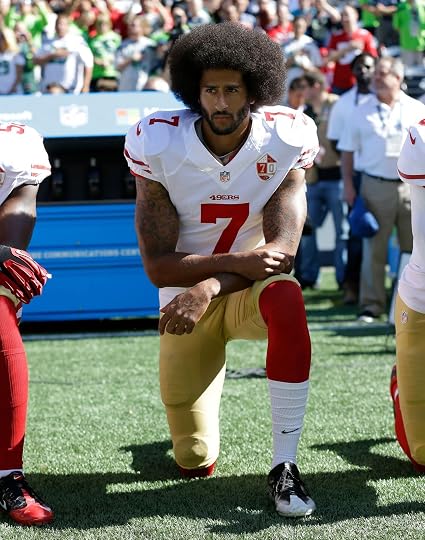
Colin Kaepernick, a player for the San Francisco 49ers, was fired for bending a knee during the playing of the National Anthem during games as a protest against police brutality.
As someone who detests football (and the NFL specifically; sports in general), I think this is all pretty fucking awesome. At the very least, it’s humorous in a way. From another vantage point, however, it’s scary as shit.
This is football, a big dumb violent sport: imagine if these people were actually upset about something that mattered? Like, climate change, universal health care, or, hell, even police brutality.
This whole issue doesn’t appear to be letting up, and, in fact, appears to be coming toward a pretty violent head. Maybe that’s a necessary thing, if not necessarily a good thing.
Conversations (a nice and completely inaccurate word for the tumult that is raging now) about mandating patriotism and punishing people for showing “inadequate” displays of national pride naturally lends itself to topics of fascism and totalitarianism, an issue that Thomas E. Ricks appropriately writes about in his latest book, “Churchill and Orwell: The Fight for Freedom”.
Ricks, a veteran war-time journalist for The Wall Street Journal and The Washington Post, is the national security advisor at the New America think tank and a contributing editor to Foreign Policy magazine. He is also, apparently, a big fan of democracy and a hater of totalitarianism.
In his view, George Orwell and Winston Churchill were the two most important figures in the past hundred years in the war against fascism: “Orwell and Churchill recognized that the key question of their century ultimately was not who controlled the means of production, as Marx thought, or how the human psyche functioned, as Freud taught, but rather how to preserve the liberty of the individual during an age when the state was becoming powerfully intrusive into private life. (p.3)”
History, Ricks posits, may have been radically different had Churchill and Orwell never been born or succumbed to an early demise. Both men suffered potentially life-ending incidents early in their career: Churchill in a deadly car accident and Orwell during the Spanish Civil War in which a sniper’s bullet struck him in the neck.
[image error]
Winston Churchill
Churchill, hated by his own party, was a lone voice of going to war against Nazi Germany in the late 1930s. Most of Britain and Europe subscribed to a policy of appeasement: just give Hitler what he wants and he won’t bother us. Churchill was disgusted by this approach, as he saw it as a slow decay of democracy and liberty in Europe. Had Churchill not eventually become the Prime Minister at the most opportune time, Neville Chamberlain’s policy of kissing Hitler’s ass would have, probably, meant the destruction of England and the rest of Europe.
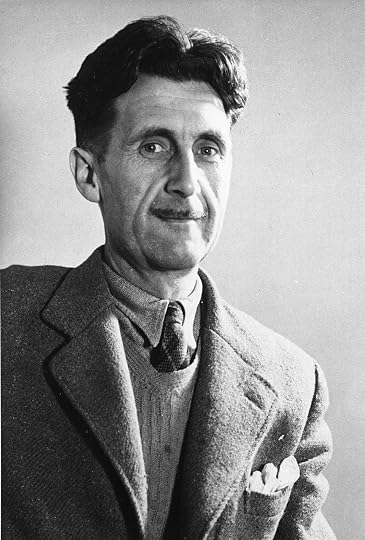
George Orwell
Prior to being shot, Orwell’s reputation as a writer was a tepid one at best, known primarily for several forgettable novels about contemporary English life and a few nonfiction works about poverty. Surviving the Spanish Civil War surprised even himself, but it resulted in the book that would put him on the map, “Homage to Catalonia”, his first-hand accounts in the very confusing, dull, and ultimately upsetting war against the fascist regime of Francisco Franco. Orwell entered the war an idealistic socialist, but he left the war a realist, realizing that fascism can take many forms.
Ricks writes, “[T]he theme that runs powerfully through all of Orwell’s writings, from his early work on “Burmese Days” through the late 1930s and then through the great essays, and into “Animal Farm” and “1984”, is the abuse of power in the modern world by both the left and the right. (p.250)”
Churchill and Orwell never actually met in person, but both men, in the short times their lives overlapped (Orwell died in 1950; Churchill outlived him another 15 years), admired each other from afar.
Orwell, in a review of Churchill’s war memoir “Their Finest Hour”: “The political reminiscences which he has published from time to time have always been a great deal above average, in frankness as well as in literary quality. Churchill is among other things a journalist, with a real if not very discriminating feeling for literature, and he also has a restless, enquiring mind, interested in both concrete facts and in the analysis of motives, sometimes including his own motives. In general, Churchill’s writings are more like those of a human being than of public figure.”
Churchill, upon reading “1984” a second time, in 1953: “It is a very remarkable book.”
Ricks’s dual biography is not overly comprehensive and it leaves the reader wanting, which is, perhaps, the goal, as it has certainly inspired me to read more about Churchill---a fascinating man---and confirms my belief that Orwell is one of the greatest writers of the 20th century.
The takeaway is a simple one, although one that is not simple at all: Resist. Always.
Ricks encapsulates the work of these two men into a “two-step process” that is as vital today as it was 80 years ago: “Work diligently to discern the facts of the matter, and then use your principles to respond. (p.265)”
Who knew that democracy’s undoing in the U.S. would be brought about by football? On the same weekend that thousands of evangelical Christians awaited the Rapture, North Korea’s Supreme Leader Kim Jung-Un threatened to possibly retaliate with nuclear weapons due to Trump’s angry tweets, and Puerto Rico suffered the aftermath of a category-5 hurricane, Trump’s main gripe was with the NFL players who were sitting out the National Anthem at football games. The man who gave a pass to white supremacists and Nazis marching in the streets of Virginia during the Unite the Right rally not a month prior derided any black player peacefully protesting the social injustice of police violence as a “son of a bitch”.
What started out as one player has turned into a movement, and the vitriol and sheer hatred from football fans has prompted serious debates, on one side, as to whether standing for a National Anthem should be mandatory and that more fans and sponsors should boycott the sport, or the other side, in which the implied (and not-so-implicit) racism of Trump and thousands of rabid fans should be met with still more boycotts of the sport. Basically, boycotting the game of football seems to be the answer to everything.
Colin Kaepernick, a player for the San Francisco 49ers, was fired for bending a knee during the playing of the National Anthem during games as a protest against police brutality.
As someone who detests football (and the NFL specifically; sports in general), I think this is all pretty fucking awesome. At the very least, it’s humorous in a way. From another vantage point, however, it’s scary as shit.
This is football, a big dumb violent sport: imagine if these people were actually upset about something that mattered? Like, climate change, universal health care, or, hell, even police brutality.
This whole issue doesn’t appear to be letting up, and, in fact, appears to be coming toward a pretty violent head. Maybe that’s a necessary thing, if not necessarily a good thing.
Conversations (a nice and completely inaccurate word for the tumult that is raging now) about mandating patriotism and punishing people for showing “inadequate” displays of national pride naturally lends itself to topics of fascism and totalitarianism, an issue that Thomas E. Ricks appropriately writes about in his latest book, “Churchill and Orwell: The Fight for Freedom”.
Ricks, a veteran war-time journalist for The Wall Street Journal and The Washington Post, is the national security advisor at the New America think tank and a contributing editor to Foreign Policy magazine. He is also, apparently, a big fan of democracy and a hater of totalitarianism.
In his view, George Orwell and Winston Churchill were the two most important figures in the past hundred years in the war against fascism: “Orwell and Churchill recognized that the key question of their century ultimately was not who controlled the means of production, as Marx thought, or how the human psyche functioned, as Freud taught, but rather how to preserve the liberty of the individual during an age when the state was becoming powerfully intrusive into private life. (p.3)”
History, Ricks posits, may have been radically different had Churchill and Orwell never been born or succumbed to an early demise. Both men suffered potentially life-ending incidents early in their career: Churchill in a deadly car accident and Orwell during the Spanish Civil War in which a sniper’s bullet struck him in the neck.
[image error]
Winston Churchill
Churchill, hated by his own party, was a lone voice of going to war against Nazi Germany in the late 1930s. Most of Britain and Europe subscribed to a policy of appeasement: just give Hitler what he wants and he won’t bother us. Churchill was disgusted by this approach, as he saw it as a slow decay of democracy and liberty in Europe. Had Churchill not eventually become the Prime Minister at the most opportune time, Neville Chamberlain’s policy of kissing Hitler’s ass would have, probably, meant the destruction of England and the rest of Europe.
George Orwell
Prior to being shot, Orwell’s reputation as a writer was a tepid one at best, known primarily for several forgettable novels about contemporary English life and a few nonfiction works about poverty. Surviving the Spanish Civil War surprised even himself, but it resulted in the book that would put him on the map, “Homage to Catalonia”, his first-hand accounts in the very confusing, dull, and ultimately upsetting war against the fascist regime of Francisco Franco. Orwell entered the war an idealistic socialist, but he left the war a realist, realizing that fascism can take many forms.
Ricks writes, “[T]he theme that runs powerfully through all of Orwell’s writings, from his early work on “Burmese Days” through the late 1930s and then through the great essays, and into “Animal Farm” and “1984”, is the abuse of power in the modern world by both the left and the right. (p.250)”
Churchill and Orwell never actually met in person, but both men, in the short times their lives overlapped (Orwell died in 1950; Churchill outlived him another 15 years), admired each other from afar.
Orwell, in a review of Churchill’s war memoir “Their Finest Hour”: “The political reminiscences which he has published from time to time have always been a great deal above average, in frankness as well as in literary quality. Churchill is among other things a journalist, with a real if not very discriminating feeling for literature, and he also has a restless, enquiring mind, interested in both concrete facts and in the analysis of motives, sometimes including his own motives. In general, Churchill’s writings are more like those of a human being than of public figure.”
Churchill, upon reading “1984” a second time, in 1953: “It is a very remarkable book.”
Ricks’s dual biography is not overly comprehensive and it leaves the reader wanting, which is, perhaps, the goal, as it has certainly inspired me to read more about Churchill---a fascinating man---and confirms my belief that Orwell is one of the greatest writers of the 20th century.
The takeaway is a simple one, although one that is not simple at all: Resist. Always.
Ricks encapsulates the work of these two men into a “two-step process” that is as vital today as it was 80 years ago: “Work diligently to discern the facts of the matter, and then use your principles to respond. (p.265)”

September 9, 2022
What can we learn from history?
Churchill & Orwell: The Fight for Freedom by Thomas E. Ricks wasn’t on my “gotta read” list. It just happened to be available at the Library, and I couldn’t help but be curious.
It is an unusual biography of two influential men in history.
Ricks highlights how the careers of these two different men greatly impacted events and attitudes in their lifetime and beyond. (The fact that 1984 became a bestseller after Trump was elected shows Orwell's continued influence.)
The author also looked at certain aspects of their lives to analyze how similar their approaches to the preservation of freedom were.
Here is a memorable passage:
"On the surface, the two men were quite different. Churchill was more robust in every way; born twenty-eight years before Orwell, he outlived him by fifteen years. But in crucial respects they were kindred spirits. In their key overlapping years in the middle of the century, the two men grappled with the same great questions — Hitler and fascism, Stalin and communism, America and its preemption of Britain. They responded with the same qualities and tools — their intellects, their confidence in their own judgments even when those judgments were rebuked by most of their contemporaries, and their extraordinary skill with words. And both steered by the core principles of liberal democracy: freedom of thought, speech and association. Their paths never crossed, but they admired each other from a distance, and when it came time for George Orwell to write 1984, he named his hero 'Winston.' Churchill is on record as having enjoyed the novel so much he read it twice."
This book isn’t a perfect depiction of these two men – but, it does give us the opportunity to pause and reflect on a time in history, and to appreciate how the influence these men had in their time continues to this day.
Churchill & Orwell: The Fight for Freedom by Thomas E. Ricks wasn’t on my “gotta read” list. It just happened to be available at the Library, and I couldn’t help but be curious.
It is an unusual biography of two influential men in history.
Ricks highlights how the careers of these two different men greatly impacted events and attitudes in their lifetime and beyond. (The fact that 1984 became a bestseller after Trump was elected shows Orwell's continued influence.)
The author also looked at certain aspects of their lives to analyze how similar their approaches to the preservation of freedom were.
Here is a memorable passage:
"On the surface, the two men were quite different. Churchill was more robust in every way; born twenty-eight years before Orwell, he outlived him by fifteen years. But in crucial respects they were kindred spirits. In their key overlapping years in the middle of the century, the two men grappled with the same great questions — Hitler and fascism, Stalin and communism, America and its preemption of Britain. They responded with the same qualities and tools — their intellects, their confidence in their own judgments even when those judgments were rebuked by most of their contemporaries, and their extraordinary skill with words. And both steered by the core principles of liberal democracy: freedom of thought, speech and association. Their paths never crossed, but they admired each other from a distance, and when it came time for George Orwell to write 1984, he named his hero 'Winston.' Churchill is on record as having enjoyed the novel so much he read it twice."
This book isn’t a perfect depiction of these two men – but, it does give us the opportunity to pause and reflect on a time in history, and to appreciate how the influence these men had in their time continues to this day.

June 21, 2018
I'm not a big fan of biographies but this book sounded interesting, two biographies linking together two very different people, the larger than life Winston Churchill and the quieter, sickly George Orwell. The main attraction here for me was Orwell, I'm a big fan of his books, especially "Down and out..." and I know very little about the chap.
I can't really see why these two people were picked as their paths never crossed and Churchill barely knew of Orwell, you'd think they could have been paired up with similar people. This does become an issue in the book because Churchill soon takes over the book, having had such an impact on history there was so much more to write about, Orwell ends up taking on a supporting roll at times.
That being said I did enjoy reading it, I learnt loads about Orwell and reading about how events in his life shaped his books was fascinating. I already knew a lot about Churchill and what he did, what was new though was his state of mind, as the war came to a close he became more withdrawn and his famous oratory skills became weaker.
The chapters are well set out, starting out with how their characters evolved and moving on to important stages of their life. The research seems to be impeccable and Thomas Ricks isn't scared to give his opinions of other biographers, his comments about Tony Blair gave me a chuckle.
struggled to decide on a rating here, bouncing continuously between 3 and 4 stars, I enjoyed the ending so have settled on 4 stars.
Blog review is here> https://felcherman.wordpress.com/2018...
I can't really see why these two people were picked as their paths never crossed and Churchill barely knew of Orwell, you'd think they could have been paired up with similar people. This does become an issue in the book because Churchill soon takes over the book, having had such an impact on history there was so much more to write about, Orwell ends up taking on a supporting roll at times.
That being said I did enjoy reading it, I learnt loads about Orwell and reading about how events in his life shaped his books was fascinating. I already knew a lot about Churchill and what he did, what was new though was his state of mind, as the war came to a close he became more withdrawn and his famous oratory skills became weaker.
The chapters are well set out, starting out with how their characters evolved and moving on to important stages of their life. The research seems to be impeccable and Thomas Ricks isn't scared to give his opinions of other biographers, his comments about Tony Blair gave me a chuckle.
struggled to decide on a rating here, bouncing continuously between 3 and 4 stars, I enjoyed the ending so have settled on 4 stars.
Blog review is here> https://felcherman.wordpress.com/2018...

June 17, 2021
Дуже цікаво проаналізовано і наведено паралелі між цими, на перший погляд, різними особистостями. Раджу!

June 9, 2017
One of the main attributes that these two figures shared was the willingness and courage to speak "unpalatable truths." For Churchill, it was about the aggressive buildup of armaments in Nazi Germany during the 30's. For Orwell, it was to expose the brutal nature of Soviet Communism that he witnessed in Spain during the Civil War.
-------
"Orwell was one of those upon whom nothing was lost. (This included, as Orwell himself said: “the power of facing unpleasant facts”). By declining to lie, even as far as possible to himself, and by his determination to seek elusive but verifiable truth, he showed how much can be accomplished by an individual who unites the qualities of intellectual honesty and moral courage."
-Christopher Hitchens
-------
"Orwell was one of those upon whom nothing was lost. (This included, as Orwell himself said: “the power of facing unpleasant facts”). By declining to lie, even as far as possible to himself, and by his determination to seek elusive but verifiable truth, he showed how much can be accomplished by an individual who unites the qualities of intellectual honesty and moral courage."
-Christopher Hitchens

May 6, 2021
Най буде 5/5. Книга хороша, читається легко, хоча іноді трохи нуднувато. Автор старався побудувати цілісну лінію оповіді, щоб читач зумів спостерегти схожість Черчилля і Орвелла, їхніх світоглядів та досвідів. Дещо патетично написано - мабуть від зачарованості обома (а вони схильні до патетичності).
Кілька останніх розділів рекомендуватиму студентам на курсі Філософія фантастики.
Кілька останніх розділів рекомендуватиму студентам на курсі Філософія фантастики.

November 27, 2017
Fairly good; not terribly demanding. Perfect for audible/driving. Some interesting insights on Churchill, but quite overrates Orwell, imo.
3.5 stars
3.5 stars

July 16, 2017
This is in some ways a book which is exasperatingly too modest in scale. Much more in depth lives of Churchill and Orwell have been written. Each of them suffers here for having to share the 270 pages of text. At the same time Ricks too often clutters the slender biographies in condescending unimportant additions and asides which the reader already understands. Essentially it focuses on how they individually experienced the 1930s, the subsequent war, and how those experiences affected their own worldview and the perceptions of those reading their work. If the narrative of the lives isn't adorned enough it does tackle the complexities of the 2 men: Churchill's complicated wartime relations with America and his fingerhold on empire alongside how Orwell developed a distrust for all forms of government.
There are clumsinesses here brought about by omissions. At the same time there's some fine history and analysis. The section describing fascist sympathies in Britain during the interwar period, a subject I know little about, is fascinating. Ricks's account of the postwar years is equally engaging. The book closes with a brilliant analysis of why Churchill's ideas have faded as history flows in other directions while history has perhaps become a tributary of Orwell's perspectives on totalitarianism.
There are clumsinesses here brought about by omissions. At the same time there's some fine history and analysis. The section describing fascist sympathies in Britain during the interwar period, a subject I know little about, is fascinating. Ricks's account of the postwar years is equally engaging. The book closes with a brilliant analysis of why Churchill's ideas have faded as history flows in other directions while history has perhaps become a tributary of Orwell's perspectives on totalitarianism.

August 4, 2020
Churchill and Orwell: The Fight for Freedom is a well-written book by the two-times Pulitzer Prize winner, Thomas E. Ricks. Though Churchill and Orwell were remarkable figures of the 20th century and both lived through WWII, their individual stories sparsely entwine. But despite their differences in perspectives, Ricks shows they both agree on one key area: that despotic governments are to be resisted. Another key point that connects them is their willingness to say, "I'm on the wrong side".
As you can tell, it's almost impossible to give a comprehensive account of the stories of Churchill and Orwell if they are lumped into a 9+ hours book. Therefore, the content of the book wasn't sufficiently thorough nor impressive. But, all in all, it was an enjoyable read.
As you can tell, it's almost impossible to give a comprehensive account of the stories of Churchill and Orwell if they are lumped into a 9+ hours book. Therefore, the content of the book wasn't sufficiently thorough nor impressive. But, all in all, it was an enjoyable read.

February 22, 2018
"Saints should be judged guilty until they are proved innocent, but the tests that have to be applied to them are not, of course, the same in all cases." George Orwell, Reflections on Gandhi
Ricks is not nearly so skeptical in judging the characters and legacies of Churchill and Orwell. I would say he flirts with beatification but stops well short of canonization. Even that much praise would've probably appalled Orwell; Churchill not so much. The test in this case, however, is the same for both men: To put it succinctly -- which would've favored Orwell's unadorned directness (see his "Politics and the English Language") and not Churchill's rhetorical exuberance -- did they tell it like it is? Indeed they did. In the final analysis, though, Ricks judges Orwell's impact to have been larger and more enduring. Quibble with that if you like, but to be fair to Ricks, such a judgement does not come at expense of Churchill's historic contributions.
I would describe Ricks's style as brisk but not breezy. But even if you already know much about both men -- and I do, especially regarding Orwell -- he makes the material quite fresh. And he's a better literary commentator than I would've expected from a military historian. Churchill's multi-volume history of WWII was displayed prominently on my father's books shelves, and though I never dipped into it myself as a boy, I still remember my father extolling Churchill's prose and historical acumen at the dinner table as the height of inspired writing. I learned a lot of history in that manner, but it didn't spoil my appreciation of Churchill's accomplishments, political or literary, to read Ricks's candid assessment of the work's strengths and weaknesses. In fact, it made me want to call my 92 year old father to ask if he'd leave them to me in his will. (He wouldn't dare part with them while still alive.)
If you know Orwell only through his famous novels, Ricks provides a very good introduction to his journalism and essays. I've reread parts of Down and Out in Paris and London, The Road to Wigan Pier, and Homage to Catalonia three or four times, and my favorite essays, such as "Shooting an Elephant" and "How the Poor Die," more times than I can remember. To fully appreciate his view of the world, one should read these works. Always an astute observer of the small, local details as well as the fraudulence of political cant around the globe, he's also a just a damn good storyteller.
(The death scene in "Shooting an Elephant" is equaled only by that in Wells Tower's GQ article "Who Wants to Shoot an Elephant?" selected in Best American Sports Writing, 2015, and I'm convinced that Tower is paying homage to Orwell, who would applaud the writing if not the venue.)
My main complaint, expressed by others in this thread, is that in order to keep both men marching through history side by side, Ricks, at times, forces things with some fairly thin, if not outright trivial connections, more chronological than thematic.
Ricks is not nearly so skeptical in judging the characters and legacies of Churchill and Orwell. I would say he flirts with beatification but stops well short of canonization. Even that much praise would've probably appalled Orwell; Churchill not so much. The test in this case, however, is the same for both men: To put it succinctly -- which would've favored Orwell's unadorned directness (see his "Politics and the English Language") and not Churchill's rhetorical exuberance -- did they tell it like it is? Indeed they did. In the final analysis, though, Ricks judges Orwell's impact to have been larger and more enduring. Quibble with that if you like, but to be fair to Ricks, such a judgement does not come at expense of Churchill's historic contributions.
I would describe Ricks's style as brisk but not breezy. But even if you already know much about both men -- and I do, especially regarding Orwell -- he makes the material quite fresh. And he's a better literary commentator than I would've expected from a military historian. Churchill's multi-volume history of WWII was displayed prominently on my father's books shelves, and though I never dipped into it myself as a boy, I still remember my father extolling Churchill's prose and historical acumen at the dinner table as the height of inspired writing. I learned a lot of history in that manner, but it didn't spoil my appreciation of Churchill's accomplishments, political or literary, to read Ricks's candid assessment of the work's strengths and weaknesses. In fact, it made me want to call my 92 year old father to ask if he'd leave them to me in his will. (He wouldn't dare part with them while still alive.)
If you know Orwell only through his famous novels, Ricks provides a very good introduction to his journalism and essays. I've reread parts of Down and Out in Paris and London, The Road to Wigan Pier, and Homage to Catalonia three or four times, and my favorite essays, such as "Shooting an Elephant" and "How the Poor Die," more times than I can remember. To fully appreciate his view of the world, one should read these works. Always an astute observer of the small, local details as well as the fraudulence of political cant around the globe, he's also a just a damn good storyteller.
(The death scene in "Shooting an Elephant" is equaled only by that in Wells Tower's GQ article "Who Wants to Shoot an Elephant?" selected in Best American Sports Writing, 2015, and I'm convinced that Tower is paying homage to Orwell, who would applaud the writing if not the venue.)
My main complaint, expressed by others in this thread, is that in order to keep both men marching through history side by side, Ricks, at times, forces things with some fairly thin, if not outright trivial connections, more chronological than thematic.

January 24, 2019
It's an ambitious task to write a biographical history at all, much less a dual biography of historical giants such as Winston Churchill and George Orwell.
Luckily, this book was excellent and included a thoughtful afterword, bringing both Churchill and Orwell's long shadow into our present day.
And what's best about it? This book is NOT a hagiography of either man. There's plenty of talk of each of their faults - their prejudices, their addictions, the way they neglected their families, their stubbornness, etc. Human stories are complex, and to gloss over faults and focus only on the things they accomplished and are "known for" is disingenuous.
I have read other biographies of both men, focusing on certain periods of their life (Churchill: Hero of the Empire: The Boer War, a Daring Escape, and the Making of Winston Churchill and Orwell: Finding George Orwell in Burma) and enjoyed the larger approach and alternating chapter focuses.
Luckily, this book was excellent and included a thoughtful afterword, bringing both Churchill and Orwell's long shadow into our present day.
And what's best about it? This book is NOT a hagiography of either man. There's plenty of talk of each of their faults - their prejudices, their addictions, the way they neglected their families, their stubbornness, etc. Human stories are complex, and to gloss over faults and focus only on the things they accomplished and are "known for" is disingenuous.
I have read other biographies of both men, focusing on certain periods of their life (Churchill: Hero of the Empire: The Boer War, a Daring Escape, and the Making of Winston Churchill and Orwell: Finding George Orwell in Burma) and enjoyed the larger approach and alternating chapter focuses.

July 13, 2017
A well-written book interweaving the biographies of 20th century’s two most influential men: Churchill, a conservative, and Orwell, a socialist. Though on the opposite sides of the political spectrum, they shared principles we would do well to be reminded of. Two that left a strong impression on me are importance of individuality and being able to correct course based on facts.
"Stature of man" - a phrase from Churchill’s speech before WWII that established him a voice in Parliament, during the time when most of the rest of UK wanted to appease Hitler: “This is not a question of fighting for Danzig or fighting for Poland. We are fighting to save the whole world from the pestilence of Nazi tyranny and in defence of all that is most sacred to man. This is no war for domination for imperial aggrandisement or material gain; no war to shut any country out of its sunlight and means of progress. It is a way, viewed in its inherent quality, to establish, on impregnable rocks, the rights of the individual, and it is a war to establish and revive the stature of man.” Similarly, though Orwell was left leaning and believed in socialism, he respected an individual’s right to hold and speak out their opinion, seek answers to their questions, and remain open to stand corrected.
On standing corrected… both men were ready to change their opinions and beliefs, based on facts. Fact seeking is draining, but it is the only way to formulate success and solid timeless values. Churchill was notorious for ‘micro-managing’ the military during WWII, asking questions on available forces, equipment, the enemy’s state, differences from WWI, etc., unlike many of the military leadership at the time. This led him and the world to victory. Orwell traveled to Burma to experience imperialism and Spain to experience the war first-hand. He found the socialists in Spain were no better than the imperialists in Burma and changed his views on socialism. The facts and wars of the present day may be different from Churchill and Orwell’s time, but the need to formulate opinions and values based on facts still holds true.
Orwell (whether he intended to or not) accurately foreshadowed our world today. It is full of people, events and ideas, against which I am reminded to use the two principles above as guards… the omniscient state and its propaganda; the ever more powerful tech companies; totalitarian-leaning leaders around the world (e.g. Assad, Duterte, Erdogan, Putin); far-off wars not paid attention to; <24 hour news cycle; fill in the many blanks.
"Stature of man" - a phrase from Churchill’s speech before WWII that established him a voice in Parliament, during the time when most of the rest of UK wanted to appease Hitler: “This is not a question of fighting for Danzig or fighting for Poland. We are fighting to save the whole world from the pestilence of Nazi tyranny and in defence of all that is most sacred to man. This is no war for domination for imperial aggrandisement or material gain; no war to shut any country out of its sunlight and means of progress. It is a way, viewed in its inherent quality, to establish, on impregnable rocks, the rights of the individual, and it is a war to establish and revive the stature of man.” Similarly, though Orwell was left leaning and believed in socialism, he respected an individual’s right to hold and speak out their opinion, seek answers to their questions, and remain open to stand corrected.
On standing corrected… both men were ready to change their opinions and beliefs, based on facts. Fact seeking is draining, but it is the only way to formulate success and solid timeless values. Churchill was notorious for ‘micro-managing’ the military during WWII, asking questions on available forces, equipment, the enemy’s state, differences from WWI, etc., unlike many of the military leadership at the time. This led him and the world to victory. Orwell traveled to Burma to experience imperialism and Spain to experience the war first-hand. He found the socialists in Spain were no better than the imperialists in Burma and changed his views on socialism. The facts and wars of the present day may be different from Churchill and Orwell’s time, but the need to formulate opinions and values based on facts still holds true.
Orwell (whether he intended to or not) accurately foreshadowed our world today. It is full of people, events and ideas, against which I am reminded to use the two principles above as guards… the omniscient state and its propaganda; the ever more powerful tech companies; totalitarian-leaning leaders around the world (e.g. Assad, Duterte, Erdogan, Putin); far-off wars not paid attention to; <24 hour news cycle; fill in the many blanks.

November 2, 2019
This was a dual-biography of Winston Churchill and George Orwell. I learned nothing new of Churchill in this book, but I learned quite a bit about Orwell as I had never read any biographical works on him. I found his life to be interesting but felt that there was not enough of him in this book. The two men had no connections other than being British at the same time during the World War II era, so the connection between them was loose at best. Worth the read as it was short, but not the engrossing read I was hoping for.

November 26, 2021
A book on Churchill and Orwell? Both men at first glance seems so different; so what does these two men have in common? Both men love freedom and opposes totalitarianism. With so much talk about fascism and also with the increase statism we are seeing worldwide today this book might be quite relevant to read. The subject matter and the two individuals that are the focus of the book are interesting enough to read as a dual biography in its one right but what further propelled me to read this is because this is authored by Thomas E. Ricks. It seems as I grow in my intellectual and thought life one can mark it with different milestone based upon books published by Thomas Ricks, from my high school years with Rick’s early book Making the Corps that was about Marine Corps boot camp when I was a high school kid dreaming about joining the Marines and then when I was a Marine and Marine veteran of Iraq with Ricks’ book The Gamble: General David Petraeus and the American Military Adventure in Iraq, 2006-2008 by Thomas E. Ricks and The Generals by Thomas E. Ricks.
In sixteen chapters Ricks weaves the biography of both men back and forth beginning with their younger days to them being young men, then as adults and their twilight years. I knew less about Orwell than Churchill though I have read both Orwell’s classics and have not read Churchill’s own writings and Memoirs so learning about Orwell was quite a treat. I think many people are in the same boat. Learning about Orwell’s interesting background really informed us of why Orwell to write Animal Farm and 1984. In some ways I thought Orwell’s work as a British imperial police in Burma and as a censor during World War even though he doesn’t agree with his work ideologically kind of fit with the same profile as the main character in 1984.
The author must be given props for weaving together two individuals who seems so different. In England where class and social statuses is rigid and important it might seem at first to look at both these men as comparison. One was a struggling writer and the other an ambitious man who became Prime Minister. Yet both were outsiders to some extent with their political affiliations; Orwell who was supposed to be a socialist but was cynical and concern about Communism as it has manifested in the Soviet Union and Churchill who was always viewed suspiciously by his conservative party. Both saw the threat against Freedom and both had concerns for fascism in Nazi Germany. Both men have also had time in the battlefields and been in different parts of the British Empire that shaped them tremendously, Orwell in Burma and Churchill in India, South Africa and elsewhere. Both have also been in war zones outside of British involvement, such as Orwell in Spain during the Spanish Civil War and Churchill in Cuba. What was surprising for me was reading how at different times Orwell in his journal supported and approved of Churchill; Orwell was definitely not someone that’s a “follow the party” socialists.
In some ways both men were insightful concerning the darker side of human nature. They are both worth reading about. While this book takes a more critical look at Churchill than some of the other biographies I read about Churchill still I appreciate the author’s analysis and evaluation. Overall though the author does appreciate both men and his discussion of their weaknesses and struggles was done fairly in my estimation yet with honestly. Ricks is not a fan boy and he’s not mythologizing these men; in light of the quality of journalism today I think I’m appreciative of Ricks’ take on these two men. I thought towards the end of the book was also helpful in evaluating both men’s legacy and contribution while lightly and rightfully deconstructing the myths of Churchill such as quotes attributed to Churchill but wasn’t cited by him but by others, etc. A good book!
In sixteen chapters Ricks weaves the biography of both men back and forth beginning with their younger days to them being young men, then as adults and their twilight years. I knew less about Orwell than Churchill though I have read both Orwell’s classics and have not read Churchill’s own writings and Memoirs so learning about Orwell was quite a treat. I think many people are in the same boat. Learning about Orwell’s interesting background really informed us of why Orwell to write Animal Farm and 1984. In some ways I thought Orwell’s work as a British imperial police in Burma and as a censor during World War even though he doesn’t agree with his work ideologically kind of fit with the same profile as the main character in 1984.
The author must be given props for weaving together two individuals who seems so different. In England where class and social statuses is rigid and important it might seem at first to look at both these men as comparison. One was a struggling writer and the other an ambitious man who became Prime Minister. Yet both were outsiders to some extent with their political affiliations; Orwell who was supposed to be a socialist but was cynical and concern about Communism as it has manifested in the Soviet Union and Churchill who was always viewed suspiciously by his conservative party. Both saw the threat against Freedom and both had concerns for fascism in Nazi Germany. Both men have also had time in the battlefields and been in different parts of the British Empire that shaped them tremendously, Orwell in Burma and Churchill in India, South Africa and elsewhere. Both have also been in war zones outside of British involvement, such as Orwell in Spain during the Spanish Civil War and Churchill in Cuba. What was surprising for me was reading how at different times Orwell in his journal supported and approved of Churchill; Orwell was definitely not someone that’s a “follow the party” socialists.
In some ways both men were insightful concerning the darker side of human nature. They are both worth reading about. While this book takes a more critical look at Churchill than some of the other biographies I read about Churchill still I appreciate the author’s analysis and evaluation. Overall though the author does appreciate both men and his discussion of their weaknesses and struggles was done fairly in my estimation yet with honestly. Ricks is not a fan boy and he’s not mythologizing these men; in light of the quality of journalism today I think I’m appreciative of Ricks’ take on these two men. I thought towards the end of the book was also helpful in evaluating both men’s legacy and contribution while lightly and rightfully deconstructing the myths of Churchill such as quotes attributed to Churchill but wasn’t cited by him but by others, etc. A good book!

April 20, 2021
Читати потрібно вже тому, щоби вони зароджували бажання почитати інші книги. "Данину Каталонії" Орвелла, наприклад, або пеиші два томи мемуарів Черчилля про Другу світову.
Це історія про битву за свободу і права людини, яка не просто залишається актуальною зараз — часом здається, що невдовзі вона лише має початися. Особливо в Україні.
І почати либонь варто з найбільш революційного (безпосередньо за Орвеллом) кроку – з тверезого погляду на факти.
Це історія про битву за свободу і права людини, яка не просто залишається актуальною зараз — часом здається, що невдовзі вона лише має початися. Особливо в Україні.
І почати либонь варто з найбільш революційного (безпосередньо за Орвеллом) кроку – з тверезого погляду на факти.

April 20, 2019
Interesting concept, dismal content and organization. Half of this book seems to consists of previously collected notes and anecdotes, slapped together without considering how, or whether, they make any sense next to each other, or whether they bear any relevance to the topic.
Why dedicate half a page to examples of random people commenting on similarities between Churchill and a pig? Why pepper around so many remarks about Mitford sister's social activities and sexual daliances (and who cares if Churchill's wife was their half sister or not, bringing it up once was too many times already)? Why follow an episode of Churchill's subbing of the American war delegation by describing his social activities on that day, and finishing up with a dance where he got so wound up that he said "Stop!" Why jump from his legacy of "special relations" to a tirade against Blair's support for Iraq intervention in 2003?
Why bring up Orwell's awkward marriage advances to his neighbor, after his wife passed? And was he a poor boy who got in Eaton on
a scholarship, or was he a high class person from Eaton who dressed like a working class nobody? Make up your mind, nobody cares anyway.
A disjointed, gossipy mess of a book.
Why dedicate half a page to examples of random people commenting on similarities between Churchill and a pig? Why pepper around so many remarks about Mitford sister's social activities and sexual daliances (and who cares if Churchill's wife was their half sister or not, bringing it up once was too many times already)? Why follow an episode of Churchill's subbing of the American war delegation by describing his social activities on that day, and finishing up with a dance where he got so wound up that he said "Stop!" Why jump from his legacy of "special relations" to a tirade against Blair's support for Iraq intervention in 2003?
Why bring up Orwell's awkward marriage advances to his neighbor, after his wife passed? And was he a poor boy who got in Eaton on
a scholarship, or was he a high class person from Eaton who dressed like a working class nobody? Make up your mind, nobody cares anyway.
A disjointed, gossipy mess of a book.

July 21, 2017
Well written biography with an interesting twist as you learn about how two very different men were able to shape the world so drastically using their strongly held principles.
The book provides a telling reminder of how important it is to look at the facts, see the world for what it is and immediately take action should there be wrongdoing being made.
I admire Churchill and Orwell for standing up against what they thought was wrong when so many choose not to. Both men, but especially Orwell, has in their books left lessons we'd be wise to remember. So if you haven't already, I recommend strongly that you read Animal Farm and 1984, two of the absolute best and most important books of the 20th century.
The book provides a telling reminder of how important it is to look at the facts, see the world for what it is and immediately take action should there be wrongdoing being made.
I admire Churchill and Orwell for standing up against what they thought was wrong when so many choose not to. Both men, but especially Orwell, has in their books left lessons we'd be wise to remember. So if you haven't already, I recommend strongly that you read Animal Farm and 1984, two of the absolute best and most important books of the 20th century.

March 7, 2021
Ця книга привернула мою увагу завдяки Черчиллю, до якого в мене є ще не усвідомлений вповні інтерес. А виявилась значно глибшою, ніж я припускала.
Надзвичайно цікаво споглядати історичний період в такому стереоефекті - двох поглядів сучасників тих подій.
Загалом книга, мабуть, про чесність із собою, і сміливість назвати те, що бачиш своїми іменами, не спокушатись на світ ілюзій.
Бо "якщо людина не може змінити своїх поглядів, то що вона взагалі може змінити"...
Треба ще якийсь час пожити з цією книгою всередині, повчуватися в її післясмак.
Але радити можу вже :)
Надзвичайно цікаво споглядати історичний період в такому стереоефекті - двох поглядів сучасників тих подій.
Загалом книга, мабуть, про чесність із собою, і сміливість назвати те, що бачиш своїми іменами, не спокушатись на світ ілюзій.
Бо "якщо людина не може змінити своїх поглядів, то що вона взагалі може змінити"...
Треба ще якийсь час пожити з цією книгою всередині, повчуватися в її післясмак.
Але радити можу вже :)

September 23, 2017
I actually could not stop reading, after hearing Ricks on NPR Fresh Air with Terri Gross. This was a fine brief (c. 275 pages) summary biography/comparison of these two. Ricks cuts through to the core: why both Churchill and Orwell matter, why Orwell grows in importance.
Recommended.
Recommended.

June 6, 2017
The heroes of every age are often not seen as heroes during their lives, or if so viewed in their own age they are not so viewed in later ages. And doubtless perceptions of heroes change as one future passes into another. But for us, today, Churchill and Orwell are heroes to many, and whatever else may be true, this alone gives the two men something in common. Thomas Ricks uses this commonality as the springboard and organizing theme for his book, which is a competently written capsule biography of its title subjects, combining examination of the men with examination of their time. His book offers both an interesting narration of known facts and some fresh insights by the author—neither an easy feat when dealing with heroes.
Most of the book consists of a chronological history of its subjects, narrated in short, pithily written chapters alternating between each man, with occasional asides by the author relating events of the past to the current day. Especially for Churchill, this history is well-trodden ground, but Ricks still manages to breathe life into his account. For Orwell, what Ricks relates is mostly about his writing, coupled with his time in the Spanish Civil War, since Orwell’s life outside writing was fairly simple and relatively short. For Churchill, the account is secondarily about his writing, and more about his deeds, from the Boer War onwards, since Churchill’s life was anything but simple.
I will not review the history Ricks covers, since it is pretty much known to all, though as I say expertly presented in this relatively short book. But I will note some areas of interest and insight. I found particularly interesting Churchill’s methods for energizing and impelling the British military bureaucracy during World War Two. We tend to think of the British people, or any people in war, as pulling energetically together in harness toward achieving a shared, existential goal. (Probably this view is encouraged by movies, which after all have to focus narrowly while creating an exciting story—showing a bunch of bored obstructionist bureaucrats for two hours of film wouldn’t attract much of an audience.) The reality is more mundane—laziness, stupidity, cupidity, and all the vices of man are just as evident at such times as at others, and bureaucracies tend to encourage such behavior. Much of Churchill’s effort went to overcoming this pernicious mix of vice and inertia, using constant demands for “Action This Day,” “followed up with intelligent memoranda and orders that spurred subordinates accustomed to a slower pace and fewer questions.” Not for Churchill the “set the agenda” model used by other leaders, hoping those below him will move toward the desired goals under their own power (something that tends to work only in authoritarian or fiercely ideological systems, such as Soviet Russia or the Obama executive branch). “At one point during the war he found time to delve into domestic egg production, badgering the minister of agriculture. ‘I wish I could persuade you to try to overcome the difficulties instead of merely entrenching yourself behind them.’” A good sentence, and Churchill’s success showed it can be done, something to remember for today’s leaders—though it requires energy and an eye for detail, together with charisma.
I also found interesting Ricks’s thoughts on the prose of his subjects. He is very much a fan of Orwell’s prose, and less so of Churchill’s. Riffing off Orwell’s “Good prose is like a window pane,” Ricks notes that Churchill’s prose was like a stained glass window pane, which is at least a partial compliment—but he also quotes, with approval, Evelyn Waugh’s complaint that Churchill was “a master of sham-Augustan prose.” In fairness, Ricks also notes that Churchill was also fully capable of making complex prose simple—famously changing the term “Local Defense Volunteers” to “Home Guard,” and “Communal Feeding Centers” to “British Restaurants.” I think that the choice between good simple and good complex prose is mostly a taste distinction, since both styles can convey complete meaning. Orwell was dedicated to clarity of thought and thereby clarity of communication, and to that end he favored a stripped down prose, which eliminated cant in large part by preventing its concealment in orotund phrasing (yes, I know “orotund” is a word Orwell would have avoided). Ricks points out that Orwell’s style has, at least on the surface, largely triumphed in modern writing—perhaps not in academic writing, which is famously opaque, but certainly in journalism and popular books.
Personally, I think that triumph is somewhat unfortunate, since there are two types of arabesque writing, with two different objects. The first is what I call the “high style,” the style in which Churchill wrote. Its aim is to paint a compelling picture, where more words are used than perhaps strictly necessary, but where those words add color, depth, and ease of remembering. It is certainly more elliptical and complex than Orwell’s recommended style, but this “high style” has been the choice of many famous and undoubtedly accomplished authors, from Gibbon to Henry James. Using this style instead of a simpler style is, therefore, of itself merely a stylistic choice, neither inherently good nor bad, although today such more complex writing seems old fashioned to us, and harder sometimes to read, since simpler prose is generally favored in modern life.
On the other hand, the second type of complex writing is, as Orwell saw, designed to conceal falsehood and to blur thought. It is designed to compel an unreasoning, or contrary to reason, conclusion by one of two mechanisms. The first is by frustrating the reader, who is forced only to see a desired conclusion, not the reasoning by which that conclusion is reached, or alternatively is forced to intuit a general feeling, since there is no reasoning at all (postmodernist writings, from Foucault to Žižek, are all like this). The second mechanism of compulsion is by executing a moral judgment upon the reader who does not immediately jump, without reasoning, to the desired ideological conclusion (Racist! Sexist! Transphobic!). This second type of complex writing is, obviously, pernicious, and was Orwell’s focus.
But that does not mean simpler is always better. In particular, simple writing that does contain clear reasoning can also conceal core falsehoods, if the vocabulary itself has been corrupted (a famous complaint of Orwell’s). One can make a very simple and apparently rational statement that is simply wholly false, very easily, if the writer knows that the zeitgeist demands that the reader not question either the false premises or the false conclusion (e.g., “Gender is a fluid social construct that each person decides for xirself.”). As long as simple writing does not have this flaw, though, it is probably the better choice for most modern prose, since it is easier to write (although not as easy as it looks), and it can reach a larger audience today, given that most readers are now unused to the “high style.” But I still like the high style.
A third point of interest is that Orwell, a man wholly of the Left, was constantly on the edge of being totally excommunicated by the Left, which then, as now, attempted to enforce discipline in a way undreamed of by the Right. Most famously this is true of Orwell’s attempt to publish “Animal Farm,” published in 1945, but it was first a challenge for Orwell when nearly ten years earlier he wrote “The Road To Wigan Pier,” about life among the British industrial working class. The Left’s objection was that Orwell refused to lie in order to properly portray the working class in the light demanded by political myth, as heroic and selfless participants in the global socialist movement. Orwell was very much a socialist, but instead he portrayed English workers as they were, simultaneously oppressed and selfish, and he dared to coldly analyze the reality of socialism as practiced and its effect on actual workers. This was an unforgiveable sin, and the reaction from the Left was harsh and permanent (as had been the reaction from the Right from Orwell’s criticism of Empire in the earlier “Burmese Days”).
It is strange, therefore, given this history, that Ricks repeatedly expresses surprise at the difficulties Orwell faced having his books published, including “Wigan Pier,” “Animal Farm,” and, of course, “1984.” But this was no surprise at all—certainly not to Orwell, who was very much aware of this problem, nor to any other member of the Left at the time, including Orwell’s sometime publisher, Victor Gollancz. Suppression of any and all dissent in the service of paving the road to Utopia has always been, and today remains, the main internal tactical characteristic of the Left. For the Left, as has been frequently noted, there are no enemies to the Left—but anyone who deviates in any way to the Right must be punished with all the severity that can possibly be mustered. (Of course, it was Alexander Kerensky who first formulated the dogma of “no enemies to the Left”—and look how that worked out for him.) The totalitarian impulse behind this condemnation of any perceived criticism of any aspect of the Left is concealed behind the usual falsehood, that any problems resulting from implementation of Left policies are due either to lack of sufficient focus in application or to Right sabotage—encapsulated in the viciously pitiful but frequently heard claim that “Communism has never actually been tried.” We have seen merely the latest iteration of this last week, in June of 2017, when the detestable Noam Chomsky, challenged, ascribed the collapse of Venezuela not to the socialist policies of Hugo Chavez that Chomsky praised only a few years ago, but to the failure to adequately suppress the hoarders and wreckers who polluted the pure light of socialism that would otherwise have been guaranteed to create the first South American paradise. And, strangely, Chavez’s other worshippers, such as the halfwit actor Sean Penn, have gone silent—not from shame, certainly, but merely to wait to offer their unthinking support to the next destructive instantiation of the Left vision.
But the worst Left heretic of all, of course, is a man of the Left who would cooperate with anyone wishing to harm politically any member of the Left, even the most evil. This happens most often, or most publicly, when members of violent Left groups are exposed by former compatriots who have seen the error of their ways. Left propaganda has successfully characterized this as a betrayal, rather than what it almost always actually is, heroic self-sacrifice. Thus, Ricks gingerly approaches Orwell’s 1949 preparation “of a list of suspected Communists,” to be delivered to those leading the fight for freedom against totalitarianism, as an action of Orwell’s that needs to be excused away—not, as Ricks should, as something that must be lionized by any decent human being. (And, of course, the list contained actual Communists personally known to Orwell, not “suspected” ones—Ricks just adds the adjective, perhaps by reflex, to give a pejorative flavor to his description of the action.)
This, of course, wholly explains why, as Ricks notes, “Orwell has not been well served by academia . . . . [he has] been ‘relatively ignored” by university faculties.” Ricks cites the sociologist Neil McLaughlin for the proposition that this ignoring is because “Orwell is esteemed in the popular culture,” to which Ricks adds “also perhaps because he has been so long embraced by conservatives.” While this latter is closer to the mark, it is also wrong. Orwell is ignored by the Left because Orwell betrayed the Left, the center of which was then, and is even more so today, universities—which are monocultures of the hard Left devoted to the destruction of the West and the creation of a Utopia, if necessary paved with the bodies of the common people. If American university faculties ran America, it would look a lot like the society of “1984,” although with less efficiency and competence, and more wine and cheese parties for those in power. It is no wonder such people ignore Orwell, when they are not attacking him.
A final point of interest is that although Ricks has obviously studied both “Animal Farm” and “1984,” and cogently discusses details of each, his summaries of both books are jarringly wrong. He says the former tells “how farm animals revolt against their human masters, only to be enslaved by the local pigs.” And he says the latter “ends with the two broken lovers meeting later, equally desolated. They confess to each other their betrayals, and then part. No hope is offered.” But in the former, it was not slavery, but totalitarian dominance of both action and thought, worse than Farmer Jones, that the pigs delivered. And it was not “the local pigs,” which implies an outside agency, but the farm animals’ former compatriots. More critically, the real ending of “1984” is not the parting of Winston and Julia, which is subsidiary to (although related to) the real ending—Winston’s solitary discovery that “He loved Big Brother.” Ricks ignores the real ending, the triumph of totalitarianism over the human desire for freedom. No hope is offered, to be sure—but the bleak ending is tied to Winston’s inner thought, not to his love for Julia. I suppose these are not critical flaws in Ricks’s book, but they are strange mis-characterizations of Orwell’s most famous and important books.
As far as insights, I think the most useful insight Ricks offers is that, if choosing dystopias that partially characterize our present, or at least our present path, we do not need to, and in fact cannot, choose between Orwell’s “1984” and Huxley’s “Brave New World.” Ricks correctly says that the distinction between Huxley’s view of a world “in which people were controlled by the state through pleasure” and Orwell’s view “of a state built on the use of pain . . . is a false distinction—both men are right. The great majority of people are content to be amused and not to challenge the state. But a dissident minority often emerges, and suppressing it generally seems to require harsher methods.”
So far, so insightful. Where this line of thought fails is that Ricks tries to tie this to the modern national security state’s monitoring of private communications, which while objectionable for a variety of reasons, doesn’t exactly seem to be a “state built on pain” or to be focused on a “dissident minority.” Doubtless realizing this weakness, he then tries to reach pain and dissent by offering the example of our torture of our enemies in foreign wars, which again seems a stretch as proof that the Ministry of Love is emerging from the shadows. I think Ricks is correct in his basic insight, but not in how the “harsher methods” are relevant to today. Rather than foreign jihadis on foreign soil, or Internet surfers who are fully aware of, but are indifferent to, the NSA hoovering up their communications, the “dissident minority” is those who are not content to be amused by the new Huxley-ite Pleasure State, the furtherance of which is the highest goal of today’s ruling class and ethos. The minority are those who refuse to agree that the unbridled pursuit of private (and group, and public) pleasure is the highest good of society—those who refuse to worship the brazen idol of Unbridled Individual Freedom. It is those people, mostly orthodox religious believers, and more generally anyone with a classical view of virtue, whom the state now persecutes—not, perhaps, or perhaps not yet, with physical pain, but rather with the psychological pain of legal and social attacks, large fines designed to destroy, loss of livelihood, and public obloquy. The end result is one in which every person is kept in a state of sated pleasure, as Huxley saw, as long as he does not challenge the sophistical battle cry that anything can be tolerated except intolerance. But if he does, if he rejects the dogma of liberal democracy that true freedom is to believe and act only in exactly the way permitted, and no other—then the machinery of the state is turned loose against him.
Both Orwell and Churchill declined, rather than rose, toward the ends of their lives. Churchill stayed too long in politics and ended up consorting with the dubious likes of Aristotle Onassis. Orwell spent time in Jura (which did no good to his decaying lungs), but at least his companions of his last days, chief among them Malcolm Muggeridge, were of a finer caliber. I did not know that Orwell was friends with Muggeridge, and it was he who arranged Orwell’s funeral in 1950. Such a friendship, had Orwell lived, might have produced spectacular fruit. But that was not to be, and so we are left with the actual deeds of these heroes, which are enough—and are both warning and path for us.
Most of the book consists of a chronological history of its subjects, narrated in short, pithily written chapters alternating between each man, with occasional asides by the author relating events of the past to the current day. Especially for Churchill, this history is well-trodden ground, but Ricks still manages to breathe life into his account. For Orwell, what Ricks relates is mostly about his writing, coupled with his time in the Spanish Civil War, since Orwell’s life outside writing was fairly simple and relatively short. For Churchill, the account is secondarily about his writing, and more about his deeds, from the Boer War onwards, since Churchill’s life was anything but simple.
I will not review the history Ricks covers, since it is pretty much known to all, though as I say expertly presented in this relatively short book. But I will note some areas of interest and insight. I found particularly interesting Churchill’s methods for energizing and impelling the British military bureaucracy during World War Two. We tend to think of the British people, or any people in war, as pulling energetically together in harness toward achieving a shared, existential goal. (Probably this view is encouraged by movies, which after all have to focus narrowly while creating an exciting story—showing a bunch of bored obstructionist bureaucrats for two hours of film wouldn’t attract much of an audience.) The reality is more mundane—laziness, stupidity, cupidity, and all the vices of man are just as evident at such times as at others, and bureaucracies tend to encourage such behavior. Much of Churchill’s effort went to overcoming this pernicious mix of vice and inertia, using constant demands for “Action This Day,” “followed up with intelligent memoranda and orders that spurred subordinates accustomed to a slower pace and fewer questions.” Not for Churchill the “set the agenda” model used by other leaders, hoping those below him will move toward the desired goals under their own power (something that tends to work only in authoritarian or fiercely ideological systems, such as Soviet Russia or the Obama executive branch). “At one point during the war he found time to delve into domestic egg production, badgering the minister of agriculture. ‘I wish I could persuade you to try to overcome the difficulties instead of merely entrenching yourself behind them.’” A good sentence, and Churchill’s success showed it can be done, something to remember for today’s leaders—though it requires energy and an eye for detail, together with charisma.
I also found interesting Ricks’s thoughts on the prose of his subjects. He is very much a fan of Orwell’s prose, and less so of Churchill’s. Riffing off Orwell’s “Good prose is like a window pane,” Ricks notes that Churchill’s prose was like a stained glass window pane, which is at least a partial compliment—but he also quotes, with approval, Evelyn Waugh’s complaint that Churchill was “a master of sham-Augustan prose.” In fairness, Ricks also notes that Churchill was also fully capable of making complex prose simple—famously changing the term “Local Defense Volunteers” to “Home Guard,” and “Communal Feeding Centers” to “British Restaurants.” I think that the choice between good simple and good complex prose is mostly a taste distinction, since both styles can convey complete meaning. Orwell was dedicated to clarity of thought and thereby clarity of communication, and to that end he favored a stripped down prose, which eliminated cant in large part by preventing its concealment in orotund phrasing (yes, I know “orotund” is a word Orwell would have avoided). Ricks points out that Orwell’s style has, at least on the surface, largely triumphed in modern writing—perhaps not in academic writing, which is famously opaque, but certainly in journalism and popular books.
Personally, I think that triumph is somewhat unfortunate, since there are two types of arabesque writing, with two different objects. The first is what I call the “high style,” the style in which Churchill wrote. Its aim is to paint a compelling picture, where more words are used than perhaps strictly necessary, but where those words add color, depth, and ease of remembering. It is certainly more elliptical and complex than Orwell’s recommended style, but this “high style” has been the choice of many famous and undoubtedly accomplished authors, from Gibbon to Henry James. Using this style instead of a simpler style is, therefore, of itself merely a stylistic choice, neither inherently good nor bad, although today such more complex writing seems old fashioned to us, and harder sometimes to read, since simpler prose is generally favored in modern life.
On the other hand, the second type of complex writing is, as Orwell saw, designed to conceal falsehood and to blur thought. It is designed to compel an unreasoning, or contrary to reason, conclusion by one of two mechanisms. The first is by frustrating the reader, who is forced only to see a desired conclusion, not the reasoning by which that conclusion is reached, or alternatively is forced to intuit a general feeling, since there is no reasoning at all (postmodernist writings, from Foucault to Žižek, are all like this). The second mechanism of compulsion is by executing a moral judgment upon the reader who does not immediately jump, without reasoning, to the desired ideological conclusion (Racist! Sexist! Transphobic!). This second type of complex writing is, obviously, pernicious, and was Orwell’s focus.
But that does not mean simpler is always better. In particular, simple writing that does contain clear reasoning can also conceal core falsehoods, if the vocabulary itself has been corrupted (a famous complaint of Orwell’s). One can make a very simple and apparently rational statement that is simply wholly false, very easily, if the writer knows that the zeitgeist demands that the reader not question either the false premises or the false conclusion (e.g., “Gender is a fluid social construct that each person decides for xirself.”). As long as simple writing does not have this flaw, though, it is probably the better choice for most modern prose, since it is easier to write (although not as easy as it looks), and it can reach a larger audience today, given that most readers are now unused to the “high style.” But I still like the high style.
A third point of interest is that Orwell, a man wholly of the Left, was constantly on the edge of being totally excommunicated by the Left, which then, as now, attempted to enforce discipline in a way undreamed of by the Right. Most famously this is true of Orwell’s attempt to publish “Animal Farm,” published in 1945, but it was first a challenge for Orwell when nearly ten years earlier he wrote “The Road To Wigan Pier,” about life among the British industrial working class. The Left’s objection was that Orwell refused to lie in order to properly portray the working class in the light demanded by political myth, as heroic and selfless participants in the global socialist movement. Orwell was very much a socialist, but instead he portrayed English workers as they were, simultaneously oppressed and selfish, and he dared to coldly analyze the reality of socialism as practiced and its effect on actual workers. This was an unforgiveable sin, and the reaction from the Left was harsh and permanent (as had been the reaction from the Right from Orwell’s criticism of Empire in the earlier “Burmese Days”).
It is strange, therefore, given this history, that Ricks repeatedly expresses surprise at the difficulties Orwell faced having his books published, including “Wigan Pier,” “Animal Farm,” and, of course, “1984.” But this was no surprise at all—certainly not to Orwell, who was very much aware of this problem, nor to any other member of the Left at the time, including Orwell’s sometime publisher, Victor Gollancz. Suppression of any and all dissent in the service of paving the road to Utopia has always been, and today remains, the main internal tactical characteristic of the Left. For the Left, as has been frequently noted, there are no enemies to the Left—but anyone who deviates in any way to the Right must be punished with all the severity that can possibly be mustered. (Of course, it was Alexander Kerensky who first formulated the dogma of “no enemies to the Left”—and look how that worked out for him.) The totalitarian impulse behind this condemnation of any perceived criticism of any aspect of the Left is concealed behind the usual falsehood, that any problems resulting from implementation of Left policies are due either to lack of sufficient focus in application or to Right sabotage—encapsulated in the viciously pitiful but frequently heard claim that “Communism has never actually been tried.” We have seen merely the latest iteration of this last week, in June of 2017, when the detestable Noam Chomsky, challenged, ascribed the collapse of Venezuela not to the socialist policies of Hugo Chavez that Chomsky praised only a few years ago, but to the failure to adequately suppress the hoarders and wreckers who polluted the pure light of socialism that would otherwise have been guaranteed to create the first South American paradise. And, strangely, Chavez’s other worshippers, such as the halfwit actor Sean Penn, have gone silent—not from shame, certainly, but merely to wait to offer their unthinking support to the next destructive instantiation of the Left vision.
But the worst Left heretic of all, of course, is a man of the Left who would cooperate with anyone wishing to harm politically any member of the Left, even the most evil. This happens most often, or most publicly, when members of violent Left groups are exposed by former compatriots who have seen the error of their ways. Left propaganda has successfully characterized this as a betrayal, rather than what it almost always actually is, heroic self-sacrifice. Thus, Ricks gingerly approaches Orwell’s 1949 preparation “of a list of suspected Communists,” to be delivered to those leading the fight for freedom against totalitarianism, as an action of Orwell’s that needs to be excused away—not, as Ricks should, as something that must be lionized by any decent human being. (And, of course, the list contained actual Communists personally known to Orwell, not “suspected” ones—Ricks just adds the adjective, perhaps by reflex, to give a pejorative flavor to his description of the action.)
This, of course, wholly explains why, as Ricks notes, “Orwell has not been well served by academia . . . . [he has] been ‘relatively ignored” by university faculties.” Ricks cites the sociologist Neil McLaughlin for the proposition that this ignoring is because “Orwell is esteemed in the popular culture,” to which Ricks adds “also perhaps because he has been so long embraced by conservatives.” While this latter is closer to the mark, it is also wrong. Orwell is ignored by the Left because Orwell betrayed the Left, the center of which was then, and is even more so today, universities—which are monocultures of the hard Left devoted to the destruction of the West and the creation of a Utopia, if necessary paved with the bodies of the common people. If American university faculties ran America, it would look a lot like the society of “1984,” although with less efficiency and competence, and more wine and cheese parties for those in power. It is no wonder such people ignore Orwell, when they are not attacking him.
A final point of interest is that although Ricks has obviously studied both “Animal Farm” and “1984,” and cogently discusses details of each, his summaries of both books are jarringly wrong. He says the former tells “how farm animals revolt against their human masters, only to be enslaved by the local pigs.” And he says the latter “ends with the two broken lovers meeting later, equally desolated. They confess to each other their betrayals, and then part. No hope is offered.” But in the former, it was not slavery, but totalitarian dominance of both action and thought, worse than Farmer Jones, that the pigs delivered. And it was not “the local pigs,” which implies an outside agency, but the farm animals’ former compatriots. More critically, the real ending of “1984” is not the parting of Winston and Julia, which is subsidiary to (although related to) the real ending—Winston’s solitary discovery that “He loved Big Brother.” Ricks ignores the real ending, the triumph of totalitarianism over the human desire for freedom. No hope is offered, to be sure—but the bleak ending is tied to Winston’s inner thought, not to his love for Julia. I suppose these are not critical flaws in Ricks’s book, but they are strange mis-characterizations of Orwell’s most famous and important books.
As far as insights, I think the most useful insight Ricks offers is that, if choosing dystopias that partially characterize our present, or at least our present path, we do not need to, and in fact cannot, choose between Orwell’s “1984” and Huxley’s “Brave New World.” Ricks correctly says that the distinction between Huxley’s view of a world “in which people were controlled by the state through pleasure” and Orwell’s view “of a state built on the use of pain . . . is a false distinction—both men are right. The great majority of people are content to be amused and not to challenge the state. But a dissident minority often emerges, and suppressing it generally seems to require harsher methods.”
So far, so insightful. Where this line of thought fails is that Ricks tries to tie this to the modern national security state’s monitoring of private communications, which while objectionable for a variety of reasons, doesn’t exactly seem to be a “state built on pain” or to be focused on a “dissident minority.” Doubtless realizing this weakness, he then tries to reach pain and dissent by offering the example of our torture of our enemies in foreign wars, which again seems a stretch as proof that the Ministry of Love is emerging from the shadows. I think Ricks is correct in his basic insight, but not in how the “harsher methods” are relevant to today. Rather than foreign jihadis on foreign soil, or Internet surfers who are fully aware of, but are indifferent to, the NSA hoovering up their communications, the “dissident minority” is those who are not content to be amused by the new Huxley-ite Pleasure State, the furtherance of which is the highest goal of today’s ruling class and ethos. The minority are those who refuse to agree that the unbridled pursuit of private (and group, and public) pleasure is the highest good of society—those who refuse to worship the brazen idol of Unbridled Individual Freedom. It is those people, mostly orthodox religious believers, and more generally anyone with a classical view of virtue, whom the state now persecutes—not, perhaps, or perhaps not yet, with physical pain, but rather with the psychological pain of legal and social attacks, large fines designed to destroy, loss of livelihood, and public obloquy. The end result is one in which every person is kept in a state of sated pleasure, as Huxley saw, as long as he does not challenge the sophistical battle cry that anything can be tolerated except intolerance. But if he does, if he rejects the dogma of liberal democracy that true freedom is to believe and act only in exactly the way permitted, and no other—then the machinery of the state is turned loose against him.
Both Orwell and Churchill declined, rather than rose, toward the ends of their lives. Churchill stayed too long in politics and ended up consorting with the dubious likes of Aristotle Onassis. Orwell spent time in Jura (which did no good to his decaying lungs), but at least his companions of his last days, chief among them Malcolm Muggeridge, were of a finer caliber. I did not know that Orwell was friends with Muggeridge, and it was he who arranged Orwell’s funeral in 1950. Such a friendship, had Orwell lived, might have produced spectacular fruit. But that was not to be, and so we are left with the actual deeds of these heroes, which are enough—and are both warning and path for us.

September 18, 2023
I've always adored George Orwell, so learning more about his life was quite interesting. Combining his biography with that of Churchill just makes sense and created a compelling comparison/contrast of their overlapping lives.
Displaying 1 - 30 of 802 reviews