

What do you think?

Achilles
Born of god and king and hidden as a girl until Odysseus discovers him, Achilles becomes the Greeks' greatest warrior at Troy. Into his story comes a cast of fascinating characters―among them Hector, Helen, Penthiselaia the Amazon Queen, and the centaur Chiron; and finally John Keats, whose writings form the basis of a meditation on the nature of identity and shared experience. Achilles is an affirmation of the story's enduring power to reach across centuries and cultures to the core of our imagination.
116 pages, Paperback
First published March 15, 2001
About the author
Elizabeth Cook
93 books23 followersElizabeth Cook was born in Gibraltar in 1952, spent her childhood in Nigeria and Dorset, and now lives in East London. She is the editor of the Oxford Authors John Keats and author of Achilles (Methuen and Picador USA), a work of fiction acclaimed on both sides of the Atlantic. Her poetry, short fiction and critical reviews have appeared in many journals including Agenda, The London Review of Books, Poetry London, Stand and Tears in the Fence. She was a Hawthornden fellow in 2003
Ratings & Reviews
Friends & Following
Create a free account to discover what your friends think of this book!
Community Reviews
Displaying 1 - 30 of 124 reviews

August 13, 2009
The first part of this novella (107 pages in my edition) almost - almost - had me sympathizing with Achilles, and then he goes and murders and rapes Penthiseleia:
With one exception, all of the sexual encounters in the book are rape scenes: Peleus and Thetis, Achilles and Penthiseleia, Helen and Theseus (and, by implication, all of her lovers). The one exception is when Achilles is hiding at the court of Lycomedes as a girl (Pyrrha), and he and Deidamia, Lycomedes' daughter, carry on an affair. It's the one encounter where there is mutual tenderness.
I'm free associating here, but that just now brings up the absence of any homosexual relationships. Explicit ones, anyway. Achilles' great love for Patroclus is evident but any sexual element is buried fairly deep in the prose.
Perhaps there's a message here that sex/love between equals (man-to-man, woman-to-pretend-woman) is tender, giving, etc. - all the things modern Western idealism makes it out to be - and that sex between unequals (man-to-woman) is inherently violent rape?
The third part of the book takes a radical departure from the first two parts. The first part sketches the life of Achilles until he's killed by Paris; the second part tells about the aftermath - primarily the slaughter of the Trojans. Part three takes us to the life of John Keats as he contemplates the life of Achilles and his death. When I first read this part, I was nonplussed. What in the world was Cook doing? But in reading some of the other GR reviews, I think I see what the purpose may have been: Keats as a modern-day Achilles; a kinder, gentler hero whose star burned bright and brief but whose relative immortality is assured.
Chalk it up to my prosaic mind but I wasn't bothered by Cook's occasional resort to crudity or mundanity (as were other GR reviewers). In fact, I consider that some of the best parts of the novella:
Or the scene where Thetis is collecting Achilles' bones and she's forced to balance his skull with her chin, like someone carrying a large load of laundry or a pile of books:
I give it but two stars because, while I liked it well enough, it was passionless for me. Too dry. An academic exercise more than a novel written from the heart.
"Now he pins her down, all his hurt, unmet tenderness turned to indignation. He bends back her fingers to make her release the flint and she makes those fingers her weapons, tearing his face, stabbing at eyes. His knee bent across her ribs, holding her down, he covers her face with one hand, the heel of the other hand cradling the back of her skull, and pushes. He feels her body trying to arch beneath him, the resistance of her head as she struggles to free it. He pushes on. Pushes and then, with practised economy, twists. He holds her a little longer. Waiting for the turmoil of the body to quieten. Waiting for it to be over." (p. 53)
With one exception, all of the sexual encounters in the book are rape scenes: Peleus and Thetis, Achilles and Penthiseleia, Helen and Theseus (and, by implication, all of her lovers). The one exception is when Achilles is hiding at the court of Lycomedes as a girl (Pyrrha), and he and Deidamia, Lycomedes' daughter, carry on an affair. It's the one encounter where there is mutual tenderness.
I'm free associating here, but that just now brings up the absence of any homosexual relationships. Explicit ones, anyway. Achilles' great love for Patroclus is evident but any sexual element is buried fairly deep in the prose.
Perhaps there's a message here that sex/love between equals (man-to-man, woman-to-pretend-woman) is tender, giving, etc. - all the things modern Western idealism makes it out to be - and that sex between unequals (man-to-woman) is inherently violent rape?
The third part of the book takes a radical departure from the first two parts. The first part sketches the life of Achilles until he's killed by Paris; the second part tells about the aftermath - primarily the slaughter of the Trojans. Part three takes us to the life of John Keats as he contemplates the life of Achilles and his death. When I first read this part, I was nonplussed. What in the world was Cook doing? But in reading some of the other GR reviews, I think I see what the purpose may have been: Keats as a modern-day Achilles; a kinder, gentler hero whose star burned bright and brief but whose relative immortality is assured.
Chalk it up to my prosaic mind but I wasn't bothered by Cook's occasional resort to crudity or mundanity (as were other GR reviewers). In fact, I consider that some of the best parts of the novella:
"Ajax and Menelaus have rescued the poor, heavy, mangled body.... Achilles washes the dear flesh. He tells Patroclus he will not sleep till Hector is dead. Nor will he eat.
Achilles of the loud war cry lets out his war cry...
and the Achaeans regroup. Each man of them merry and agile for war.
The Trojans shit themselves. (p. 33)
Or the scene where Thetis is collecting Achilles' bones and she's forced to balance his skull with her chin, like someone carrying a large load of laundry or a pile of books:
"It is Machaon, the surgeon, who follows Thetis into the heart of the ash-field, who lifts the skull of Achilles from the dust. He wipes the dust from it and gazes with humble reverence into the dark hollows that housed the eye-pits. He walks over to Thetis. Gently he sets the skull down at the top of her bundle of bones.
Like the jar which Hephaestus gave her she has to hold it in place with her chin to keep it from rolling off." (p. 69)
I give it but two stars because, while I liked it well enough, it was passionless for me. Too dry. An academic exercise more than a novel written from the heart.

February 6, 2024
'Achilles' is a beautiful yet brutal piece in which Elizabeth Cook lays bare the fleeting nature of human life, and the tenuous threads which bind all people. Cook's writing is breathtaking and, at times, almost repulsive in it's raw honesty; she doesn't shy from scenes of brutality.
I refer to 'Achilles' as a piece as it is neither a novel nor poetry, but something in between. Achilles' breathes life, and his story is less a narrative and more of an experience always present, despite it's beginnings in the underworld. Cook takes on the story with the authority of a god, cutting to the core of each character's nature and biology.
This is a must read for anybody fascinated by the story of Troy or Achilles. You will approach the piece looking to satisfy your urge for a captivating tale, and leave moved by it's grand and painful depiction of mortality, feeling more connected to the story than ever but oddly troubled.
I refer to 'Achilles' as a piece as it is neither a novel nor poetry, but something in between. Achilles' breathes life, and his story is less a narrative and more of an experience always present, despite it's beginnings in the underworld. Cook takes on the story with the authority of a god, cutting to the core of each character's nature and biology.
This is a must read for anybody fascinated by the story of Troy or Achilles. You will approach the piece looking to satisfy your urge for a captivating tale, and leave moved by it's grand and painful depiction of mortality, feeling more connected to the story than ever but oddly troubled.

June 7, 2010
Poetic is exactly the word I would use to describe Elizabeth Cook's Achilles - it is very easy to see her background in poetry shining through her words. Cook has boiled down the life of the greatest of Homer's heroes to just over 100 pages, each word and phrase weighted with marvelous spirit and meaning.
For the most part, Achilles is a beautifully written and bewitching read. There are however a few pieces of literary oddities. Cook tends to follow a beautiful turn of phrase with vulgarity that spoils the entire thing. Case in point:
"Achilles of the loud war cry lets out his war cry...
and the Achaeans regroup. Each man of them merry and agile for war.
The Trojans shit themselves."
I understand what she was trying to do here, but that last bit ruined it for me. The overt crudity in some parts of the story stopped Achilles from being an otherwise seamlessly captivating novella. Luckily there are only a couple of these unsightly blemishes to spoil the story.
My other issue with Achilles is that the end is disjointed, jumping from the days of Troy to the time of John Keates. The idea had real possibilities but was poorly executed. The novella went from well-formed to weird in just a turn of the page. If I had it to do over again, I would have simply skipped the last chapter and ended my journey in Troy.
My overall impression of Elizabeth Cook's Achilles is that it is an imperfect adaptation of life of Achilles. The writing is dramatic and worthy of the epic, but there are a few choice phrases that come together to really damage the whole. My advice is to read Achilles for Cook's poetic interpretation of the life of Achilles, and try to ignore the offensive parts.
For the most part, Achilles is a beautifully written and bewitching read. There are however a few pieces of literary oddities. Cook tends to follow a beautiful turn of phrase with vulgarity that spoils the entire thing. Case in point:
"Achilles of the loud war cry lets out his war cry...
and the Achaeans regroup. Each man of them merry and agile for war.
The Trojans shit themselves."
I understand what she was trying to do here, but that last bit ruined it for me. The overt crudity in some parts of the story stopped Achilles from being an otherwise seamlessly captivating novella. Luckily there are only a couple of these unsightly blemishes to spoil the story.
My other issue with Achilles is that the end is disjointed, jumping from the days of Troy to the time of John Keates. The idea had real possibilities but was poorly executed. The novella went from well-formed to weird in just a turn of the page. If I had it to do over again, I would have simply skipped the last chapter and ended my journey in Troy.
My overall impression of Elizabeth Cook's Achilles is that it is an imperfect adaptation of life of Achilles. The writing is dramatic and worthy of the epic, but there are a few choice phrases that come together to really damage the whole. My advice is to read Achilles for Cook's poetic interpretation of the life of Achilles, and try to ignore the offensive parts.

February 18, 2015
So much sexual assault/rape. Why? I mean, Thetis and Peleus - okay, I get it, it's a story about Achilles and that's where he started. Okay. Fine. It was still disturbing but go ahead, it's your book.
But so much uncomfortable violation that wasn't necessary. I enjoyed it mildly but I kept getting yanked out of the story by wondering when the next rape scene would be sprung on me. I just... why?
I'm doomed to overly artistic Achilles wordage from authors who think they're the literary lovechild of T.S. Eliot and Kurt Vonnegut. It makes me sad. I want a good, meaty story like the Iliad deserves, not lace and metaphors and the occasional "shit" thrown in for shock value. Honestly, all three that I've read so far - TSoA, Ransom, and now Achilles - they all remind me of Eliza Doolittle at Ascot. They look nice and you think maybe they won't let you down and then they open their mouths and they just sound ridiculous. And you're wondering what's wrong with addlepated Freddy Eynsford-Hill over there and my metaphor got away from me. Where's the kind of Iliad story that looks fabulous while singing "Without You" equally fabulously?
Anyway.
Like Ransom, there were really nice things about this, enough to nudge the rating up, but there's so much uncomfortableness, both in subject matter and in writing style, that keeps it to a high 2.something.
But so much uncomfortable violation that wasn't necessary. I enjoyed it mildly but I kept getting yanked out of the story by wondering when the next rape scene would be sprung on me. I just... why?
I'm doomed to overly artistic Achilles wordage from authors who think they're the literary lovechild of T.S. Eliot and Kurt Vonnegut. It makes me sad. I want a good, meaty story like the Iliad deserves, not lace and metaphors and the occasional "shit" thrown in for shock value. Honestly, all three that I've read so far - TSoA, Ransom, and now Achilles - they all remind me of Eliza Doolittle at Ascot. They look nice and you think maybe they won't let you down and then they open their mouths and they just sound ridiculous. And you're wondering what's wrong with addlepated Freddy Eynsford-Hill over there and my metaphor got away from me. Where's the kind of Iliad story that looks fabulous while singing "Without You" equally fabulously?
Anyway.
Like Ransom, there were really nice things about this, enough to nudge the rating up, but there's so much uncomfortableness, both in subject matter and in writing style, that keeps it to a high 2.something.

December 13, 2019
Like reading a weird, abbreviated, novelization of Homer. Perhaps a grade school primer for Myrmadonian kids? The Keats tie-in was not necessary for them nor me. With that I’m sure this is a college lit text.

April 18, 2009
The first "chapter" was beyond amazing; poetic, sad, fragile in many ways...it was perfect, and I fell in love with it. However, the second Achilles is revealed to be a boy, the writing changes and becomes more brutal, less magic. The dilemma is, of course, is that on purpose or not (writing becoming masculine as the child goes from occupying a space between the genders to being set as male)? Even if it was a conscious decision, it still mars the book in many ways, I feel. The Keats "chapter" is interesting, and if I felt more warmth towards Keats, I think I would have liked it more, but to be honest he's never been one of my favorites. So, the concept here is amazing, and kudos to Cook for having the bravery to do a project like this...unfortunately it falls short of the potential.

January 25, 2022
This book was so much more than I expected. I love everything to do with the epic cycle, but this went above and beyond—the descriptions were phenomenal, the ending (I won’t spoil it) was spectacular. It’s a short but powerful read. The imagery will stay with me for a long time.

May 15, 2013
I didn't read every word of this book. I read several long passages and skimmed others. I read this, Madeline Miller's Song of Achilles, The Iliad, AND The War that Killed Achilles over the past month and risked ODing on Achilles.
But the powerful poetic language of this slim volume, telling stories from the life of Achilles taken from the Iliad, the Odyssey and from the Aeneid, was simply stunning. For those who already are familiar with the classical stories, this short, moving volume should be a delight.
The ending -- quite criticized, I gather -- is a tough coda to love. As I reflect on it, though, I think that I understand it's importance. By ending with John Keats and his meditations on life and mortality, the author underscores the continuity between those who lived (in the remote past), and those who live now. The connection and continuity of emotions is passed, like a baton. And perhaps this explains the continued relevance and importance of the story of Achilles today. His experience is not divorced from our own; it is a link in a continuous chain.
But the powerful poetic language of this slim volume, telling stories from the life of Achilles taken from the Iliad, the Odyssey and from the Aeneid, was simply stunning. For those who already are familiar with the classical stories, this short, moving volume should be a delight.
The ending -- quite criticized, I gather -- is a tough coda to love. As I reflect on it, though, I think that I understand it's importance. By ending with John Keats and his meditations on life and mortality, the author underscores the continuity between those who lived (in the remote past), and those who live now. The connection and continuity of emotions is passed, like a baton. And perhaps this explains the continued relevance and importance of the story of Achilles today. His experience is not divorced from our own; it is a link in a continuous chain.

April 23, 2022
oh my god I reallyyyyyy didn't like this. it was supposed to be written poetically, yet some of the wording was really terrible and it ruined the whole flow of it all. I also got really lost in the actual story itself and couldn't follow it at all for some reason. would not recommend :)

February 15, 2017
Eeehhh. Nah.

April 18, 2018
Had some very interesting ways of interpreting Ancient Greek mythology, especially Achilles and Iphigenia's relationship, but had a lot of references to sexual assault, so I decided not to finish it.

January 3, 2022
"Achilles" (2001) by Gibraltarian/British writer Elizabeth Cook.
Retelling of the welknown tale about the life of greek hero Achilles.
It is beautifully written more often than not, but sometimes i just couldn't get behind the authors phrasing... Some pieces of the book would ruin whole sections and it is not for the squimish as a lot of rape is portrayed in this small book.
Born of the Neried Thesis and king Peleus of Phthia. He is trained by the centaur Chiron and hidden as a girl until Odysseus discovers him. From then on Achilles becomes the Greeks' greatest warrior of Troy. But as his beloved Patrclus is killed by the Trojan prince, Hector, he is set on getting avenge his loss with the help from the Gods.
''We honoured you like a god while you were alive. No one could match you. Now that you're dead we still speak of you as one who will never be surpassed.''

He kills Hector, but is later killed himself by being shot by an arrow on his heel. Achilles was invulnerable in all of his body except for one heel, because when his mother Thetis dipped him in the river Styx as an infant, she held him by one of his heels.
Therefore his death came as a shock and both mortals as well as Gods grieved.
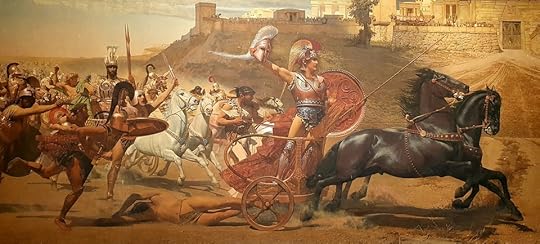
Through the story we meet also Helen, Penthiselaia the Amazon Queen, Ajax, the muses and many more.
The story ends with John Keats, whose writings form the basis of a meditation on the nature of identity and shared experience.
Retelling of the welknown tale about the life of greek hero Achilles.
It is beautifully written more often than not, but sometimes i just couldn't get behind the authors phrasing... Some pieces of the book would ruin whole sections and it is not for the squimish as a lot of rape is portrayed in this small book.
Born of the Neried Thesis and king Peleus of Phthia. He is trained by the centaur Chiron and hidden as a girl until Odysseus discovers him. From then on Achilles becomes the Greeks' greatest warrior of Troy. But as his beloved Patrclus is killed by the Trojan prince, Hector, he is set on getting avenge his loss with the help from the Gods.
''We honoured you like a god while you were alive. No one could match you. Now that you're dead we still speak of you as one who will never be surpassed.''
He kills Hector, but is later killed himself by being shot by an arrow on his heel. Achilles was invulnerable in all of his body except for one heel, because when his mother Thetis dipped him in the river Styx as an infant, she held him by one of his heels.
Therefore his death came as a shock and both mortals as well as Gods grieved.
Through the story we meet also Helen, Penthiselaia the Amazon Queen, Ajax, the muses and many more.
The story ends with John Keats, whose writings form the basis of a meditation on the nature of identity and shared experience.

September 15, 2023
This is a short novel that centres around the Trojan War and Achilles, one of the most famous Greek warriors. The prose was rather poetic but the story wasn't particularly linear. It didn't really grip me.
July 24, 2026
Me reading this has nothing to do with Nolan’s Odyssey.

Read
July 24, 2023DNF. Not for me.

October 4, 2023
Very interesting, gave me another perspective on the Achilles’ story after reading song of Achilles a while ago. Very different writing (sometimes too smart for me lol) but liked it a lot

July 5, 2022
The writing style was interesting and flowed well with it not being overly flowery or descriptive.
Im not a huge fan of the roman canon so the inclusion of the heel and such was not my thing.
The keats chapter at the end was definitely ... trying to do something ... It didnt work.
Im not a huge fan of the roman canon so the inclusion of the heel and such was not my thing.
The keats chapter at the end was definitely ... trying to do something ... It didnt work.

August 22, 2013
It's a hard book to understand, emotionally or in meaning. Especially for the 21st century, where we now realize rape is morally unacceptable and most wouldn't be able to kill someone with as much ease as these less-evolved men. I asked myself, in what sort of mind-set are we supposed to read such an angering story? But it seems we should look at history and see all the mistakes as well as the achievements. Achilles is many things, good or bad at different times. These characters are not perfect, they were a product of their blood thirsty, remorseless time and that's how they turned out. Cook is just staying accurate to the mindset of the time.
If I hadn't had to read this for AP Literature, I probably would have put it down during the second chapter (the vividly described rape of Thetis). But on comparing that scene to Helen's story, it seems to say those who choose the black river can contaminate those in the green one (re-read the first chapter for clarity). From the victim's (s') perspective, there is nothing glorious about pillaging villages, or any of the warrior's gains from doing so; the warriors don't feel for the people they're hurting.
I was unable to enjoy this story emotionally, but I can see what emotions are supposed to be inspired where and understand the how clever and well written this book is. It's deep, don't comment if you didn't try to understand it.
If I hadn't had to read this for AP Literature, I probably would have put it down during the second chapter (the vividly described rape of Thetis). But on comparing that scene to Helen's story, it seems to say those who choose the black river can contaminate those in the green one (re-read the first chapter for clarity). From the victim's (s') perspective, there is nothing glorious about pillaging villages, or any of the warrior's gains from doing so; the warriors don't feel for the people they're hurting.
I was unable to enjoy this story emotionally, but I can see what emotions are supposed to be inspired where and understand the how clever and well written this book is. It's deep, don't comment if you didn't try to understand it.

October 21, 2010
The writing focused on Achilles, hero at Troy and known for his vulnerable Achilles' heel. Unconstraint and imagination of the prose had Achilles do fantastic feats from Homeric epic and explored his disposition. Except for the ending, the story is set in about 1200 B.C. Troy, then breaks off and enters British Romanticism in early 1800s. In London, the reader is in the surgical theater of Astley Cooper with Keats among the students and with a corpse. Btw, Keats wrote "On First Looking into Chapman's Homer". Cook the author brings in more surgeons and surgeries but also brings in Hazlitt, Hammond, Cary's Dante, Charles Cowden Clarke, and others. Cook mends the split in time, connecting Achilles to Keats, Troy to London, by Keats', being outdoors, catching a lock of floating reddish hair, an incident harking back to the air-blown locks of mourners' hair from off the pyres of Patroclus and Achilles on the Trojan plain. The similarity between Achilles and Keats has partly to do with their physical components of body and brain and with their holding and releasing an object. The human body apparently completely changes every seven years, so exactness is precluded.

February 26, 2017
The final chapter on Keats ties it all together; this is about early death and about immortality, poetic and otherwise, and in that context it's really sad and really touching. Up to then it had been a somewhat disjointed retelling of Achilles's life and death and others' reactions to that, with some slightly awkward phrases but a remarkable and lovely sympathy and generosity towards Thetis, Deidameia, Penthesileia, Briseis, Iphigeneia and Helen. (it's so nice to see something which doesn't vilify or erase the women in Achilles's life in order to exalt his love for Patroclus.)
Even though I think it would get much better on a second reading, once you understand what it's trying to do, I've given it two stars because it does seem disjointed and I'm not sure how much it illuminates what's in Homer, beyond its musings on Achilles' choice. (the chapter on Helen is fascinating, but e.g. the one where Priam reclaims Hector's body doesn't add anything to the original.) If you love everything to do with the Iliad, I'd read it, but if you're a casual fan I'd go for other retellings first.
Even though I think it would get much better on a second reading, once you understand what it's trying to do, I've given it two stars because it does seem disjointed and I'm not sure how much it illuminates what's in Homer, beyond its musings on Achilles' choice. (the chapter on Helen is fascinating, but e.g. the one where Priam reclaims Hector's body doesn't add anything to the original.) If you love everything to do with the Iliad, I'd read it, but if you're a casual fan I'd go for other retellings first.

January 2, 2011
A poetic retelling of the story of Achilles. I *really* liked the first 4/5 of this beautifully written work, which opens with Achilles being called up out of the underworld by Odysseus. The language was beautiful, and it had some really interesting insights into the characters. I was, however, quite put off by the end section, which is about Keats. Yes. For one thing, I didn't know anything about Keats, and had no idea why that section was there; for another, I think it's simply distracting. But other than that, I really liked this work. However. It's unsuitable -- again! -- for the Kinder, since it has graphic sex scenes and use of primary obscenities. (I wish I knew for certian what school policy was about things like that.) Still, I highly recommend this for adults, though I suggest reviewing something about Keats before you get to that last section, lest it be as incomprehensible to you as it was to me on first read.

August 3, 2018
I bought this on a bit of a whim a few years ago, and then promptly never picked it up because I was afraid it might be the kind of book that hurts too much to read. I had a train journey a few weeks ago and this book fit nicely in my bag, so I took it, and finally read it. And it sort of was the kind of book that hurts too much to read, but I'm still glad I read it.
The language here is just really without peer, and I've yet to read a retelling of the Iliad which deals with Thetis' plight so well as this one does. If I had to pick anything to criticise, it would be that Cook glosses over Patroclus almost entirely, and that there's a lot of references to rape which, although thematically appropriate here, do sometimes jar, especially when we're supposed to relate to characters who are capable of such awful things. Still, this is a slim and fruitful retelling of the Iliad, and it humanises some of the more demonised characters in interesting ways.
The language here is just really without peer, and I've yet to read a retelling of the Iliad which deals with Thetis' plight so well as this one does. If I had to pick anything to criticise, it would be that Cook glosses over Patroclus almost entirely, and that there's a lot of references to rape which, although thematically appropriate here, do sometimes jar, especially when we're supposed to relate to characters who are capable of such awful things. Still, this is a slim and fruitful retelling of the Iliad, and it humanises some of the more demonised characters in interesting ways.

September 30, 2011
I'm giving this four stars more because I found Achilles so unusual and interesting than because I thought it accomplished all its goals. Like most modern readers (probably?), I prefer Odysseus to Achilles: it's easier to deal with selfishness and cruelty when accompanied by cunning and an actual goal (and IIRC, everyone Odysseus has sex with wants to have sex with him? not true of Achilles!). But Achilles is iconic, and I'm interested in works exploring this. It seems unlikely that there is another work so ... experimental and unexpected as this one out there. It's the kind of novel that asks more questions than it answers - and that's fine with me.

July 14, 2015
An evocative retelling of the story of Achilles. It begins with him in Hades then tells his story from birth to death and beyond. The novella was a glorious, intense prose-poem. I especially liked the childhood of Helen; episode of Chiron, the wounded centaur and healer making Achilles' ash spear; and the meeting of Achilles and Priam. I thought any connection of Keats with the story was tenuous at best and did not see why the author even included it. Did I miss something?
Recommended but for the Keats episode tacked on.
Recommended but for the Keats episode tacked on.

February 18, 2017
This book is gorgeously written, and the amount of unnecessary rape scenes would make GoT writers blush.
I would love to recommend it to everyone who is into poetic prose, but at the same time it is triggering as hell so please proceed with extreme caution.
I would love to recommend it to everyone who is into poetic prose, but at the same time it is triggering as hell so please proceed with extreme caution.

August 27, 2014
Al least the small part about Achilles and Patroclus near the beginning quite good.

February 15, 2016
It was a fun read. It was a little short and I wish there were more details about Achilles' life.
Apart from that, I enjoyed the book and the style of writing the author used.
Apart from that, I enjoyed the book and the style of writing the author used.

January 1, 2024
"He stands apart with Patroclus, his beloved through all eternity, and Patroclus - who loves Achilles but not as much as he is loved - waits for Achilles to move. His deference to Achilles is different from that of others, They honour and respect him, keep a wise distance, because Achilles was better than the rest. Better at being human. Fighting, singing, speaking, raging (oh, he is good at that still). Killing. But Patroclus alone is humbled by Achilles' love. "
This passage lives rent free in my head forever, and it comes back to me often. Like so many passages in this book it's stunningly beautiful, but the love in it just /aches/ in a way that had me holding my breath and reading it over and over the first time I read this book.
I read this book when I was in high school, because I was desperately in love with the movie Troy and I had already read the original source material and wanted more- and the stark yet poetic beauty and brutality of this book changed me forever. It's incredibly well done and it sucked me in so deeply I could hardly put it down- but.
But, but, but. I cannot recommend it for everyone. It still gets 5 stars from me because for /me/ it was a fabulous and wholly positive experience even when it became shocking or painful, but I have many friends who could not/should not read this book, because there is a significant amount of sexual assault and it often comes out of absolute left field, or seems to. For me, there is narrative purpose to that- sexual violence often doesn't come when it's expected, and the places where it happens here don't feel gratuitous and all serve a purpose- but they are heavy and /a lot/, particularly a scene that involves a grown man raping a young girl. If rape/sexual violence is a trigger for you, this book would not be a good fit. It's also got a good bit of bloodiness and brutality- it's friggin bleak in places, but it's also beautifully written, and the love between Patroclus and Achilles really shines in the moments you see it.
This passage lives rent free in my head forever, and it comes back to me often. Like so many passages in this book it's stunningly beautiful, but the love in it just /aches/ in a way that had me holding my breath and reading it over and over the first time I read this book.
I read this book when I was in high school, because I was desperately in love with the movie Troy and I had already read the original source material and wanted more- and the stark yet poetic beauty and brutality of this book changed me forever. It's incredibly well done and it sucked me in so deeply I could hardly put it down- but.
But, but, but. I cannot recommend it for everyone. It still gets 5 stars from me because for /me/ it was a fabulous and wholly positive experience even when it became shocking or painful, but I have many friends who could not/should not read this book, because there is a significant amount of sexual assault and it often comes out of absolute left field, or seems to. For me, there is narrative purpose to that- sexual violence often doesn't come when it's expected, and the places where it happens here don't feel gratuitous and all serve a purpose- but they are heavy and /a lot/, particularly a scene that involves a grown man raping a young girl. If rape/sexual violence is a trigger for you, this book would not be a good fit. It's also got a good bit of bloodiness and brutality- it's friggin bleak in places, but it's also beautifully written, and the love between Patroclus and Achilles really shines in the moments you see it.
This entire review has been hidden because of spoilers.

December 9, 2023
réécriture - mythologie - poésie
"A mortal gets to do what the long of the gods is afraid of."
TW : death, blood, rape
Odysseus, on this road from Troy, find some souls in the Hades. This is were he find Achilles and start to tell him whats happening here...
This book is full or poetry and i really like it. It's a way to know the history of the great Achilles, starting with his creation to after his death. It was beautifully writen, interesting and i also like the relation between Iphigenie and Achilles.
The second part of the book, stating in our actual world was a bit strange, but i finally like the notion of "contemporan Achilles" in the author.
But... Yeah, it was hard top read. Hard, because there is nearly three scenes of rape ? I don't know why, if it's to show horror and crualty of tjis times, but this need to known before reading it.
-------------
Dans son trajet de retour, Ulysse, à la recherche d'une certaine personne, s'arrête près des portes des Enfers. Là, il y croise Achilles qui demande des nouvelles des vivants...
Le style de l'autrice est très poétique et agréable à lire, d'autant plus qu'il s'agit d'une nouvelle et cela se lit donc rapidement. Plus que les vivants, on revit l'histoire d'Achilles, de sa naissance à sa mort.
En plus de la plume poétique, j'ai beaucoup aimé la relation entre Achilles et Iphigénie ; du moins, celle qu'elle aurait pu être.
La deuxième partie de l'histoire, qui se trouve dans notre monde actuel, est au départ déroutant, mais lorsqu'on comprend la parallèle entre l'Achille de Troie et cette notion d'un Achille moderne, la lecture est bien plus appréciée.
Malgré tout... Les scènes de viols sont présentes et violentes. Je n'en ai pas compris la raison, si c'est une volonté de le dénoncer, ce n'est pas le ressenti que j'en ai eu. Si vous lisez ce livre, n'oubliez pas cette notion là s'il vous plaît 🖤
"A mortal gets to do what the long of the gods is afraid of."
TW : death, blood, rape
Odysseus, on this road from Troy, find some souls in the Hades. This is were he find Achilles and start to tell him whats happening here...
This book is full or poetry and i really like it. It's a way to know the history of the great Achilles, starting with his creation to after his death. It was beautifully writen, interesting and i also like the relation between Iphigenie and Achilles.
The second part of the book, stating in our actual world was a bit strange, but i finally like the notion of "contemporan Achilles" in the author.
But... Yeah, it was hard top read. Hard, because there is nearly three scenes of rape ? I don't know why, if it's to show horror and crualty of tjis times, but this need to known before reading it.
-------------
Dans son trajet de retour, Ulysse, à la recherche d'une certaine personne, s'arrête près des portes des Enfers. Là, il y croise Achilles qui demande des nouvelles des vivants...
Le style de l'autrice est très poétique et agréable à lire, d'autant plus qu'il s'agit d'une nouvelle et cela se lit donc rapidement. Plus que les vivants, on revit l'histoire d'Achilles, de sa naissance à sa mort.
En plus de la plume poétique, j'ai beaucoup aimé la relation entre Achilles et Iphigénie ; du moins, celle qu'elle aurait pu être.
La deuxième partie de l'histoire, qui se trouve dans notre monde actuel, est au départ déroutant, mais lorsqu'on comprend la parallèle entre l'Achille de Troie et cette notion d'un Achille moderne, la lecture est bien plus appréciée.
Malgré tout... Les scènes de viols sont présentes et violentes. Je n'en ai pas compris la raison, si c'est une volonté de le dénoncer, ce n'est pas le ressenti que j'en ai eu. Si vous lisez ce livre, n'oubliez pas cette notion là s'il vous plaît 🖤

February 25, 2026
A succinct and great exploration of the Achillies Myth, though it was difficult to read this book without comparing it to the Song of Achilles. There was part of my wished that I could have read this version first, but as a result it doesn’t quite reach the esteem that I hold Madeline Millers book in.
The style of writing is not the easiest to read, though at times reads more like poetry than a novella, which is an interesting mix. The description isn’t like anything I’ve seen before, they are vivid and detailed - the pursuit of Thetis capturing the horror of the moment, same with the fall of Troy and the death of the Amazon.
I enjoyed the section with Deidamia, it was really good to hear some of her story, but I think I would liked to have the same amount of attention for his relationship with Patroclus. It wasn’t devoid of this, which was great, I just personally wanted more. The section on Helen was fantastic and deserved a Novella on its own, her portrayal as a ‘thing’ to the men around her, how they see their own desire reflected was described beautifully. The final chapter with a time skip forward to Keats was a bit jarring and I’ll admit to losing interest here - but the rest of the novella was a good solid telling of the myth.
Overall, it was good. The descriptive poetic style was not always easy to read but the story was solid and the characters came to life on the page.
The style of writing is not the easiest to read, though at times reads more like poetry than a novella, which is an interesting mix. The description isn’t like anything I’ve seen before, they are vivid and detailed - the pursuit of Thetis capturing the horror of the moment, same with the fall of Troy and the death of the Amazon.
I enjoyed the section with Deidamia, it was really good to hear some of her story, but I think I would liked to have the same amount of attention for his relationship with Patroclus. It wasn’t devoid of this, which was great, I just personally wanted more. The section on Helen was fantastic and deserved a Novella on its own, her portrayal as a ‘thing’ to the men around her, how they see their own desire reflected was described beautifully. The final chapter with a time skip forward to Keats was a bit jarring and I’ll admit to losing interest here - but the rest of the novella was a good solid telling of the myth.
Overall, it was good. The descriptive poetic style was not always easy to read but the story was solid and the characters came to life on the page.
Displaying 1 - 30 of 124 reviews