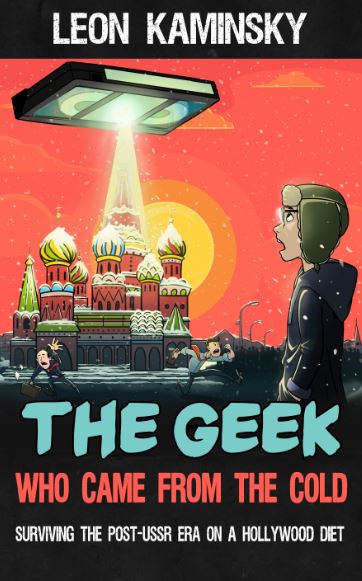
When the first wave of pirated videotapes from the west reached the USSR in the second half of the 1980s, that stuff was still illegal. If you had money, you still watched it, of course, be it “Commando”, or “The Godfather”, or “Emmanuelle”, or whatever you were lucky to get. Maybe you’d get arrested, maybe you wouldn’t. If you were found out, in most cases that meant prison. But you still watched it – and couldn’t get enough of it. Being a shy, mild-mannered Jewish boy in a repressed and conservative society dominated by very specific ideas of masculinity was difficult enough. But being one of the first film geeks in a country that never had a word like “geek” in its vocabulary… well, that made life so much more complicated. Hollywood’s fairy tales may offer you shelter from reality, make you forget all the bullying at school, death in the family or the shaky financial situation in the country, but it’s only a question of time until you snap.
“The Geek Who Came from the Cold – Surviving the Post-USSR Era on a Hollywood Diet” is Leon Kaminsky’s second novel – tragicomic, wistful and of course extremely nerdy.
Leon Kaminsky is a writer and translator living in London. He was born in 1981 in Leningrad, USSR, studied applied linguistics and translation in Saarbrücken, Germany, and then buggered off to the UK because he felt like it. He has published numerous fiction and non-fiction books under different names, but decided he needed a fresh start, and this is precisely what his debut novel, "Raw Sexuality, or A Year of Indiscretion" is.
I was looking for a novel about post-Soviet life, and this one was both interesting and affordable. It is apparently autobiographical, as it is "based on true stories" and the main character has the same name as the author.
The main character had undiagnosed ADHD and a variety of other tics and quirks. He was bullied, not only by fellow students but occasionally by his stressed-out mother (who was normally his greatest ally). His life with ADHD and his mother's efforts to help him were just as interesting to me as the post-Soviet setting.
There were many things that made post-Soviet Russia different from the 80s and 90s that I remember, and very different from what was depicted in the Hollywood movies that the main character used as an escape. No one in Hollywood would remember the first time they ever tasted a banana, or would ever seriously propose swapping a yacht for a VCR (they were rare luxuries for a long time), just to name a few examples.
The book contains some adult language and sex talk, plus references to many old movies - so this might not be a good choice for younger readers. But it was a quick, informative and enjoyable read for me.
This book is not about author's life in USSR. It is about his addiction to movies. It is a kind of log book where you can check what movies author has seen. I come to know about this book from the ushanka show. You can give it a try at least the price of the book is cheap.
As a cold war vet I enjoy reading about how crummy life was behind the Iron Curtain, something about long lines for bad products always makes me feel better
Readers should not be fooled by the title The Geek Who Came From The Cold: Surviving The Post-USSR Era On A Hollywood Diet by Leon Kaminsky has nothing to do with food or dieting at all. The “Hollywood Diet” mentioned in the title is movies, mainly those from the US. A little bit of knowledge about Russia and their policies would be helpful when reading this book but is not required.
Leon is a young boy growing up in Russia at the end of the 1900s. He has a nervous problem (possibly anxiety) and has a hard time at school and with other people in general. Leon quickly falls in love with movies, specifically those from Hollywood after seeing them for the first time. Like so many other people who are not exactly social for one reason or another, he trades social interaction for watching films. His love for movies over the years borders on the edge of obsession as he knows not only actors and directors but also the Russian’s who voice over the tapes to translate them. His daily and weekly schedule revolves around what movies are being played on TV or at the theaters.
He takes readers through the difficulty of obtaining some of the popular movies that can be found just about anywhere here in the United States. This difficulty is not only because of how much Russia censored movies from just about anywhere but because the titles are often changed as well. Leon shares his excitement and the challenges he faced to get his first VCR play and to transport his VHS collection when his family moved. He even talks about when owning a VCR was illegal in Russia and when people would give anything to have one, including offering to trade a boat for a VCR.
What I liked best was that the informative quality of the book was wonderful and the author clearly did his research (I even wondered at times if the book was based on the author’s own childhood). I appreciated the human qualities of the book, such as the struggles Leon faces at school. New facts about Russia was presented to the readers in a way that prevented anything from feeling too overly informative. What I did not like was the fact that the book ends fairly abruptly. I would have liked to see at least one chapter about after the family’s move to Germany. There were also multiple sections where it would begin on one topic and end on another, seemingly unrelated topic.
Movie fans will enjoy this book but it is recommended that they be somewhat familiar with movies from the 1980s (I think was the time period of most movies mentioned in the book, I myself am far from a movie buff at all) and newer. High school students may not be able to fully appreciate the cinematic history in this book and may feel more like a history book to them. It should also be noted as VHS tapes are already a thing of the past (I am holding on to a few to show my children in the future) upcoming generations may not know what the book is talking about without asking their parents or google. Finally, I give this book a rating of 3 out of 4. This book is very informative about a topic not many people are probably aware of. Sadly this gives it a very narrow target audience. The way the book is written makes it feel like it is an autobiography about a movie lover growing up where movies are largely controlled. The plot of the book is frequently lost through during all the movie talk.